3 Ornamental Grasses for Garden Borders
Compare three ornamental grasses for garden borders by sun, soil, size, color, and maintenance, including the caveats that keep each one healthy.
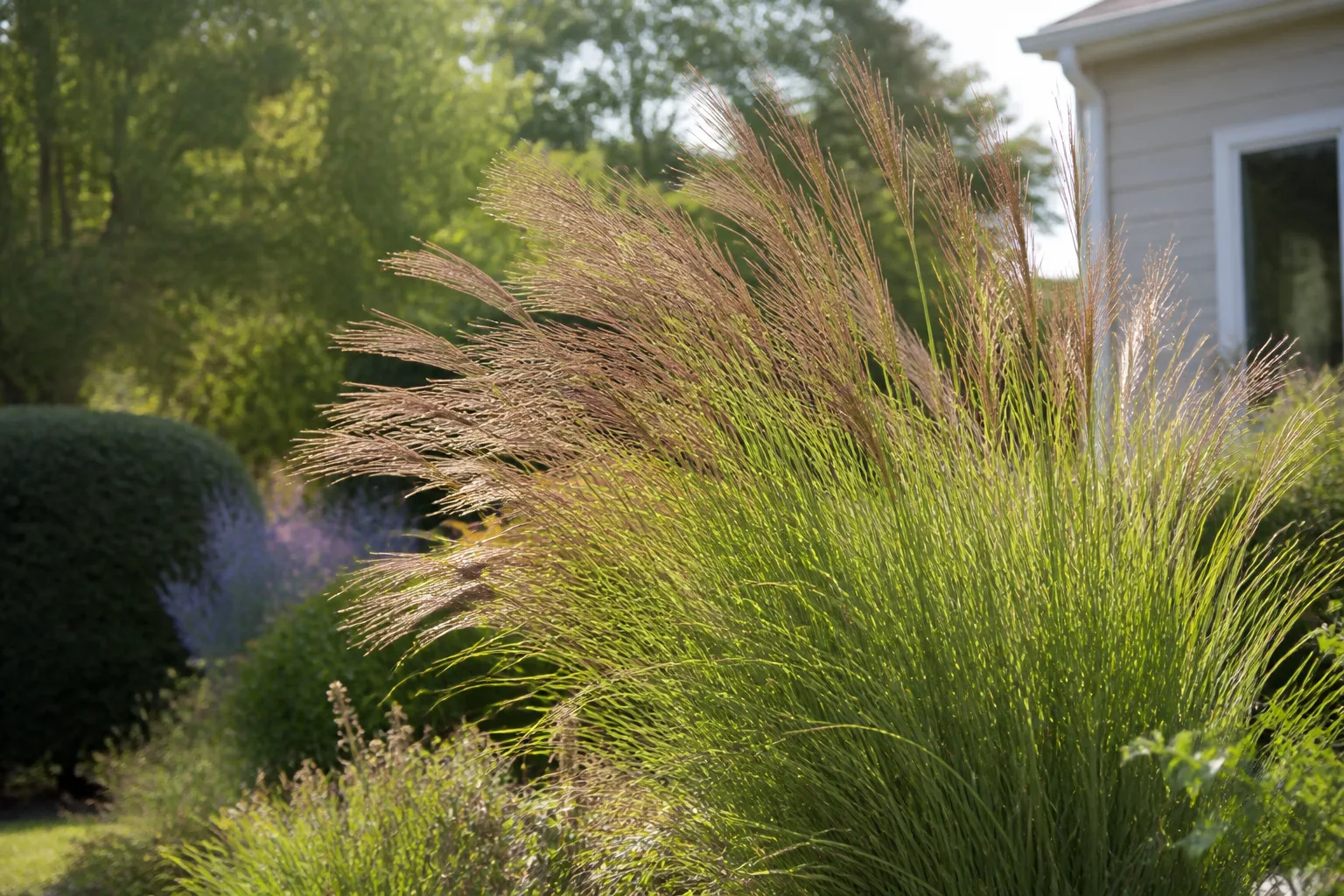
An empty border usually needs more than a plant with pretty flowers. It needs a dependable shape, a little movement in the breeze, and enough texture to keep the bed interesting after the first flush of bloom has passed. Ornamental grasses and grass-like sedges are unusually good at that job, but the right choice depends on what the border is actually like.
The three plants in this guide solve different problems: Carex oshimensis ‘Everillo’ brightens a partly shaded front edge, Little Bluestem ‘The Blues’ brings upright blue foliage to a hot, dry border, and Dwarf Fountain Grass ‘Hameln’ adds bottlebrush plumes and a soft, arching silhouette in full sun. They are not interchangeable, and treating them as one generic category is the quickest way to end up with a struggling plant or a grass that outgrows its space.
Use the comparison below to choose by site first. Then use the planting and maintenance guidance to give the clumps enough room to mature without turning the border into a row of isolated plants.
Choose by site before you choose by color
Color is the fun part of choosing a grass, but it is a poor first filter. A lime-green sedge may look perfect beside a gray wall, yet fail in a dry, exposed strip; a blue little bluestem may be the right visual contrast, yet flop or lose its best color if it is planted in shade and rich, constantly wet soil.
The best border planting starts with three observations: how many hours of direct sun reach the bed, how quickly water drains after rain, and how much room remains when each plant reaches its mature width. Those details determine whether the plant will look intentional or spend the season compensating for a bad location.
Start with sun, moisture, and drainage
Everillo is the moisture-and-part-shade choice. The North Carolina Extension Gardener Plant Toolbox identifies Carex oshimensis as a grass-like perennial sedge that tolerates full sun to partial shade but prefers rich, moist to wet soil. It specifically warns that the plant does not tolerate drought, so do not place it in the driest part of a sunny gravel border just because its narrow leaves resemble a drought-tolerant grass. NC State Extension’s profile of Carex oshimensis also notes that it works well at the front of a border, in containers, and near rain gardens or pond margins.
Little Bluestem is the dry, sunny choice. This warm-season native grass performs best in full sun and well-drained soil, tolerates clay and lean ground, and develops excellent drought resistance after it is established. It can handle a wider range of soil conditions than the other two plants, but that does not make it suitable for a dark, waterlogged border. NC State Extension’s Little Bluestem profile describes its narrow upright clumps, blue summer cast, copper fall color, and persistent winter interest.
‘Hameln’ wants sun and average moisture. Dwarf Fountain Grass flowers best in full sun and prefers fertile, well-drained soil. It can tolerate occasional dry or wet periods once established, but it is not a reason to ignore a new planting during a hot summer. If the border receives only weak light, the plant may survive while producing fewer plumes and a looser shape.
Plan for mature width, not the nursery pot
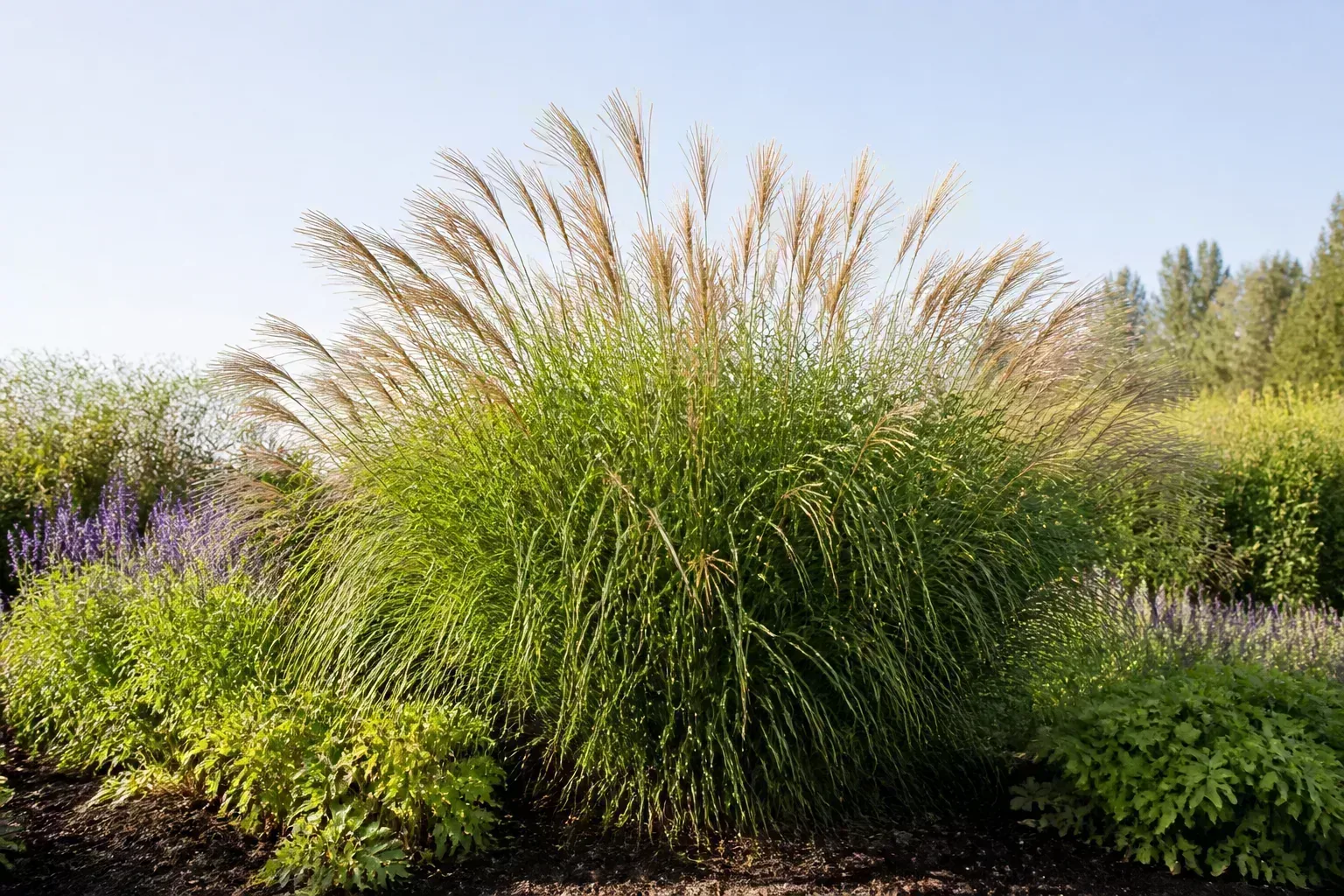
New grasses are often sold as small plugs or one-gallon plants, which makes it easy to plant them too close. The pot tells you what you are holding; the mature width tells you how much border the plant will occupy. NC State lists Carex oshimensis at roughly 1 to 1.5 feet tall and wide, Little Bluestem at about 2 to 4 feet tall with a similar spread, and ‘Hameln’ at about 2 to 3 feet tall and wide. Cultivar, climate, soil, and pruning can shift those dimensions, so use the tag for the exact plant you buy.
| Border condition | Best starting choice | What to watch |
|---|---|---|
| Part shade with evenly moist soil | Carex ‘Everillo’ | Drought, hot afternoon exposure, and winter sogginess |
| Full sun with dry or lean, well-drained soil | Little Bluestem ‘The Blues’ | Mature height, spring dormancy, and crown rot from wet soil |
| Full sun with average moisture and room for plumes | Dwarf Fountain Grass ‘Hameln’ | Local spread rules, self-seeding in related forms, and winter cleanup |
For a quick, dense fill, plants can be placed toward the closer end of their recommended spacing. For an airy, architectural border, give them more room and use low perennials to occupy the gaps while the clumps grow. Either way, leave enough clearance that air can move through the foliage and you can reach the crown with a hose or pruners.
The three grasses that earn a place in a border
These picks are best understood as three different design tools. Everillo is a glowing front-edge mound, Little Bluestem is a vertical color and structure plant, and ‘Hameln’ is a plume-producing middle or back layer. The strongest border may use one of them repeatedly rather than forcing all three into a narrow strip.
Carex ‘Everillo’ for a bright, partly shaded front edge
Although it is commonly grouped with ornamental grasses, Carex ‘Everillo’ is a sedge, not a true grass. That distinction matters because it behaves more like a moisture-loving, grass-like foliage perennial than a prairie plant. Its lime-green leaves arch outward from a compact clump, making it useful beside a path, in front of darker shrubs, or at the base of a wall where the border gets morning sun and afternoon shade.
The color is its main contribution. Everillo creates a bright ribbon through a bed that might otherwise be dominated by deep green leaves, gray stone, or dark mulch. Its soft cascading habit also takes the hard edge off concrete, steps, and retaining walls without blocking the taller plants behind it. Gardenia’s Everillo profile likewise describes the cultivar as a low, arching, lime-green sedge with strong textural value.
Give it rich, moisture-retentive soil that still drains. In full sun, the soil needs to stay especially consistent; in part shade, the plant is easier to keep hydrated and less likely to scorch. A position with bright morning light and protection from hot afternoon sun is a reliable compromise in warmer climates.
Everillo is a clump-former, not a runner that races through the bed. The clump slowly increases over the years and can be lifted and divided in spring or fall if it becomes crowded. It usually needs only the removal of tired or damaged foliage rather than a hard annual cutback, which is one reason it works so well where you want year-round structure.
The important limitation is drought. If the border is watered only when everything else is wilting, choose Little Bluestem instead or install Everillo where irrigation and soil moisture are dependable. A sedge that is browning at the tips in a dry bed is not asking for more fertilizer; it is telling you the site does not match its water needs.
Little Bluestem ‘The Blues’ for a sunny, dry middle layer
Little Bluestem (Schizachyrium scoparium) earns its place through a color sequence rather than showy flowers alone. The foliage can look steel blue in summer, the stems and leaves warm toward copper and orange in fall, and the airy seedheads persist into winter. ‘The Blues’ is a useful cultivar to look for when you want a stronger blue effect, although the final height and density still depend on the growing conditions.
This is the most forgiving choice of the three for a hot, sunny border with average to dry soil. NC State Extension describes the species as native to eastern North America, tolerant of clay and infertile ground, and highly drought resistant once established. It is also listed as resistant to deer browsing and valuable to wildlife, with seeds and cover that can support birds and small animals.
Place it where the sun can reach the whole clump. Six or more hours of direct light helps the stems hold their upright form and brings out the best blue and copper color. In a rich, damp bed with too much shade, it may grow green and floppy instead of giving you the clean vertical punctuation that makes it useful in a border.
Little Bluestem is a warm-season grass, so it may look quiet in spring while cool-season plants are already growing. That is normal, not proof that the plant died. Mark its location before planting companions around it, and keep the crown free of a heavy layer of wet mulch while the new shoots are still emerging.
Cut the old foliage down in late winter or early spring before new growth begins, rather than removing the seedheads as soon as they turn tan. The dried stems are part of the winter display, and leaving them in place also keeps the border from looking bare during the season when the plant is dormant.
Dwarf Fountain Grass ‘Hameln’ for soft plumes and movement
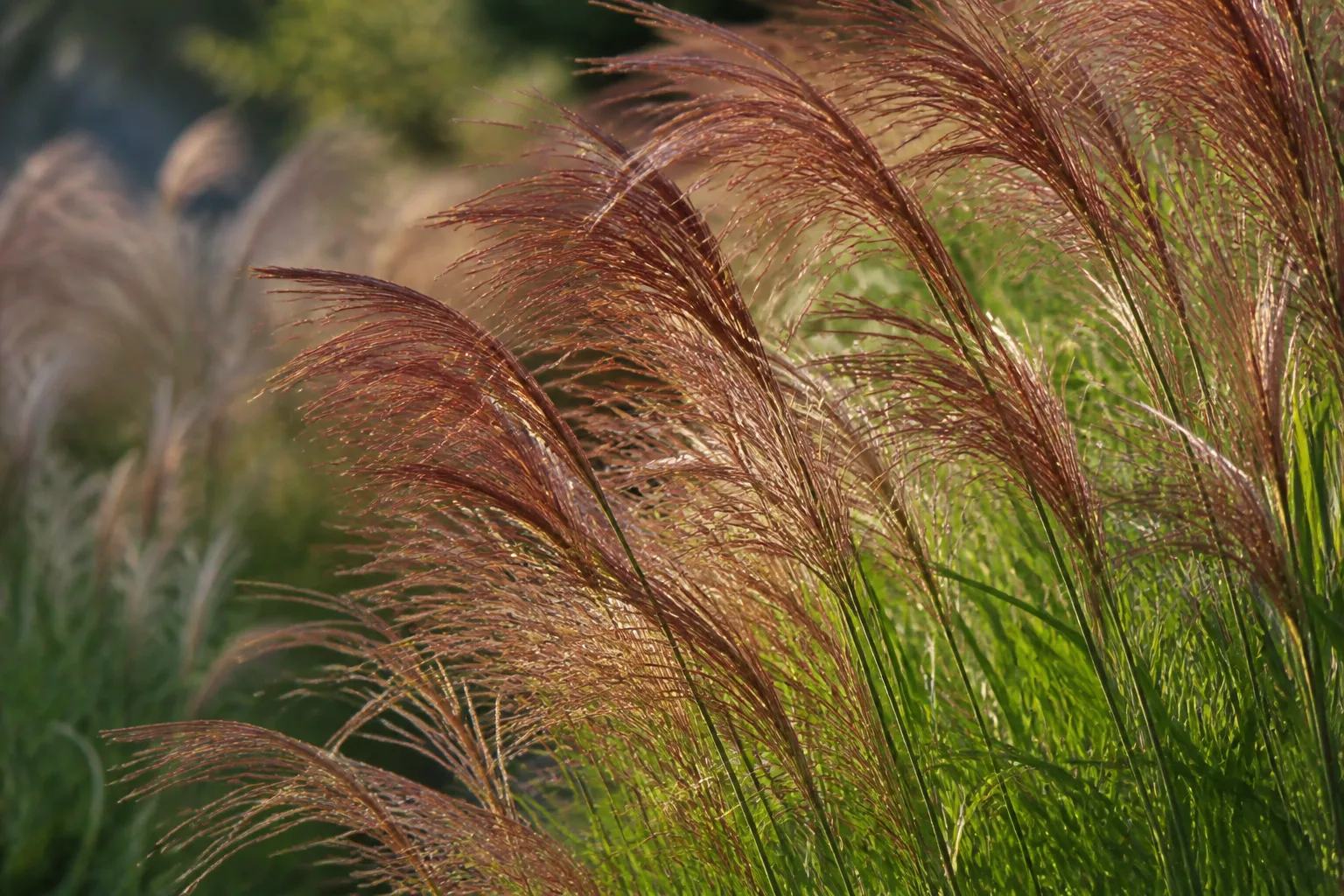
‘Hameln’ is the compact form of Dwarf Fountain Grass, listed by NC State under the current botanical name Cenchrus alopecuroides ‘Hameln’ and often sold under the older name Pennisetum alopecuroides ‘Hameln’. Its bottlebrush flower spikes appear earlier than those of many other fountain grasses and age from pale, silvery-pink tones toward tan. In a group, the arching foliage and plumes create the effect of a low fountain spilling through the border.
This is the movement plant. Use it where a static foundation bed needs a little sway, beside a walkway where the plumes can be seen at eye level, or among broad-leaved perennials that need a fine-textured contrast. NC State lists it as a compact, clumping plant that works in mass plantings, mixed perennial borders, containers, patios, walkways, and slopes. Its flowers and seedheads can remain attractive into winter.
Give ‘Hameln’ full sun for the best flowering and a soil that drains without becoming bone dry. It tolerates part shade, but shade can mean fewer flowers. A newly planted clump also needs regular attention during its first growing season, particularly when placed against a hot wall or beside paving that reflects heat.
There is a useful distinction between ‘Hameln’ and the broader fountain-grass category. NC State’s cultivar profile says ‘Hameln’ has sterile seeds, while the extension service’s species profile warns that some Chinese fountain grass can spread quickly by seed and has become problematic in parts of the country. Before planting, check your state or local invasive-plant guidance and buy the exact cultivar named on the label; “fountain grass” by itself is not enough information.
If your garden is near the colder edge of the plant’s range, confirm the cultivar’s hardiness and protect the crown from winter wet. The grass is listed for USDA Zones 5a through 9b, but a zone range is a starting point, not a promise for an exposed, poorly drained site. Choose it for the combination of sun, soil, and room it needs, not just for the flower spikes in a nursery photograph.
Use their different habits to build a border
A border looks more deliberate when each plant has a job. The goal is not to create a collection of three grasses in a row; it is to use differences in height, leaf width, color, and movement to make the whole bed feel layered. The same logic works whether the border runs along a fence, a sidewalk, a patio, or the front of a house.
Make the front edge soft, the middle layer upright, and the back layer airy
Start with Everillo at the front if the light and moisture fit. Its low, arching leaves can soften the transition between paving and planting soil without hiding flowers behind it. In a partly shaded foundation bed, repeat it as a small drift rather than scattering single plants at random.
Use Little Bluestem in the middle of a sunny border, where its narrow, upright habit can rise above low perennials without becoming a wall. Pair the blue foliage with pink or purple flowers, warm gold flowers, or dark-leaved plants; the contrast will be clearer than if every neighboring plant is the same cool green.
Place ‘Hameln’ toward the middle or back when the bed is wide enough for its plumes to rise above shorter plants. It can also sit near a path as a single specimen, but leave room for the arching leaves to spill without covering the walkway. For a narrow border, use ‘Hameln’ sparingly and repeat Everillo or a low perennial at the edge.
Epic Gardening’s ornamental-grass design guidance makes a useful broader point: grasses are most effective when they are layered with shrubs, perennials, and evergreen structure rather than treated as isolated decorations. Let the grass supply texture and motion, then let flowers supply seasonal color around it.
Repeat a grass in groups instead of collecting one of each
One of each plant can look like a plant-shopping list. Repeating one grass in a group of three, five, or more usually creates a stronger visual rhythm, especially along a long fence or walkway. The number should follow the bed’s scale and the plant’s mature width, not a fixed recipe.
For a small border, choose one role and repeat it: a run of Everillo for part shade, a few Little Bluestem clumps for a sunny prairie look, or a compact group of ‘Hameln’ for plumes. For a deeper bed, use two layers and repeat the same grass in both places only if the light and soil are genuinely similar. Do not put an Everillo drift in the dry end of a bed just to mirror a healthy clump in the moist end.
Leave deliberate gaps for companion perennials while the grasses establish. Coneflower, catmint, yarrow, sedum, and other sun-loving plants can occupy the early space around Little Bluestem or ‘Hameln’; in shade, heuchera, hosta, ferns, and woodland perennials can frame Everillo. Keep companion choices low enough that they do not bury the grass crown or trap wet leaves against it.
Planting and first-season care that prevents failure
Ornamental grasses are often advertised as easy, and mature clumps usually are. The first season is different: the plant has not yet rooted into the surrounding soil, and a small root ball can dry out or remain waterlogged much faster than an established clump. A few careful decisions at planting time prevent most of the problems that later get blamed on the plant.
Prepare the soil and give each clump breathing room
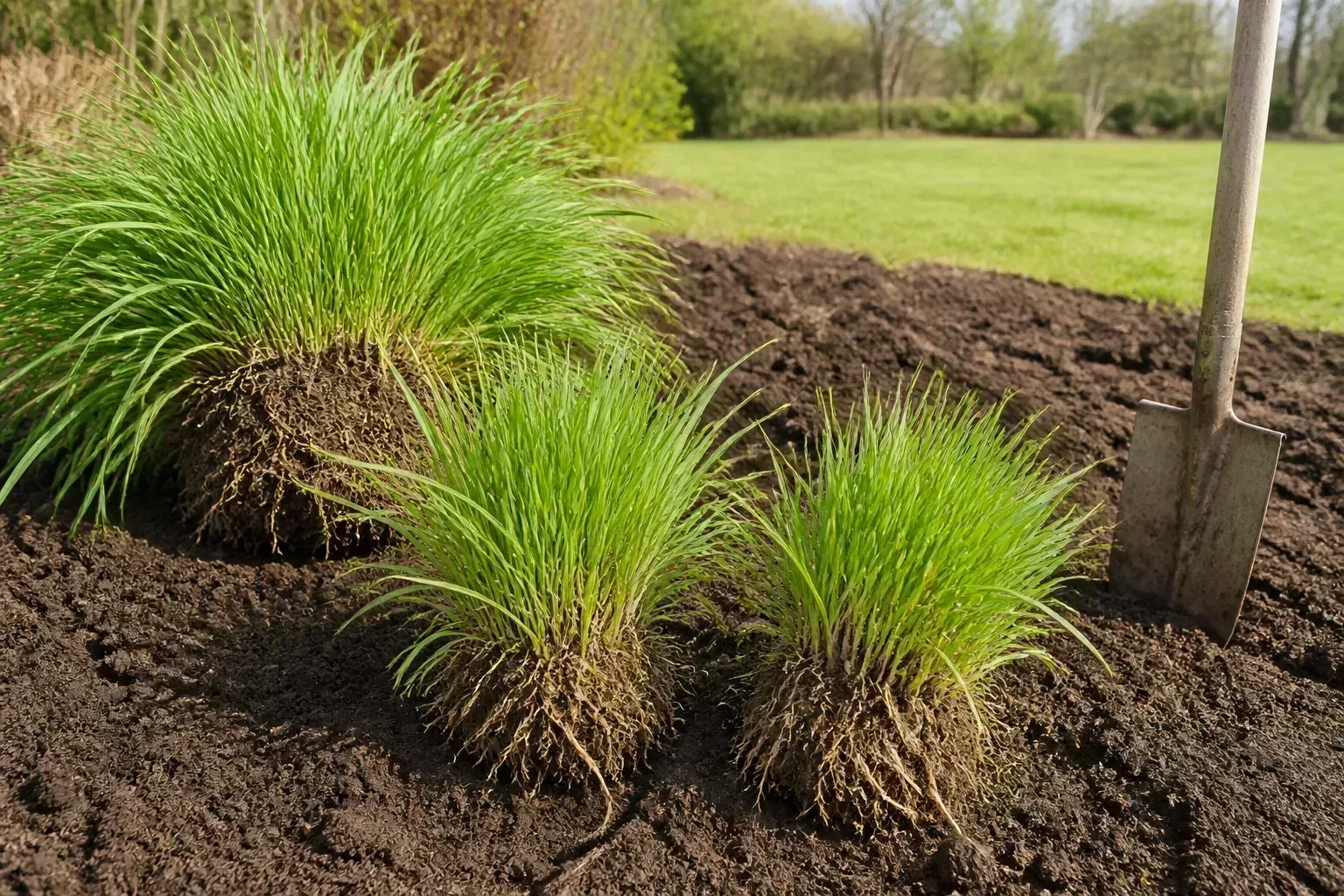
Dig a planting hole about as deep as the root ball and noticeably wider. Loosen compacted soil around the hole so new roots can move outward, but do not create a rich, isolated pocket in heavy clay that holds water like a bowl. If drainage is poor, improve the bed or choose a moisture-tolerant plant; adding a little grit to one hole rarely fixes a saturated border.
Set the crown at the same level it was growing in its pot. Planting a grass too deeply can trap moisture at the crown, while leaving the root ball high can expose roots and make the plant dry out. Water the hole thoroughly after planting so the soil settles around the roots, then add a thin layer of mulch over the root zone while keeping it away from the crown.
Use mature width to estimate spacing. If you want a quick, continuous drift, place clumps closer together but accept that division or thinning may come sooner. If you want each form to read clearly, space them farther apart and fill the foreground with short-lived annuals or low perennials while the grasses grow.
Water deeply, mulch lightly, and do not overfeed
Proven Winners recommends spring or early fall as the easiest planting windows because the roots have time to establish before the stress of summer heat or winter extremes. Its ornamental-grass care guide also separates warm-season grasses from grass-like sedges and cautions that overfeeding can make many grasses stretch and flop.
During the first season, check the soil around the root ball rather than watering by a rigid calendar. In hot or windy weather, inspect new plantings several times a week. Water slowly and deeply when the root zone begins to dry; a quick sprinkle that wets only the mulch does little for roots at the bottom of the planting hole.
The three picks do not get the same “let it dry out” treatment. Little Bluestem can move toward longer intervals after it establishes in well-drained soil. ‘Hameln’ prefers average moisture and should not be allowed to stay bone dry while young. Everillo should remain more consistently moist, especially in full sun.
Mulch moderates soil temperature and slows evaporation, but keep it a few inches away from the crown. Skip routine high-nitrogen fertilizer unless a soil test or local recommendation identifies a deficiency. Excess fertility can produce lush, weak foliage that flops open and needs more cutting, which defeats the low-maintenance purpose of the planting.
Maintenance without erasing winter interest
The easiest maintenance plan is not to cut every grass on the same day. Decide whether the plant is a grass-like evergreen sedge or a warm-season grass that goes dormant, then choose the lightest cleanup that keeps the crown healthy and the border attractive.
Cut back by plant type, and leave the right ones standing
Everillo usually does not need a ground-level spring haircut. In late winter or early spring, comb out loose dead blades with gloved hands and trim only damaged or brown leaves. A hard cut can remove more of the evergreen structure than necessary and leave a ragged mound while it regrows.
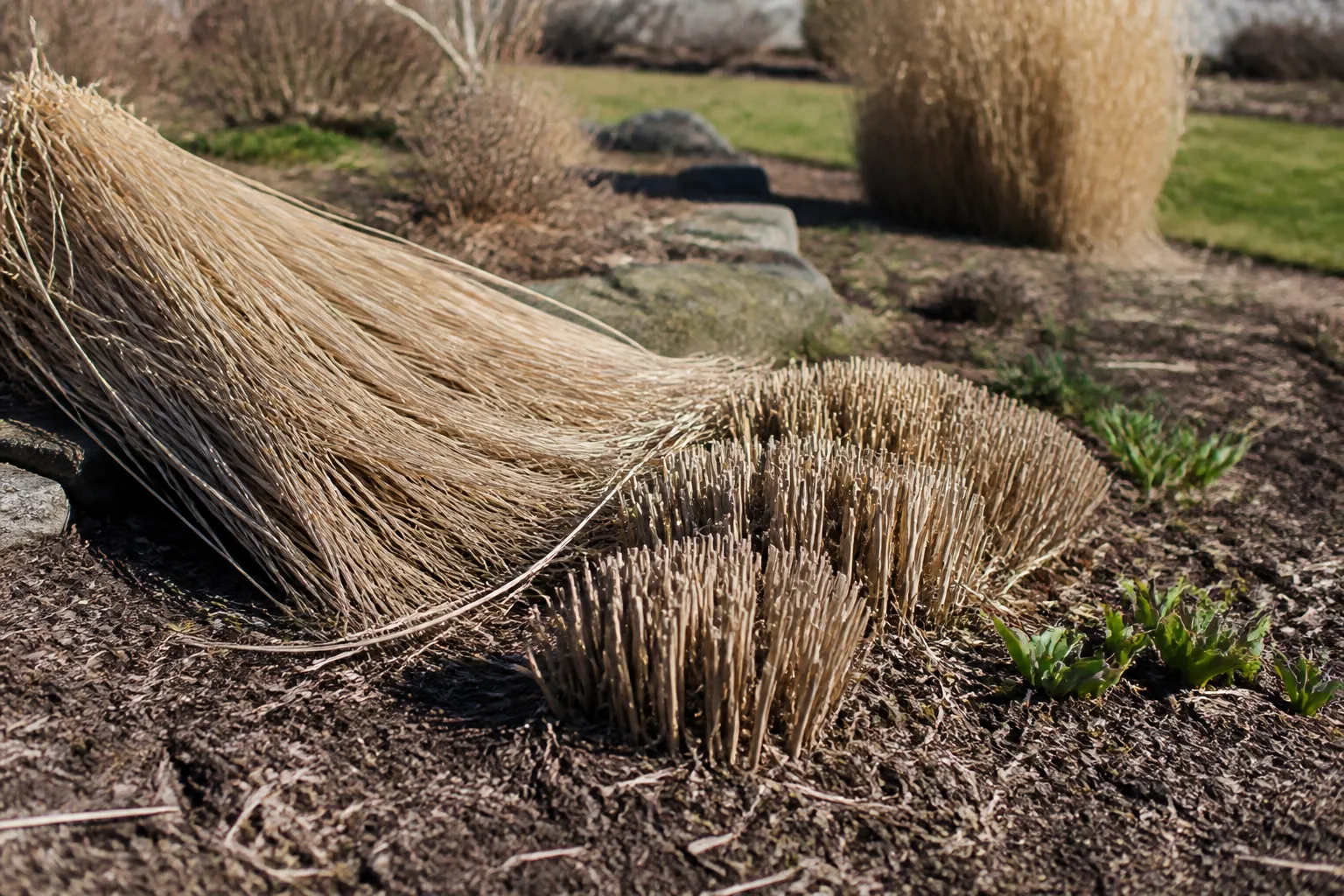
Little Bluestem and ‘Hameln’ can be left standing through winter for stems, seedheads, and movement. Cut their old foliage back in late winter or early spring before new growth begins. If your area has a serious seasonal fire risk, local guidance may justify earlier cleanup; otherwise, leaving the dry structure in place gives the border more presence during the quiet season.
Wear thick gloves when handling dried grass foliage. Many blades have sharp edges, and tying a larger clump into a bundle before cutting makes cleanup easier. Cut just above the crown rather than digging pruners into the growing point, and remove the old material from the crown if it mats into a wet layer.
Divide only when a clump is too large, has a dead center, or is crowding its neighbors. Everillo is best divided in spring or fall, while warm-season grasses should be divided during active growth rather than while flowering. Digging and dividing a healthy plant just to make more plants is optional; thinning the outer edge is often less disruptive than lifting the entire clump.
Common mistakes that make ornamental grasses fail
-
Calling every ornamental grass drought tolerant. Everillo is the clear counterexample here: it prefers moist soil and does not tolerate drought. Match the plant to the bed’s moisture pattern instead of relying on the word “grass” on a plant label.
-
Assuming a warm-season grass is dead in spring. Little Bluestem and ‘Hameln’ may start later than nearby perennials. Scraping out the crown or replacing the plant before late spring can turn normal dormancy into an unnecessary loss.
-
Spacing by the current pot size. A one-gallon clump can become a two- or three-foot plant. Measure the mature width on the tag, then decide whether you want a fast-knit drift or a more separated architectural rhythm.
-
Feeding for faster growth. More nitrogen can mean taller, softer foliage and more flopping, not a better border. Improve light, drainage, and spacing before reaching for fertilizer.
-
Cutting everything down in fall. Fall cleanup may be sensible for fire safety or a grass that collapses unattractively, but many warm-season grasses offer their best winter structure as dried plants. Leave them standing when the site allows, then cut back before spring growth.
-
Ignoring the difference between a cultivar and a species. ‘Hameln’ is listed as having sterile seeds, while other fountain grasses may self-seed or be invasive in some areas. Buy by the full botanical name and check local guidance before planting a fountain-grass selection.
Conclusion
The best ornamental grass for a garden border is the one that fits the site and performs a clear design job. Choose Carex ‘Everillo’ for a bright, low front edge with dependable moisture and part shade; choose Little Bluestem ‘The Blues’ for full sun, lean soil, blue-to-copper color, and mature drought tolerance; choose ‘Hameln’ fountain grass for sunny borders that can support soft plumes and arching movement.
Plant for the mature clump, water deeply while roots establish, and keep fertilizer modest. Then let the seasonal form do some of the work: Everillo can hold its foliage, while Little Bluestem and ‘Hameln’ can carry texture into winter before their late-winter cleanup.
If you are unsure, start with the border’s hardest fact rather than its prettiest color. Moist shade points toward Everillo, dry sun points toward Little Bluestem, and sunny average soil with room for plumes points toward ‘Hameln’. That simple match will do more for a breezy, textured landscape than planting an ornamental grass wherever an empty spot happens to be.



