Christmas, Easter, and Thanksgiving Cacti Differences
Learn the reliable differences between holiday cacti, including pointed or scalloped segments, flower clues, naming confusion, and species-specific bloom care.
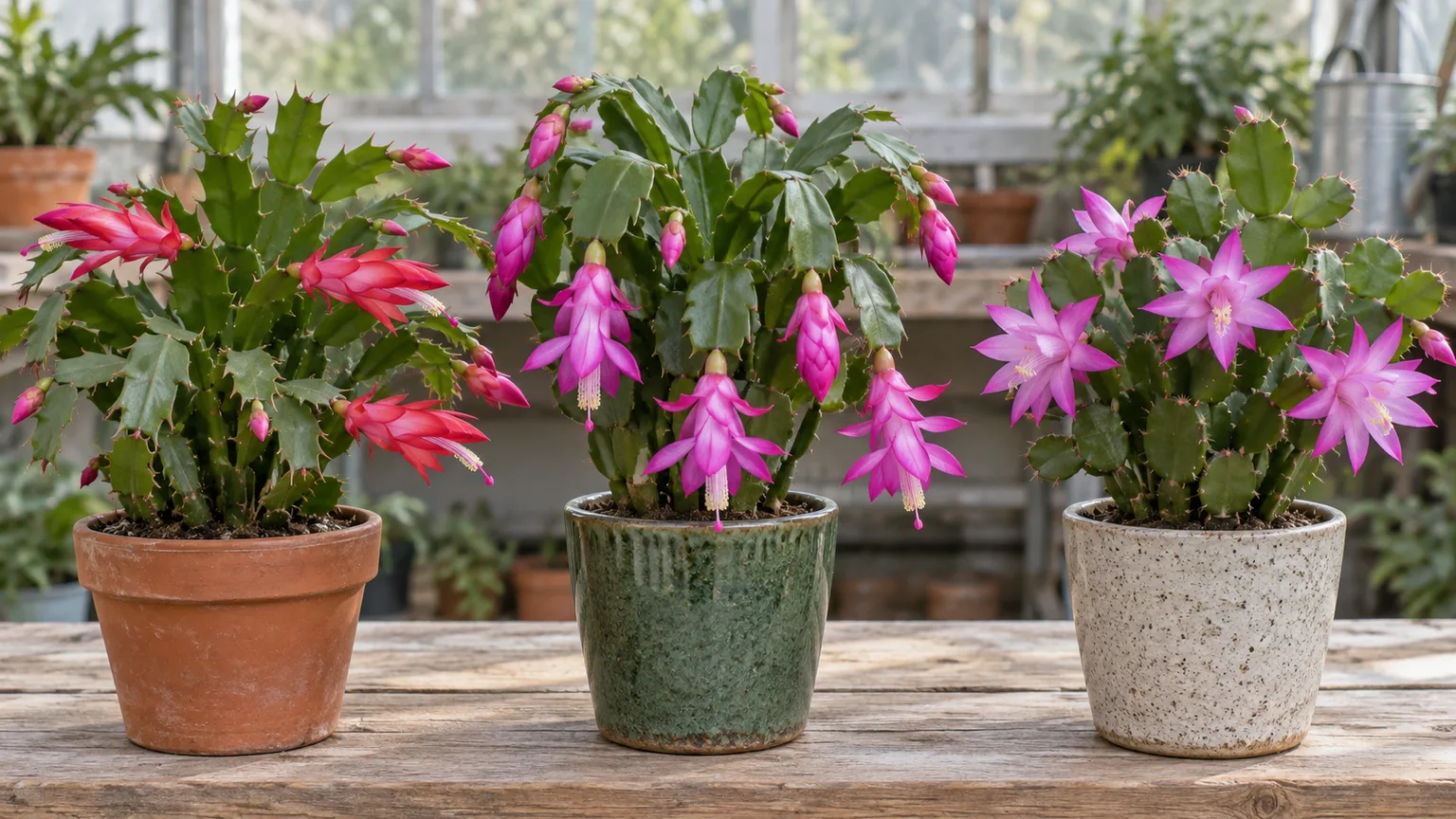
If your “Christmas cactus” opens its flowers in November, the plant may be a Thanksgiving cactus—or a hybrid with a less predictable schedule. The three holiday cacti share a cascading habit and bright seasonal flowers, but they are not interchangeable names for one plant. Their stem segments give you a better first clue than the label or the month on the calendar.
Look at the margins of a mature segment, the flattened jointed pieces that make up the plant’s stems. Pointed teeth suggest a Thanksgiving cactus; smoother scallops fit a Christmas cactus; rounded edges with tiny bristles point toward an Easter cactus. Flowers and bloom timing can confirm an identification, but growers’ hybrids and indoor conditions often blur those secondary clues.
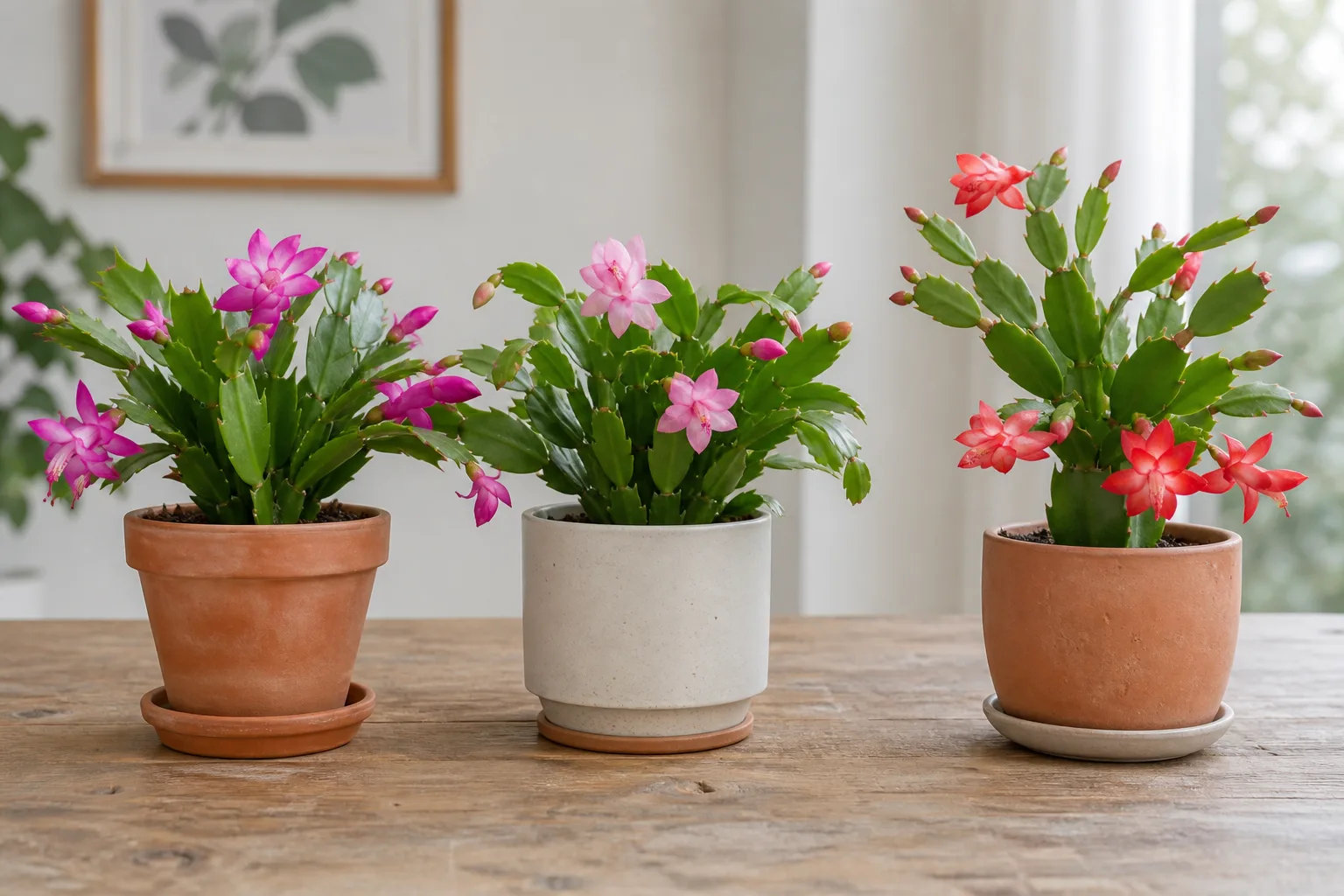
A quick comparison of the three holiday cacti
The shared nickname “holiday cactus” covers two closely related Schlumbergera types and a spring-flowering cactus traditionally placed in Rhipsalidopsis. Thanksgiving and Christmas cacti are usually closer in appearance and care; Easter cactus is the easier one to spot once you notice its flat, star-like flowers and small bristles on the stem segments. All three belong to the cactus family, despite their forest habitat and need for more regular moisture than a desert cactus.
| Type | Best stem clue | Flower clue | Typical Northern Hemisphere flowering |
|---|---|---|---|
| Thanksgiving cactus (Schlumbergera truncata) | Pointed, claw-like teeth along the segment edges | Tubular flowers often held more horizontally; yellow anthers are common | Late fall, often around November |
| Christmas cactus (often called Schlumbergera × buckleyi) | Rounded, smooth scallops; segments often look pear-shaped | Tubular flowers tend to hang; anthers may be pink or purplish brown | Early to midwinter, often December |
| Easter cactus (Rhipsalidopsis gaertneri) | Rounded margins with fine bristles at segment tips or joints | Flatter, radial, star-shaped flowers | Spring, often March through May |
Treat those dates and flower details as patterns rather than guarantees. The stem shape is usually the best clue when a plant is not flowering, and a nursery hybrid can combine features from more than one Schlumbergera parent. UW–Madison Extension and Penn State Extension both describe the rounded versus pointed segment distinction and the different bloom seasons, while NC State’s profile highlights bristles and spring flowers on Easter cactus (UW–Madison Extension; Penn State Extension; NC State Extension).
Start with the stem segments, not the calendar
What many people call leaves are actually flattened, jointed stem segments, often called cladodes or phylloclades. Their edges are more dependable for identification than a remembered bloom date, particularly if you inherited the plant, bought it in flower, or grow it in a warm room with evening lights.
Examine several mature segments in good light, especially near the tips of healthy branches. New growth can look softer and less pronounced, and hybrids may show intermediate margins; one unusual segment is not enough to overturn the pattern across the plant. You do not need to detach a piece or handle the plant roughly—turn a branch gently and look along both sides of the joint.
Thanksgiving cactus: pointed, claw-like margins
Thanksgiving cactus, Schlumbergera truncata, has flattened segments with distinct pointed projections along the margins. They resemble small crab claws or saw teeth, though they are not cactus spines and should not be treated as a sharp defense. If you see several obvious points on each mature segment, Thanksgiving cactus is the strongest match.
The plant’s branching habit can be somewhat upright when young, then cascade as older stems lengthen. That shape can support an identification, but it is less reliable than the teeth because pot placement, pruning, and plant age change how a specimen grows. Penn State Extension describes the pointed serrations and the more horizontal flower posture as useful Thanksgiving-cactus clues (Penn State Extension).
Christmas cactus: smooth scallops and pear-shaped segments
The traditional Christmas cactus has rounded, smooth margins rather than the pronounced points of S. truncata. Individual segments may taper toward the base and widen toward the tip, creating a pear or teardrop outline. The curves are subtle, so compare a mature segment with a known Thanksgiving type if the edges are hard to read.
Botanical names for Christmas cactus can be inconsistent in horticultural writing. Many modern care references use Schlumbergera × buckleyi for the rounded-segment hybrid, while other publications use S. bridgesii or discuss S. russelliana as part of its ancestry. The practical point for a home grower is that the label alone may not tell you whether a plant is a pure old type or a newer hybrid; rounded, scalloped margins are a useful visual clue, not proof of pedigree. NC State Extension’s Schlumbergera material distinguishes S. × buckleyi from pointed S. truncata, and Better Homes & Gardens notes that retail plants may have mixed parentage (NC State Extension; Better Homes & Gardens).
Easter cactus: rounded segments with tiny bristles
Easter cactus segments have rounded or weakly scalloped edges, so they can be mistaken for Christmas cactus when you inspect only the outline. Look for tiny bristles at the segment tips and sometimes near the joints. These small tufts are a stronger clue than “smooth versus scalloped” alone, and they do not resemble the pronounced claw-like teeth of Thanksgiving cactus.
Easter cactus commonly appears as Rhipsalidopsis gaertneri; Hatiora gaertneri is an older name that is still used in some references. NC State Extension lists Hatiora gaertneri among its previous names and describes the rounded segments, bristles, and spring star-shaped flowers that separate it from the winter bloomers (NC State Extension).
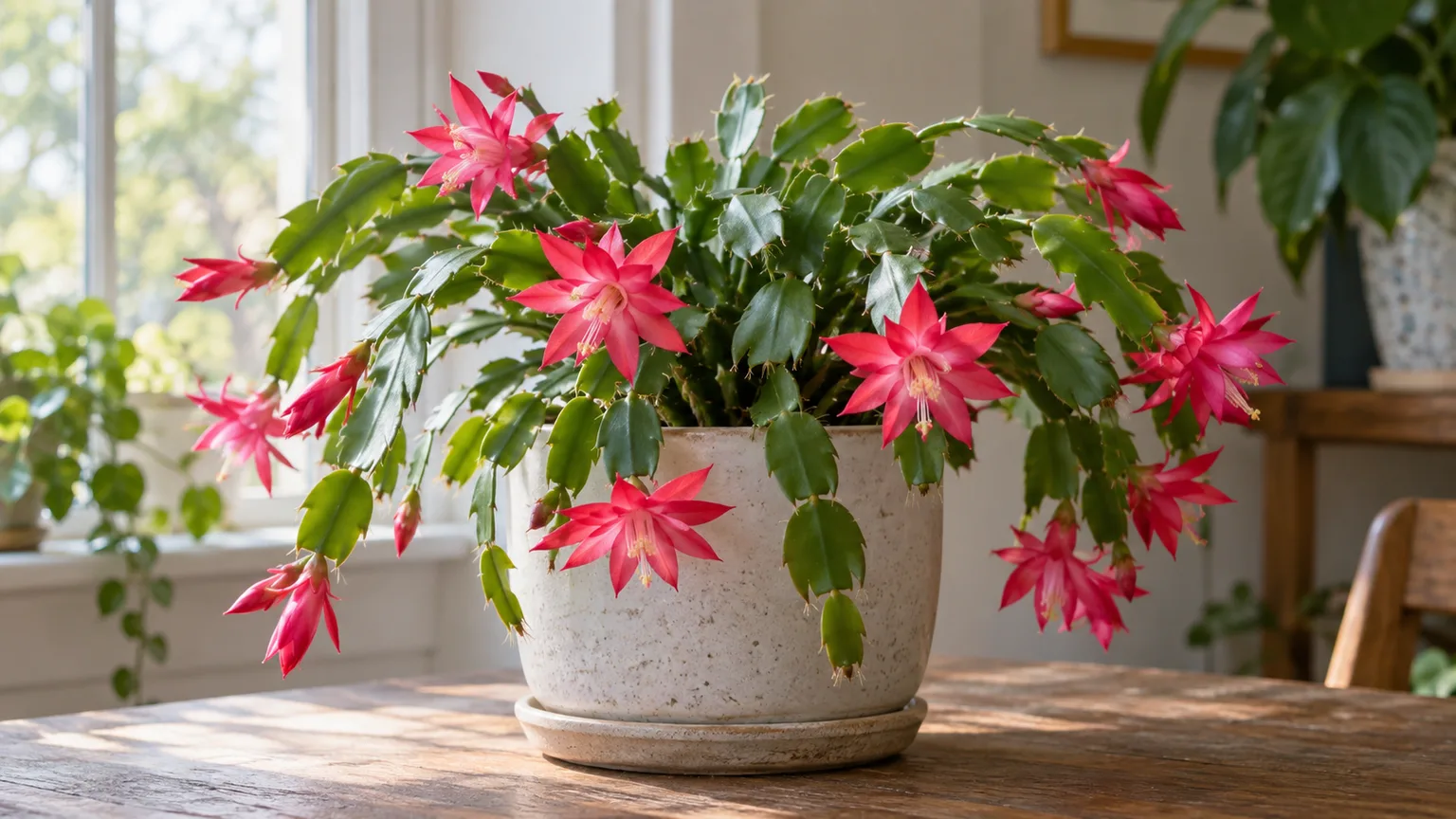
If there are no flowers and you cannot find bristles, call it a likely Easter cactus rather than forcing a certain identification. A close comparison with a clearly flowering specimen or a reliable plant reference can help; a nursery label may preserve a cultivar name, but labels for common holiday cacti are often broad or simply wrong.
Use flowers as a second identification check
Flower shape helps most when the plant is in bloom. Thanksgiving and Christmas flowers are elongated and tubular, with petals that sweep backward from the floral tube. Thanksgiving blooms commonly face outward or more horizontally from the stem; Christmas blooms often droop from the tips. Penn State Extension notes yellow anthers on Thanksgiving cactus and purplish-brown anthers on Christmas cactus, but flower posture and pollen color can vary among cultivars, so use them as supporting evidence rather than a stand-alone test (Penn State Extension).
Easter cactus flowers look flatter and more star-like, with a more symmetrical outline when viewed from the front. They open at the ends of segments and can be vivid red, pink, or white. NC State Extension lists flowers roughly 1.5 to 3 inches across and a spring bloom period; that clear flower form often makes Easter cactus the least ambiguous of the three once it opens (NC State Extension).
Do not identify a plant by color. Pink and red are common across all three, and cultivated varieties extend the palette to white, orange, peach, yellow, and combinations. A pink flower is not an Easter-cactus test, just as a tubular red flower cannot separate Thanksgiving from Christmas cactus by itself.
Bloom time is a clue, not a guarantee
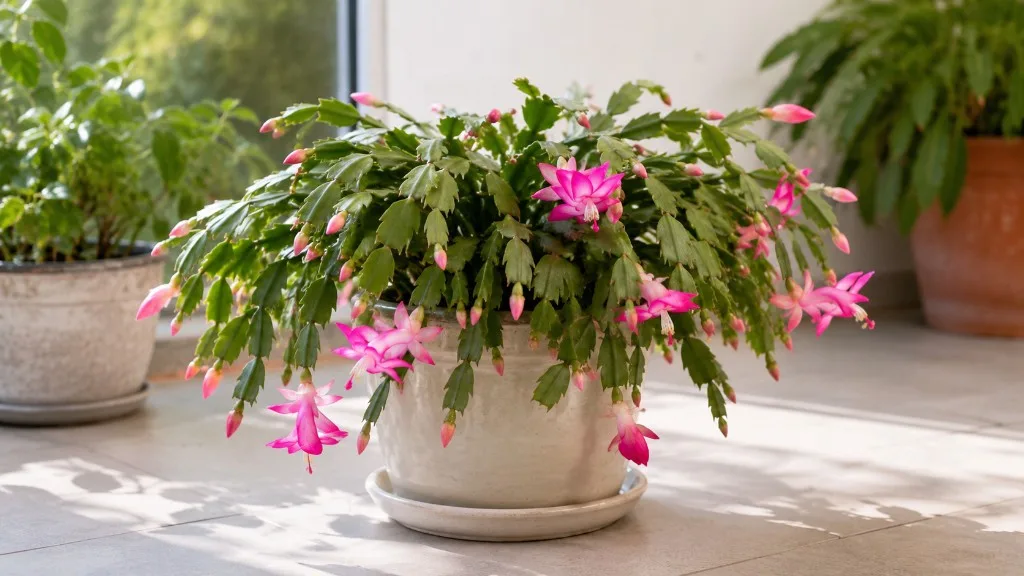
In the Northern Hemisphere, Thanksgiving cactus usually flowers first in late fall, Christmas cactus follows in early winter, and Easter cactus blooms in spring. NC State Extension describes Easter cactus flowering from March through May, while UW–Madison Extension places many Schlumbergera holiday blooms from early November into January (NC State Extension; UW–Madison Extension). Exact dates shift with cultivar, latitude, light exposure, temperature, and the growing schedule used by a commercial greenhouse.
A plant sold in bloom may have been manipulated to flower for a retail window. Commercial growers can control day length and temperature, so a plant called “Christmas cactus” might open before December at home, or an Easter cactus might flower outside the calendar Easter date. UConn’s Home Garden Education Center also points out that hybridization and grower-managed light and temperature can lengthen or shift the bloom window (UConn Home Garden Education Center).
Use the bloom date as a tie-breaker, not your first test. If the segments show clear claws, an early bloom supports Thanksgiving cactus; if the margins are smooth and rounded, a later bloom supports Christmas cactus. When those clues conflict, record the plant as a holiday-cactus hybrid and keep watching—it is more useful to give it sound care than to insist on a precise species name.
Why names and nursery labels get confusing
“Christmas cactus” is often used as a catch-all retail name for winter-flowering Schlumbergera. Plants sold under that label may have traits from Thanksgiving cactus or mixed parentage, and some older botanical names remain in circulation even when newer sources organize the group differently. The same issue appears with Easter cactus, which may be labeled Rhipsalidopsis gaertneri or the older Hatiora gaertneri.
Common names describe a traditional display period, not a strict biological appointment. Growers can shift flowering with long, uninterrupted nights and cool temperatures, while home lighting and warmth can delay bud formation. A plant that flowers on a different holiday is not necessarily mislabeled or unhealthy; compare its segments and flower structure before deciding.
There is also a useful distinction between species and cultivars. A cultivar is a named cultivated selection, and many plants in garden centers are hybrids chosen for flower color, compact growth, or predictable shipping schedules. Their features may not match a textbook specimen exactly, so a hybrid can reasonably resist a tidy three-column identification chart.
The care all three holiday cacti share
The three plants have overlapping baseline needs because each comes from forest habitats rather than dry desert. Think “bright filtered light, an airy root zone, and a careful wet-dry rhythm,” not prolonged drought in gritty soil. Everyday care is similar; the main differences show up in flowering season and the timing of their rest and dark-period routines.
Give them filtered light and stable temperatures
Place a holiday cactus in bright, indirect light, such as a bright east window or a few feet back from harsh afternoon sun. Strong direct sun can scorch or redden the flattened stems; very deep shade may keep the plant alive but reduce flowering and produce weaker growth. Penn State Extension describes these cacti as preferring filtered light, and UW–Madison Extension recommends bright indirect light rather than prolonged intense sun (Penn State Extension; UW–Madison Extension).
During warm months, you can move the plant outdoors to a sheltered, partly shaded spot after gradually acclimating it to brighter air. Keep it protected from intense afternoon sun, heavy rain that leaves the pot saturated, and sudden temperature changes. Bring it inside before cold nights approach the plant’s low-temperature tolerance; a frost-free houseplant is not an outdoor winter cactus.
Keep the pot away from radiators, air-conditioning vents, exterior doors, and cold panes that cause abrupt swings. Stable conditions matter particularly once buds appear. Moving a blooming plant from a cool, dim spot to a warm, brightly lit display can cause buds to abort, even though the plant looked fine the day before.
Water by soil condition and keep roots airy
Holiday cacti need more consistent moisture than desert cacti, but they do not want waterlogged roots. Use a pot with drainage holes and an airy, organic mix—such as a quality indoor potting mix amended with perlite or fine bark—rather than a dense soil that stays wet or an extremely gritty desert blend that dries in a flash. Their epiphytic roots naturally sit in pockets of leaf debris and moss, with water draining away quickly; UConn and UW–Madison Extension both connect that habitat to rich but well-drained growing media (UConn Home Garden Education Center; UW–Madison Extension).
Check the mix instead of watering on a fixed weekly schedule. When the upper layer begins to dry, water thoroughly until excess drains from the bottom, then empty the saucer. The interval will be shorter in warm, bright summer weather and longer in a cool room during post-bloom rest; pot size, material, and mix also change how quickly moisture disappears.
An Easter cactus can be less forgiving of both soggy and severely dry conditions than a well-established Schlumbergera. If its segments shrivel or detach, check the roots and mix moisture before watering again: limp stems can reflect root damage from excess water, not just thirst. NC State Extension specifically warns that overwatering or underwatering may cause Easter cactus to drop segments (NC State Extension).
Let the season guide feeding and rest
Feed during active spring and summer growth with a balanced water-soluble houseplant fertilizer at a conservative dilution, following the product label. Stop or reduce feeding as the plant enters the fall bud-setting period; fertilizer is not a substitute for the correct night length or cool temperature, and pushing soft growth late in the year can work against a compact plant.
After flowering, ease back on watering while growth is slow, then return to the regular rhythm when new segments emerge. Do not combine a dry rest with bone-dry soil for months: these plants store water in their stems, but that does not make severe drought harmless. Watch the plant’s actual growth and substrate rather than applying a calendar rule across all rooms and cultivars.
Match the dark-period routine to your cactus
Holiday cacti are responsive to photoperiod: a long, uninterrupted night helps signal that it is time to set buds. A practical home routine is to provide about 12 to 14 hours of darkness each night for several weeks, with bright indirect light during the day. A lamp in the living room or a porch light that shines on the plant can interrupt the dark period, so move it to a genuinely dark room or cover it with a breathable box if household lighting is unavoidable.
For a Northern Hemisphere display, UConn’s schedule suggests beginning short-day treatment around September 1 for Thanksgiving cactus, October 1 for Christmas cactus, and January 1 for Easter cactus. Its fact sheet describes roughly four to five weeks of long nights, or cool nighttime temperatures around 55°F, as ways to support bud formation; Penn State Extension likewise identifies at least 12 hours of uninterrupted darkness as a flowering cue (UConn Home Garden Education Center; Penn State Extension).
These are starting windows, not a promise that every cultivar will flower by a holiday. If exact timing does not matter, let natural shortening days and cooler nights do the work in a stable bright room. If timing does matter, keep a simple calendar for your own plant because hybrids, local daylight, warm interiors, and stray nighttime light can all change the response.
Cool nights can help, but cold is not the goal. Do not expose a potted plant to frost or a drafty window just to trigger buds; the room can be cooler at night than during the day without becoming dangerously cold. Once you see buds, stop experimenting with its location and keep light, moisture, and temperature steady. Garden Gate’s practical guidance also stresses long nights and cool evenings, while UW–Madison Extension cautions that sudden changes can cause buds to abort (Garden Gate; UW–Madison Extension).
What to do after flowering
Let spent flowers fall naturally or pinch them off gently once they wilt. For a tidier, bushier plant, shorten selected branches by twisting off one or two segments at a natural joint after bloom; late spring is a better shaping window than cutting heavily while buds are forming. Healthy pieces can be rooted as cuttings, but avoid major pruning immediately before the next bloom season.
Repot only when there is a practical reason, such as a mix that no longer drains well or roots emerging heavily from the drainage holes. These cacti tolerate being somewhat snug in a pot, so moving them into a much larger container can leave extra wet mix around a small root system. If you do repot, use a modestly larger pot with drainage and wait until flowers have finished rather than disturbing a plant in active bloom; Penn State Extension advises repotting after the flowering period and roughly every three to four years when the plant needs it (Penn State Extension).
If buds drop, first review what changed in the last week: did the plant move, the room warm up, soil remain wet, a draft hit the pot, or nighttime light interrupt its dark period? Correct the likely cause and keep conditions stable rather than compensating with extra water or fertilizer. UConn lists temperature swings, drafts, light, watering, and low humidity among common contributors to bud drop (UConn Home Garden Education Center).
A simple identification decision process
When you are unsure, follow this order:
- Inspect several mature segments. Obvious pointed teeth indicate Thanksgiving cactus; smooth scallops suggest Christmas cactus; rounded margins with tiny bristles suggest Easter cactus.
- Use flower shape if available. A flatter star points to Easter cactus; a tubular bloom supports one of the two Schlumbergera types.
- Compare bloom timing last. Late-fall flowers support Thanksgiving cactus, early-winter flowers support Christmas cactus, and spring flowers support Easter cactus—but hybrids and grower-forced plants may shift.
- If traits disagree, keep the label broad. “Holiday cactus hybrid” is a more honest identification than a confident species name based on one feature.
That process helps you make the important care decisions even if the exact parentage remains unknown. Start with the shared bright filtered light, drainage, and soil-moisture check; then time the darkness routine according to the bloom window you want to encourage. No identification label can replace observing how your own plant responds to the light and temperature in your home.
Conclusion
The fastest way to tell Thanksgiving, Christmas, and Easter cacti apart is to inspect their segment margins. Thanksgiving cactus has pointed claw-like teeth, Christmas cactus has smoother rounded scallops, and Easter cactus has rounder segments with tiny bristles and flatter spring flowers. Flower posture and bloom season help confirm the answer, but hybrids, alternate botanical names, and greenhouse scheduling make calendar clues less dependable than they seem.
Give all three bright indirect light, an airy mix that drains freely, and water when the surface begins to dry rather than on a rigid schedule. For repeat blooms, provide several weeks of long, uninterrupted nights at the appropriate point in the season, then leave the plant stable after buds appear. If a label and the plant disagree, trust the plant’s features—and keep its care grounded in what it is doing now.



