How to Grow and Care for Flowering Quince
Grow flowering quince in sun and well-drained soil, then prune after bloom. Get practical planting, watering, cultivar, fruit, and troubleshooting advice.
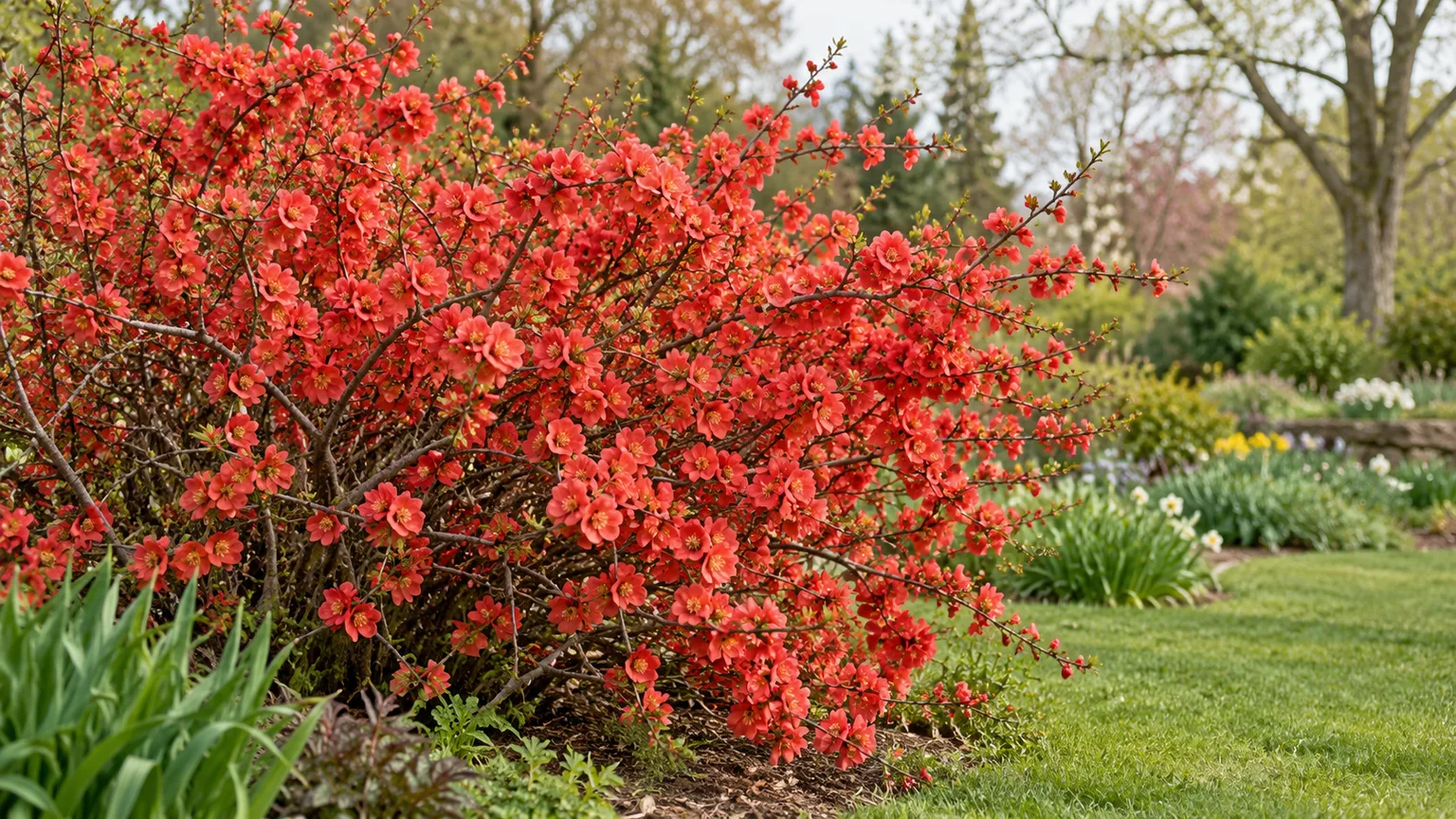
Flowering quince (Chaenomeles speciosa) is a deciduous shrub that earns its space early: its red, orange, pink, salmon, or white flowers open along bare branches before most leaves appear. It can make a spring border feel awake weeks before summer shrubs leaf out, and its dense, thorny stems can form an informal barrier. The same traits that make it useful also shape where it belongs: give it room, keep it away from narrow paths, and decide whether you want flowers, fruit, or a tightly controlled outline before you start pruning.
For reliable bloom, plant it where it receives at least six hours of direct sun in soil that drains after rain. Water a new shrub through its first dry seasons, then reduce irrigation as roots establish. Most important, prune just after flowering if you want to shape it; flowering quince carries its next display on growth that develops during the season, so a late-summer or winter trim can remove buds before you see them.
What flowering quince needs to thrive
The species is a multi-stemmed, branching shrub in the rose family, native to Asia. A typical C. speciosa can reach about 6 to 10 feet tall and spread as wide or wider, though named cultivars range from low mounds to substantial shrubs. Its branches are dense and often thorn-tipped, its leaves are glossy and toothed, and its small apple-shaped fruits ripen from green to yellow later in the year. NC State Extension and Oregon State University’s landscape plant profile describe the plant’s variable size, early flowers, and spiny habit.
The plant is not difficult to grow, but “low maintenance” does not mean “fits anywhere.” It can tolerate some shade and a range of soils, yet it flowers best in brighter conditions and dislikes a site where water lingers around the roots. Its root system can also send up suckers, gradually widening the clump. Choose a spot where that spread is acceptable or where you can reach the base to remove unwanted shoots.
Choose a site that suits its mature shape
Use flowering quince where a thorny shrub is an asset: at the back of a broad border, along a property edge, in an informal hedge, or against a wall with a simple wire support. A spring-flowering hedge can provide early color and some physical deterrence, but it is not a neat, narrow screen unless you commit to regular shaping. A shrub left to its natural habit often becomes a tangled mound rather than a clipped geometric hedge.
Keep it away from a busy walkway, children’s play area, gate, or space where people will brush past the branches. That distance also makes pruning safer, since you can approach the shrub from more than one side. Before planting a row, look up the mature dimensions of the cultivar on the nursery label; spacing small plants by their current pot size is a common way to create an overcrowded hedge that later needs severe cuts.
Flowering quince is deciduous, so it does not provide year-round screening. Its strongest ornamental moment is brief, typically in late winter or spring depending on climate, and the foliage is useful but less showy afterward. Pair it with evergreen structure or plants that carry summer interest if the border needs to look finished beyond bloom time.
Give it enough light for a strong bloom
Full sun is the best choice when spring flowers are your priority. NC State defines full sun as six or more hours of direct sunlight and notes that flowering quince tolerates partial shade but flowers most freely in sun. In a partly shaded position it can still grow, but expect a looser shrub and a lighter display; the exact difference depends on how much direct light reaches the branches.
Watch the plant over a full day rather than judging by the brightness of the yard. A location that gets morning light and deep afternoon shade may be adequate for growth but disappointing for flowers. In very hot, dry regions, some afternoon shade can ease summer stress, but that is a trade-off: use the brightest site that fits your local climate and your watering capacity.
Prepare soil for drainage, not a perfect texture
Flowering quince grows in loam, clay, and sandy soil if excess water can drain away. A heavy soil is not automatically unsuitable; a low spot that stays saturated is. If water stands after a soaking rain, improve the site or plant on a broad raised mound rather than filling one small planting hole with loose compost. A basin of amended soil inside dense clay can hold water around the root ball like a pot.
Soil reaction deserves a little more nuance than a universal “acidic only” rule. NC State warns that alkaline soil can lead to chlorosis, while the RHS says the plant can tolerate lime but may become chlorotic in very alkaline conditions. That difference is a reason to check the soil before applying sulfur, iron, or an acidifying fertilizer. If leaves yellow while their veins stay green, test the soil pH and drainage first; yellowing alone does not prove that the plant needs a particular amendment. RHS plant guidance describes the range of soils it accepts and the alkaline-soil caveat.
Spread a thin layer of compost over the root zone if the ground is poor, then mulch to conserve moisture and limit weeds. Keep mulch a few inches away from the stems so the crown remains airy. A thick mound against the base can hold moisture against bark and conceal suckers you may want to remove.
Plant without burying the crown
Plant a container-grown shrub in spring or fall when the soil is workable and the weather is mild. In a colder region, spring gives a young plant time to root before its first winter; in a hot-summer region, fall planting can reduce heat stress. If planting during another season, monitor moisture closely and avoid working frozen or waterlogged soil.
Dig a hole no deeper than the root ball and roughly twice as wide. Tease loose circling roots outward, set the shrub so the top of its root ball is level with the surrounding grade, and backfill with the soil you removed. Water slowly to settle the ground and eliminate large air gaps. Do not bury the crown to suppress suckers: doing so can create other problems without removing the plant’s tendency to spread.
For a hedge, mark the final line and check the cultivar’s mature width before digging. If you are planting beside a wall, set the shrub far enough forward that air can move around the stems and you can work behind it. A wall can make a useful warm microclimate, but it does not turn a shrub into a self-clinging vine; provide wires or another support and tie selected branches in place.
Water young shrubs, then taper as they establish
During the first growing season, water deeply whenever the root zone begins to dry rather than giving the plant frequent, shallow sprinkles. The goal is to wet the original root ball and the nearby soil, then let excess drain. Check beneath the mulch with a finger or trowel; the surface can look dry while the root zone remains moist, especially in clay.
Newly planted shrubs need extra attention through dry spells for at least the first season and often longer in hot, windy, or sandy sites. Once established, flowering quince is more tolerant of dry conditions, but drought tolerance is not a reason to leave it parched while it is forming flowers or fruit. Water at the base in prolonged drought, and avoid routinely wetting the foliage late in the day.
Use rainfall, soil texture, temperature, and plant response to set the schedule. A fixed weekly amount cannot account for a cool rainy spring, a fast-draining slope, or a young plant in a heat wave. Drooping leaves and dry soil suggest a need for water; persistently wet soil, yellowing, and weak growth point toward drainage or root stress instead.
Feed only when the soil or growth calls for it
A well-established shrub in reasonably fertile soil may not need annual fertilizer. If growth is sparse or the shrub is recovering from major renovation, start with a soil test and a light compost top-dressing. Where a test or local extension recommendation calls for fertilizer, apply a balanced product in spring at the label rate and keep it away from the stems.
Avoid trying to fix poor flowering with a large dose of high-nitrogen fertilizer. Extra nitrogen can push leafy shoots without correcting the real problem, which may be shade, a late prune, frost injury, or a cultivar that is still establishing. If the shrub grows vigorously but flowers poorly, check its light and pruning history before feeding it.
Prune after flowering to protect next year’s buds
Flowering quince produces blossoms on older wood: the flowering branches formed during the previous growing season. That makes timing more important than the exact month. In a warm garden the flowers may finish in early spring; in a colder place they may not fade until later. Start pruning when the display is over, not on a calendar date. Purdue Arboretum’s plant profile notes that flowers occur on old wood, and the RHS places ordinary shrubs in a post-flowering pruning group.
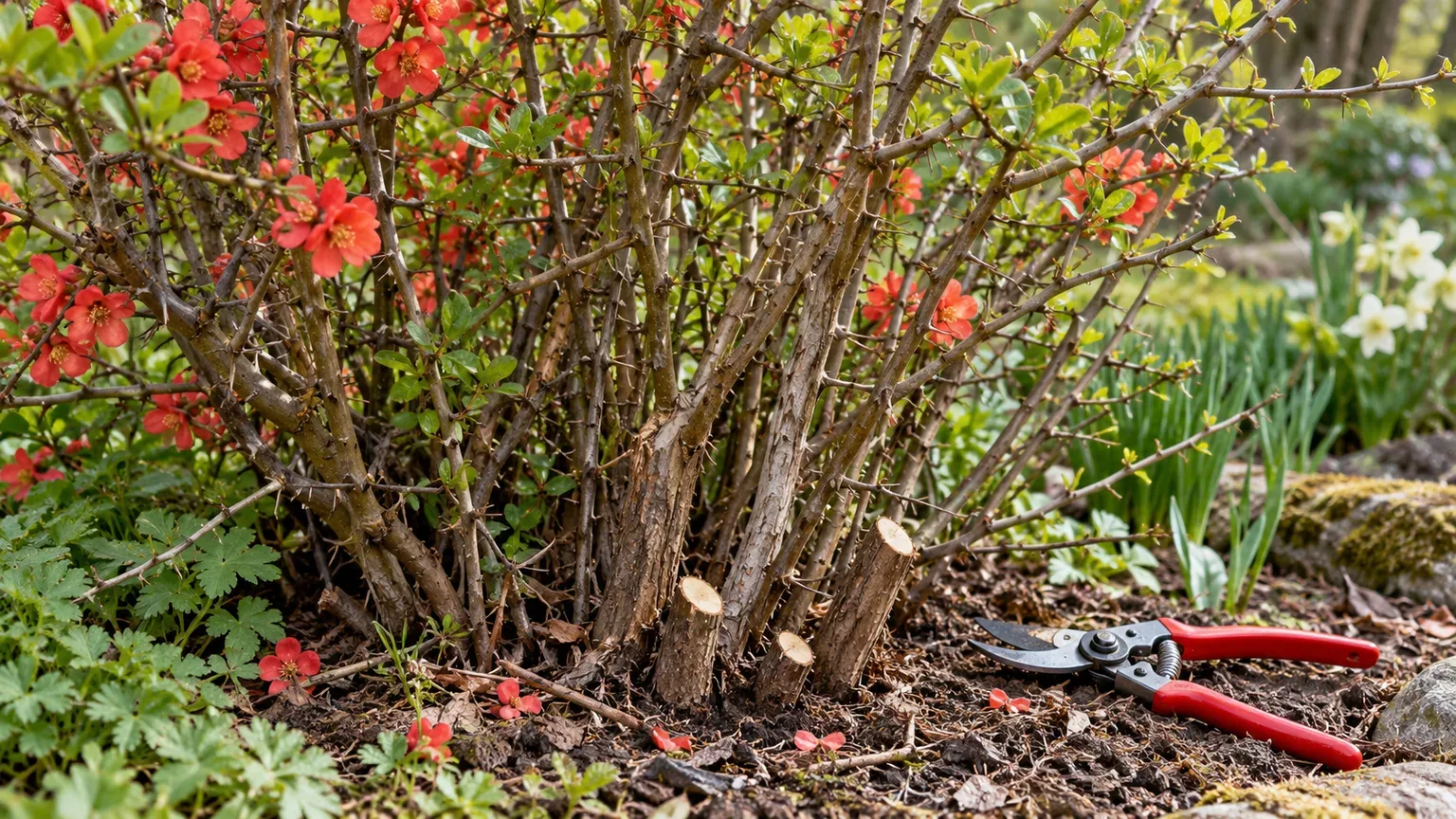
Wear sturdy thorn-resistant gloves, long sleeves, and eye protection. Use clean, sharp bypass pruners for small stems and a pruning saw for older canes. The tangled branches can hide sharp points, so pause to see where a stem begins before reaching into the shrub; do not pull blindly at a branch caught in the center.
Make light annual cuts for shape and airflow
Begin by removing dead, broken, or obviously diseased stems at their origin. Then take out a few of the oldest canes at ground level, especially those that cross the center or rub against younger stems. This selective thinning keeps the shrub’s natural outline while letting light and air reach the interior; shearing only the outside creates a dense shell and does little to improve congestion inside.
If a branch is simply too long, shorten it to a side branch or outward-facing bud rather than cutting every stem to the same height. Make the cut just above the point you want to encourage, and step back often to keep the shrub’s informal shape. Garden Gate’s shrub-pruning guide places flowering quince in late spring to summer and flags its spiny flowering spurs as a reason to wear gloves. Homes & Gardens’ flowering-quince pruning guide likewise recommends working after bloom, removing damaged or congested stems, and taking older stems gradually.
Pruning right after flowers fade leaves the rest of the growing season for replacement growth. That new growth is what carries the following spring’s flowers, so avoid tidying the shrub again in late summer or winter unless you are removing a hazard or diseased wood. A light, timely trim usually preserves more bloom than an infrequent severe haircut.
Rejuvenate an overgrown shrub in stages
If the plant has become a crowded thicket, do not start by shearing the whole canopy. First identify the healthiest young canes and the oldest, least productive ones. Remove roughly a third of the oldest stems at ground level after flowering, then reassess the shape next year; staged renewal maintains some flowering wood while opening the center.
A very neglected shrub can be cut back hard while dormant, but expect to sacrifice much or all of the next flowering display. Oregon State lists renovation cutting as an option, and Homes & Gardens describes hard renovation as a recovery measure. Treat it as a reset for a plant whose shape or health justifies the temporary loss of flowers, not as an annual routine. If the shrub is large and thorny, remove it in manageable sections rather than wrestling with one tangled mass.
Control suckers and train branches against a wall
Flowering quince can send shoots up from spreading roots. If a sucker appears beyond the clump, trace it to the point where it joins the root or parent plant and cut it there when accessible; a flush cut at soil level may only prompt another shoot. Repeat checks during the growing season because one pass will not permanently stop a suckering shrub.
Mowing can keep grass from swallowing isolated suckers, but it does not remove a root-connected shoot cleanly and is a poor solution in a thorny bed. If you want a compact hedge, use a cultivar whose mature dimensions fit the space and prune lightly after flowering. For a wall-trained specimen, tie a few flexible stems to wires and remove unwanted laterals after bloom. Do not hard-prune the entire face in winter if next season’s flowers matter.
Troubleshoot weak flowering and unhealthy leaves
Flowering quince can look healthy and still produce few blossoms. Diagnose in a useful order: check whether it was pruned after the previous bloom; estimate direct sun; consider whether flower buds were exposed to a late freeze; then assess water stress, plant age, and cultivar. Changing fertilizer before checking these causes is unlikely to help.
Diagnose missing flowers before adding fertilizer
The most common fixable cause is pruning at the wrong time. A winter or late-summer trim may have removed the wood that would flower in spring. Skip pruning for a season, then resume just after bloom and make lighter cuts. A young shrub also needs time to establish, and a plant in deep shade may survive without producing a strong display.
An early warm spell can open buds before a frost, particularly in a sheltered warm microclimate. A frost-damaged flower crop does not necessarily mean the shrub itself is dead; wait for leaves and new growth before deciding to cut back living stems. If only some branch tips fail, inspect the buds and stems, then remove truly dead wood after the risk of hard frost has passed.
Separate chlorosis from disease symptoms
Yellow leaves with greener veins can point to iron chlorosis in alkaline soil, but also check whether the soil remains wet or the plant is under drought stress. NC State lists chlorosis in high-pH soil among flowering quince problems; the RHS notes that strongly alkaline conditions can cause the same issue. Test pH and drainage before changing the soil, because adding iron will not fix waterlogged roots.
Leaf spots, premature leaf drop, or blackened shoot tips call for a closer look. NC State identifies scab and fire blight as possible problems, but symptoms can overlap with weather damage and other diseases. Remove fallen, spotted leaves from the ground and avoid overhead watering when foliage stays wet. If shoots blacken and curl, photograph the affected area and consult a local extension office for diagnosis and region-specific sanitation guidance before applying any pesticide or making extensive cuts.
Aphids may cluster on tender new growth, especially when the shrub is stressed. If the infestation is light, monitor it and use a strong water stream to dislodge insects; protect beneficial insects and follow local extension advice if the problem persists. Do not reach through thorny growth without protective gear.
Choose a cultivar for size, color, and thorns
Cultivar names help you choose a realistic footprint and flower color, but the label should guide the final decision because size and thorniness vary. Oregon State lists ‘Jet Trail’ as a low-growing, white-flowered selection and ‘Texas Scarlet’ as a compact, spreading form with red flowers. NC State describes ‘Orange Delight’ as low and spreading, and lists the double-flowered ‘Orange Storm,’ ‘Pink Storm,’ and ‘Scarlet Storm.’ Check whether a selection is a pure C. speciosa or a hybrid, since catalogs sometimes group several Chaenomeles species under flowering quince.
Some cultivars are selected for a particular habit or flower form, and not every plant will produce the same amount of fruit or thorns. For a small bed, prioritize the mature height and width first, then color. For a barrier hedge, ask the nursery about thorniness and sucker habit. For fruit, ask whether the selection sets fruit reliably; a heavily double-flowered cultivar may be less useful if harvest is the main goal.
Propagate with cuttings, layering, or seed
Semi-ripe stem cuttings and layering are the most dependable home methods when you want a plant like the parent. The RHS recommends semi-ripe cuttings in summer or layering in autumn. Take several cuttings rather than relying on one: rooting success varies, and a few attempts give you a better chance of establishing a new shrub.
For semi-ripe cuttings, choose a healthy current-season shoot that is firming but not fully woody. Cut a section several inches long, remove lower leaves, and insert the base into a clean, free-draining propagation mix. Keep it evenly moist in bright indirect light, not in hot direct sun; cover loosely if needed to hold humidity, and ventilate so condensation does not keep the cutting wet. Pot on only after roots have formed and new growth is steady.
Layering is a lower-tech option if a flexible low branch can reach the soil. Bend a section down, lightly wound or scrape the underside, pin it beneath the soil while leaving the tip exposed, and keep the spot moist. Once it has rooted, separate it from the parent and move it during a cool, mild period. Check for roots rather than tugging hard on the stem.
Seeds are possible but slower and less predictable, especially when the plant is a named hybrid. They need a period of cold stratification before germination, and seedlings may not resemble the cultivar that produced the fruit. Choose seed if you enjoy raising plants and can wait; use cuttings or layering when preserving a particular flower color or growth habit matters.
Decide whether fruit is worth preserving
After flowering, the shrub may set firm, greenish-yellow fruits that resemble small apples. They are not usually pleasant to eat raw: the flesh can be hard and astringent. The fruit is used in preserves and jelly, where cooking and sweetening make its strong flavor useful. Fruit quantity varies with cultivar, weather, pollination, and how much flowering wood you leave intact.
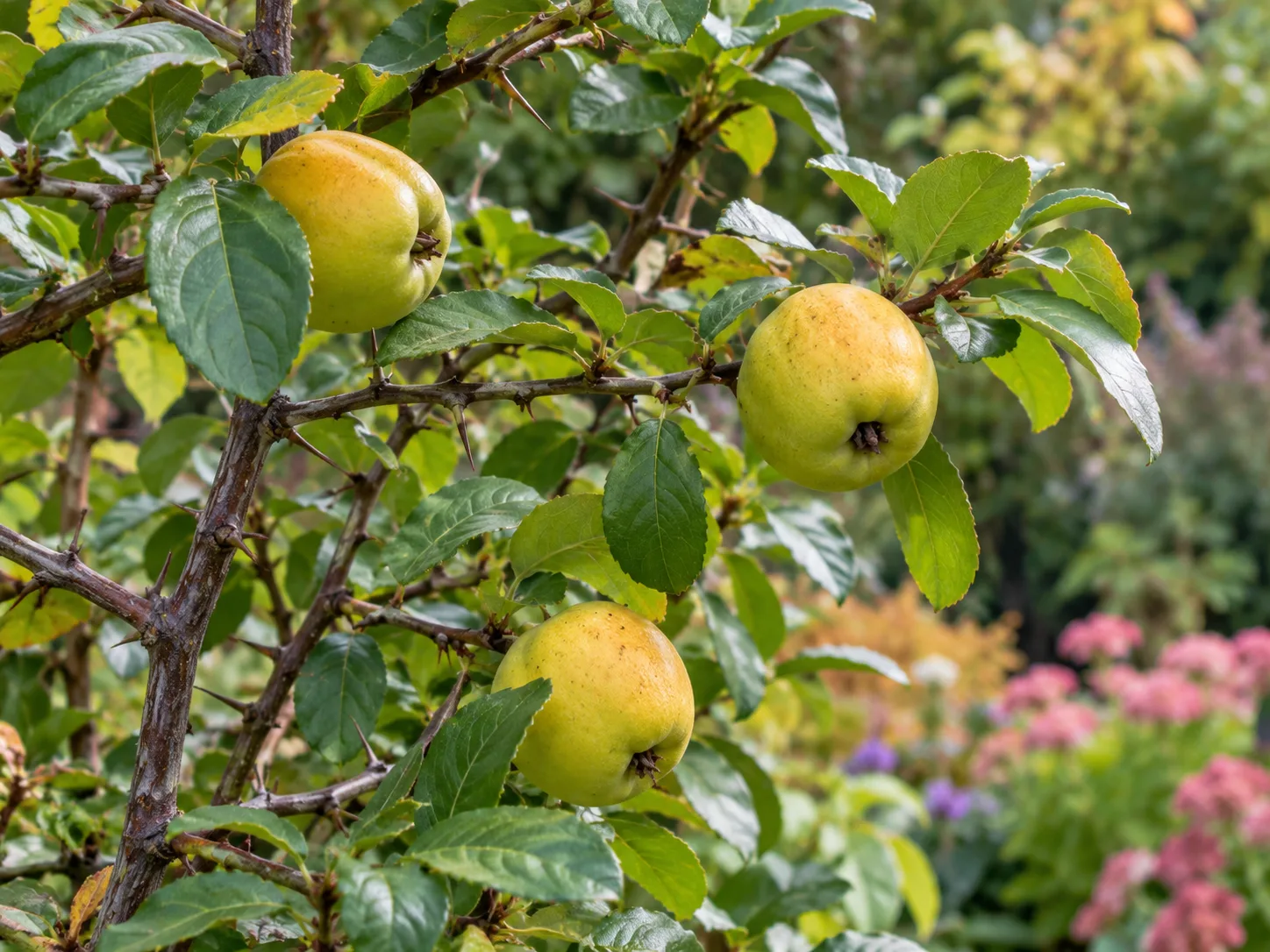
If harvest matters, prune less and make only the cuts needed for access, safety, and plant health. Every cut that removes a flowering stem can also remove a potential fruiting point. Leave some fruit to ripen until it is fragrant and yellowing, then follow a tested recipe; remove seeds and do not eat them. The RHS notes that seeds contain toxins, so keep preparation to the edible flesh and use a reliable food-preservation method rather than improvising with raw fruit.
Grow compact cultivars in containers with extra care
A compact cultivar can grow in a large outdoor container, but a pot makes a shrub with thorny branches harder to move and more dependent on you for water. Choose a heavy container with multiple drainage holes and room for the root ball to expand. Use a durable, free-draining potting mix, set the crown at the same level as it was in its nursery pot, and place the container where the shrub gets ample sun without blocking a path.
Check moisture more often than you would for an in-ground plant, especially in windy weather. Water until excess runs from the drainage holes, then empty any saucer; do not leave roots sitting in water. In cold climates, the root ball in a pot is more exposed than roots in garden soil. Move the pot to a sheltered location or protect the container for winter, and make sure it still drains during wet weather.
Conclusion
Flowering quince is easiest to enjoy when you plan for its real shape: a broad, deciduous, thorny shrub that flowers early and may spread by suckers. Give it sun, drainage, space, and steady water while it establishes; once it is settled, let rainfall do more of the work. If flowers matter most, prune just after bloom, remove a few old stems at a time, and avoid late-season shaping. Choose a compact cultivar when space is limited, and keep fruit, hedge density, and easy access in mind before deciding how much to cut.