31 Terrarium Ideas for a Home Garden Under Glass
Find 31 terrarium ideas for every room, container, and plant type, plus practical guidance for light, drainage, watering, and long-term upkeep.
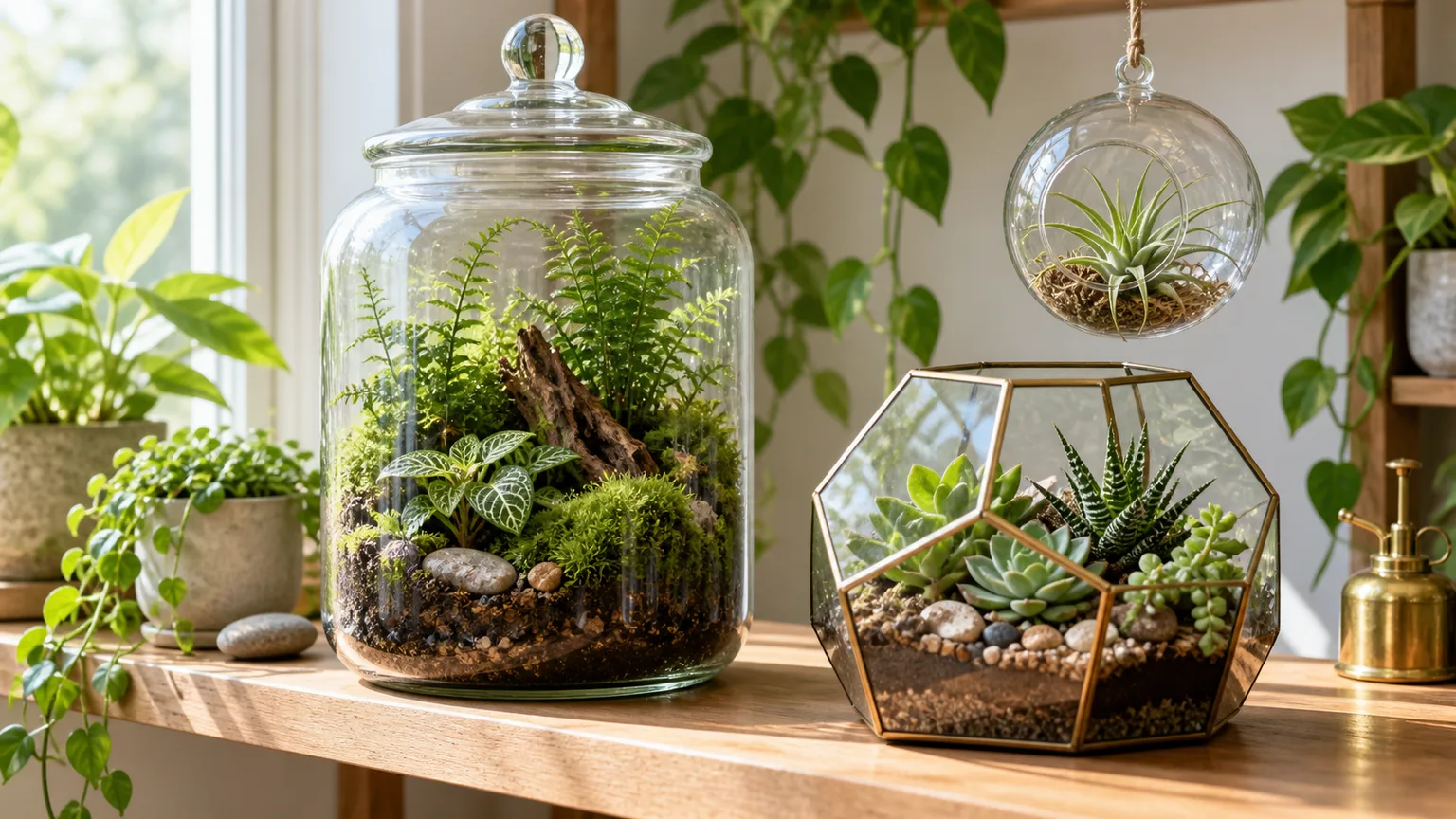
A good terrarium is not simply a glass container crowded with small plants. It is a deliberately chosen microclimate: either an airy display where the growing mix dries, or a humid little world where moisture condenses, falls, and returns to the soil. That distinction determines whether your inspiration photo becomes a healthy miniature garden or a jar of collapsed stems.
The easiest way to choose among these terrarium ideas is to start with the plants and the place they will live. A bright windowsill may suit an open bowl of haworthia; a bright room away from hot sun is better for a closed jar of moss and fittonia. The sections below give you 31 designs to borrow, then show how to build and maintain one without relying on guesswork.
Open or closed? Choose the microclimate before the container
In the broadest sense, a terrarium is a clear enclosure arranged for growing plants indoors. The historical Wardian case was a sealed glass case, but modern terrariums also include open bowls, hanging globes, and dish gardens. Encyclopaedia Britannica’s definition of a terrarium captures that range while noting that the plant palette changes with temperature and humidity.
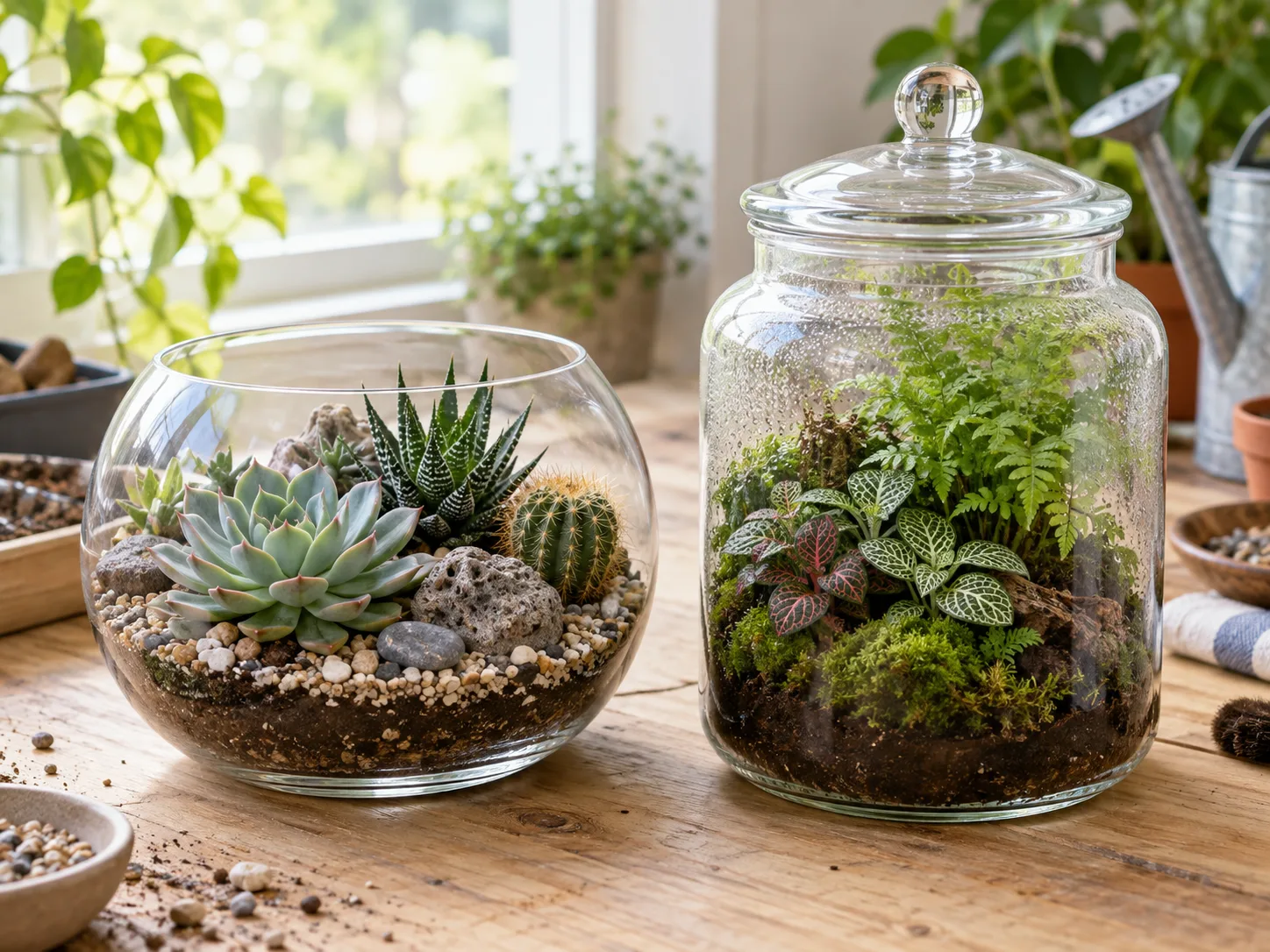
Choose an open terrarium when your plants need air movement and a drying cycle. Succulents, cacti, haworthia, jade, aloe, sedum, and many air plants belong here. The opening also makes watering, pruning, pest checks, and eventual replanting straightforward, which is why Oregon State University Extension guidance published by Plant Something Oregon calls open glass displays a sensible starting point for beginners.
Choose a closed terrarium when your plants prefer stable moisture and higher humidity: mosses, small ferns, fittonia, pilea, peperomia, and some compact begonias are stronger candidates. A sealed jar can establish a small rain cycle, but it gives you far less room for error. Penn State Extension’s closed-terrarium guidance makes the key distinction clear: the closed system has a tighter plant palette and must be kept out of direct sun.
Match plants by moisture, light, growth rate, and mature size
Before buying a container, write down four requirements for every plant you want to use: how bright the light should be, how quickly the plant grows, how wet the root zone can remain, and how large it will become. If two plants disagree on any of the first three, do not force them into one scene just because their colors look good together. A terrarium is a shared root zone, not a flower vase where each plant can follow its own schedule.
Use this quick filter:
- Closed, humid, indirect light: moss, fittonia, small ferns, pilea, peperomia, creeping fig, and carefully selected begonias.
- Open, bright light, fast drying: haworthia, echeveria, jade, aloe, sedum, small cacti, and other compact succulents.
- Open, bright indirect light, no soil: Tillandsia, or air plants, displayed on clean stone, cork, or driftwood.
The plant’s mature size matters more than the size of the nursery pot. Oregon State Extension’s practical advice is worth keeping: start with the smallest healthy specimens you can find, but expect some plants to outgrow the glass and eventually need replacing. A plant that is “mini” today may become the canopy that shades everything else next season.
31 terrarium ideas to borrow for your home
The 31 ideas below are meant to be adapted, not copied as rigid recipes. Each one includes a visual direction, a compatible plant group, and the trade-off that will determine whether it lasts. Keep the tallest plant toward the back when the terrarium faces one direction; if you view it from all sides, place the focal plant near the center and keep the rim clear.
Lush woodland and rainforest scenes
1. Lidded woodland jar. Pair moss with a miniature fern and one fittonia in a clear cookie jar or apothecary jar. The lid turns the vessel into a humid woodland, so keep the soil lightly damp and place it in bright indirect light rather than a sunny window.
2. Moss-and-driftwood cloche. Set a clean piece of non-resinous driftwood into a shallow closed cloche and let moss form the ground layer around it. The wood supplies height and shadow; remove it if it begins to soften, smell sour, or grow fuzzy mold.
3. Fittonia jewel box. A glass trinket box makes a jewel-toned display with red, pink, or white-veined nerve plants. Choose one compact plant or a restrained trio, because the box’s low height is a strength only while leaves stay below the lid.
4. Fern-in-a-fishbowl. A wide fishbowl gives a small button fern or bird’s-nest fern room to arch without forcing leaves against the glass. If the bowl is open, water it like a houseplant; if you add a fitted cover, switch to condensation-based checks.
5. Mini rain forest in a cookie jar. Build a back-to-front scene with a small parlor palm, moss at the foreground, and a trailing pilea or creeping fig tucked to one side. This looks lush quickly, but the palm and vine will compete for space, so plan to trim or replace the faster grower.
6. Orchid-and-moss showcase. Use a small orchid only in a roomy, ventilated container where its roots and crown are not permanently wet. Moss can supply the woodland feeling, but do not bury an orchid crown or seal a jar around a plant that needs its potting medium to dry.
7. Begonia color study. A single rex begonia or another compact foliage begonia can be the entire composition. Its patterned leaves do the decorating, while a few dark stones or a low moss patch provide contrast without turning the glass into a crowded greenhouse.
Open arid compositions
8. Hanging air-plant globe. Suspend a clear globe with one Tillandsia resting on cork or a small stone, leaving space around every leaf. Take the plant out to water it, let it drain and dry fully, then return it; do not let the base sit in trapped water.
9. Geometric succulent bowl. Use an open geometric terrarium for echeveria, haworthia, and one trailing sedum. The faceted glass supplies enough visual structure that the planting can stay simple; use a gritty mix and give each rosette room to grow.
10. Cactus constellation. Arrange two or three small cacti of different shapes in a wide open bowl with mineral top dressing. Keep spines away from a walkway, child’s reach, and a narrow shelf where the container could be knocked over.
11. Haworthia rock garden. Haworthia creates a strong miniature landscape without demanding the intense sun that some larger succulents prefer. Place it beside a low stone, keep the neck of the plant above the soil, and wait for the mix to dry before watering again.
12. Jade and stone desert bowl. A young jade plant becomes the small tree in an open dish, with pale gravel and one branching stone around it. This is a long-term pruning project rather than a sealed ecosystem; give it bright light and expect woody growth.
13. Aloe on a windowsill. Use one small aloe as a sculptural focal point in an open, wide-mouth vessel. Aloe wants a drying root zone and strong light, so it is a poor candidate for a damp moss composition but a good choice for a sunny, uncluttered sill.
14. Rainbow mineral layers. Create bands of pale sand, pumice, and natural gravel around shallow-rooted succulents. Keep the colored effect natural and thin; thick decorative layers can hide wet soil and make it harder to judge whether the root zone has dried.
Upcycled vessels with a new purpose
15. Thrifted fishbowl landscape. A secondhand fishbowl can become an open succulent garden after a careful wash and rinse. Its broad mouth makes planting easy, but its lack of a drainage hole means you must water sparingly and treat any pooled water as a problem to correct.
16. Victorian greenhouse look. Choose a small glass-and-metal greenhouse with hinged panels and plant it like an open or vented woodland case. The architecture supplies the drama, so use three textures—fern, moss, and stone—instead of many competing foliage colors.
17. Cake-stand garden. A clear cake dome or pedestal can protect moss and a tiny fern while turning the display into a table centerpiece. Confirm that the dome can be lifted easily for airing and that the plants will not touch hot bulbs, radiators, or a bright beam of midday sun.
18. Lidded cookie-jar terrarium. The wide mouth of a cookie jar is forgiving for beginners and lets you reach the back without specialized tools. Use it for a closed fittonia-and-moss scene, but leave headroom and start with less water than you think you need.
19. Teapot terrarium. A glass teapot with a removable lid creates a charming woodland container with a built-in handle for moving it. The spout can improve ventilation, but it can also dry one side faster, so rotate the pot or plant for the actual light pattern rather than styling alone.
20. Perfume-bottle micro-terrarium. A thoroughly washed, residue-free bottle can hold preserved moss or a single tiny living plant if the opening permits care. This is a display for scale and patience, not a good first home for a fast grower; never use a bottle that still smells of fragrance or cleaner.
21. Glass jewelry-box garden. A hinged glass box works for a low closed arrangement of moss, fittonia, and one smooth pebble. Keep the décor nonporous and washable, and make sure the hinge can open often enough to remove a leaf or correct condensation.
Storybook, sculptural, and seasonal scenes
22. Driftwood ridge. Build a miniature hillside by sloping the soil around one clean piece of driftwood, then tuck moss into the lower edge. The slope creates depth when viewed from the front, but do not bury the plant crowns just to make the ridge taller.
23. Fairy woodland with one accent. Add one small glass, resin, or glazed-ceramic figure to a moss-and-fern planting. A single object gives the eye a story; a collection of wet, porous, painted ornaments adds places for algae, residue, and contaminants to hide.
24. Miniature cave and path. Use flat, stable stones to suggest a cave entrance and a narrow pebble path through moss. Set every stone firmly before planting, because a loose rock can crush roots or crack thin glass when the container is moved.
25. Blue-lagoon-inspired scene. A blue glazed dish with natural gravel can suggest a tiny pool beside drought-tolerant plants. Keep the “water” purely visual in an open succulent design; an actual standing pool turns a decorative scene into a different aquatic growing project.
26. Faux seasonal terrarium. Preserved moss, artificial leaves, and washable nonporous accents give you a zero-watering centerpiece for Halloween, winter, or a child’s room. Keep faux materials separate from living plants unless you can clean them thoroughly and verify that paint, wire, and adhesives will not leach into damp soil.
Minimal, miniature, and collection displays
27. One-plant specimen jar. A single fittonia, fern, or peperomia can look more intentional than a packed jar when the container has an interesting silhouette. The empty space shows condensation and leaf shape clearly and gives you room to remove the plant without damaging neighbors.
28. Pilea clipping nursery. Root a small pilea cutting in a tiny pot inside a cloche, or display a young plant temporarily while it establishes. Treat this as a propagation vignette, not a permanent closed ecosystem; once roots and leaves fill the space, move the plant to its own pot.
29. Parlor-palm forest. Group two or three miniature parlor palms in a broad container for a canopy effect, then keep the foreground low with moss or a clean mineral path. Watch the center carefully: if fronds press against the glass, the composition is telling you it has outgrown the vessel.
30. Wall-mounted air plants. Cluster open glass wall pockets with Tillandsia, leaving enough gap for air to move around each plant. The design is light and sculptural, but the plants still need to be removed for thorough watering and dried upside down before returning.
31. A shelf of related terrariums. Make three small displays—moss and fern in a closed jar, succulents in an open bowl, and an air plant in a globe—and repeat one material such as river stone across all three. Vary height and shape, not care requirements; the collection looks cohesive because the styling repeats while each plant receives the environment it needs.
How to build a terrarium that stays healthy
The most reliable build is less about adding layers than about controlling moisture. Penn State Extension recommends clear glass or plastic, a low-fertility soilless mix, healthy plants, and careful watering; it also cautions that a thick rock layer does not create true drainage in a closed container with no hole. Use the layers for structure and appearance, not as permission to flood the bottom.
Prepare the container and plants
Wash the container with soap and hot water, rinse it well, and let it dry. If you use a commercial glass cleaner, leave the container open until fumes are gone; a master-gardener guide from Mobile County Master Gardeners likewise recommends clean materials and chemical-free glass cleaning once the garden is planted.
Choose healthy, pest-free plants and inspect undersides, leaf joints, and the soil surface before they enter the jar. Remove yellow leaves, loosen circling roots gently, and keep new plants separate from your established collection for a short observation period if their source is uncertain. A humid container can turn one unnoticed pest or soft leaf into a whole-jar problem.
Build layers without creating a water trap
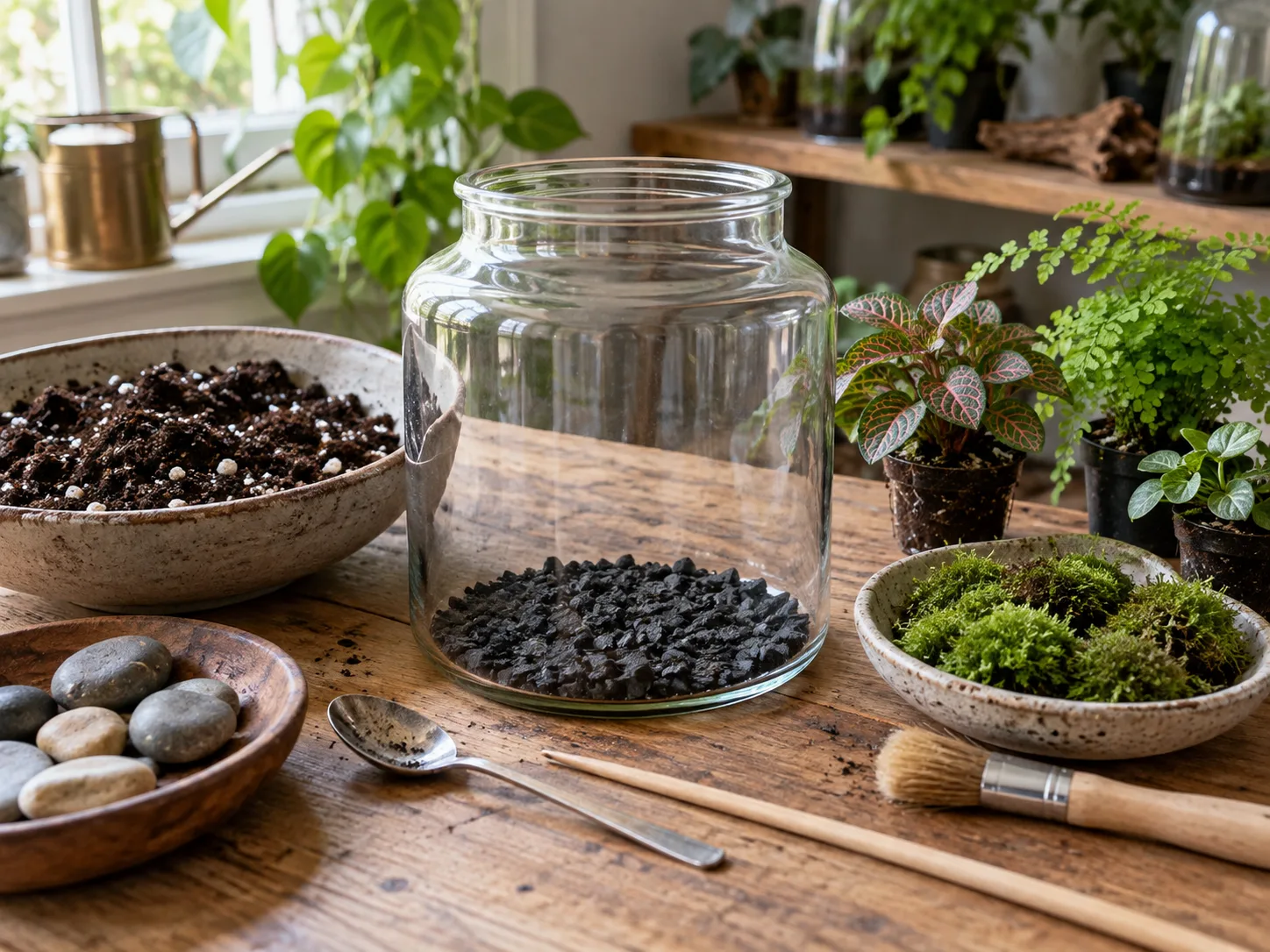
For a closed terrarium, begin with a shallow layer of horticultural charcoal if you want its dark texture and odor-absorbing role, then add just enough lightly damp soilless mix to cover the roots. Do not copy a deep “drainage base” automatically; Penn State’s guidance explains that rocks at the bottom do not improve drainage in this no-hole system, and water added to the jar cannot be poured out later.
For an open terrarium, a mineral layer can be useful as a visual boundary and may keep the planting mix from touching a decorative dish, but it still is not equivalent to a pot with a drainage hole. Use a gritty, fast-drying mix for succulents and cacti, and keep moisture-loving plants in a different container. Terrarium Tribe’s open-terrarium guide makes the same practical point from the other direction: arid plants need a soak-and-dry rhythm, not repeated misting.
Plant for airflow, access, and a good view
Test the composition outside the glass first. Put the focal plant in back or in the center, add a lower groundcover, then remove one item if the scene feels crowded. Plants should not be pressed against the glass, and a hand or long spoon should still be able to reach the back for cleanup.
Make a hole just large enough for each root ball, settle the plant at its original depth, and firm the mix without compacting it. Brush soil from leaves and glass before watering. For a closed jar, mist or add a few drops around the root zone rather than soaking the whole build; for an open succulent bowl, wet the mix thoroughly enough to reach roots, then let it dry completely before repeating.
A care routine based on what the glass tells you
A terrarium is low-maintenance, not maintenance-free. Give it a stable location, observe it weekly at first, and let the plants—not a calendar—tell you when to intervene. Bright indirect light is the safe starting point for most closed plantings; direct sun can heat the glass rapidly and damage both leaves and roots.
Read condensation, soil, and leaf posture
In a closed jar, a light veil of condensation that clears and returns is a good sign that the rain cycle is functioning. Heavy droplets running down all sides, permanently wet soil, a sour smell, or leaves that remain wet are signs to open the lid for a day or two and let excess moisture escape. If there is no condensation for several days, the soil is dry, and foliage is beginning to droop, add a small amount of water and observe again.
In an open design, check the soil at the depth where roots are growing. Succulents and cacti should dry between waterings; misting them repeatedly keeps the surface damp without giving the roots the useful soak-and-dry cycle they need. Air plants are a separate case: remove them from the vessel for watering and let them dry completely before putting them back, a handling sequence also described in the Oregon State Extension guidance published by Plant Something Oregon.
Rotate a terrarium occasionally if plants lean toward one window. Prune leaves that touch the glass, remove dead material promptly, and clean the outside with a soft cloth. A small brush can lift dust from stones without disturbing roots. Avoid spraying household cleaner near an open lid or into a closed container.
Troubleshoot mold, rot, legginess, and pests
Most terrarium failures are visible before they become fatal. The useful question is not only “what does this look like?” but “what changed the balance?” Too much water, too little light, incompatible plants, contaminated material, and poor access each require a different correction.
Correct excess moisture and stagnant air
Mold or algae: Open a closed container, remove dead leaves and visibly affected décor, and wipe the glass with a clean damp cloth. If the mold returns, the jar is probably too wet, too crowded, or too dim; increase air exchange, reduce water, and remove the fastest-growing plant if leaves are packed together.
Soft stems or black roots: Treat this as rot until proven otherwise. Lift the plant, cut away mushy material with clean scissors, and decide whether it belongs in a drier open setup or a fresh container. Do not keep watering a failing plant because the glass looks empty; wetness is often the cause, not the cure.
Leggy growth: Stretching means the plant is reaching for more light, though heat or a poor plant match can complicate the diagnosis. Move the terrarium to brighter indirect light, prune weak growth, and do not place it against a hot pane to “make up” for low light.
Fungus gnats or flying insects: Remove the affected plant if possible and inspect the soil and decaying material. Open terrariums can be monitored and treated as houseplants, but a closed jar gives you fewer safe control options; quarantine, sanitation, and correcting excess moisture are better first moves than spraying an enclosed ecosystem.
Reset plants that are declining
If one plant fails while the others look fine, remove it quickly. A sealed terrarium rewards early, decisive editing: take out the soft stem, replace contaminated mix around its root zone, and clean the glass before the problem spreads. When several plants decline together, dismantle the scene, wash the container, and rebuild with a smaller plant group matched to the actual light and moisture conditions.
Do not fertilize a new closed terrarium to accelerate growth. Fast growth is aesthetically satisfying for a few weeks but quickly consumes the headroom that keeps leaves away from the glass. If an established planting later shows genuine nutrient-related weakness after its light and roots are sound, use a very dilute fertilizer during active growth and accept that feeding may shorten the time before pruning or replacement.
Safety and the long-term life of a terrarium
Use stable, crack-free glass on a surface that can carry its weight. Large bowls become much heavier once filled with soil and stone, and hanging globes need secure hardware well away from a place where they could fall on people or pets. Keep sharp gravel, cactus spines, wire, and tiny removable ornaments out of a young child’s reach.
Choose decorations that are clean, nonporous, and free of flaking paint, fragrance residue, or unknown adhesives. A piece of stone, glass, or glazed ceramic is easier to wash than damp wood or porous craft material. If you have cats, dogs, birds, or children who may chew leaves, identify every plant independently before bringing it home; a terrarium is a display method, not a safety certification.
Expect a terrarium to change. Some plants are short-lived in a miniature container, vines may need trimming, and a once-balanced scene can become shaded as the tallest plant grows. Refreshing is not failure: remove the overgrown plant, preserve the strongest design element, and replant the container for the room and season you actually have.
Conclusion
The best terrarium idea is the one that matches a plant’s environment before it matches your décor. Start with a clear glass vessel, choose either a drying open system or a humid closed one, group plants with the same light and moisture needs, and leave enough room to observe and reach them.
Once you treat condensation, soil texture, leaf posture, and growth rate as useful signals, the glass stops being a mystery. It becomes a small, readable garden—one you can shape with moss, stone, driftwood, geometry, or a single beautiful plant while keeping the living part healthy.