How to Grow and Care for African Violets
Grow African violets indoors with the right light, bottom watering, airy soil, and small pots—plus propagation, repotting, and bloom fixes.
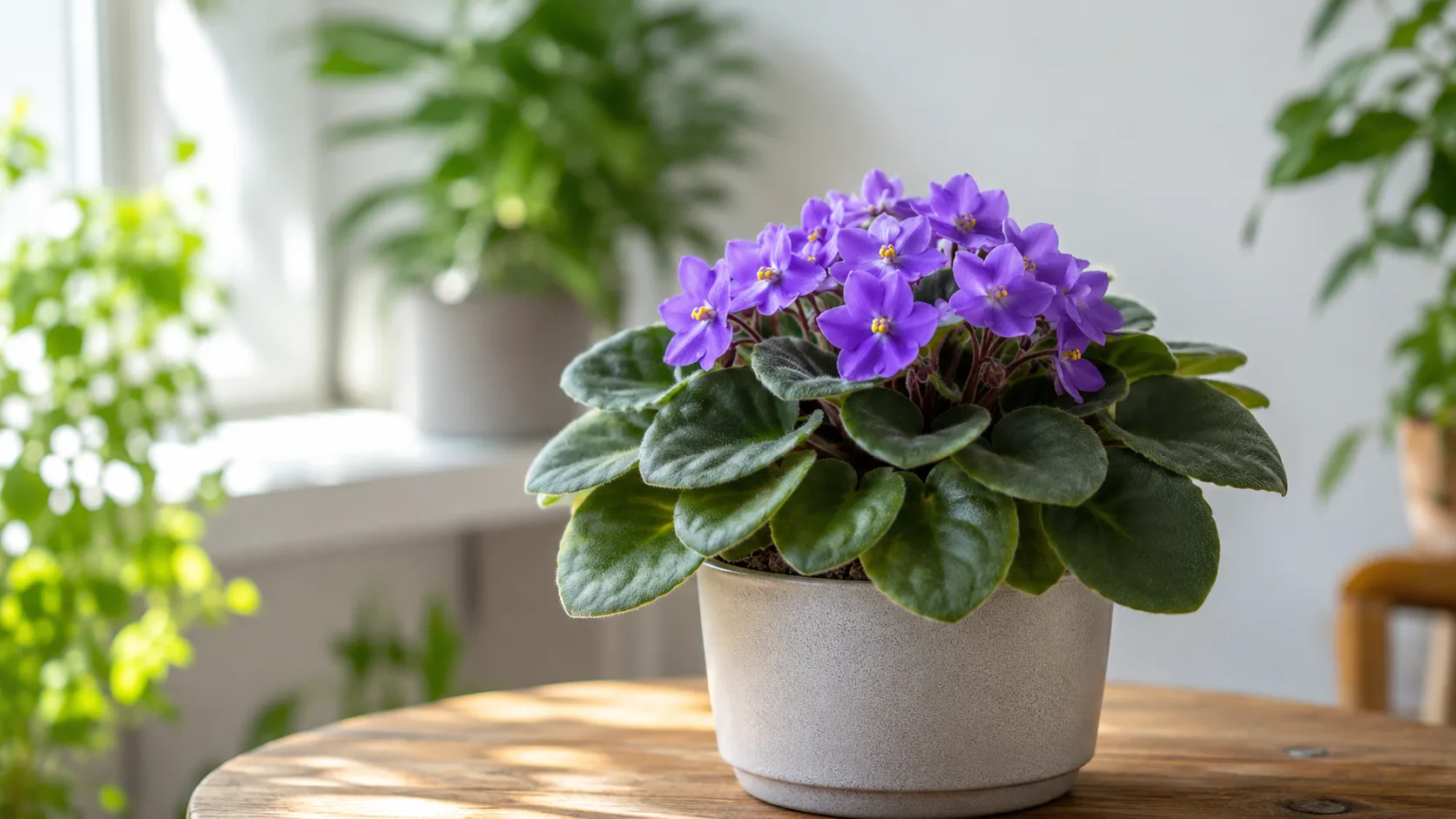
An African violet in bloom looks like a tiny bouquet tucked into a fuzzy rosette—compact, colorful, and surprisingly long-lived when you treat it as a flowering houseplant, not a generic foliage pot. The species most people grow, now classified as Streptocarpus ionanthus (formerly Saintpaulia ionantha), comes from cloud-forest conditions in Tanzania and Kenya. Indoors, that translates to bright filtered light, evenly moist but airy soil, warm stable air, and leaves that stay dry. Get those basics right and an African violet can bloom off and on for years; miss them and you get leggy stems, permanent leaf spots, or a rotting crown that no amount of bloom booster will fix.
African Violet Quick Reference
Use this table before you change multiple variables at once. African violets punish stacked fixes—new pot, new window, and extra fertilizer in the same week usually makes diagnosis harder, not easier.
| Factor | Indoor target | Common mistake |
|---|---|---|
| Light | Bright indirect; 10–16 hr/day | Dim shelf survival without blooms |
| Water | Room-temp; top ½ in. dry between drinks | Cold splash on leaves → ring spot |
| Soil | Light African violet mix; pH ~6.0–6.5 | Heavy all-purpose mix that stays wet |
| Pot | Small with drainage; ~⅓ leaf span wide | Oversized pot → soggy roots, no flowers |
| Temperature | 65–75°F days; not below 60°F | Cold glass contact or hot drafts |
| Humidity | 40–60%; pebble tray or humidifier | Misting fuzzy leaves |
| Fertilizer | Dilute balanced feed when actively growing | Full-strength feed on stressed plant |
| Pets | Non-toxic to cats and dogs (ASPCA) | Assuming “safe” means chew-proof |
For deeper single-topic schedules, the African violet plant hub breaks care into light, watering, soil, fertilizer, repotting, propagation, and pruning pages when one factor—not the whole plant—needs attention.
What African Violets Need to Thrive Indoors
African violets are slow-growing rosettes with thick, hairy leaves and flowers that emerge from the center crown. Mature plants typically reach 6–9 inches across in standard sizes, though miniatures stay under 6 inches and large standards can exceed 12 inches. NC State Extension notes they belong to Gesneriaceae, the same family as gloxinias and streptocarpus, which explains why they want steady moisture in the root zone but hate wet crowns and leaves. (NC State Extension)
The mental model that unlocks most care: roots need air and moisture at the same time. Dense, constantly saturated soil suffocates fine roots even if the leaves still look fine for a week. That is why pot size, mix texture, and drain time matter as much as how often you water. Smithsonian Gardens emphasizes keeping the crown slightly above the soil line and never burying it deeper at repot—buried crowns are a fast route to stem rot. (Smithsonian Gardens)
Gift-shop plants are often force-bloomed under greenhouse light and humidity. At home, expect the first flush to finish; your job is to transition into steady culture and set up the next bloom cycle rather than chasing perpetual flowers with extra water.
Light for Compact Leaves and Steady Blooms
Insufficient light is the number-one reason African violets fail to flower. UGA Extension reports that roughly 1,000 foot-candles for 6–8 hours daily supports good growth and bloom—similar to a bright east or west window or a bank of fluorescent shop lights. (UGA Extension) Too little light produces dark green, thin leaves on long weak petioles and few or no buds. Too much direct sun bleaches leaves yellow-green or burns patches outright.
Healthy foliage in low light can mislead beginners: the plant looks “fine” while quietly refusing to bloom. Fix light before fertilizer whenever leaves are green but flowerless.
Window placement and seasonal shifts
East windows are the safest default in most homes—morning sun is bright but gentler than afternoon rays. North windows work only if the room is bright; hold your hand above the plant at midday and look for a soft shadow. No shadow usually means bloom trouble ahead.
South and west windows need filtering in spring and summer. A sheer curtain diffuses intensity and protects leaves from hot glass. UGA Extension recommends shifting exposure seasonally: south or west windows often perform best in winter when the sun is lower, while east or north exposures can be safer during hotter months. (UGA Extension)
Keep rosettes pulled back from cold glass in winter. Leaves touching a freezing pane can curl, cup, or develop brittle edges even when room air feels comfortable.
Fluorescent and LED grow lights
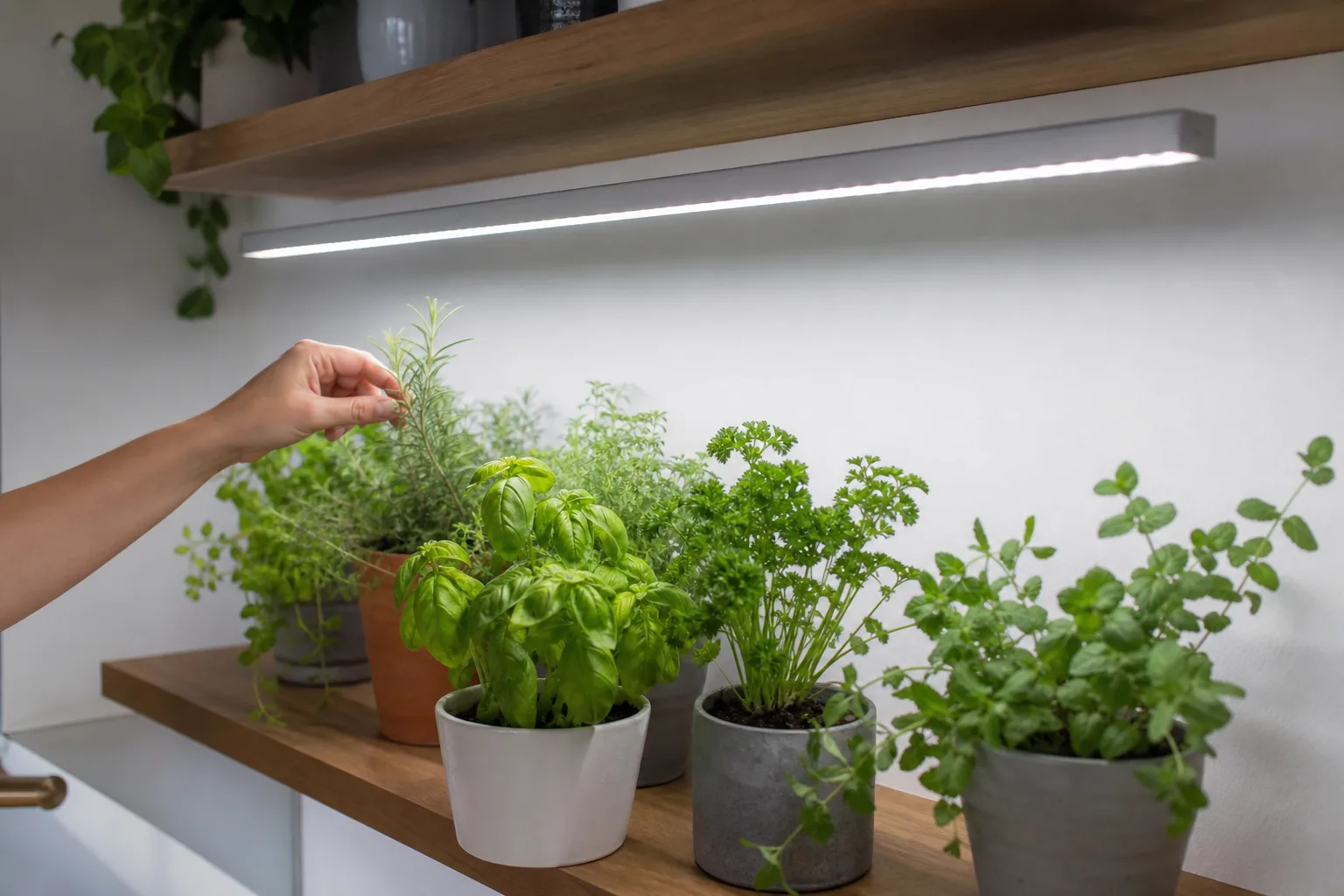
When window light is weak or inconsistent, artificial light is reliable. UGA Extension recommends about 600 foot-candles for 14–16 hours daily under fluorescents, with tubes 12–15 inches above the leaf tops. Inexpensive cool white fluorescent shop tubes work well; plant-specific tubes emit a spectrum weighted for photosynthesis but are not mandatory for success. (UGA Extension)
Cornell Cooperative Extension suggests a similar setup: two 40-watt fluorescent tubes roughly 12 inches above plants for 12–14 hours using a timer. (Cornell Cooperative Extension) UF/IFAS adds that African violets also need a dark period—continuous light stresses them. (UF/IFAS)
Modern full-spectrum LED grow bulbs can substitute if you match intensity and distance; watch for leaf bleaching and raise the fixture if centers tighten or leaves pale.
Soil, Pot Size, and Drainage
African violets need a light, porous, sterile mix that holds moisture without collapsing into mud. UF/IFAS targets pH 6.0–6.5 and recommends commercial African violet mix or a blend of peat, vermiculite, and perlite. (UF/IFAS) UGA Extension notes that coarse, well-drained mixes dry faster and need more frequent watering than heavy blends—another reason to match watering checks to your actual mix, not a calendar.
Pot size drives bloom timing. Smithsonian Gardens and multiple extension guides agree that violets flower best when slightly root-bound in a small pot. A practical rule: choose a container about one-third the diameter of the leaf span, always with a drainage hole. An oversized pot surrounds small roots with wet soil, delaying flowers and inviting rot.
Never use pots without drainage for long-term culture. Decorative cachepots are fine only if the inner pot lifts out and drains fully after every watering.
When repotting, set the plant so the crown sits just above the soil—roughly ¼–½ inch below the rim—and firm mix gently around the old root ball without burying the stem. For mix recipes and refresh timing, see the African violet soil guide.
Watering Rules That Prevent Ring Spot and Crown Rot
Watering is where African violet care succeeds or fails in most homes. Aim for even moisture, not alternately flooded and bone dry. Touch the surface: when the top ½ inch feels slightly dry and the pot feels lighter, it is time to water. University of Minnesota Extension warns that a plant can look wilted while soil is still wet—a sign of root rot, not thirst. Adding more water makes that worse. (University of Minnesota Extension)
Two non-negotiables protect the foliage:
Keep water off fuzzy leaves. Cold or even room-temperature splashes on warm leaves cause ring spot—permanent pale green or tan rings. UGA Extension notes damage can occur when leaf and water temperatures differ by as little as 10°F, and water below 55°F is especially risky. (UGA Extension) Always use room-temperature water.
Never leave the pot sitting in drained water. Roots need air. Empty saucers within 20–30 minutes after watering.
Bottom watering without drowning roots
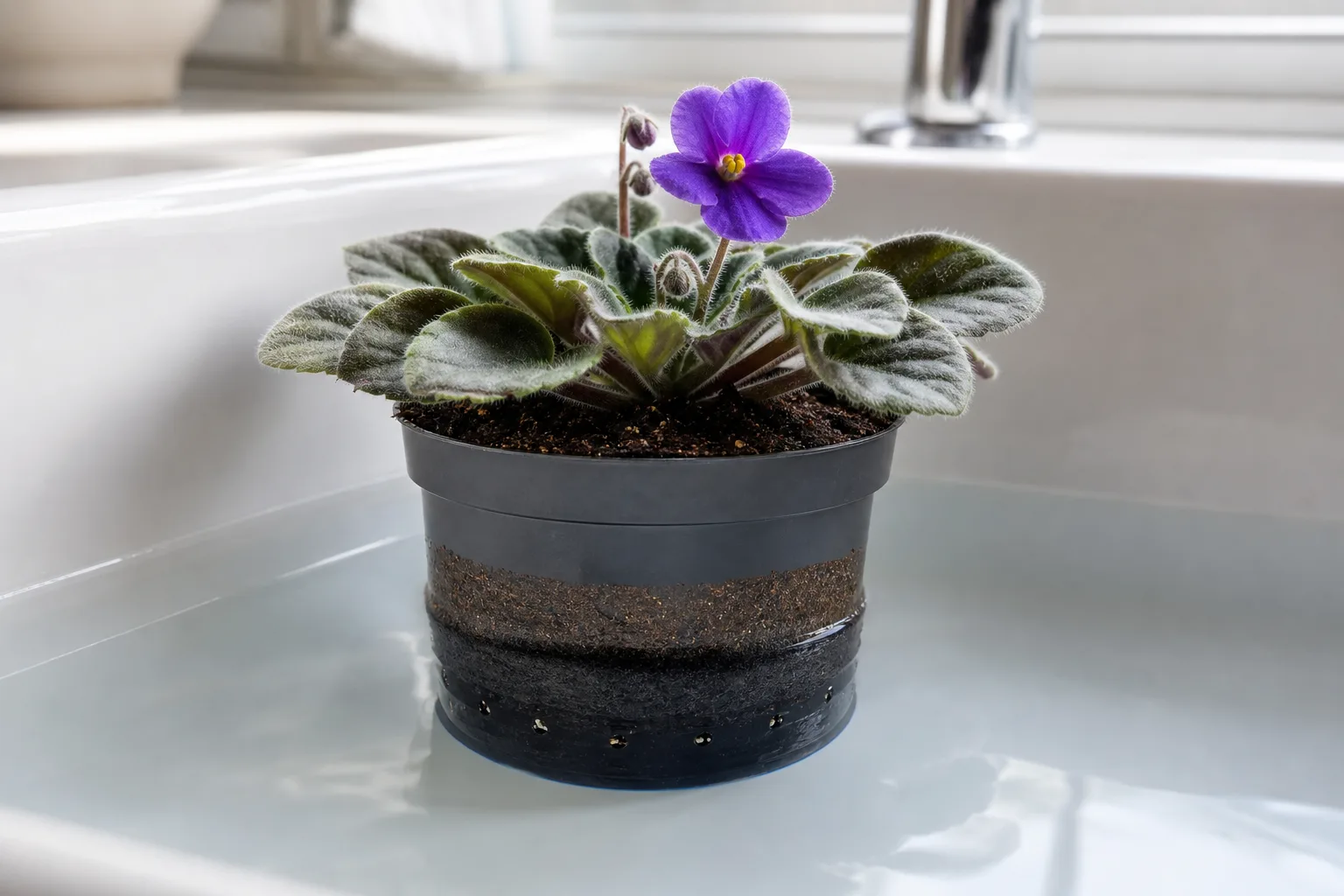
Bottom watering—setting the pot in a shallow tray of water until the surface darkens—keeps leaves dry and is the method most violet growers prefer for routine care. Soak 15–30 minutes, then lift the pot out and drain completely. Smithsonian Gardens caps bottom watering at about 30 minutes for the same reason. (Smithsonian Gardens)
Bottom watering alone does not leach salts that accumulate from fertilizer and tap water. UGA Extension recommends occasional top watering with warm water until it runs through the drainage hole, then discarding the excess—roughly monthly in many homes. Cornell CCE describes a similar salt flush when crust appears on soil or leaf edges brown from buildup. (Cornell Cooperative Extension)
Wicking or self-watering systems can work if the reservoir never keeps the mix saturated. If the center crown stays wet or algae grows on the surface, revert to manual bottom watering until roots recover.
Temperature, Humidity, and Air Movement
African violets prefer warm, stable indoor conditions. UGA Extension lists ideal nights at 65–70°F and days at 70–90°F, with deformation below 60°F—cupped, brittle leaves and discolored flowers. (UGA Extension) Cornell CCE narrows the sweet spot many homes hit naturally to 65–75°F. (Cornell Cooperative Extension)
Avoid hot or cold drafts from HVAC vents, exterior doors, and radiators. Leaves rubbing a cold window pane show injury even when the thermostat reads 72°F.
Humidity near 40–60% supports best growth. Average homes are often lower in winter; pebble trays (pot above the water line), grouping plants, or a small humidifier raise ambient moisture without wetting leaves.
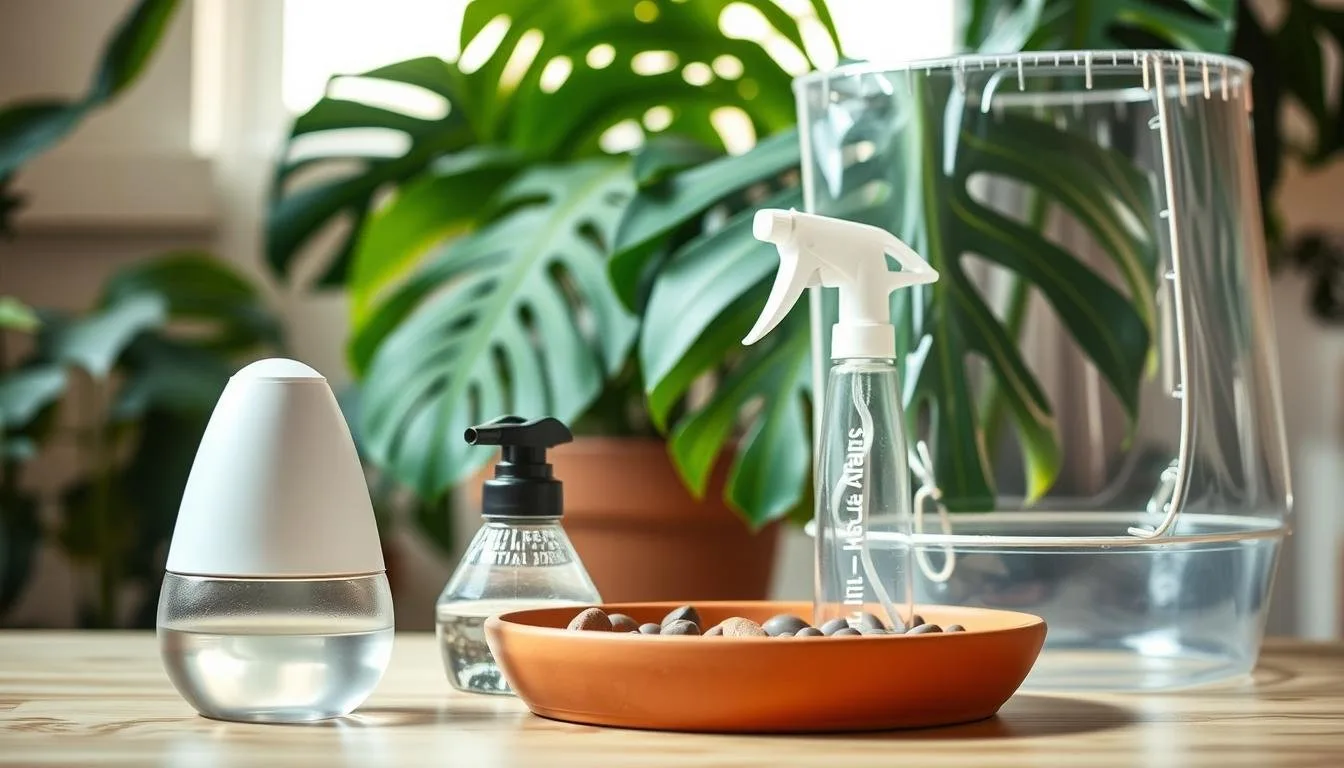 Do not mist African violets—water droplets on fuzz cause spots and do little to change room humidity.
Good air circulation reduces botrytis on spent flowers and crowded leaves. A gentle room fan or occasional space between plants helps, but avoid blasting dry heat directly onto rosettes.
Fertilizer Without Salt Damage
Feed only when the plant is actively growing and healthy—not when recovering from rot, repot shock, or pest damage. UGA Extension suggests liquid 20-20-20 or African violet formulas every four to six weeks, while many hobbyists use one-third to one-half label strength because violets are sensitive to soluble salt buildup. (UGA Extension)
UF/IFAS recommends a balanced soluble fertilizer at ¼ teaspoon per gallon during active growth, applied to moist soil. (UF/IFAS) Dry fertilizers are usable on moist mix only; never scatter them on dry roots.
Signs of excess salt include tight crowns, crust on soil, and brown leaf margins. Flush with plain water before resuming feed at lower strength. Skip fertilizer entirely on newly rooted cuttings for the first few months; UGA Extension mixes a small amount into soil only when potting mature divisions into larger containers. (UGA Extension)
Types of African Violets Worth Knowing
Breeding has exploded beyond the classic purple single. Knowing size class helps you pick pots, light distance, and shelf space before you buy.
Miniatures stay under 6 inches and suit windowsill trays and terrarium-style displays. Semi-miniatures and standards fill a 4-inch pot at maturity; large standards need more horizontal space and stronger light to bloom proportionally.
Flower forms include single, semi-double, double, and frilled edges; chimera varieties show pinwheel streaking and propagate true only from suckers, not leaf cuttings. Foliage ranges from plain green to variegated white-and-green, which often needs slightly gentler light to avoid pink or bleached patches.
Named cultivars such as ‘Persian Prince’ (miniature purple semi-double), ‘Lyon’s Lavender Magic’ (lavender star), and ‘Summer Twilight’ (variegated leaves with frilled lilac blooms) illustrate how different shapes can be—but local club sales and grocery labels may use trade names instead. Buy for plant health and size class, not label rarity.
Trailing multi-crown types behave like small hanging baskets; they need more frequent division and stronger air movement than single-crown rosettes.
Propagation by Leaf Cuttings and Suckers
African violets are easy to propagate, which is part of their long-term appeal. A flowering plant from a leaf cutting typically takes about 10 months under good conditions; suckers and divisions reach bloom faster.
Leaf-petiole method: Choose a healthy mature leaf from the middle or lower row. Cut the petiole at a 45-degree angle to about ½ inch length. Insert the petiole into moist vermiculite, perlite, or a 50/50 peat-perlite mix. UF/IFAS describes rooting in water or moist media covered loosely to maintain humidity. (UF/IFAS) UGA Extension’s low-maintenance box method—overlapping leaves in a sealed clear container in bright indirect light—produces plantlets in 8–10 weeks, ready to separate in about three months. (UGA Extension)
Suckers are small plantlets that emerge beside the main crown. Remove them when they have several leaves, pot separately, and the parent often blooms more vigorously with one dominant crown. Chimera varieties must be propagated from suckers to preserve flower pattern.
Seed propagation is possible but most hybrids do not come true from seed; treat seed as a fun experiment, not a clone guarantee.
Full step-by-step timing lives on the African violet propagation guide.
Repotting and Re-rooting a Long Neck
Repot only when needed—usually every 12–18 months for active plants, or when you see a “neck” of bare stem below the rosette, roots circling the surface, or repeated wilting despite correct watering. African violets tolerate repot during bloom; waiting for flowers to finish is optional, not required.
Move up one pot size at most. Remove the plant gently, trim dead outer leaves, and scrape lightly if a corky neck has formed. Re-set the rosette so fresh mix covers the bare stem and the crown sits at the correct height. Some growers re-root from a neck slice—cutting the stem, scraping callus, and burying it like a new cutting—when a plant has grown tall and leggy over years.
After repot, keep humidity slightly higher and hold fertilizer until new center growth looks firm. See the repotting guide for neck-depth diagrams and mix-in-fertilizer rules.
Pests, Diseases, and When to Discard
Mealybugs show as white cottony masses in crowns and leaf axils; isolate and treat early with insecticidal soap or horticultural oil on leaf undersides, repeating weekly until clear. Spider mites cause stippling and fine webbing—shake a leaf over white paper to confirm. Aphids cluster on new growth and flower buds.
Cyclamen mites are the serious outlier: microscopic feeders that distort the center growth into tight, hairy, twisted leaves. By the time damage is obvious, the crown is often unsalvageable. UGA Extension’s practical advice matches what most growers do—discard the plant and sterilize the area rather than fighting a hidden mite colony in fuzzy leaf crevices. (UGA Extension)
Botrytis blight appears as gray mold on spent flowers and injured tissue; remove affected parts, improve air flow, and avoid wet crowns. Crown and root rot from overwatering or buried stems causes sudden wilting with wet soil—often terminal unless caught very early. Clemson HGIC summarizes cultural controls: sterile mix, drainage, and avoiding overhead water. (Clemson HGIC)
Quarantine new purchases for two weeks before placing them near collection plants.
Troubleshooting No Blooms and Leaf Spots
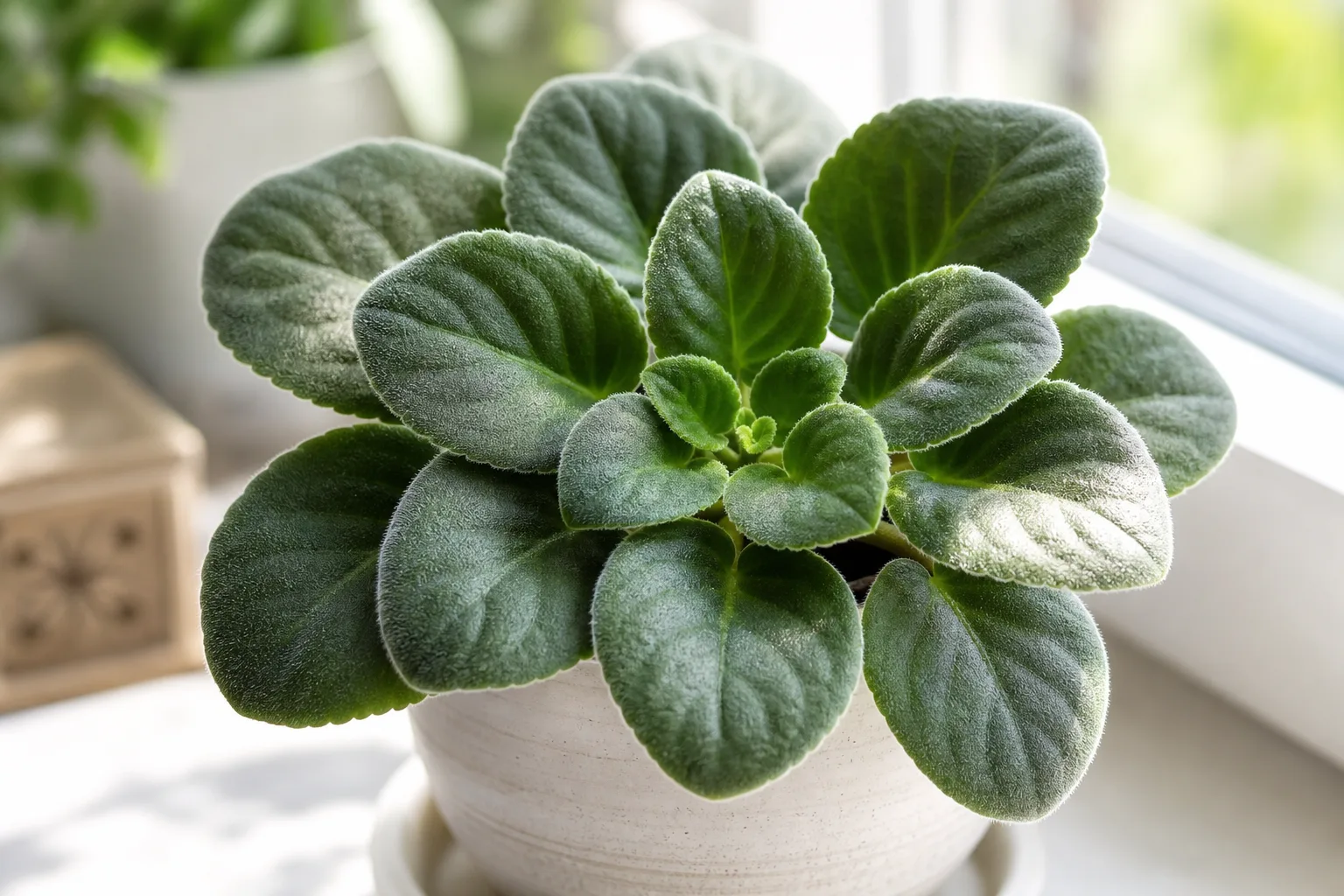
No flowers usually traces to one of four causes, in this order: too little light, oversized wet pot, missing dark period under grow lights, or root stress from rot or extreme dryness. Move to brighter filtered light or add timed fluorescents for 12–16 hours, confirm the pot is appropriately small, and inspect roots before increasing fertilizer.
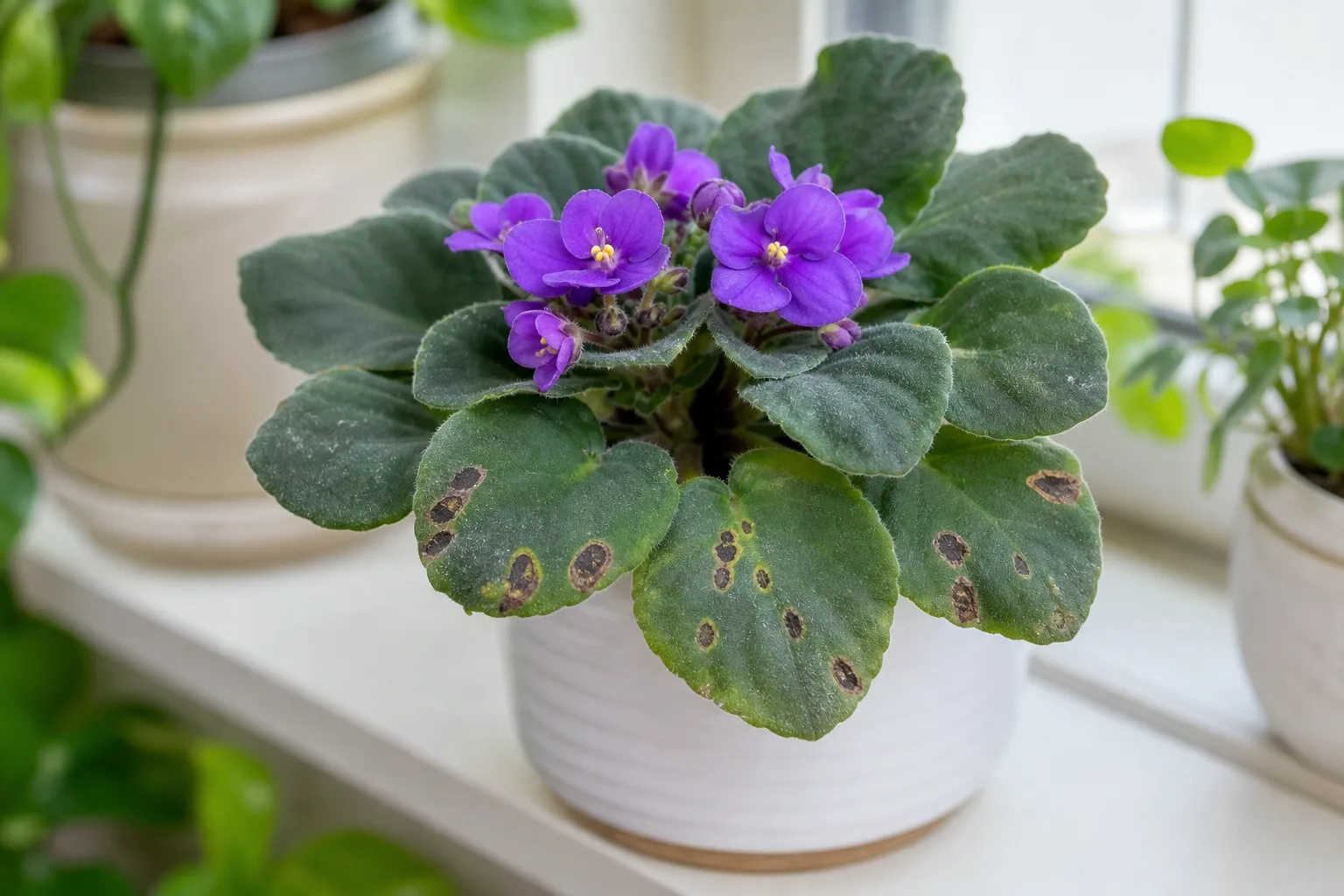
Ring spot and tan patches on leaves mean water or condensation touched foliage—often cold tap water, splash from top watering, or misting. Switch methods; existing marks permanent, but new growth stays clean once leaves stay dry.
Leggy long petioles mean stretch for light—move closer to the window or lower the grow light, rotating the pot weekly for even growth.
Crown rot shows as a soft, collapsed center while outer leaves still green briefly. Stop watering, discard if mushy, or try to salvage unattached side suckers that remain firm.
Yellow lower leaves can be normal aging—remove gently—or signal overwatering, cold damage, or nitrogen imbalance. Check moisture and temperature before feeding.
For symptom-specific fixes, browse African violet plant problems starting with no flowers, black spots, and crown rot pages.
Buying Your First African Violet
At the store, choose plants with firm, symmetrical rosettes, no brown spots on leaves, and no sticky residue or webbing underneath. A few open flowers plus visible buds beats a plant fully finished blooming with none coming.
Read the label for size class so you do not repot immediately into a giant container. Avoid pots wrapped in foil that trap water unless you punch drainage or remove the wrap the first day home.
Pet note: ASPCA lists African violet as non-toxic to dogs, cats, and horses. (ASPCA) That does not make leaves a snack—keep pots off curious pet routes and clean fallen blooms.
Bring new plants home to bright indirect light, skip fertilizer for the first month, and learn your watering rhythm before repotting.
Conclusion
African violets look fussy because they punish wet leaves, cold water, oversized pots, and dim corners—not because they need exotic equipment. Give them bright filtered light or timed fluorescents, a small draining pot in light mix, room-temperature bottom watering with occasional salt flush, warm stable air, and gentle fertilizer when growth is strong. Remove spent blooms, divide suckers when crowns crowd, and repot before necks grow long. Do that consistently and a single plant can bloom repeatedly for decades. When something fails, fix light and roots first, then adjust water and feed—and use the African violet hub for deeper single-topic help without starting over from scratch.