How to Grow and Care for Maidenhair Fern Indoors
Grow maidenhair fern indoors with even moisture, high humidity, bright indirect light, and pot-weight checks that stop overnight collapse.
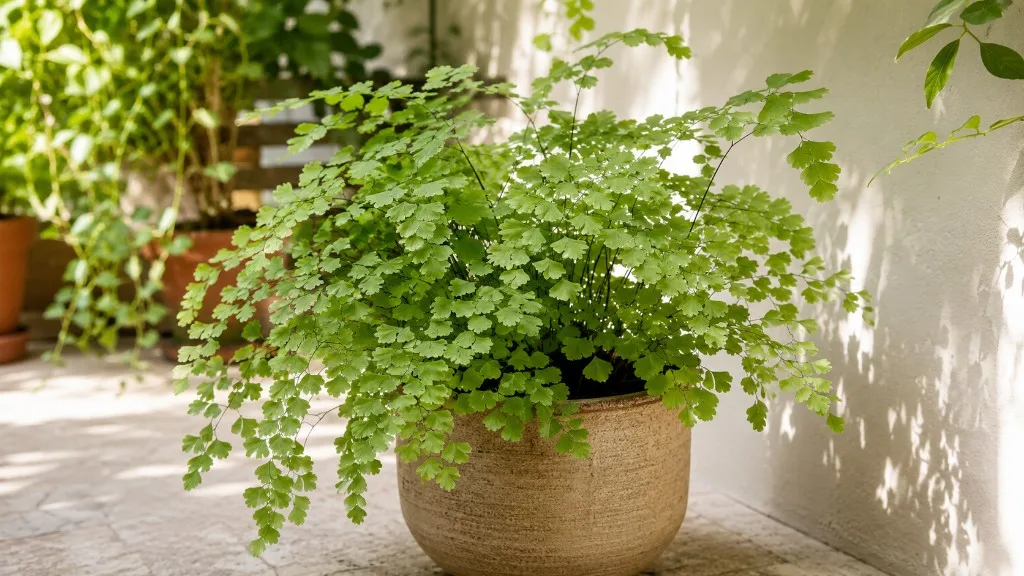
Maidenhair fern looks like it belongs in a watercolor—fan-shaped leaflets on glossy black stems, layered so fine you can see light through them. That beauty comes with a reputation: the plant collapses fast when soil or air dries out, and it will not wait politely for your weekend watering routine. The species sold in most houseplant shops, Adiantum raddianum (delta maidenhair fern), evolved beside moist rock and spray in the Tropical Americas and West Indies, where roots never go bone dry and humidity stays high. Your living room, especially in winter, is the opposite environment. Indoor maidenhair fern care is less about memorizing rules and more about building a stable moisture-and-humidity system around a thin-leaved fern that loses water to the air faster than thick succulents ever will.
This guide covers what you are growing, whether your home can support it, and the placement, watering, humidity, soil, temperature, feeding, repotting, and propagation steps that keep Adiantum lush. When fronds brown, yellow, curl, or drop overnight, you will get a first-action troubleshooting order—not a vague “water more” loop—and a revival path if the rhizome is still alive.
Maidenhair Fern Quick Reference
Use this table as a checkpoint before you change multiple variables at once. Ferns punish stacked mistakes.
| Factor | Indoor target | First sign you missed it |
|---|---|---|
| Light | Bright indirect; gentle morning sun OK | Bleached or scorched fronds = too much sun; sparse pale growth = too dim |
| Water | Evenly moist mix; never bone dry | Pot feels light; fronds limp by evening |
| Humidity | 60–80% ideal; ~50% minimum | Crispy edges with “correct” watering |
| Soil | Moist-retentive but drains freely | Soggy smell, black crown = rot |
| Temperature | Roughly 65–75°F days; avoid cold snaps | Below ~60°F slows growth; drafts crisp tips |
| Fertilizer | Light feed Mar–Sep if needed; skip in winter | Tip burn after heavy nitrogen |
| Pets | True Adiantum generally non-toxic | Do not confuse with toxic asparagus “fern” |
| Outdoor zones | USDA 10–11 for A. raddianum | Invasive risk in Hawaii—avoid outdoor planting there |
For topic-specific schedules, the maidenhair fern plant hub breaks care into light, watering, soil, fertilizer, repotting, propagation, and pruning pages when one factor—not the whole plant—needs attention.
What You Are Actually Growing (Adiantum raddianum and Lookalikes)
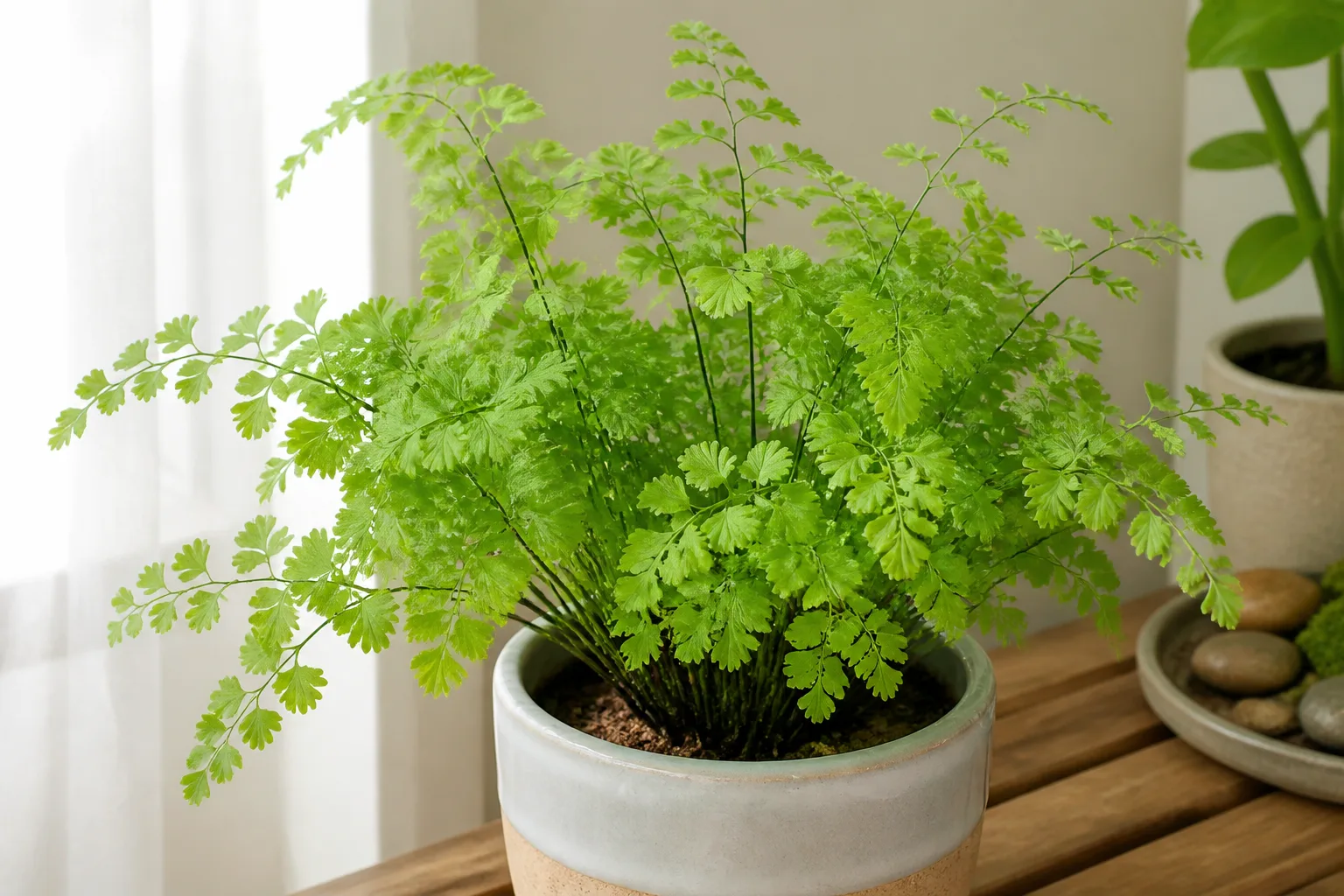
Maidenhair fern is a common name for several species in the genus Adiantum, in the Pteridaceae family. The NC State Extension Gardener Plant Toolbox describes Adiantum raddianum as a herbaceous perennial with creeping rhizomes, delicate lace-like fronds, and a soft fragrance—tags include high maintenance and humidity tolerant, which tells you the plant can handle humid air but not neglect. (NC State Extension) The genus name comes from Greek adiantos, meaning unwetted, because water beads on the leaf surface rather than soaking in—which is why misting the fronds feels productive and barely helps.
Unlike the popular asparagus “fern” (which is not a fern and is toxic to pets per ASPCA listings), maidenhair is a true fern. It reproduces by spores on frond undersides and spreads in nature by rhizomes—the same structure you divide when propagating at home. Missouri Botanical Garden notes A. raddianum as perhaps the most commonly grown non-hardy maidenhair, with triangular fronds on dark stipes, typically reaching about 12 inches wide and 18 inches long in cultivation, on a plant 1–2 feet tall and wide. (Missouri Botanical Garden)
Delta Maidenhair vs Other Common Adiantum Species
Shop labels often say only “maidenhair fern.” Care overlaps, but hardiness and size expectations differ if you move plants outdoors.
| Species | Common name | Typical use | Notes |
|---|---|---|---|
| Adiantum raddianum | Delta / trailing maidenhair | Indoor pots | Reference species for this guide; USDA 10–11 |
| Adiantum pedatum | Northern maidenhair | Shade gardens (temperate) | Native to eastern North America; hardy farther north |
| Adiantum aleuticum | Western maidenhair | Cool moist sites | Often near waterfall spray in the wild |
| Adiantum capillus-veneris | Southern / Venus maidenhair | Temperate to tropical regions | Delicate; similar indoor moisture needs |
The RHS lists A. raddianum for moist but well-drained culture in bright indirect light, with free watering in the growing season and sparing water in winter, plus high humidity. (RHS) If your tag says Fragrans or Microphyllum, you still have an Adiantum raddianum cultivar—same indoor playbook.
Outdoor caution: CABI Compendium documents Adiantum raddianum as invasive in Hawaii. Do not plant it outdoors in frost-free tropical climates where escape is a risk. Indoors in pots, that is not your problem—but it is a reason not to “set it free” in a warm yard.
Is Maidenhair Fern Right for Your Home?
Honest self-assessment saves money and guilt. Maidenhair rewards growers who can supply stable moisture and humidity, not perfect intentions.
Good fit if you:
- Have a bright bathroom, kitchen, or terrarium spot—or will run a cool-mist humidifier daily in winter
- Check soil moisture every few days without treating it as a chore
- Prefer a challenge plant with pet-safe foliage (true Adiantum is generally listed as non-toxic, unlike asparagus “fern”)
- Enjoy fine texture and do not need a plant that forgives a two-week vacation drought
Poor fit if you:
- Keep the thermostat high and humidity below 40% all winter with no humidifier plan
- Water on a fixed calendar without touching the pot
- Need a plant for a hot south window with afternoon sun blasting the glass
- Want set-and-forget care like a snake plant or ZZ plant
Clemson Cooperative Extension groups maidenhair-type ferns among delicate indoor ferns that need high humidity—around 50% or higher—and consistent moisture without waterlogging. (Clemson HGIC) That is achievable in normal homes, but not in every room.
Light and Window Placement Without Scorch or Stall
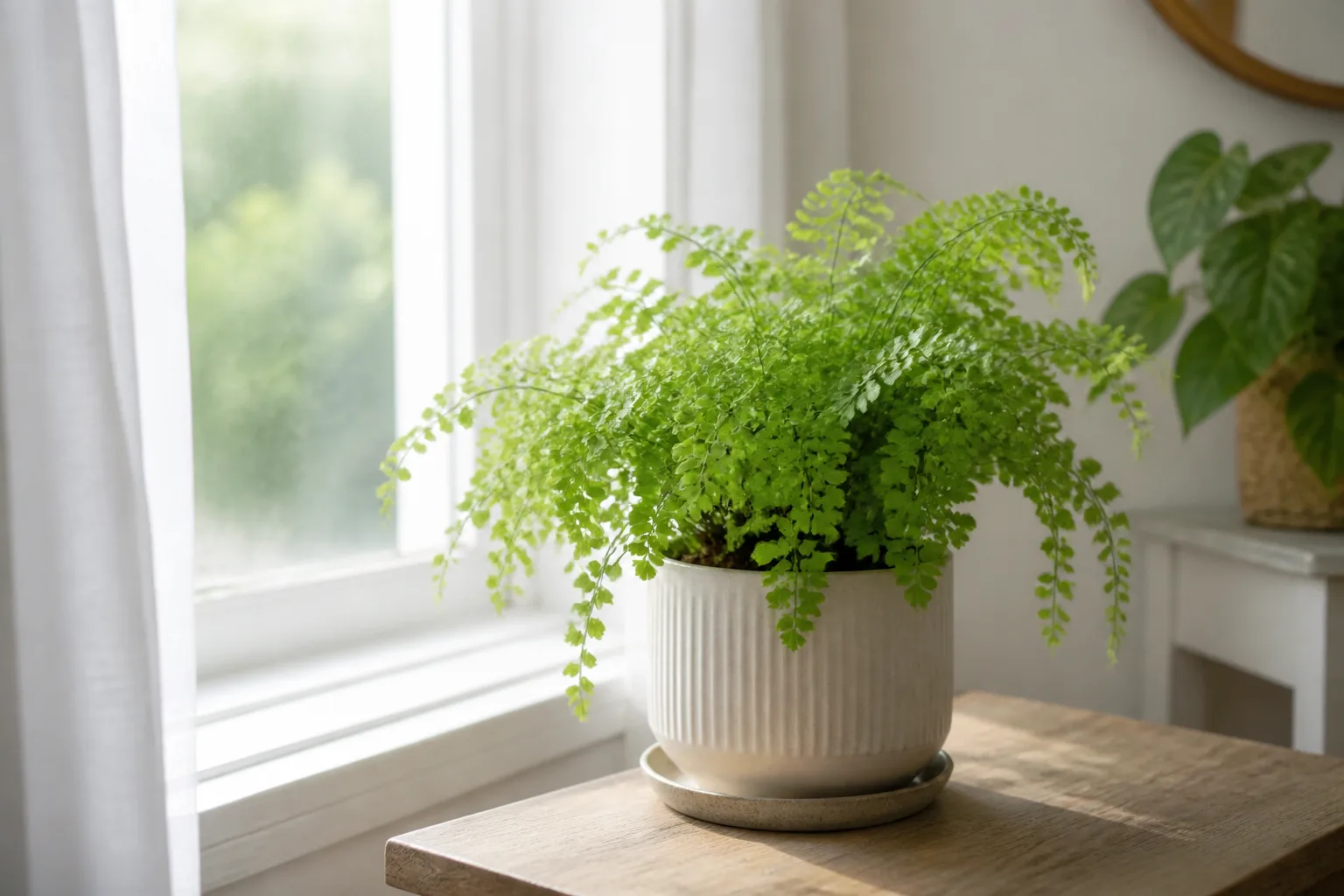
Maidenhair wants bright indirect light, the kind a forest floor gets through a canopy—not direct beams that cook thin leaflets. NC State lists partial shade to shade, noting the plant loses vitality in too much shade or full sun. (NC State Extension) Missouri Botanical Garden recommends part shade to full shade indoors with no direct sun, and warns that cold drafts damage fronds. (Missouri Botanical Garden)
Practical placement:
- East-facing windows are often ideal: gentle morning sun, softer afternoon.
- North-facing windows work if the room is not dim; watch for sparse, pale fronds.
- West- and south-facing windows need several feet of setback or a sheer curtain—hot afternoon sun scorches leaflets fast.
- Grow lights: Full-spectrum LED, 10–14 inches above fronds, ~12–14 hours daily if natural light is weak. Bleached or crisp tips on the light-facing side mean move the lamp farther or shorten photoperiod.
Too little light produces leggy, sparse fronds; too much produces bleached or brown scorched patches. Adjust one variable—distance from glass or curtain thickness—and wait two weeks before moving again. Ferns hate shuffle stress.
Watering Maidenhair Fern Without Rot or Drought Collapse
The core rule is simple and unforgiving: keep the root zone evenly moist; never let the whole ball go bone dry. NC State is explicit that roots should not be allowed to dry out. (NC State Extension) UF/IFAS notes many tropical ferns cannot tolerate drought and suffer quickly when soil dries completely. (UF/IFAS EDIS)
That does not mean soggy soil 24/7. Waterlogging drives root rot, especially in cool rooms. The goal is moist like a wrung sponge, with excess draining out the hole.
How to water:
- Use room-temperature water. University of Minnesota Extension recommends lukewarm or room-temperature water for tropical ferns and notes fluoride and chlorine in tap water can damage sensitive species—rainwater, distilled, or filtered water helps if tips brown despite good humidity. (UMN Extension)
- Water until a little runs from the drainage hole.
- Empty the saucer within 30 minutes. Never let the pot sit in standing water.
- In active growth (spring–summer), check every 2–3 days; in winter, every 5–7 days—but only as a reminder to check, not as automatic watering.
The Pot-Weight Test and Top-Inch Check
Calendar watering kills maidenhair ferns. Use two physical checks instead:
- Top-inch test: When the top 1 cm (⅜ inch) feels barely dry to the touch, water. If the surface is still cool and damp, wait.
- Pot-weight test: Lift the pot after a thorough watering—that heft is your “well watered” baseline. When the pot feels noticeably lighter and the top inch is dry, water again. A light pot plus limp fronds means you already crossed into drought stress.
If fronds collapse in a day, you likely let the root ball dry once too often—not that the plant ” hates you.” Correct moisture and humidity; new croziers (coiled new fronds) can emerge from a firm rhizome in weeks.
Humidity That Actually Works Indoors
Heated indoor air often sits at 30–40% relative humidity in winter. Maidenhair wants roughly 50% minimum, with 60–80% for lush unfurling, per RHS and Clemson indoor-fern guidance. (RHS; Clemson HGIC) Because Adiantum leaflets shed mist droplets instead of absorbing them, occasional misting is cosmetic, not a humidity strategy.
Ranked by reliability:
- Cool-mist humidifier within a few feet of the plant, run enough to keep a hygrometer near the fronds at or above ~50%. Clean the tank weekly to prevent mold blowback onto foliage.
- Bright bathroom where shower steam raises humidity regularly—if light is still bright indirect, not a dark corner.
- Closed or mostly closed terrarium for small specimens. UMN Extension notes terrariums act as mini-greenhouses that hold humidity for sensitive houseplants. (UMN Extension)
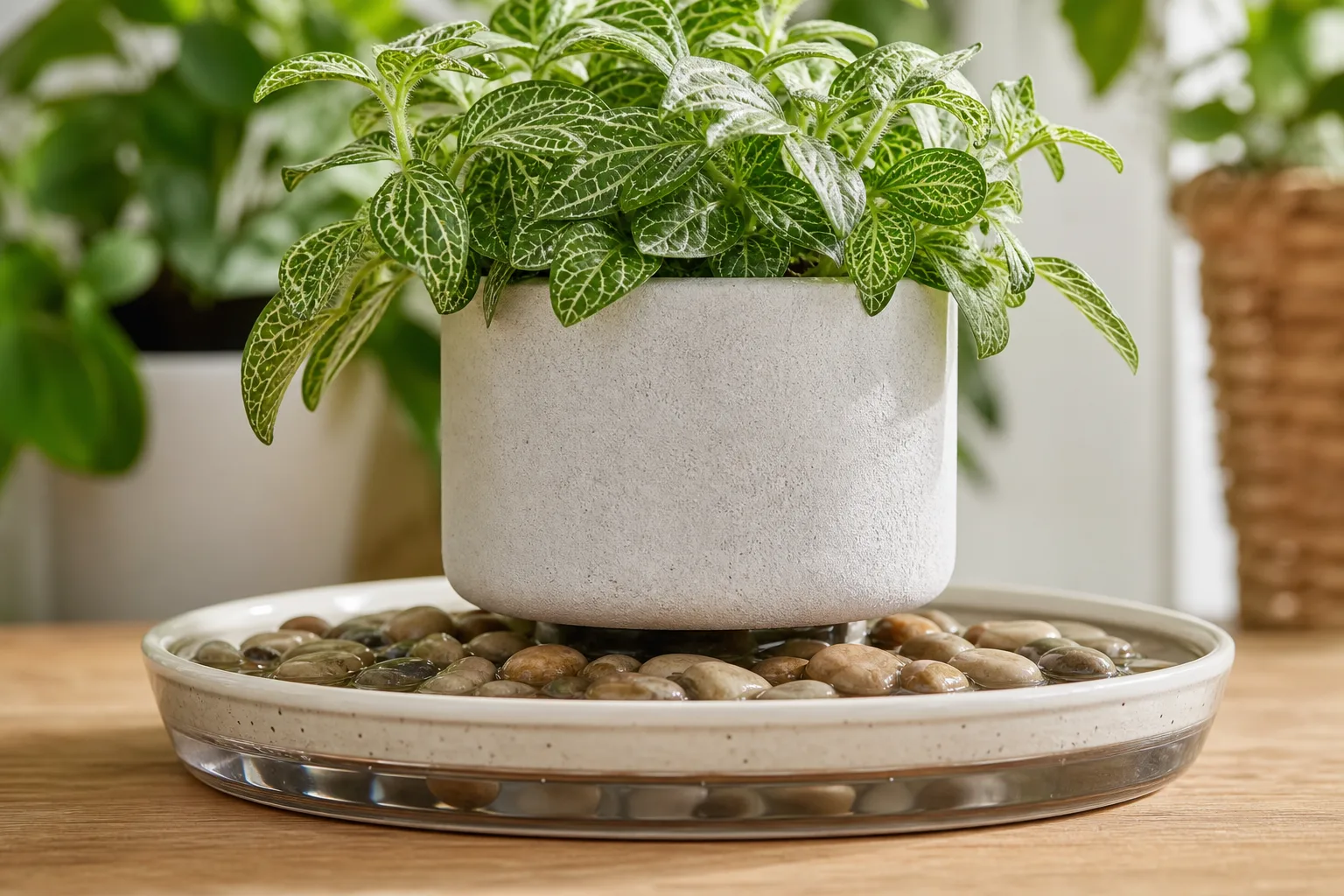
- Pebble humidity tray: shallow tray, pebbles, water below stone tops, pot sitting on pebbles—not in water. Helps locally; rarely enough alone in dry winters.
- Grouping plants raises humidity a few points; combine with a humidifier for best results.
NC State specifically mentions bathrooms and terrariums as good sites for delta maidenhair when humidity is the limiting factor. (NC State Extension) If tips brown while soil moisture is perfect, measure humidity before buying another pot.
Soil, Pots, and Drainage (Why Terra Cotta Often Fails)
Use a moisture-retentive but well-drained mix. RHS culture for A. raddianum is moist but well-drained with organic matter. (RHS) A workable indoor blend:
- 50–60% high-quality peat-free or peat-based potting base
- 20–30% perlite or pumice for aeration
- 10–20% compost or fine bark for structure
UF/IFAS recommends organic, well-drained soil for ferns and warns against mixes that stay waterlogged. (UF/IFAS EDIS)
Pot choice:
- Plastic or glazed ceramic holds moisture more evenly—often better for maidenhair indoors.
- Unglazed terra cotta wicks water away fast; in dry rooms it can desiccate roots between checks. If you love terra cotta, compensate with more frequent checks or a pebble tray—and still do not let the pot sit in water.
- Drainage hole is non-negotiable. No hole means root rot waiting to happen.
Repot into a container only 1–2 inches wider when roots circle the pot. Maidenhair tolerates slight crowding; oversized pots stay wet too long in the center.
Temperature, Drafts, and Winter Slowdown
Maidenhair prefers warm, stable room temperatures. Gardeners’ World recommends keeping indoor maidenhair around 18–24°C (64–75°F) and avoiding cold below about 10°C (50°F). (BBC Gardeners’ World) RHS tender-fern guidance similarly warns against letting plants drop below 10°C. (RHS tender ferns)
Avoid:
- Heat and AC vents blowing directly on fronds
- Single-pane winter windows where leaflets touch cold glass at night
- Frequent temperature swings from opening exterior doors nearby
Growth slows in cooler, shorter days. Reduce watering frequency slightly in winter—still never bone dry—and hold fertilizer until new spring growth appears.
Fertilizer: When to Feed and When to Skip
Maidenhair ferns are not heavy feeders. Missouri Botanical Garden notes they can grow well without much fertilizer if soil and moisture are right. (Missouri Botanical Garden) If fronds look pale and you have ruled out too much sun and drought, use a balanced liquid houseplant fertilizer at half strength once monthly from March through September. Skip feeding in winter and on newly divided or repotted plants for six to eight weeks to avoid root burn.
Avoid high-nitrogen formulas that push soft tissue—tips can scorch on delicate leaflets. Never fertilize a collapsed or crisping plant; fix moisture and humidity first.
Pruning, Repotting, and Root-Crown Health
Pruning: Cut dead or damaged fronds at the base near the crown with clean scissors. Do not pull. Removing brown material improves airflow and lets you see new croziers emerge.
Repotting: Repot when roots fill the container or water runs straight through without absorbing—often every 1–2 years for actively growing specimens. Spring is ideal. See the maidenhair fern repotting guide for step-by-step division-friendly repotting. After repotting, keep humidity high and skip fertilizer briefly.
Crown check: A healthy rhizome feels firm. Soft, black, foul-smelling crown tissue means rot—salvage is unlikely. A firm crown after collapse can still push new fronds once moisture and humidity stabilize.
Propagating Maidenhair Fern by Division
Maidenhair propagates reliably by rhizome division, the same method NC State lists among propagation options. (NC State Extension) RHS fern guidance also recommends division for many tender houseplant ferns. (RHS fern growing guide)
Steps:
- Water the parent plant two days before dividing so the root ball is hydrated but not soggy.
- Remove the plant from its pot. Tease apart or cut the rhizome with a sterile knife into 2–3 sections, each with healthy roots and several fronds.
- Plant sections in fresh mix in pots with drainage. Firm lightly; do not bury the crown deep.
- Water thoroughly, place in bright indirect light, and maintain high humidity (humidifier or clear bag vented daily for a week if needed).
- Do not fertilize for six to eight weeks. New croziers confirm success.
Full detail lives in the maidenhair fern propagation guide.
Common Pests on Indoor Maidenhair Ferns
Indoor maidenhair ferns mainly attract scale and mealybugs, which cling along stipes and leaflet bases. Check weekly when you water—early infestations wipe off with alcohol on a cotton swab; heavier cases need insecticidal soap applied to all surfaces including undersides, repeated per label until clear.
Clemson HGIC cautions that pesticides can burn delicate fern fronds—test a small area first and favor soft options like insecticidal soap over harsh sprays. (Clemson HGIC) Isolate infested plants so crawlers do not spread to neighboring pots.
Troubleshooting Brown, Yellow, Curling, or Falling Fronds
Start with one diagnosis path—changing water, light, humidity, and pot all at once makes recovery harder to read.
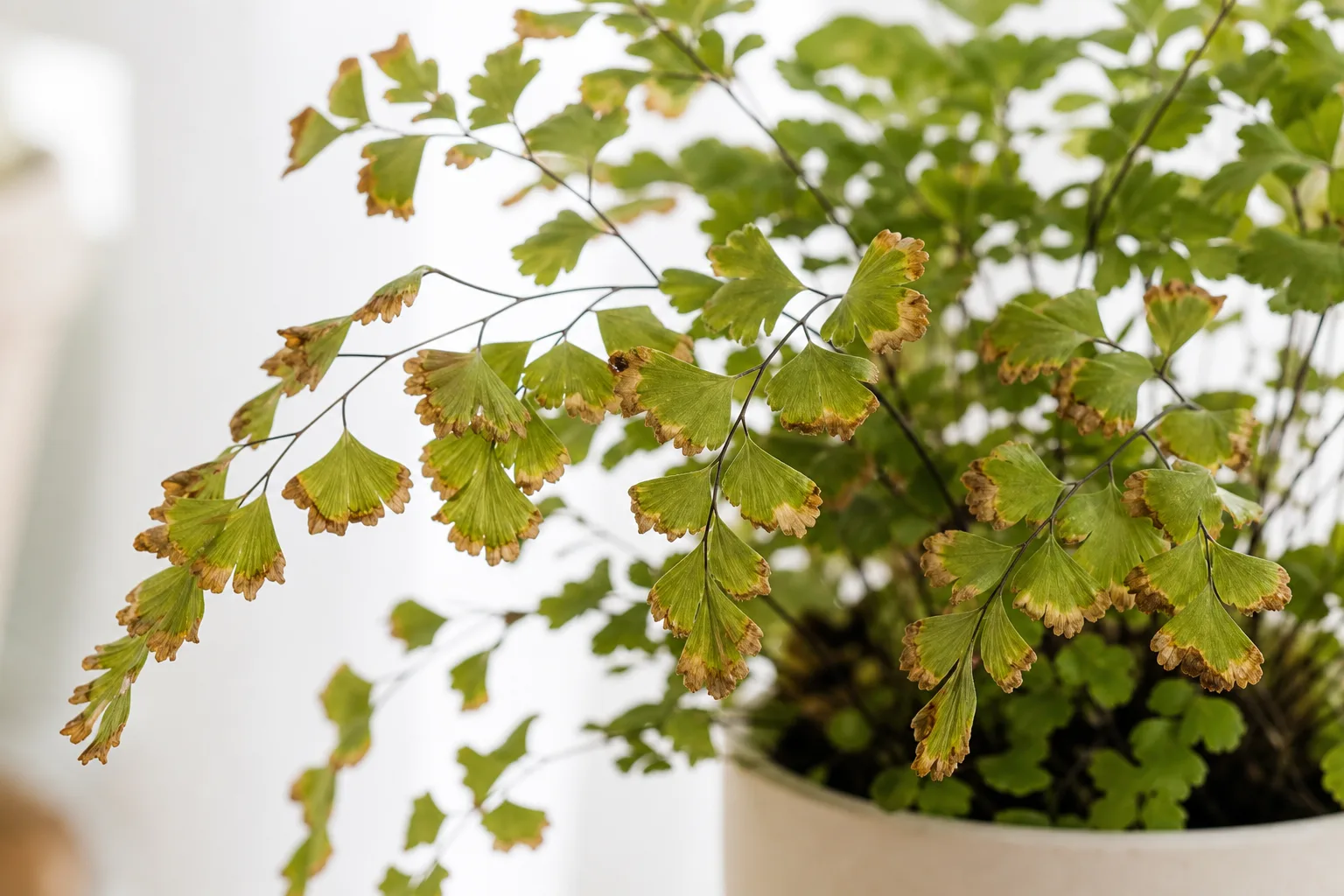
Brown or crispy fronds usually mean dry soil, low humidity, direct sun, heat/AC drafts, or fluoride/chlorine buildup from tap water. Check pot weight and humidity near the plant before assuming “underwatering” alone. Remove fully dead fronds at the base after you fix conditions.
Yellow fronds often signal overwatering and poor drainage, especially if soil smells sour or the crown softens. Let the mix dry slightly closer to the surface, confirm the drainage hole is open, and repot into fresh airy mix if rot is suspected—trim black roots with sterile scissors.
Curling leaflets commonly track low humidity even when soil is moist. Add a humidifier or bathroom placement; pebble trays alone may not suffice in winter.
Leaflets dropping after crisping means the plant dried out severely at least once. Trim damage, re-establish even moisture, raise humidity, and watch for new croziers from a firm rhizome.
Reviving a Collapsed Maidenhair Fern
When the whole plant hangs like wet paper overnight:
- Feel the rhizome at soil level. Firm = worth saving; soft, mushy, foul = discard responsibly.
- Cut all collapsed fronds to the soil line with clean scissors.
- Water slowly until mix is evenly moist—not flooded.
- Move to bright indirect light and raise humidity toward 60% with a humidifier.
- Do not fertilize until new fronds are several inches tall.
- Expect 2–4 weeks for croziers if conditions stay stable—timeline varies with temperature and light.
If nothing emerges after six weeks with a firm crown, the rhizome may be dormant beyond recovery. Learn from pot weight: a collapsed maidenhair is almost always a drought event, not random bad luck.
Conclusion
Maidenhair fern rewards growers who treat moisture and humidity as daily physics, not monthly chores. Give Adiantum raddianum bright indirect light, evenly moist well-drained soil, warm stable air, and real humidity support in dry seasons, and those black-stemmed fronds stay worth the effort. Use pot weight and the top-inch check instead of a calendar, choose plastic or glazed pots if terra cotta dries you out, and divide healthy plants in spring to share or replace tired clumps.
When fronds fail, diagnose in order—water, humidity, light, drainage—before repotting or feeding. A firm rhizome can come back from a dramatic collapse; a soft crown cannot. For deeper dives on each factor, start at the maidenhair fern hub and adjust one lever at a time until new croziers unfurl without crisping at the tips.