How to Grow and Care for Dragon Fruit Plant
Grow dragon fruit with the right trellis, cultivar pairing, night pollination, pruning, and container sizing—plus a Florida invasive warning.
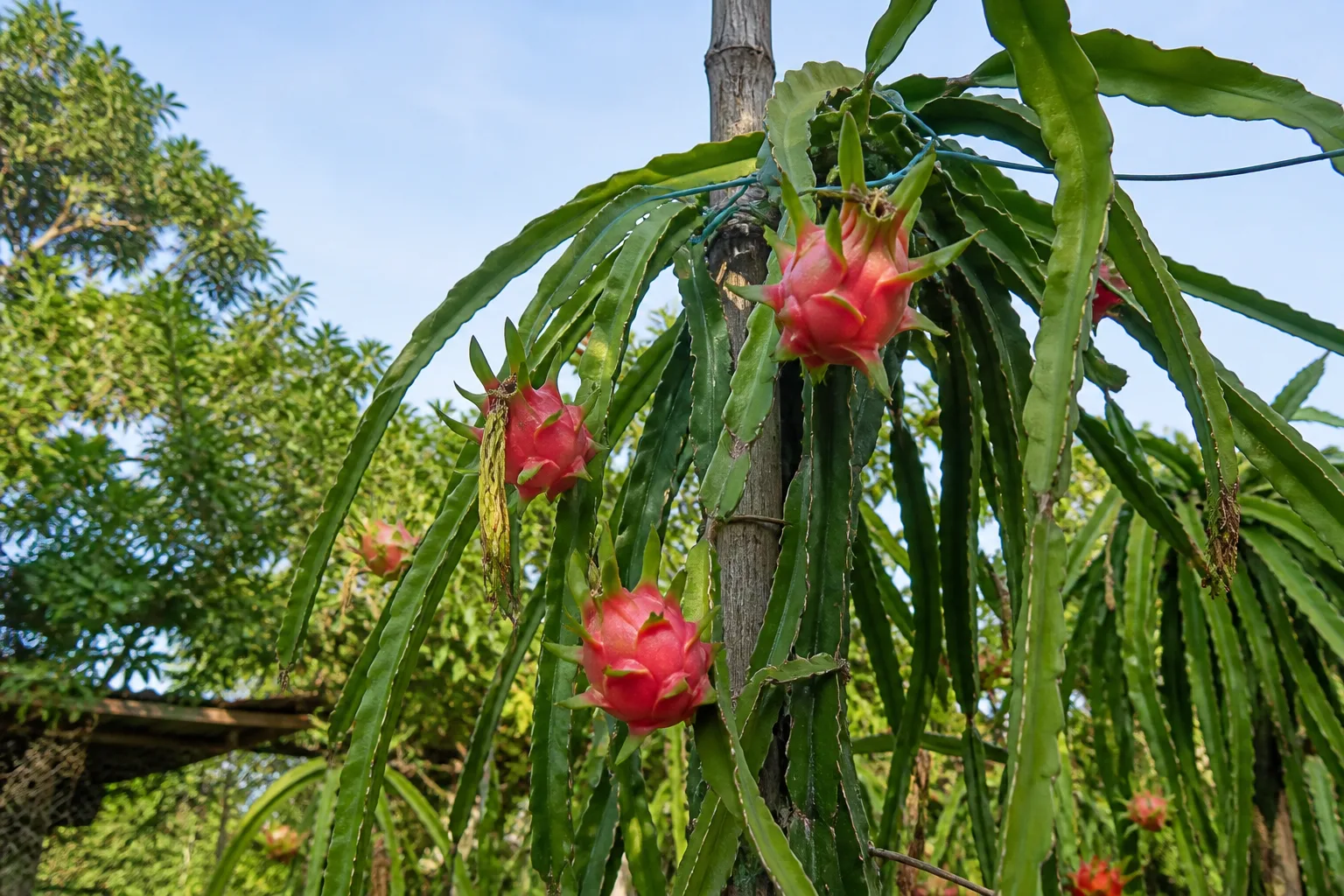
Dragon fruit looks like something from a fantasy market—hot-pink or yellow skin, white or magenta flesh speckled with tiny black seeds—but the plant behind it is a fast-growing, vining cactus that climbs, blooms at night, and rewards careful setup with sweet, antioxidant-rich fruit. Most home growers fail not because the plant is fragile, but because they treat it like a desert cactus in a tiny pot with no trellis and one lonely cultivar that never gets pollinated. Get the support structure, cultivar pairing, and night pollination right, and pitahaya becomes one of the most productive edible vines you can grow in frost-free climates.
Dragon Fruit Quick Reference
| Attribute | Details |
|---|---|
| Accepted botanical name | Selenicereus undatus (formerly Hylocereus undatus) |
| Common names | Dragon fruit, pitahaya, pitaya, strawberry pear, Honolulu queen, moonlight cactus |
| Plant type | Perennial, epiphytic/climbing cactus (Cactaceae) |
| Mature size | 8–20 ft tall on trellis; stems to 33 ft long (NC State) |
| USDA zones | 10a–11b outdoors; container + winter protection elsewhere |
| Light | Full sun with young-plant shade; partial afternoon shade above 100°F (UF/IFAS HS303) |
| Soil | Well-drained loam or cactus mix; high organic matter |
| Water | Dry winter/early spring for bloom induction; consistent moisture from flower to harvest |
| Pollination | Self-fertile or self-incompatible by cultivar; moths, bats, bees, or hand pollination |
| Trellis | 4–6 in pole + metal grid at top; no bare wire (UF/IFAS HS303) |
| Container size | 25–35 gallons for a mature specimen (Epic Gardening) |
| Time to fruit (cuttings) | As fast as 6–9 months; often 1–3 years (UF/IFAS HS303) |
| Pet safety | Non-toxic to pets (NC State) |
| Florida status | Invasive in Central and South Florida (UF/IFAS Assessment) |
What Is Dragon Fruit? Taxonomy and Plant Type
Dragon fruit is the edible berry of a climbing cactus native from Mexico through Honduras, now cultivated commercially from Southeast Asia to Israel and across the warm Americas. Taxonomy shifted in recent years: the white-fleshed species most Americans know is now accepted as Selenicereus undatus, though nurseries and older references still label it Hylocereus undatus or even Cereus undatus (NC State). The name Selenicereus combines Greek selene (moon) with Cereus, referencing the spectacular nocturnal flowers.
Unlike desert barrel cacti, dragon fruit is a subtropical epiphyte adapted to humid forests where stems scramble up trees and rocks. Stems are triangular, green, segmented, and often spineless or lightly spined, with wavy rib margins (undatus means “wavy”). Aerial roots form along stems and cling to supports. Flowers are hermaphroditic, bell-shaped, fragrant, and enormous—up to 14 inches long—opening at night and closing by morning (UF/IFAS HS303). Each flower lasts one night; miss pollination and that bloom is gone.
Fruit is technically a berry with leathery, scale-covered skin (pink, red, or yellow depending on species/cultivar) and sweet pulp studded with edible black seeds. Mature plants are heavy; a 3- to 4-year-old vine may yield around 220 lb of fruit annually and live roughly 20 years (UF/IFAS HS303). Plan for size from day one.
Choosing a Cultivar: Self-Fertile vs Cross-Pollinating
Before you buy, answer one question: Will this cultivar set fruit alone? Dragon fruit flowers contain both male and female parts, but many commercial cultivars are self-incompatible—pollen from the same genetic line cannot fertilize the stigma reliably (UF/IFAS HS303). UF/IFAS notes that self-incompatibility documentation for named cultivars is incomplete, which makes nursery labels unreliable. Use this framework instead:
If you can only fit one plant: Choose a cultivar marketed as self-fertile or self-pollinating, then still hand-pollinate the first few bloom cycles to confirm fruit set. If you have trellis space for two or three posts: Plant 2–3 different genetic types (not clones of the same variety) within cross-pollination distance. If flowers appear but fruit never forms: Pollination—not watering—is the likely bottleneck.
Self-fertile cultivars worth knowing
These names appear frequently in U.S. nurseries and are commonly described as self-fruitful, though always verify with your seller:
- ‘David Bowie’ (S. undatus type): pink-red skin, white flesh, lemony flavor; widely sold as self-pollinating.
- ‘American Beauty’ (Hylocereus guatemalensis hybrid): red skin, magenta flesh; labeled self-fertile.
- ‘Purple Haze’: large pink-skinned fruit with purple flesh; sold as self-pollinating.
- ‘Zamorano’: red flesh, mild sweetness; slower growth suits containers.
Self-fertile labels help, but night pollinators are inconsistent in home gardens—UF/IFAS reports moth and bat pollination is not commonly observed in Florida plantings (UF/IFAS HS303). Treat self-fertility as a head start, not a guarantee.
When you need a second variety
Plant a second (or third) cultivar when:
- Your variety is known self-sterile (e.g., ‘Dark Star’, a hybrid with purple flesh often listed as self-sterile).
- You grow a species type with uncertain compatibility (red pulp species like Hylocereus costaricensis alongside white S. undatus).
- Flowers open fully but ovaries swell and abort within days—classic unpollinated bloom.
Space cross-pollinating partners on the same trellis grid or within a few yards so you can transfer pollen between flowers the same night. You can even grow two types in one large container if the pot and trellis are scaled up (Epic Gardening).
Where to Plant Dragon Fruit
Site selection matters more than for most fruit because the vine becomes a permanent structure. UF/IFAS recommends planting 15–25 ft away from homes, other trees, power lines, and utilities—mature stems are long, heavy, and studded with spines (UF/IFAS HS303). Choose the warmest, best-drained spot in the landscape that does not hold water after summer storms.
Plant in early spring to ride the March–August growth window, or anytime in frost-free regions if you can irrigate through establishment. Dig a hole 3–4 times the pot width and 3 times the depth, backfill with native soil mixed with compost, and set the plant at the same depth it grew in the nursery pot. Never bury the stem base; keep mulch 8–12 inches back from the stem to prevent rot (UF/IFAS HS303).
Florida growers: UF/IFAS classifies Selenicereus undatus as Invasive in Central and South Florida and does not recommend it there; it is reassessed on a 10-year cycle (UF/IFAS Assessment). In North Florida it is not documented as a problem species at this time. If you garden in Miami, Fort Lauderdale, Tampa, or similar climates, consider container culture with fruit cleanup, or choose a native fruit crop instead. Escaped stems root from aerial nodes and spread into natural areas. Outside Florida, NC State notes frost kills the species, limiting invasion risk in temperate states (NC State).
Light, Soil, and Water Requirements
Dragon fruit wants full sun in principle—extension sources call it a full-sunlight crop in its native range—but young stems burn in intense, low-humidity heat. UF/IFAS recommends ~30% shade for the first 3–4 months after planting and wherever sunburn has been observed; too much shade later reduces yield and fruit quality (UF/IFAS HS303). If your summers regularly hit 100°F, give afternoon protection. Optimal growth temperatures fall between 65°F and 77°F; prolonged exposure below 31°F damages stems, though plants recover from light freezes (UF/IFAS HS303).
Soil flexibility is high if drainage is sharp. Sandy Florida rockland, calcareous soils, and container mixes all work when organic matter is present and water never pools. NC State recommends loam or cactus potting mix with good aeration (NC State). High-pH soils may show minor-element deficiencies; UF/IFAS addresses this with chelated iron drenches and nutritional sprays on its fertilizer calendar.
Watering follows a seasonal rhythm, not a daily schedule. A dry winter and early spring help trigger bloom induction; once flowering begins, consistent moisture through harvest prevents fruit drop and size loss (UF/IFAS HS303). Overwatering is the fastest way to kill roots—stem rot, anthracnose, and bacterial spot all thrive in soggy, shaded canopies. Let the top few inches of container mix dry between waterings, then soak thoroughly. Never run lawn sprinklers on a timer against the stem base; UF/IFAS warns this causes chronic overwatering and decline (UF/IFAS HS303).
Building the UF/IFAS Pole Trellis
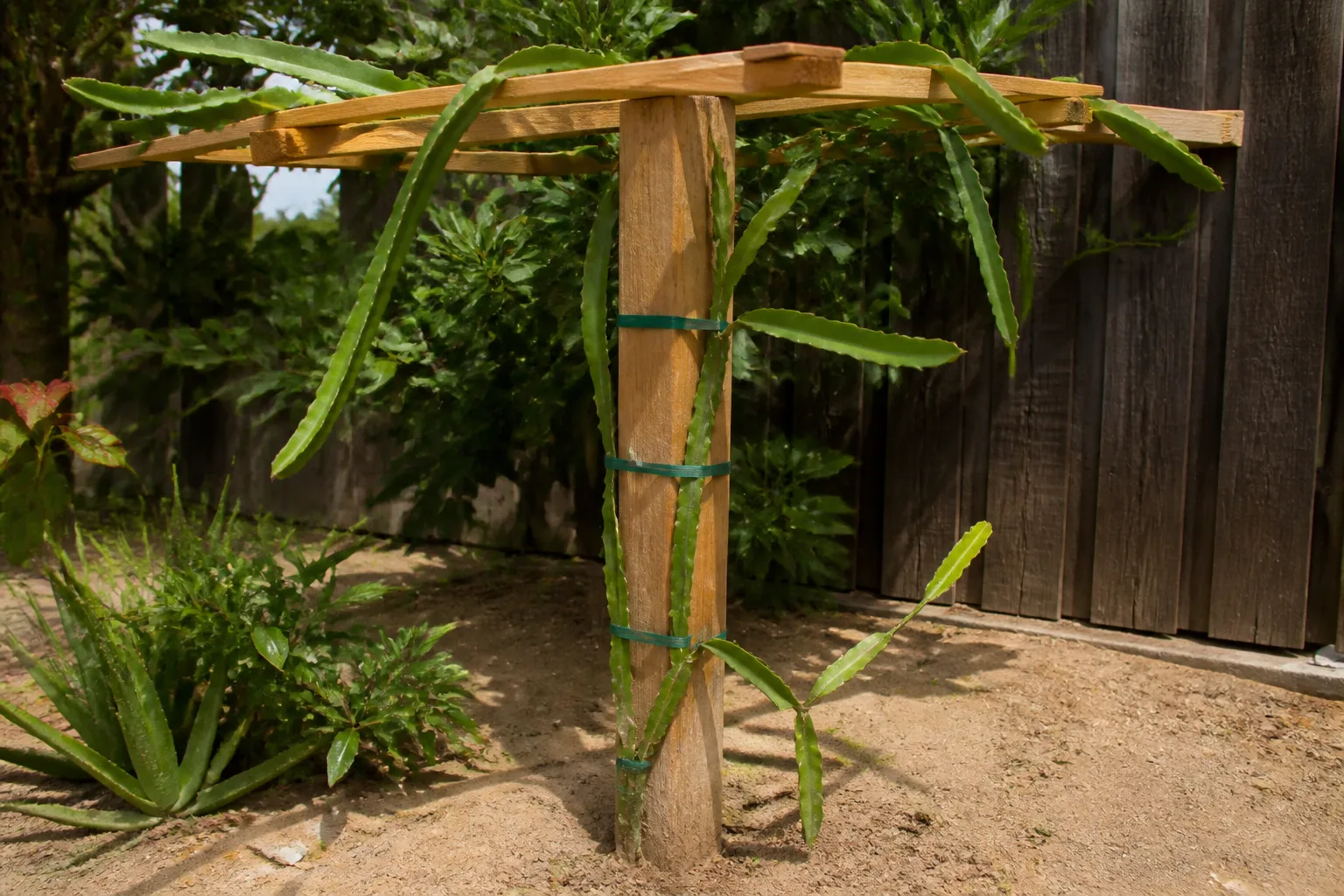
A dragon fruit vine without support becomes a tangled ground sprawl that shades itself, hides fruit from pollinators, and invites disease. UF/IFAS recommends a pole-and-grid trellis strong enough to hold several hundred pounds of stem weight (UF/IFAS HS303).
Materials and dimensions:
- One 4–6 inch diameter pressure-treated wooden post, set deep and stable.
- A metal grid or rebar frame bolted to the post top (not bare wire—wire cuts stems; sleeve wire in plastic hose if used).
- Overall height typically 6–7 ft to the grid for home plantings; commercial posts go taller.
- Position the trellis 10–15 ft from structures and other plants.
Epic Gardening describes a practical home version: a 4×6 inch post, 4–6 ft above soil, anchored with rebar or a crossed-board base, topped with a wooden box frame built from 2×4 lumber to support lateral branches (Epic Gardening). Install the post before backfilling soil or filling a container so you do not pierce roots later.
Training vines up the post
Training is the first pruning job, and it shapes every harvest afterward. UF/IFAS outlines a two-phase approach (UF/IFAS HS303):
Phase 1 — Vertical trunk: Select one or two main stems and remove all lateral branches below the trellis top. Tie the main stem loosely to the post with soft cloth ties as it climbs. Goal: a clean “trunk” reaching the grid.
Phase 2 — Horizontal canopy: When the stem reaches the grid, cut the tip to force side branches. Tie selected laterals along the frame so they arch slightly downward—fruit forms on newer segments at the canopy edge where light is strongest.
For container plantings, place two or three cuttings around the same post in one large pot to maximize cross-pollination and canopy coverage (Epic Gardening). Replace ties every season; girdling stems snap in wind.
Hand Pollination at Night
Because flowers open after dusk and close by mid-morning, hand pollination is the most reliable home-garden method—even when bats and moths are present in the wild, UF/IFAS notes they are rarely observed pollinating cultivated plantings (UF/IFAS HS303). Some cultivars stay open into early morning when bees may visit; do not depend on that alone.
Night workflow (9 PM–8 AM window):
- Watch the calendar. Flowering peaks late spring through fall; each bud opens one night only.
- At dusk, identify open flowers. Fully open blooms are white, fragrant, and expose cream-colored stamens and a lobed stigma.
- Collect pollen by gently brushing a cotton swab, small brush, or tweezers across stamens of a donor flower (different cultivar if cross-pollinating).
- Apply to stigma of the recipient flower with a light dabbing motion. Use a fresh swab per recipient to avoid cross-contamination if tracking genetics.
- Repeat across all open flowers the same night—pollen viability drops as the bloom closes.
- Mark the calyx with a tie or tag if you want to track which pollinations set fruit.
If you only have one self-fertile plant, transfer pollen within the same flower or between flowers on the same vine—some self-fertile cultivars still set heavier fruit with cross-pollen from a second type. Rain during bloom washes pollen; hand pollinate again on the next dry night if buds remain.
Fertilizing Dragon Fruit Through the Seasons
Dragon fruit is a heavy feeder relative to desert cacti, but young roots burn easily. UF/IFAS publishes age-based rates (UF/IFAS HS303):
Year 1: Wait one month after planting, then apply 0.25 lb of 6-6-6, 8-3-9, or 8-4-12 (palm-type with 2–3% magnesium) every two months. Topdress 4 lb compost or manure (keep off the stem). Spray micronutrients (Mn, Zn) 4–6 times March–September; chelated iron drenches on high-pH soils.
Years 2–3: Increase to 0.3–0.4 lb per application on the same schedule; raise compost to 6 lb per application.
Year 4+: Apply 0.5–0.75 lb 3–4 times per year plus 5 lb compost twice annually.
For containers, Epic Gardening suggests a balanced 6-6-6 or 10-10-10 in spring, with a higher-phosphorus boost in summer to support flowering (Epic Gardening). Topdress compost each spring instead of dumping high-nitrogen lawn fertilizer nearby—UF/IFAS warns excess lawn nitrogen reduces fruiting (UF/IFAS HS303). Reduce or pause feeding in winter during dormancy.
Pruning for Airflow and Fruit Set
Unpruned dragon fruit becomes a dense thicket where the center rots, mealybugs hide, and fruit size shrinks. Production pruning serves three goals: light penetration, disease prevention, and manageable harvest height (UF/IFAS HS303).
When: 1–3 times per year, with a major session soon after harvest. Remove pruned material from the site—do not compost diseased stems beside the trellis.
What to cut:
- Dead, damaged, diseased, or crossing stems.
- Any stem touching soil (soil contact invites rot and ants).
- Excess interior growth shading the canopy.
- Overlong hangers that exceed trellis capacity.
How: Use clean, sharp loppers or saws; wear thick gloves. Treat large cuts with fungicide per UF/IFAS recommendation to limit Neoscytalidium canker entry (UF/IFAS HS303). Selectively keep the plumpest, healthiest canes and tie them to the grid. Tip pruning after harvest stimulates branching and future flower buds.
Container growers prune more aggressively to keep vines within the 25–35 gallon root zone and frame size (Epic Gardening).
Growing Dragon Fruit in Containers
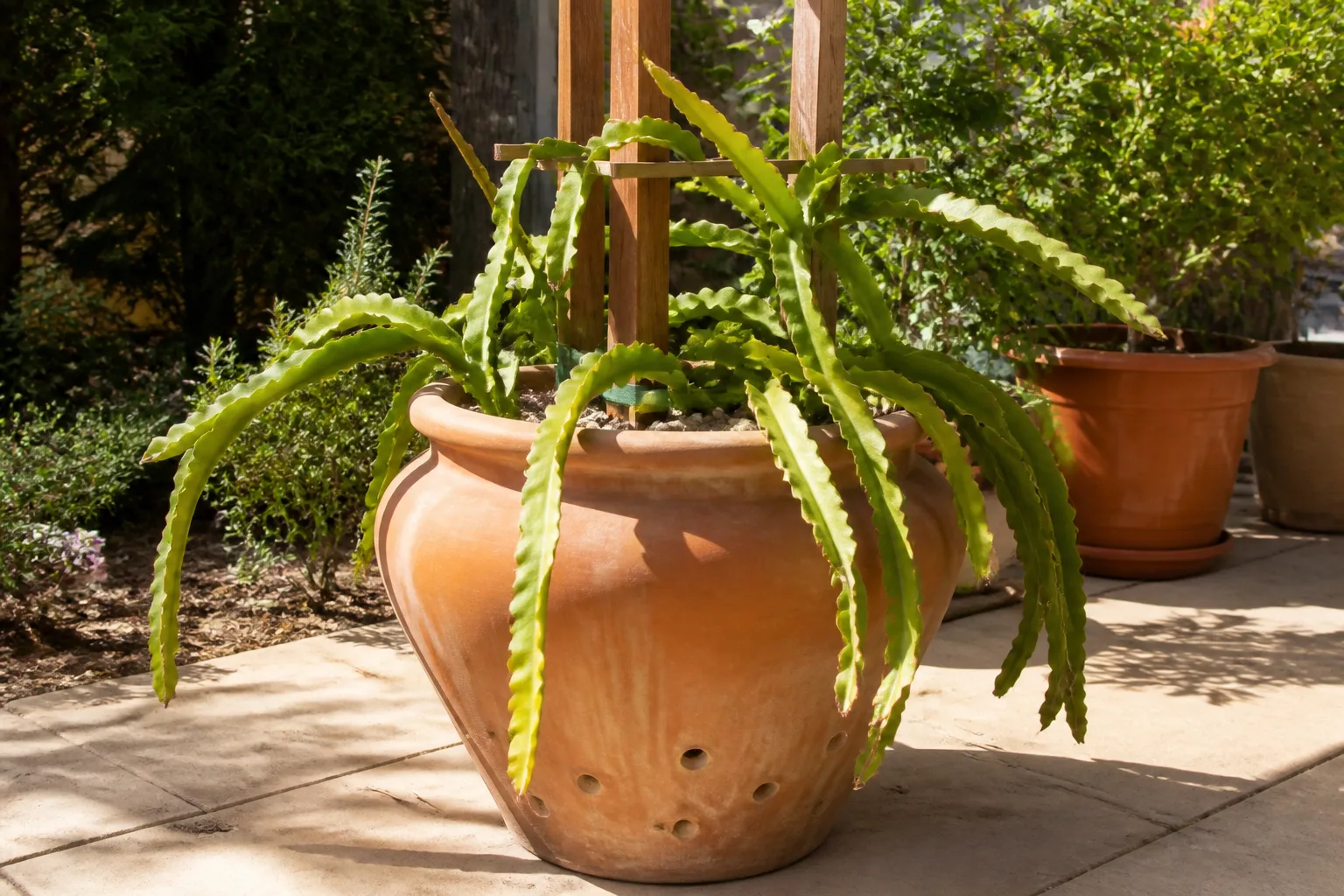
Containers make sense in zone 9 and below (move indoors before frost), on patios, or in Florida invasive zones where you want controlled growth. They also let you regulate water and soil precisely—critical for a cactus that still needs summer moisture (Epic Gardening).
Pot size: Start cuttings in a 3–5 gallon nursery pot for 4–6 months while roots develop, then move to a 25–35 gallon final container (Epic Gardening; UF/IFAS HS303). Choose a pot wider than it is tall to prevent toppling; ceramic or terracotta adds stability. Multiple drainage holes are mandatory.
Mix: Use fast-draining succulent or cactus mix blended with 10–20% compost—not straight desert cactus mix alone. NC State emphasizes good drainage with organic richness (NC State). Mulch the surface in hot climates, keeping mulch off stems.
Trellis in pot: Set the post at planting time before filling mix. A mature containerized vine is ** difficult to relocate**; plan the winter storage spot before it weighs 100+ lb with wet soil.
Overwintering: When nights drop below 40–45°F, move pots to a bright indoor room or greenhouse (Epic Gardening). Reduce watering but do not desiccate roots. Resume outdoor placement when days stay above 70°F and frost danger passes.
Propagation From Stem Cuttings
Seed-grown dragon fruit takes up to 7 years to fruit and does not come true to type (UF/IFAS HS303). Stem cuttings are the standard home method.
Steps:
- Take a 12–15 inch healthy segment (UF/IFAS uses 6–15 in segments; longer cuttings reach the trellis faster).
- Bevel the base; treat with fungicide.
- Cure 7–10 days in dry shade until the cut surface calluses.
- Optional: dust base with rooting hormone.
- Plant callused end 2–3 inches deep in well-drained mix; stake if needed.
- Water lightly; keep barely moist until roots resist a gentle tug (4–6 months in pots).
- Transplant to the trellis or final container with the post already installed.
Cuttings can grow 1.2 inches per day under warm conditions and fruit in 6–9 months in ideal commercial scenarios; home growers more often see harvest in 1–3 years (UF/IFAS HS303). Label each cutting with cultivar name at rooting time—future pollination depends on it.
Harvesting and Storing Dragon Fruit
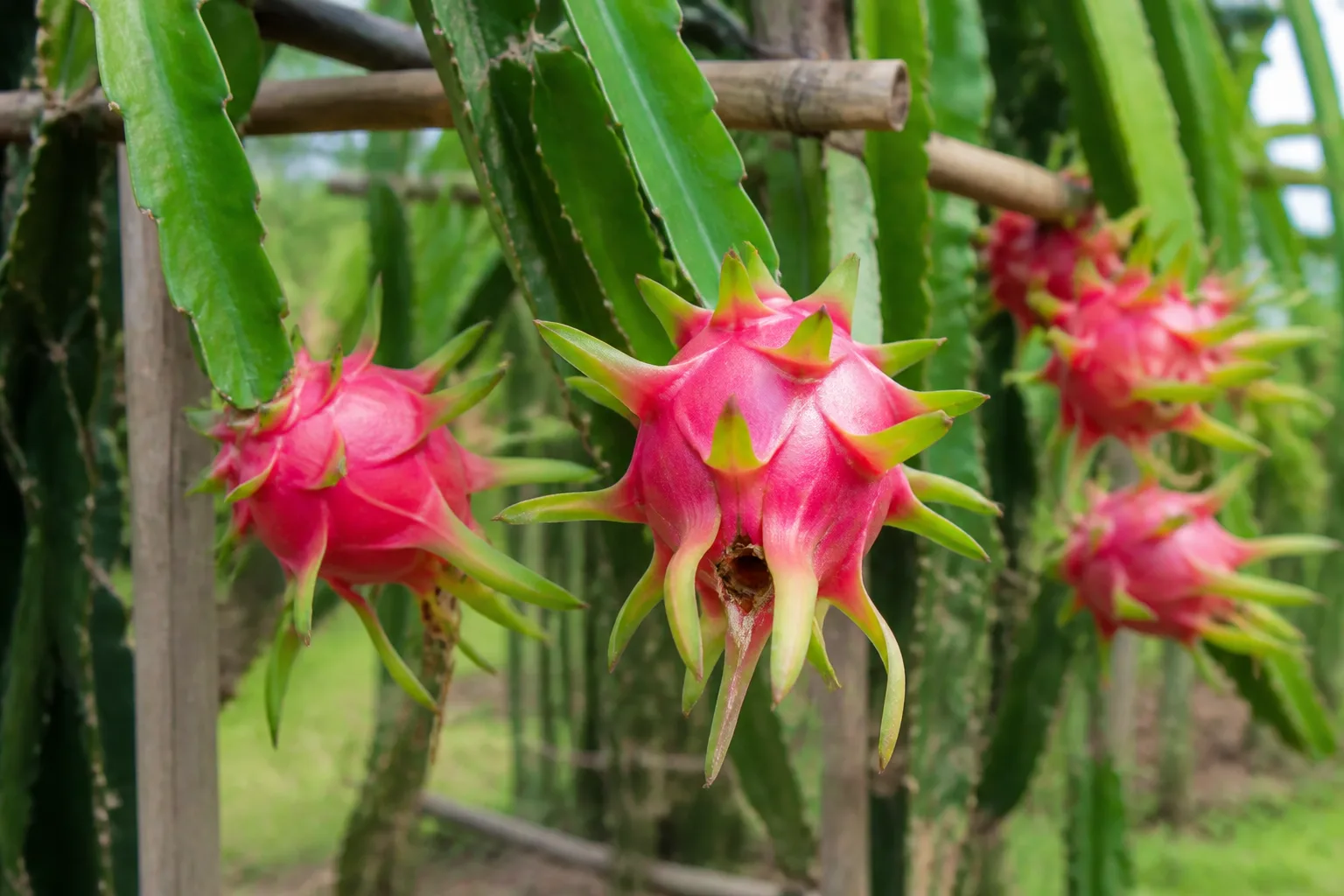
Florida H. undatus types ripen June through November (UF/IFAS HS303); timing varies by climate and cultivar. Harvest only fully colored fruit—pink or yellow skin with scaled bracts beginning to dry at the tips. Underripe fruit lacks sweetness; overripe fruit splits or drops.
Method: Wear gloves for spiny types. Cut the peduncle flush to the fruit surface with hand pruners—do not twist and tear stems (UF/IFAS HS303). The “shake test” works: if the fruit wobbles independently on the stem, it is ready.
Storage: 4–5 days at room temperature; several weeks in a plastic bag in the refrigerator (UF/IFAS HS303). Flavor is best fresh; pulp freezes well for smoothies. Protect ripening fruit from birds, rats, and raccoons with netting before color breaks.
Edible flowers can be harvested as unopened buds for cooking (UF/IFAS HS303), though most growers prioritize fruit set and pollinate every open bloom instead.
Common Problems: Troubleshooting Decision Tree
Use this sequence before guessing at fertilizer or watering changes:
Step 1 — Is the plant growing new stem segments?
- No: Check light (too dark), temperature (below 60°F slows growth), and root rot from overwatering. Repot only if roots are healthy white tips, not mush.
- Yes: Proceed to Step 2.
Step 2 — Are flower buds forming?
- No: Confirm the plant is mature enough (often year 2+ from cutting). Ensure winter dry period—not constant wet soil. Increase sun if canopy is overly shaded after skipping pruning. Prune dead weight redirecting energy.
- Yes: Proceed to Step 3.
Step 3 — Do flowers open fully at night?
- No: Buds may abort from heat stress, excess nitrogen, or drought during bud swell. Stabilize water; avoid lawn fertilizer near roots.
- Yes: Proceed to Step 4.
Step 4 — Do flowers close with swollen ovary base?
- No swelling after multiple blooms: Pollination failure. Add a second cultivar; hand pollinate every open night. Confirm labels—two pots of “dragon fruit” from the same clone will not cross.
- Swelling then yellow drop: Possible incompatible cross, extreme heat, or thrips; inspect with magnification.
Step 5 — Stems show brown lesions or soft rot?
- Dry brown patches on sun-exposed faces: Sunburn—add afternoon shade on young stems (UF/IFAS HS303).
- Wet rot with orange/pink spores: Anthracnose or stem canker—remove affected tissue back to healthy green, improve airflow, avoid overhead watering, contact your county extension for current fungicide options (UF/IFAS HS303).
- Mushy base at soil line: Root rot—reduce water, verify drainage, discard if crown collapses.
Step 6 — Foliage pests?
- White cottony clusters: Mealybugs—wash with alcohol swab; check ants farming them (NC State).
- Fine stippling: Mites—rinse stems; increase humidity slightly.
- Fruit pecked overnight: Birds or mammals—net before color break.
Most “problem” emails trace back to Steps 3–4: gorgeous night flowers, zero fruit, fixable with a cotton swab and a second genotype.
Conclusion
Growing dragon fruit rewards growers who respect its split personality: a drought-tolerant cactus that still demands summer water, a sun lover that burns without acclimation, and a self-contained flower that often needs human matchmaking. Anchor Selenicereus undatus (or your chosen species) on a UF/IFAS-style pole trellis, match self-fertile or cross-pollinating cultivars deliberately, and walk the garden after dark with a swab when blooms open. Fertilize on an age-based calendar, prune for light and airflow, harvest at full color with a flush cut, and scale containers to 25–35 gallons for long-term production. If you garden in Central or South Florida, weigh the invasive status before planting in open ground. Do those pieces in order and dragon fruit stops being an ornamental curiosity and becomes a reliable, striking backyard crop.