How to Grow and Care for a Money Tree
Pachira aquatica care made simple: know when to water, prevent root rot, choose its spot, and propagate a healthy money tree from a cutting.
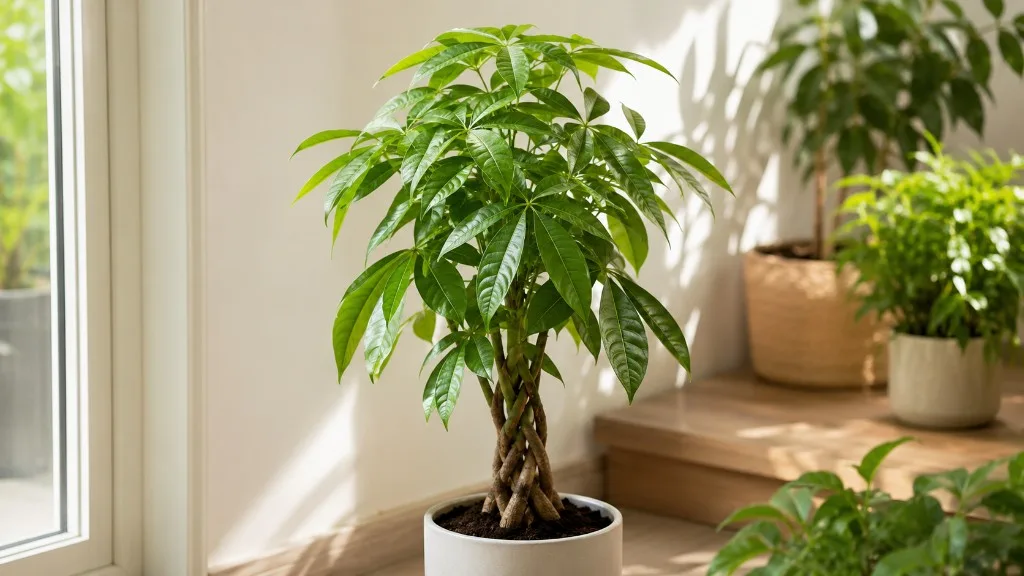
The money tree, Pachira aquatica, is forgiving in the way a good houseplant should be: it can handle a missed watering, adapts to ordinary rooms, and grows into a small indoor tree with glossy, hand-shaped leaves. It is not forgiving of a pot that stays wet for weeks, a dark corner, or a braided trunk cinched so tightly that the stems cannot expand.
The reliable formula is simple: give it bright indirect light, an open potting mix, thorough watering only after the root zone has partly dried, and stable warmth. North Carolina State Extension places the species in tropical wetlands and river-edge habitats, but also warns that standing water can cause root rot; that combination explains why “it likes water” is an incomplete care instruction. (NC State Extension Plant Toolbox)
Money Tree Care at a Glance
Use this table as a starting point, then adjust by how quickly your pot dries. A small plant in a bright terracotta pot may need water much sooner than a tall money tree in a large cachepot, so the calendar is less useful than the soil and pot weight.
| Care factor | Good indoor target | What to watch |
|---|---|---|
| Light | Bright, indirect light; gentle morning sun is usually safer than hot afternoon sun | Long bare stems and small leaves mean too little light; bleached or crispy patches suggest too much |
| Water | Water thoroughly when the top 2–3 inches of mix are dry and the pot feels lighter | Constantly wet mix, yellow leaves, or a soft base point to a root problem |
| Soil | Open, moisture-retentive but free-draining houseplant mix | Dense mix stays wet and removes air from the roots |
| Temperature | About 65–75°F (18–24°C), away from drafts | Protect from cold windows, AC blasts, heaters, and sudden moves |
| Humidity | Average indoor humidity is workable; moderate humidity supports better foliage | Humidity cannot compensate for poor light or wet soil |
| Fertilizer | Half-strength balanced fertilizer during active growth | Feeding a stressed or dimly lit plant can worsen leaf-tip burn |
| Outdoor growing | Warm-season patio use; year-round outdoors only in suitable tropical climates | Bring it in before cold nights and acclimate it to outdoor light |
Start With the Right Plant: Pachira aquatica vs. Other “Money” Plants
The common name money tree usually means Pachira aquatica, also called Guiana chestnut, Malabar chestnut, or French peanut. It belongs to the mallow family, Malvaceae, and has palmate leaves made of several narrow leaflets. The name is also used for jade plants and Chinese money plants, which have very different light, water, and toxicity profiles.
In the wild, Pachira aquatica can become a large tropical tree. In a container, it is commonly sold at roughly 6–8 feet tall or less, and the familiar braided trunk is normally created by nurseries while young stems are flexible. The RHS describes it as an evergreen houseplant that grows in open, free-draining compost and can reach 1–1.5 metres in a pot under its growing conditions. (Royal Horticultural Society)
Money-tree symbolism can be enjoyable, but it is not a care requirement. Treat the braided trunk as a living structure that needs room to thicken, not as a permanent decorative tie, and identify the plant by its botanical name before applying advice meant for a jade or Pilea peperomioides.
Light and Placement That Keep Growth Compact
Place a money tree near a bright window where the light is filtered by a sheer curtain or softened by distance from the glass. An east-facing window is often easy to manage; a bright south- or west-facing room can work when the plant is set back from the strongest afternoon rays. Rotate the pot every week or two so one side does not stretch toward the window.
Direct sun is not automatically forbidden, but a plant grown in a dim store or interior corner can scorch when moved suddenly into intense sun. Increase light gradually over a week or two. The first damage often appears as bleached, tan, or papery patches on the window-facing leaves rather than as a whole-plant decline.
How to Read the Plant’s Light Signals
Long internodes, sparse leaves, and a leaning crown mean the plant is spending its energy reaching for light. Move it closer to a bright window, improve the room’s overall exposure, or add a grow light on a consistent timer. Pruning a leggy money tree without correcting the light only creates a shorter leggy tree.
Pale new growth or scorched patches call for the opposite adjustment. Move the plant back from harsh glass or diffuse the light, and avoid making a second major change—such as repotting or heavy feeding—until you can see how the leaves respond.
Watering Without Creating Root Rot
Water a money tree when the top 2–3 inches of potting mix feel dry and the pot is noticeably lighter, not because it is “watering day.” Push a finger or wooden skewer into the mix away from the trunk; if it comes out cool and damp with soil clinging to it, wait. A moisture meter can help in a very large pot, but it is still worth learning the weight and feel of your own container.
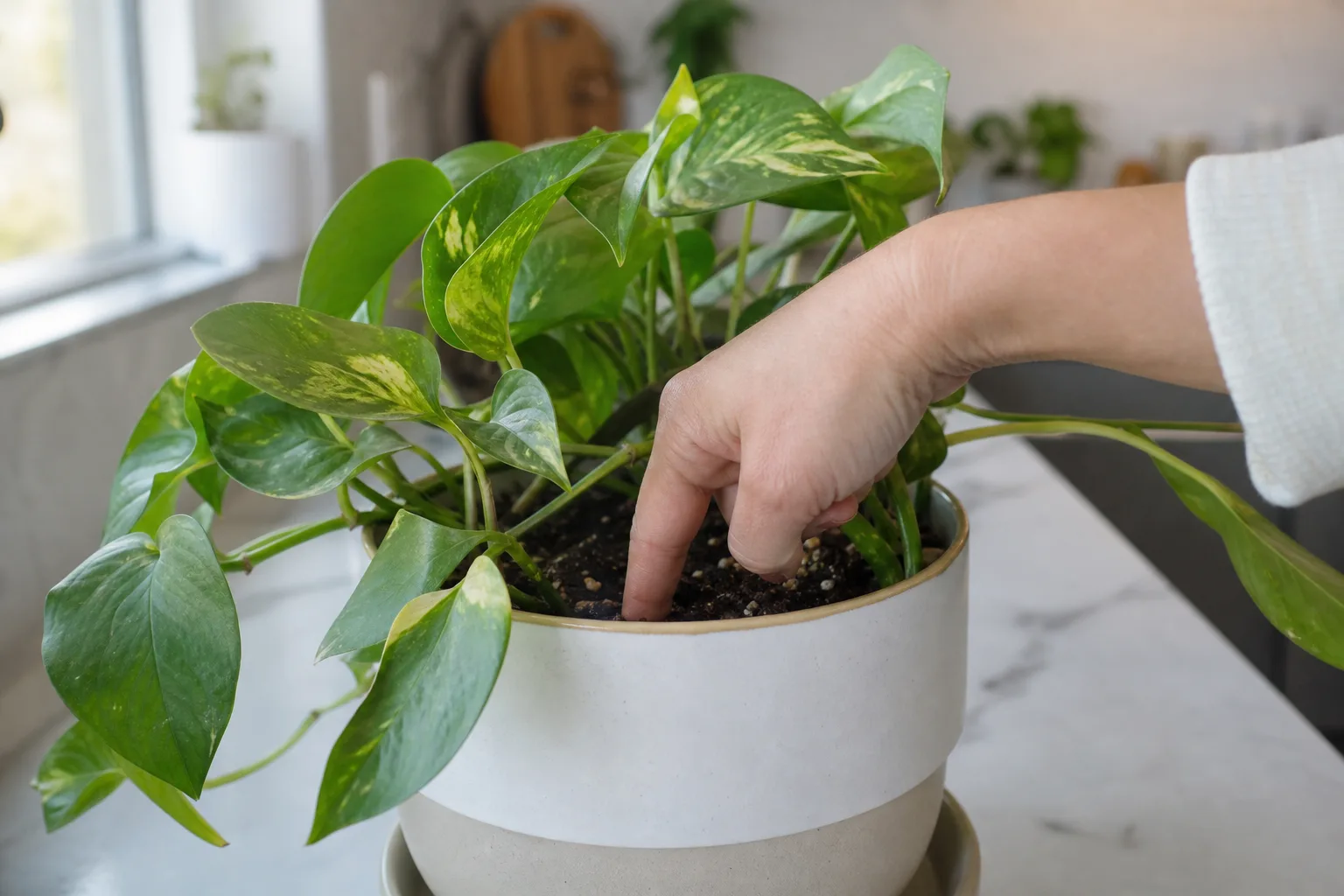
When it is time to water, apply enough to moisten the entire root ball and let excess flow from the drainage holes. Empty the saucer or decorative cachepot after the pot has finished draining. BBC Gardeners’ World gives the same practical rule in its money-tree guide: let the top layer of compost dry before watering and reduce watering in winter, when growth and evaporation slow. (BBC Gardeners’ World Magazine)
Do not pour a small amount onto the center of the pot every few days. That can leave dry pockets at the edges while keeping the trunk area damp. If very dry mix repels water and it runs down the sides, set the nursery pot in a shallow basin for a short period so the mix can rehydrate, then lift it out and let it drain completely.
The Soil and Pot-Weight Decision Rule
Use this sequence whenever you are unsure:
- Check the top few inches of mix, not just the surface crust.
- Lift the pot or compare it with its weight after a full watering.
- Look at the drainage hole if the plant seems to stay wet unusually long.
- Water deeply only when the root zone has partly dried.
- Empty trapped water and record roughly how many days the pot took to dry.
The interval may be every 7–14 days in a bright, warm room or much longer in winter, a low-light office, or a large pot. A fixed schedule is especially risky for money trees because the swollen lower stems can hold water while the roots remain vulnerable to low oxygen in saturated mix.
Soil, Pots, and Drainage
Choose a quality indoor potting mix that holds some moisture but contains enough coarse material to drain freely. A peat-free houseplant mix blended with perlite, fine bark, or another aerating ingredient works well; the goal is structure, not a magic ingredient list. The RHS recommends an open, free-draining compost, while NC State Extension lists peat moss, perlite, loam, or sand among suitable components for a moist but well-drained mix.
Use a nursery pot with actual drainage holes. A decorative pot without holes is a cachepot, not a safe root container, unless the plant is kept in a removable inner pot and excess water is poured out. Do not place a layer of gravel in the bottom of a sealed pot and assume it creates drainage; it simply reduces the volume available for roots while the perched water remains.
Oversized pots are another quiet cause of decline. Move up only one pot size—usually about 1–2 inches wider—when roots have filled the existing container, the mix has broken down, or the plant dries far faster than it used to. The extra soil in a very large pot can remain wet for too long after the surface looks dry.
Temperature, Humidity, and Indoor Placement
Money trees grow best with stable warmth around 65–75°F (18–24°C). Keep the pot away from a cold window at night, a heating vent, a radiator, and a strong air-conditioning stream. NC State Extension lists USDA zones 10–12 for outdoor hardiness and recommends bringing the plant inside before temperatures fall below about 45°F; a container exposed to wind or a sudden cold snap can be damaged sooner than an established tree in the ground.
Humidity helps the leaves stay full, especially in a heated or air-conditioned room, but it is not the first lever to pull. A humidifier or a group of plants can raise local humidity more reliably than occasional misting. A pebble tray is fine as a nearby setup if the pot sits above the waterline, but it must never turn the drainage hole into a standing-water reservoir.
If the room is dry, watch for crispy tips and edges while checking watering, salts, drafts, and sun exposure at the same time. Low humidity is often a stress multiplier rather than the only cause, so raising humidity without fixing a waterlogged mix will not rescue the plant.
Fertilizing a Money Tree Without Salt Buildup
Feed during active growth in spring and summer with a balanced liquid houseplant fertilizer diluted to half the label strength, usually about once a month. Water the plant first if the mix is very dry, because fertilizer solution applied to a desiccated root ball can be harsher than the same dose applied to moist soil.
Reduce or stop feeding in fall and winter when light and growth slow. A money tree in a dim room does not need extra fertilizer to compensate for insufficient energy. Pale growth caused by low light will not be fixed by adding more nutrients, and excess fertilizer can leave salts that burn leaf tips and root tissue.
If a white crust forms on the soil or pot rim, pause feeding and flush the mix with several slow passes of plain water, allowing the pot to drain fully each time. Do this only in a container with good drainage. Persistent buildup, compacted soil, or a pot that drains poorly is a reason to refresh the mix rather than repeatedly flushing the same unhealthy root environment.
Pruning, Braiding, and Size Control
Prune in spring or during another period of active growth to remove dead twigs, damaged leaves, crossing stems, or branches that have outgrown the shape. Use clean, sharp shears and cut just above a leaf node or growth point. University of Georgia Extension’s money-tree guidance recommends limiting a routine cut to no more than about one-third of a stem, a useful ceiling for avoiding a sudden loss of foliage.
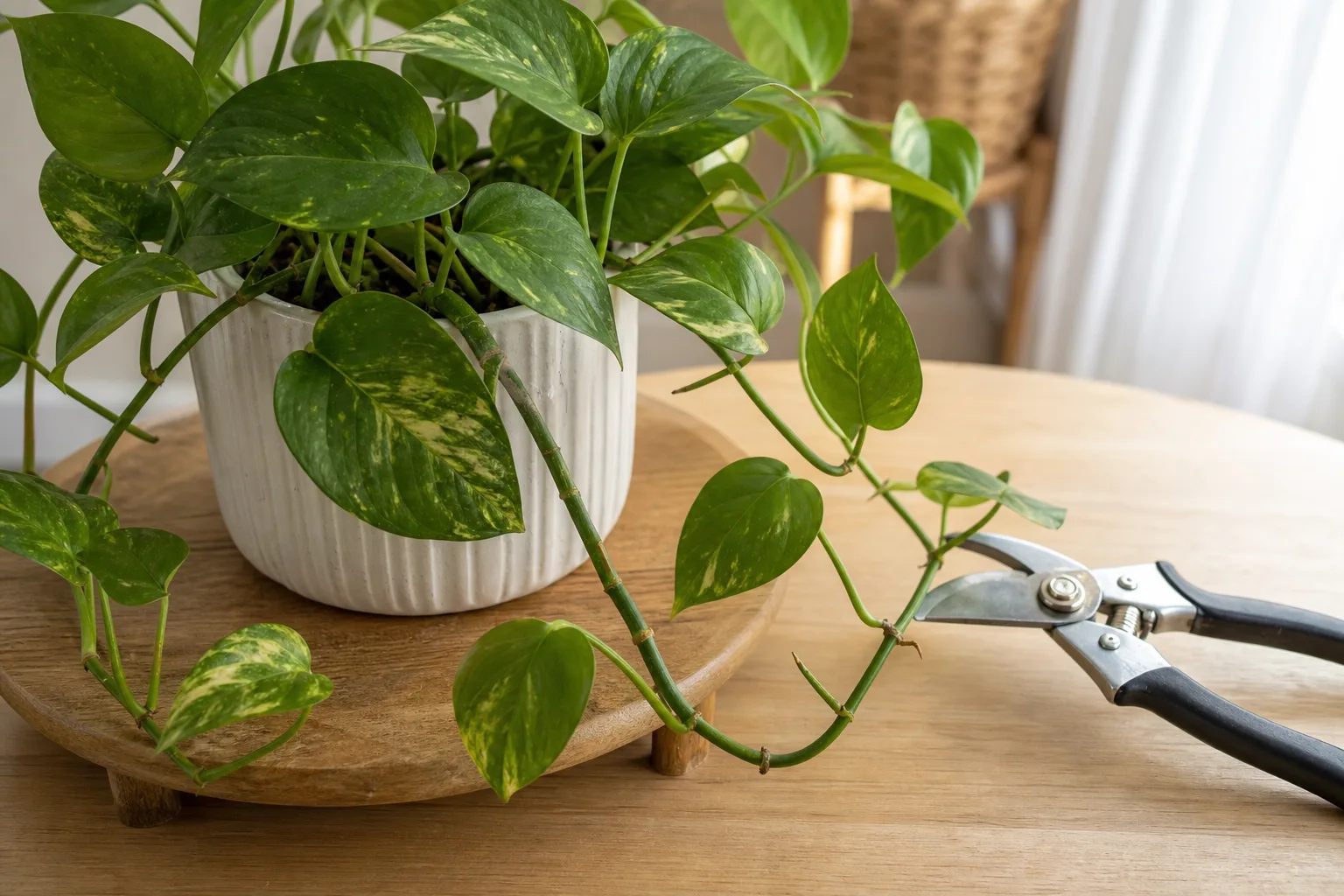
When a money tree is leggy, first improve the light, then prune the longest stems back to a node so new growth can branch below the cut. Do not remove every leaf at once. Leave enough healthy foliage for the plant to keep making energy while it adjusts to the brighter position.
The classic braid is usually made from several young plants or flexible stems. Never tighten a tie as the trunks thicken; a constricting ribbon or wire can cut into living tissue. If the braid is already tight, remove decorative ties carefully and let the stems grow naturally rather than trying to force woody trunks into a new pattern.
Propagating From Stem Cuttings
Stem cuttings are the most practical home method when you want a second money tree or need to save healthy growth above a damaged base. Late spring and summer are the easiest times because warmth and active growth support rooting. Select a firm, healthy shoot with at least two nodes; avoid taking a cutting from a stem that is soft, pest-ridden, or already declining.
- Sterilize the shears and cut a 4–6 inch section just below a node.
- Remove the lower leaves so no foliage sits in water or rooting medium.
- Root the cutting in clean water or a fresh, lightly moist mix of potting medium and perlite; keep it in bright indirect light.
- If using water, change it when it becomes cloudy. If using mix, keep it evenly moist but never saturated.
- Pot the cutting once it has a small bundle of firm roots, then keep the new plant slightly more evenly moist while it establishes.
The RHS lists semi-ripe cuttings, seed, and air-layering as propagation options, and University of Georgia Extension advises sterile medium, warm bright light without direct sun, and transplanting once roots are established. A cutting is a backup plan, not a guarantee: a mature braided trunk may not root as readily as a healthy young side shoot.
Repotting Without Overpotting
Repot when roots circle densely around the root ball, emerge from drainage holes, the mix has collapsed into a dense mass, or the plant dries almost immediately after watering. Spring is convenient because growth is restarting, but root rot and broken-down soil should be addressed when you find them rather than left until a preferred season.
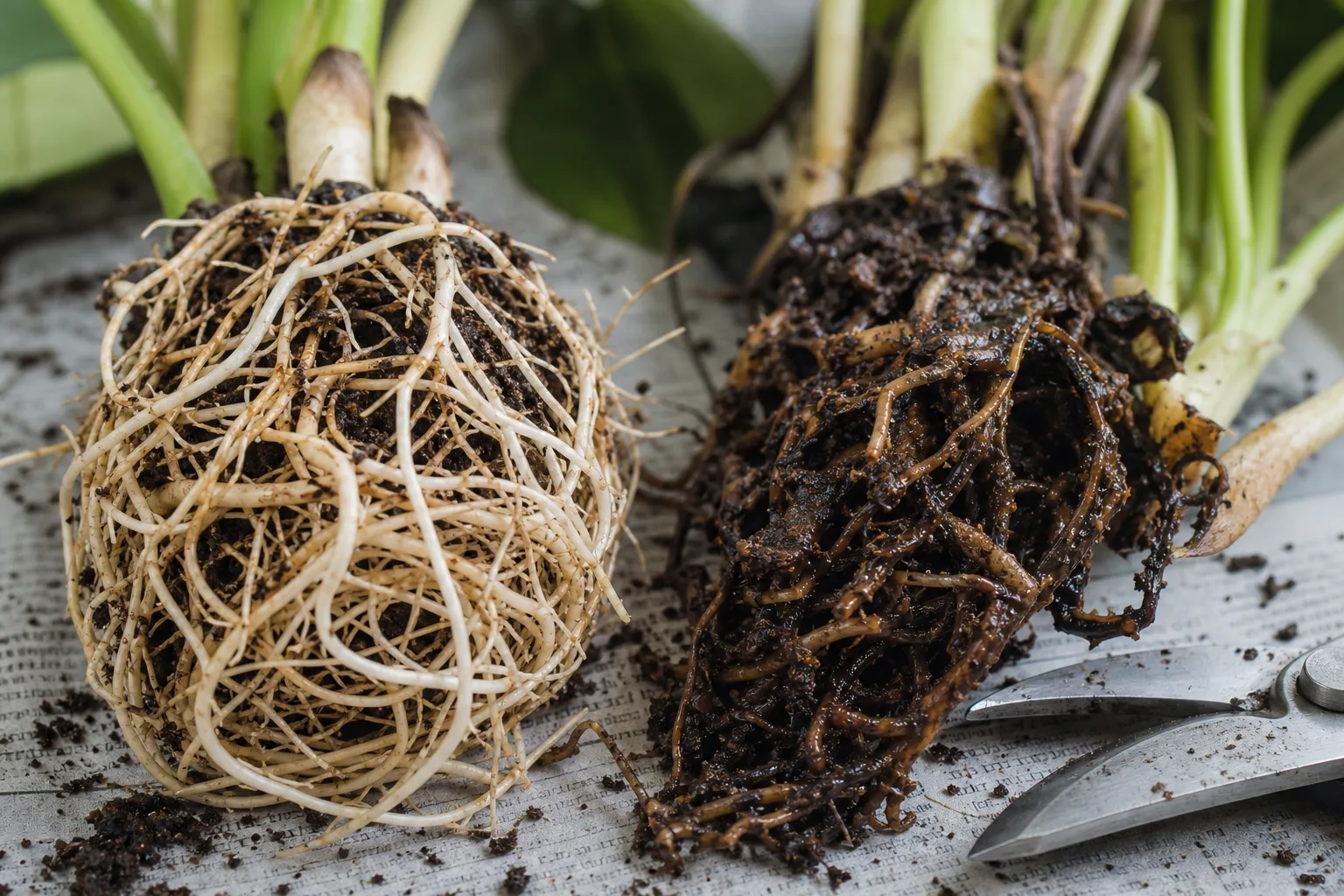
Slide the plant out and inspect before choosing the new pot. Healthy roots are generally firm and light-colored; dark, mushy, foul-smelling tissue needs to be removed with sterile shears. Set the plant at the same depth, backfill with fresh open mix, water once to settle it, and let the pot drain.
For an ordinary houseplant, do not aggressively cut healthy roots just to make a large tree fit a small pot. If you are deliberately maintaining a bonsai-sized plant, root pruning is a separate technique; UGA Extension suggests that no more than roughly one-quarter to one-third of the roots be trimmed when a plant is being returned to a thoroughly cleaned pot. Most money-tree owners will get a safer result by moving up one size and pruning the canopy gradually.
Growing a Money Tree Outdoors and Getting Flowers
In warm, frost-free climates, a money tree can grow outdoors in a sheltered position with bright filtered light, moisture-retentive but well-drained soil, and protection from strong wind. NC State Extension places it in USDA zones 10–12, but a zone label is not permission to leave a container outside through every cold or wet spell. Pots cool and dry differently from garden soil.
To summer a houseplant outdoors, move it first to bright shade for a few hours, then increase outdoor exposure over 7–14 days. Keep it out of harsh midday sun until the leaves have acclimated, check the pot after rain, and bring it indoors before nights approach the plant’s cold limit. Inspect the leaves and drainage holes for pests before bringing it back inside.
Outdoor trees may produce fragrant flowers and fruit in warm conditions, while indoor plants rarely flower. NC State notes that flowering is unlikely indoors or when the plant is braided, so a lack of flowers is not evidence that your indoor care has failed. Give the indoor plant enough light for healthy foliage rather than chasing a bloom with excessive fertilizer.
Money Tree Pests and Early Control
Inspect leaf undersides, leaf joints, and the braided trunk whenever you water. Mealybugs look like white cottony clusters and can leave sticky honeydew; scale looks like small fixed bumps along stems or veins; aphids cluster on tender growth; and fungus gnats are small flies associated with persistently damp mix. NC State Extension lists aphids, mealybugs, scale, and fungus gnats among pests to monitor on Pachira aquatica.
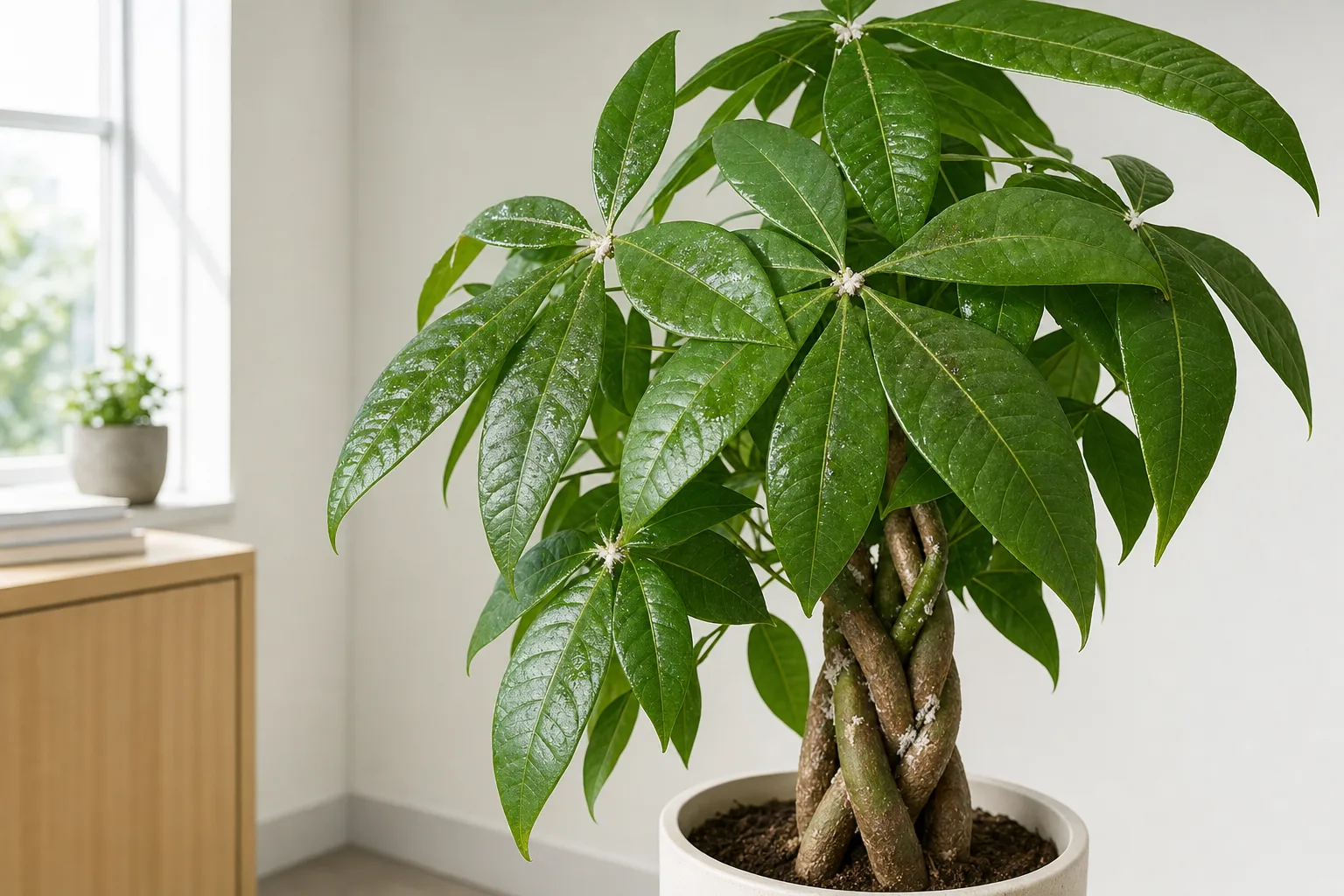
Isolate an infested plant before treating it. Iowa State Extension recommends early scouting, isolation, rinsing, selective pruning, and combining methods rather than relying on one spray. For a few mealybugs, dab the insects with a cotton swab lightly moistened with rubbing alcohol after testing an inconspicuous leaf; for broader infestations, use an insecticidal soap or another product only when the label lists indoor plants and the species, and repeat as directed because immature insects can appear later. (Iowa State University Extension and Outreach)
Do not treat every sticky leaf with neem or pesticide. Sticky residue plus cottony insects, bumps, ants, or black sooty growth points toward sap-feeding pests. Clear droplets without insects may be ordinary plant exudate, but the plant still deserves an inspection rather than an automatic spray.
Common Money Tree Problems and First Fixes
When a money tree declines, check the order that most often reveals the cause: soil moisture, drainage, light, temperature changes, pests, and only then fertilizer. Changing several things at once makes it impossible to tell what helped and can turn a mild stress problem into root damage.
Yellow or Brown Leaves
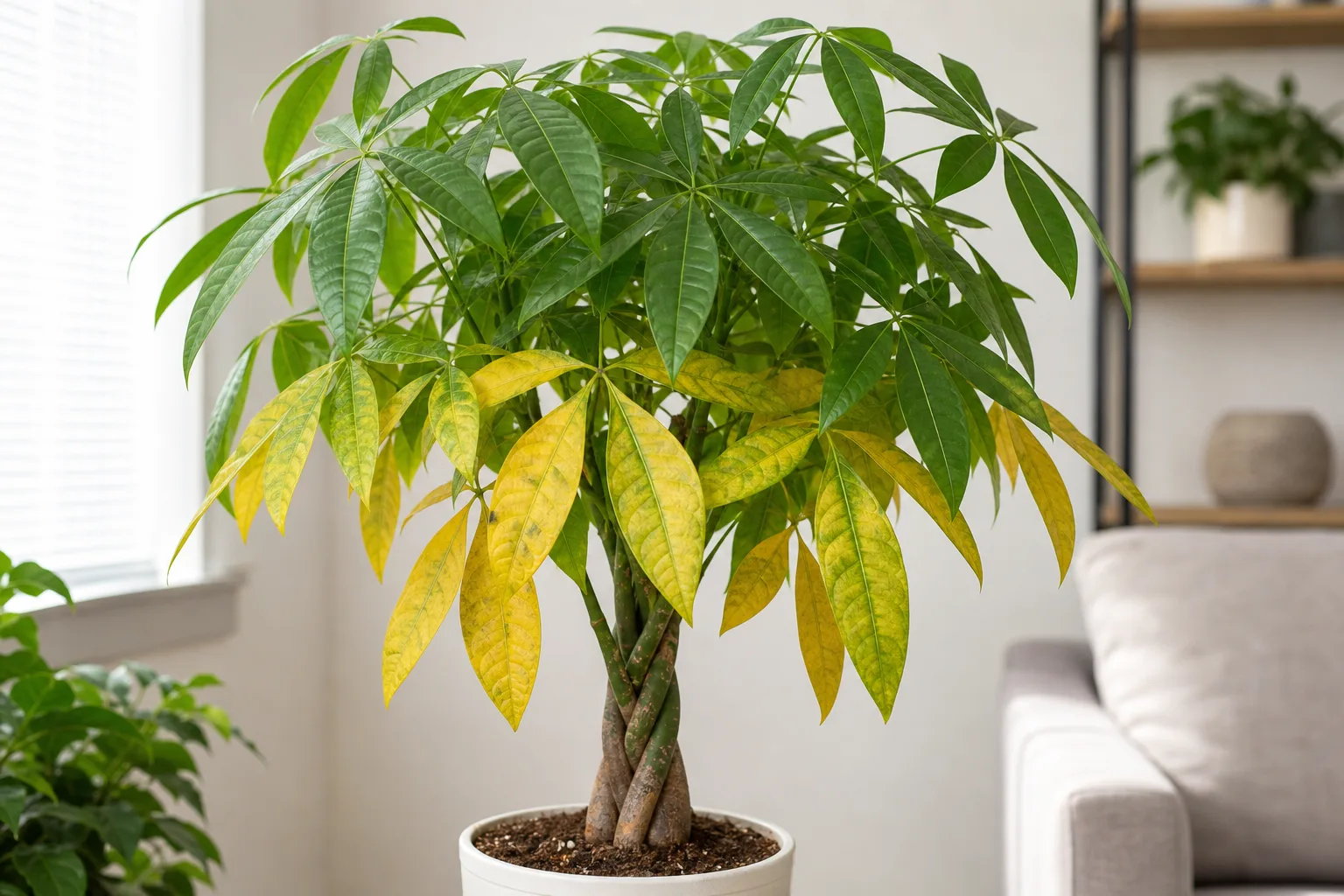
Yellow leaves are a symptom, not a diagnosis. One old lower leaf may simply be aging, but several yellow leaves at once—especially when the pot stays heavy and wet—suggest overwatering, poor drainage, low light, or root stress. Let the mix partly dry, check the drainage hole, and inspect the roots if the soil smells sour or remains wet much longer than it should.
Brown tips and edges have a different pattern. Crispy damage can follow dry spells, low humidity, fertilizer salts, or hot direct sun; brown patches on the window-facing side are more consistent with scorch. Trim only the dead tissue for appearance, then correct the cause so new leaves emerge clean.
Soft Trunk, Wet Soil, and Root Rot
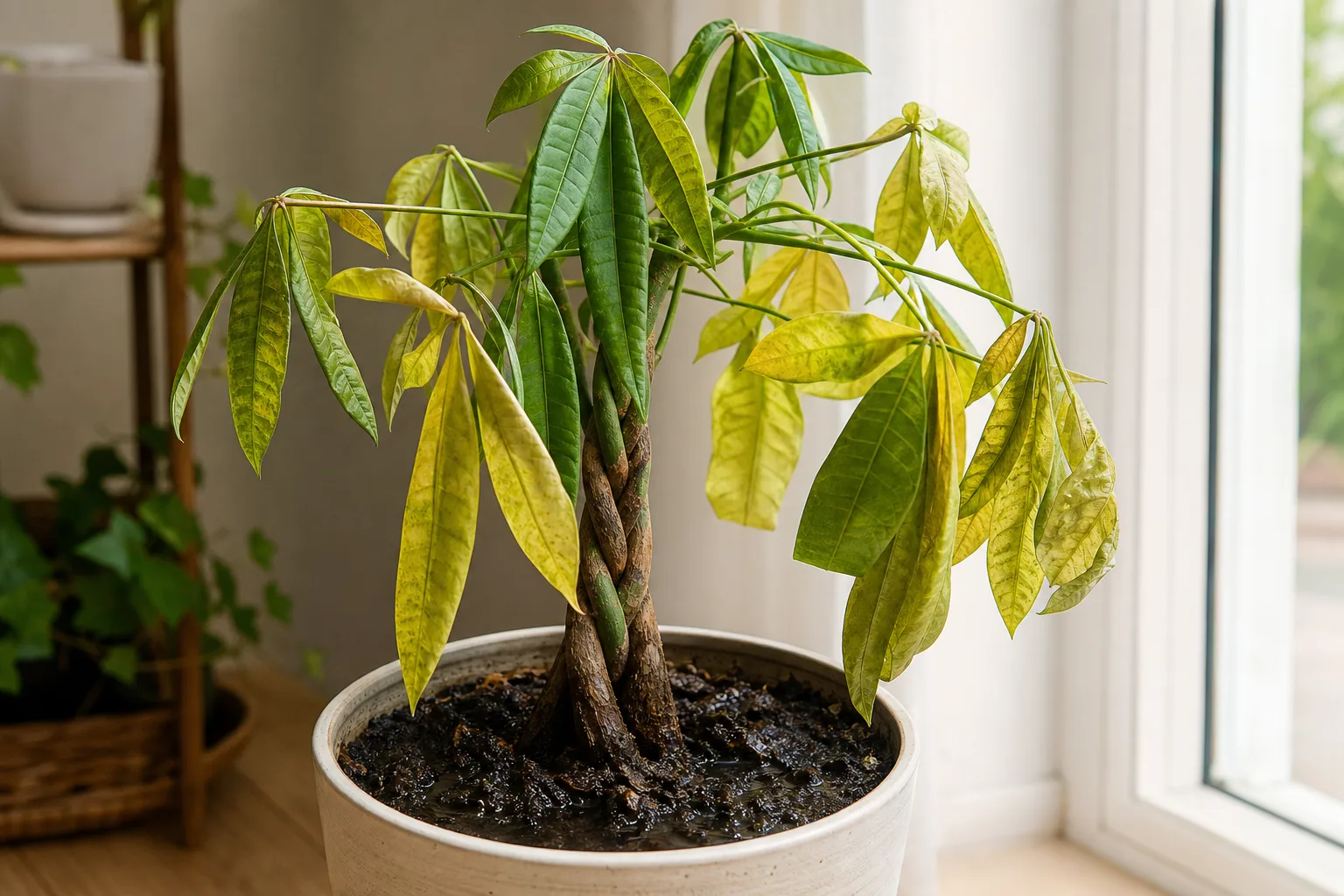
A soft, collapsing trunk base or mushy braided stem is urgent. Stop watering, slide the plant from its pot, and examine the roots; healthy roots should not be slimy, dark, or foul-smelling. Remove dead tissue, cut back to firm material, repot into fresh well-drained mix in a clean pot, and keep the recovering plant in bright indirect light.
If the rot has reached most of the trunk or there are few firm roots left, salvage a healthy upper cutting instead of repeatedly watering the damaged base. Do not seal the plant in a humid plastic cover while the root zone is saturated. Recovery begins with air and a dry-down, not with more moisture.
Leggy growth usually starts with insufficient light, while sudden leaf drop often follows a move, a cold draft, overwatering, or a sharp change in light. Stabilize the plant in one suitable location, improve light gradually, and wait for new growth before deciding it needs more fertilizer or another repot.
Pet Safety and the “Money Plant” Name Problem
The ASPCA lists Pachira aquatica as non-toxic to dogs, cats, and horses, with no toxic principle listed. That does not mean a pet should eat it freely: ASPCA notes that plant ingestion can still be followed by nausea, vomiting, or loose stool, so contact a veterinarian if symptoms appear. (ASPCA Animal Poison Control)
Confirm the botanical identity before relying on a “money plant” label. Jade (Crassula ovata) is also called a money tree in some contexts and has a different pet-safety profile. NC State Extension also flags conflicting information about the seeds of Pachira aquatica, so do not treat the nuts as a snack or use them in food without authoritative species-specific guidance.
Conclusion
The healthiest money trees are not kept on a rigid watering schedule or in the darkest corner because they are labeled easy-care. They are placed in bright indirect light, planted in an open mix inside a pot with drainage, watered when the root zone has partly dried, and protected from drafts, constricting ties, and oversized containers.
If leaves turn yellow, start at the roots and moisture rather than reaching for fertilizer. If the trunk softens, act quickly; if the plant grows long and sparse, fix the light before pruning. With those decisions in the right order, Pachira aquatica can stay a durable, leafy indoor tree long after the gift-wrap and good-luck story have faded.



