How to Grow and Care for Harry Lauder's Walking Stick
Grow Harry Lauder's walking stick with the right light, moisture, and selective pruning, and learn what to check before eastern filbert blight causes dieback.
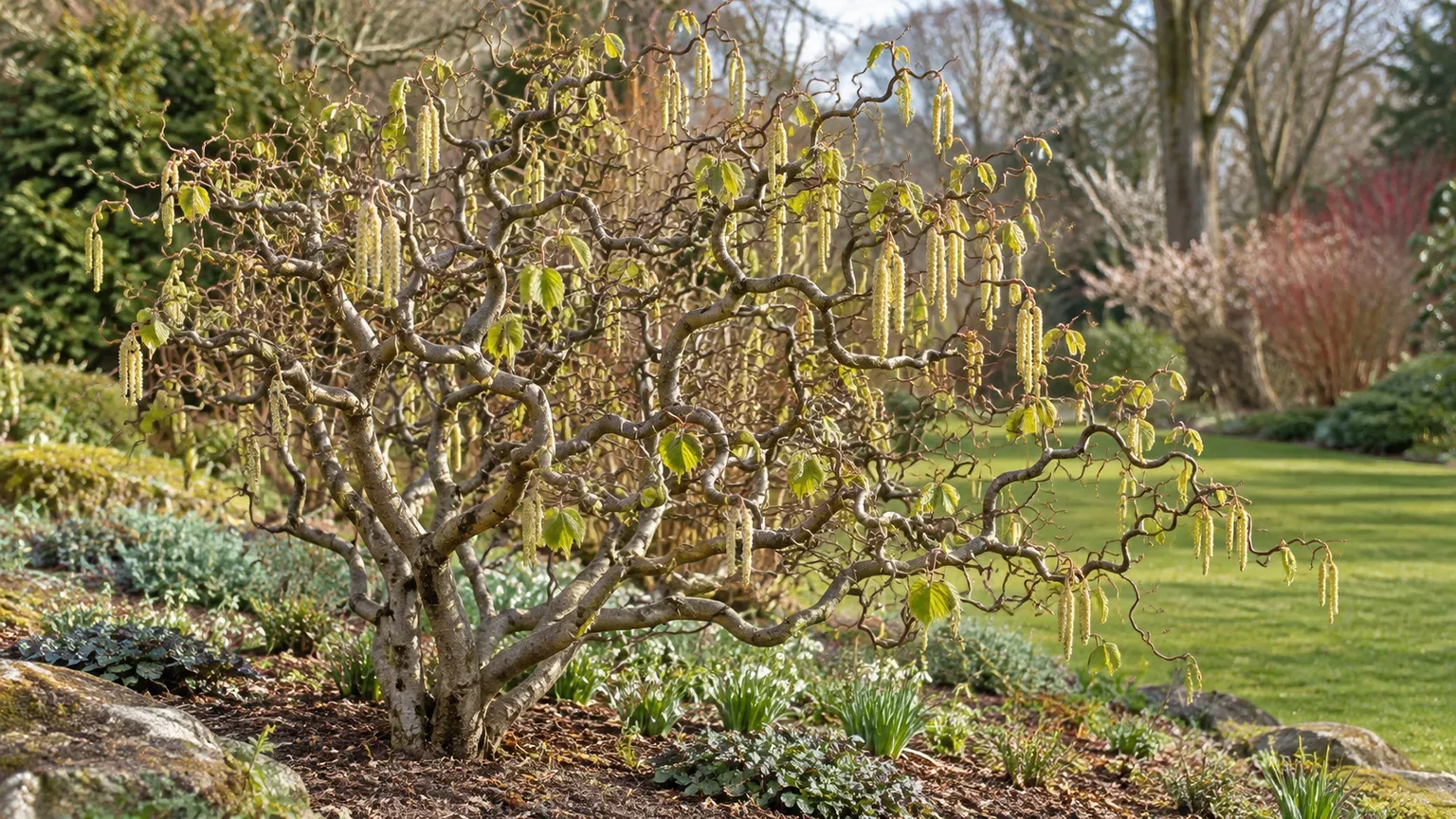
Harry Lauder’s walking stick earns its place by making a bare winter garden look intentional: gray-brown branches twist into corkscrews, then dangling yellow catkins appear before the leaves. The main care challenge is not coaxing flowers or training a perfect shape. It is protecting the plant’s distinctive form while noticing eastern filbert blight early enough to make a sensible decision.
The plant is a cultivar of European hazel, Corylus avellana ‘Contorta’, also called contorted filbert or corkscrew hazel. Most nursery specimens are grafted, which explains why some apparently ordinary shoots can erupt from the base and why indiscriminate pruning can remove the wrong growth. A simple care plan is enough once you know where the graft is and what normal twisting looks like.
What Makes This Contorted Filbert Different
‘Contorta’ is a deciduous ornamental selection, not a separate species of hazel. Its leaves are toothed and slightly crinkled, but the bare framework is the reason most gardeners choose it: the curves remain visible through winter, and long male catkins hang from the branches in late winter or early spring. Duke Gardens notes that the less conspicuous female flowers are tiny red tendrils near buds, so the yellow catkins are the display most people notice first. Duke Gardens’ profile also traces the plant’s history and explains why a grafted specimen can grow as a small tree rather than a multi-stem shrub.
That winter silhouette is both an asset and a diagnostic complication. A naturally bent branch can look gnarled, but a disease can add a localized swelling, crack, or dead tip that does not belong to the cultivar’s normal pattern. The two are easier to separate when you inspect the whole branch from its tip toward the trunk rather than reacting to one dark patch.
Decide Whether It Fits Your Yard
Treat this as a specimen shrub that needs room around its branches, not as a compact foundation plant. The Royal Horticultural Society lists a mature height and spread of about 2.5–4 meters (roughly 8–13 feet), while many U.S. references describe plants nearer 8–10 feet; nursery stock, climate, age, and training account for some of that variation. Allow a similar width unless the grower gives a more precise cultivar-specific size.
| Care factor | Practical target |
|---|---|
| Light | Full sun to partial shade; give hot-summer sites afternoon protection |
| Hardiness | Commonly listed for USDA Zones 4–8; check local heat and winter exposure |
| Mature footprint | Plan for roughly 8–13 feet tall and wide, then confirm the plant tag |
| Soil | Moist but well drained; avoid a hole that stays saturated |
| Water | Regular, deep watering while roots establish; supplement in prolonged drought |
| Pruning | Minimal canopy shaping; identify and remove unwanted rootstock suckers |
Duke Gardens and Epic Gardening place the plant in roughly Zones 4–8, but hardiness zones describe winter minimum temperatures, not comfort through hot, humid summers. In a hot region, choose a site with morning sun and some afternoon shade, keep the root zone evenly moist, and ask a local nursery whether the cultivar performs reliably in your area. If you cannot give it a broad, visible planting spot, a narrower shrub will usually be easier to manage.
Pick a Site for Catkins, Curves, and Healthy Roots
A position with full sun or partial shade supports steady growth; open light also makes the twisty branches easier to see. In mild climates, a sunny border works well. Where summer heat is intense, light afternoon shade reduces stress without hiding the plant in deep shade. Epic Gardening recommends at least six hours of sun for best growth, while the RHS accepts both full sun and partial shade.
Choose a location where winter viewing is part of the design. A spot beside a path, near a window, or against a calm evergreen background lets the stems read clearly after leaf fall. Keep the mature spread away from walls, narrow walkways, utility lines, and shrubs that will swallow the canopy; give yourself access to inspect the graft union and prune without squeezing through a thicket.
Plant It Shallow and Water the Root Ball In
Plant in fall or early spring when the soil is workable and temperatures are moderate. Dig a broad hole no deeper than the root ball, loosen circling roots if they are present, and set the plant so its root flare sits at the surrounding soil line. If the specimen is grafted, keep the graft union above ground; burying the union can encourage the scion to root or make it harder to recognize shoots that belong to the rootstock.
Backfill mostly with the soil you removed rather than creating a rich, soft pocket that holds water differently from the surrounding ground. Water slowly after planting to settle soil around the roots, then add a thin mulch layer over the root zone without piling it against the stems. Practical planting guidance from MyGardenLife’s contorted filbert profile likewise emphasizes planting in cool seasons, a wide planting area, and keeping the soil line at the plant’s root flare.
Water by Soil Condition, Not a Weekly Script
A newly planted shrub needs consistent moisture while it makes roots beyond the nursery root ball. Water deeply enough to moisten the root ball and nearby soil, then check again before watering; a fixed daily schedule can drown roots in slow-draining clay or leave a sandy site dry during hot, windy weather. The top few inches of soil are a useful starting check, but probe beside the original root ball too because the ball and surrounding ground can dry at different rates.
After establishment, the plant is more forgiving of short dry periods, but it is not a desert shrub. Give it a deep soak during extended dry spells, especially when leaves wilt in the morning or the soil below the mulch is dry. If leaves droop only at the hottest part of a heat wave and recover by evening, check moisture before adding water; heat stress and drought can look similar, and saturated roots will not improve with another drink.
For a container, check moisture more often than you would in the ground. Wind, sun, and a limited soil volume speed drying, while a saucer full of standing water can keep the root ball airless. Use a large pot with drainage holes and empty any cachepot or tray after watering.
Keep Soil Moist but Well Drained
The useful target is moisture without stagnation. The RHS lists chalk, loam, and sand as suitable soil types when drainage is good, and it accepts acid, neutral, or alkaline pH. The species can struggle in dense clay that stays waterlogged, so judge the site after a heavy rain rather than trying to fix a drainage problem with a watering adjustment.
If water remains in the planting hole for a long time, plant on a broad raised mound or choose another location. Do not fill a small clay hole with a very different potting mix; the surrounding soil still controls how water leaves the root zone. A two- to three-inch layer of organic mulch helps moderate soil temperature and conserve moisture, but keep a clear gap around the base so bark stays exposed and dry.
Skip Routine Fertilizer
A healthy plant growing at a steady pace usually does not need an annual feeding. If leaves are unusually pale, shoots are weak, or growth has stalled, first check drainage, planting depth, drought, and root damage; fertilizer cannot correct those problems. A soil test is a better reason to add nutrients than an assumption that every shrub needs a spring boost.
If a test shows a deficiency, use a product suited to woody ornamentals at the labeled rate and timing. Avoid heavy nitrogen applications: lush, fast growth is not the goal for a slow-growing specimen whose fine branch structure is its main feature. Epic Gardening’s growing guide also advises against routine fertilizer in fertile soil and warns that excessive feeding can produce weak growth.
Prune for Structure, Not a Round Silhouette
This is not a plant to shear into a ball. Its value comes from individual lines and knots, so pruning should remove growth that competes with the contorted framework rather than flattening the whole canopy. The RHS lists ‘Contorta’ in its light-pruning group and says routine pruning is generally unnecessary; make corrections gradually, because heavy cuts can take years to grow back on a slow-growing shrub.
First identify the graft union
Look at the lower trunk for a change in bark, a swelling, an angled join, or a change in stem direction. That boundary is where the contorted cultivar (the scion) was joined to a different rootstock. Duke Gardens notes that a quick examination can reveal the union on a grafted specimen; some plants, however, grow on their own roots, so not every sucker is automatically a different plant.
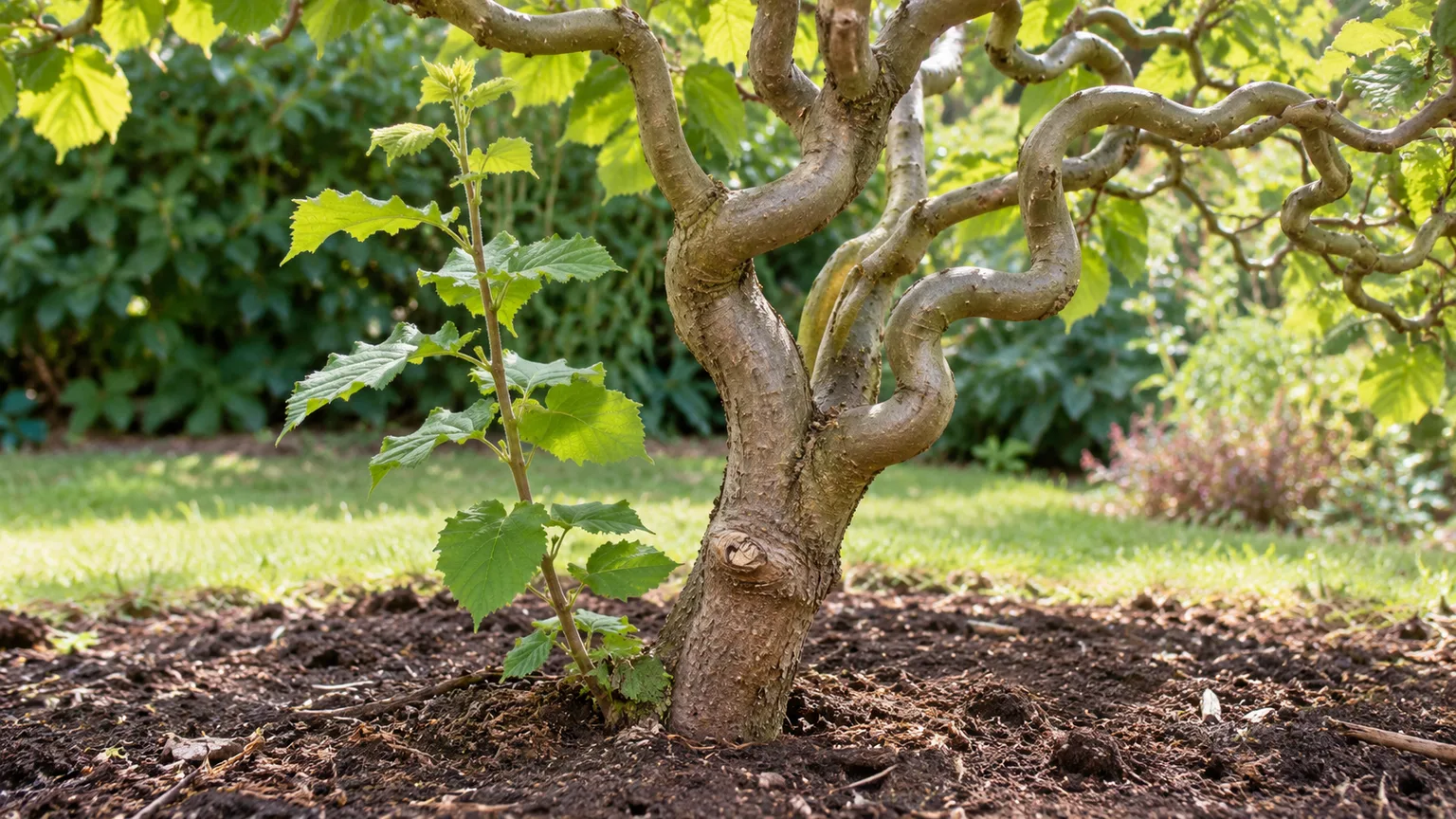
A straight shoot that begins below the graft union is usually rootstock growth and will not develop the desired corkscrew form. A shoot emerging above the union belongs to the named cultivar unless it is a reversion or damaged growth; watch how its leaves and branches develop before cutting.
If the union is hidden under soil, gently brush soil away until you can see the trunk base instead of guessing and removing every upright stem. When buying, ask whether the plant is grafted: Gardening Know How recommends an own-root specimen to avoid straight shoots from a separate rootstock, although an own-root hazel may still make suckers that carry the contorted form.
Remove rootstock suckers and preserve the twisted canopy
On a grafted plant, remove confirmed rootstock suckers at their point of origin as soon as practical. Use sharp bypass pruners for a small shoot or a pruning saw for a larger one, and cut close to the attachment without slicing into the trunk or leaving a tall stub. Topping a sucker halfway up often leaves buds that resprout, so the goal is to remove the shoot at its source rather than keep shortening it.
On an own-root specimen, a basal shoot may carry the contorted trait and can be kept as a replacement stem if the shrub is sparse. Remove it only if it crowds the shape or expands the footprint beyond what you want. That distinction is why the advice to “remove every sucker” is too broad: the right choice depends on whether the plant is grafted and where the shoot begins.
For discretionary shaping, wait until the catkins have released pollen if preserving that winter display matters to you. Leafless late winter makes the branch structure easy to read, but pruning then can remove catkins and buds you were hoping to enjoy. Dead, broken, or clearly diseased branches are different: remove them promptly, and follow local extension advice if you suspect a contagious canker.
Monitor for Eastern Filbert Blight
Eastern filbert blight is the most consequential disease to understand before you plant this cultivar. It is caused by the fungus Anisogramma anomala and can kill susceptible European hazels, including contorted filbert. Purdue Landscape Report explains that the disease may be hidden for months before symptoms appear, and that the contorted silhouette can disguise the branch changes that would be more obvious on a straight-stemmed shrub.
Look for cankers beyond normal contortions
Inspect the shrub once or twice a year, especially during leafless weather when you can trace each branch. Normal cultivar growth bends smoothly along the length of a stem; a canker is a localized abnormal area that may swell, crack, darken, or sink into the bark. Watch for dead tips above a lesion and small raised black fruiting structures on older cankers. A few rough spots alone do not diagnose the fungus, so compare the whole branch and avoid cutting into the bark to “check.”
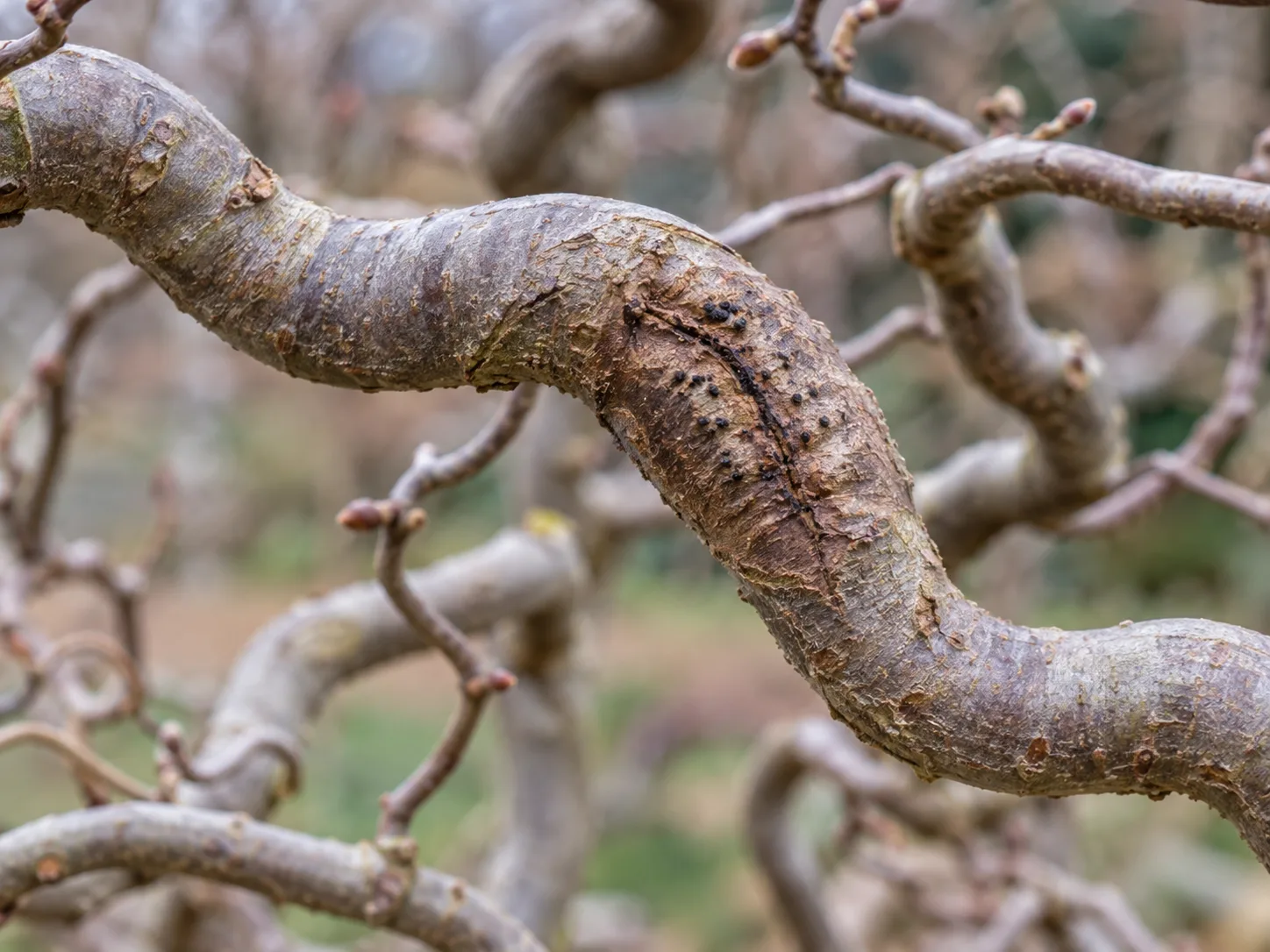
Purdue reports that spores can move to other plants on wind and can spread within a plant through splashing water. That means distance from a visibly diseased hazel is not a reliable guarantee of safety, and a clean-looking shrub can still be in an early stage. If you see progressive dieback, multiple swollen lesions, or black structures, photograph the branch and ask a local Extension plant clinic or qualified arborist to help confirm the diagnosis.
Make a realistic response plan
If a professional or Extension service confirms early disease on a limited branch, prompt removal below the visible canker may slow damage. Purdue notes that pruning has to extend several inches below discolored wood; on a contorted specimen, that can remove much of the very architecture you bought it for. Do not make repeated large cuts on a hunch, and ask how the affected wood should be disposed of in your locality.
When cankers reach major scaffold branches or the trunk, there may be no practical way to retain an attractive, structurally sound specimen. Purdue also cautions that preventive fungicide use would require repeated applications through the growing season, which makes it an unrealistic rescue plan for many home landscapes. If replacing the shrub, Oregon State University identifies ‘Red Dragon’ as an ornamental filbert with twisted stems that is resistant to eastern filbert blight; resistance lowers risk, but it is not a promise of immunity. Oregon State’s cultivar profile is a useful reference when comparing alternatives.
Handle Leaf Damage and Other Pests
A plant can have leaf damage without having eastern filbert blight. Japanese beetles chew leaves into a lacy, skeletonized pattern, while scale insects look like small fixed bumps on stems or leaf undersides and may leave sticky honeydew. The NC State Extension profile for European hazel lists Japanese beetles and several diseases among issues seen on the species; use it as species-level context, not proof that every symptom on this cultivar has the same cause.
For a small number of Japanese beetles, hand-pick them into soapy water or knock them into a container early in the morning when they move slowly. For scale, first confirm that the bumps are insects rather than normal buds or bark texture; prune a badly infested small twig if that solves the problem. If you consider horticultural oil, insecticidal soap, or another pesticide, choose a product labeled for the plant and pest in your location and follow its label—broad spraying can harm beneficial insects and will not fix a fungal canker.
Leaf spots should be assessed separately from branch dieback. Remove fallen, heavily spotted leaves, water at soil level where practical, and keep nearby growth from pressing tightly against the canopy. If a spot pattern spreads or branches begin dying, take a clear sample or photos to Extension rather than cycling through fungicides based on guesswork.
Protect Winter Interest and Understand the Flowers
The shrub is deciduous, so its annual rhythm is part of the point. Leaves emerge in spring and provide textured green cover; they usually turn yellow in autumn before dropping. The bare stems then become the main feature, followed by yellow male catkins in late winter or early spring. RHS describes the catkins and branching as a specimen shrub with interest across the year, while Duke Gardens notes that small red female flowers are easy to miss.
You may see a few nuts in a good season, but this ornamental selection is not a dependable hazelnut crop. Nuts, when they form, are often sparse and may be taken by wildlife; choose a productive hazelnut variety if harvesting is the main goal. You can also cut a few slender contorted branches for a winter arrangement, but harvest selectively so the shrub keeps enough of its framework for next season’s display.
Choose a Variety, Propagation Route, or Container Carefully
‘Contorta’ is the classic green-leaved form. ‘Red Majestic’ adds burgundy new foliage and pinkish catkins, while ‘Red Dragon’ combines twisted stems with burgundy buds and leaves. If eastern filbert blight is common in your region, put resistance ahead of leaf color and ask a local nursery which cultivar has performed well nearby; a resistant selection is a risk-reduction choice, not a disease-proof guarantee.
Most garden plants are grafted, so a seedling will not reliably reproduce the named cultivar, and a sucker below the graft is the rootstock rather than a clone of the contorted top. The RHS lists grafting or layering as propagation methods, but grafting requires matching the desired scion to a suitable rootstock. For most home gardeners, buying a correctly named plant from a reputable nursery is more dependable than trying to raise a true-to-type specimen from seed or a basal shoot.
A large patio container is possible, but it asks more of you than an in-ground planting. Epic Gardening suggests a 20- to 25-gallon pot as a starting scale; that is a substantial planter, not a promise that the plant will stay permanently small. Choose sturdy drainage, use a free-draining woody-plant mix, water more often than an in-ground shrub, and protect the pot from severe root-zone freezes. If you cannot lift, insulate, or eventually upsize the container, plant in the ground instead.
Conclusion: Keep the Signature Form, Protect the Shrub
Give Harry Lauder’s walking stick a visible, well-drained site with room for its eventual spread, then water the root ball deeply while it establishes. Once it is growing, the best pruning is usually restrained: identify the graft, remove only the shoots that do not belong, and keep the graceful twists rather than forcing a compact shape.
The one inspection worth building into your routine is a winter look at the branches for progressive cankers and dieback. A rough stem may simply be the cultivar doing what it does; a localized crack or swelling with dead growth deserves a closer check. If blight is confirmed, make decisions from the extent of infection rather than from wishful spraying or a drastic cut that strips away the plant’s reason for being.



