4 Warning Signs Your Fiddle Leaf Fig Is Craving More Sunshine
Yellow leaves, leggy stems, slow growth, or leaf drop? Diagnose low light in a fiddle leaf fig and correct the setup step by step.
The fastest way to tell if light is the problem
Look at the pattern of change, not one imperfect leaf. A fiddle leaf fig that has been short on usable light usually changes slowly: new leaves arrive smaller or farther apart, the plant leans toward one window, growth pauses, and older leaves become easier to shed. Those clues become much more persuasive when several appear together.
Light is also easy to misjudge indoors. A room can feel bright to you while the plant sits in a corner where the leaves receive very little direct or reflected daylight. Before you change the potting mix, add fertilizer, or water more often, compare the plant’s newest growth with its older growth and inspect the soil, roots, window, and undersides of leaves at the same time.
The four warning signs below are useful clues, not standalone diagnoses. Yellow leaves can come from wet roots, brown patches can come from sunburn, and sudden leaf drop can follow a draft or a move. The goal is to identify whether light is the main limiting factor and then correct it without creating a second stress.
How much light does a fiddle leaf fig need?
An indoor fiddle leaf fig (Ficus lyrata) belongs in the brightest practical area of the home, with strong light reaching as much of the canopy as possible. The New York Botanical Garden recommends the brightest room while protecting the leaves from harsh direct rays, and the RHS plant profile lists full or filtered light for plants grown under glass. That is a better indoor rule than treating “indirect” as synonymous with dim.
The plant’s outdoor and indoor needs can sound contradictory because they describe different conditions. UF/IFAS lists fiddleleaf fig as a full-sun-to-partial-shade tree outdoors, while an indoor plant that has lived behind a window may scorch if it is placed abruptly in strong afternoon sun. Glass, heat, reflection, season, and acclimation all change the experience of “full sun.”
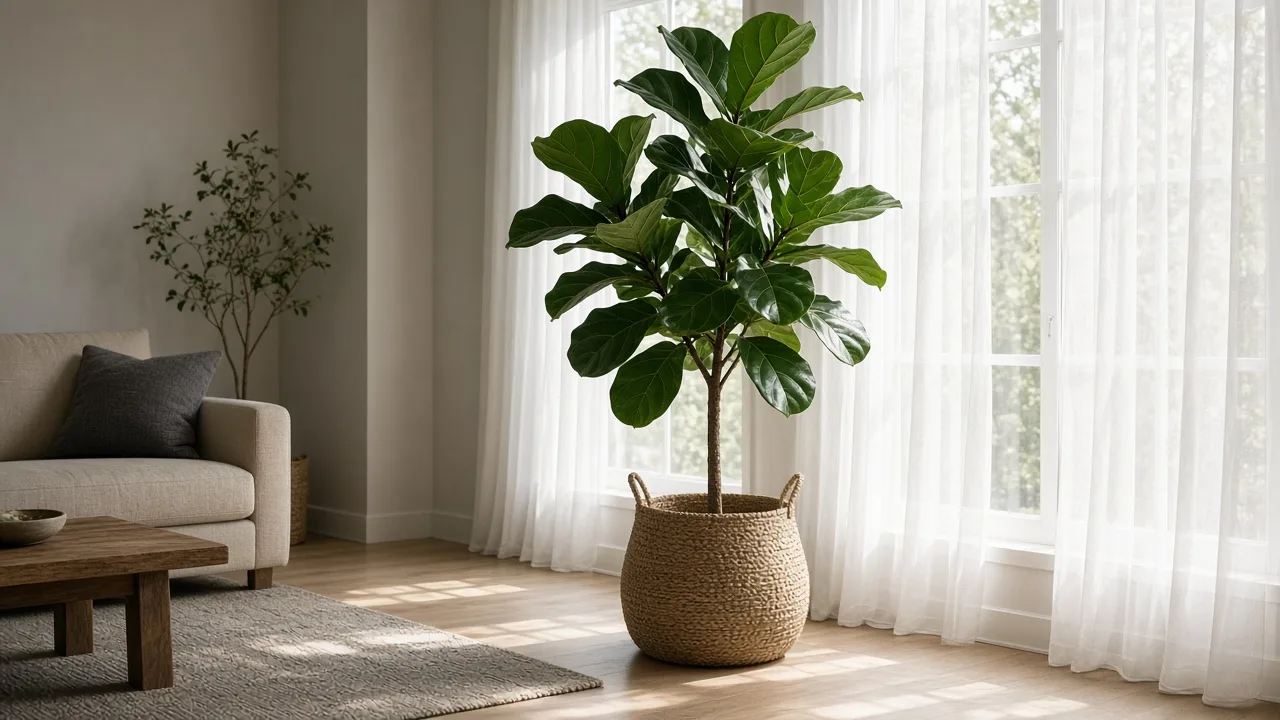
The most useful target is bright, stable, and usable light for much of the day, with protection from sudden heat or unfiltered midday glare. Your fig should be able to “see” a bright window or open sky, not just a pale wall several feet away. In a dim room, a broad-spectrum LED grow light can supplement or replace daylight; a decorative lamp that merely looks bright to you may not deliver enough light to the leaves.
Caption: A bright room only helps when usable light reaches the plant’s leaves; distance from the glass matters.
Judge the window, not the room
Window direction is a starting point, not a guarantee. An unobstructed south- or west-facing window can deliver intense light and heat, while trees, balconies, neighboring buildings, tinting, screens, blinds, and deep overhangs can turn the same exposure into a weak one. An east-facing window often offers gentler morning sun, but a small east window in a shaded apartment may still be inadequate.
Use this as a placement framework rather than a rigid formula:
| Window or setting | What it can offer | Practical fiddle-leaf fig approach |
|---|---|---|
| East-facing | Gentle morning sun followed by bright daylight | Often the easiest place to start; watch new growth and keep the plant close enough to see the sky |
| South-facing | The strongest all-day exposure in many homes | Use a sheer curtain or step the plant back if direct rays heat or bleach leaves; winter may be gentler |
| West-facing | Bright, hot afternoon light | Filter or move farther from the glass, especially in summer; inspect for crisp patches |
| North-facing | The least intense natural window light in many homes | May work only with a large unobstructed window, reflective surroundings, or supplemental light |
| Several feet into a room | Light drops quickly with distance | Test the actual plant position; a “bright” room can be too dark at the pot |
Light powers photosynthesis, so it affects more than color. The RHS explanation of plant light connects inadequate light with weak, pale, and spindly growth because the plant cannot make enough sugar to support vigorous new tissue.
Warning sign 1: Lower leaves turn yellow or fall
One yellow lower leaf is not an emergency. Older leaves naturally age, and a fig may shed an isolated bottom leaf after a move, a seasonal change, or a small care mistake. The warning sign is a pattern: several lower leaves yellowing over a short period, leaves dropping while the plant is also stretching, or a canopy that is thinning from the bottom upward.
In low light, the plant has less energy to maintain every leaf. It may keep the youngest leaves at the top, where they are closer to the window, while gradually abandoning shaded lower foliage. NYBG’s fiddle-leaf fig guide notes that lower leaves can age naturally, but that a larger wave of lower-leaf loss can signal lost vigor; it also lists inadequate light among the conditions worth checking.
Do not expect a fallen leaf to return. Your useful question is whether the next leaves stay firm and green after the light is corrected. If the plant is otherwise stable, new growth is a better progress marker than trying to restore a damaged older leaf.
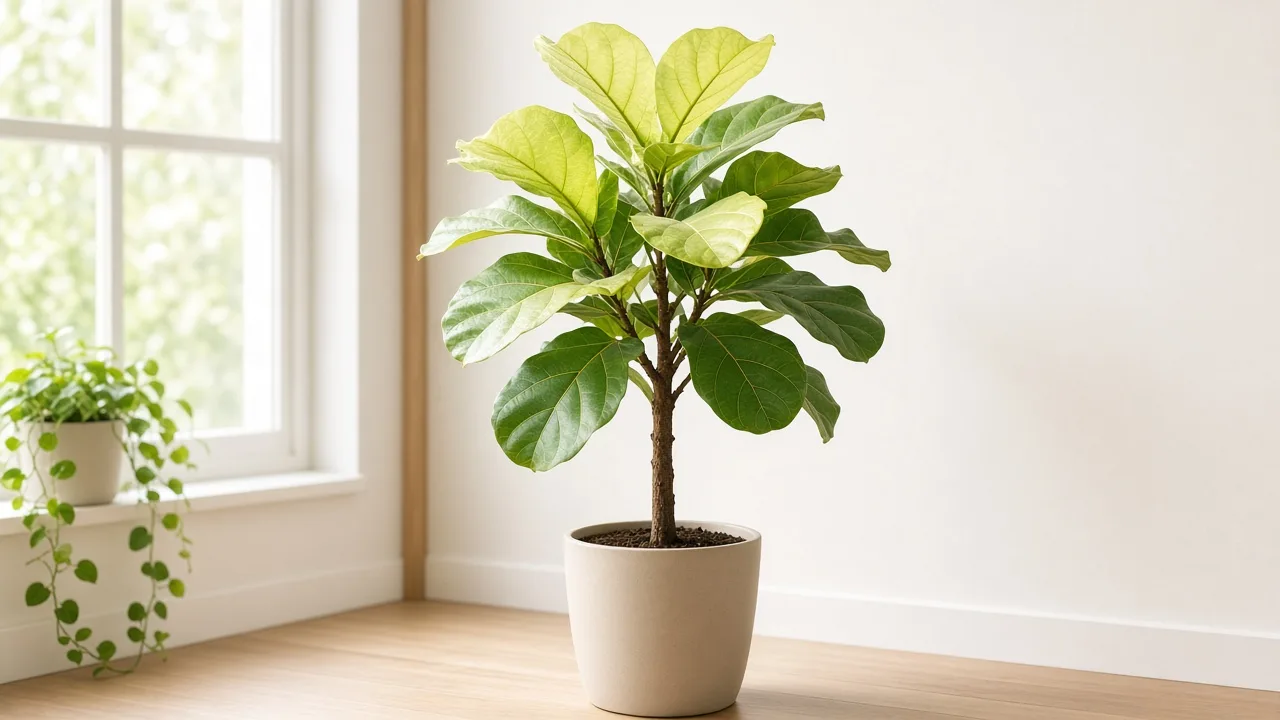
Caption: Pale new leaves are a useful signal to inspect light, but not proof that light alone is the problem.
Separate low-light yellowing from wet-soil trouble
Low light and overwatering often travel together. When a plant sits in a dim spot, it uses water more slowly; if you continue watering on the old schedule, the root zone can stay wet for too long. That means “move it to more light” may help, but only if you also stop treating the calendar as the watering signal.
Check the soil at root depth, not just the surface. If the top couple of inches are still damp, the pot feels unusually heavy, drainage is slow, or the mix smells sour, hold off on more water and inspect the drainage hole. Soft, dark roots, a persistently wet center, and yellowing that begins low in the canopy point more strongly toward root stress than light alone.
Low-light yellowing is more plausible when the soil is drying normally, the plant is noticeably leaning, leaves on the window-facing side look stronger than leaves in the shade, and new growth is small or widely spaced. If yellowing appears with sticky residue, fine webbing, cottony clusters, or distorted new leaves, inspect for pests before changing the light.
Warning sign 2: New growth is small, pale, or far apart
New leaves tell you about current conditions more reliably than old leaves do. A young fiddle-leaf fig leaf can emerge lighter green and deepen in color as it hardens, but repeated flushes of unusually small, pale, thin, or widely separated leaves suggest that the plant is not receiving enough energy to build its characteristic canopy.
Look at the spacing between leaf attachment points, called internodes. If the newest section of stem has noticeably longer gaps than the older section, the plant is trying to place leaves where they can intercept more light. This is a growth response, not a sign that fertilizer is automatically missing.
A brighter location can improve future leaves, but it cannot enlarge leaves that have already finished expanding. Give the plant several weeks of stable conditions before judging the result. During that time, avoid stacking changes such as repotting, hard pruning, heavy feeding, and a major watering overhaul; too many simultaneous corrections make the real cause harder to identify.
Dust can make the situation worse. Fiddle-leaf fig leaves have a large surface area, and a film of dust reduces the light reaching the leaf surface. Wipe each leaf gently with a damp, clean cloth when needed; do not coat foliage with oil or leaf shine, which can leave a stronger light-blocking film and irritate the leaf surface.
Warning sign 3: Stems stretch and lean toward the window
A stem that bends toward the nearest window is giving you a physical light reading. If the plant has long bare stretches, weak side branches, and leaves concentrated at the brightest end, it is likely receiving light from too narrow an angle or at too low an intensity. The NYBG guide specifically links long, widely spaced limbs and an unstable trunk with inadequate light.
This is called etiolated or leggy growth. It is not the same as a naturally bare lower trunk on an older tree, nor is it fixed by simply tying the stem upright. A stake can prevent a top-heavy plant from falling, but the plant will keep producing sparse growth until more usable light reaches the canopy.
The shaded side of a large plant deserves special attention. A window may illuminate the upper leaves while the lower leaves sit behind the pot, furniture, or the plant’s own canopy. Raise the pot on a stable stand if the lower leaves cannot see the window, move obstructions, or add a side light aimed at the shaded portion.
Rotate the plant, but do not confuse rotation with a fix
Rotating the pot a quarter turn after watering helps distribute light and prevents one-sided growth. It does not increase the total light available in a dim corner. Rotation is a balance tool; relocation or supplementation is the correction.
Rotate gradually rather than spinning a stressed plant daily. A small change every couple of weeks, or a quarter turn at a consistent watering check, is usually easier for the plant to tolerate and makes it simpler to observe which side is producing new growth. If the plant is already leaning heavily, support it while you improve the light rather than forcing the stem upright in one move.
Warning sign 4: Growth stalls even though the plant is alive
A fiddle leaf fig can remain green for months while making almost no new growth in a marginal location. That survival mode is easy to mistake for a healthy plant because there is no dramatic collapse. In reality, a dormant-looking canopy, no fresh bud movement during a season when the plant normally grows, and a slow loss of lower leaves can mean the light budget is too small.
The RHS ornamental-fig guide lists poor new growth or small pale leaves among the symptoms associated with inadequate light, while also warning that other issues—such as overwatering, low winter temperatures, excess fertilizer, and drafts—can cause leaf drop. That overlap is why stalled growth should trigger an audit, not an automatic fertilizer dose.
Check whether the plant is warm enough, whether the pot drains freely, whether the roots are circling tightly, and whether pests are feeding on the newest leaves. If those factors look reasonable and the plant is still in a deep room corner, light becomes the leading suspect. Move one variable at a time and record the date so you can compare new growth after a month rather than relying on memory.
Brown leaves are not automatically a low-light sign
Brown tissue is a location and texture clue. Dry, papery patches on the window-facing side after a sudden move into strong sun point toward scorch; brown edges with a dry root ball point more toward water stress or dry air; soft, spreading brown spots with wet soil raise concern about root or leaf problems. Low light can contribute to decline, but it is not the only explanation.
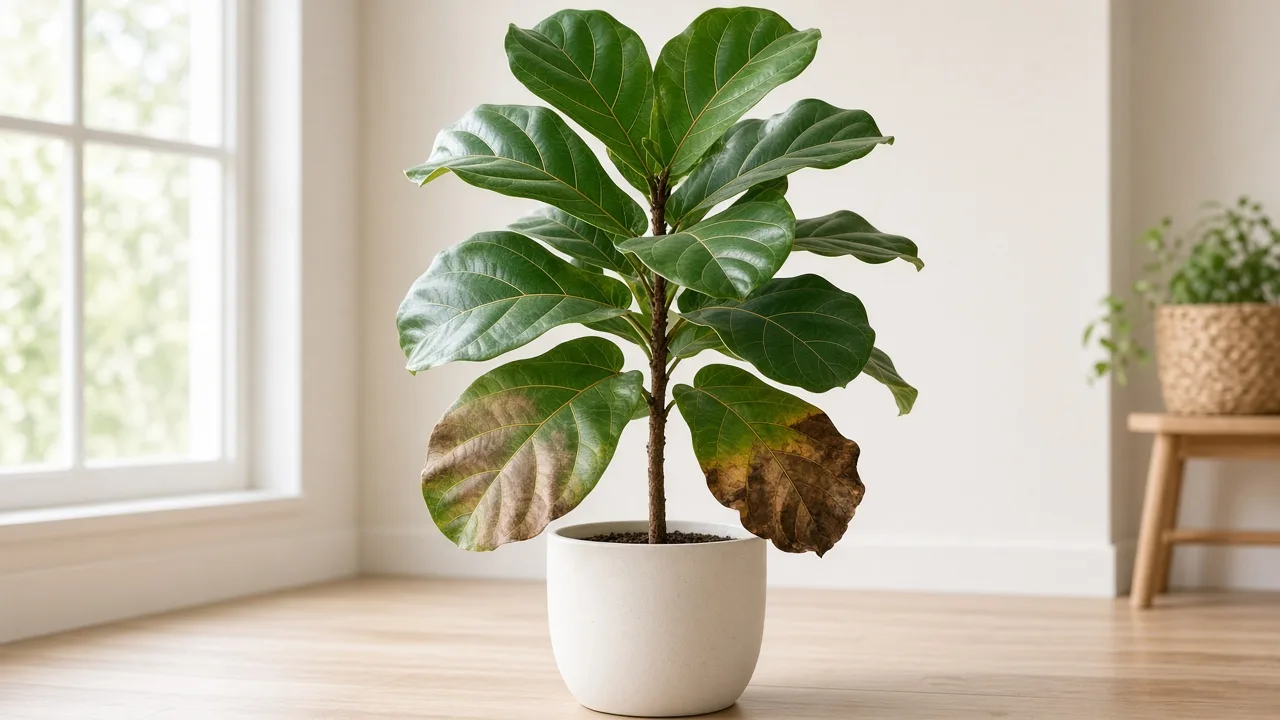
Caption: Brown patches need pattern-matching before you decide whether to add or reduce light.
Before moving a brown-leaf fig into brighter sun, ask three questions. Did the damage appear on the side facing the glass? Is the tissue crisp and bleached, or soft and dark? Was the plant recently moved, repotted, chilled by a draft, or kept wet? The Costa Farms fiddle-leaf fig care notes make the same practical distinction: insufficient light, excessive light, water, and temperature can all produce overlapping leaf symptoms.
Sunburned tissue will not turn green again. Prune only the dead or badly damaged portion once the plant is stable, and leave healthy green tissue in place so the leaf can continue contributing energy. If there is no new damage after the light is corrected, the old brown patches are a cosmetic record of the earlier stress, not evidence that the current placement is failing.
Do a five-minute light audit before moving the pot
Photograph the plant from the same angle, note the window direction, and record how many hours the leaves receive direct sun or bright open-sky light. Then look for obstructions: sheer curtains, blinds, tinted glass, an outdoor tree, a deep overhang, a nearby wall, or furniture that shades the lower canopy.
Next, inspect the whole plant rather than only the front. Turn leaves over for pests, check the soil several inches down, feel whether the pot drains after watering, and note whether the plant is leaning. A low-light diagnosis is strongest when the placement is dim, the growth is stretched or stalled, and the root-zone findings do not explain the decline better.
Do not use a fixed “three feet from the window” rule without considering the window. Three feet from a clear south window can be much brighter than three feet from a shaded north window. The correct distance is the one that gives the canopy enough usable light without prolonged scorching, and it may change between summer and winter.
Use a phone light meter carefully
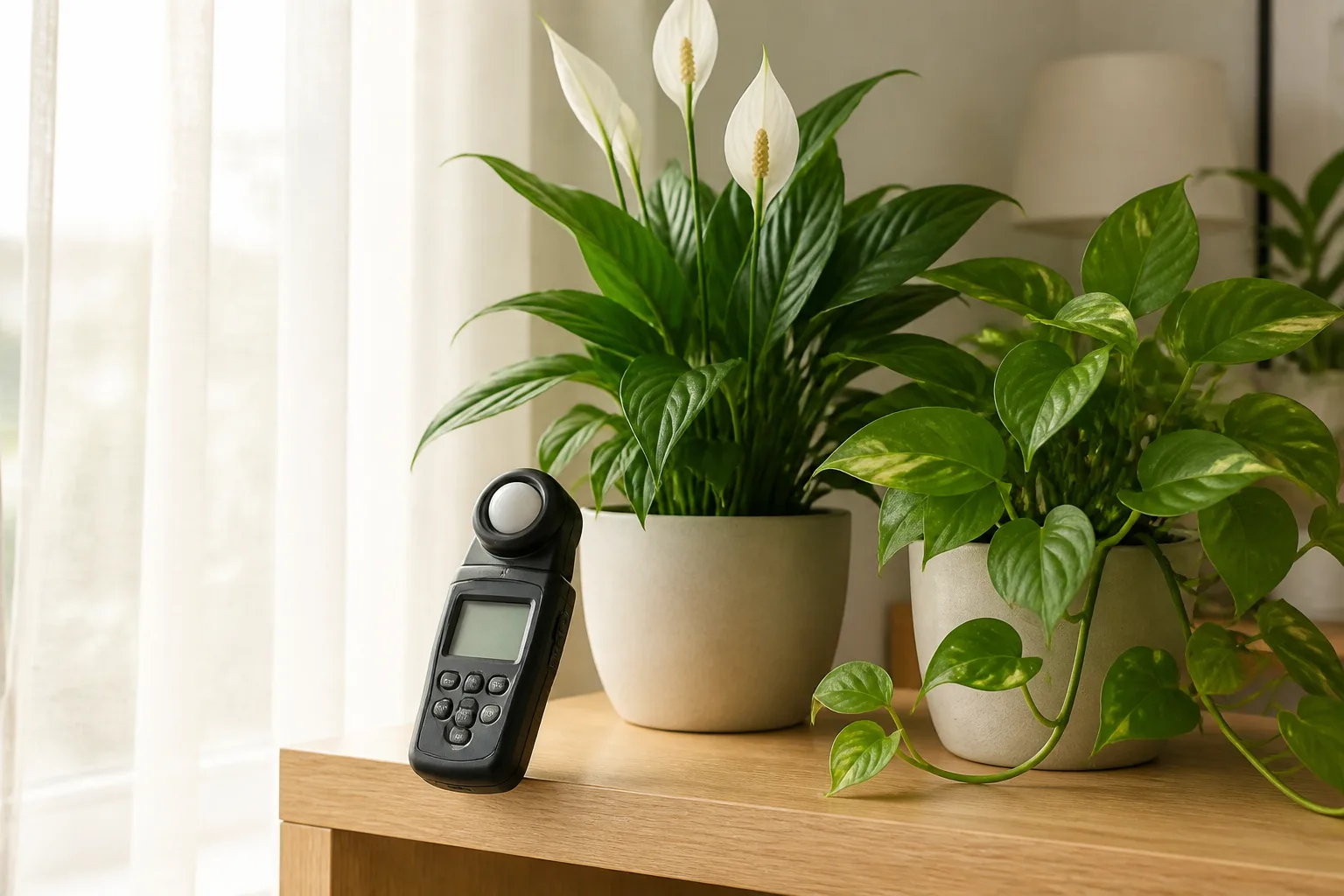
Human eyes adapt so quickly that they are poor light meters. UF/IFAS explains that a space near a window can be many times brighter than a nearby room that still looks bright to us, and it recommends a simple digital meter or a phone app as a practical estimate rather than relying on appearance alone. Take readings at the canopy, not at the window, and measure at a similar time of day when comparing locations.
Treat phone readings as comparative, not laboratory-grade. Use the app to answer “Is spot A brighter than spot B?” and “Did the curtain reduce the light?” rather than chasing one universal number for every fiddle-leaf fig. Cloud cover, camera calibration, window glass, and the app’s measurement method can all shift the result.
Correct low light in the right order
Start with the least disruptive correction that can solve the problem:
- Remove avoidable shade. Move the plant out from behind furniture, open the curtain, clean the window, and make sure the lower canopy can see the light source.
- Improve the position. Move toward a brighter east, south, or west exposure, using a curtain or some distance from the glass when the rays are intense.
- Acclimate. Increase exposure over days or weeks instead of making a dramatic same-day jump.
- Supplement. Add a broad-spectrum LED when natural light is inconsistent or the best window cannot supply enough.
- Rebalance water. Let the root zone dry at an appropriate rate for the new light instead of keeping the old calendar.
- Prune later. Once new growth is healthy, shorten only the bare or awkward sections you truly want to reshape.
This order matters because pruning a low-light plant removes leaves that are still making energy, while fertilizer cannot compensate for a missing energy source. The plant needs a stable light improvement before it can use extra water or nutrients productively.
Acclimate the plant to a brighter window
If your fig has been in a dim corner, begin near the brighter window but out of the strongest direct beam, or use a sheer curtain. After several days, extend the brighter exposure if the leaves remain firm and free of new bleached or crisp patches. The exact pace depends on the current light, season, window glass, outdoor climate, and the plant’s history, so use the leaves as your feedback.
For an outdoor summer move, start in bright shade or gentle morning light. Increase sun gradually while protecting the pot from wind, checking moisture more often, and keeping the plant away from a hot wall or reflective patio. UF/IFAS describes fiddleleaf fig as a full-sun-to-partial-shade tree outdoors, but an indoor specimen still needs the transition that an outdoor-grown tree has already experienced.
Do not place a recently moved fig against hot glass and assume brown leaves mean it needs even more sun. If leaves curl, bleach, or develop dry tan patches on the exposed side, step back, filter the light, and let the plant stabilize before trying again.
Use a grow light when windows fall short
A grow light is a sound solution when the brightest window is still too dim, winter days are short, or the plant must live away from glass. UF/IFAS explains that plants can grow entirely under appropriate artificial light and that LEDs are efficient, low-heat options; a broad-spectrum or cool-white fixture is a practical starting point.
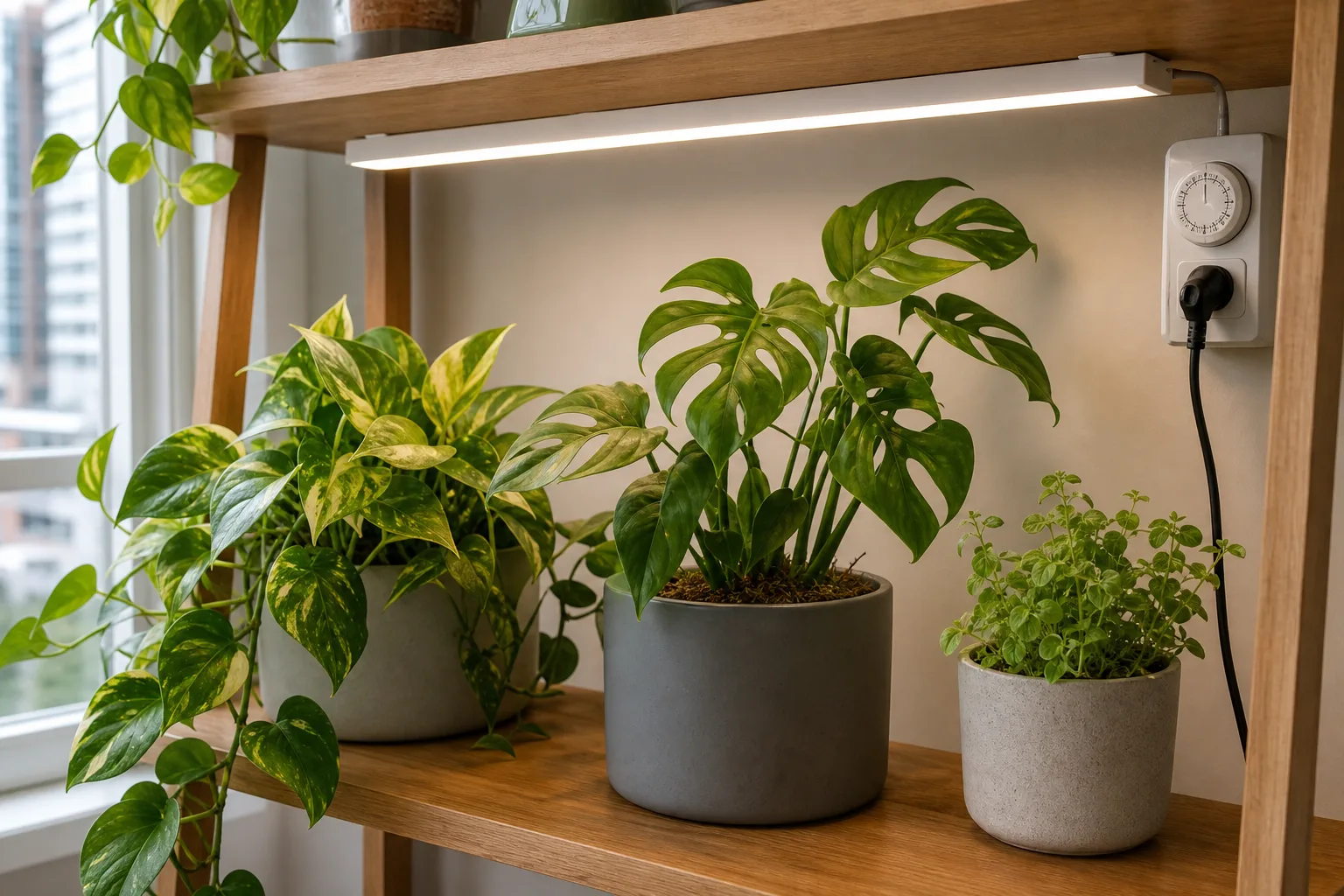
Place the fixture so it lights the whole canopy rather than only the top leaf. Follow the manufacturer’s distance and timing guidance, start conservatively, and watch for bleaching, curling, or heat buildup. A light several feet away may look brilliant to you while providing little at the leaves, so adjust by observing new growth and, when possible, comparing readings at canopy level.
Run the light on a consistent timer with a dark period. More hours are not always better: the goal is a repeatable daily supply that supports photosynthesis without drying or heating the foliage. If the fixture cannot cover the plant’s width, use a second source or turn the plant periodically so one side is not permanently shaded.
Rebalance watering after moving the plant
More light usually means faster water use, but the adjustment is not “water immediately after moving.” First check the root zone. Water thoroughly only when the upper layer has dried to the depth appropriate for the pot and season, allow excess to drain, and empty the saucer or cachepot. The NYBG guide recommends waiting until the top two inches feel dry and emphasizes that winter low light can slow water uptake.
For the first two weeks after a move, check the soil more frequently than usual without watering on autopilot. A brighter, warmer window may dry the surface quickly while the center stays wet, especially in a large pot or dense mix. Conversely, a drafty winter window can make leaves lose water while the cold root ball remains damp; moving the pot away from the draft may matter as much as moving it closer to light.
Do not use fertilizer as a rescue for pale leaves before the light and roots are checked. Fertilizer salts can add stress to a plant that is already unable to use water normally. Once the plant is growing again and the light is adequate, resume a restrained feeding routine suited to the product label and active season.
When a brighter spot is the wrong first move
Pause before moving the plant if the newest leaves have sharply defined bleached patches, the potting mix is saturated, the plant was just repotted, or the room has a cold or hot draft. Those clues call for correcting the immediate stress first. A plant with damaged roots may not be able to handle a major light increase until drainage and root health are addressed.
Also look for pests. Scale, mealybugs, thrips, and spider mites can weaken growth, distort new leaves, and create yellow or brown marks that resemble a light problem. Inspect leaf undersides, petioles, and stem joints with a bright light; isolate the plant if you find an infestation, and identify the pest before choosing a treatment.
Another exception is a plant that has just arrived from a nursery or spent time in a low-light store. Its foliage was produced under one set of conditions, and a sudden home placement can cause stress even if the new spot is ultimately right. Give it a stable transition, avoid moving it around every day, and judge the health of new leaves rather than expecting instant cosmetic improvement.
Choose another plant when the room cannot change
Fiddle-leaf figs are rewarding when the room can supply their light, but they are a poor match for a deep, permanently shaded corner if you do not want to use a grow light. Keeping one alive in that spot may mean accepting sparse growth, lower-leaf loss, and a plant that never develops the full canopy you pictured.
Choose a plant whose natural light tolerance matches the room instead. Cast-iron plants, snake plants, pothos, some dracaenas, and certain palms can be more forgiving in lower light, although “low light” still means some daylight and does not mean no light. A plant that fits the site will usually need fewer emergency corrections than a sun-hungry fig forced into a dark corner.
Conclusion
The clearest signs that a fiddle leaf fig needs more sunshine are progressive lower-leaf yellowing or drop, small or pale new leaves, stretched and leaning stems, and stalled growth. None proves low light on its own, so pair the visual clue with a soil check, pest inspection, window audit, and look at recent temperature or placement changes.
Give the plant the brightest stable light you can, protect it from abrupt scorch, rotate for balance, and add a suitable LED when natural light cannot do the job. Then adjust watering to the new drying rate and wait for clean new growth. Old brown or fallen leaves may never recover, but a healthier light budget can change what the plant produces next.
Caption: Recovery shows first in clean, firm new growth; older damaged leaves will not turn green again.