How to Trim a Palm Tree Safely: Timing and Cuts
Learn how to trim a palm tree without scalping it: identify dead fronds, choose the right season, make clean cuts, and know when to hire an arborist.

The safest way to trim a palm tree is to remove only material that is fully dead, broken, diseased, or creating a clear hazard. A healthy green frond is not excess foliage to thin away, and a palm should not be shaved into a feather duster just because a bare trunk looks tidy.
Before cutting, identify the palm, look at the whole crown, check what could fall, and decide whether you can do the work from stable ground. Height, nearby structures, utility lines, sharp leaf bases, local rules, and the weight of the fronds matter more than confidence. If the work requires climbing or puts you under a falling frond, hire an ISA-certified arborist.
The short answer: trim only for a clear reason
Palm pruning is usually maintenance, not a growth treatment. Remove a completely brown frond if it hangs over a walkway, roof, pool, driveway, or seating area; is likely to fall; blocks visibility; or is trapping debris. You can also remove a flower stalk or fruit cluster when its litter, weight, or seedlings create a practical problem.
Leave healthy green fronds alone, even when they arch downward or make the canopy look crowded. Partly yellow or brown leaves need diagnosis before removal because they may still be photosynthesizing or recycling nutrients to newer growth. UF/IFAS explains that an ideal palm has a rounded crown with green leaves down toward the bottom, not a stripped crown.
The useful decision is not “Does this palm look messy?” It is “What specific tissue needs to come off, what risk does it create, and can I remove it without damaging the growing point or putting myself beneath it?” If you cannot name the reason for a cut, pause.
Decide what the palm is telling you before cutting
Walk all the way around the palm and look up into the crown from several angles. Note fronds that are detached or hanging, broken petioles, stalks touching a building, fruit over a hard surface, signs of pests, and a center spear that looks loose, collapsed, or discolored. A palm can have one dead frond that needs removal and several yellowing leaves that should stay.
Brown, yellow, green, and damaged are not the same
Fully brown and dry usually means the frond has completed its useful life. If it is accessible and safe to remove, it is the clearest pruning candidate. A brown tip on an otherwise green frond is different: trimming the tip only changes appearance and does not solve drought, salt, wind, cold, nutrient, pest, or disease stress.
Yellowing or orange-spotted older leaves deserve caution. Palms move mobile nutrients such as potassium from older leaves toward new growth when supplies are inadequate. Removing a discolored leaf too early can move the visible symptom upward into leaves that were still green. Treat the underlying nutrition, drainage, or root problem according to the palm’s species and local extension guidance rather than using pruning as a diagnosis.
Green leaves that point down are normally part of the working canopy. Downward angle is not proof that a frond is dead, dangerous, or ready to cut. If a palm has only a few green leaves left after drought, cold, transplanting, or previous over-pruning, keep those leaves unless they are broken or directly hazardous.
Frayed or torn leaves can follow wind, ice, dry air, mechanical contact, pests, or disease. Gardening Know How notes that frayed tips are often cosmetic and do not automatically require removal; if damage is limited to exposed leaflets, wait for the cause and the weather to settle before deciding whether the entire frond is expendable. (Gardening Know How)
Palm structure changes the pruning rules
Palms are not branching shade trees. Their leaves emerge from a central growing point at the top of the trunk, so cutting cannot be used to create new branches lower down. Removing too much canopy reduces photosynthetic capacity, and repeated over-pruning can leave a palm with smaller leaves and a less substantial trunk.
The visible trunk may also include leaf bases or palm boots. Those rough pieces are not automatically trash to shave away. Cutting or tearing into the trunk makes a permanent wound and creates an entry point for pathogens and pests. The correct finish is clean and selective, not aggressively scraped.
Crownshafts and self-cleaning palms need less help
A crownshaft is a smooth, often green section where tightly clasping leaf bases form a collar at the top of the trunk. On many crownshaft palms, an old leaf turns brown and drops naturally when the palm is healthy. If a dead leaf is not creating a hazard, letting the palm shed it can be the best pruning plan.
Other palms hold dead fronds against the trunk or form a skirt of old leaf bases, so some manual cleanup may be normal. Even within that group, species vary. A Mexican fan palm may retain a skirt while young and become more self-cleaning as it matures; a pindo palm can keep rough leaf-base stubs that should not be cut flush. Identify the palm before applying a generic “clean trunk” rule.
Choose the best time by reason, weather, and location
There is no universal month when every palm benefits from pruning. The palm itself can tolerate selective removal of fully dead material whenever the work is safe, while climate changes what should remain for protection. UF/IFAS’s current palm-pruning guidance likewise makes timing secondary to palm type, health, and the reason for the cut. In a warm, frost-free region, routine dead-frond or stalk cleanup can be scheduled around the tree’s growth and the site’s litter or access needs.
The practical timing rule is simple: act promptly for a real falling or clearance hazard, but delay cosmetic cuts when weather or tree stress makes the remaining canopy valuable. A dead frond over an open lawn can wait for a safe dry day; the same frond over a front door deserves earlier attention, preferably by a professional if it is high.
A seasonal timing guide for warm, cold, and storm-prone climates
| Situation | Better timing | What to do |
|---|---|---|
| Routine dead fronds in a warm climate | A dry, calm day when reachable | Remove only fully dead or dangerous material |
| Before hurricane or monsoon season | Inspect early, then prune selectively | Clear loose dead material and structure contact; do not strip healthy leaves |
| After a windstorm | Once the site is safe | Remove hanging hazards; retain partly damaged leaves if they still provide useful canopy |
| After frost or a cold snap | Wait until the threat of more cold passes | Leave damaged leaves as temporary insulation unless they are an immediate hazard |
| Newly planted or drought-stressed palm | Delay cosmetic pruning | Stabilize water, drainage, roots, and establishment; remove only dead or dangerous tissue |
| Wet, windy, or lightning-prone weather | Do not start | Falling fronds, slippery tools, and unstable access make the job riskier |
The old “hurricane cut” is not a smart default. UF/IFAS reports that heavily stripped palms were more likely to lose their crowns in observations after major Florida hurricanes, while fuller crowns offered better support to the youngest leaves. Storm preparation should mean inspection and selective hazard removal, not removing most of the living canopy. (UF/IFAS, Pruning Palms)
When not to prune a palm tree
Do not prune simply to make the trunk longer, expose a smooth “pineapple” shape, copy a neighbor’s palm, or force every frond to sit above a chosen angle. Do not cut a green leaf because it points toward the ground, has a few brown tips, or makes the crown look full. A natural, rounded crown is usually a sign that the palm still has the leaf area it needs.
Wait when the palm is newly transplanted, has very few healthy leaves, has recently suffered drought or flooding, or is showing an unexplained decline. A partly brown canopy may be a nutrition, root, pest, salt, cold, or disease problem. Cutting away the evidence can remove the plant’s reserves without fixing the cause.
Also wait after cold damage until another freeze is unlikely. UF/IFAS notes that the remaining leaves and leaf bases may provide some protection to the bud or meristem; that protection is more valuable when a palm is already recovering. This advice is about avoiding unnecessary cuts, not ignoring a frond that is actively falling onto people or property.
Set the safety boundary before you gather tools
DIY palm pruning is limited to work you can do from stable ground or, at most, a properly positioned step stool for a small palm. Do not climb the trunk, use climbing spikes, stand on the top step of a ladder, lean a ladder against a palm, or work beneath a frond that could swing as it separates. Spikes leave permanent holes in the trunk and can invite disease.
Stop and hire an arborist when the palm is tall, the frond is heavy, the cut is over a roof, pool cage, road, driveway, or power line, or the tree is leaning or storm-damaged. Pole saws increase reach but not control; they can make a falling cut harder to predict. Practical palm-safety guidance from Green Keeper Tree Care makes the same key point: overhead cutting from a ladder combines poor balance with an unexpectedly heavy falling frond. Keep children, pets, and bystanders outside the drop zone, and do not assume a frond is light because it is dry.
Wear gloves, eye protection, long sleeves, long pants, and closed-toe shoes. Palm petioles and leaflets can be stiff, sharp, or spiny, and the central spear may behave like a rigid spike. Keep your face and torso out of the path of the cut and never pull down on a stubborn leaf base.
Tools and preparation for a small, reachable palm
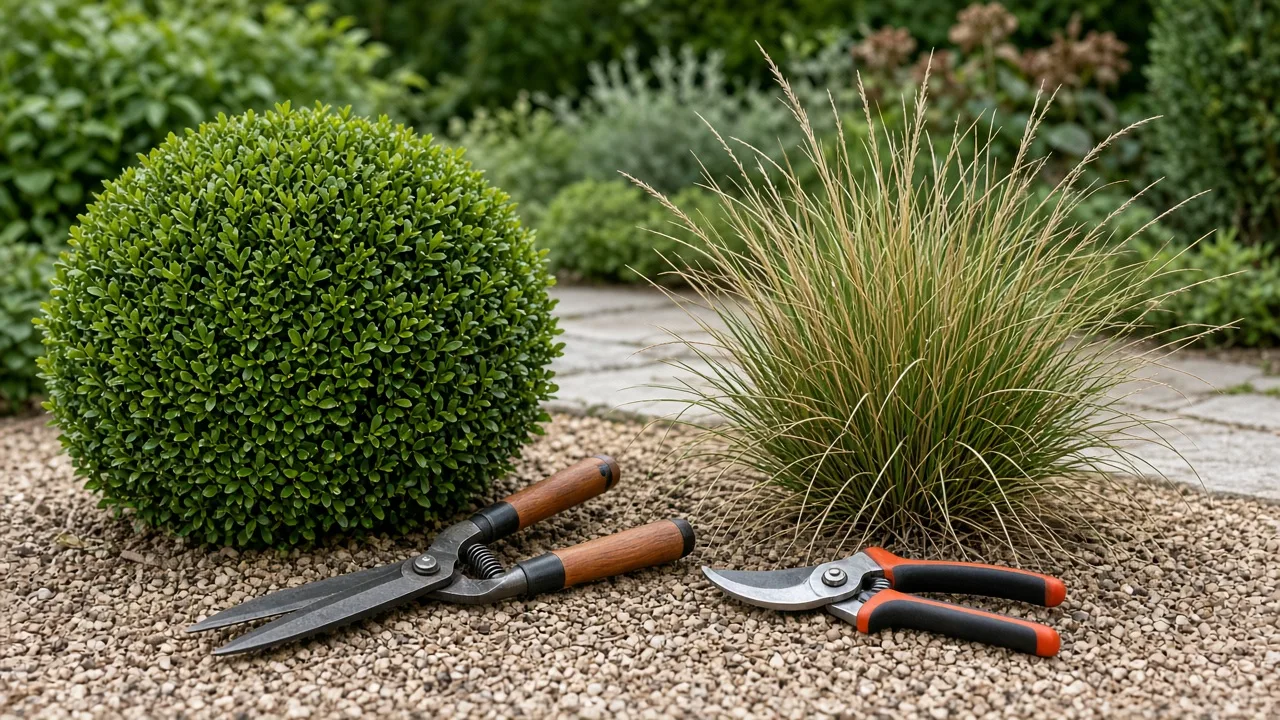
Use a sharp pruning saw for thick petioles and hand pruners for thin stalks. A clean cloth or disposable towel and a suitable disinfectant are part of the kit, not an optional extra. A tarp or bin helps keep dry fronds from scattering across a lawn, and a second person can watch the drop zone—but a helper does not make an unsafe height safe.
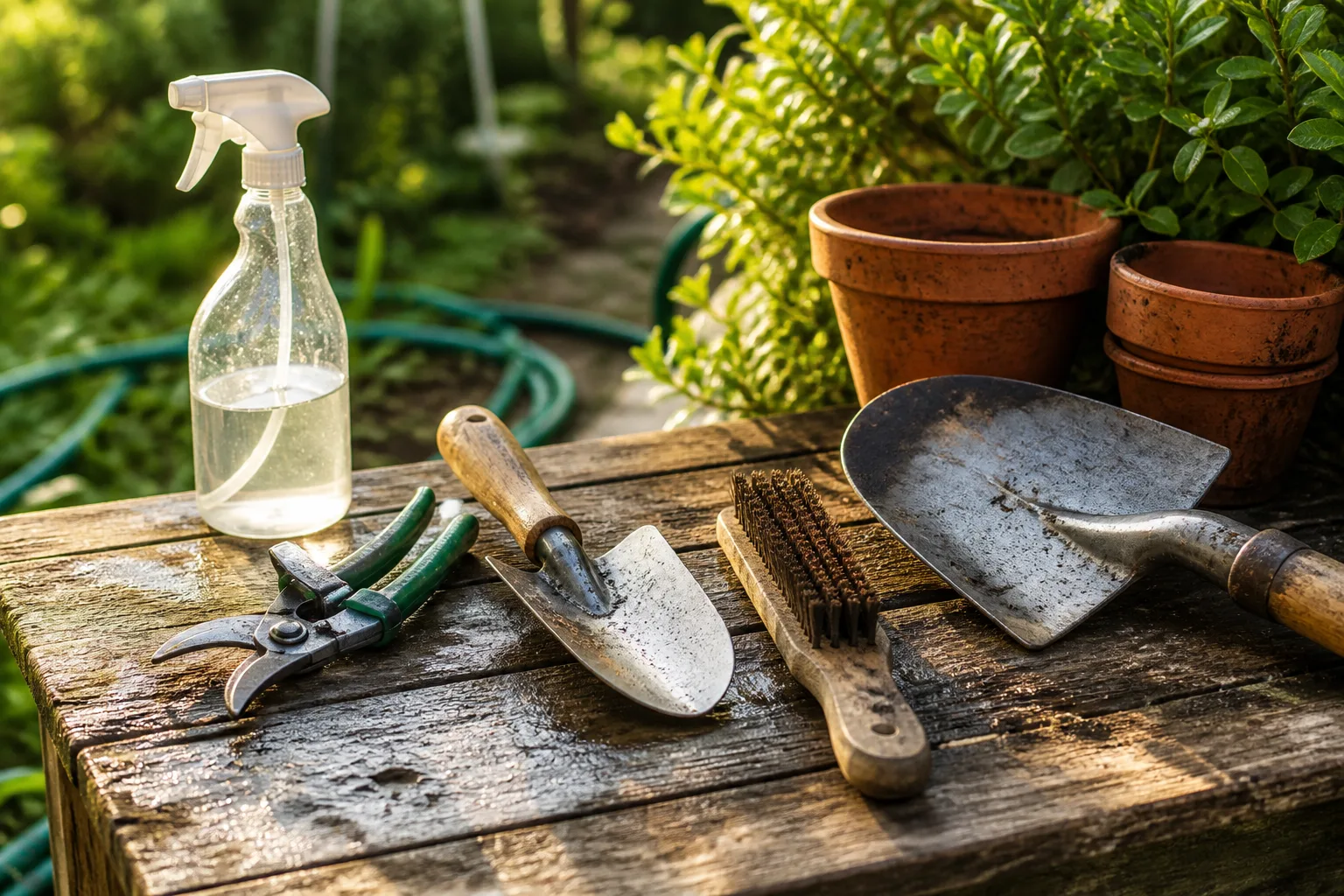
Before the first cut, confirm the palm’s species if you can, check local rules for palm waste, and make a quick hazard map. Decide where each frond will fall, which cut must happen first, and whether fruit or seed stalks could roll, stain, sprout, or land in a pool. Clear the ground and keep tools within reach so you are not twisting or stretching while cutting.
Remove soil and plant residue from the blades before disinfecting them. Rubbing alcohol can be useful for routine tool cleaning, but disease-specific situations may require a disinfectant and contact time recommended by an extension service or label. A palm-specific pruning overview from Mission Palm Trees likewise treats tool choice, timing, and height as separate decisions rather than a single recipe. If you have pruned a palm with a suspected lethal disease, stop moving those tools between palms and seek a diagnosis before continuing.
How to trim a palm tree step by step
Work slowly from a safe position and reassess the crown after every removal. Start with the single clearest hazard, not a goal such as “remove a third of the leaves.” The correct amount depends on the palm’s species, existing health, and rate of natural leaf production.
Remove dead or hazardous fronds without wounding the trunk
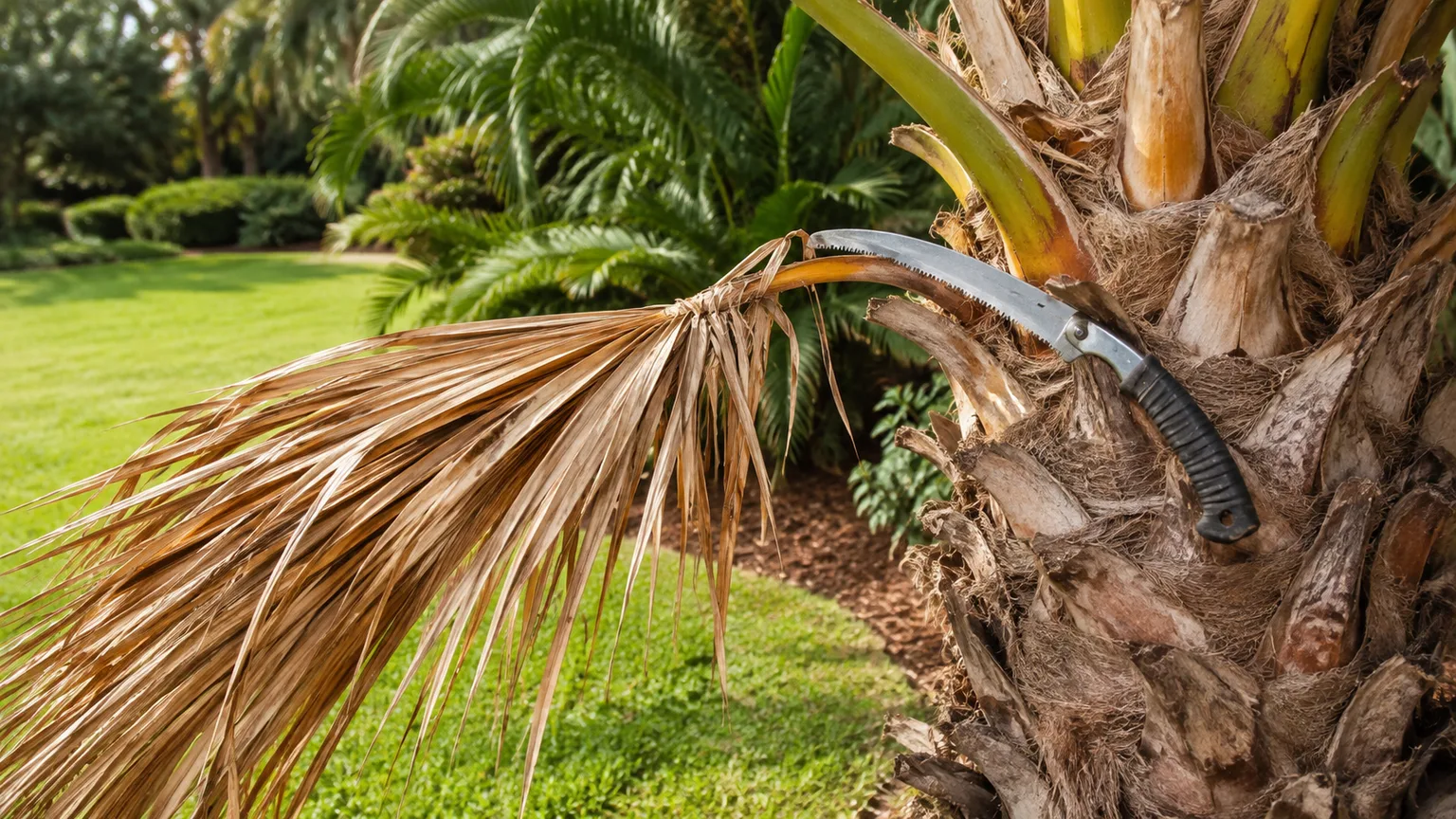
First, identify the frond’s petiole—the stalk connecting the leaf to the trunk or crown. Let a fully dead frond settle before cutting so you know its weight and direction. Support is not a reason to put your hand beneath it; if it is overhead or hung up in other foliage, the job belongs to an arborist.
Make a controlled cut close to the leaf base, leaving enough tissue that the blade does not bite into trunk tissue. The exact distance varies with palm type and the shape of the leaf base, so “flush cut” is a poor universal rule. Never chop into the trunk with a machete, and never yank a leaf that does not release easily. UF/IFAS warns that torn tissue and trunk wounds can allow diseases such as Thielaviopsis trunk rot to become established. (UF/IFAS)
Let the cut surface remain natural. Do not paint it, seal it, or carve surrounding boots for a smoother finish unless a qualified professional and local guidance specifically call for another treatment. A clean cut through the frond base is the goal; a polished trunk is not.
Remove flower stalks, fruit clusters, and seed pods selectively
Flower and fruit stalks are legitimate pruning targets when they create litter, attract unwanted wildlife, block access, or hang over areas where falling fruit could hurt someone or stain a surface. Removing a stalk before fruit matures is usually easier than dropping a heavy cluster later. It can also prevent seedlings in beds or cracks.
Treat stalk removal as a safety job, not a license to cut green fronds. Use clean pruners or a saw appropriate to the stalk’s thickness, control the drop, and do not stand beneath a mature cluster. In public spaces or near walkways, the liability and access issues are reasons to hire the work out.
Handle partly damaged or cold-stressed fronds cautiously
If a frond is kinked, torn, or wind-frayed but still mostly green, leave it when it is not hazardous. It may still contribute energy while the palm produces replacement growth. Remove it when the petiole is broken, the leaf is hanging into a high-use area, or the damaged tissue is clearly no longer functional.
After frost, do not rush to tidy brown leaves. Wait until the forecast is reliably past the damaging event, then assess the spear and crown. If the center spear pulls out easily, smells foul, or the crown is collapsing, that is not a routine pruning question; it may indicate serious damage or rot and needs expert evaluation.
Prevent disease from traveling on pruning tools
Palm disease hygiene is stricter than simply wiping a blade on a shirt. UF/IFAS documents that infested pruning tools can transfer fungal material from an infected palm to a healthy one, including the serious risk associated with Fusarium wilt of Canary Island date palms. It recommends disinfecting tools before moving to another palm and emphasizes the danger of pruning living tissue on a diseased tree. (UF/IFAS, Pruning Palms)
Use this sequence:
- Brush or wipe soil, sap, fibers, and plant residue from the blade.
- Apply the disinfectant according to its label or the relevant extension recommendation.
- Keep the required wet contact time; a quick splash is not the same as disinfection.
- Rinse and dry when the product instructions call for it, then lubricate moving parts if appropriate.
- Repeat between palms, especially when one tree has unexplained wilt, trunk lesions, unusual streaking, or a declining crown.
If the palm looks seriously diseased, do not use the same tools on neighboring palms and do not compost suspicious material. Photograph the symptoms, contact a local extension office or qualified arborist, and follow local disposal instructions.
Clean up, monitor, and correct the cause
Collect every cut frond, stalk, fruit, and loose boot from the base. Debris can harbor pests, hide sharp pieces, create a trip hazard, or sprout where seeds contact soil. Do not burn palm waste, and do not assume ordinary green-waste pickup accepts large fronds; local public works or sanitation departments often have specific rules.
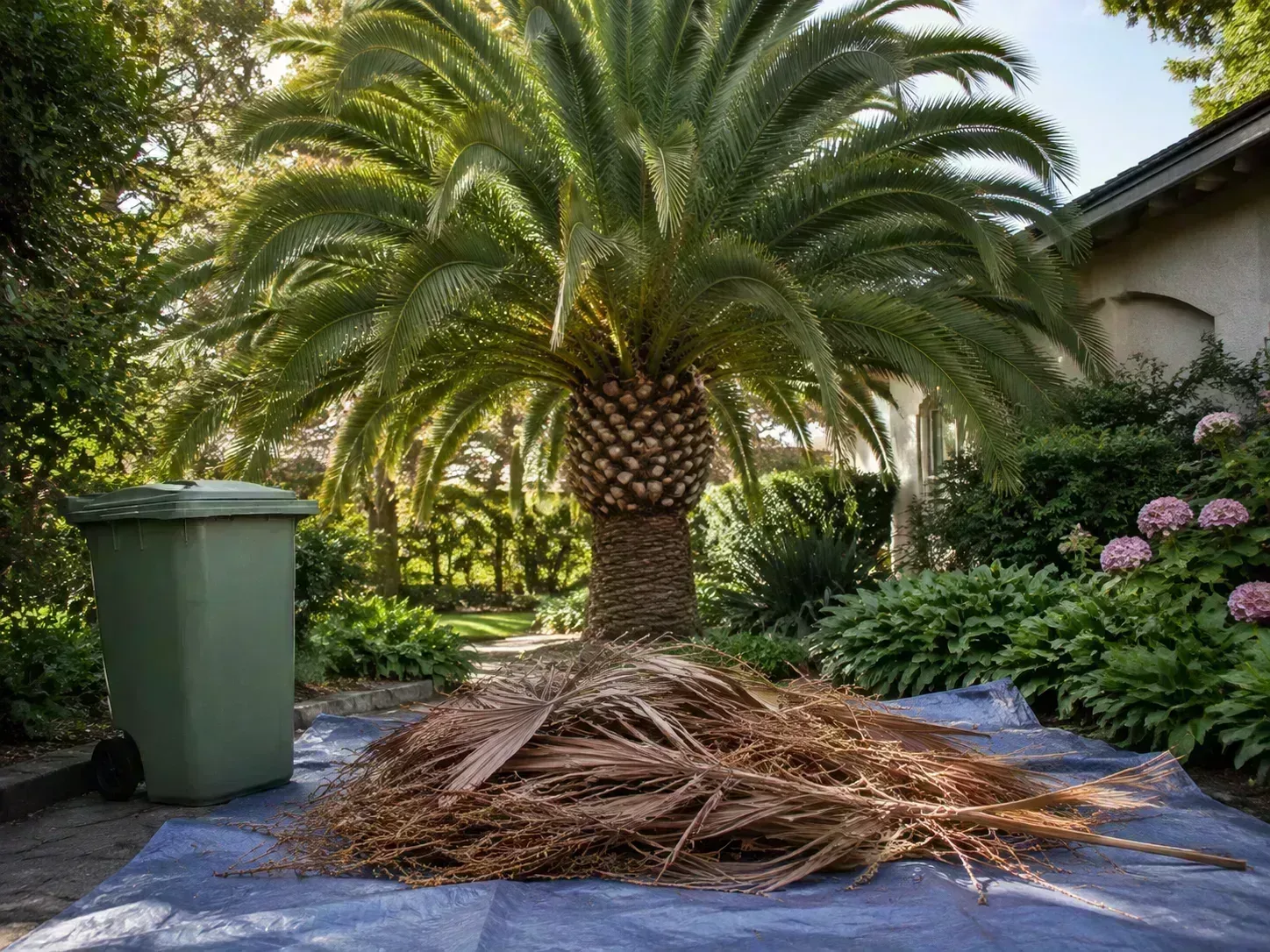
After pruning, look at the center spear and the remaining crown rather than expecting new branches at the cuts. A palm replaces leaves from the growing point, so recovery is measured in healthy new spears and stable color over time. Keep irrigation appropriate to the species and soil, protect the trunk from mowers and string trimmers, and correct drainage, salt, nutrient, or pest problems before scheduling another cosmetic visit.
If yellowing continues, compare the pattern across older and newer leaves. If symptoms move into new growth, the crown thins rapidly, or the spear changes, pruning is no longer the main task. A palm health diagnosis may require species identification, soil and irrigation history, and an in-person inspection.
Common palm-pruning mistakes that create bigger problems
Scalping before storm season. Removing most green leaves does not make a palm storm-proof. Preserve a full, natural canopy and remove only loose or hazardous material.
Treating yellow as dead. Yellow leaves can reflect nutrient or root stress and may still be supplying resources. Diagnose before cutting.
Cutting brown tips from a living frond. This improves the outline for a short time but leaves the underlying stress untouched. Correct the cause and remove the whole frond only when it is fully dead or hazardous.
Shaving boots or cutting into the trunk. Palm trunks do not heal like a painted fence. Wounds remain vulnerable to pathogens and pests.
Using a dirty saw on several palms. Sap and plant fibers can carry disease. Clean and disinfect between trees.
Pulling a stubborn frond. If it will not release with gentle movement, it is not ready or the attachment is unsafe. Cut it from a stable position or call a professional.
Climbing because the tree looks easy. A palm’s smooth trunk, sharp leaf bases, falling mass, and overhead cutting position make height the deciding risk. If you need a ladder to reach the crown, reconsider; if you need to climb, stop.
Pruning on a calendar instead of a condition. A yearly visit can be reasonable when it removes only dead material, but a yearly “cleanup” that always removes green leaves gradually weakens the canopy.
Conclusion
To trim a palm tree well, start with restraint: identify the palm, name the hazard, and remove only what is fully dead, broken, diseased, or causing a genuine clearance or litter problem. Keep green and partly yellow leaves when they are still functioning, and do not confuse a natural rounded crown with neglect.
Choose a dry, calm window, use clean tools, cut the frond base without wounding the trunk, disinfect between palms, and dispose of the debris responsibly. If the palm is tall, storm-damaged, diseased, near utilities, or over a place where people and property could be hit, an arborist is the right tool. A palm that still looks full after pruning is usually the one you protected.