Lady Beetle vs. Ladybug: Names, Species, and ID
Lady beetle vs. ladybug: learn why the names overlap, how to recognize Asian lady beetles, and what to do when they gather around your home before winter.

The short answer: “ladybug” and “lady beetle” are common names for members of the same beetle family, Coccinellidae. They do not name two cleanly separated kinds of insect. The multicolored Asian lady beetle, Harmonia axyridis, is one species in that family; people also call it an Asian ladybug.
That distinction is useful if you have found an orange beetle in a garden or a cluster near a window. A red shell, a certain number of spots, or an indoor sighting cannot by itself tell you whether it is a native species, H. axyridis, or another relative. Look for several features together, then choose a response that fits the situation: most lady beetles outdoors are predators worth leaving alone, while a mass of overwintering beetles indoors is a building-exclusion problem.
The short answer: same family, overlapping names
“Ladybug” is not a formal scientific group. It is a familiar common name used for many beetles in Coccinellidae, just as “lady beetle” and, in some regions, “ladybird” are. The word “bug” is part of the nickname, but these insects are beetles in the order Coleoptera, not true bugs in Hemiptera.
Penn State Extension makes the distinction plainly: the common names are applied across the family, and Asian lady beetles can also be called Asian ladybugs. “Lady beetle” is often clearer in technical writing because it avoids confusion with true bugs. In everyday conversation, though, the names overlap, so “ladybug versus lady beetle” is not a biological either-or question.
What “lady beetle” means
Coccinellidae is a large family with thousands of species worldwide. Many adults are rounded and dome-shaped, with hardened forewings called elytra; patterns vary widely, from red with black spots to yellow, orange, black, or nearly unmarked. The familiar red beetle with seven black spots is only one species, not the template every lady beetle must match.
When people say “Asian lady beetle,” they usually mean the multicolored Asian lady beetle, Harmonia axyridis. “Multicolored” is an important part of the name: adults of this one species can look strikingly different from one another. Some are orange or red with many spots, some have only a few, and some have none; dark forms can have reddish marks on black wing covers. The species is native to East Asia and has become established in North America and other regions where it was introduced.
Garden articles often set up an “Asian lady beetle versus ladybug” comparison because one species is especially likely to gather on buildings in autumn. That shorthand can be useful for a first look, but Better Homes & Gardens and Gardening Know How illustrate how easily common names get presented as separate categories. The more accurate comparison is between H. axyridis and another identified lady beetle species, not between a lady beetle and a ladybug.
A quick comparison: names versus a particular species
The chart below separates the name question from the identification question. It also shows why behavior is helpful context but not a substitute for looking at the insect itself.
| Question | What the answer means |
|---|---|
| Is a ladybug different from a lady beetle? | No fixed taxonomic distinction: both are common names for Coccinellidae beetles. |
| Is an Asian lady beetle a lady beetle? | Yes. Harmonia axyridis is one species in the lady beetle family. |
| Can shell color identify the species? | No. H. axyridis has multiple color forms, and other species can overlap in color. |
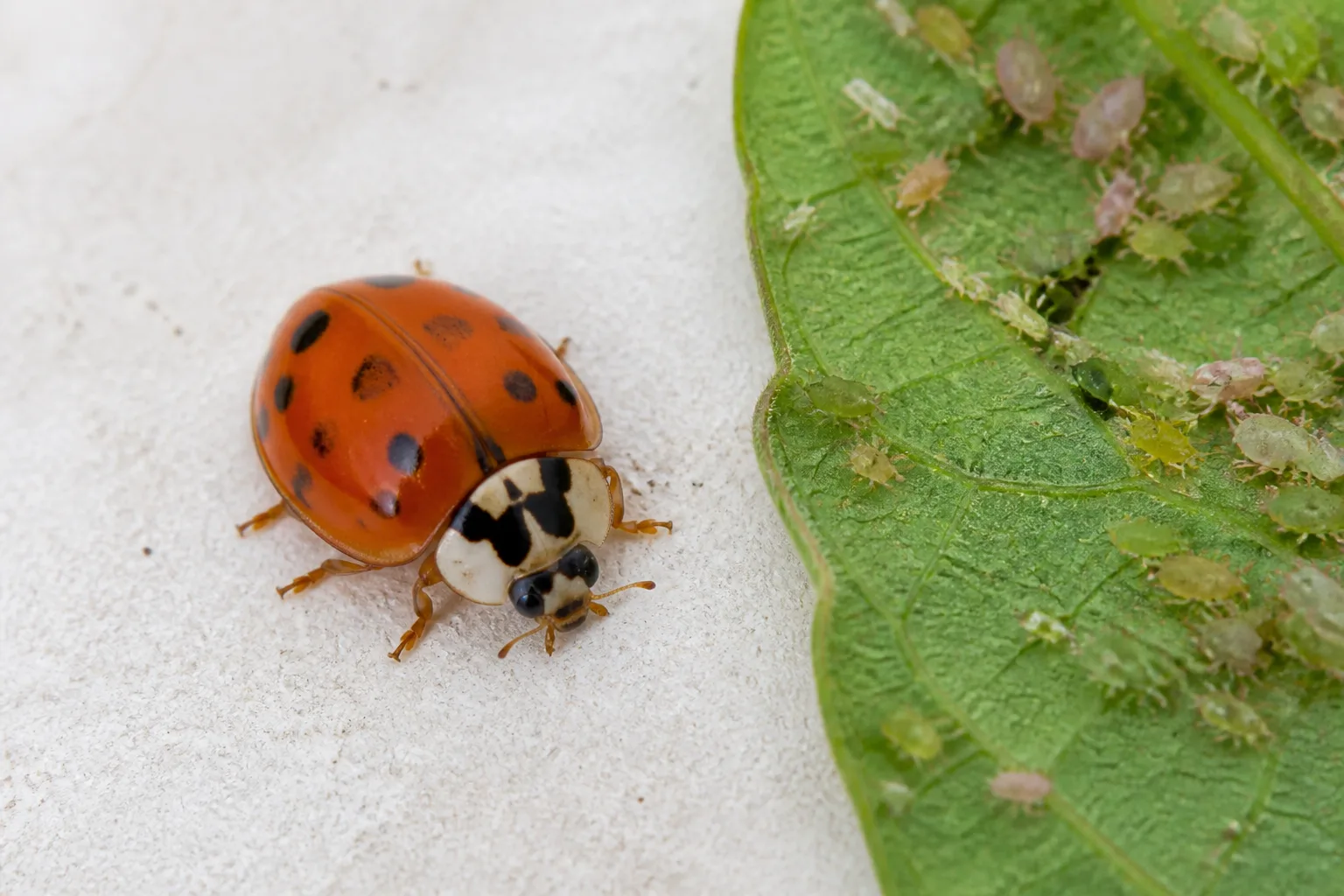
| Does the black M or W mark help? | It is a useful clue on the pale area behind the head, but markings vary and should be assessed with other features. |
| Does an autumn house cluster prove the species? | It raises suspicion for H. axyridis in many regions, but location and season are supporting clues rather than a stand-alone ID. |
| Are all lady beetles beneficial? | Many prey on plant pests; a few species feed on plants, and even predatory species can create a seasonal indoor nuisance. |
For an everyday garden decision, you often do not need a perfect species name. If a dome-shaped adult is feeding among aphids and not damaging the plant, avoid broad insecticide treatment. If many similar beetles are congregating on a sunny exterior wall or emerging around a window in fall, focus on exclusion and indoor removal while recognizing that a photo may still be needed for a confident species-level identification.
How to identify a multicolored Asian lady beetle
Adults of H. axyridis are oval and convex, like many relatives. Penn State Extension describes adults around 7 millimeters long, but size varies with sex and individual development, and native species can be close in size. Use shape and scale as clues, not a ruler test.
The best quick approach is to combine three kinds of evidence: the pale pronotum behind the head and its dark pattern; the beetle’s overall color and body shape; and the setting where you found it. Penn State Extension and UC Statewide Integrated Pest Management Program both document substantial variation in this species, which is why a one-mark rule can lead to a confident but incorrect identification.
Read the pronotum, not just the spots
The pronotum is the shield-like section immediately behind the head. In many multicolored Asian lady beetles, pale cream or white areas border a dark marking that looks like an M, W, or several joined black patches, depending on the individual and the viewing angle. That pattern is one of the most helpful visible clues, but it is not a perfect barcode: some individuals show a less distinct mark, and similar-looking patterns can occur in other lady beetles.
Check the whole head-and-pronotum area rather than tracing one letter. The dark mark can look like a W when viewed from one direction and an M from another; lighting, camera angle, and the beetle’s posture may obscure it. If the mark is not clear, record the uncertainty instead of deciding that every orange beetle must be the Asian species.
Use size, shape, and behavior as supporting clues
Wing-cover color and spot number are especially unreliable on their own. H. axyridis may have up to 18 black spots, very few, none, or a dark form with red-orange spots. Some familiar native species also have a familiar fixed pattern, but a spot count does not tell you which family members are “ladybugs” and which are “lady beetles.”
Some gardening identification guides use color, body size, and spots as quick comparison clues, which can help you decide what to photograph Better Homes & Gardens, Gardening Know How. Extension descriptions add the necessary caution: the Asian species itself has many color and spot forms, so those features should support, not replace, the pronotum check and a look at the larger context Penn State Extension, UC Statewide IPM Program.
An aggregation on a sunlit wall in fall makes H. axyridis more likely in areas where it occurs, but it is not a field mark. Conversely, one beetle on an aphid-covered rose in June is not automatically native or harmless by virtue of its location. The responsible conclusion may simply be “lady beetle, exact species uncertain,” especially when the choice is to leave a predator outdoors.
Which lady beetles are native or introduced?
Native status depends on the species and the region, not on whether someone calls it a ladybug. North America has many native Coccinellidae, and their ranges differ; H. axyridis is native to East Asia and nonnative in North America. Its North American establishment was first recorded in Louisiana in 1988, after decades of unsuccessful intentional releases elsewhere, according to Penn State’s species history.
The Asian species is sometimes described as an invasive pest, but that phrase can blur two separate effects. Its adults and larvae are predators that consume aphids and other small arthropods, while its spread has been associated with declines in some native lady beetle species that use similar prey. The ecological balance varies by crop, region, and species; a useful garden predator can still be a nonnative competitor and an autumn nuisance in buildings.
Avoid judging a beetle’s value from a red shell or a black spot pattern. If you suspect a plant-feeding species because leaves are being chewed, identify both the insect and the damage before choosing treatment. Many lady beetles are predators, but “all ladybugs are good” and “all Asian lady beetles are bad” are both too simple to guide a garden decision.
Why lady beetles can help in a garden
Adult and larval lady beetles feed on aphids and other soft-bodied prey, including some scales and insect eggs. The larvae do not look like the familiar round adult; they are elongated, dark, and somewhat spiny, often with orange markings, which can make a beneficial predator look like a tiny alligator. UC IPM’s natural-enemy guide shows that the Asian species is a voracious aphid predator in crop and garden systems, while Penn State describes both the adult and larval stages as useful predators.
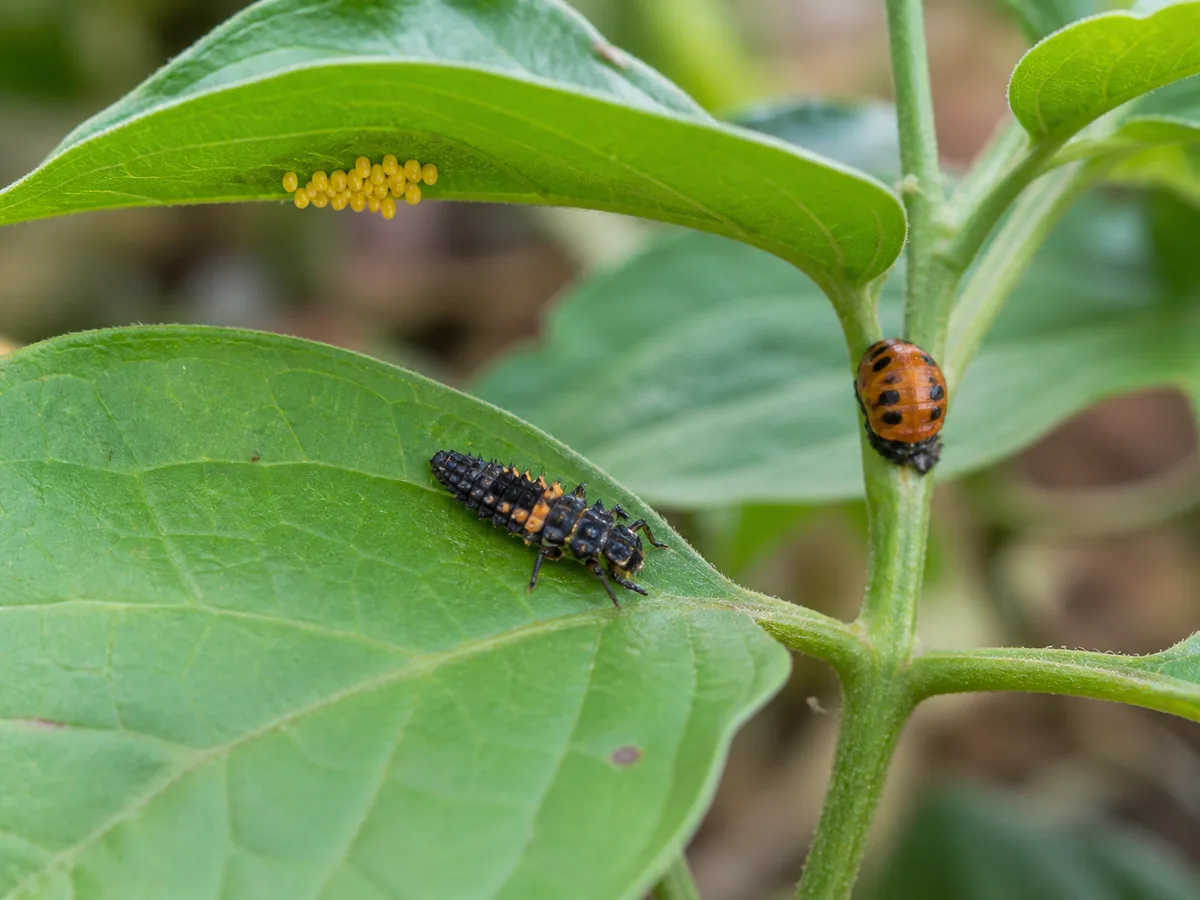
If you find adults or larvae among aphids, avoid spraying the entire plant with a broad-spectrum insecticide as a first move. Check whether the plant is actually being injured; a small aphid colony can support predators without causing lasting damage, and those predators may reduce the population over time. If the plant is under stress or the aphids are expanding quickly, use a targeted method compatible with beneficial insects, such as dislodging aphids with water where the plant tolerates it, then reassess rather than coating all nearby foliage.
The Asian species is not a garden “good bug” in every context. Its contribution to prey control does not erase its nonnative status or documented competition with some native lady beetles. The useful decision is narrower: do not destroy a predator on a plant just because the same species can later gather on your house; manage the building problem at the building.
Why multicolored Asian lady beetles gather around homes
The seasonal invasion is mainly a shelter-seeking behavior. As days shorten and temperatures change, adults look for protected sites in which to overwinter; cracks and voids in houses, sheds, and other structures can provide shelter. They are not usually entering a living room because they want houseplant leaves or pantry food.
In colder regions, some beetles overwinter in natural shelters such as leaf litter or beneath bark, while others use siding, attics, and wall voids. Adults may move within those voids and appear indoors when the building warms them during winter. Seeing beetles come out of a wall does not by itself mean they reproduced there or that you have a food source indoors.
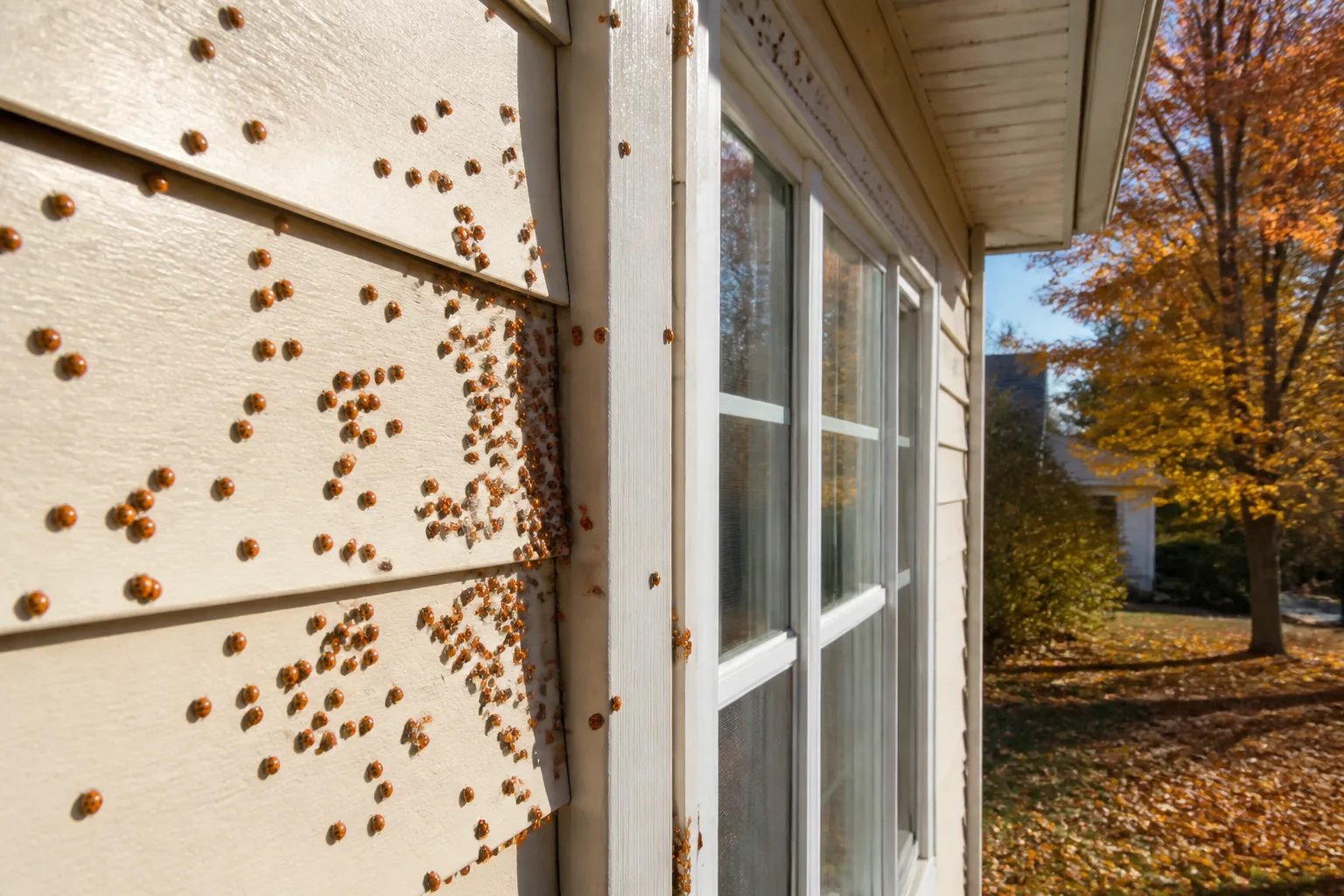
A sunny wall can become an overwintering target
Warm, bright afternoons after cooler weather can bring beetles to exposed, sun-facing walls. They may crawl around rooflines, window frames, trim, soffits, and small gaps before entering the building envelope. Penn State reports that south- or southwest-facing surfaces commonly attract these aggregations in its region; the exact timing and wall orientation vary with local weather and building design.
The group may seem to appear all at once because many adults arrive during a short period. If the same wall draws beetles most autumns, mark the spots where they congregate and inspect those areas before the next fall season. That pattern is useful for prevention even when a close-up photo is not available to identify every individual.
What to do when you find one indoors
One adult wandering across a window is different from dozens gathering in a room. A single beetle can be captured with a cup and paper or removed with a vacuum; if it is a possible native species and you can release it safely outdoors, do so without crushing it. There is rarely a reason to spray a room for one beetle.
For a cluster, use a vacuum rather than crushing or sweeping the beetles. When disturbed, multicolored Asian lady beetles can release a yellow-orange defensive fluid that smells unpleasant and may stain light surfaces. A vacuum with a bag is straightforward: remove and seal the bag after cleanup, then discard it outdoors or follow the vacuum maker’s disposal guidance.
With a bagless vacuum, Penn State describes placing a nylon stocking inside the hose and securing it around the opening so beetles collect near the nozzle instead of entering the canister. Turn the vacuum off before removing the stocking, close it securely, and take the catch outside for disposal. If you have a known allergy or strong respiratory reaction to beetle clusters, avoid stirring them up and ask another household member or a pest professional to handle removal.
Indoor light traps may catch moving beetles in dark spaces, but they do not remove insects already hidden behind siding or stop new ones from entering. Skip indoor foggers or improvised insecticide use in wall voids; killing insects in an inaccessible cavity can create other cleanup problems and does not repair the entry point. If beetles are emerging from a structural void in large numbers, a licensed pest professional can inspect the building and explain options appropriate to the site.
How to keep seasonal groups outside
Exclusion is the most durable step because it addresses the route rather than just the insects already inside. Start inspecting the exterior in late summer or before the first recurring fall aggregation, then repair defects before adults begin seeking shelter. If this is a repeat problem, prioritize the sunny side of the home and the floors or rooms where beetles appeared the previous year.
Check screens for tears and make sure they fit tightly in window frames. Inspect door sweeps and weatherstripping, gaps around window and door trim, siding joints, utility pipes and cables, roofline openings, soffit vents, and gaps around chimneys. Seal cracks with an exterior-grade material suited to that joint, and use compatible fine mesh on vents where airflow must remain open; do not block drainage paths or ventilation openings that the building needs.
A quick exterior walkthrough can be more useful than applying a pesticide perimeter. Match an indoor appearance point with the exterior wall and nearby opening, then repair the likely route. Focus on the building envelope rather than removing all plants or leaf litter from the yard; broad habitat destruction does not reliably prevent flying beetles from landing on a warm wall.
If the adults have already settled inside wall cavities, sealing visible gaps may stop additional entry but will not instantly remove every beetle already sheltered within. You may still see occasional individuals as temperatures fluctuate. Keep removing visible beetles, track where they emerge, and arrange an inspection if the activity is extensive or a hidden access point cannot be reached safely.
Bites, odor, and pet contact
Multicolored Asian lady beetles can occasionally pinch or bite people, though they are not pursuing humans as prey. For most people, an encounter is more unpleasant than dangerous; avoid handling a cluster, wash skin after contact, and do not rub your eyes if beetle fluid gets on your hands. People who develop a persistent or significant skin, eye, breathing, or allergy-type reaction should seek appropriate medical advice.
The yellow-orange fluid is a defensive secretion released when the beetle is stressed or crushed. It can leave marks on walls or fabric and has a noticeable odor, which is why vacuuming is usually tidier than swatting. Wipe a stain with a cleaner appropriate for the surface, test it in a discreet spot first, and avoid rubbing it into porous material.
Pets are most at risk when they chew or swallow beetles. Penn State notes that consumed multicolored Asian lady beetles may cause chemical burns inside the mouth; that is a reason to prevent a dog or cat from eating a group, not a reason to assume that merely seeing one beetle means poisoning. Move the pet away, remove the insects, and contact a veterinarian or animal poison service if the pet ate several or shows mouth discomfort, drooling, pawing at the face, vomiting, or unusual behavior. Do not induce vomiting or try a home treatment unless a veterinarian directs you.
Do store-bought ladybugs control aphids?
For an open yard or garden bed, releasing a bag of adult lady beetles is often disappointing. Adults can fly away, and a release is unlikely to solve the underlying reason aphids are thriving. Penn State Extension notes that H. axyridis is often already present in the surrounding environment; when prey is abundant it can attract local predators, while released adults may disperse when prey is scarce.
First identify the pest and look for resident eggs, larvae, and adults before ordering more insects. The dark alligator-shaped larva among aphids may be the stage doing the most feeding, and broad pesticide use can remove it along with the target aphids. If you are managing a greenhouse or other enclosed growing space, biological control may be more workable, but the beneficial-insect species, release stage, timing, and conditions should match the pest and crop.
In a home garden, support existing predators with flowering plants and a range of habitat, tolerate small prey populations when the plant is healthy, and use targeted controls when damage is growing. Buying insects is not automatically wrong, but an open garden is difficult to contain and no release guarantees that beneficial beetles will stay where you put them.
How to document an uncertain identification
If you need a species-level answer, take one sharp photo from above that includes the head, pronotum, and full wing covers. Add a second close view from the front or side if the dark pattern behind the head is hard to see; avoid pressing the beetle against a surface, which can crush it and obscure the markings.
Record the date, location, approximate size, whether the beetle was on a plant or a building, and what it was doing. A photo of several individuals can show that patterns vary within one aggregation, while a wider shot may explain why the group is at that location. If the plant itself is damaged, photograph the leaf injury and nearby insects rather than only the insect.
Send the images to a local cooperative extension or an established insect-identification service when the distinction affects a control decision. Mention your state or region because native species and seasonal behavior vary geographically. It is perfectly reasonable to report “lady beetle, species uncertain” and avoid a treatment until better evidence is available.
Conclusion
“Ladybug” and “lady beetle” are overlapping common names for the Coccinellidae family; the multicolored Asian lady beetle is one species within it. For a quick identification, combine the pale pronotum and dark M/W-like mark with body form and context, and treat color, spot count, bites, or an indoor sighting as clues rather than proof.
Outdoors, leave likely aphid predators alone unless you confirm plant-feeding damage. Indoors, vacuum a cluster carefully and seal the openings that let the next group in before autumn. That approach protects useful garden insects while addressing the specific species and setting that create a nuisance.