10 Fig Tree Species for Indoor and Outdoor Growing
Compare 10 fig tree species for fruit, indoor foliage, containers, and warm-climate landscapes, with size, light, hardiness, and care trade-offs.
“Fig tree” can mean a Mediterranean fruit tree, a trailing vine, a glossy houseplant, or a tropical banyan with roots that eventually make their own trunks. They all belong to the genus Ficus, but they do not share the same job in a garden or home.
The fastest way to choose well is to start with the result you want. If you want fresh fruit, shop among Ficus carica cultivars. If you want a dramatic indoor tree, look at fiddle-leaf, rubber, or weeping figs. If you want a climber, creeping fig is the outlier. The banyans and Moreton Bay fig belong in frost-free landscapes with room for extraordinary scale.
Choose by the job the plant must do
Fruit, indoor foliage, or vertical coverage
Common fig and its cultivars are the practical fruit trees in this list. Their edible figs develop on plants grown in the right climate, with sufficient sun and a long enough warm season; some cultivated common figs are self-fertile, so one tree can be enough. The RHS describes Ficus carica as a spreading shrub or small tree with edible fruit and notes that root restriction can help control size and improve fruiting. RHS plant profile
Most of the familiar indoor “figs” are ornamental foliage plants. Fiddle-leaf fig, rubber tree, and weeping fig can look like small trees in a bright room, but a container-grown specimen rarely gives you a meaningful harvest. The RHS notes that ornamental figs are popular houseplants with bold leaves, while Missouri Botanical Garden says fiddle-leaf fig fruit is rarely seen outside its native habitat. Missouri Botanical Garden profile
Creeping fig solves a different problem. It can trail from a pot, cover a support, or cling to a wall outdoors in a suitable climate. Its juvenile leaves are small and heart-shaped, which is why it looks delicate at the garden center; its mature climbing behavior is much more vigorous.
Space, climate, and container reality
The plant in the nursery pot is not the mature plant. A fiddle-leaf fig may be manageable at waist height for years, then become a tall, top-heavy floor plant. A weeping fig can fill a room with a dense canopy, while a rubber tree can eventually become a substantial tree outdoors. Banyans and Moreton Bay figs are landscape-scale plants, not small-yard selections.
Containers make more species possible, but they do not make every species small forever. A pot restricts roots and often slows top growth, yet it also dries faster, becomes heavy to move, and needs periodic root and soil management. For an edible fig, that restriction can be useful; for a tropical banyan, it is a long-term maintenance strategy rather than a guarantee of miniature growth.
The 10 fig tree species and cultivars
1. Common fig (Ficus carica)
Best for: edible fruit in warm, sunny gardens or large containers.
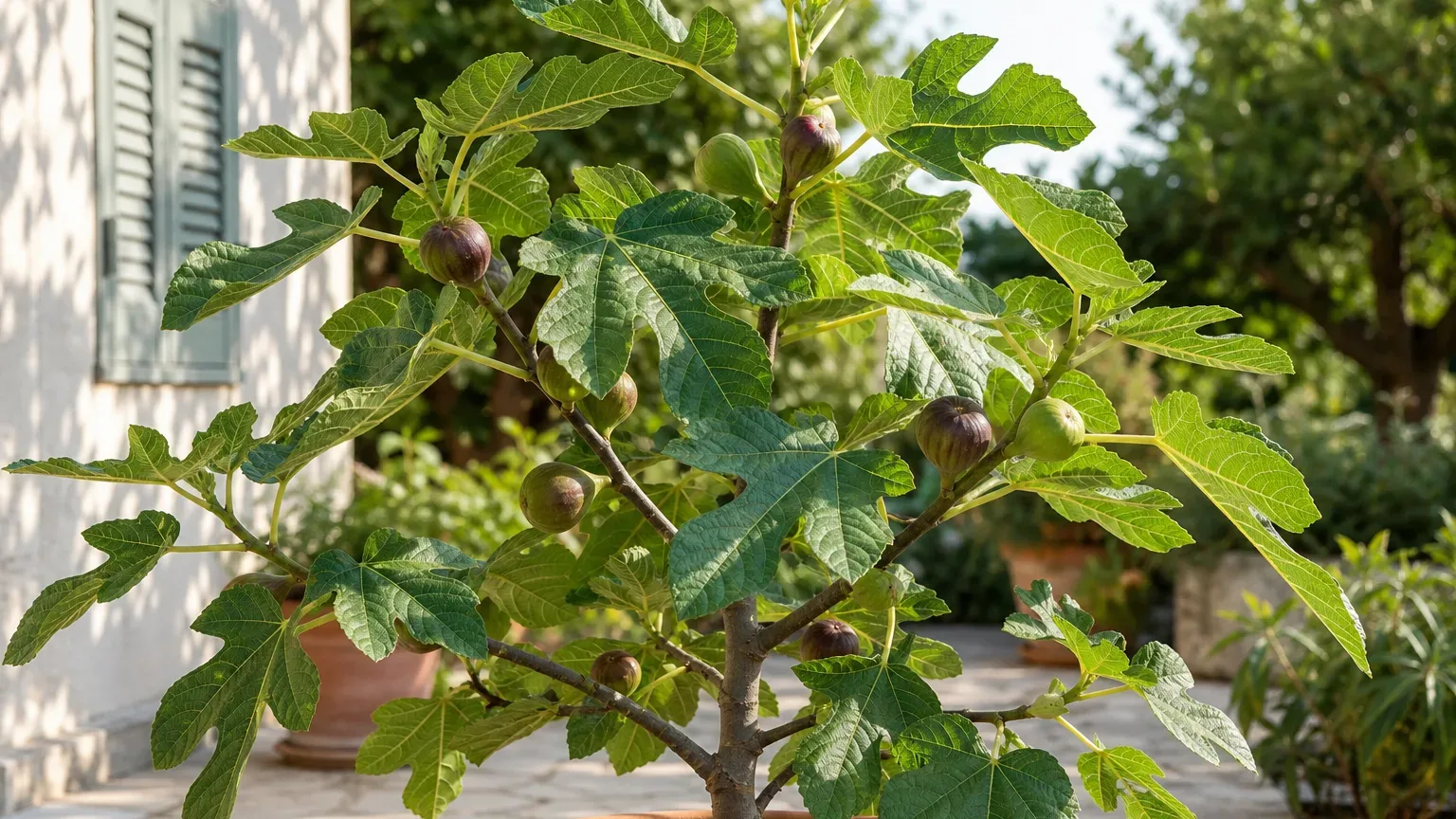
Common fig is the classic deciduous fig grown for fresh and dried fruit. It has deeply lobed leaves, smooth gray bark, and a broad, branching habit. In a warm climate it can become a spreading small tree; in a colder climate it is often grown as a shrub, fan-trained against a warm wall, or kept in a container so it can be protected.
Give it the sunniest position you have, excellent drainage, and enough summer heat for the fruit to ripen. A sheltered south- or west-facing wall can add useful warmth, but do not plant it where roots will compete with foundations, pipes, paving, or thirsty trees. The RHS recommends root restriction and container culture as practical ways to manage size and support fruiting. RHS growing notes
Common figs are often sold as “self-fertile,” but that does not mean every tree fruits heavily in every home garden. A young plant, a short summer, excessive shade, drought at fruit set, or pruning away the wood carrying the crop can all produce leaves without ripe figs. Choose a cultivar proven for your climate rather than assuming the species label guarantees a harvest.
2. Red leaf fig (Ficus congesta)
Best for: a tropical collection or warm-climate landscape where unusual growth is the goal.
Red leaf fig is a rainforest species known for new leaves that unfurl in reddish tones and for clusters of figs that can form on the trunk and branches. It is more of a collector’s or tropical-landscape plant than a typical indoor choice. Give it warmth, humidity, and room to develop rather than expecting the restrained, slow-growing look of a small houseplant.
This species is a poor match for a frost-prone garden and an awkward choice for a dim room. Its appeal is seasonal color and tropical structure, not dependable edible fruit for the kitchen. In a warm climate, use it where the canopy can be viewed from several sides and where you can maintain even moisture without creating stagnant, waterlogged soil.
3. Creeping fig (Ficus pumila)
Best for: trailing containers, topiary frames, or vertical coverage in a mild outdoor climate.
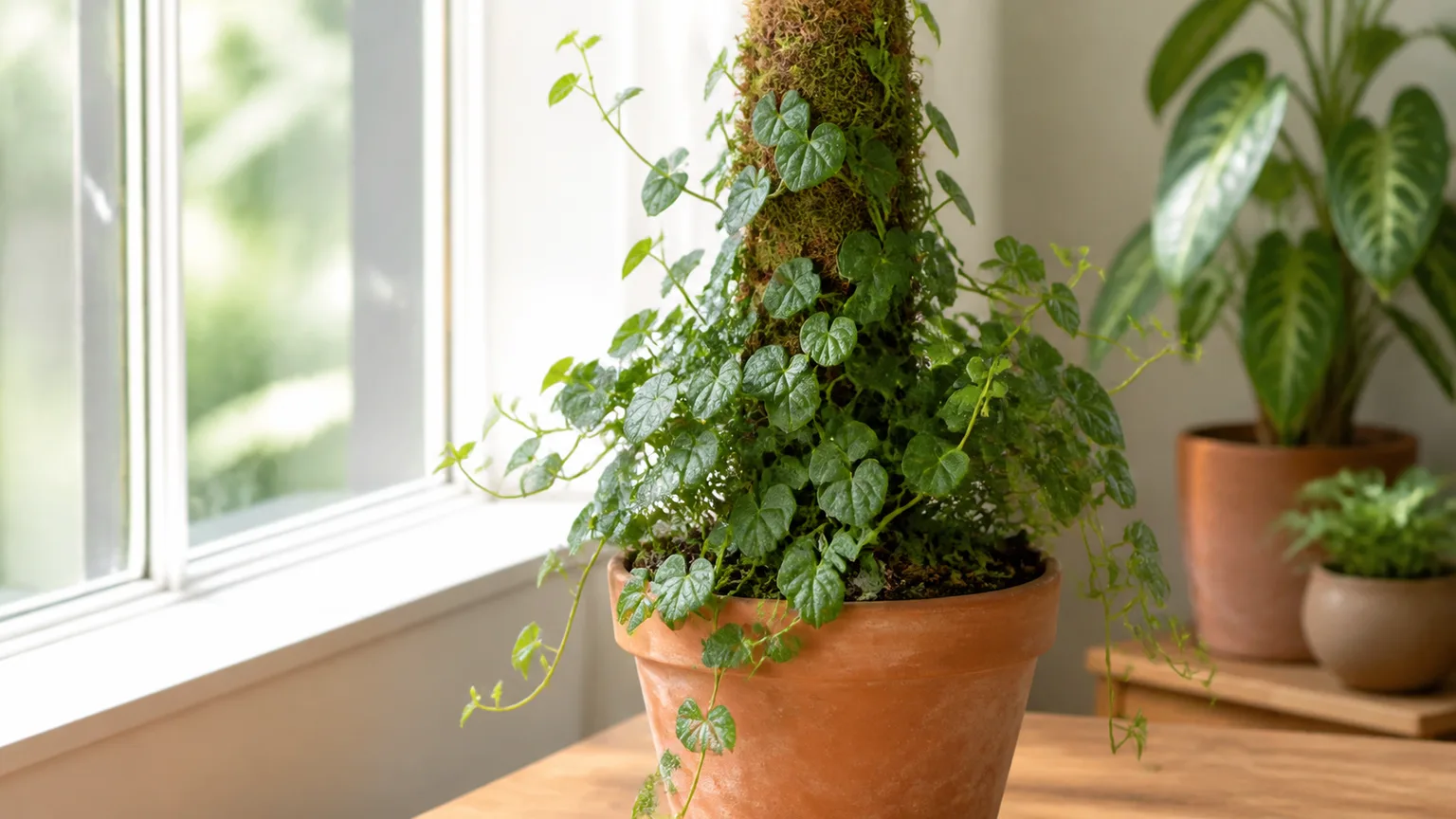
NC State Extension describes creeping fig as a vigorous evergreen woody climber that attaches by clusters of short roots and can climb roughly 8 to 15 feet in favorable conditions. Indoors it prefers bright indirect light or part shade; outdoors it tolerates dappled light, but its attachment habit is the detail that should determine where you plant it. NC State Extension profile
The juvenile form has dense, small, heart-shaped leaves and is the form most often sold as a houseplant. On an outdoor wall or support, it can mature into a stronger, larger-leaved climber. It may cement itself to porous surfaces and can be difficult to remove without damaging the surface, so do not let it “try the wall” beside painted siding, delicate masonry, or a neighbor’s fence.
Its figs are not the reason to grow it: indoor plants rarely fruit, and the outdoor fruit is generally not worth eating. Prune it to keep it within its support, keep the pot from drying completely, and inspect stems for scale, aphids, mealybugs, thrips, and spider mites.
4. Fiddle-leaf fig (Ficus lyrata)
Best for: a tall indoor statement plant with large, violin-shaped leaves.
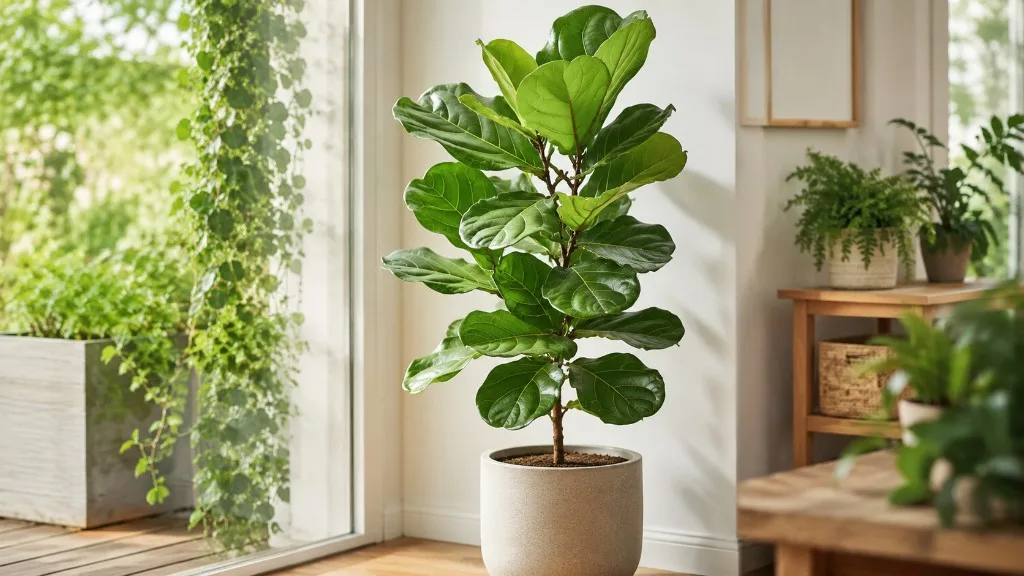
Fiddle-leaf fig earns its place through leaf scale and architectural form. The leaves can reach impressive sizes, and the upright habit takes less floor width than a broad, arching tree. The RHS lists it as a tender ornamental fig and Missouri Botanical Garden records bright indirect light, protection from harsh afternoon sun, and reduced winter watering as useful indoor conditions. RHS plant profile
A bright room is not the same as a room that looks bright to you. Put this plant close enough to a window that the leaves receive strong ambient daylight, but use a sheer curtain if the glass turns hot with direct afternoon sun. Rotate the pot only when necessary, because sudden changes in light and temperature can trigger stress.
Expect a fiddle-leaf fig to grow toward the light and to become top-heavy if it is never pruned. Remove damaged or crossing growth with clean tools, support a leaning trunk if needed, and repot only when roots and drying speed show that the current container is limiting the plant. It is a foliage specimen, not a practical indoor fruit tree; fruit is rarely seen on container-grown plants. Missouri Botanical Garden profile
5. Rubber tree (Ficus elastica)
Best for: a forgiving, glossy-leaved indoor tree or a large tropical landscape specimen.
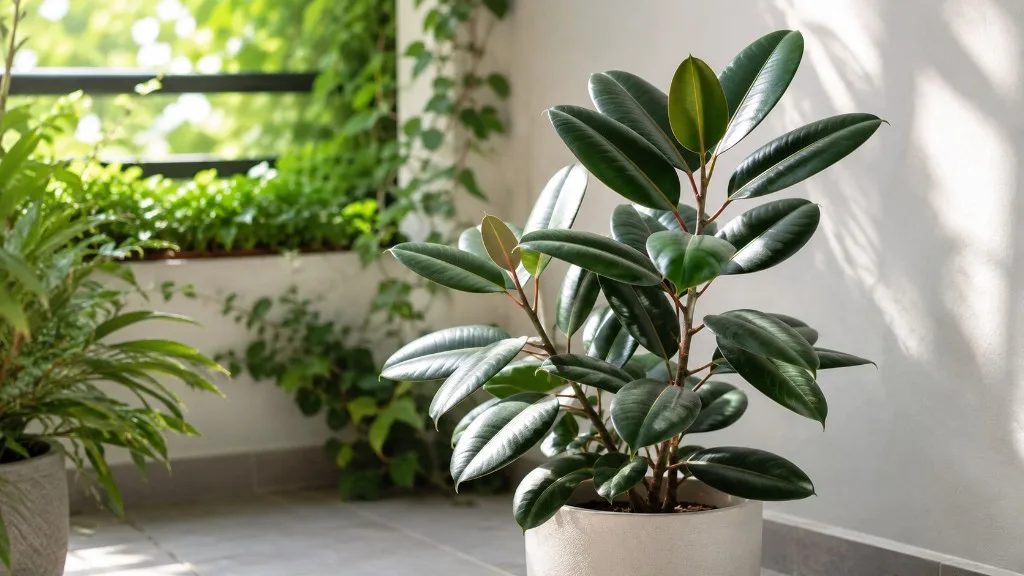
Rubber tree has thick, leathery leaves and a naturally strong presence. Green, burgundy, and variegated forms are sold as houseplants, but the mature outdoor plant is a very different proposition: in a frost-free climate it can become a large tree, develop aerial roots, and need more space than its container suggests.
Indoors, give it bright filtered light and water when the upper layer of mix has dried, then drain the pot completely. Avoid leaving the root ball sitting in a cachepot of runoff. A rubber tree tolerates a missed watering better than a continually saturated mix, but repeated drought followed by flooding can still cause leaf drop and root stress.
The white latex released by a cut stem is irritating to some people. Wear gloves for pruning, keep sap away from eyes and broken skin, and wipe tools after use. The RHS ornamental-fig guidance recommends gloves because ficus sap can irritate skin or aggravate allergies. RHS ornamental fig guide
6. Weeping fig (Ficus benjamina)
Best for: a traditional indoor tree with a fine-textured, arching canopy.
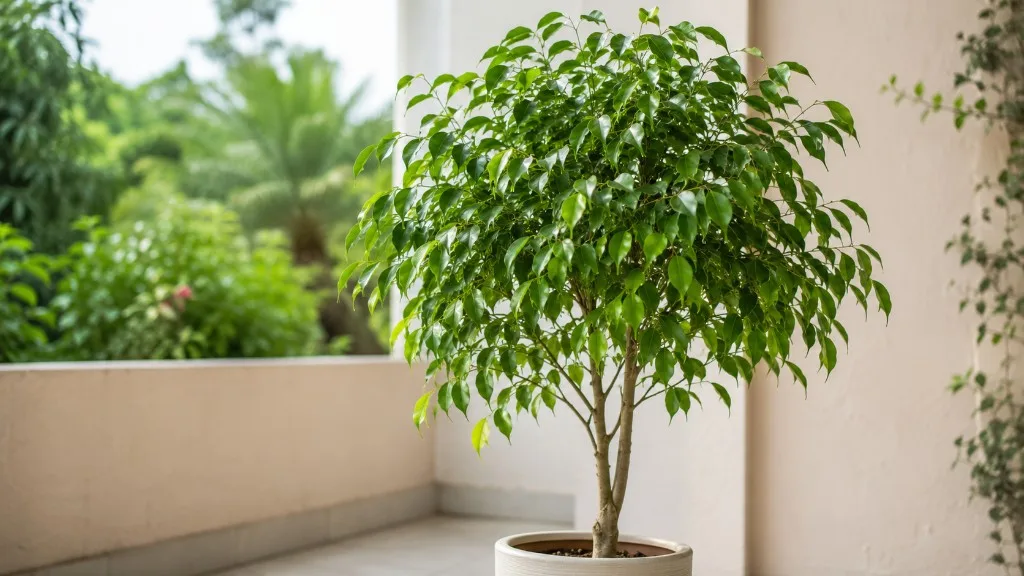
Weeping fig has smaller leaves and more delicate-looking branches than rubber tree or fiddle-leaf fig. It is frequently sold with braided trunks or as a lollipop standard. That polished form can be attractive, but the plant still has the same need for stable light, watering, and temperature.
Its reputation for sudden leaf drop is deserved, but leaf drop is a symptom, not a care calendar. A recent move, a cold draft, lower winter light, waterlogged soil, dry roots, or pests can all be involved. Gardening Know How’s practical troubleshooting guide recommends checking water, light, movement, drafts, humidity, sooty mold, and sap-feeding insects rather than treating every fallen leaf as one problem. Gardening Know How leaf-drop guide
Choose its permanent position before you buy a large specimen. Give it bright light, keep it away from heating and cooling vents, and make changes gradually. Once established, prune in late winter or early spring to maintain shape, but do not repeatedly shear the canopy so hard that the plant loses the leaf area it needs to recover.
7. Indian banyan (Ficus benghalensis)
Best for: a spacious, frost-free landscape or a bonsai-style specimen—not a small suburban bed.
Indian banyan is famous for aerial roots that descend from branches and can become additional trunks. That growth strategy creates the broad, multi-trunked architecture associated with banyan trees, but it also creates a planning problem: the plant’s footprint expands as the canopy and roots mature.
In a tropical landscape, site it where there is generous clearance from buildings, utilities, paving, and other trees. A young plant may look harmless in a pot; that is not a reliable guide to its final scale. It can be maintained as a container or bonsai subject with specialist pruning, but that is a continuing art of root and canopy management rather than ordinary houseplant care.
Do not choose Indian banyan for an average indoor room unless you specifically want a long-term bonsai project and understand its light needs. It needs strong light, warmth, and enough root volume to stay vigorous. In colder climates, it is best treated as a protected tropical specimen.
8. Chinese banyan (Ficus microcarpa)
Best for: tropical street-tree settings, warm-climate specimens, or bonsai.
Chinese banyan is also sold under names such as curtain fig, Malayan banyan, and ginseng fig. It has small leaves relative to many large ficus trees, and its thickened or trained trunk makes it popular for bonsai. As a landscape tree, however, it can develop a broad crown and aerial-root structures that demand space.
The common name can mislead a buyer into thinking “small.” Ginseng ficus bonsai is small because it is selected, trained, root-pruned, and kept in a shallow container—not because the species has a permanently miniature habit. Buy a trained specimen for that purpose and learn its pruning cycle; do not plant a bonsai in the ground beside a foundation and expect it to remain bonsai-sized.
Because large ficus species can naturalize or behave invasively in some warm regions, check your local extension or invasive-plant listings before planting Chinese banyan outdoors. In a climate with frost, grow it as a bright indoor or protected container plant and move it only with an acclimation plan.
9. Moreton Bay fig (Ficus macrophylla)
Best for: huge public landscapes and frost-free gardens with room for buttressed roots and a spreading canopy.
Moreton Bay fig is an Australian rainforest fig with large leaves, substantial buttress roots, and the potential to become a landmark tree. Its roots and canopy are the point of the plant, not an inconvenience to be pruned away later.
It can be magnificent in a park or estate landscape, but it is one of the worst matches for a small yard, narrow sidewalk, pool edge, or planting strip. Give it full sun to partial shade according to the site, warmth, and a wide root zone. If your available space is measured in feet rather than acres, choose a fruiting F. carica cultivar or an indoor ornamental instead.
This is another species where a nursery-sized plant gives a false sense of proportion. Research the mature canopy and root behavior before buying, and verify local rules or invasive-plant concerns in tropical regions. Pruning can shape young growth, but it cannot turn a giant landscape fig into a compact patio tree without ongoing structural compromises.
10. Chicago Hardy fig (Ficus carica ‘Chicago Hardy’)
Best for: gardeners in cooler areas who want to try edible figs with winter protection or a movable container.
Chicago Hardy is a cultivar of the common fig, also known as ‘Bensonhurst Purple’. Gardening Know How describes it as a cold-tolerant fig that can be grown in containers and protected in colder regions; its article also emphasizes that winter dieback can occur even when the plant rebounds in spring. Gardening Know How Chicago Hardy guide
Treat hardiness as a survival range, not a promise of an unchanged tree and a full crop every year. In a marginal climate, plant it in a protected site, mulch the root zone, and be prepared to wrap the plant or lay down a low shrub form for winter. A container can be moved into an unheated garage or other cool protected space, but the pot must be heavy enough for the tree in summer and light enough—or movable enough—to handle safely.
The cultivar can fruit on older wood and new growth, so cold protection and pruning affect the following harvest. Reduce watering as the plant enters dormancy, then increase it as growth resumes. A warm, sunny summer still matters: cold tolerance does not replace the heat and light required to ripen figs.
Give every indoor fig the right light and routine
The indoor figs in this list are not low-light plants. The RHS recommends bright indirect light for ornamental figs, and Missouri Botanical Garden gives fiddle-leaf fig bright indirect light or part shade with protection from harsh afternoon sun. RHS ornamental fig guide Missouri Botanical Garden profile
Start with placement, then build the routine around how quickly the pot dries. A plant beside a bright east or west window may need water more often than the same plant in winter, while a large pot in a dim corner may stay wet for too long. Test the mix with a finger or moisture meter, lift the pot when you can, and water thoroughly when the plant’s normal drying threshold is reached. Then empty the saucer.
Keep temperatures even and avoid blasts from vents, open doors, and cold glass. Humidity can help, but it cannot compensate for inadequate light or a suffocating mix. A pebble tray may modestly improve the air immediately around a plant if the pot sits above the waterline; it is not a substitute for drainage, and misting should not be used to keep leaves constantly wet.
When moving an indoor fig outdoors for summer, acclimate it over several days to brighter light and wind. Do the reverse before cold weather: inspect for pests, move it gradually, and expect some adjustment if the indoor light is much lower. This transition is safer than carrying a sun-starved plant directly from a room into hard afternoon sun.
Plan outdoor figs around roots, fruit, and winter
For edible figs, full sun, drainage, heat, and site shelter matter more than a generic fertilizer schedule. BBC Gardeners’ World Magazine recommends a sunny sheltered position, root restriction in the ground or a large container, regular watering during active growth, and feeding when fruits begin to develop. Its guidance also notes that ripe figs should hang down and feel soft rather than being picked by calendar date alone. BBC Gardeners’ World Magazine fig guide
Root restriction is useful when it is deliberate and engineered. In the ground, a root-control bed or physical barrier can prevent an edible fig from turning into a broad, thirsty shrub; in a pot, the same restriction increases the need for consistent watering and occasional top-dressing or repotting. Do not add a barrier that traps water around the root ball. Drainage always comes first.
Pollination is more nuanced than the “every fig has a wasp” story. Common figs sold for home gardens are often self-fertile and can produce without the specialized pollinator relationship required by some other fig types. Ornamental species may produce figs that are inedible, rarely appear indoors, or require conditions you cannot reproduce in a living room. Choose the cultivar and fruiting type for your region rather than buying any Ficus and expecting grocery-store fruit.
Winter planning begins before the first frost. Decide whether the tree will stay in the ground with mulch and wrapping, be trained low enough to protect, or live in a container that you can move. Do not wait until the soil is frozen or the plant is fully exposed to a hard freeze; the best winter method is the one you can carry out without breaking branches, straining your back, or leaving the root ball wet and cold.
Troubleshoot leaf drop, no fruit, and runaway growth
Leaves falling from an indoor ficus: first ask what changed in the last two to four weeks. Check for a move, a draft, a darker window, dry soil, persistently wet soil, and pests on leaf undersides and stems. Gardening Know How notes that ficus can respond to both overwatering and underwatering, and that moving, temperature swings, low light, humidity, and insects may all contribute. Gardening Know How leaf-drop guide
Leaves are pale or new growth is small: improve light before adding fertilizer. A plant cannot use extra feeding to overcome a dark location, and excess fertilizer can damage roots. Move it closer to a suitable window gradually, ensure the roots are not staying saturated, and wait for new growth before judging the change.
The tree is leafy but produces no figs: confirm that it is an edible F. carica cultivar rather than an ornamental ficus. Then check sun exposure, the length of the warm season, container volume, drought at fruit set, and pruning timing. A young tree may need several seasons to establish, and a severe winter may remove the wood carrying the next crop.
The fig is outgrowing its space: prune with a purpose, not panic. Remove dead, crossing, or badly placed branches first; shorten vigorous shoots to a bud facing the direction you want growth to take. If the roots are lifting paving or the canopy is pressing against structures, the correct fix may be relocation or removal while the plant is still manageable—not harsher pruning every year.
Sap gets on skin: stop pruning, wash the area with soap and water, and avoid rubbing your eyes. Wear gloves for future cuts. Ficus sap can irritate skin, and the RHS specifically advises gloves for ornamental figs. RHS ornamental fig guide
Conclusion: buy for the mature plant, not the nursery pot
The best fig tree species is the one that fits your actual job. Choose common fig or Chicago Hardy for edible fruit, fiddle-leaf fig for large indoor leaves, rubber tree for glossy resilience, weeping fig for a fine-textured canopy, and creeping fig when you want a climber and can control its attachment. Reserve red leaf fig, banyan species, and Moreton Bay fig for warm climates and enough room for their mature behavior.
Before you buy, write down four facts: your coldest winter temperature, the hours of usable sun or brightness, the final planting or pot location, and whether fruit truly matters. That short check prevents most fig mistakes. A healthy fig is not difficult because it needs mysterious care; it is difficult when the species, space, climate, and intended use do not agree.



