How to Grow Macadamia Nut Trees: Care and Harvest
Get practical macadamia tree care advice on climate, drainage, planting, pollination, pruning, nut harvest, and the long wait for a crop.
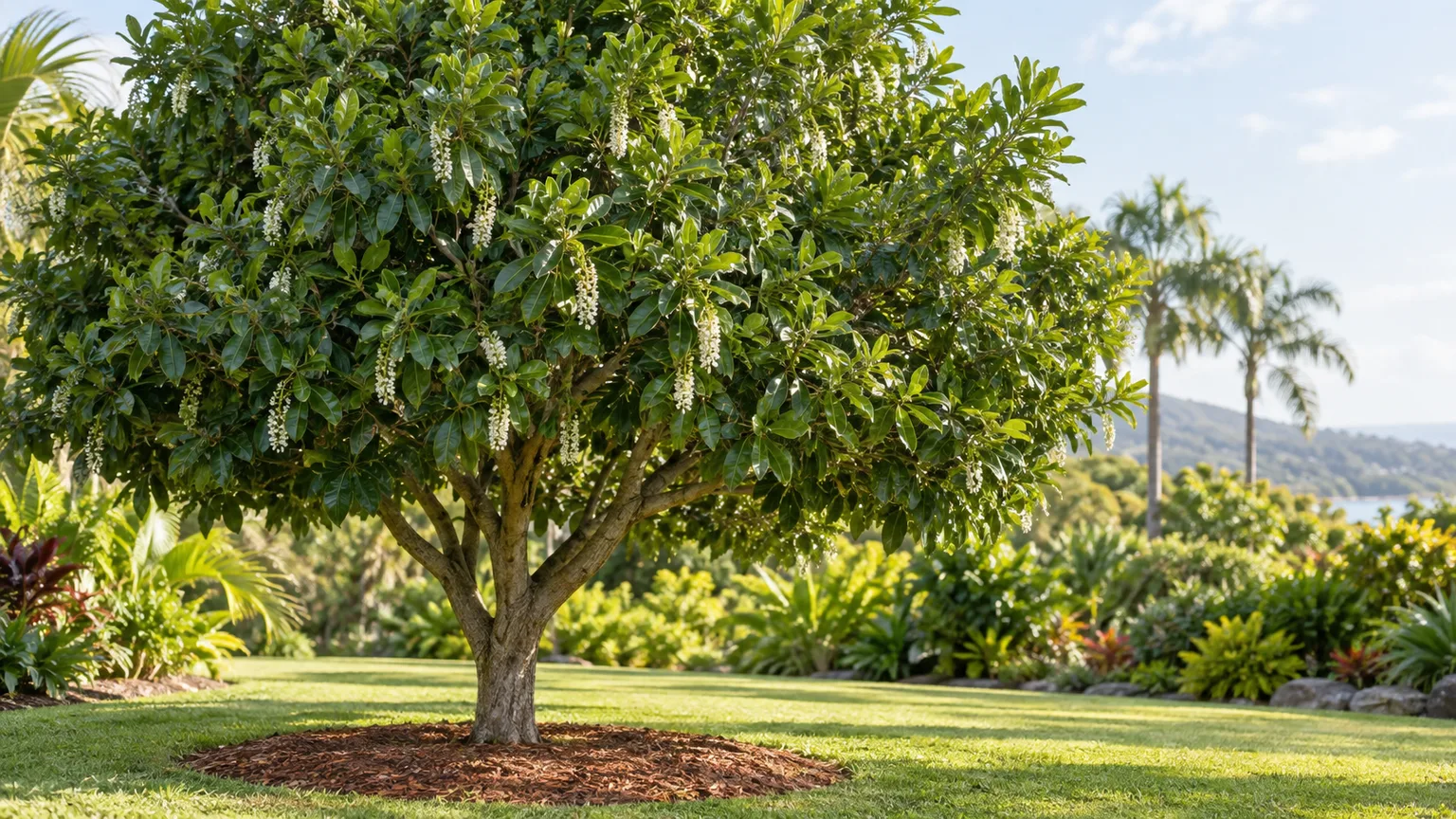
Macadamia trees can be beautiful evergreen shade trees, but dependable nut harvests are a long-term project. Before you buy one, check three things: whether your site stays warm enough, whether the soil drains quickly, and whether you can give a large tree years of space and care before it produces much. A tree may grow outside its ideal crop climate and still never become a reliable nut producer.
For edible nuts, choose a named, grafted cultivar from a reputable nursery rather than planting a grocery-store nut. Keep the root zone evenly moist while the tree establishes, avoid standing water and untested fertilizer, and collect fallen nuts before they sit wet on the ground. The University of Hawaiʻi College of Tropical Agriculture and Human Resources (CTAHR) describes Hawaiian orchard conditions; use its crop guidance as a useful reference, not a universal calendar for every backyard (CTAHR macadamia growing information).
Start with the climate and space check
Macadamias are subtropical evergreens native to eastern Australia. They need a long, warm growing season and are poorly suited to places with recurring hard freezes. A young tree is especially vulnerable to cold and wind damage, and even a tree that survives occasional cold may lose flowers or developing fruit. A USDA hardiness zone can help screen a location, but a zone number does not tell you whether your yard has enough heat, a sheltered microclimate, or a sufficiently long frost-free season for nuts to mature.
The practical test is to ask whether a macadamia is already grown successfully outdoors in your local climate, not just whether a seller lists your zone. Coastal subtropical areas and frost-free parts of Hawaii, Florida, Southern California, and the Gulf region are more plausible than inland sites with winter freezes, but conditions vary sharply by elevation and neighborhood. If local extension or experienced growers cannot confirm fruiting trees nearby, plan on ornamental foliage as the likely reward rather than budgeting for a crop.
Space matters almost as much as temperature. These are trees, not patio shrubs: leave room for a broad canopy, roots, a safe distance from foundations and overhead wires, and access to the ground beneath it for harvesting. If your only possible site is a cramped courtyard or a cold patio where the tree must stay in a pot, another tropical fruit tree may be a better fit.
Know which macadamia you are buying
The genus includes several species, but commercial nut orchards primarily rely on Macadamia integrifolia and M. tetraphylla, along with hybrids and named cultivars. They belong to the Proteaceae family and form dense evergreen canopies with long, narrow leaves and dangling clusters of small flowers. The smooth-shelled M. integrifolia is the species covered most directly in CTAHR’s crop reference; performance and cold tolerance can differ among species and cultivars.
The word “macadamia” on a seed packet or an unlabeled seedling does not tell you how the mature tree will perform. Ask a nursery for the botanical name, cultivar, rootstock, approximate mature dimensions, and the source of its climate recommendation. For fruit, prioritize a cultivar known to bear well in a similar climate and sold by a nursery that can explain whether it is grafted. If you are comparing food-tree projects, Epic Gardening’s edible nut-tree guide places macadamia alongside other nut trees; use local climate records to decide whether that category fits your yard.
Choose a cultivar and grafted nursery tree
A grafted tree combines a selected fruiting cultivar, called the scion, with a rootstock grown for its root system and adaptation. This gives you more predictable characteristics than a seedling, which may not match its parent and can take longer to bear. CTAHR notes that Hawaiian commercial orchards are planted with grafted seedlings and that a small crop can begin around the fifth year, with full production taking roughly 12 to 15 years under those conditions. A home-grown tree may take longer or yield less, so treat that timeline as an indication of patience required rather than a guarantee (CTAHR macadamia growing information).
Ask the nursery which cultivars are compatible for cross-pollination and whether one tree can set fruit in your area. A lone tree may flower and produce some nuts, but a second compatible cultivar can improve pollination and yield. Do not buy two unrelated plants simply to satisfy a rule: confirm flowering overlap, local performance, and whether you can fit both trees at mature size. If space allows one tree only, choose a cultivar selected for reliable single-tree performance locally and accept that the crop may be smaller.
Find a sunny, sheltered planting site
Choose a place with full sun for most of the day. Shade slows canopy development and can reduce flowering and fruiting; it also makes a warm-climate tree harder to grow in a marginal climate. Avoid a frost pocket at the bottom of a slope, a cold wind tunnel, or a site exposed to strong salt-laden or drying winds.
Wind deserves special attention because branches and young trunks can be damaged before the tree has a chance to establish. CTAHR identifies strong wind as a major concern in Hawaiian orchards and notes that certain narrow-profile cultivars are more wind resistant. That does not mean a home gardener should assume a particular variety is storm-proof; ask a local nursery which cultivars handle your exposure and use a temporary stake only when the young tree needs support. Remove or loosen ties before they constrict the trunk.
Look at the site after heavy rain as well as on a sunny day. If water pools around the future planting spot or soil remains saturated for days, fix the drainage problem or choose another location before planting. A raised planting berm can help in some landscapes, but it cannot compensate for a water table that stays high or a site that floods repeatedly.
Build the right soil and drainage conditions
Macadamias prefer a deep, well-drained root zone. CTAHR gives a soil pH range of about 5.0 to 6.5 for Hawaiian production and emphasizes drainage. That range is a useful starting point for a soil test, not an invitation to pour acidifier or lime around a tree without measuring. Soil texture, irrigation water, organic matter, and local climate all affect how a tree responds.
Before amending, test the soil and check how water moves through it. If the ground is heavy clay, planting into a deep hole filled with loose potting mix can create a sump that holds water around the roots. Instead, choose a naturally draining site, improve a broad area only as local soil guidance recommends, or plant on a broad raised mound where the roots can spread laterally into oxygenated soil.
Avoid fresh manure and thick layers of rich compost directly against the root ball. A tree needs soil that drains and supports roots, not a heavily amended pocket that settles or remains wet. A thin mulch layer can protect the soil surface after planting, but mulch is not a substitute for good drainage.
Plant the tree without burying its roots
Plant during a reliably warm, mild period when the young tree will not face a cold snap or prolonged dry spell immediately afterward. Water the nursery root ball before planting so it is moist but not dripping. Slide the tree out carefully, loosen only circling roots that can be corrected without tearing the root system, and keep the trunk and graft union above the soil line.
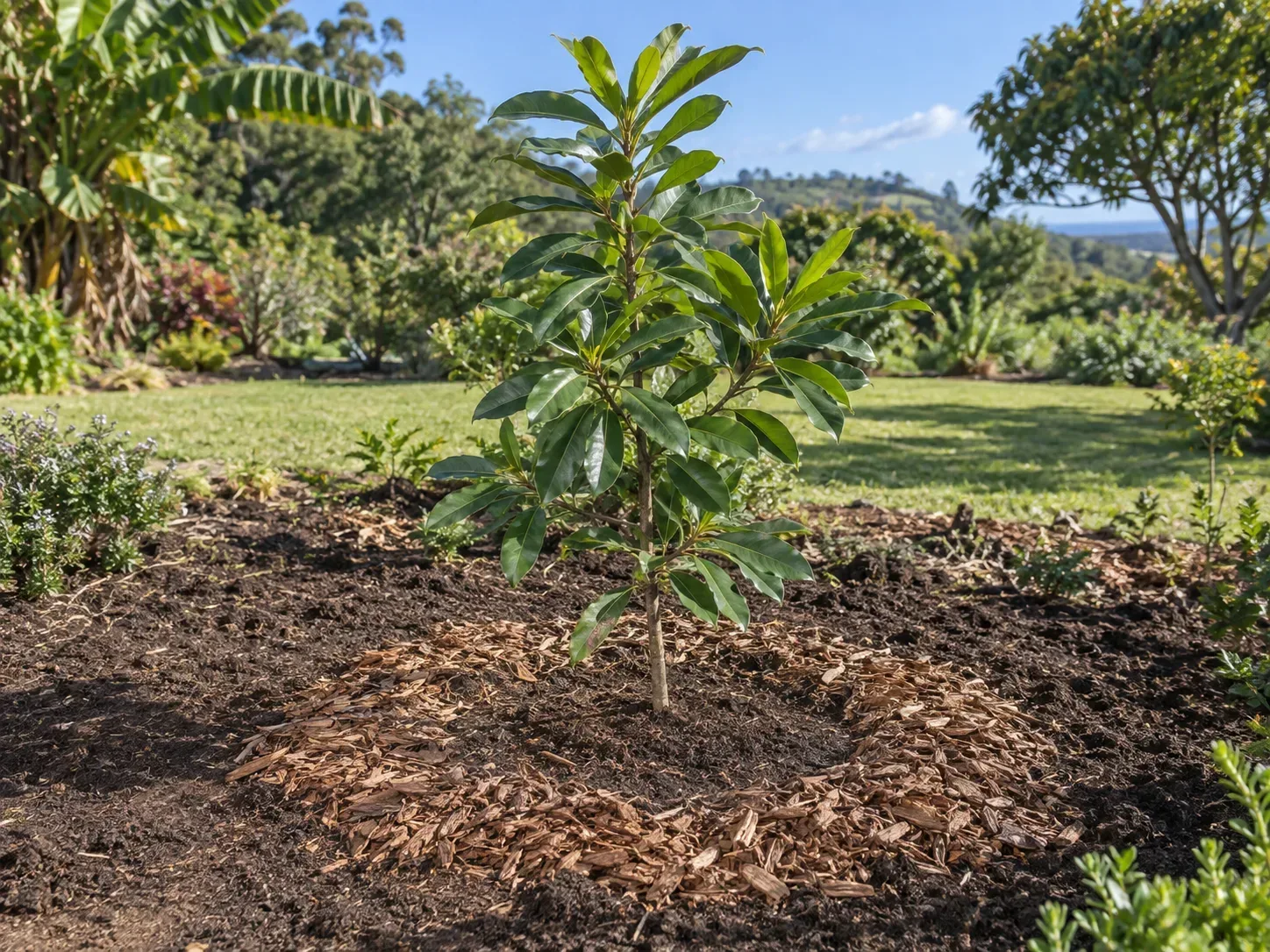
Dig a hole broad enough to loosen the surrounding soil, but no deeper than the root ball. Set the tree at the same depth it grew in the nursery, with the uppermost structural roots near the finished soil surface. Backfill with the native soil you removed, firm it gently to eliminate large air pockets, and water slowly to settle it. Do not bury the trunk, pile soil over the root flare, or add a concentrated fertilizer to the planting hole.
Make a shallow watering basin just beyond the root ball if the site is sloped, then cover the surrounding soil with a loose organic mulch layer. Keep mulch several inches away from the trunk so the bark stays dry and visible. If you stake the tree, use two flexible ties low enough to allow slight trunk movement; a rigidly immobilized trunk can develop weaker structure.
Water steadily while roots establish
During the first growing seasons, the goal is consistent moisture in the root ball and the soil just beyond it, without keeping the site soggy. Check the soil with a finger or narrow trowel a few inches down rather than using a fixed weekly quota. If the root zone is still cool and damp, wait; if it is beginning to dry, water deeply enough to moisten the full root ball and surrounding soil.
How often that means watering depends on rain, heat, wind, soil texture, mulch, and container or in-ground conditions. Sandy soil loses water faster than clay, while a humid rainy season can leave heavy ground wet for too long. CTAHR describes high annual rainfall in its Hawaiian macadamia production context, but converting that regional rainfall figure into a universal gallons-per-week recommendation would be misleading.
As the tree grows, extend irrigation beyond the trunk instead of keeping every emitter beside the stem. The feeder roots spread outward under the canopy. Drip irrigation or a slow soaker line can wet a broad root zone with less runoff than a short daily sprinkle; use local water-conservation guidance and adjust the system after rain. Reduce irrigation during cool or wet weather, and never compensate for wilt by flooding saturated soil.
Fertilize from evidence, not a generic formula
A universal high-potassium fertilizer is not a safe macadamia recipe. The nutrients a tree needs depend on its age, cultivar, soil, rainfall, and crop load; an unnecessary application can salt roots or create a nutrient imbalance. CTAHR recommends leaf-tissue analysis for orchard fertilizer planning rather than relying on visual guesses alone.
For a home tree, begin with a soil test and ask your local extension service whether leaf analysis is available or worthwhile. Follow the local test report for product, dose, timing, and placement. If the tree is young, do not pile fertilizer against the trunk or force rapid growth with repeated heavy applications; steady establishment is more useful than soft shoots that are vulnerable to wind and cold.
Yellow leaves, weak growth, and poor flowering are not proof that the tree needs more fertilizer. Waterlogged roots, drought, cold injury, soil pH, root damage, and pests can all produce similar symptoms. Check drainage and watering first, compare new growth with older leaves, and test before applying a concentrated nutrient—especially potassium or phosphorus—because excess can be difficult to correct.
Prune and mulch for a healthy canopy
Let a young tree build a strong, balanced framework before trying to shape it for maximum yield. Remove dead, broken, rubbing, or inward-growing branches with clean sharp tools, and make cuts just outside the branch collar rather than leaving long stubs. If two leaders compete, select the stronger well-positioned branch early instead of waiting until it becomes a large wound.
Keep pruning conservative. The tree needs enough healthy leaf area to build roots and eventually support flowering; aggressive topping can trigger weak shoots, expose bark to sun injury, and delay a crop. If the canopy becomes crowded, thin selected branches to improve light and airflow rather than shearing the outside into a dense shell. For a large or storm-damaged tree, consult a qualified arborist rather than making ladder cuts overhead.
Maintain an open mulch ring to reduce lawn competition and protect shallow feeder roots from mower or string-trimmer damage. Keep the layer loose, avoid volcano-mulching the trunk, and replenish it as it decomposes. A clean mulched area also makes fallen nuts easier to see and pick up, which is valuable once the tree begins bearing.
Improve flowering and pollination
Macadamia flowers appear in long hanging clusters, but flowers do not guarantee a full crop. Pollination, temperature, wind, water stress, cultivar compatibility, and the age of the tree can all affect how many nuts set and mature. A tree may also flower heavily one year and lightly the next without a single obvious care mistake.
CTAHR reports that interplanting two cultivars can improve yield through cross-pollination. In a small garden, that supports a simple decision: if nut production is a priority and you have room, choose two compatible cultivars with overlapping bloom; if there is room for only one, select a cultivar recommended for single-tree performance and do not expect commercial orchard yields. Nearby macadamia trees may also provide pollen, but distance and flowering overlap matter.
Do not use a nitrogen-heavy fertilizer as a shortcut for flowers, and do not prune the tree hard just before expected bloom. Instead, keep the root zone healthy, protect flowers from severe wind exposure, and note bloom and fruit-set dates for several years. This record can tell you whether poor crops correlate with weather, a lack of compatible pollen, or an immature tree.
Set realistic expectations for first nuts
Seed-grown macadamias are unpredictable. They may take many years to fruit and may not produce nuts like the parent tree, which is why a named grafted tree is the more practical choice for a homeowner who wants an edible harvest. Even grafted trees need time to build structure before they carry much fruit.
CTAHR’s Hawaii-specific reference places the first small crop from grafted trees around year five and full production around years 12 to 15. Those milestones are not a promise for every climate or cultivar. A cooler site, wind damage, poor pollination, root restriction, drought, or waterlogging can delay flowering and reduce yield.
Plan to care for the tree as an ornamental for several years before it becomes a food source. Avoid judging the nursery tree by a handful of early nuts, and do not let a tiny initial crop exhaust a young tree if it is struggling to establish. The mature payoff, when it comes, is usually a long-lived canopy plus periodic nuts rather than instant abundance.
Harvest and handle nuts promptly
Macadamia fruits are ready to harvest when they mature and fall naturally. Pick nuts from the ground rather than stripping green fruit from branches; fallen nuts have had more time to mature. Lay the harvest out where you can inspect it, and discard nuts that are moldy, cracked, soft, or already sprouting.
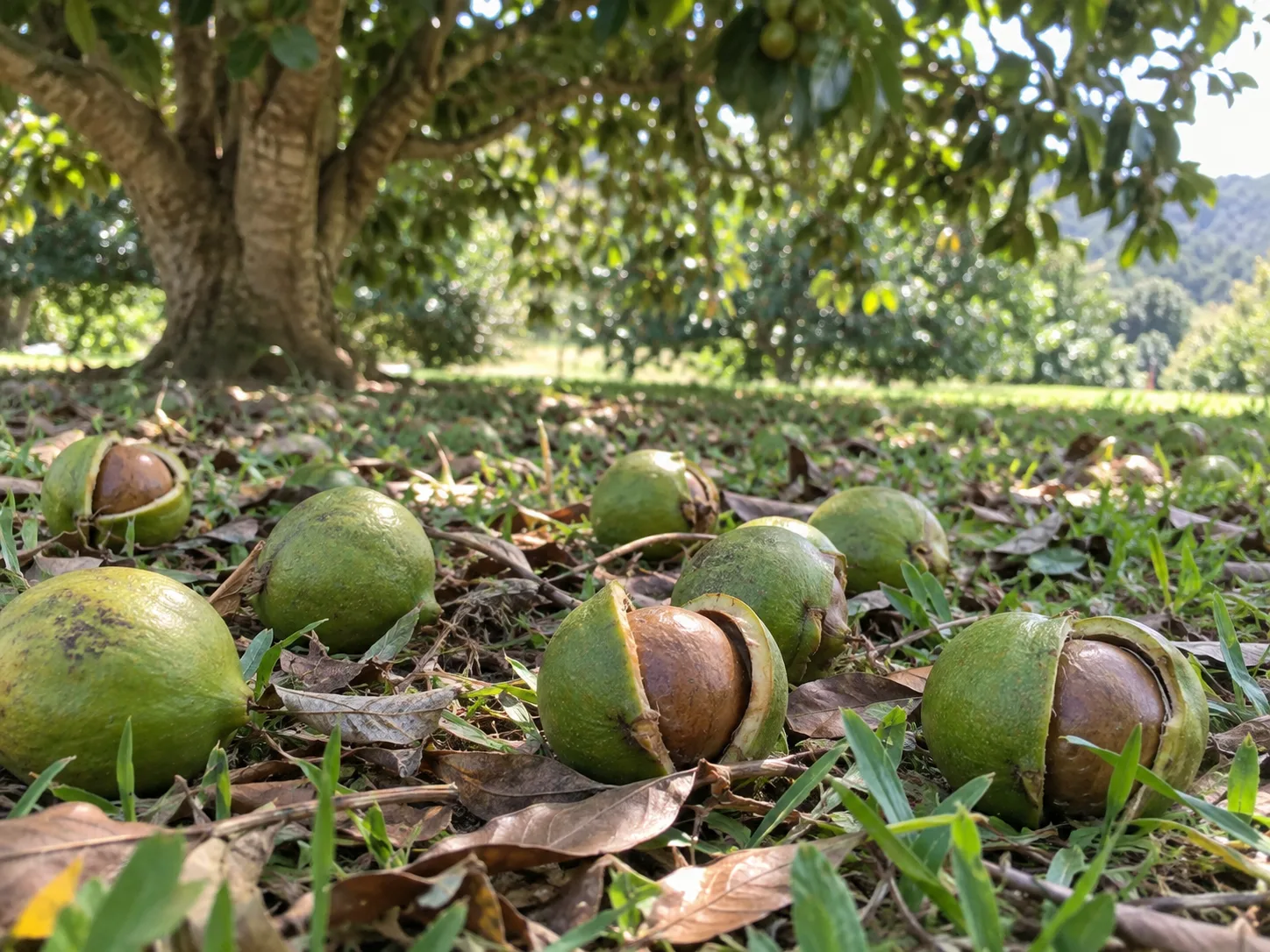
Remove the outer husk promptly and keep the in-shell nuts in a dry, airy place. CTAHR advises against leaving unhusked nuts in a bag or box for more than a day because trapped moisture can encourage spoilage; it recommends husking promptly or spreading in-husk nuts on a ventilated rack protected from rain and direct sun if they cannot be processed right away. In a backyard, the same principle applies: don’t let a damp pile sit in a bucket in the garage.
The shell is exceptionally hard, so use a purpose-built macadamia cracker or a safe, stable method rather than striking nuts on a countertop or holding them in your palm while hammering. Drying and roasting practices differ among home processors, and the source material does not establish one universal time or temperature. Follow a tested food-preservation or nut-processing method for your harvest, label the batch, and discard kernels with rancid, musty, or moldy odors.
Harvest timing varies by cultivar and location. In Hawaii, CTAHR describes nuts dropping over much of the year, including a July-to-March period; do not copy that calendar for another hemisphere or climate. Watch for the first natural drop in your own garden, then check beneath the canopy regularly—especially during wet weather, when fallen fruit can spoil faster or attract animals. If dogs use the yard, pick up nuts promptly and keep stored harvest out of reach: the ASPCA includes macadamia nut on its dog plant list. Contact a veterinarian or animal poison-control service if a dog eats macadamia nuts rather than trying a home remedy.
Diagnose the most common setbacks
When a macadamia looks unhappy, start with the root zone and recent weather. Wilting with wet soil points toward poor aeration or root injury; wilting with dry soil is more consistent with drought. Leaf yellowing can reflect pH or nutrient problems, but it can also follow cold, root stress, or overwatering, so appearance alone is not a diagnosis.
If the tree grows leaves but does not flower, consider its age, light, climate, and cultivar before reaching for fertilizer. A young seedling may simply not be mature; a shaded tree may have too little energy for good flowering; a marginal winter climate may damage buds or fruit. Improve the underlying condition you can verify, then give the tree time to respond through a full growth cycle.
Watch for branch dieback, cankers, spots, or fruit damage, and note whether symptoms appear on one branch or across the whole canopy. Use clean pruning tools and avoid wounds from mowers and string trimmers. CTAHR’s macadamia materials document losses associated with mold and rot, insects, immature or sprouting nuts, and rodents in harvested crops, but those older Hawaii figures should not be treated as a current backyard pest forecast. For a spreading disease or a pest you cannot identify, photograph the damage and ask a local extension service for a diagnosis before applying pesticides.
Decide whether seed or grafting makes sense
Plant a seed only if you are curious about germination and willing to wait without knowing exactly what fruit the tree will produce. Fresh seed can be used to raise rootstock or an experimental tree, but it is a poor shortcut to a predictable crop. A seedling may take longer to bear, and its flowers, fruit quality, or canopy may not match the parent.
Grafting is a specialized way to preserve a selected cultivar. Commercial trees are commonly propagated by grafting, but home grafting takes practice, clean tools, suitable scion material, and the right timing. If your goal is a backyard harvest rather than learning propagation, buying a healthy grafted tree from a reputable nursery is usually the more economical use of years and space.
When comparing nursery stock, check for a clear graft union, a well-rooted but not pot-bound root system, an undamaged trunk, and a label that names the cultivar. Ask whether the nursery can replace or advise on a tree that fails to establish. A bigger tree is not automatically a better buy if it has circling roots or has been stressed in its container.
Growing macadamia in a container or greenhouse
A young macadamia can live in a large container temporarily, but the species is not a naturally compact houseplant. Roots eventually need more volume than a patio pot can provide, and restricted roots limit canopy, water buffering, and long-term fruiting. Indoor conditions usually lack the sun, warm air, and room needed to raise a healthy large tree.
A greenhouse may protect a tree from cold, but it must be bright, warm, well ventilated, and spacious enough for a mature canopy. The structure also needs reliable irrigation and drainage; in a hot greenhouse, containers can dry quickly, while standing water in a saucer creates a different problem. Before putting a tree under glass, compare the cost and space with buying nuts and growing a better-adapted fruit tree outdoors.
If you keep a tree in a pot while young, use a stable, well-draining container with drainage holes and a medium suitable for woody fruit trees. Move it up only when roots fill the current pot, and avoid repeated root pruning to hold a large tree at bonsai size if the goal is nuts. Treat a container macadamia as a temporary or ornamental project, not a dependable crop plan.
Common mistakes that waste years
The most expensive mistake is planting first and checking climate later. A macadamia that repeatedly takes frost damage may survive but stay small or fail to fruit, so confirm local outdoor success and winter exposure before paying for a tree. A second mistake is choosing a seedling because it is cheap, then discovering a decade later that the fruit or canopy is not what you expected.
Avoid the three common care shortcuts: giving a fixed large water volume because an article quoted it, applying a high-potassium fertilizer without a soil or tissue test, and assuming every tree needs exactly the same second cultivar. These choices ignore rainfall, texture, root size, cultivar, and local pollination. Observe the soil, record growth and bloom, and make one measured change at a time.
Also resist planting too close to paving or a building, flooding the root ball, burying the graft union, piling mulch against bark, and pruning away too much canopy. Those errors are harder to correct once the tree is large. A thoughtful site choice and steady first-year care matter more than a complicated fertilizer schedule.
Conclusion
Macadamia nut trees are most rewarding where the climate is warm and nearly frost-free, the soil drains well, and the gardener can reserve space for a large evergreen tree. Start with a named grafted cultivar recommended for your region, test the soil, plant high enough to keep the trunk and graft union clear, and water according to root-zone moisture rather than a fixed quota. Keep pruning light and use test results—not a generic NPK formula—to guide fertilizer.
For a harvest, add compatible pollination where space and cultivar recommendations support it, then be patient: a first crop can take several years and a mature yield much longer. If your site fails the climate or drainage check, enjoy the tree as an ornamental only if it can thrive there, or choose a better-adapted edible tree. That honest decision can save years of care with little return.