25 Lettuce Companion Plants for a Smarter Garden Bed
Find 25 lettuce companion plants grouped by season and job. Learn which pairings save space, support aphid predators, offer shade, and need extra room.
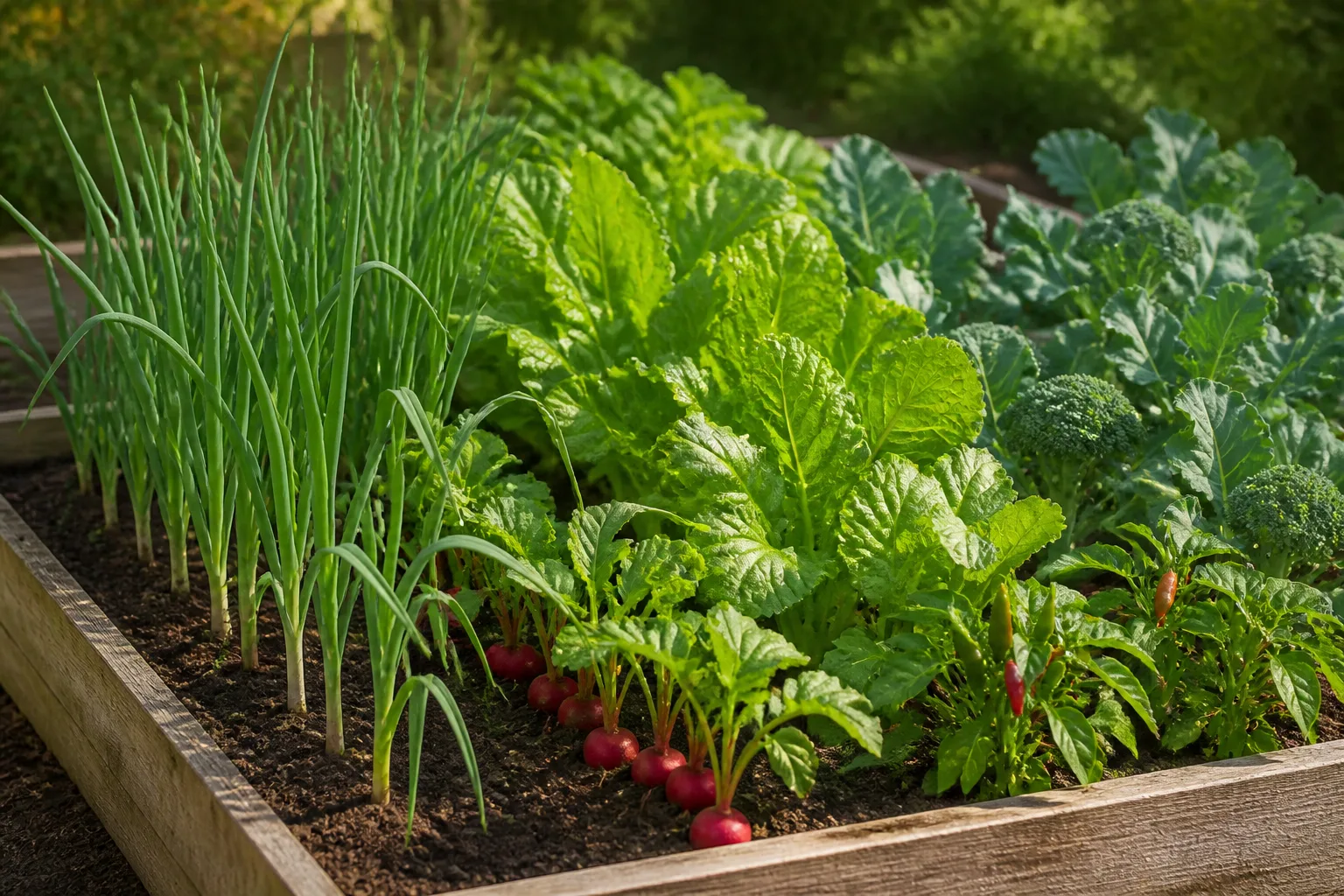
The most useful lettuce companion is often the crop that shares its cool-season schedule, leaves room for its mature canopy, or flowers long enough to feed a helpful insect. That is a more dependable way to choose than expecting a neighboring herb to repel every pest or make lettuce taste sweeter.
Lettuce is a quick-growing, shallow-rooted leafy crop, but that does not mean it can be squeezed beside anything. Head lettuce needs room to form a full plant, roots need consistent moisture, and crowded leaves dry slowly after rain or overhead watering. In a home garden, the best companion planting is usually a careful layout that earns a second harvest or gives beneficial insects a reason to visit.
Quick picks: choose partners by the job
If you only want a few combinations to try, start with radishes or scallions for compact use of space, spinach or arugula for a cool-season bed, and sweet alyssum for a documented floral resource for hoverflies. Try a tomato or trellised cucumber as a seasonal source of partial shade only if you can keep enough light and air around the lettuce. These pairings solve different problems; none is a universal pest shield.
| Your goal | Good first choice | Why it can fit | Main caution |
|---|---|---|---|
| Fill open space early | Radishes | Harvested quickly while lettuce is small | Thin promptly and avoid crowding the lettuce row |
| Share a cool-season bed | Spinach or arugula | Similar cool-season timing and moisture needs | Both still compete if densely sown |
| Encourage aphid predators | Sweet alyssum | Nectar and pollen can support hoverflies | A flower does not guarantee control in a small garden |
| Add a narrow border crop | Chives or scallions | Upright habit uses little bed width | Their scent is not proven protection for every pest |
| Moderate strong afternoon sun | Trellised cucumber or tomato | A canopy can cast useful shade later in the season | Too much shade and poor airflow reduce lettuce quality |
What makes a good lettuce companion?
A good companion is not necessarily a plant that “helps” lettuce biologically. It may simply use another part of the bed at a different time, stay compact, provide a useful flower, or create a little shade when temperatures rise. The pairing is successful if both crops remain easy to water, inspect, and harvest.
Timing matters more than labels
Lettuce performs best in cool weather and is often finished before warm-season vegetables reach full size. Utah State University Extension notes that lettuce grows best below about 75°F; heat can slow growth and produce bitter leaves, while temperatures above 80°F can reduce seed germination. Its home-garden guidance gives head lettuce a typical final spacing of 8 to 12 inches in the row, with 12 to 18 inches between rows, so a “small” neighbor still needs to fit around that mature footprint. USU Extension’s lettuce guide
Think in overlapping calendars rather than static companion charts. A row of lettuce can occupy the bed while peas are young, for example, then be harvested as the pea canopy climbs; lettuce planted beside a full-grown tomato in midsummer faces a different combination of shade, heat, and water demand. The best match can change from April to July even in the same garden.
Pest support works through specific mechanisms
Some companion planting has a clearer mechanism than others. Flowers can provide nectar and pollen to adult beneficial insects, while mixed canopies can make a crop harder for a pest to locate; these effects depend on the insect, the crop, the flower, and the scale of the planting. A strong scent from an herb is not, by itself, evidence that aphids, slugs, or rabbits will stay away. Epic Gardening’s lettuce guide also notes that some individual benefits remain debated, so a practical pairing should have a specific job beyond an appealing name. Epic Gardening
Sweet alyssum is a useful example because its relationship to lettuce aphids has been studied in commercial fields. USDA Agricultural Research Service research horticulturist Eric Brennan describes alyssum as a nectar and pollen source for hoverflies, whose larvae eat aphids; he also describes field layouts that placed alyssum among lettuce plants. A home bed is smaller and less controlled than that trial, so use alyssum to support beneficial insects, then inspect leaves and manage aphids directly if needed. USDA ARS on sweet alyssum and natural enemies of lettuce aphids
25 lettuce companions, grouped by function
These are 25 plants that can make sense near lettuce for a specific reason: compatible timing, harvest overlap, a useful flower, or a manageable canopy. “Companion” here means a practical neighbor, not a promise that one species will increase the other’s yield. Before planting, check each crop’s mature spread, water needs, and days to harvest.
Cool-season greens and quick roots
These eight crops are easiest to combine with lettuce in spring or fall, when their growing conditions overlap. Use small successions and harvest short-season crops before their leaves or roots compete for the final space lettuce needs.
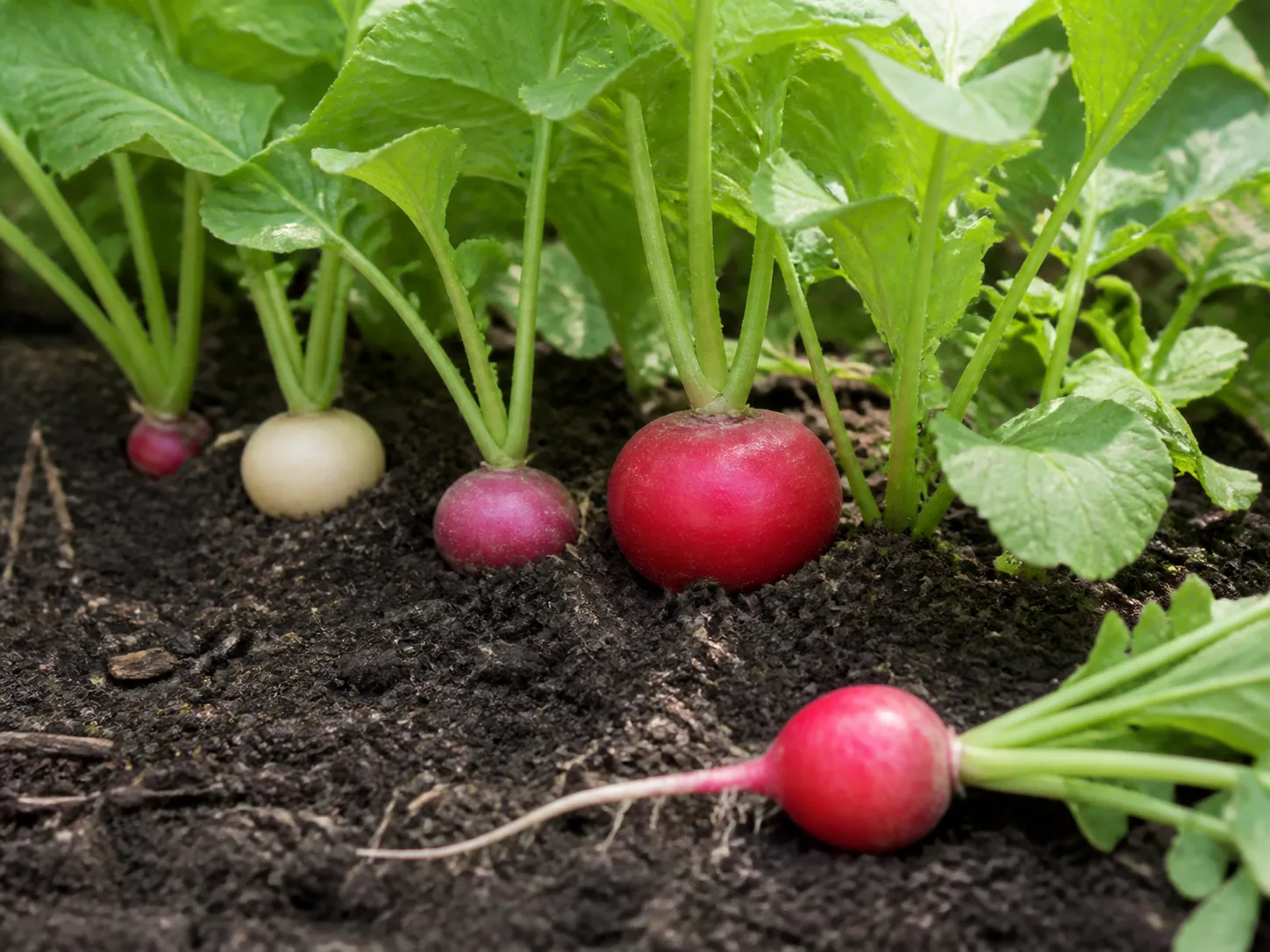
Radishes can be pulled while young lettuce is still expanding; thin both crops so the bed does not become congested.
-
Arugula — This fast, cool-season green shares lettuce’s preference for mild weather and can be cut as baby leaves before a lettuce head fills out. Sow it in a separate narrow band rather than scattering seed through the lettuce row, so you can harvest without bruising or stepping on lettuce.
-
Spinach — Spinach and lettuce can share a spring or fall bed because both appreciate cool conditions and steady moisture. Their leaves overlap quickly, though, so choose baby-leaf harvest for one crop or leave a clear lane between mature plants; planting them tightly does not eliminate competition.
-
Swiss chard — Chard stays productive longer than lettuce and can become a taller leafy anchor at the edge of a bed. Put it where its full leaves will not shade young lettuce all day, and harvest outer leaves regularly if the rosette begins to lean over the lettuce row.
-
Radishes — Quick radishes can use open soil between young lettuce plants, then come out before the lettuce reaches full size. Their value is mainly timing and a second harvest, not proven soil aeration or guaranteed pest repellence; thin them early and do not leave oversized roots to crowd neighboring plants.
-
Carrots — Carrots can share a bed with lettuce when the soil is loose and the rows remain distinct. Lettuce seedlings can help mark a slower-germinating carrot row, but this is a layout convenience, not a reason to sow both so densely that carrot roots fork or lettuce lacks airflow.
-
Beets — Beets add a root crop and edible greens to the same cool-season bed, but their crowns and leaves need space as they size up. Grow them in a parallel row or harvest some as baby beets; do not assume that different root shapes mean the two crops cannot compete for water.
-
Turnips — Small salad turnips mature quickly enough to fit a succession plan with lettuce, especially in fall. Their broadening tops can shade seedlings and their roots expand belowground, so harvest at the size you want rather than letting a quick crop linger until it dominates the row.
-
Strawberries — Strawberries are a reasonable neighbor at the edge of a garden or in a separate permanent bed, where their ground-level foliage and fruit are easy to reach. They are perennial, so avoid planting lettuce in the middle of an established strawberry patch that you need to mulch, weed, or renovate; the two crops also need separate pest checks.
Compact alliums and useful herbs
Alliums and herbs fit best along edges or in modest clusters where you can harvest them without letting them shade lettuce. Their strongest reliable benefit is culinary diversity and, for flowering herbs, a possible food source for beneficial insects—not a scent barrier that replaces pest control.
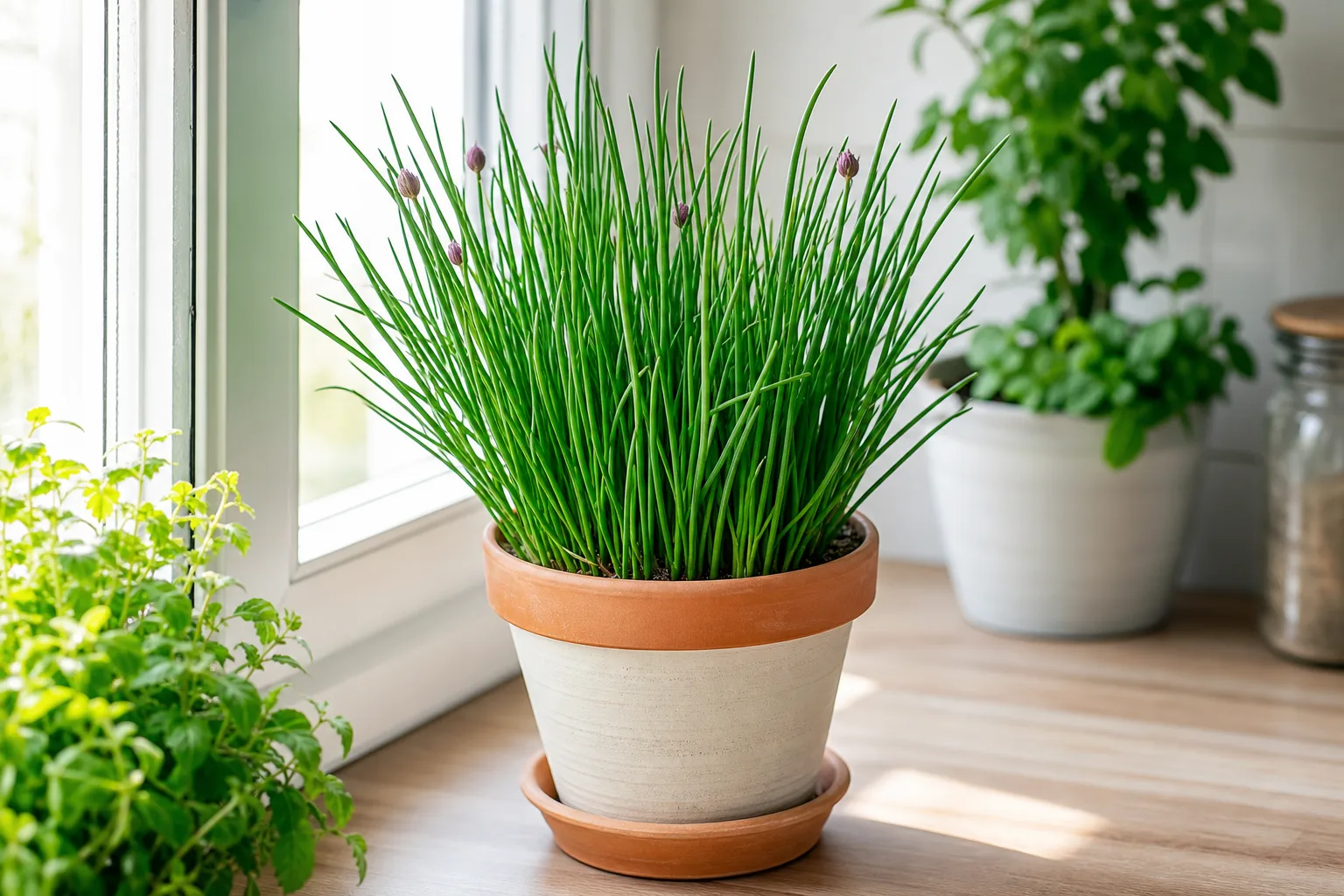
Upright herbs and alliums can use a narrow edge, but keep their mature clumps out of the lettuce’s air space.
-
Chives — Chives grow as a narrow clump and are easy to tuck at a bed corner or along a path. Their purple flowers can attract visitors when allowed to bloom, but the plant’s onion scent should not be counted on to prevent aphids or other lettuce pests.
-
Scallions — Scallions take little horizontal space and can be harvested young, which makes them convenient between lettuce successions. Sow them in a line with room for the bulb base and for lettuce leaves to dry after rain; interplanting every gap can make both crops harder to inspect.
-
Bulb onions — Onions can share a vegetable bed if you plan around their slower bulbing period and keep the lettuce row accessible. Their smell is often described as a pest deterrent, but the more practical reason to pair them is their upright form; scout for pests instead of relying on fragrance.
-
Garlic — Garlic is most often planted in fall and harvested in early summer, so its calendar can overlap with spring lettuce without a full-season crowding problem. Plant cloves in their own row and lift them after the leaves yellow; pulling bulbs through a dense lettuce patch can damage both crops.
-
Dill — Young dill can fit at the edge of a lettuce bed, and flowering dill offers nectar and pollen to beneficial insects. The plant can become tall and self-seed, so give it an end position and clip seed heads if volunteers would crowd the next lettuce planting.
-
Cilantro — Cilantro is another cool-weather herb that can be harvested for leaves while lettuce is growing. It bolts as temperatures rise, but its umbels may then draw beneficial insects; stagger a few small sowings and leave enough room to remove plants cleanly once flowering ends.
-
Parsley — Parsley is a compact edge herb that can share a bed across more of the season than lettuce. It may become dense and shade small seedlings, so plant it at a corner or in a pot beside the bed rather than filling the spaces between every lettuce head.
-
Basil — Basil can grow near lettuce during warm weather, but it is not a proven flavor enhancer or pest shield for lettuce. Use it as a nearby culinary crop in a sunny spot; if the lettuce needs cool conditions, do not keep it in full heat just to match basil’s preference.
Flowers that add habitat
A few flowers earn a place because they bloom near the crop and support beneficial insects, but flower choice and placement matter. Garden Gate’s practical companion-planting coverage describes sweet alyssum alongside lettuce as a nectar source for hoverflies and parasitoid wasps; its value is ecological support, not a pesticide effect. Garden Gate’s companion planting examples

Flowering plants can provide habitat near vegetables, but the pictured mix is an example of layout, not proof that every flower controls every pest.
-
Sweet alyssum — Sweet alyssum is the strongest choice on this list when your specific goal is to support hoverflies that prey on aphids. Plant a short border or a few plants near lettuce, keep flowers blooming, and still check leaf undersides; a small home planting cannot guarantee the aphid reductions seen in field research.
-
Calendula — Calendula brings long-lasting flowers and can be useful as a border crop, but claims that it reliably traps slugs or repels lettuce pests are too broad. Place it where you can notice slug damage and remove it if it becomes a hiding spot or takes over a narrow bed.
-
French marigolds — French marigolds add a bright, compact flower that can share an edge with vegetables and support insect activity. Do not treat them as a fungicide or as a universal nematode treatment; any soil-pest suppression depends on marigold species, cultivar, density, and how the crop is grown.
-
Nasturtiums — Nasturtiums spill over bed edges and are edible, making them useful where a trailing plant will not cover young lettuce. They may attract aphids themselves, so monitor the leaves and remove badly infested growth rather than assuming the plant will draw pests away safely.
Tall crops for carefully placed shade
Tall or climbing crops can provide useful late-day shade, but they need more space and water than lettuce. The cleanest arrangement is often lettuce as an early crop in front of a trellis or warm-season vegetable, with the lettuce harvested before that neighbor fills the canopy.
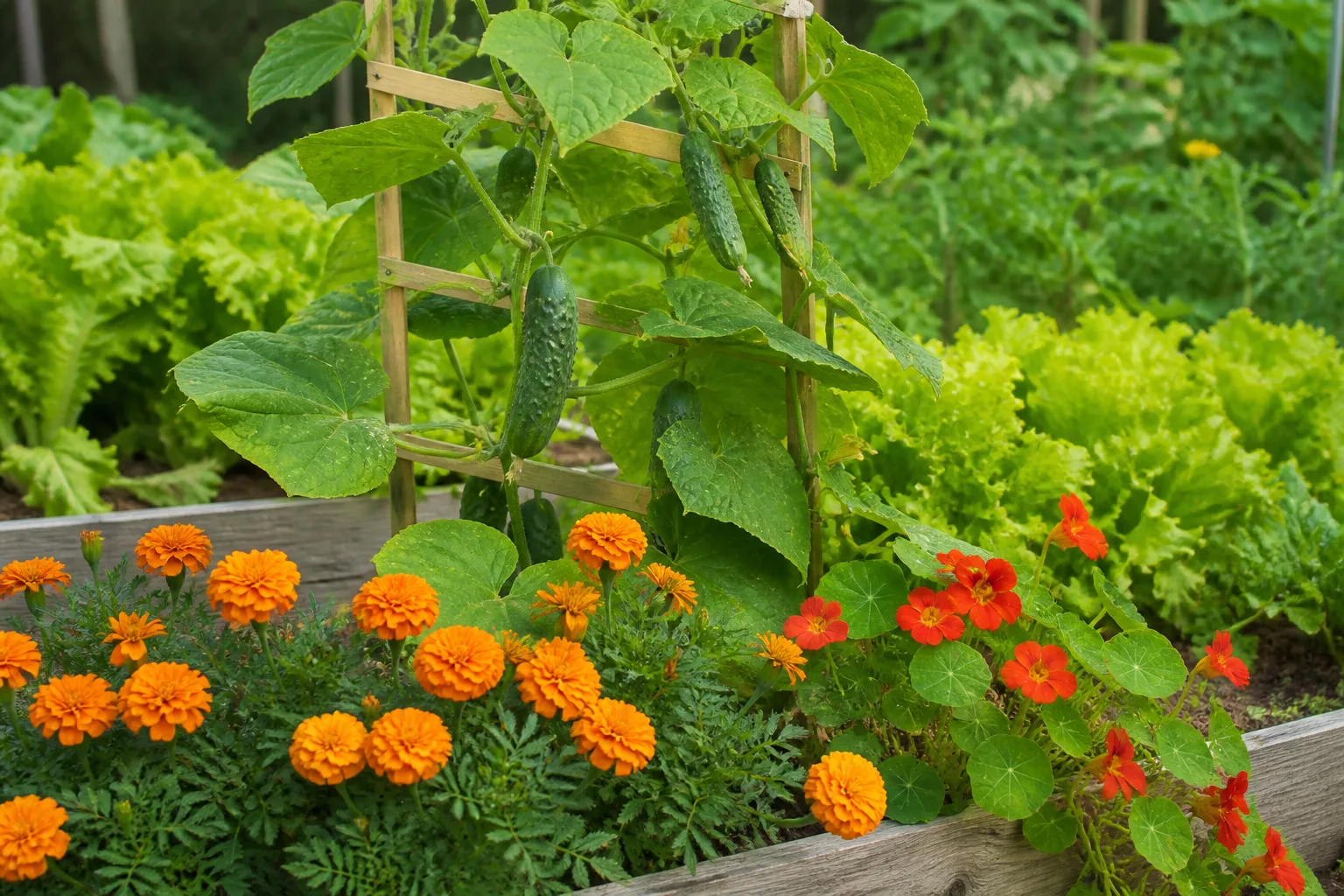
Vertical crops save ground space only when vines are trained and the bed below them still receives enough light and air.
-
Tomatoes — A tomato can cast partial shade over lettuce during hot weather, especially if the lettuce is planted on the cooler side of the plant and harvested early. Tomatoes are large, thirsty crops; give them their own root zone, prune or stake for airflow, and do not let foliage form a dense roof over lettuce.
-
Cucumbers — Trellised cucumbers can offer dappled shade while keeping vines off the ground, and an early lettuce crop may finish before cucumber foliage becomes dense. Leave a harvest aisle and water the roots consistently; a sprawling cucumber can quickly cover a small lettuce patch and make pest scouting difficult.
-
Pole beans — Pole beans add a vertical crop and can shade nearby lettuce when temperatures climb. Legumes form nitrogen-fixing associations, but gardeners should not count on a live bean plant to fertilize its lettuce neighbor during the same season; use beans for the crop and structure, then manage soil fertility based on garden needs.
-
Peas — Peas are a cool-season climber that can share spring space with lettuce if both are given a trellis and clear access. Lettuce can mature while pea vines are still modest, then be harvested before the pea canopy becomes dense; avoid letting vines fall over the lettuce row.
-
Eggplant — Eggplant’s broad leaves can shade lettuce in a hot garden, but it is a warm-season plant with a larger root and canopy footprint. Treat the pairing as a brief shoulder-season overlap or use eggplant on the bed edge; do not crowd a lettuce head beneath a mature plant.
How to pair crops without crowding lettuce
Plan from the lettuce’s mature size outward. Utah State University Extension gives head lettuce a wider final spacing than baby-leaf crops, and its leafy-greens guide emphasizes spacing for airflow because crowded leaves can stay damp and invite disease. For mixed beds, the practical rule is to leave lettuce’s full mature footprint open and use the surrounding gaps for crops that will be harvested early or remain narrow. USU’s leafy-greens planting and spacing guidance
A small-bed layout
In a 4-by-8-foot bed, reserve a strip for lettuce rather than scattering plants across every open inch. Grow head lettuce at the variety’s recommended spacing, tuck a short radish succession in a separate open band, and place chives or scallions along an edge; if adding alyssum, use a small border near the bed rather than sowing flowers through the harvest row.
For a summer transition, put a trellised cucumber or tomato where its shade falls during the hottest part of the day, then use lettuce as a spring crop in front of it. Remove or harvest lettuce as the warm crop expands. This avoids the common mistake of trying to maintain a cool-season crop under a mature, thirsty canopy long after its best season has passed.
Pots and tight spaces
A wide planter can hold one lettuce plant with a compact herb or a few scallions, but a pot is not a miniature field. All the roots share the same small water and nutrient supply, and a companion that looks tiny at transplanting can occupy most of the container by midsummer. Use a container with drainage holes, keep crops that need similar moisture together, and harvest leafy greens young.
If you want flowers for beneficial insects, use a separate pot of alyssum beside the lettuce container. That keeps the lettuce’s root zone and harvest area clear while still placing flowers near the crop. In a very small space, one well-grown lettuce plant and one useful companion will usually outperform a crowded combination of five species.
When shade can save a lettuce crop
Partial shade can help lettuce through a hot spell, but it is a temperature-management choice rather than a cure for bolting. Lettuce still needs enough light to grow well, and a large canopy can create a damp, stagnant pocket where leaves dry slowly. Aim for gentle afternoon shade in a hot climate, not deep shade from morning to evening.
A companion crop only casts shade when its height, row position, and the sun’s angle line up. Observe the bed for a few days before planting: note where the strongest afternoon sun falls, then place a trellis or larger crop so its shadow reaches lettuce during that heat window. If shade arrives too early, move the lettuce to the sunnier edge or choose a more heat-tolerant cultivar and sow another crop when temperatures ease.
What not to plant close to lettuce
There is no need to follow a rigid “good plant/bad plant” chart as if every pairing worked everywhere. Avoid crowding lettuce with mature mint, a large fennel plant, perennial asparagus, or any crop whose roots, leaves, or maintenance will repeatedly disturb the lettuce row. These are layout conflicts: sprawling growth, persistent roots, or poor access can make lettuce difficult to water, weed, and harvest.
Brassicas such as cabbage, broccoli, or kale are not automatically toxic neighbors, but they can create dense shade and share a cool-season bed with lettuce, so spacing and crop rotation matter. Claims that brassicas prevent lettuce germination should not become a universal ban without cultivar- and condition-specific evidence. If germination is poor, first check seed age, soil temperature, sowing depth, and moisture.
Fennel is often kept separate because it can grow large and has a reputation for suppressing nearby crops, but size and shading are enough reason to avoid putting a mature fennel plant beside a compact lettuce row. Likewise, mint belongs in a pot if you want it near the bed; its running roots can spread beyond the spot where you planted it.
Companion plants will not replace scouting
Lettuce leaves hide small pests well, particularly near the crown and on the undersides. Utah State University Extension notes that aphids can distort leaves, reduce vigor, and contaminate produce; it recommends scouting crops, checking transplants, encouraging natural enemies, and using row covers where appropriate. Look under several leaves twice a week, especially during warm weather, instead of waiting until a whole head is affected. USU Extension’s vegetable aphid guidance
Companion flowers can be part of integrated pest management, but they are one tool. If you find aphids, identify whether they are active and increasing, rinse small colonies from leaves, protect beneficial insects, and use only products labeled for edible lettuce when a treatment is truly needed. A flower border cannot substitute for clean transplants, adequate spacing, regular observation, and sensible crop rotation.
Use succession planting to keep pairings productive
Lettuce is useful in companion planting because it can be sown in small batches and removed before slower neighbors reach full size. Instead of filling a whole bed at once, plant a short row, wait a week or two, and sow the next row if the weather still suits lettuce. Pull or harvest fast companions as their purpose ends, then replant the cleared space with the next cool-season crop.
Keep a simple record of the pairing, sowing date, variety, spacing, shade pattern, pest levels, and harvest date. If a combination stays healthy but yields less lettuce, it may be a good-looking bed that is too crowded; if alyssum blooms and hoverflies visit but aphid pressure remains, the flowers may still support beneficial insects without controlling the outbreak. Change one variable at a time so the next season tells you more than a long list of simultaneous experiments.
Conclusion
The best lettuce companion plants are the ones that fit lettuce’s cool-season calendar and mature size. Radishes, spinach, arugula, scallions, and herbs can share a bed efficiently when you keep their rows distinct; sweet alyssum offers a better-documented way to support hoverflies that prey on aphids; and tomatoes or trellised cucumbers can provide partial shade when placed carefully.
Treat the rest of the companion-planting chart as a set of options to test, not guarantees. Leave enough room for air and harvest access, avoid dense shade, and keep scouting for pests even when flowers are blooming nearby. A small, well-timed pairing usually gives you more than an overcrowded bed planted in the name of companionship.