Peppermint Oil for Mice: Does It Work?
Peppermint oil can deter mice when used correctly—but not while they're nesting inside. Learn recipes, placement, timing, and what to do first.

Peppermint oil can discourage house mice from crossing treated lanes—but it does not control an active infestation, kill rodents, or replace sealing gaps and setting traps.
The menthol-rich vapor irritates their sensitive noses and can make a baseboard or cabinet feel unsafe for a few days. That is useful. What it is not: a standalone solution for mice already nesting in your walls, attic, or pantry.
If you are standing in the essential-oil aisle hoping one bottle solves a scratching-in-the-walls problem, you need a different plan first. If you have already sealed entry points, removed the mice inside, and want a low-toxicity layer to discourage new explorers, peppermint oil earns a place in the toolbox—used correctly and refreshed often.
The Honest Answer: Peppermint Oil Deters, It Does Not Control
Think of peppermint oil as a lane marker, not a fence. Mice navigate by smell and touch, running whiskers along walls in predictable paths. A strong mint vapor on that path can persuade a cautious mouse to turn around—especially if food and shelter are available elsewhere. Leave a chewed cereal box in the pantry and a pencil-width gap under the garage door, and the same mouse will push through the scent because survival beats discomfort.
University integrated pest management guidance is consistent on the hierarchy: sanitation, exclusion, and population reduction (trapping or, in some settings, rodenticides) come before gimmicks. UC IPM notes there is little evidence that ultrasonic, magnetic, or vibrational repellent devices drive established house mice from buildings (UC IPM House Mouse). Commercial chemical repellents for outdoor deer mice are similarly not sufficiently effective to justify their cost (UC IPM Deer Mouse). Peppermint sits in the same category: a possible nudge, not a cure.
What the Science Actually Says About Peppermint and Rodents
Peppermint essential oil is high in menthol and related monoterpenes—volatile compounds that evaporate quickly and register as intense odor to animals with far better olfactory resolution than humans. Lab and field anecdotes suggest rodents avoid concentrated mint vapors when an easier route exists. What is missing is rigorous proof that peppermint eliminates indoor populations or keeps mice out long-term without exclusion work.
That gap matters. Mice habituate to repeated stimuli, and essential oils fade as VOCs dissipate—faster in dry winter air, near HVAC returns, and on non-porous surfaces. A cotton ball that smelled sharp on Monday can read as background noise by Thursday. Peppermint is best understood as a short-term irritant you maintain, not a one-and-done treatment.
When Peppermint Oil Helps—and When It Makes Things Worse
Timing separates a helpful deterrent from an expensive air freshener—or an active mistake.
Why You Should Not Spray Peppermint While Mice Are Still Inside
The biggest peppermint error is spraying while mice are still nesting indoors. A strong repellent odor can cause rodents to relocate deeper into wall voids, cabinet backs, or insulation where the scent is weaker but shelter remains. You may hear less scratching in the kitchen while activity spikes in the attic. That is not control; it is displacement.
Use peppermint only after you have:
- Sealed exterior entry points larger than ¼ inch (the width of a pencil eraser)
- Trapped or otherwise removed mice already inside
- Cleaned droppings and food debris that hold mouse pheromone trails
If you still find fresh droppings nightly, you are in the trap-and-seal phase—not the peppermint phase.
Best Use Cases for Peppermint Oil
Peppermint oil earns its keep in specific, limited jobs:
-
Maintenance after successful trapping: A final wipe or spray along baseboards helps mask residual odor trails that might invite new explorers.
-
Seasonal prevention in sealed homes: After fall exclusion work, perimeter misting on interior thresholds can add a low-toxicity barrier before cold weather pushes field mice toward foundations.
-
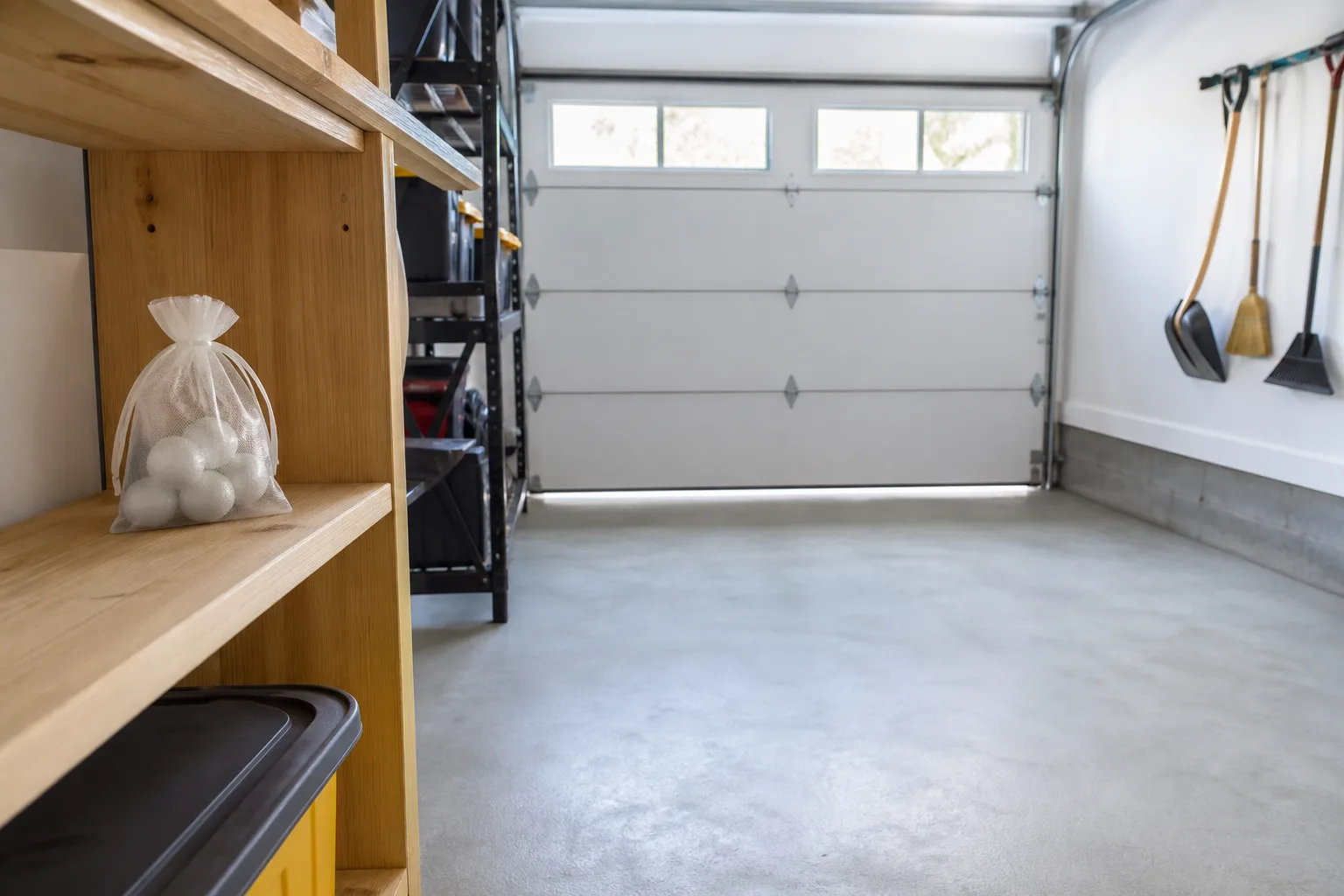
Garage and shed transitions: Treat door sweeps and stored-hose corners when the structure is mouse-free but historically vulnerable.
-
Supplement to a broader natural program: Pair with steel-wool exclusion and sanitation rather than replacing them. Our natural ways to repel mice guide covers the full layered spray recipe pros actually use.
Peppermint is a poor fit for open food storage areas (you do not want oil residue on prep surfaces), active infestations, or outdoor burrows where rain and wind strip scent in hours.
The Right Order of Operations for Mouse Control
Peppermint is step five or six, not step one. CDC rodent guidance frames the durable approach as removing food, water, and shelter, then sealing up, trapping up, and cleaning up (CDC Rodent Control). Fold peppermint in only after those pillars are in motion.
Step 1: Confirm You Have Mice, Not Rats or Bats
Identification changes your scale of traps, hole sizes, and health precautions. Quick field checks:
- House mouse droppings: rice-grain size, pointed ends, often along walls
- Rat droppings: larger, blunt-ended, comparable to a small candy tic-tac
- Bat droppings: crumble when rolled between gloved fingers; mouse and rat droppings squash flat
Scratching at night, chewed packaging, and greasy rub marks along baseboards point to commensal house mice—the species peppermint questions usually involve. Deer mice in rural cabins carry hantavirus concerns; cleanup requires stricter disinfection protocols (UC IPM Deer Mouse). If you are unsure, photograph droppings and consult your local extension office before disturbing nesting material.
Step 2: Seal Entry Points Mice Cannot Chew Through
Exclusion is the most successful and permanent form of house mouse control (UC IPM House Mouse). Mice squeeze through gaps ¼ inch tall and holes ⅜ inch wide—spaces easy to dismiss as “too small.”
Inspect with a bright flashlight and mirror:
- Foundation cracks and siding-to-foundation joints
- Garage door sweeps and warped thresholds
- Utility penetrations for AC lines, gas pipes, and cable bundles
- Attic vents, soffit gaps, and damaged screening
- Crawlspace access doors
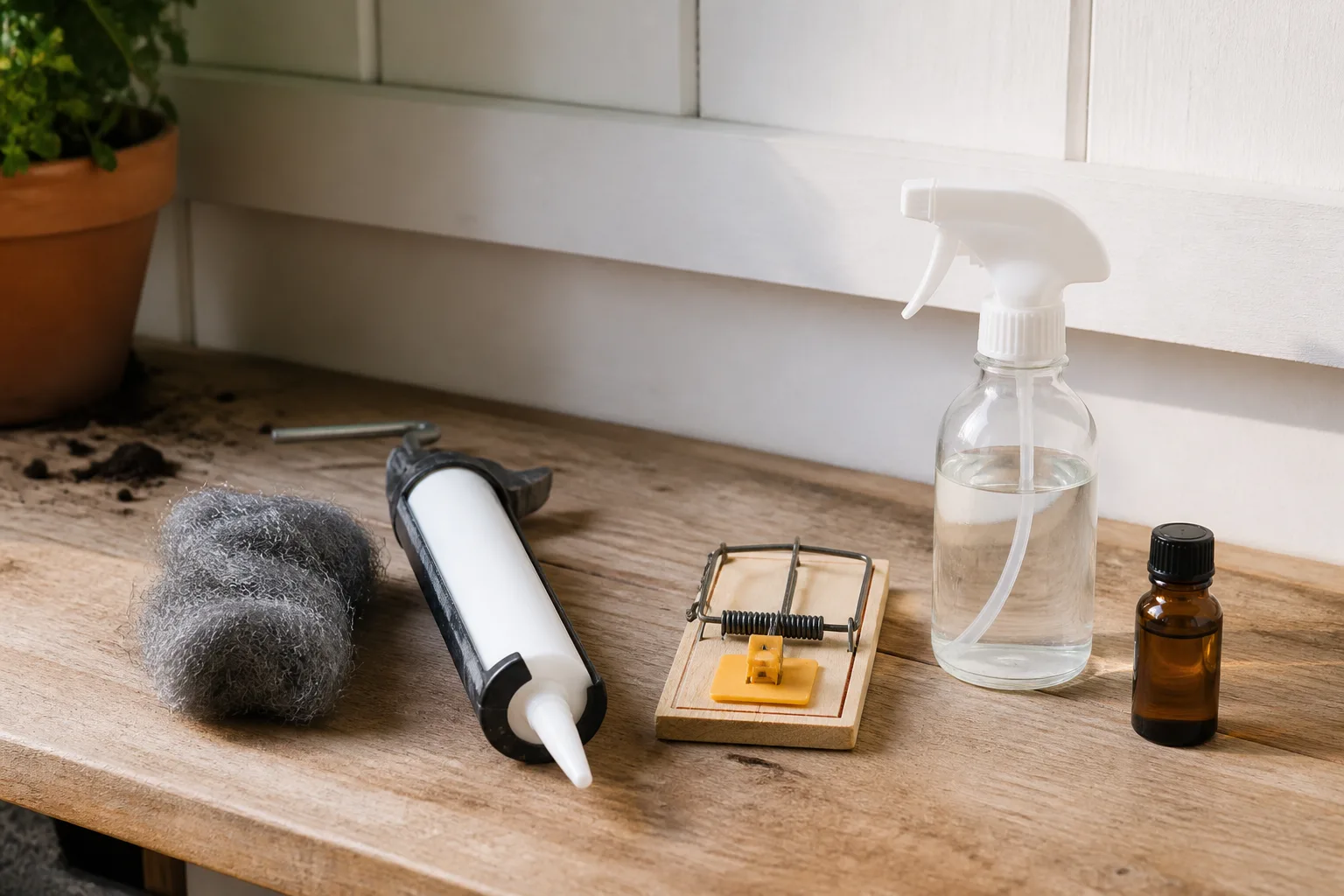
Do use: hardware cloth, metal flashing, escutcheon plates, exterior-grade caulk paired with metal backing, and coarse steel wool packed tightly into small indoor gaps.
Do not use: spray foam alone, plastic mesh, rubber, or wood plugs—mice chew through them. Steel wool can rust in damp exterior zones; follow with metal mesh where moisture is present.
Step 3: Trap Active Mice Before Any Repellent
For small indoor populations, snap traps are the preferred first reduction tool—no rodenticide odor risk, and you can confirm success (UC IPM House Mouse). Place traps perpendicular to walls along travel lanes, spacing them no more than 10 feet apart in active zones. Peanut butter, nesting cotton, or the food mice are already stealing all work as bait.
Check traps daily. Continue until you have at least two weeks with zero fresh droppings and no new chew marks. Mouse traps and rat traps are not interchangeable—rat traps are larger and can misfire on small mice without killing cleanly.
If you are not catching within the first few nights, the trap is in the wrong lane, not the wrong bait. Move sets to darker corners behind appliances where droppings concentrate.
Step 4: Deep-Clean Nesting Zones and Food Sources
Mice leave scent maps—urine pillars, grease rubs, and cached food—that invite the next explorer. Cleaning is not optional aesthetics; it is pheromone removal.
Focus on:
- Pantry shelves, stove drawers, and pet food stations (store dry goods in airtight containers)
- Attic or crawlspace insulation disturbed by nesting (replace badly soiled sections)
- Garage clutter along the foundation where mice hide
Never vacuum dry mouse droppings. Disturbing waste aerosolizes pathogens. Spray droppings with disinfectant (commercial product or 1½ cups bleach per gallon of water), let soak 10 minutes, then wipe with a damp paper towel while wearing nitrile gloves (CDC Clean Up). Wash hands thoroughly afterward.
Trim vegetation touching the siding, relocate firewood piles, and secure compost and birdseed—the outdoor sanitation layer that stops new mice from testing your repairs.
How to Make and Apply Peppermint Oil Mouse Repellent
Buy 100% pure peppermint essential oil labeled Mentha piperita. Fragrance oils lack consistent menthol content and may include solvents you do not want on trim or near pets.
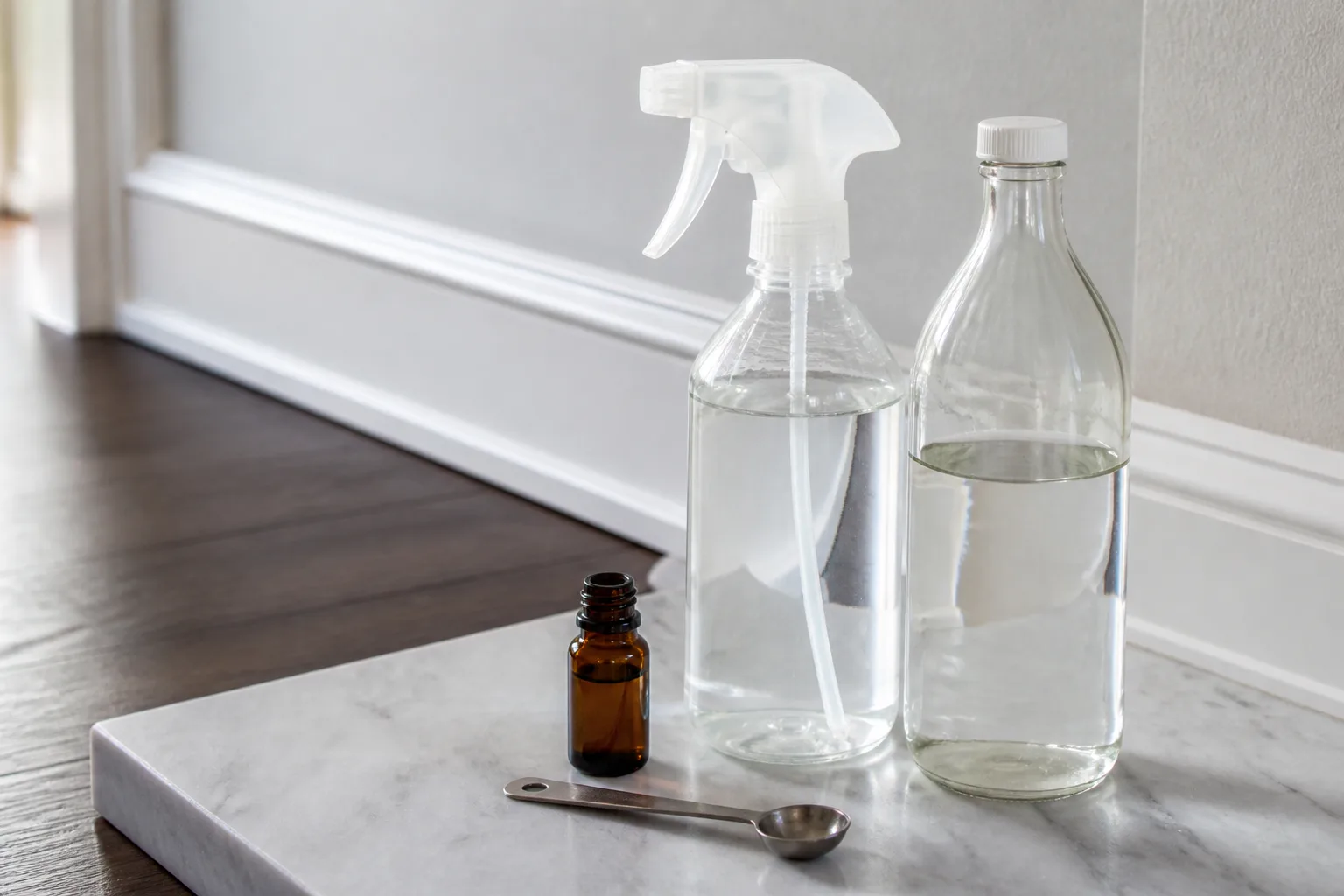
Spray Recipe for Baseboards and Entry Lanes
For a one-quart spray bottle:
- 2 teaspoons pure peppermint essential oil
- 1 teaspoon mild liquid castile soap (optional emulsifier)
- 1 cup distilled white vinegar
- 3 cups water
Add oils first, then vinegar and water. Shake vigorously before each use—separation is normal. Lightly mist along baseboards, door thresholds, pipe chases, and the rear edges of cabinets where whiskers travel. You want a thin film on porous surfaces, not puddles that stain wood or create slip hazards.
A simpler maintenance cleaner after deep cleaning: ⅓ vinegar, ⅔ water, plus 20–30 drops peppermint oil per quart. Wipe floors and sills to remove odor trails, then leave a mint edge along the wall line.
Cotton Ball and Sachet Method for Cabinets and Voids
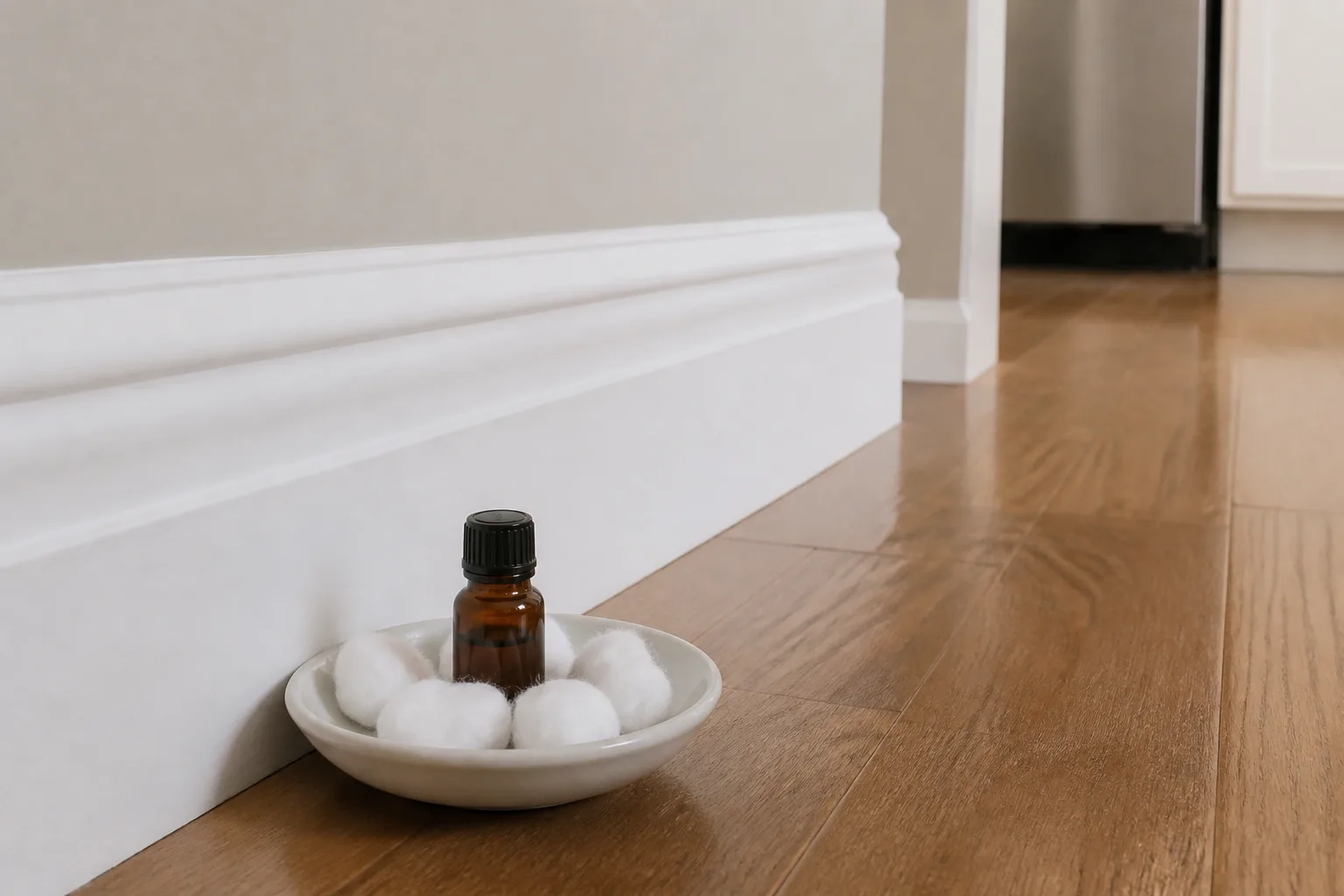
For enclosed, low-traffic zones—under sinks, behind appliances, inside garage storage lockers—soak four to six cotton balls in peppermint oil (roughly ½ teaspoon total across the batch). Place them on small dishes or in ventilated mesh sachets so oil does not contact finished wood. Do not stuff loose oil-soaked cotton where pets can ingest it.
Replace cotton balls at least weekly, or when you can no longer smell mint when standing a foot away. In dry winter heat, expect three to five days before refresh is needed.
How Much Oil to Use and Where to Place It
More oil is not more control—overapplication risks stained trim, slippery tile, and respiratory irritation for people and pets. Target lanes, not rooms:
| Zone | Method | Notes |
|---|---|---|
| Interior baseboards | Light spray mist | Reapply after mopping |
| Door thresholds (interior side) | Spray or cotton sachet | Pair with physical door sweep repair |
| Under-sink cabinets | Cotton sachet in dish | Avoid drain traps and pet bowls |
| Garage entry wall | Spray along bottom plate | Only after garage is mouse-free |
| Attic hatch frame | Cotton sachet | Ventilate; heat accelerates fading |
Skip nursery rooms, pet sleeping areas, food prep counters, and anywhere toddlers crawl. Peppermint belongs on perimeter runways, not center-floor “freshening.”
How Long Peppermint Oil Lasts and When to Reapply
Essential oils are volatile. Expect noticeable deterrence for roughly 3–7 days on cotton balls in enclosed cabinets, 2–5 days on open baseboards in heated winter air, and less than 48 hours near open windows or garage doors. Humidity, airflow, and surface porosity all shorten the window.
Reapply when:
- You no longer smell peppermint at the treatment site
- Fresh droppings appear despite sealed entries (that is a trapping problem, not a refresh problem)
- You mop, paint, or run heavy HVAC that strips VOCs from treated surfaces
Calendar reminders every Sunday work for maintenance mode; activity-based triggers work better during active prevention season.
Safety Notes for Pets, Children, and Sensitive Surfaces
Concentrated essential oils are not harmless. Cats lack efficient glucuronidation pathways for phenols and monoterpenes—peppermint and other mint oils can be toxic to cats when inhaled at high concentration or ingested from soaked cotton. Dogs are generally less sensitive but can develop GI upset if they eat treated materials.
Keep soaked cotton in closed cabinets or mesh containers pets cannot open. Ventilate while spraying. Wash skin contact promptly. Never apply peppermint oil to pet bedding, litter areas, or food bowls.
On surfaces, test a hidden patch first—oils can dull finishes on unsealed wood. Avoid spraying near open flames; VOCs are flammable at high concentrations.
Other Scents Mice Avoid (and Their Limits)
Peppermint is the most discussed, not the only scent experiment homeowners try:
- White vinegar: sharp acetic acid odor; useful in cleaning solutions but fades fast and does not seal gaps
- Ammonia: mimics predator urine cues; hazardous to breathe in enclosed spaces—poor choice indoors
- Cayenne or clove oil: occasional anecdotal success; can stain and irritate skin and airways
- Cedarwood: common in commercial “natural” repellent blends; same evaporation limits as peppermint
None of these replace exclusion. At best, they add rotating odor layers along the same wall lanes—useful only after mice inside are gone. For a broader scent-based program, see our guide on smells rats hate—many principles overlap, though rat entry points and trap sizes differ.
Signs Peppermint Is Working vs. When to Escalate
Working looks like: no new droppings along treated baseboards for two-plus weeks, no fresh chew marks on sealed entries, and occasional single exploratory signs that do not repeat after trap checks.
Failing looks like: nightly scratching, droppings accumulating behind the same cabinet, pantry packages re-chewed, or grease marks spreading to new rooms. Peppermint will not fix that—you need more traps, better sealing, or professional inspection.
Call a licensed pest professional when:
- Activity spans multiple rooms despite consistent trapping
- You cannot access crawlspaces, voids, or insulation where nesting is likely
- You identify deer mice in sleeping areas and need hantavirus-safe remediation
- Structural repairs exceed DIY comfort (roofline gaps, extensive soffit damage)
Professionals integrate monitoring, exclusion materials, and targeted reduction—tools scent alone cannot match.
Conclusion
Peppermint oil does not control mice—it can discourage them from using treated paths once your home is sealed, cleaned, and cleared of active rodents. Use pure Mentha piperita oil in light sprays or refreshed cotton sachets along baseboards and entry lanes, reapply every few days in dry heat, and keep pets and children away from concentrated applications. Do the real work first: confirm the species, plug ¼-inch gaps with metal and steel wool, trap until droppings stop, and disinfect nesting zones. Then peppermint becomes a sensible, low-toxicity maintenance layer—not the whole plan.