Why Do My Plants Drop Leaves in Summer? Causes and Fixes
Plants dropping leaves in summer is common but not normal. Learn the 7 real causes — heat, AC drafts, pests, watering mistakes — and how to stop leaf drop before your plant thins out.
What This Guide Covers
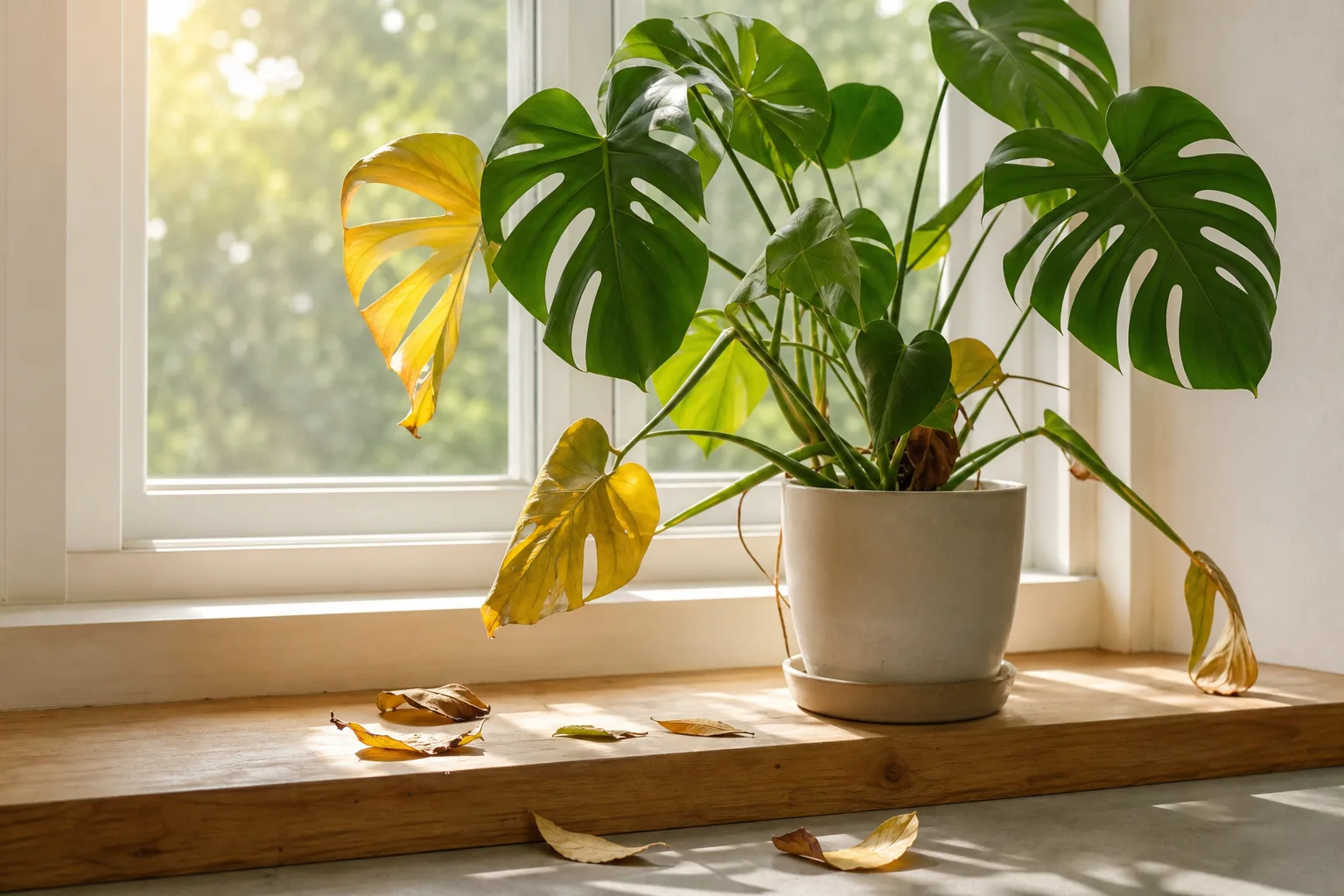
When the mercury climbs and your houseplants start shedding — green leaves, brown leaves, sometimes entire stems — it is easy to assume the worst. Summer leaf drop is unnerving because it contradicts what we expect: more sun, longer days, vigorous growth. Instead, you find your otherwise-healthy monstera or ficus thinning out on the sunniest week of the year.
This guide walks through the seven most common reasons indoor plants drop leaves in summer — heat stress, water mismanagement, air conditioning shock, pest surges, light changes, repotting-timing mistakes, and nutrient issues — and gives you a systematic way to identify which one is happening on your shelf. Leaf drop is a symptom, not a disease. The fix depends entirely on what is causing it. By the end, you will know how to read the clues, stop the shedding, and adjust your summer care so the plant stabilizes and regrows.
Heat Stress: When the Leaf Loses Water Faster Than the Roots Can Replace It
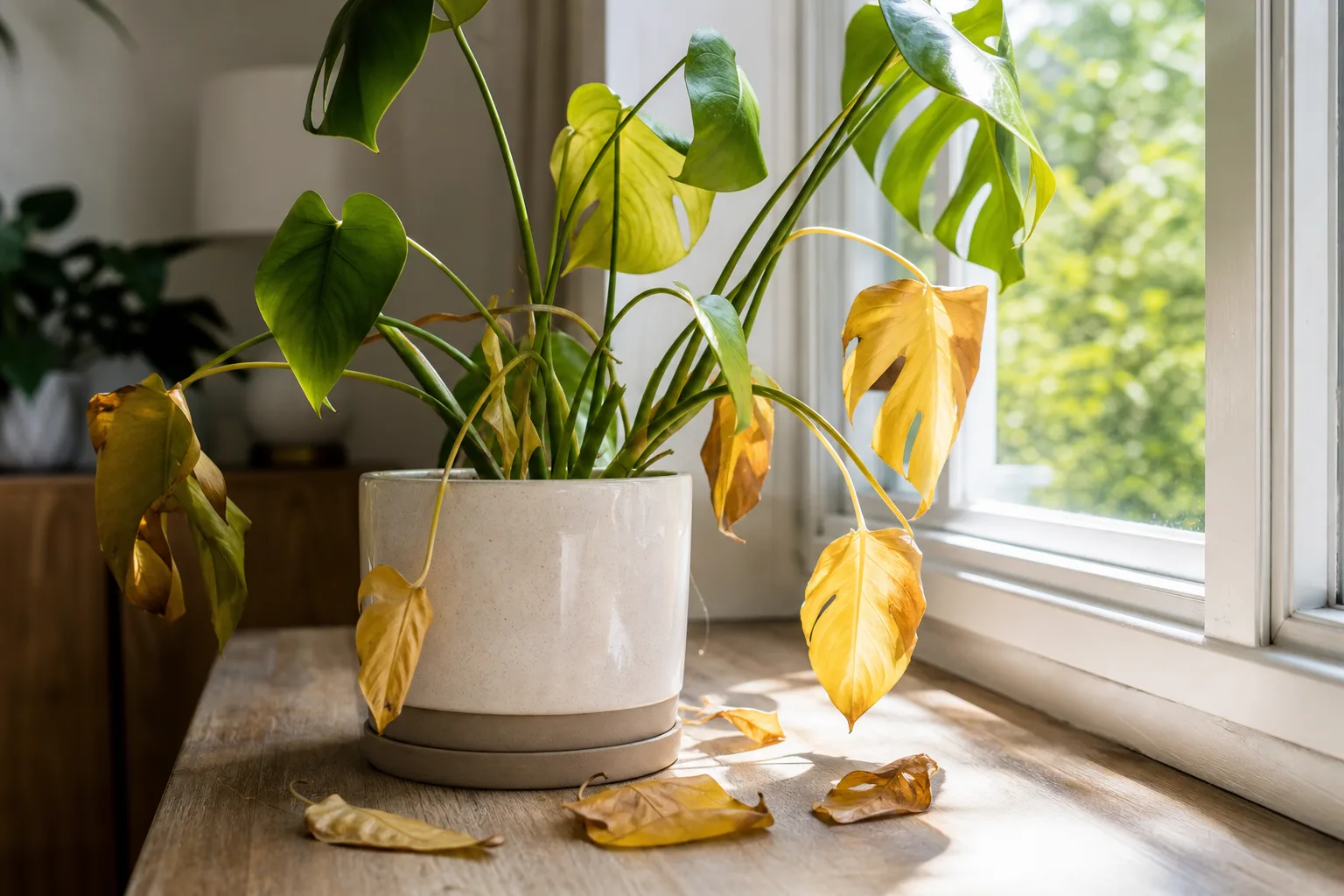
Heat is the most common summer leaf-drop trigger and the easiest to misunderstand. A plant sitting in a south-facing window in July is not experiencing the same conditions it did in March — even if it has not been moved an inch. The sun is higher, the daylight hours are longer, and indoor temperatures near glass can spike 15°F to 20°F above the room’s ambient reading. (UC Marin Master Gardeners)
Plants cool themselves through transpiration — water evaporating from leaf pores pulls heat away, similar to how sweating works in humans. When ambient heat rises faster than the roots can pull moisture from the soil, transpiration cannot keep pace. The leaf overheats, cells rupture, and the plant responds by cutting its losses: it abscises the leaf, sealing it off at the petiole and dropping it. This survival mechanism reduces the total leaf surface area so the remaining leaves have less demand on a stressed root system. (N.C. Cooperative Extension)
The diagnostic clue for heat-driven leaf drop is timing and pattern. Leaves drop during or immediately after a heat wave, not randomly throughout the summer. The leaves that fall are often the ones closest to the glass — the ones getting direct midday or afternoon sun. You may also see wilting during the hottest part of the day, even when the soil is moist. (OSU Extension Service)
The fix is straightforward but often underapplied: move the plant back from the window by 2 to 4 feet during peak summer weeks, or add a sheer curtain that cuts direct-beam intensity without blocking the light the plant needs. For plants that cannot be moved easily, a small fan set on low and pointed away from the foliage can improve air circulation and convective cooling without blasting the leaves dry. This is especially important for broad-leaf tropicals like calatheas and alocasias, which evolved in still, humid forest understories and have no natural tolerance for the combination of direct sun and stagnant hot air.
Watering Mistakes That Intensify in Summer
Summer alters the watering equation, but not in the simple “water more” direction that most people assume. Higher temperatures do increase evaporation from the soil surface and transpiration through the leaves, which means many plants genuinely need more frequent watering. But the same conditions that dry out pots faster can also obscure overwatering problems — and both extremes trigger leaf drop.
Underwatering and Drought-Induced Leaf Drop
When the soil stays dry for too long, fine root hairs die back. The plant can no longer absorb enough water to support its full leaf canopy, so it sheds older, lower leaves first to reduce demand. (University of Maryland Extension) The leaves that drop from drought are typically yellow before they fall, sometimes with brown, crispy edges. The pattern is bottom-up: lower leaves go first, and the plant looks progressively thinner from the base upward.
The test is simple. Push your finger into the soil to the second knuckle. If it is bone-dry and the pot feels noticeably light when you lift it, the plant is underwatered. Water deeply — slowly, until water runs out the drainage holes — rather than giving small, frequent sips that never reach the deeper roots. For terracotta pots, which wick moisture through the walls and dry out even faster in summer, you may need to check every 2 to 3 days instead of once a week. This is also the season when humidity-loving plants on pebble trays may need refills more often, since both the tray water and the soil moisture deplete faster.
Overwatering and Root Rot in Warm Soil
The flip side is less obvious but equally dangerous. Warm, wet soil is a petri dish for the fungal pathogens that cause root rot — Phytophthora, Pythium, and Fusarium species all thrive in the combination of heat, moisture, and low oxygen that develops when pots stay saturated. A plant sitting in a decorative cachepot with no drainage, watered on the same schedule used in spring, can develop root rot within weeks. The visual symptoms — yellowing leaves that drop, soft stems, a sour smell from the soil — look similar to underwatering, which is why so many people double down and add more water when the real problem is that the roots are already drowning.
The diagnostic difference is in the soil, not the leaves. Overwatered soil stays wet for days after watering. The pot feels heavy. If you slide the plant out of its pot and the roots are brown, mushy, and pull apart with a gentle tug instead of feeling firm and white, you have rot. The treatment is to trim away the damaged roots with sterilized scissors, repot into fresh dry mix, and reduce watering frequency going forward — even in summer. A plant recovering from root rot needs less water than a healthy plant, not more, because its reduced root mass cannot absorb what a full root system could. For a deeper dive, see our root rot guide.
Air Conditioning and Draft Shock
Air conditioning creates three simultaneous stresses for tropical houseplants: cold air blasts, rapid temperature fluctuations, and humidity collapse. None of them would exist in the environments where these plants evolved.
When an AC vent blows directly on a plant, the leaf surface temperature can drop 10°F to 15°F within minutes. Tropical species — monsteras, philodendrons, ficus, aglaonemas — have no adaptive mechanism for rapid cooling. Their stomata (the pores that regulate gas exchange) close abruptly, interrupting photosynthesis and triggering an ethylene-mediated abscission response: the plant drops the affected leaf. The damage is not from the absolute temperature (70°F is not inherently harmful) but from the rate of change. A plant that experienced a 5°F daily swing is not prepared for a 15°F swing in 10 minutes.
The second problem is humidity. Air conditioning removes moisture from the air by design — that is how it cools. A room that holds 50% relative humidity at 75°F can drop to 30% or lower when the AC runs heavily, especially in arid climates. The thin boundary layer of humid air that normally surrounds a leaf surface — called the leaf boundary layer — thins out or disappears entirely. The leaf then loses water to the drier surrounding air at a rate much higher than it can replace through root uptake. The result is desiccation damage that looks like brown leaf edges, curling, and eventual leaf drop — often misdiagnosed as a watering problem because the soil is wet while the leaf is dying.
The fix is to keep plants out of the direct path of AC vents and away from doors that open frequently to the outside. A minimum of 3 to 4 feet from the nearest vent outlet is a good rule of thumb. If a room runs the AC heavily, grouping plants together on a humidity tray or pebble tray creates a microclimate with higher local humidity around the foliage — not enough to compensate for fully arid air, but enough to reduce the severity of the boundary-layer effect. For plants that are visibly struggling with dry air despite these adjustments, a small humidifier placed near the plant shelf (not aimed directly at the leaves) is the next step. Our humidity guide covers this in more detail.
Summer Pest Surges
Pest populations explode in summer because the conditions they need to reproduce — warmth, low humidity, and stressed host plants — all peak simultaneously. Two pests in particular are responsible for a disproportionate share of summer leaf drop: spider mites and thrips. Both are small enough to go unnoticed until the damage is already visible, and both feed by piercing leaf cells and draining their contents, which causes leaves to yellow, desiccate, and eventually abscise.
Spider mites thrive in hot, dry air — exactly the conditions created by air conditioning and summer heat near windows. A single female can lay hundreds of eggs in her 2- to 4-week lifespan, and the full egg-to-adult cycle can complete in as little as 5 days at 80°F. (UC Statewide IPM Program) The earliest sign is usually fine stippling on the upper leaf surface — tiny pale dots where individual cells have been drained. By the time you see webbing at leaf nodes or between stems, the infestation is advanced and multiple generations are present. Leaves that drop from mite damage often have a dull, dusty appearance and may curl downward before falling.
Thrips are harder to spot because they hide in leaf crevices, emerging to feed and then retreating. Their damage pattern is distinctive: irregular silvery streaks or patches on the leaf surface, often accompanied by tiny black specks of frass (excrement). Thrips can vector plant viruses in addition to the direct feeding damage, so a thrips infestation that is left untreated can cause problems that extend well beyond leaf drop. (RHS)
The single most effective pest-prevention step for summer is inspection. Check the undersides of leaves — especially the lower, older leaves where infestations often start — every 10 to 14 days during the warm months. A jeweler’s loupe or a phone camera zoomed in reveals mites and thrips that are invisible to the naked eye. If you catch either early, insecticidal soap or horticultural oil applied to all leaf surfaces (tops and bottoms) for 2 to 3 applications spaced 5 to 7 days apart is usually sufficient. For established infestations, see our dedicated guides on spider mites and thrips.
Light Intensity and Sunburn
The sun’s angle changes significantly between spring and summer, and a spot that delivered gentle morning light in April may be a scorching midday beam by July. South- and west-facing windows are the most likely to cause this problem, but east-facing windows can also become problematic if the plant sits close enough to the glass during long summer mornings.
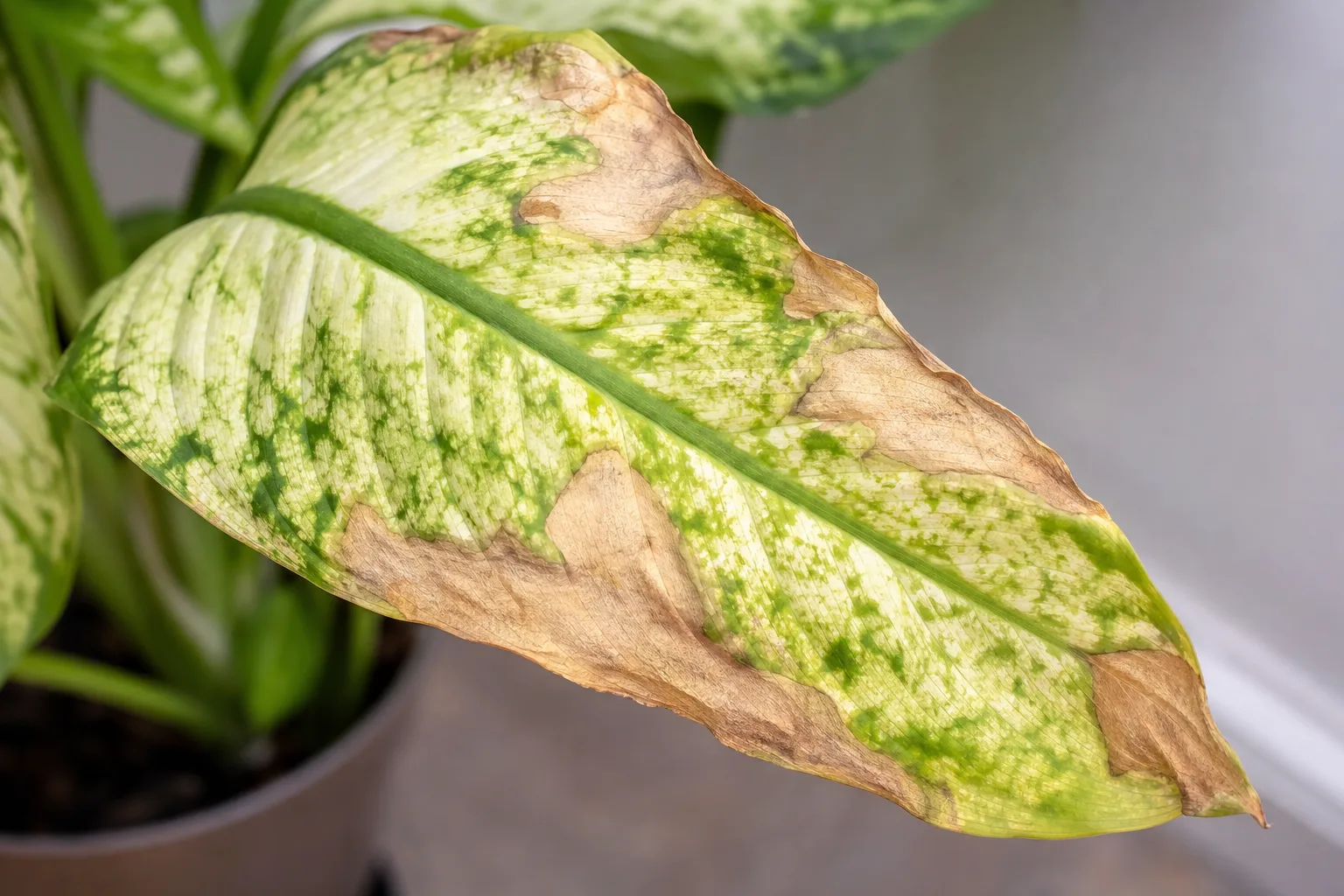
Sunburn damage on leaves is unmistakable once you know what to look for: bleached or faded patches that turn papery and brown, often with the leaf veins remaining green while the tissue between them scorches. The damage is always on the side of the plant facing the window. Unlike pest damage or nutrient issues, sunburn does not spread — the burned tissue stays where it is, and only the leaves in the direct light path are affected. Leaves that are severely burned will drop; mildly burned leaves may survive with cosmetic scarring.
The important principle here is that light intensity, not just duration, is the variable that changes most in summer. A plant that receives 200 foot-candles in March from the same window might receive 800 to 1,000 foot-candles in July, simply because the sun is higher and the beam is more direct. Plants acclimate to gradual changes, but the transition from spring to summer light can outpace their ability to adjust. Moving the plant 18 to 24 inches back from the glass, or filtering the light through a sheer curtain, is often the difference between a plant that thrives through August and one that drops half its leaves by mid-July.
Repotting at the Wrong Time
Repotting during peak summer heat is one of the most reliable ways to trigger leaf drop, and it is a mistake that catches even experienced growers because the logic feels right: the plant is actively growing, so this must be a good time to give it fresh soil and a larger pot. The problem is that repotting damages fine root hairs — unavoidably, even with careful technique — and those root hairs are the plant’s primary water-absorption surface. In cool, mild conditions, the plant can afford to lose some absorptive capacity while it regenerates roots in the new medium. In summer heat, when transpiration demand is at its highest, the math flips: the plant desperately needs every root hair it has just to stay hydrated through the afternoon, and the repotting insult pushes it past its compensatory threshold.
Penn State Extension recommends repotting at the start of the active growing season — early spring — specifically to avoid this heat-stress overlap. The cooler temperatures and lower transpiration rates of spring give the plant a window to re-establish roots before the demands of summer arrive. If you absolutely must repot in summer — because the plant is severely root-bound and circling the pot, for instance — minimize root disturbance as much as possible. Do not tease apart the root ball, do not bare-root the plant, and do not up-pot by more than one pot size (roughly 2 inches wider in diameter). Water thoroughly after repotting and keep the plant in a cooler, shaded spot for at least 7 to 10 days before moving it back to its normal summer location. Expect some leaf drop regardless. The goal is to minimize it, not eliminate it entirely.
For a complete walkthrough of repotting technique, see our repotting guide.
Nutrient Imbalances and Salt Accumulation
Summer is when most people fertilize most aggressively — the logic being that since plants are (or should be) in active growth, they need more nutrition. That logic is sound in principle but breaks down in two common scenarios that produce leaf drop.
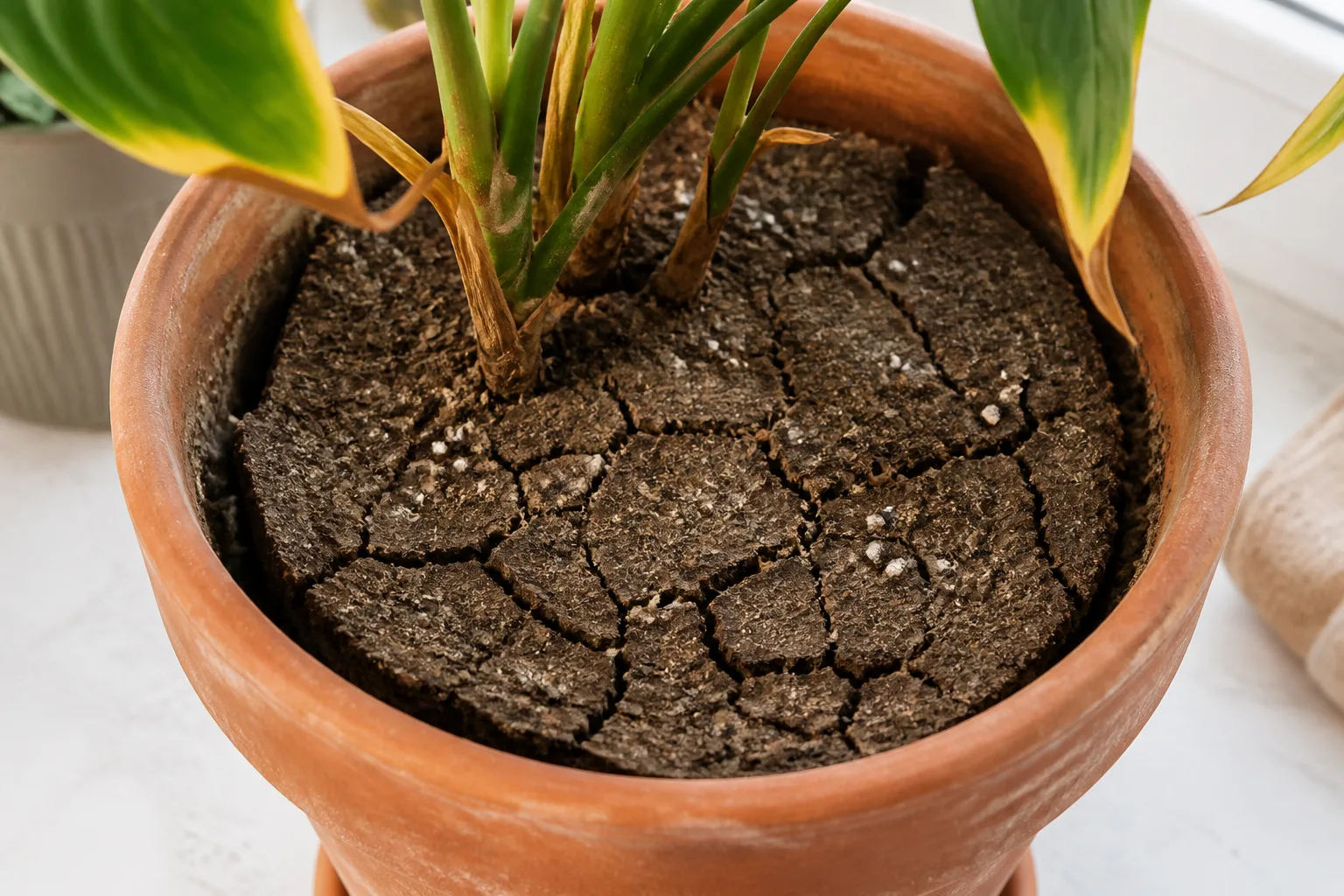
The first is fertilizer burn from overapplication. When you apply more fertilizer than the plant can use, the excess salts accumulate in the potting medium and raise the osmotic pressure of the soil solution. Water moves from areas of low solute concentration to areas of high solute concentration — so instead of the roots absorbing water from the soil, water is pulled out of the roots and into the salty soil. The plant experiences this as physiological drought, even in wet soil, and responds by dropping leaves. The telltale sign is a white or crusty residue on the soil surface and on the inside rim of the pot, which is crystallized fertilizer salt. The treatment is to flush the pot thoroughly: water slowly and heavily until water has run freely from the drainage holes for at least 30 seconds, which leaches the excess salts out of the medium.
The second scenario is nutrient deficiency from rapid growth. A plant that is genuinely pushing out new leaves at a fast summer pace can deplete the available nutrients in its pot faster than expected, particularly nitrogen and potassium, which are mobile nutrients that the plant can translocate from older leaves to support new growth. When this happens, older leaves yellow and drop — the classic “nutrient cannibalization” pattern. The difference from fertilizer burn is that the leaves yellow evenly (not with burned edges) and there is no salt crust on the soil surface. The fix is to fertilize at half the label-recommended strength every 2 to 3 weeks during active growth, rather than full-strength once a month, which delivers a steadier nutrient supply without the risk of salt buildup.
Natural Leaf Senescence vs. Problem Leaf Drop
Not every leaf that falls in summer is a problem. Plants, like all organisms, replace old tissue — it is called senescence, and it is as normal as shedding hair or skin cells in animals. The diagnostic difference between senescence and stress-induced leaf drop is worth knowing because it prevents unnecessary interventions that can create real problems where none existed.
Senescent leaf drop follows a predictable pattern. A single older leaf, usually the lowest one on the stem, slowly yellows over the course of a week or two, then separates cleanly and falls. The rest of the plant looks healthy, the new growth at the top is vigorous, and there are no spots, lesions, or crispy edges on the falling leaf. If you are losing one leaf every few weeks on an otherwise thriving plant with active new growth, this is almost certainly just the plant retiring old tissue. Do not change your watering, move the plant, or add fertilizer — you are more likely to introduce stress than solve a nonexistent problem.
Problem leaf drop looks different. Multiple leaves fall in a short window — a cluster over 2 to 3 days. The leaves that drop are green (or partially green) rather than fully yellowed and senesced. Leaves fall from multiple stems or from the middle and top of the plant, not just the bottom. And there are usually secondary clues: spots, stippling, curled margins, wilting, or visible pests. If the plant looks like it is thinning out rather than simply shedding its oldest leaf, you have a problem that needs diagnosis, and the sections above give you the framework to identify it.
Related Guides
- Summer Plant Care and Indoor Humidity Tips
- Houseplant Humidity Guide: Ideal Levels, Meters and Easy Fixes
- Root Rot in Houseplants: Signs, Treatment, and Prevention
- Repotting Houseplants: When, Why, and How to Do It Right
- Signs Your Houseplants Need More Humidity
- How to Save a Dying Houseplant
Conclusion
Leaf drop in summer is almost never random, and it is almost never unsolvable. The plant is communicating — you just need to know which channel to listen on. Heat stress leaves its signature in wilting and leaves that fall closest to the glass. Water problems hide in the soil, not the canopy, and the pot’s weight tells you more than the leaf’s color. AC drafts and pest surges are invisible to the casual glance but obvious once you look for cold spots and stippled leaf undersides. Sunburn does not lie about where the light hits. And repotting during a heat wave asks a plant to rebuild its root system at the exact moment it most needs every root hair functioning at full capacity.
The right response is usually the lightest one, not the most dramatic. Move the plant a few feet. Check the soil before you water. Inspect the leaves with magnification once every two weeks in summer. Resist the urge to fertilize, repot, or relocate unless the evidence clearly points to that specific intervention. Most summer leaf-drop issues self-correct within 2 to 3 weeks once the underlying stressor is removed. The leaves that already dropped will not regrow from the same nodes, but new growth will fill in the gaps — and that new growth will be stronger because it developed under the corrected conditions.