12 Rosebush Pests and How to Treat Them
Find aphids, rose slugs, beetles, mites, and other rose pests by their damage. Match each to a practical treatment that protects blooms and beneficials.
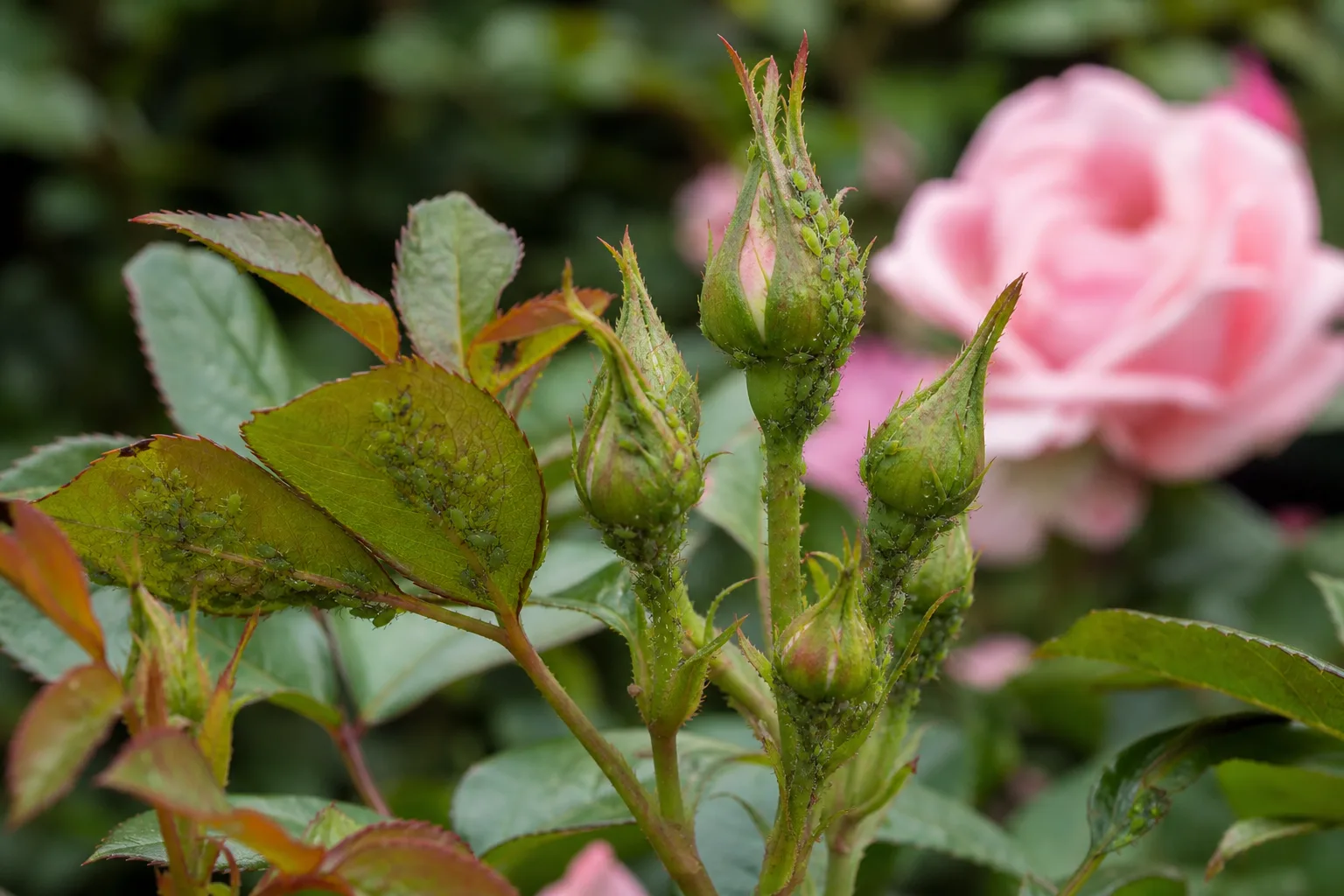
A few insects on a rose are not automatically a problem. The useful question is whether the plant is losing new growth, flower buds, or enough leaf area to struggle—or whether you are seeing a short-lived colony, a bit of cosmetic chewing, or a pollinator doing its job. Treating before you identify the cause can remove helpful predators, miss the insect hiding under a leaf, or injure the rose with an unnecessary spray.
Start with the damage pattern. Sap-feeders tend to cluster on tender shoots or leave fine stippling; chewing insects make holes, scallops, or translucent “windows”; bud and cane pests may leave distorted flowers or a dying stem. Clemson Cooperative Extension recommends regular inspection, correct identification, and physical controls first where practical. The guide below uses that order so you can tell what is happening before choosing a response.
Identify the damage before you reach for a spray
Inspect the whole plant, not just the leaf that caught your eye. Look at the newest stems and buds, turn over several leaves, check inside damaged flowers, and examine the cane below any wilted tip. A hand lens helps with tiny thrips, mites, and eggs; a white sheet of paper under a branch makes moving specks easier to see.
| What you notice | Likely suspects | First check |
|---|---|---|
| Clusters on new shoots; sticky leaves | Aphids, sometimes whiteflies | Look for pear-shaped insects, ants, shed skins, and natural enemies |
| Fine pale dots, bronzing, or delicate webbing | Spider mites | Tap a leaf over white paper and watch for crawling specks |
| Silvering or brown-streaked petals; unopened buds | Thrips | Open a damaged bud and inspect between petals |
| Pale stippling; small wedge-shaped insects that jump | Rose leafhoppers | Turn leaves over and disturb the plant gently |
| Clear “windows,” brown patches, or leaf skeletons | Sawfly larvae | Inspect both sides of leaves for tiny green larvae |
| Ragged flowers or skeletonized leaf tissue | Japanese beetles, rose chafers | Check the plant while feeding is happening; the beetle’s appearance matters |
| Smooth semicircles cut from leaf edges | Leaf-cutting bees | Look for clean, rounded cuts rather than ragged chewing |
| Blackened or distorted flower buds | Rose midge or thrips | Split a damaged bud and look for larvae or tiny insects |
| Wilted cane above a hole or dark tunnel | Cane borer or unrelated cane injury | Trace the damage down the stem before pruning |
These clues narrow the search; none should be treated as a diagnosis by itself. Yellow leaves, for example, also result from drought, waterlogged roots, nutrient problems, and diseases. If you cannot find a pest, compare the pattern with a rose problem guide or ask a local extension office before applying a product.
Sap-feeding pests that distort leaves and buds
Sap feeders pierce plant tissue rather than making obvious bites. A few may be tolerated, but persistent feeding can deform soft growth or reduce bloom quality. A targeted water rinse often handles exposed colonies; pests inside buds or hidden on leaf undersides call for closer inspection and repeated monitoring.
Aphids
Rose aphids are small, soft-bodied, pear-shaped insects that may be green, pink, or reddish. They gather on new stems, leaf undersides, and flower buds, where their feeding can curl leaves or distort blooms. Sticky honeydew, ants tending a colony, and black sooty mold on the honeydew are additional clues, though ants or dark coating alone do not prove aphids are present.
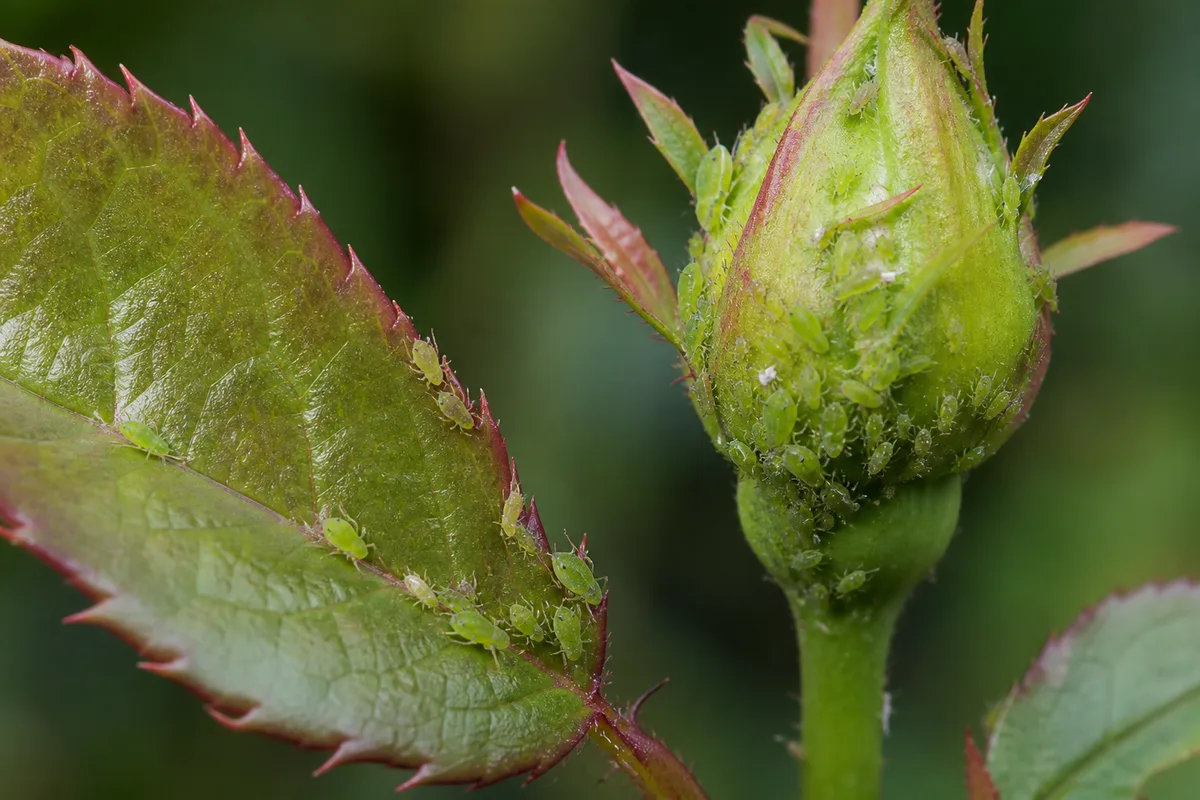
Aphids collect around tender rose buds and shoots; check nearby leaves for predators before intervening.
Do not judge control by how many insects you see in one glance. The Royal Horticultural Society’s rose aphid guidance advises tolerating populations where possible because aphids feed many predators; lady beetles, hoverfly larvae, lacewings, and parasitoid wasps can catch up after aphids appear. If shoots are still expanding normally and the colony is modest, leave it and check again in a few days.
When a cluster is deforming buds or spreading across tender growth, direct a firm but not damaging stream of water onto the insects, including the undersides of leaves. Recheck and repeat if necessary. If water cannot reach a dense plant, pinch out only badly distorted tips or use a product labeled for aphids on roses, following the label. Contact sprays work only where they land; avoid spraying open flowers or beneficial insects, and do not use soap or oil on a hot, drought-stressed rose.
Spider mites
Spider mites are not insects; they are tiny relatives of spiders that feed mostly on leaf undersides. Early damage looks like many fine yellow or pale dots, often followed by bronzing, dull leaves, and—when populations are high—fine webbing. Hot, dry weather and drought stress favor outbreaks, but dry weather by itself does not confirm mites.
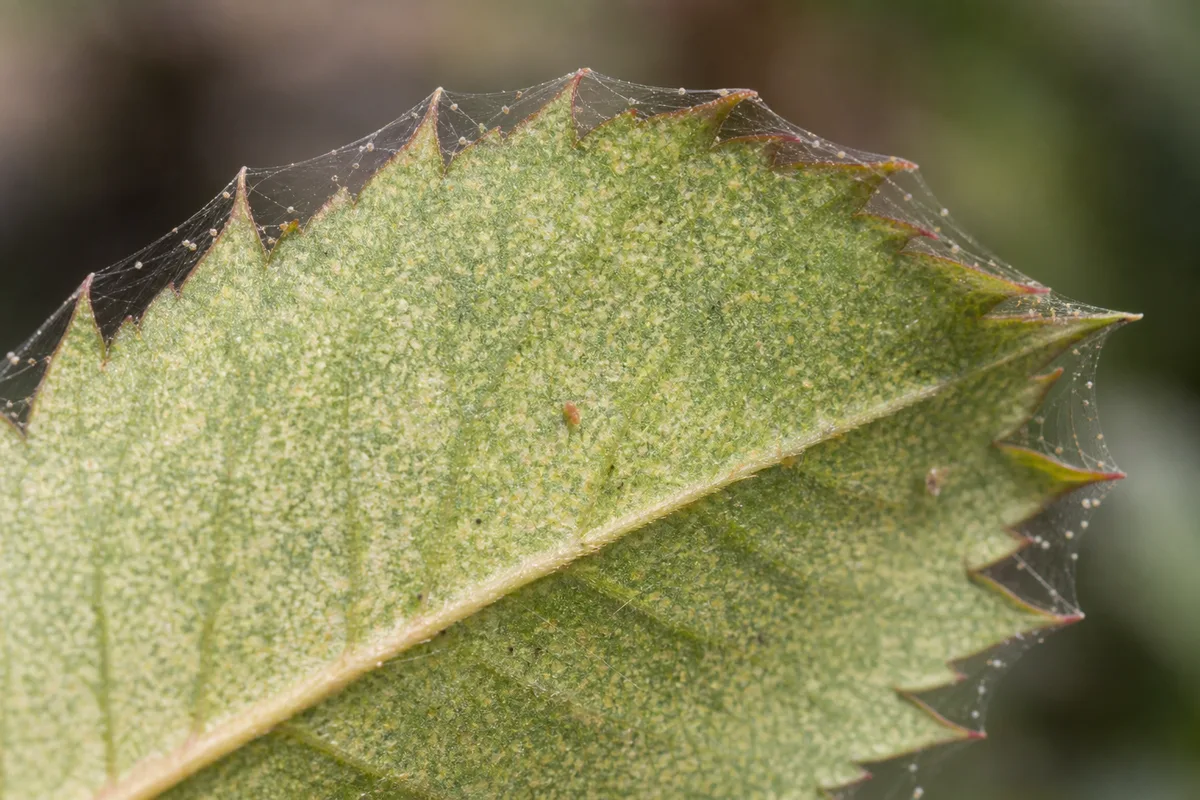
Fine stippling and webbing on the underside of a rose leaf can point to spider mites; confirm with a leaf-tap check.
Use the white-paper test: hold the paper beneath a suspect branch, tap the leaves, and watch the fallen specks for movement. Illinois Extension recommends this kind of leaf-tapping check because the mites are difficult to see on the plant. Some harmless dust or pollen may fall too, so look for moving specks alongside the stippling pattern rather than relying on the paper alone.
If mites are confirmed on a small area, rinse the undersides thoroughly and keep the rose evenly watered at the root zone. Avoid repeated overhead watering late in the day, which can create a separate disease problem. Reinspect after several days. If damage is spreading despite rinsing, choose a labeled mite-control product that fits your region and rose, and follow its restrictions; broad-spectrum insecticides can kill predatory mites and other natural enemies, allowing the outbreak to rebound.
Thrips
Thrips are narrow, tiny insects that can hide inside buds and between petals. Their feeding may leave pale or brown streaks on flowers, ragged petal edges, silvered foliage, or buds that brown and fail to open. Light-colored roses make petal scarring easy to notice, but damaged petals alone do not identify thrips; weather, disease, and other bud feeders can look similar.
To check, shake a flower or leaf over white paper, then inspect a damaged bud closely. The Epic Gardening rose-pest guide recommends looking inside buds because thrips may remain concealed there. Remove badly damaged buds and discard them rather than leaving a sheltered breeding site on the plant. Keep weeds and tall grass from crowding the rose, but avoid clearing flowering habitat indiscriminately across the garden.
Because thrips are hard to reach and sprays can expose pollinators, do not coat open blooms as a first response. If repeated damage is ruining successive flushes, confirm that the insects are present and check local extension guidance for the right timing and product. If a labeled treatment is justified, apply only as directed and avoid blooming flowers when the label requires pollinator precautions.
Rose leafhoppers
Rose leafhoppers are small wedge-shaped insects that jump or fly when disturbed. Their sap feeding causes pale stippling on the upper surface of leaves, which can merge into a washed-out or nearly white patch; severe injury can lead to premature leaf drop. Eggs may be inserted into canes, so the problem can return even when you remove visible adults.
Turn over affected leaves and look for nymphs and adults before acting. Clemson HGIC notes that damsel bugs and assassin bugs prey on rose leafhoppers, so a broad-spectrum spray can remove the predators along with the pest. If a rose has only light stippling, leave it alone and track whether new leaves are affected.
When damage is extensive and continuing, first rinse the lower leaf surfaces and improve the plant’s overall growing conditions. If you decide to use a product, confirm the label covers rose leafhoppers on roses and make sure the directions specify leaf-surface coverage. Do not treat a white leaf as evidence of leafhoppers if no insects or feeding pattern support the diagnosis.
Whiteflies
Whiteflies are tiny, pale, winged insects that lift off in a cloud when disturbed. Their immature stages cling to leaf undersides, where they suck sap and may leave sticky honeydew; heavy feeding can yellow or weaken foliage. They are less commonly the main rose problem than aphids, mites, or sawflies, so verify the insects before treating.
Turn over several leaves and look for both the adults and flat, scale-like immature stages. Sticky foliage may also come from aphids, and yellowing can have many non-pest causes. If you find just a few adults and new growth looks healthy, monitor the plant rather than applying a broad insecticide.
For a small outbreak, remove heavily infested leaves if the rose can spare them and rinse the undersides of remaining leaves. Repeat inspection because contact methods miss insects hidden on the plant. If the infestation persists, use only a product labeled for whiteflies and roses, with pollinator and temperature restrictions followed exactly.
Chewing pests that leave holes or skeletonized leaves
Chewed foliage looks dramatic, but a rose can often replace some leaf area without lasting harm. Focus on whether new growth is being stripped and whether the plant is repeatedly losing most of its leaves. A photo of the insect beside the damage is more useful than a leaf-hole pattern alone because several pests leave overlapping marks.
Rose sawfly larvae (rose slugs)
Rose slugs are the larval stage of sawflies, not true slugs and not caterpillars. Depending on the species and age, the larvae may look shiny, wet, bristly, or caterpillar-like. They feed on one or both leaf surfaces, leaving translucent windows that turn brown; older larvae may make larger holes or leave only veins.
Inspect the undersides and tops of leaves, especially in spring when young larvae are small and hard to spot. Clemson HGIC describes several rose sawflies with different feeding patterns, which explains why “skeletonized leaf” is not one uniform symptom. Hand-pick larvae or dislodge them with a stream of water; they generally cannot climb back onto the bush once knocked off.
Do not reach automatically for Bacillus thuringiensis (Bt) sold for caterpillars. Rose slugs are sawfly larvae, and Clemson notes that caterpillar-specific Bt products do not control them. If the infestation keeps stripping leaves, consult a local extension service and use only a product specifically labeled for the rose and pest. A few damaged leaves on a vigorous plant seldom justify spraying every nearby insect.
Japanese beetles
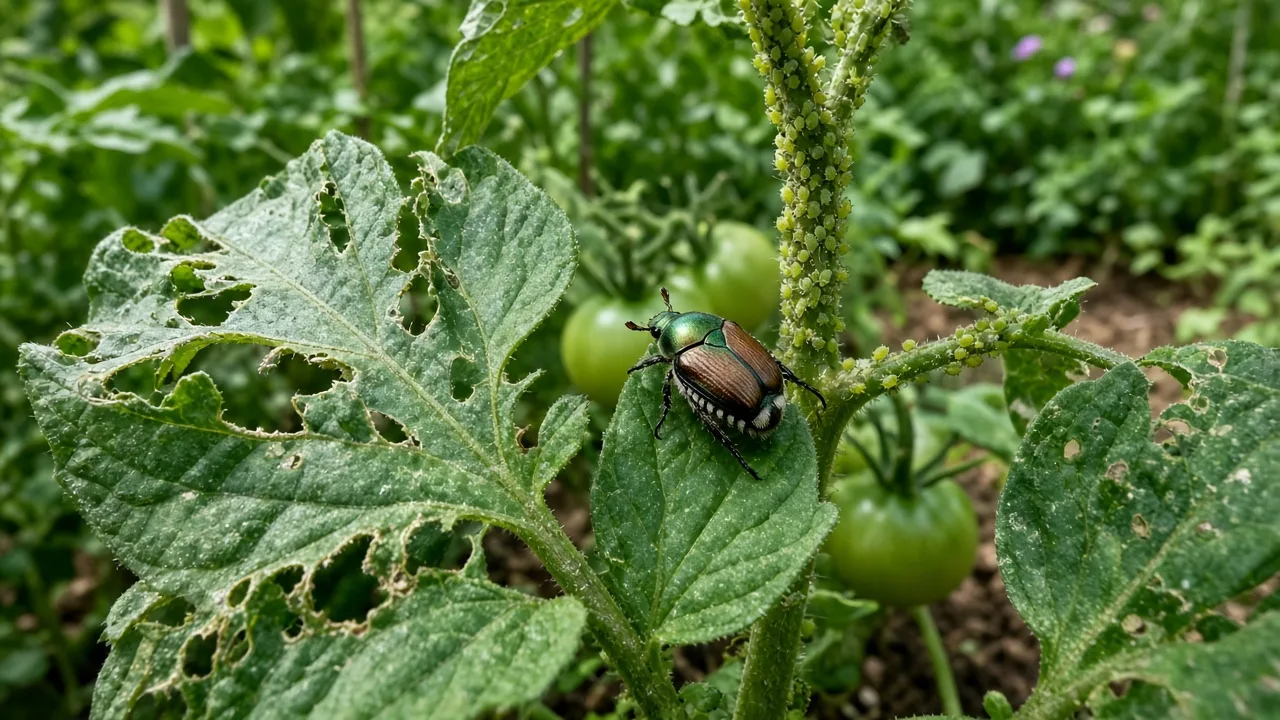
Adult Japanese beetles have metallic green bodies and coppery wing covers. They feed in daylight on roses and other plants, often chewing between leaf veins until the leaf looks lacy; petals and buds may also be ragged or partly eaten. Look for the beetles on the plant while damage is fresh, because similar holes can come from other chewers.
Pick adults off in the cool morning when they move more slowly and drop them into soapy water. On a small plant, fine mesh can exclude beetles if it does not crush blooms or trap pollinators inside. Clemson’s guidance cautions that baited traps can draw beetles into a landscape; if you use one, place it well away from the roses you are protecting rather than beside the bush.
Do not assume treating lawn grubs will quickly stop adult beetles on roses. Adults can fly in from elsewhere, and grub products affect a different life stage. If a labeled insecticide is the only practical option during severe feeding, follow its rose, timing, and pollinator directions and do not spray open flowers.
Rose chafers
Rose chafers are slender, tan or yellowish beetles that can feed on flowers and leaves, particularly where many are emerging at once. Their damage includes holes in petals and foliage, but appearance and local timing vary. Confirm the insect itself before deciding the rose needs treatment; a few beetles and some petal damage are different from sustained feeding that strips a young shrub.
Pick visible chafers by hand and dispose of them, or use a gentle water rinse if the insects are exposed and the plant can dry promptly. Inspect again rather than relying on a single pass; a new group may arrive the next day. Avoid broad sprays across flowers, where pollinators and other beneficial insects are likely to be present.
When damage is limited to a few blooms, removing the affected flowers and waiting is often the better trade-off. For repeat severe feeding, ask a local extension office what species is active in your area before using a product: “rose chafer” is used for more than one beetle, and treatment recommendations are not universal.
Fuller rose beetles
Fuller rose beetles are flightless, brownish weevils that often feed at night. They chew notches along leaf margins and can be hard to catch during a daytime inspection. Look for fresh scalloped edges, then check the plant after dusk with a flashlight; seeing the beetle is the strongest confirmation.
Hand-pick adults when they are on the plant and drop them into soapy water. Trim or tie back canes that touch the soil or neighboring plants if they create an easy route onto the rose, while keeping enough airflow around the bush. Check nearby foliage too, since adults may move between plants.
The amount of leaf notching matters more than the presence of one beetle. On an established rose, isolated notches are usually cosmetic; protect a small or newly planted rose if fresh feeding is widespread. Avoid using a broad insecticide for an insect you have not seen, especially when the mark could be caused by a different nighttime feeder.
Leaf-cutting bees
Leaf-cutting bees remove neat, circular or semicircular pieces from leaf edges to line their nests. The cut surface is smooth, unlike the ragged edge left by many chewing insects. You may never see the bee because she can make a quick cut and leave.
Although the holes can make a prized rose look untidy, these bees are pollinators and the injury is usually cosmetic. Clemson HGIC recommends no control for leaf-cutting bees because the damage is generally minor and the bees are important pollinators. Do not spray or trap them; allow the leaves to remain unless they are diseased or badly damaged for another reason.
If you are unsure, watch the rose for a few minutes or photograph a leaf edge. A smooth crescent cut without skeletonized tissue points toward a leaf-cutter. The useful response is acceptance, not trying to repel or kill every bee that visits the garden.
Pests that attack flower buds or canes
A damaged bloom may be the only visible sign of a pest, while a cane problem can threaten the branch above it. Inspect the inside of buds and follow a wilted stem to its base. Avoid cutting an entire cane until you have identified a clear point of dieback or tunneling.
Rose midges
Rose midges are tiny flies whose larvae feed in young shoots and flower buds. The damaged growth may become twisted, blackened, or fail before opening; the adult fly is easy to miss. Midge injury is therefore more likely when new buds repeatedly blacken or deform than when only open petals are browned.
Remove affected buds and shoot tips as soon as the damage is clear, then place them in household waste rather than leaving them beneath the bush. Inspect new growth frequently during the active flush, especially if the same rose has been affected before. Clemson and Illinois Extension describe pruning out infested plant parts as an initial control.
A rose midge problem can resemble thrips or environmental damage. Cut a damaged bud open and look for larvae before escalating. If the problem continues, contact a local extension office because midge timing and life cycle vary by region; use a labeled product only if local guidance and the label support it.
Cane borers
“Cane borer” describes larvae from several kinds of insects rather than one rose pest with one predictable life cycle. Possible clues include a hole in a cut stem, a tunnel, a brown cane, or wilting above the damaged section. But ordinary dieback, frost injury, canker, and pruning wounds can look similar, and some insects found in canes are not the cause of serious rose decline.
Trace a dead tip downward and make a small test cut below the damaged area. Continue only until the pith and tissue are healthy, then clean the pruners before using them elsewhere. Remove the affected cane from the garden. Do not cut into a living crown or keep shortening a sound cane just because its center looks different from the outer wood.
Keep roses vigorous with suitable light, root-zone moisture, and pruning that removes dead or damaged wood; this reduces stress but does not make a plant immune. A hollow or bored stem without active injury does not always justify an insecticide. If a valuable rose keeps declining, photograph the bore and cane cross-section and ask an extension diagnostician to identify the cause.
Use a treatment ladder, not a spray reflex
Begin with the least disruptive step that matches the confirmed pest. This preserves predators and pollinators, and it avoids exposing the rose to a product it does not need. The Clemson HGIC rose pest guide stresses regular inspection, accurate identification, physical controls when possible, and careful label use if a pesticide becomes necessary.
- Decide whether the damage is increasing. Mark or photograph a few affected leaves, buds, or stems and check the same area again in two or three days. If the plant is growing normally and the injury is limited, monitoring may be enough.
- Confirm the pest. Look for the insect, egg, larva, webbing, honeydew, or distinctive cut pattern. Check both sides of leaves and inside damaged flowers; do not choose a spray from a symptom alone.
- Use a targeted physical control. Rinse aphids or exposed mites from leaf undersides, pick beetles and larvae, remove midge-damaged buds, or protect a small plant with a breathable cover.
- Preserve beneficial insects. Lady beetles, lacewing larvae, hoverflies, and small parasitoid wasps may be working on aphids. Avoid applying contact sprays to them or to open flowers.
- Escalate only if new damage continues. Select a product whose current label names the pest and roses as an approved site. Follow dose, repeat interval, weather, protective-equipment, and pollinator directions on that label; never improvise concentrations or mix products.
Horticultural oils and insecticidal soaps are not harmless because they are called “organic” or “natural.” They can injure plants under stressful conditions and harm insects they contact. Apply only as the label directs, test a small part of the rose if the directions allow it, and avoid spraying in heat or on wilted plants. The Savvy Gardening rose-pest guide also emphasizes that controls should be weighed against effects on non-target wildlife; pesticide risk depends on product, timing, and exposure, not on the label’s marketing language.
Prevent repeat outbreaks with better scouting
A brief weekly check during active growth catches pests before they spread through the whole shrub. Scan from top to bottom, especially soft shoots and the undersides of leaves; check buds before they open and look for fresh damage on canes. In hot, dry spells, add a mite check because stressed leaves are more vulnerable and webbing may appear late.
Water the soil deeply enough to support steady growth, rather than keeping foliage wet every evening. Avoid crowding roses against walls or dense shrubs where it is difficult to inspect them. Remove fallen or heavily infested plant material when it is part of a confirmed pest cycle, but do not strip healthy foliage or clear every flowering plant that could support beneficial insects.
A diverse planting can provide nectar or habitat for natural enemies, but companion plants are not a dependable force field. Treat rose vigor, spacing, sanitation, and regular observation as the foundation; use companion planting as supporting habitat. The University of Illinois Extension rose pest notes and Epic Gardening’s practical rose pest guide cover scouting and common control approaches, while local extension advice can account for regional pests and timing.
Conclusion
The best rose pest treatment starts with the damage pattern and a close look for the insect. Rinse or hand-pick exposed pests, remove clearly infested buds, and tolerate minor leaf injury when the rose is growing well—especially when the visitor is a pollinating leaf-cutting bee or a colony that predators are already reducing.
Escalate only when fresh injury continues to affect buds, new growth, or a substantial share of the canopy. Confirm the pest, protect beneficial insects, and follow a current product label if you need a spray. That measured approach will usually protect the flowers and the living garden around them better than treating every hole or insect as an emergency.