Should You Prune Hydrangeas in Fall? Check This First
Should you prune hydrangeas in fall? Use this old-wood vs. new-wood guide to identify your type, deadhead safely, and protect next year's flowers.
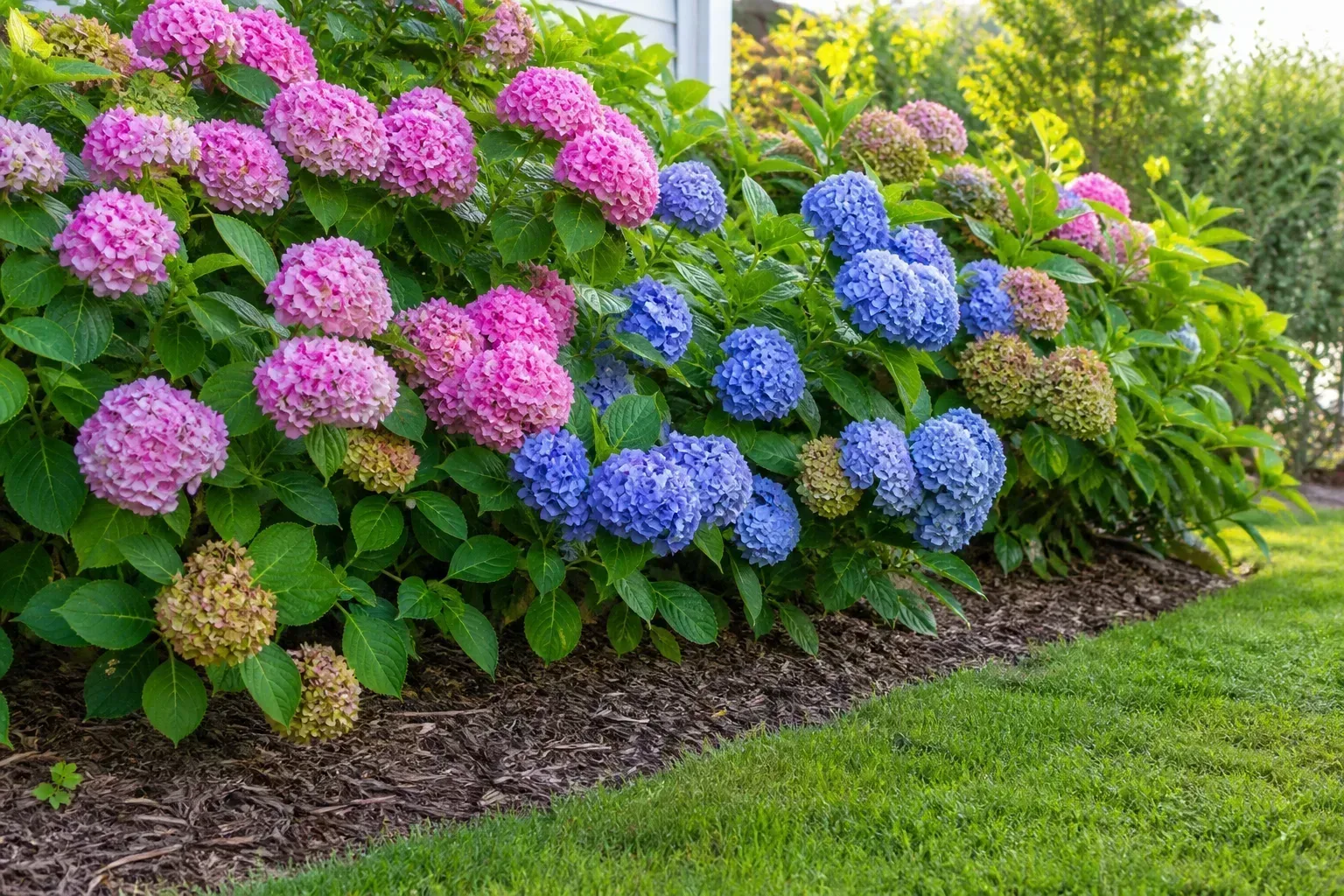
Fall is when many hydrangeas look as though they need a haircut: flowerheads turn papery, leaves thin out, and long stems can flop across a path. The safest answer is not “yes” or “no.” It is what type of hydrangea is it, and are you removing a spent flower or a stem that already carries next year’s buds?
If you can identify the shrub as a panicle or smooth hydrangea, selective fall cleanup is usually low-risk, although late winter or early spring is often the better time for major pruning. If it is bigleaf, mountain, oakleaf, or climbing hydrangea, avoid structural pruning in fall because those shrubs commonly set next year’s flowers on old wood. If the label is gone and you are not sure, leave healthy stems alone and limit your work to obvious dead or broken wood.
The Fall Pruning Decision in One Minute
Use this three-gate check before you pick up the pruners.
- Identify the type. Cone-shaped flowers usually point toward panicle hydrangea; oak-shaped leaves point toward oakleaf; big rounded or lacecap heads with thick, serrated leaves often indicate bigleaf or mountain types. A plant tag or cultivar name is more reliable than appearance alone.
- Name the job. Removing a brown flowerhead is deadheading. Shortening, thinning, or reducing the shrub is structural pruning. The first is often optional; the second can remove future buds.
- Check the season and condition. Fall color and dried flowers are not proof that a shrub is dormant. In warm autumns, a hydrangea may still be actively growing, and in cold areas a stem can look lifeless while its buds are still worth protecting.
The practical rule is simple: new-wood types can receive light fall shaping, but save a hard cut for dormancy; old-wood types should not be cut back in fall; an unknown type gets no major pruning until you can identify it. Penn State Extension makes the same biological split: bigleaf and oakleaf hydrangeas bloom on old wood, while smooth and panicle hydrangeas bloom on new wood. (Penn State Extension)
Why Blooming Wood Controls the Answer
“Old wood” and “new wood” describe the age of the stems that carry flower buds. This is more useful than memorizing a single calendar date because the correct window shifts with climate, winter damage, and the cultivar.
Old wood means next year’s buds are already on the shrub
Old-wood hydrangeas form flower buds on stems made during the previous growing season. Those buds overwinter on the plant, so a fall cut can remove the very structures that would have opened next summer. A shrub may respond with healthy leaves and vigorous shoots after the mistake, yet still produce few flowers because leaf growth and flower-bud preservation are separate jobs.
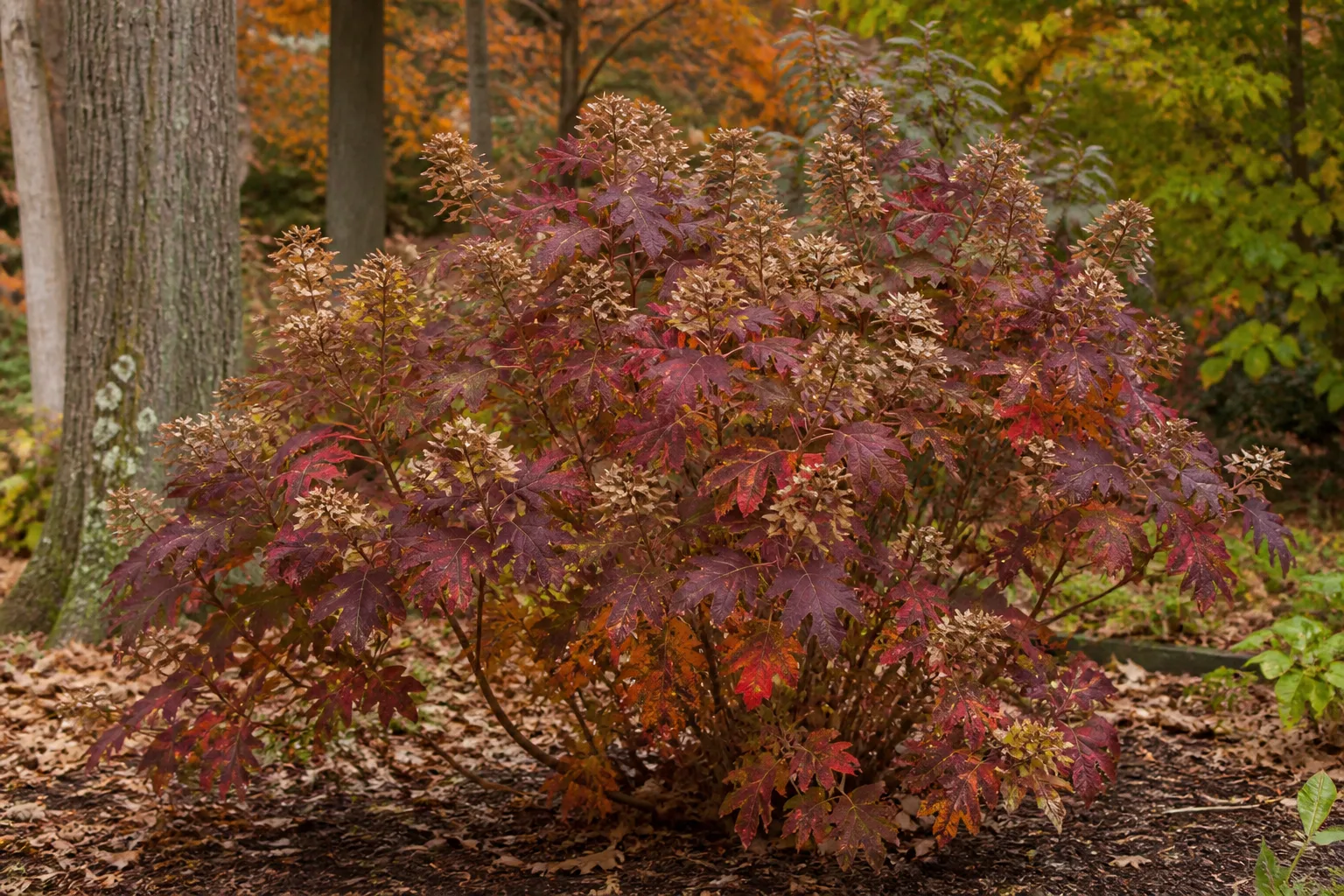
Bigleaf hydrangeas are the classic example. Mopheads carry rounded flower clusters; lacecaps have a flatter ring of showy flowers around smaller fertile flowers. Mountain hydrangeas are close relatives with a similar old-wood risk, and oakleaf hydrangeas add distinctive oak-like foliage and strong fall color. Their dried heads may look untidy, but those heads and the stems below can help shield tender buds from cold. RHS guidance recommends leaving mophead flowerheads over winter in many situations, then cutting back to a strong pair of buds in spring. (RHS hydrangea pruning)
New wood gives you a wider pruning window
New-wood hydrangeas form flowers on shoots that emerge during the current growing season. That means a late-winter or very early spring cut generally happens before the plant makes the stems that will flower. Smooth hydrangeas, including ‘Annabelle’, and panicle hydrangeas, including ‘Limelight’, fall into this more forgiving group.
“Forgiving” does not mean “cut whenever and however you like.” A late-fall cut can remove winter structure, expose the crown to weather, or stimulate soft growth in a mild spell. The best substantial cut is usually made while the shrub is dormant and before fresh spring growth begins. RHS recommends pruning panicle and smooth hydrangeas in early spring, cutting last year’s stems back to healthy buds or a chosen framework. (RHS growing guide)
Identify Your Hydrangea Before Cutting
Start with the label if you have it. Cultivar names such as ‘Endless Summer’, ‘BloomStruck’, ‘Limelight’, ‘Bobo’, or ‘Annabelle’ can answer the question faster than a visual guess, and a nursery description may tell you whether a bigleaf plant is a rebloomer.
If there is no label, combine flower shape, leaf shape, bloom timing, and stem habit. One clue is never a guarantee: breeding has produced cultivars that look similar while following different bud-setting patterns.
Bigleaf, mountain, oakleaf, and climbing types protect old wood
Bigleaf hydrangea (Hydrangea macrophylla) has thick, broad, serrated leaves and either mophead or lacecap flowers. Traditional forms bloom on old wood. Mountain hydrangea (H. serrata) is usually smaller, with narrower leaves and lacecap-like flowers, but it also needs its overwintering stems protected.
Oakleaf hydrangea (H. quercifolia) is easiest to spot by foliage shaped like an oak leaf. Its cone-shaped flower clusters can be confused with panicle flowers, but the leaves matter more than the bloom shape here. Oakleaf hydrangea is an old-wood bloomer, so do not assume that a cone means you can cut it in fall.
Climbing hydrangea (H. anomala subsp. petiolaris) is another old-wood type. It is pruned after flowering when long shoots need control, not as part of a general fall cleanup. Because flowers tend to occur toward the ends of shoots, indiscriminate shortening can be especially disappointing.
Panicle and smooth types bloom on new wood
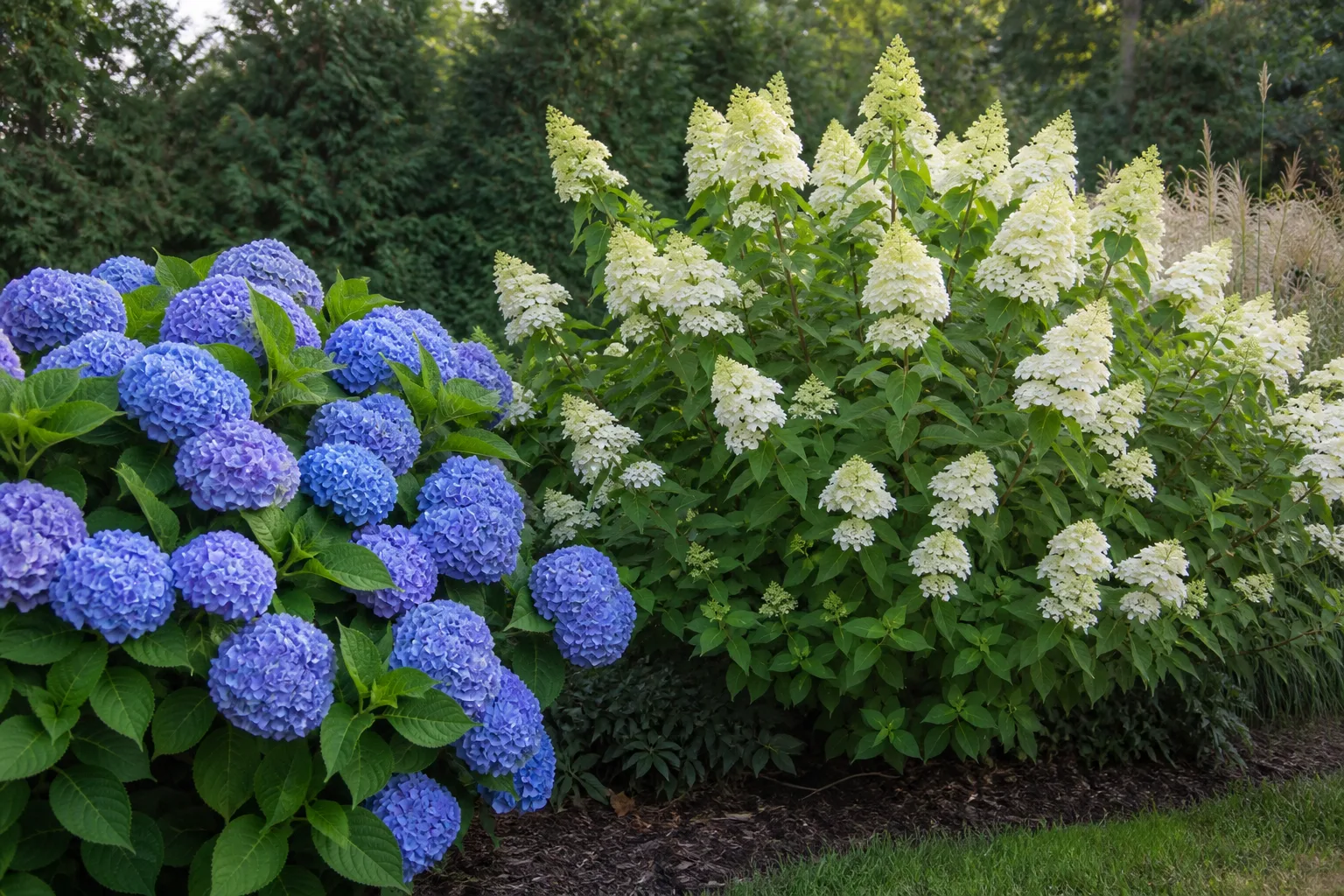
Panicle hydrangeas (H. paniculata) have elongated, cone-shaped flowerheads that often age from white or green to pink, red, or tan. ‘Limelight’, ‘Little Lime’, ‘Bobo’, and ‘Fire Light’ are common examples. They can be shrubs or trained as standards, and they generally tolerate more size reduction than old-wood types.
Smooth hydrangeas (H. arborescens) often have rounded white or pink flowerheads, which can make them look like bigleaf mopheads at a glance. ‘Annabelle’ and ‘Incrediball’ are smooth hydrangea cultivars. The species blooms on new wood, so a dormant late-winter cut can be useful, but leaving a modest framework often produces sturdier stems than cutting everything to the ground.
There is a useful trade-off here. A very low cut can produce large flowerheads, but the resulting shoots may be thin and more likely to bow under rain. Keeping some woody framework gives the new growth a structure to branch from and can make the display easier to support.
Reblooming cultivars are the middle case
Some bigleaf and mountain hydrangeas are bred to bloom on both old and new wood. The Endless Summer, Let’s Dance, and certain other reblooming lines are examples. They can flower on surviving old stems and later produce flowers on new growth, which makes them more resilient after winter damage—but not immune to lost blooms after a hard cut. (Epic Gardening)
For a rebloomer, fall is a poor time for aggressive shaping because you may remove the first flush of next season’s flowers. Deadhead lightly if you need to, remove a truly broken stem, and save size reduction for a time when the cultivar instructions support it. If you cannot confirm that a bigleaf plant is a rebloomer, treat it as an old-wood hydrangea.
What to Do With Hydrangeas in Fall
Fall care is not a race to make the shrub bare. A hydrangea with dry flowerheads can be healthy, attractive in winter, and better protected than one that has been stripped of every stem.
Safe fall cleanup versus structural pruning
The safest fall cuts are the ones with a clear reason and a clear target:
- Remove a stem that is broken, hanging into a walkway, or rubbing hard against another branch.
- Remove a clearly dead stem at its base if it is brittle and shows no living buds or flexible tissue.
- Remove a diseased section only when the damage is obvious, cutting well below the affected area into healthy wood and disinfecting the tool between plants. If leaf spots or stem symptoms are confusing, compare them with the hydrangea disease guide before making a large cut.
- Deadhead a flowerhead for appearance only when you can make a short, conservative cut that will not remove a long section of old wood.
Do not use fall to reshape an old-wood hydrangea into a tight ball. Hedge shears remove many stems at once, ignore the plant’s natural branching, and make it difficult to see which buds you are sacrificing. A few deliberate bypass-pruner cuts are safer than a general “evening up” pass.
When leaving flowerheads is the smarter choice
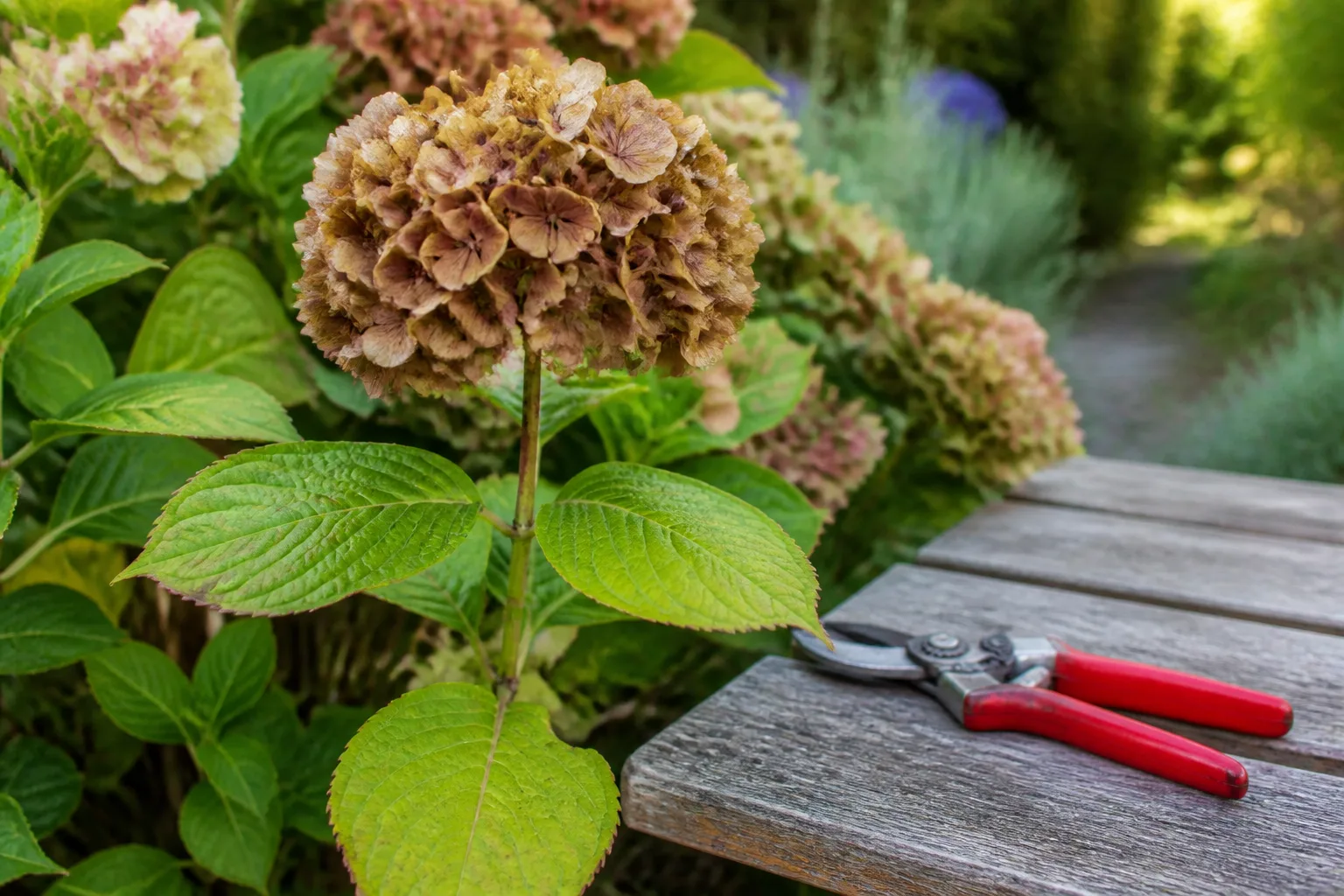
Leave dried flowerheads in place when the shrub is an old-wood type, the weather is exposed, or you enjoy winter structure. The flowerhead itself is not the only consideration: the buds directly below it may be tender, and the old stems can reduce the impact of wind and frost.
Leaving them also supports a more wildlife-friendly garden by preserving winter structure. If a head is collapsing, diseased, or blocking a path, remove it; otherwise, you can wait until spring and cut down to the first or second strong bud below the old bloom. The RHS specifically notes that old mophead flowers can provide winter protection for the growth buds beneath them. (RHS hydrangea pruning)
If you want dried flowers indoors, cut a few stems when the petals feel papery but before repeated rain turns them to mush. Keep the harvest selective on old-wood shrubs; cutting a bouquet-length stem is still pruning, and every long stem removed may carry next year’s flowers.
How to Prune Each Type Without Losing Flowers
The goal is not to make every hydrangea the same size. It is to remove the least valuable wood at the safest time while keeping enough structure for the plant’s natural habit.
New-wood hydrangeas: shape now, cut hard later
For panicle and smooth hydrangeas, fall can be used for a light tidy-up: remove damaged or crossing stems, shorten a branch that is genuinely obstructing a path, and remove spent flowerheads if you do not want winter interest. Keep the cuts selective and stop if the shrub is still actively growing.
Save major size reduction for late winter or very early spring, before new leaves expand. Begin by removing dead and weak stems at the base, then thin out one or two crowded branches. If the plant needs a stronger renovation, shorten last year’s stems to a pair of healthy buds or leave a framework about 12 to 24 inches high, depending on the desired height and cultivar.
Panicle hydrangeas usually look best when you preserve a branching framework rather than shearing every stem to one level. Smooth hydrangeas can be cut lower, but leaving some framework can help support the heavy heads. RHS notes that annual pruning can produce more and larger flowers on these types, while dead wood removal is the only essential task. (RHS hydrangea pruning)
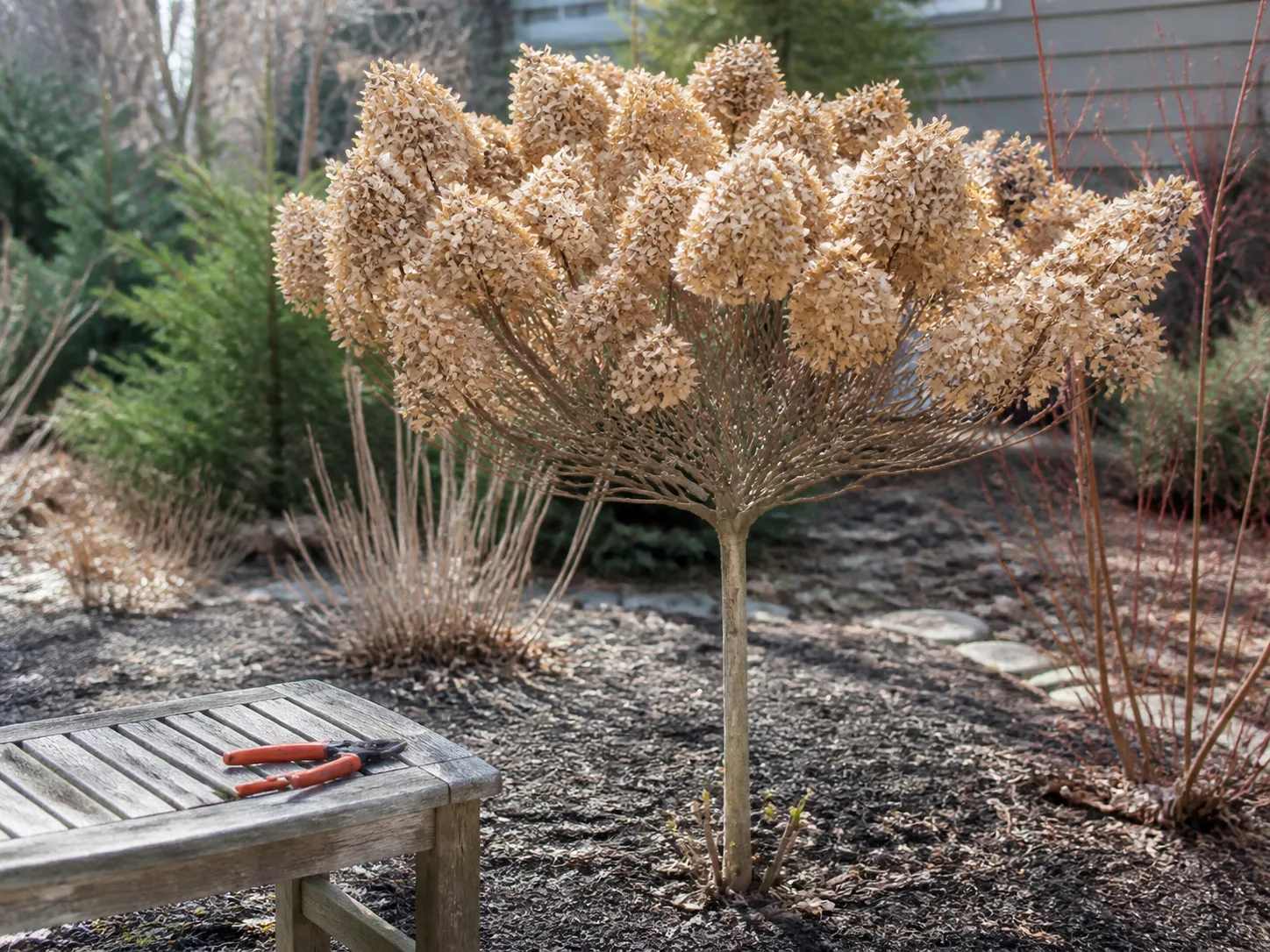
For detailed cultivar-specific steps, use the Limelight pruning guide if your plant is a panicle hydrangea sold under that name. The same broad biology applies to other panicles, but mature size and stem strength vary.
Old-wood hydrangeas: make only light, purposeful cuts
For bigleaf, mountain, oakleaf, and climbing hydrangeas, the ideal structural-pruning window is after flowering, not in late fall. If that window has passed, the best fall plan is often to do less: remove only broken or clearly dead wood, and leave healthy flowering stems in place.
When pruning is appropriate after flowering, cut one stem at a time. Remove the oldest or weakest stems at ground level to open the center, then shorten an overlong flowering stem just above a strong pair of leaves or buds. Avoid removing more than about one-third of the plant in a season, and do not make a severe cut just because the shrub has outgrown its space.
The one-third limit is a practical safeguard, not a magic number. A crowded, old shrub may benefit from gradual renewal over several years, while a damaged plant may require immediate removal of unsafe wood. If the issue is simply that the cultivar is too large for the bed, transplanting or replacing it can preserve more flowers than repeated hard pruning.
If you have not yet read the bigleaf hydrangea care guide, its advice on moisture, light, and winter exposure can help explain why a plant may be sparse even when pruning was correct.
Reblooming or unknown hydrangeas: use the conservative plan
For a reblooming hydrangea, deadhead only the flowerhead and a short piece of stem if necessary. Do not remove long green canes in fall, even if the plant has finished flowering. In spring, wait for leafing to reveal which stems survived winter, then remove dead wood and make only the shaping cuts the cultivar requires.
For an unknown hydrangea, take a photograph, check old plant tags or purchase records, and observe when it blooms next year. A plant that flowers early on stems already present in spring is likely using old wood; a plant that sends up new shoots before flowering later in the season is more likely a new-wood type. This observation is not a substitute for a cultivar label, but it is safer than guessing from a cone or round flowerhead.
If the shrub is healthy, fits its space, and blooms well, you do not have to prune it every year. A natural hydrangea is not a failed hydrangea. Selective thinning and deadwood removal are maintenance choices, not annual requirements.
Common Mistakes and How to Recover
The biggest mistake is treating “fall cleanup” as a universal instruction. Old-wood hydrangeas are not dead because their leaves are falling, and dried flowers are not a signal that every stem below them is disposable.
Another mistake is confusing deadheading with pruning. Deadheading removes a spent flower; pruning changes the branch structure. On an old-wood hydrangea, a short cut just below the flower may be acceptable in a safe window, while a long cut deep into the shrub can remove multiple future buds.
Dull or dirty tools create rough wounds and can move problems from one shrub to another. Heeman’s practical pruning guidance recommends clean, sharp bypass pruners for ordinary stems and emphasizes that many hydrangeas need only deadwood removal and light shaping. (Heeman’s pruning guide) Wipe blades before moving between plants, especially when you are cutting tissue that looks diseased.
If you already pruned an old-wood hydrangea in fall, do not compound the mistake with another “correction” cut. Leave the remaining healthy stems intact, water normally during dry weather until the ground freezes, and protect the root zone with a layer of mulch kept away from the stems. In spring, test questionable branches by scraping a tiny spot or cutting back to live tissue; green, flexible wood and swelling buds are more useful signs than a brown outer surface alone.
You may lose some flowers next season, but the shrub is not automatically ruined. Old-wood hydrangeas can produce leaves and new shoots after a bad cut, and reblooming types may still flower on new growth. If the plant is repeatedly damaged by late frosts, deer, or an exposed site, solve that underlying problem rather than pruning harder. Penn State Extension notes that winter injury and browsing can reduce flowering for the same reason as mistimed pruning: the flower-bearing wood is lost. (Penn State Extension)
Finally, do not assume a hard cut always creates stronger stems. Very low pruning can produce large heads on new-wood types, but heavy flowerheads on thin shoots may flop. A moderate framework, correct light, consistent moisture, and cultivar-appropriate expectations usually produce a better-looking shrub than the shortest possible stubs.
Conclusion: Make the Type Check Before the Cut
Should you prune hydrangeas in the fall? Only after you know what kind of wood carries its flowers. Panicle and smooth hydrangeas can handle limited fall cleanup, with major shaping saved for dormancy. Bigleaf, mountain, oakleaf, climbing, reblooming, and unknown hydrangeas are safer with healthy stems left in place until the right pruning window.
Your fall checklist is short: remove hazards and obvious dead wood, deadhead conservatively or leave the flowerheads, mark the plant’s type, and wait for late winter or spring when a structural cut is appropriate. The best pruning cut is not the one that makes the shrub look smallest today; it is the one that preserves the buds, framework, and growing conditions that will make next season’s flowers possible.



