10 Hydrangea Diseases: Identify and Treat Them
Learn how to identify 10 hydrangea diseases by leaf, flower, and root symptoms, then choose sanitation, cultural, or labeled treatment steps that fit the cause.
Brown spots, a gray bloom, sudden wilt, and yellow rings can all appear on a hydrangea—but they do not all call for the same treatment. The most useful first step is to identify the pattern and the plant part involved, not to reach for a fungicide. A leaf spot caused by a fungus, a bacterial infection, a sap-feeding insect, and sun scorch can look surprisingly similar from across the yard.
Most hydrangea problems are manageable when you catch them early. Start with the low-risk actions that help almost every diagnosis: keep new problems from spreading, remove tissue that is clearly dead or infected, keep leaves dry when you irrigate, and avoid disturbing healthy roots. Then use the clues below to decide whether the next step is cultural care, a labeled product, a laboratory diagnosis, or removal of the plant.
Start With Symptoms, Not a Spray Bottle
University of Minnesota Extension’s hydrangea diagnostic guide organizes problems by the visible symptom—dead branches, discolored buds, leaf spots, pale leaves, and distorted leaves—because the same cause rarely explains every pattern. The University of Minnesota Extension symptom index is a useful reminder that diagnosis starts with observation, not a product name.
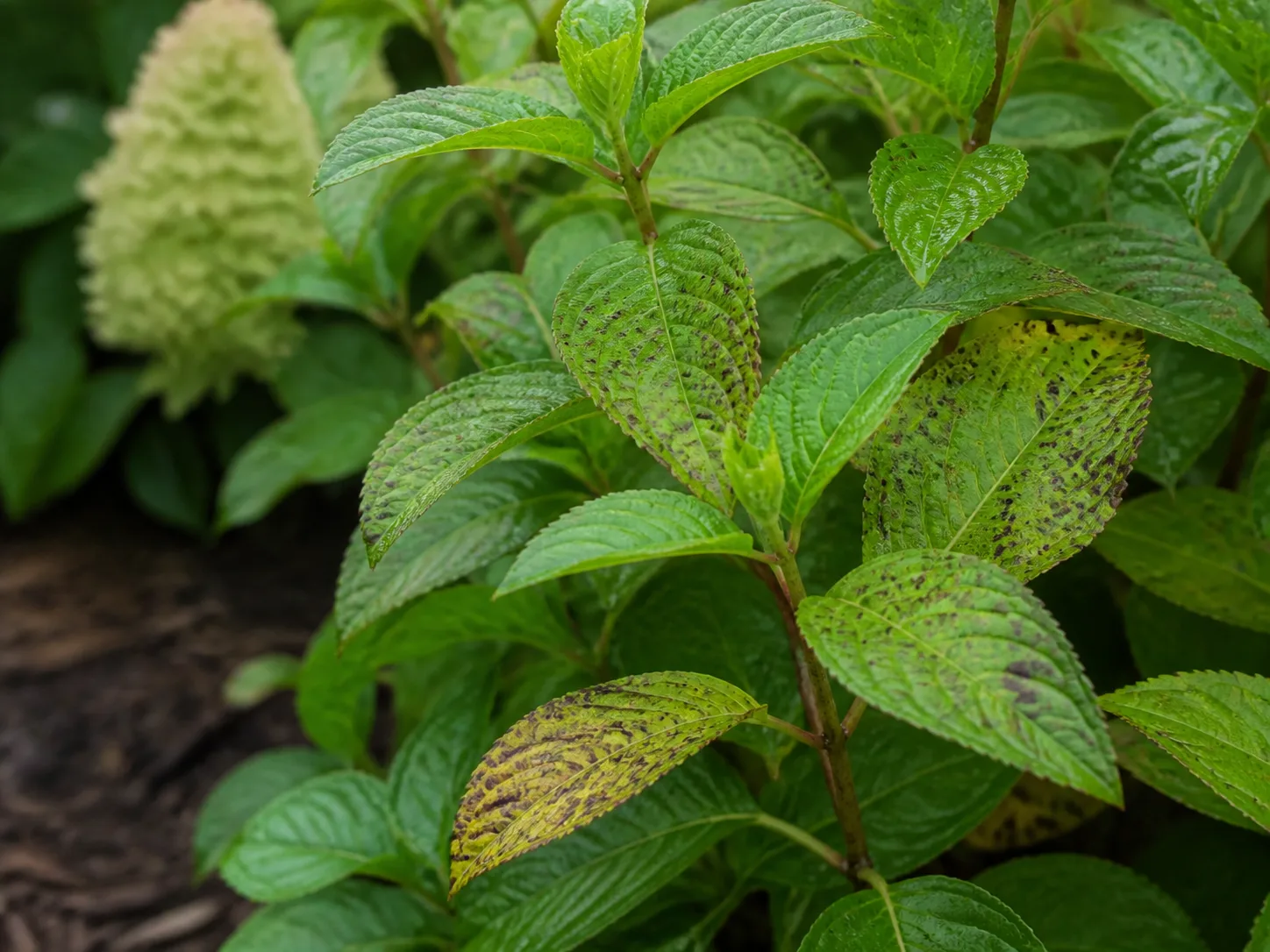
Fast triage by plant part and pattern
Walk around the shrub and inspect both the newest growth and the oldest leaves. Look under leaves with a hand lens, check whether symptoms are limited to one stem or spread through the plant, and note what the weather did before the damage appeared.
| What you see | More likely starting points | First move |
|---|---|---|
| White or gray powder on leaf surfaces | Powdery mildew | Improve airflow, remove the worst tissue, and keep scouting |
| Tan or brown spots with distinct halos | Cercospora or another leaf spot | Remove fallen leaves and keep irrigation off the foliage |
| Large, fast-growing brown lesions on leaves and flowers | Anthracnose or severe blight | Remove infected tissue and avoid splash-up during wet weather |
| Brown, water-soaked petals or fuzzy gray mold | Botrytis blight | Remove spent or infected flowers and increase ventilation |
| Orange pustules under leaves | Rust | Remove affected leaves and confirm the host and disease |
| Wilting that does not improve after watering | Root damage, root rot, or bacterial wilt | Inspect the crown and roots before watering again |
| Yellow rings, mosaic patterns, distorted growth, or color-breaking flowers | Virus or phytoplasma disorder | Isolate the plant and seek confirmation before propagating |
| Sticky leaves, ants, stippling, webbing, notches, or skeletonized leaves | Aphids, scale, mites, weevils, or beetles | Inspect for insects before treating as a disease |
The pattern is more informative than the color alone. A single brown edge after a hot, dry afternoon is not enough to call a disease, while spots that expand, appear on several leaves, and follow wet weather deserve closer inspection. Washington State University Hortsense lists non-disease causes such as leaf scorch, drought, excess sun, herbicide injury, and improper pruning alongside fungal diseases, which is exactly why a blind spray can miss the real problem.
When a photo is not enough: A phone photo can narrow the possibilities, but it usually cannot identify the exact fungus, bacterium, virus, or root pathogen. Leaf spots overlap; a mixed problem is possible; and a plant that was sprayed recently may have altered symptoms. For a high-value shrub, a rapidly declining plant, or a diagnosis that changes whether you remove the plant, send a sample to your local Extension office or a plant diagnostic laboratory.
Do not take cuttings from a plant with unexplained mosaic, ringspot, distorted growth, or systemic decline. Keep suspicious container plants away from healthy stock while you inspect them, and clean tools between plants. This short quarantine is useful even when the final diagnosis turns out to be a harmless environmental problem.
Fungal Diseases of Hydrangeas
Fungal problems are often favored by prolonged leaf wetness, crowded growth, poor air movement, or infected debris. They are not all interchangeable: a fungicide labeled for powdery mildew may not control a leaf spot, and a product cannot repair tissue that is already brown or dead.
Powdery mildew
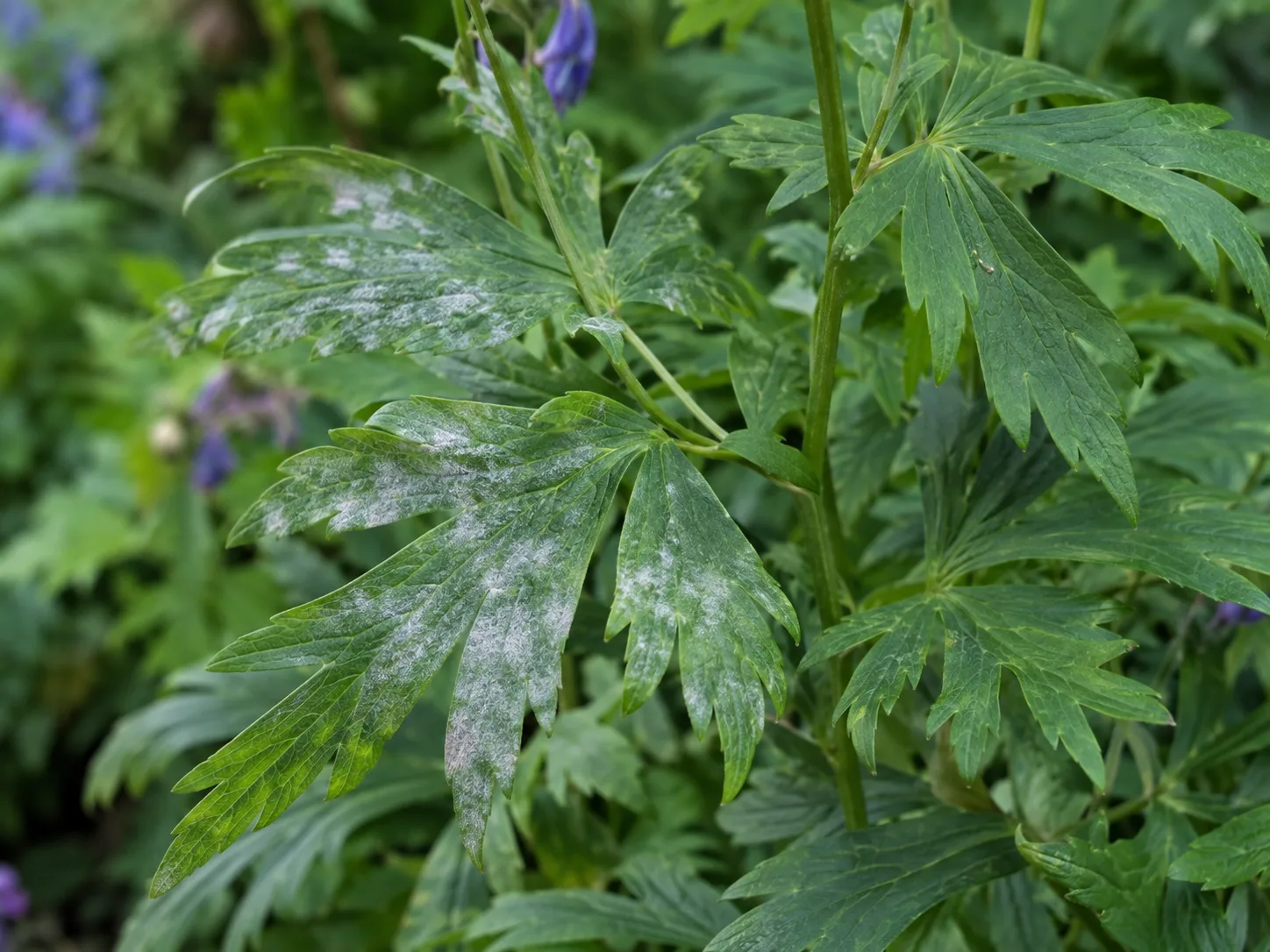
Powdery mildew looks like a dusty white or gray coating on leaves, young stems, or flower parts. The coating may begin in patches, and yellow or purple areas can develop around infected tissue. It is especially common when warm days meet cool nights or when a hydrangea is crowded in a humid, shady position.
Bigleaf hydrangeas can be particularly susceptible, but the disease can occur on other types as well. The University of Connecticut’s hydrangea disease guidance notes that powdery mildew is often more cosmetic than lethal, although a severe infection can distort new growth and reduce the plant’s ability to make food.
Begin by thinning only enough growth to open the plant; do not shear a hydrangea indiscriminately. Remove badly affected leaves and clean up fallen tissue. Water the soil, not the canopy, and avoid a dense, constantly wet mulch layer against the stems. If the disease continues to spread or threatens new growth, choose a fungicide or horticultural oil that is specifically labeled for hydrangeas and powdery mildew in your area, and follow the label for timing, coverage, re-entry, and plant-safety precautions.
Do not expect treatment to erase the white coating instantly or turn damaged leaves green. The goal is to protect new tissue and slow spread. If new leaves emerge clean after airflow and sanitation improve, more spraying may add risk without adding much benefit.
Botrytis and bud blight
Botrytis blight, also called gray mold, starts on flowers as small water-soaked spots that become irregular brown blotches. Buds may die before opening, and faded petals can fall onto leaves and create additional spots. In advanced cases, a fuzzy gray growth appears on flowers or other wet, damaged tissue.
Cool, humid, rainy weather is the classic setup. Penn State Extension’s hydrangea disease table recommends spacing plants for air circulation, avoiding late-day wetting, removing debris, and using a labeled protectant fungicide when needed. Those steps matter because the pathogen can persist in plant debris and move to healthy tissue when moisture splashes spores around.
Cut off infected flower clusters and leaves as soon as you can, especially before a stretch of rain. Bag the material or place it in household waste according to local rules; do not leave it under the shrub. Disinfect pruners after the cut, and avoid working through a wet canopy when your clothing and tools can carry moisture and debris to another plant.
Fungicides work best as protection for healthy tissue or as part of a recurring management plan, not as a way to revive brown petals. If the infection is limited to aging flowers near the end of their display, removal and sanitation may be all that is worthwhile. Repeated spraying without reducing wetness and crowding is a poor trade.
Cercospora and other leaf spots
Hydrangea leaf spot is a group of problems rather than one single disease. Cercospora commonly produces tan or brown spots surrounded by reddish-brown or purple halos, often beginning on lower leaves. As spots multiply, leaves may yellow and drop, leaving the shrub thin even though the stems remain alive.
The key distinction is the pattern and progression, not simply “brown equals fungus.” Fungal leaf spots may be circular, angular, or irregular; bacterial spots often begin water-soaked and darken; scorch tends to follow exposed margins or sun-facing tissue. The University of Connecticut fact sheet explains that minimizing leaf wetness, removing infected leaves, and cleaning up at season’s end can reduce the inoculum that starts the next cycle.
Rake fallen leaves from the crown and dispose of them rather than composting visibly diseased material. Water at the base in the morning, improve spacing, and prune crossing or congested stems only when pruning is appropriate for the hydrangea type. If the shrub had a serious leaf-spot problem last year, a local Extension recommendation may support a preventive product before wet weather; once symptoms are widespread, the product may slow new infections but will not cure existing spots.
Anthracnose
Anthracnose can produce large, dark brown lesions on leaves and flowers. Spots may begin small, develop lighter centers, and expand quickly during warm, wet weather. Lesions that cross veins can look angular, and heavily affected leaves may turn brown and fall.
It is easy to confuse anthracnose with Cercospora or bacterial leaf spot. A useful clue is the speed and scale of the lesions: anthracnose often creates larger, more aggressive patches on both foliage and flowers, while a mild leaf-spot outbreak may stay as many smaller haloed spots. That is a clue, not a laboratory diagnosis.
Remove badly infected tissue and all fallen debris, then water the soil without splashing the canopy. Avoid high-nitrogen feeding while the plant is stressed; pushing lush, tender growth into wet weather can make the canopy harder to ventilate. If the disease is recurring, ask your Extension office which products are currently labeled for anthracnose on hydrangea where you live. Some extension programs recommend copper-based or other protectant fungicides in specific situations, but the label—not a generic recipe—controls the legal rate and interval.
Rust
Rust is most recognizable by orange or reddish-brown pustules on the undersides of leaves, often paired with yellow spots on top. It is associated particularly with smooth hydrangea in the sources reviewed, although the exact host range and disease pressure vary by region.
Remove badly infected leaves and fallen debris, open the plant to air movement, and avoid overhead irrigation. Because some rust fungi require more than one host to complete their life cycle, removing one visible leaf may not end the problem. Gardener’s Path’s hydrangea disease overview describes rust management as difficult and emphasizes sanitation and clean pruning tools.
Do not spray household mixtures such as aspirin or peroxide on a valuable shrub without an evidence-based, label-compliant recommendation. If rust returns each year or causes major defoliation, confirm the diagnosis and ask for region-specific management advice. A resistant cultivar may be a better long-term solution than repeated, broad treatments.
Root and Crown Problems
Root problems are the most dangerous hydrangea disorders to misread because wilt can look like thirst. When roots lose oxygen in saturated soil or are damaged by a root pathogen, adding more water can speed decline rather than correct it.
Root rot
Root rot can be caused by several organisms, including Armillaria, Phytophthora, Pythium, and Rhizoctonia, and the appropriate response depends on which one is present. Above ground, the early signs may be one or more shoots wilting, yellowing foliage, weak growth, and a plant that does not perk up after the soil is watered. Roots may be brown, soft, poorly attached, or foul-smelling instead of firm and pale.
Inspect before you irrigate again. For a container hydrangea, slide the root ball out carefully and look at the outer roots and lower mix. For a landscape shrub, expose a small section near the crown rather than tearing out the entire plant immediately. Persistent wet soil, standing water after rain, a dark or soft crown, and a history of decline after irrigation all raise the odds of a root-zone problem.
The University of Connecticut guidance notes that Armillaria can produce white fan-shaped growth under bark, dark rhizomorphs, or honey-colored mushrooms after heavy rain, while Phytophthora is favored by poorly drained soil. There is no simple chemical cure for established Armillaria root rot. If a container still has substantial healthy roots, repot it into clean, well-draining mix and remove the rotted material with sterile tools; a collapsed crown or mostly rotten root system is unlikely to recover.
Do not “fix” root rot by putting the plant on a stricter watering calendar, adding fertilizer, or burying the crown deeper. Improve drainage, correct irrigation, and avoid planting another susceptible shrub in a persistently flooded pocket until the site is changed. When the diagnosis will affect neighboring plants, use a lab or Extension service rather than guessing from wilt alone.
Bacterial and Virus-Like Diseases
Bacterial and viral problems deserve extra restraint because a fungicide cannot cure them. They may also spread through wounds, contaminated tools, insects, infected plant material, or soil-associated vectors, so sanitation and diagnosis matter more than finding a stronger spray.
Bacterial leaf spot and bacterial wilt
Bacterial leaf spot often begins as small, water-soaked lesions that darken, enlarge, and become angular. The bacteria can enter through natural openings or wounds made by insects, weather, or pruning. Bacterial wilt affects leaves, flowers, and sometimes the whole plant; it is more concerning when wilting progresses rapidly after hot, wet weather and does not respond to corrected watering.
These conditions can look like fungal blight. The practical response while you are confirming the cause is the same low-risk cleanup: remove tissue that is clearly infected, keep irrigation off the leaves, improve airflow, and sanitize pruners between cuts and plants. Do not propagate from the shrub or share cuttings until the diagnosis is settled.
There is no dependable home rescue for systemic bacterial wilt, and bacterial leaf spot is not automatically cured by a copper product. Epic Gardening’s reviewed hydrangea disease guide also emphasizes that bacterial diseases may have no chemical treatment. If a plant is collapsing from a confirmed systemic infection, removal and disposal may protect nearby hydrangeas better than repeated spraying. Follow local disposal guidance and keep diseased tissue out of home compost.
Viruses and virescence
Viruses can cause mottled or mosaic leaves, yellow rings, line patterns, distorted growth, flower-color breaking, weak flowering, or an overall decline. Virescence is different but similarly unusual: flowers become green or leafy, may be stunted, and can produce leafy shoots from flower parts. These symptoms are distinctive enough to take seriously but not specific enough to diagnose from a single photo.
There is no curative spray for an established plant virus. Isolate the plant, mark it so it is not pruned casually with healthy shrubs, and sanitize tools before moving on. Avoid taking cuttings, sharing soil, or adding the plant to compost. Depending on the virus, transmission can involve tools, pollen, insects, or nematodes, so an Extension diagnosis is valuable when you have a collection of hydrangeas or other valuable stock.
The best replacement is clean, reputable plant material rather than a cutting from a suspicious shrub. Control a confirmed insect vector as part of integrated pest management, but do not blanket-spray every insect in the garden: broad-spectrum products can remove predators and pollinators while leaving the underlying diagnosis unresolved.
Insects That Mimic Disease
Many “disease” questions turn out to be feeding damage. Look for the insect, its cast skins, honeydew, webbing, frass, eggs, or characteristic bite pattern before treating. UConn’s hydrangea pest guidance notes that many pests cause cosmetic damage and that chemical control should follow cultural and physical methods when those are sufficient.
Aphids, scale, and spider mites
Aphids gather on soft new growth and flower stems. Their feeding can distort or yellow leaves, while sticky honeydew coats foliage and may support black sooty mold. Ants are often present because they collect honeydew, not because ants caused the leaf damage. A strong water spray can reduce a light infestation; insecticidal soap can help when coverage reaches the insects and the product is labeled for the plant.
Scale insects are more stationary and may look like bumps or crusts on stems and leaf undersides. They also produce honeydew, and their vulnerable crawler stage is easier to manage than mature, armored individuals. Prune out heavily infested twigs where practical, then use a labeled horticultural oil only when the product, temperature, plant stage, and coverage instructions fit the situation.
Spider mites cause fine stippling or a dusty, bronzed look, sometimes with silk webbing on leaf undersides. They thrive in hot, dry conditions and often flare after a broad-spectrum insecticide kills their predators. Check with a hand lens, rinse foliage when appropriate, reduce plant stress, and preserve predatory mites, lacewings, and other beneficials. If treatment is needed, choose the least disruptive, label-approved option rather than reaching for a general insect killer.
Weevils, plant bugs, and beetles
Black vine weevil adults leave notches along leaf margins at night, while larvae feed on roots. A hydrangea with yellowing and browning at the top, unexplained decline, and nighttime notches deserves a root-zone inspection. UConn identifies insect-pathogenic nematodes as one possible control for larvae and notes that adult treatment, where necessary, must be timed to feeding and before egg laying; local labels and Extension advice should guide the decision.
Four-lined plant bugs and tarnished plant bugs create round, brown, sunken spots around feeding punctures. Those spots can resemble a leaf-spot disease, but the pattern and the presence of insects point elsewhere. Populations often do not justify treatment; when they do, insecticidal soap or horticultural oil may be used only according to the label.
Skeletonized leaves usually indicate beetles rather than a fungus. Japanese beetles are more likely to bother oakleaf hydrangea than other types, and rose chafers can skeletonize leaves and flowers in sandy-soil areas. Hand-picking, removing damaged leaves, and reducing nearby breeding habitat can be more effective than a spray that kills beneficial insects and is followed by reinvasion.
A Treatment Sequence That Avoids Common Mistakes
The order of operations matters more than the brand on a bottle. Use this sequence whenever you notice a new hydrangea problem:
- Photograph and mark the symptom. Record whether it is on old or new growth, flowers or leaves, upper or lower surfaces, and one stem or the whole plant.
- Check moisture and roots before watering. A wilted plant in wet soil needs a root inspection, not another soak.
- Inspect for insects and sticky residue. Use a hand lens and look under leaves, inside flower clusters, and along stems.
- Remove clearly infected tissue. Cut back to healthy tissue where appropriate, bag the debris, and do not compost suspect leaves or flowers.
- Sanitize tools between plants. Clean soil and sap from blades, then use a disinfectant appropriate for the tool and follow its safety instructions.
- Change the environment. Improve spacing and airflow, direct water to the soil, fix drainage, and remove persistent leaf litter.
- Choose a product only after narrowing the cause. Use a pesticide only if it is labeled for hydrangea and the diagnosed pest or disease; follow the label exactly and keep people, pets, and pollinators in mind.
- Monitor new growth. A successful intervention shows as clean new leaves or stopped spread, not as old spots disappearing.
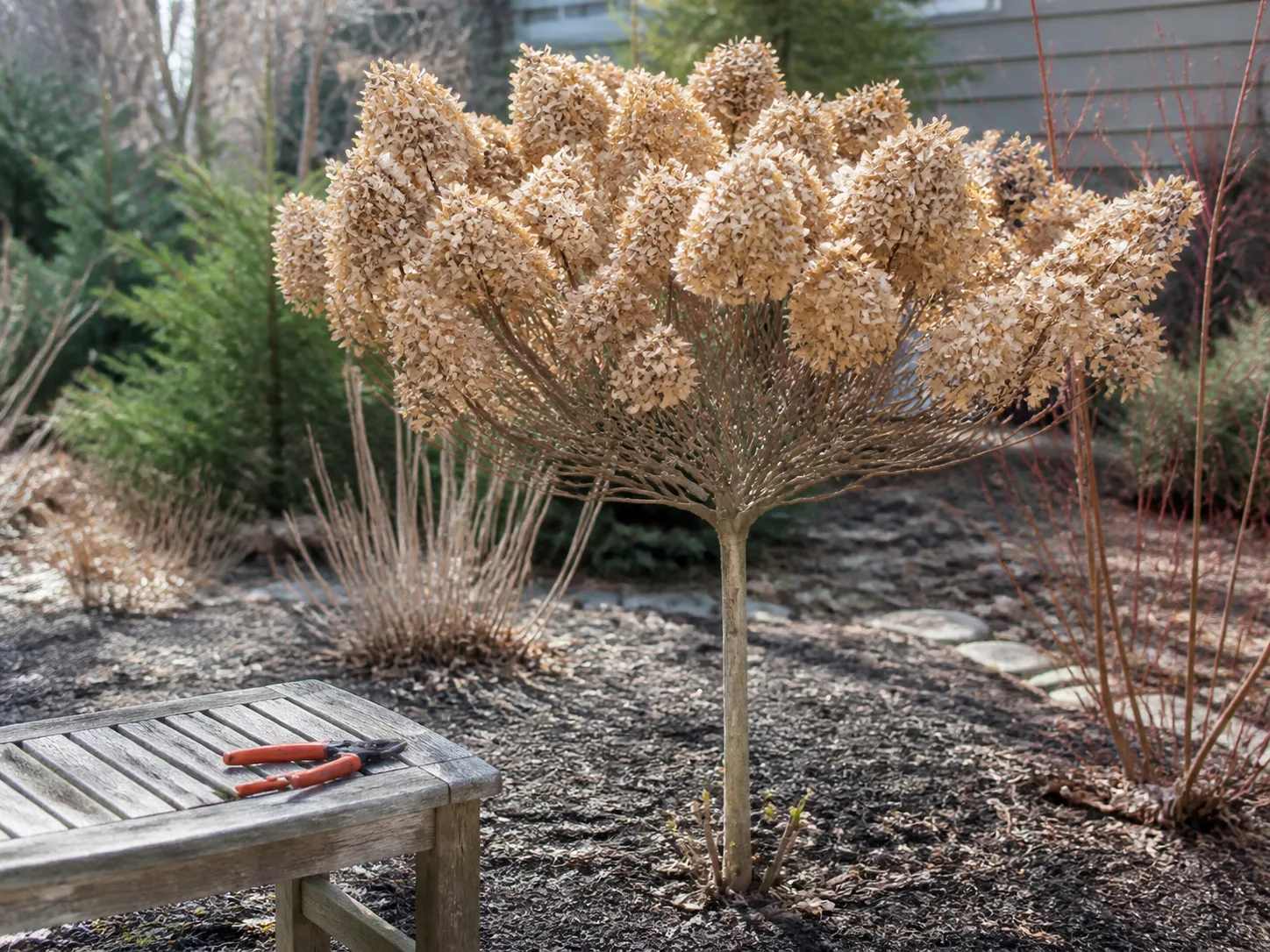
The most common mistake is repeating step seven while skipping steps four through six. A fungicide cannot dry a crowded canopy, an insecticide cannot cure a virus, and a root drench cannot repair roots sitting in stagnant water. If the diagnosis remains uncertain after a week of careful observation, escalate rather than rotating through products at random.
Prevention and Recovery Checklist
Healthy growing conditions reduce pressure, but they do not make a hydrangea immune. Choose a site with enough room for the mature shrub, give the root zone consistent moisture without flooding, and match pruning to the species: removing old wood at the wrong time can reduce blooms and create unnecessary wounds. Washington State University’s hydrangea references specifically identify improper pruning as a common reason for bloom failure, which is easy to mistake for a disease problem.
Frequent scouting is worth more than a calendar full of sprays. Practical guidance from Homes & Gardens likewise emphasizes early observation, sanitation, and airflow because treatments can limit spread but cannot reverse tissue that is already damaged.
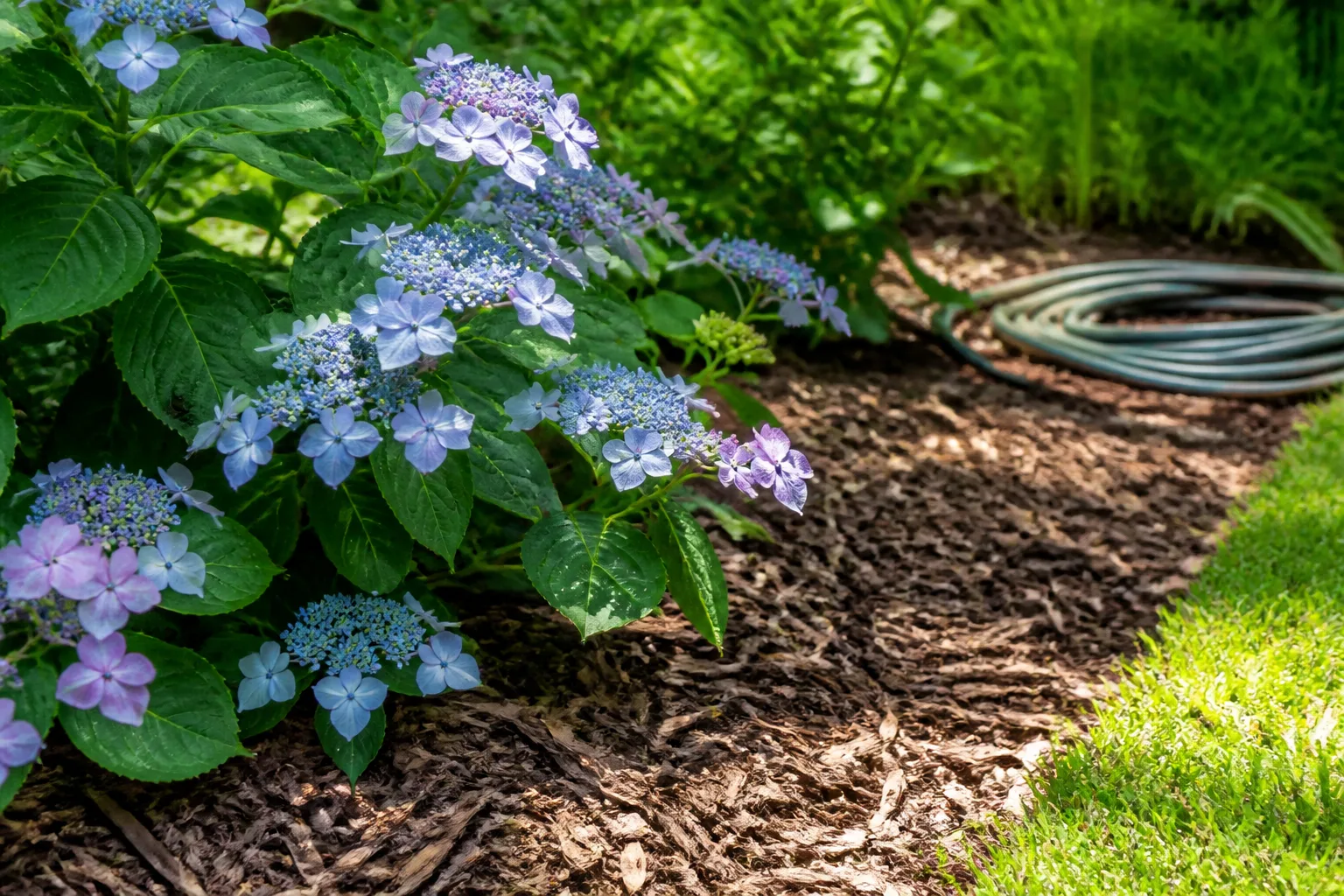
Use a short weekly scouting routine during the growing season:
- Look at the undersides of leaves and the newest stems for insects, eggs, webbing, or pustules.
- Remove fallen leaves and spent flowers that are wet, moldy, or visibly spotted.
- Water at the base in the morning when possible, especially before a cool, damp night.
- Keep mulch a few inches away from stems and crowns so the base stays ventilated.
- Clean pruners before moving to another hydrangea, not only after a problem is obvious.
- Avoid excess nitrogen and unnecessary broad-spectrum pesticides.
- Keep suspicious plants out of the propagation and compost loops until they are cleared.
After treatment, judge recovery by the plant’s next flush of growth. Existing brown spots remain brown, and a leaf that has fallen will not return. Give the shrub time to make clean foliage before removing more living tissue. A plant that is steadily declining despite corrected moisture, sanitation, and pest control may have a root, bacterial, viral, or vascular problem that needs professional confirmation.
Conclusion
Hydrangea diseases are easiest to manage when you treat the symptom as a clue rather than a verdict. White powder points you toward mildew; water-soaked flower lesions suggest Botrytis; haloed leaf spots suggest a leaf-spot complex; orange pustules suggest rust; and wilt in wet soil raises a root problem. Sticky residue, webbing, notches, and skeletonized leaves move insects higher on the list.
Start with inspection, sanitation, airflow, and correct watering. Use a labeled fungicide, soap, oil, or other pesticide only when the likely cause and product match, and remember that no spray reverses dead tissue or cures an established virus. When the plant is collapsing, the roots are involved, or the pattern is unusual, a local Extension office or diagnostic lab can save you from treating the wrong problem—and can help protect the hydrangeas you still have.