10 Spiky Plants for Dramatic Landscaping
Find a spiky landscape plant that fits your climate, soil, space, and safety needs, with hardiness, size, light, and design notes.
Spiky plants are less a botanical category than a design language. Sword-like leaves, radiating rosettes, fan fronds, prickly pads, and stiff flower heads bring a clear silhouette to a garden, but they do not all want the same amount of sun, water, winter protection, or personal space.
The best choice depends on the site before it depends on the look. A dry, sunny rock garden can support agave or prickly pear; a cold border may be better served by yucca, sea holly, or blue fescue; a warm, humid patio can handle ti plant or New Zealand flax. Use the comparison below to shortlist plants, then read the individual notes before you buy.
Choose a spiky plant by climate, soil, and traffic
Climate and mature size come before looks
Start with the coldest conditions your garden reliably experiences, then check the exact cultivar. USDA hardiness zones are useful for comparing plants, but a zone number does not account for wet winter soil, reflected heat, strong wind, sudden freezes, or a sheltered wall that creates a warmer pocket. A plant that is technically hardy may still fail when its crown stays cold and saturated or when a palm is exposed to drying winter wind.
Next, measure the space at the plant’s mature width rather than the width of the nursery pot. A six-inch agave can become a six-foot architectural anchor, and a palm that looks compact in a container can eventually shade a window or crowd a path. This is also where “low maintenance” becomes practical: a plant that fits its space rarely needs repeated cutting, moving, or defensive pruning.
Treat traffic as a design constraint. Put plants with sharp leaf tips, spines, or glochids at the back of a bed, beside a wall, or in a container where their reach is easy to see. If children, dogs, or frequent guests use a narrow path, a rounded grass or less heavily armed plant may give you the same vertical effect with less risk.
Drainage and establishment decide success
Most of the genuinely drought-tolerant choices here prefer soil that drains quickly after rain. That does not mean the soil must be infertile or bone dry; it means water should not sit around the crown and roots for days. Gardenia’s practical drought-garden guidance makes the same point: match plants to the site, avoid places that stay wet after storms, and group plants by water need rather than treating every “drought-tolerant” plant as interchangeable. (Gardenia’s drought-tolerant landscape guide)
Improve drainage by choosing a naturally raised or gravelly position, correcting compaction, and keeping mulch away from the crown. Do not solve a wet planting site by simply adding a thin layer of grit to the top; water still follows the underlying compacted layer. If the spot stays wet, choose a plant that tolerates more moisture—windmill palm or ti plant, for example—or move the architectural plant to a raised bed or container.
Quick comparison of 10 architectural plants
The zone ranges below are useful starting points from plant profiles, not guarantees for every cultivar. “Dry” means the plant wants quick drainage and a substantial dry-down; it does not mean a newly planted specimen can be ignored.
| Plant | Approx. USDA zones | Light | Mature scale | Best landscape job | Main caution |
|---|---|---|---|---|---|
| Krantz aloe | About 9–11 | Full sun | Large shrub or small tree | Warm-climate focal point | Frost and wet winter soil |
| New Zealand flax | 9–11 | Sun to partial shade | 1–8 ft., cultivar-dependent | Colorful evergreen mass | Heat and cold limits vary |
| Agave | 8–11 for A. americana | Full sun | About 6–10 ft. wide | Dry-garden specimen | Sharp leaves and one-time bloom |
| Curlyleaf yucca | 4–10 | Sun to partial shade | 3–8 ft. tall | Cold-hardy anchor or barrier | Sharp tips and offsets |
| European fan palm | 8–11 | Sun to partial shade | 6–15 ft. tall | Mediterranean-style focal point | Spiny petioles and width |
| Eastern prickly pear | 4–9 | Full sun | 6–12 in. tall | Rock garden, slope, or edge | Glochids and wet soil |
| Sea holly | 5–9 | Full sun | 2–3 ft. tall | Blue pollinator accent | Prickly bracts and root disturbance |
| Ti plant | 10–12 | Bright shade to partial shade | 9–15 ft. in the ground | Tropical foliage or container | Cold and dry conditions |
| Windmill palm | 7–11 | Sun to partial shade | About 8–10 ft. in cultivation | Hardy tropical-looking tree | Wind can tear fronds |
| Blue fescue | 4–8 | Full sun | 9–12 in. tall | Low edging and repetition | Declines in hot, humid summers |
1. Krantz aloe
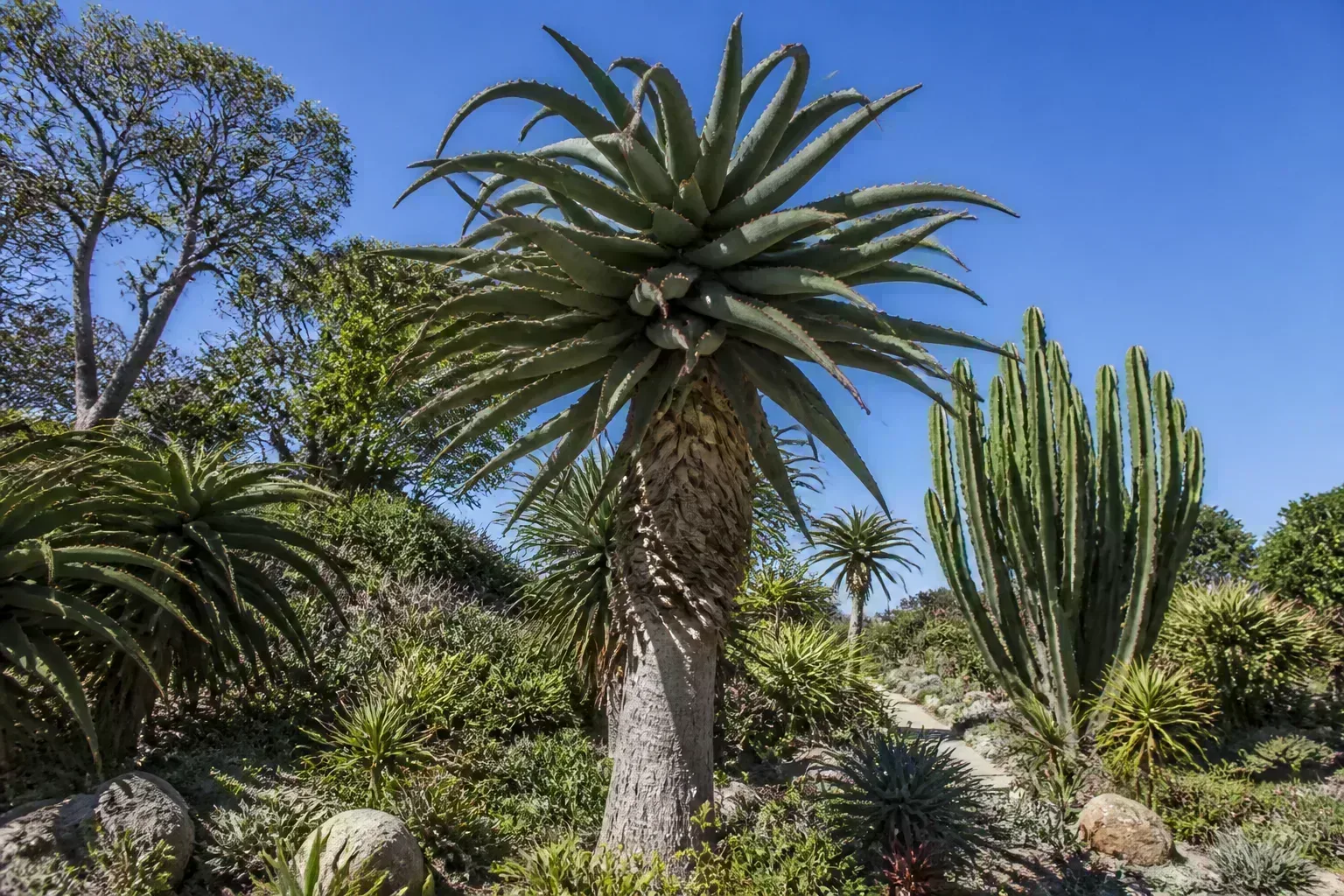
Krantz aloe (Aloe arborescens) gives a warm-climate garden the shape of a small tree made from stacked rosettes. Its fleshy, pointed leaves read as spiky from a distance, while red-orange flower clusters add a winter or early-season color moment when many dry gardens are quiet. The branching form works well as a single specimen, a loose hedge, or a backdrop for lower gravel-garden plants.
Give it full sun, fast drainage, and room to become a substantial plant. NC State Extension’s aloe guidance recommends very bright light, coarse well-drained soil, a container with several drainage holes when grown in pots, and a full dry-down between waterings. (NC State Extension’s aloe profile) For an in-ground specimen, water deeply while it establishes, then reduce irrigation rather than keeping the root zone constantly damp.
Krantz aloe is a poor choice for a frost-prone or waterlogged corner. In a colder climate, grow it in a heavy container that can be moved under cover, and do not place the pot where a sharp leaf points into a doorway. The flowers are a bonus; the year-round rosette structure is the reason to plant it.
2. New Zealand flax
New Zealand flax (Phormium tenax) is the most useful choice here when you want long, strap-shaped leaves without a true cactus look. Cultivars come in green, bronze, red, pink, cream, and striped forms, so a clump can act as both a structural plant and a color block. Tall flower stalks may rise above the foliage and attract hummingbirds in a suitable climate.
It grows in full sun to partial shade and wants well-drained soil, but it is not a universal desert plant. NC State Extension lists it as reliably suited to USDA Zones 9–11 and notes that excessive summer heat can be a problem; variegated forms often hold their color better with some afternoon protection. (NC State Extension’s New Zealand flax profile)
Use a dwarf cultivar in a pot or at the front of a border, and reserve large forms for places where the 3- to 8-foot range will not hide windows or swallow neighboring perennials. New Zealand flax is especially effective near patios and coastal gardens, but “salt tolerant” does not remove the need for drainage or establishment water.
3. Agave
Agave is the classic desert-style focal point: a dense rosette of broad, rigid leaves with a strong terminal spine. For a large example, American century plant (Agave americana) can reach roughly 6 to 10 feet in height and width, so it belongs where its mature outline—not its nursery size—can be appreciated.
The plant wants full sun and good drainage. NC State Extension describes A. americana as a low-maintenance succulent for specimen, rock, slope, and drought-tolerant gardens, but also notes that root rot becomes a risk in overly moist soil. It can take many years to flower; when it sends up its tall flowering stalk, the main rosette dies after blooming while offsets often form around the base. (NC State Extension’s American century plant profile)
Use agave as a punctuation mark, not as a repeated line along a narrow walkway. Plant it at the back of a wide bed, surround it with low rounded or fine-textured companions, and leave space for removing offsets later. If you want the same rosette effect with less scale, choose a smaller species or cultivar after checking its adult dimensions.
4. Curlyleaf yucca
Curlyleaf yucca (Yucca filamentosa) is one of the strongest choices for a cold-winter landscape that still wants an arid or tropical silhouette. Its evergreen basal rosette holds stiff, pointed leaves through the seasons, and its tall panicles of creamy bells rise well above the foliage in spring or early summer.
This yucca handles full sun or partial shade, drought, heat, poor soil, salt spray, and even some soil compaction once established. NC State Extension places it across a wide hardiness range, roughly Zones 4–10, and describes it as a low-maintenance accent, barrier, slope, bank, rock-garden, or native-garden plant. (NC State Extension’s curlyleaf yucca profile)
The trade-off is physical sharpness and a tendency to make offsets. Keep it out of a child’s play zone and away from the inside corner of a path. If the leaves look tired after flowering, remove only damaged or spent material at the base; repeatedly shearing healthy leaves ruins the rosette and creates more work.
5. European fan palm
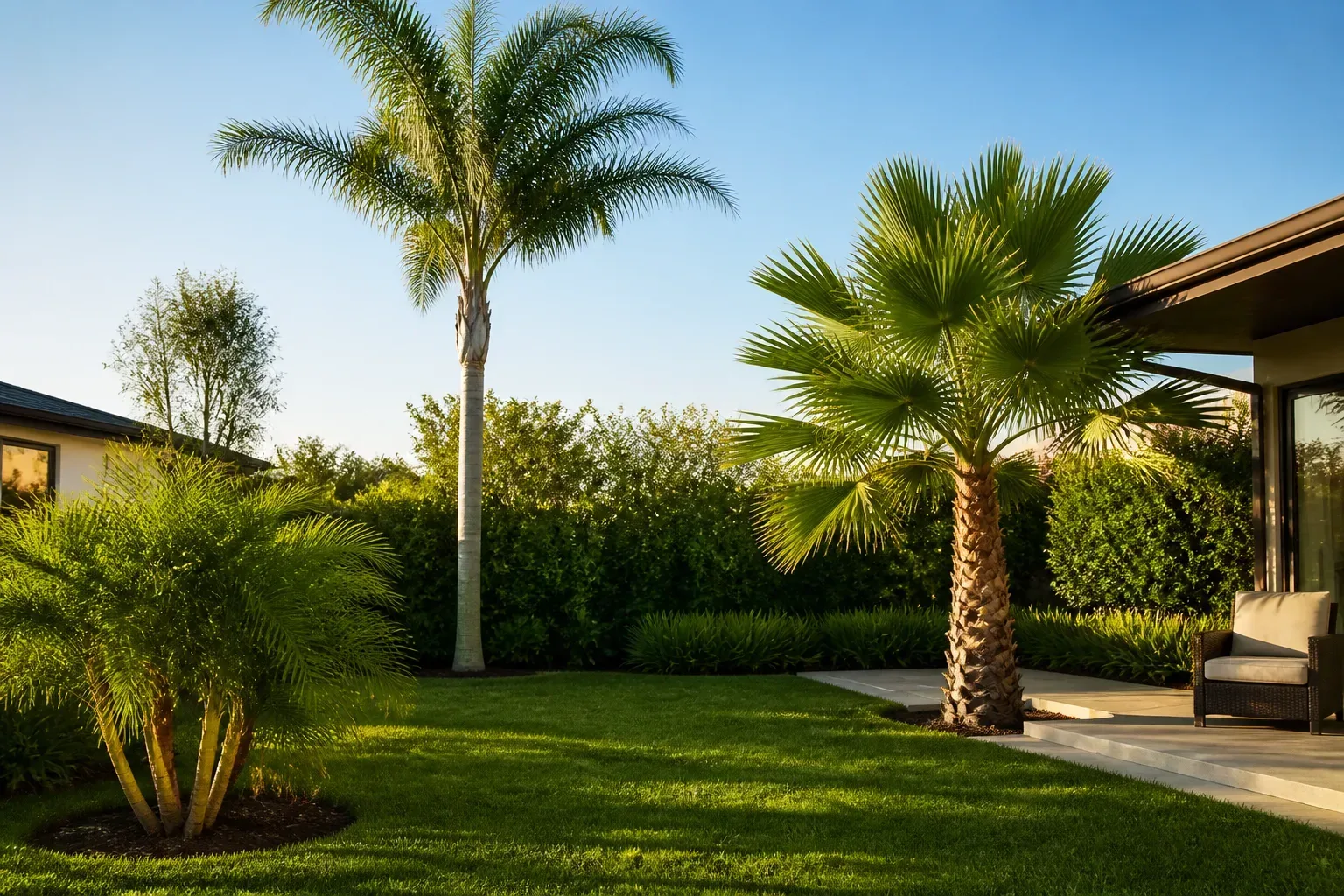
European fan palm (Chamaerops humilis) brings a Mediterranean shape to a landscape without requiring a truly tropical climate. Its blue-green fan leaves emerge from spiny petioles, and the plant can be grown as a single-trunk specimen or allowed to form a multi-stemmed clump that reads more like a shrub.
Give it bright sun for the tightest, most compact form, although partial shade is tolerated. NC State Extension lists it as a low-maintenance, well-drained-soil plant for roughly Zones 8–11 and notes that established plants tolerate heat and drought. (NC State Extension’s European fan palm profile)
Its broad eventual spread is more important than the height on the plant tag. Site it beside a wall, lawn, or gravel area where the fan can open without brushing a walkway. In a colder or wet climate, a container lets you control drainage and shelter the palm, but a mature container will be heavy and still needs winter planning.
6. Eastern prickly pear cactus
Eastern prickly pear (Opuntia humifusa) is the small-space option that proves a spiky plant does not have to be tall. It forms low, flat green pads, bright yellow flowers, and fruit that can mature red or purple. It is native to the eastern United States and Mexico and suits sunny rock gardens, dry slopes, retaining-wall edges, and containers.
NC State Extension describes this species as very drought- and salt-tolerant, but intolerant of shade and wet, poorly drained soil. It is usually only about 6 to 12 inches tall and 1 to 1½ feet wide, with barbed bristles called glochids even when the pads appear spineless. (NC State Extension’s eastern prickly pear profile)
Handle it with thick gloves, long sleeves, and tools rather than bare fingers. Put it where people will not kneel or brush past it, and avoid using edible-fruit language as an invitation to experiment; identification, safe handling, and local guidance matter more than the fruit’s color.
7. Sea holly
Sea holly (Eryngium planum) is the softer-looking, more flower-forward member of the list. Its blue-green stems and steel-blue flower heads bring a metallic, thistle-like effect to a sunny border, and the dry flower heads can hold their shape well after bloom. It is a strong transition plant between bold rosettes and looser ornamental grasses.
Unlike a cactus, the species itself is not covered in long spines, but the flower bracts and plant texture are still prickly. NC State Extension lists it as a low-maintenance perennial for full sun, well-drained sandy or loamy soil, and roughly Zones 5–9; its flowers attract bees and butterflies. (NC State Extension’s sea holly profile)
Give sea holly a permanent position if possible. It dislikes repeated root disturbance, and the best blue color comes from strong light rather than rich, wet soil. Plantsman highlights sea holly as an architectural border contrast and recommends letting the dried heads contribute winter interest, while Ideal Home’s hot-weather planting guidance pairs it with airy grasses and salvias. (Plantsman’s architectural plant guide) (Ideal Home’s hot-weather plant guide)
8. Ti plant
Ti plant (Cordyline fruticosa) is the colorful tropical exception in this list. Its lance-shaped leaves spiral around upright stems in shades of green, pink, purple, red, and cream, giving a shaded patio or warm-climate border the same graphic impact that agave gives a desert bed.
Do not treat ti plant like a succulent. NC State Extension describes it as a moisture-loving tropical that prefers bright indirect to filtered light, fertile well-drained soil, humidity, and regular watering with a modest dry-down. It is listed for roughly Zones 10–12 and does not tolerate temperatures below about 50°F, so it is better as an outdoor seasonal container in colder areas than as a permanent in-ground plant. (NC State Extension’s ti plant profile)
Use ti plant where you can protect it from cold and harsh afternoon sun. A container makes it easy to move, refresh, or combine with softer foliage, but it will need more frequent attention than an agave because the soil dries faster in a pot and the plant does not store water in the same way.
9. Windmill palm
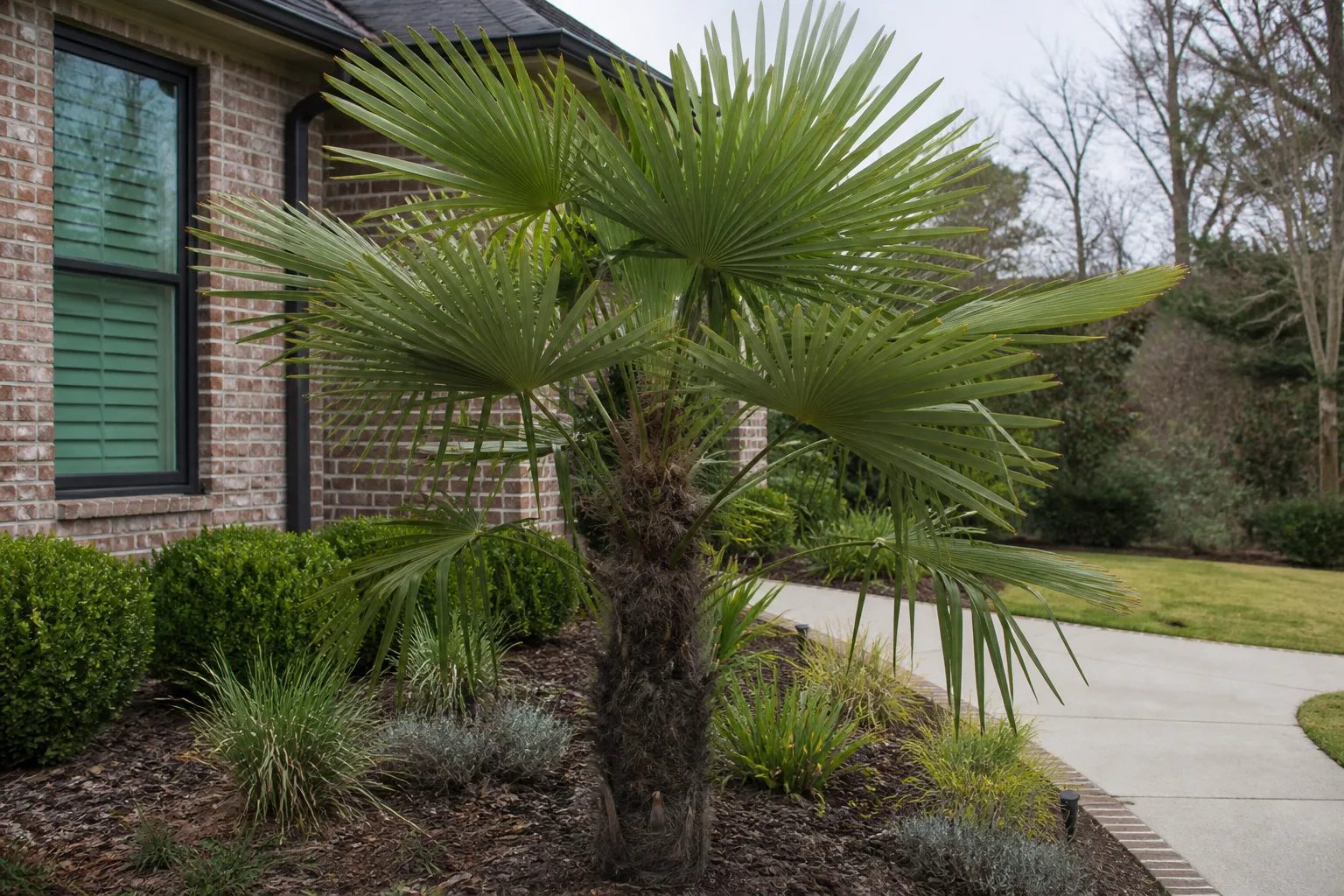
Windmill palm (Trachycarpus fortunei) is the tall, cold-hardy tropical accent for gardeners who want a trunk and canopy rather than a low rosette. Its fan-shaped fronds and fibrous trunk can frame an entry, pool, patio, or garden room, and it looks convincing even when surrounded by temperate plants.
Although it tolerates full sun, partial shade and protection from strong or cold winds can produce better-looking foliage. NC State Extension lists it for roughly Zones 7–11, notes that cultivated plants often top out around 10 feet, and warns that strong wind can tear the leaves even when the damage is not fatal. (NC State Extension’s windmill palm profile)
Plan the palm’s canopy and the path below it together. Keep the trunk clear of structures as it grows, give the root zone consistent moisture during establishment, and do not mistake “cold hardy” for “wind proof.” A torn palm can survive and still look ragged for a full season.
10. Blue fescue
Blue fescue (Festuca glauca) is the low edging plant that makes taller spiky plants look intentional. Its fine blue-gray blades form tidy domes, giving you a repeated color and texture without adding much height. It works along a gravel path, in a rock garden, at the front of a sunny border, or in a container with a larger focal plant.
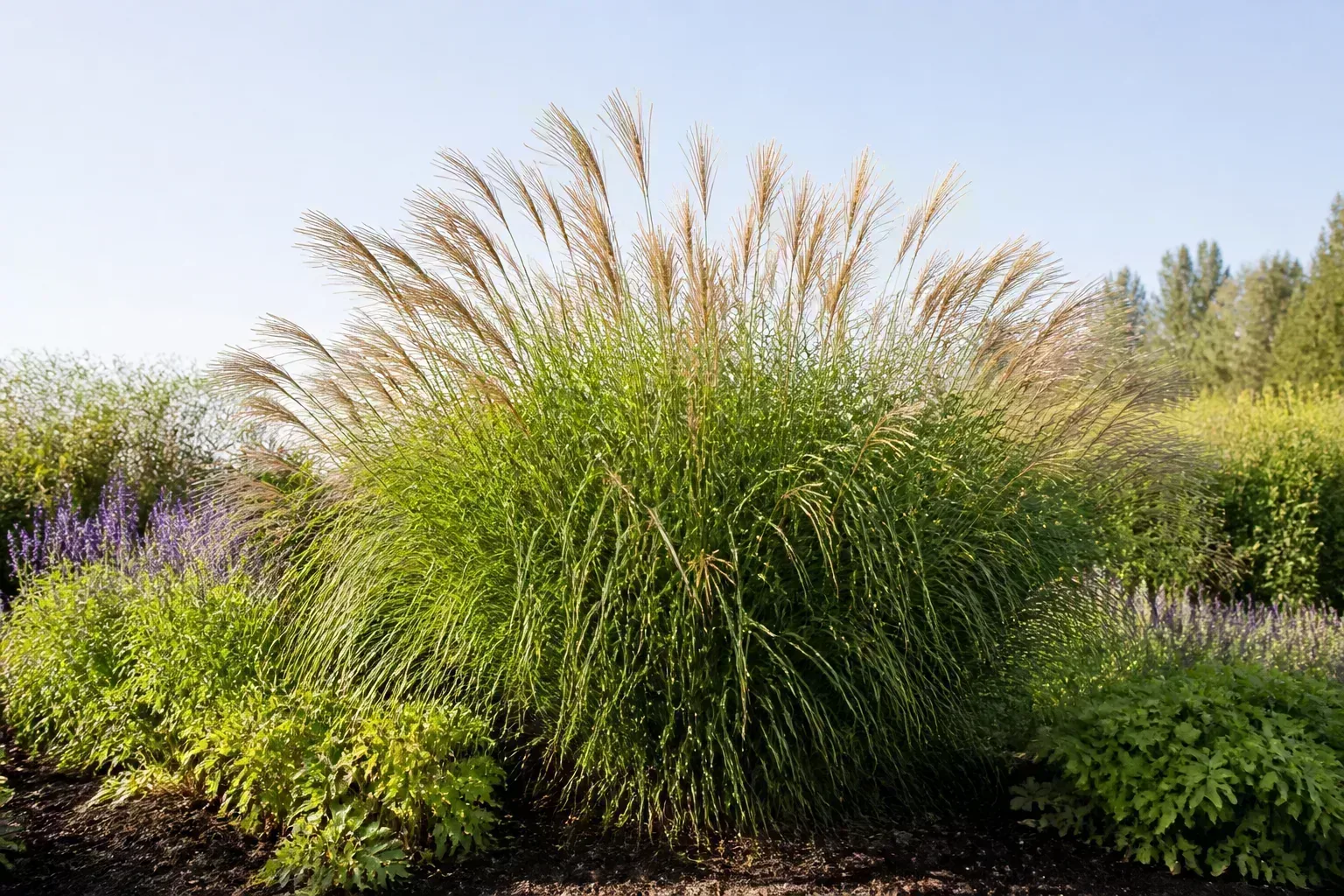
NC State Extension lists blue fescue for roughly Zones 4–8 and describes it as a clumping, cool-season perennial that prefers full sun, medium-moist to dry well-drained soil, and poor-to-average conditions. It can decline in hot, humid summers, and clumps may need dividing or replacing every two to three years. (NC State Extension’s blue fescue profile)
That shorter lifespan is not a defect if you use it as a rhythm plant rather than a permanent hedge. Space clumps so air can move between them, avoid heavy irrigation from a nearby lawn zone, and cut back only what has browned rather than flattening the entire dome.
Design rules for a dramatic but livable planting
Pair hard spikes with soft textures
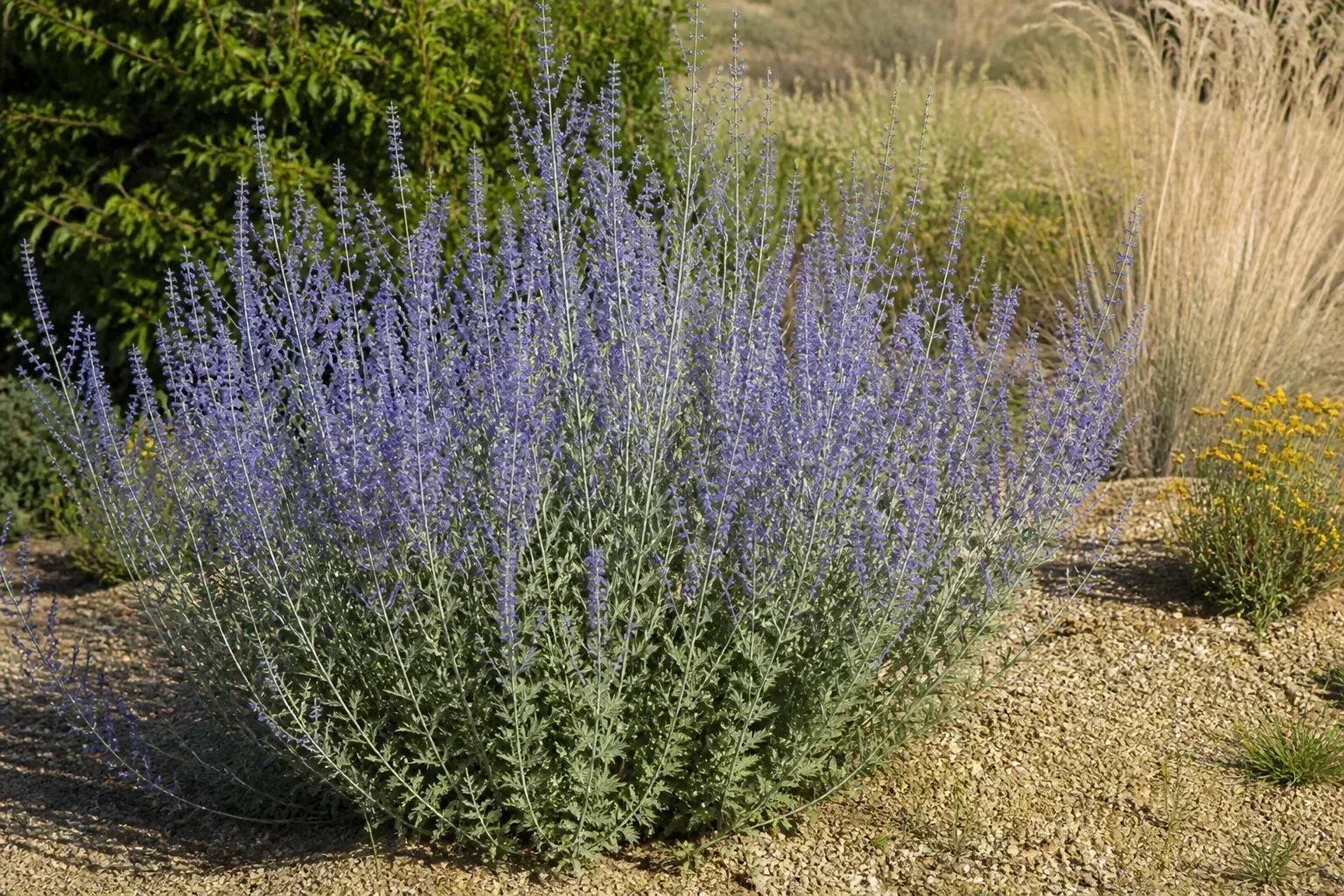
Spiky plants look strongest when their neighbors provide contrast. Combine one rigid form with a rounded shrub, a loose perennial, a fine grass, or low groundcover; the eye reads the contrast more clearly than it reads ten identical spikes packed together. In a dry bed, gravel and broad stones can reinforce the architecture, while silver foliage and billowy flowers keep the composition from feeling hostile.
Use the plant’s natural silhouette as the design material. Agave and yucca supply broad rosettes, blue fescue supplies low repetition, sea holly supplies vertical flower heads, and palms supply height. A planting with all four layers has more depth than a row of the same plant, and it gives each species enough room to stay healthy.
Repeat color and stagger height
Choose one repeated color before you choose every plant. Blue-gray fescue can echo the foliage of an agave or the stems of sea holly; bronze flax can echo a warm stone; the green fan of a palm can connect a tropical focal point to ordinary shrubs. Repetition turns a collection into a plan.
Then build a simple three-layer sequence: one tall focal point, two or three mid-height structural plants, and a low edge. For example, a windmill palm can sit behind yucca or flax, with blue fescue at the front; in a warmer dry garden, tree-form aloe can rise behind prickly pear and gravel. Always leave the mature spread of the tallest and sharpest plant visible on paper before you dig.
Avoid mixing plants with opposite water needs just because the colors work. Ti plant and New Zealand flax need more regular moisture than agave or prickly pear, while sea holly and blue fescue can suffer when an irrigation zone stays wet. Group by water demand first, then repeat color across the groups with paths, pots, or gravel to connect them visually.
Watering and winter care after planting
Even the driest-looking plant needs help after installation. For the first several weeks, check the root ball frequently and water deeply when it begins to dry; a new plant has not yet explored the surrounding soil. During the first growing season, extend the interval between waterings as roots spread, but do not let a small transplant go bone dry during a heat wave.
Once established, water according to the plant and the weather rather than a weekly calendar. Succulents and prickly pear want a full dry-down, sea holly and blue fescue want drainage with only occasional moisture, palms appreciate more even moisture, and ti plant needs the most regular attention of the group. Water at the soil line, soak the root zone, and let the surface dry as appropriate; frequent shallow sprinkles encourage shallow roots and wet foliage.
Containers dry and cool faster than beds. Use a pot with a drainage hole, choose a mix that stays open rather than dense, and move frost-sensitive aloe, flax, or ti plant under cover before a freeze rather than after tissue has collapsed. For windmill palm, protect the canopy from the prevailing wind; for agave and yucca, protect the crown from winter wet more than from a little cold.
Do not fertilize a struggling plant as a first response to brown tips or soft leaves. Check drainage, light, temperature, and watering history first. A spiky silhouette hides problems well until the root system is already damaged, so site matching is the most effective maintenance you can do.
Conclusion
The right spiky plant makes a landscape feel composed because it gives the eye a firm shape to hold onto. Choose curlyleaf yucca, prickly pear, sea holly, or blue fescue for a colder garden; choose aloe, agave, flax, fan palm, or ti plant when your warmth, drainage, and winter protection match their needs; and use windmill palm when you want a hardy vertical focal point rather than a low rosette.
Before planting, check the species name, mature width, hardiness, drainage, and distance from traffic. One well-sited focal plant with a few repeated textures will create more drama—and far less work—than a crowded bed of spikes.



