How to Identify Hummingbird Moths: 8 Field Clues
Learn how to identify hummingbird moths by their antennae, wings, legs, proboscis, size, flight, flowers, and caterpillar clues.
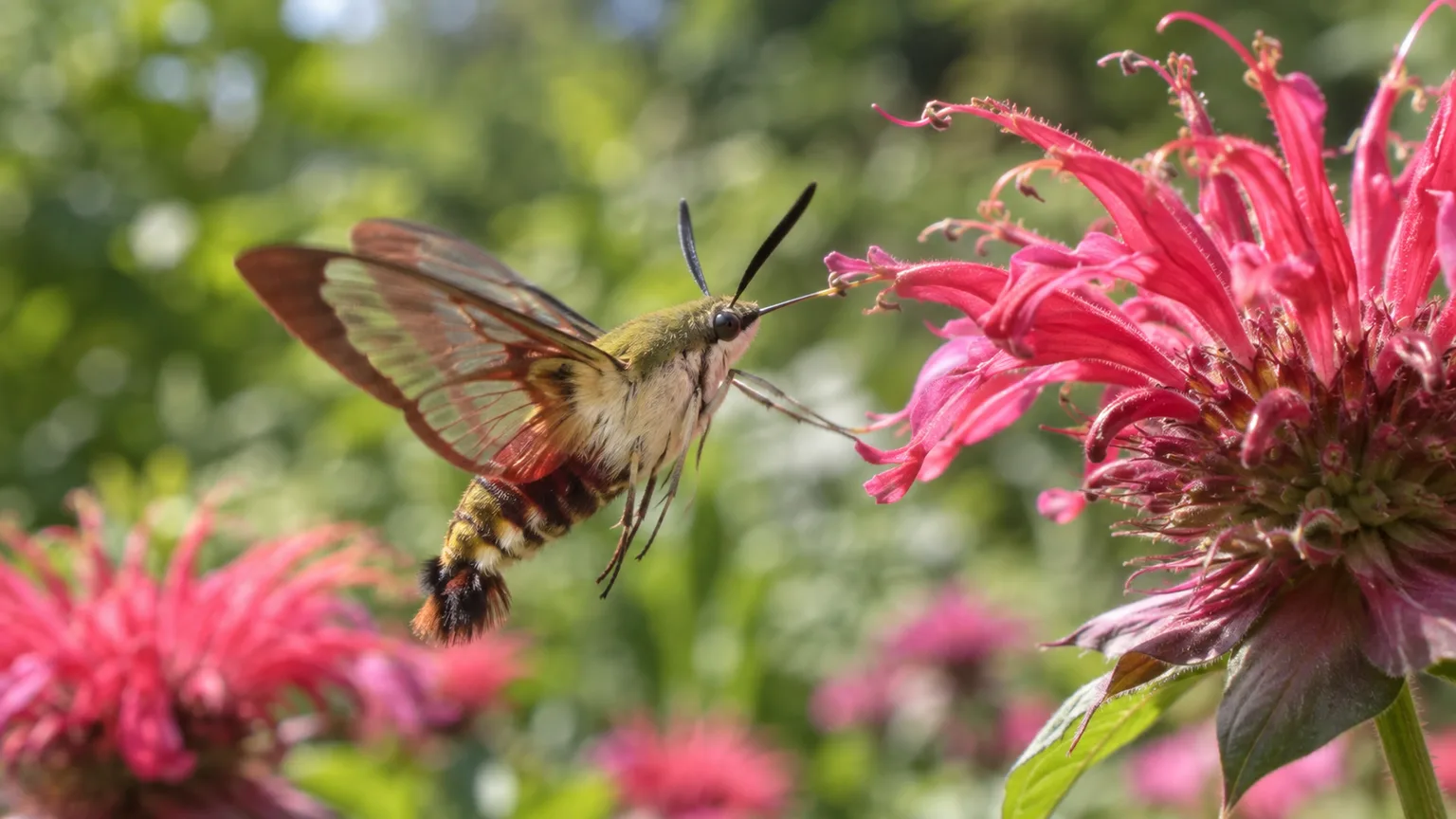
The quickest way to identify a hummingbird moth is to look past the illusion of flight. A hovering, buzzing visitor at a tubular flower may look like a tiny bird from across the yard, but an insect gives itself away with antennae, six legs, two pairs of wings, and a flexible proboscis that coils when it is not feeding.
The common name covers several sphinx moths, so color alone will not give you a reliable species identification. Use the clues in this order: movement, head and legs, wings, body shape, then time, place, flower, and host plant. That sequence lets you make a useful identification even when the moth is too fast for a crisp photograph.
Start with the movement, not the color
Watch the visitor for a few seconds before reaching for a camera. A hummingbird moth often holds its body almost stationary in front of a flower, darts away, and returns to another bloom with a direct, purposeful flight. It may hover while feeding, move sideways, or make a quick retreat without ever landing on the petals.
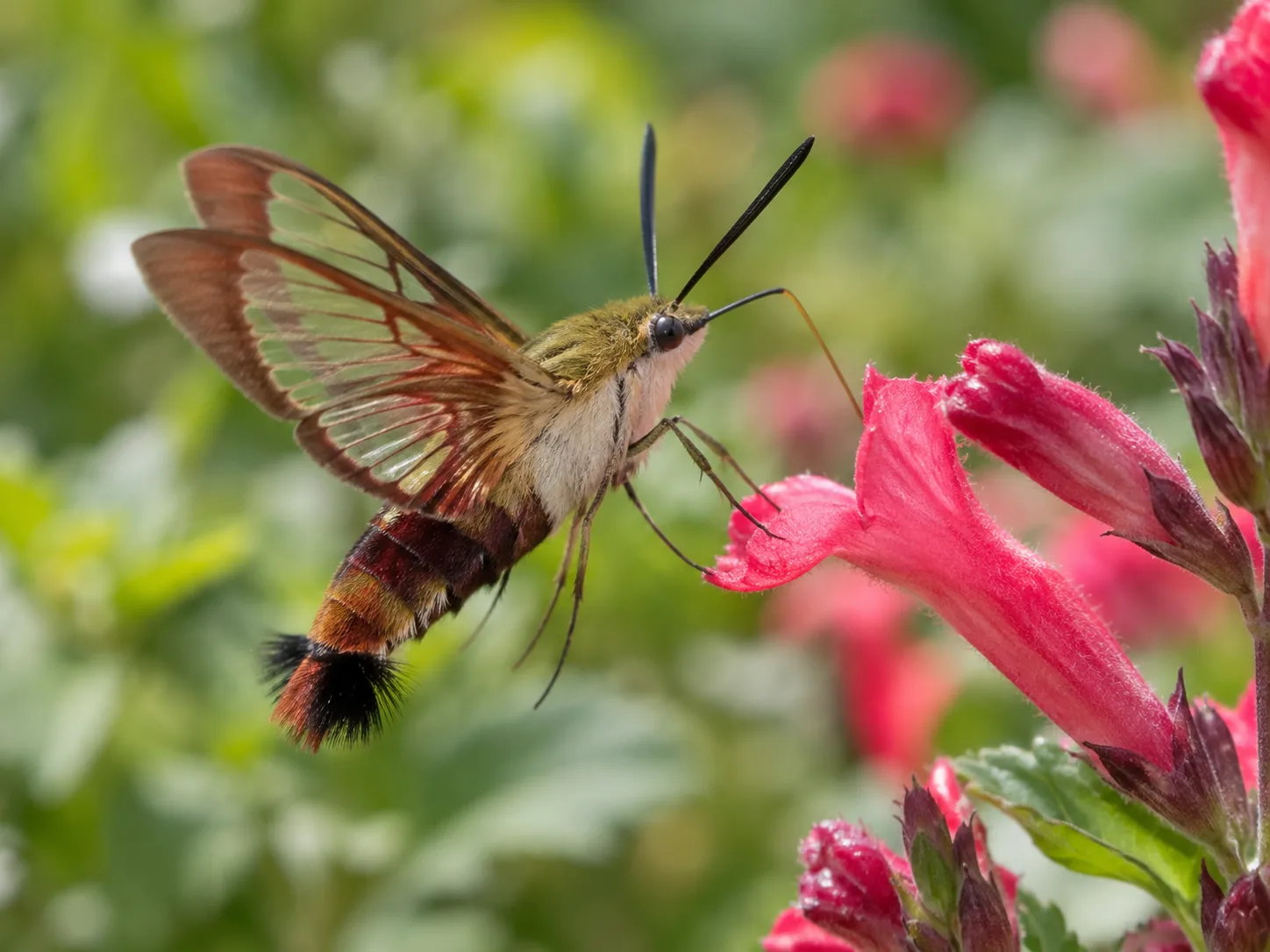
That behavior explains the name, but it cannot prove what you saw. Hummingbirds hover too, and some bees can pause in front of a flower. Even a soft buzzing sound is only supporting evidence: rapidly beating moth wings can make a hum, while a bird’s wingbeats can also sound busy at close range.
The useful question is not “Did it hover?” but “What did the hovering animal look like while it hovered?” A moth usually appears fuzzy and thick-bodied, with legs hanging below it and a long mouthpart reaching into the flower. A hummingbird looks smoother and more tapered, with its bill projecting straight from the head and its feet tucked close to the body.
Check the body while it feeds
Feeding gives you the best viewing opportunity because the visitor often returns to the same patch of flowers. Stand still, avoid waving a hand through the flight path, and watch the side of the animal rather than trying to follow every wingbeat.
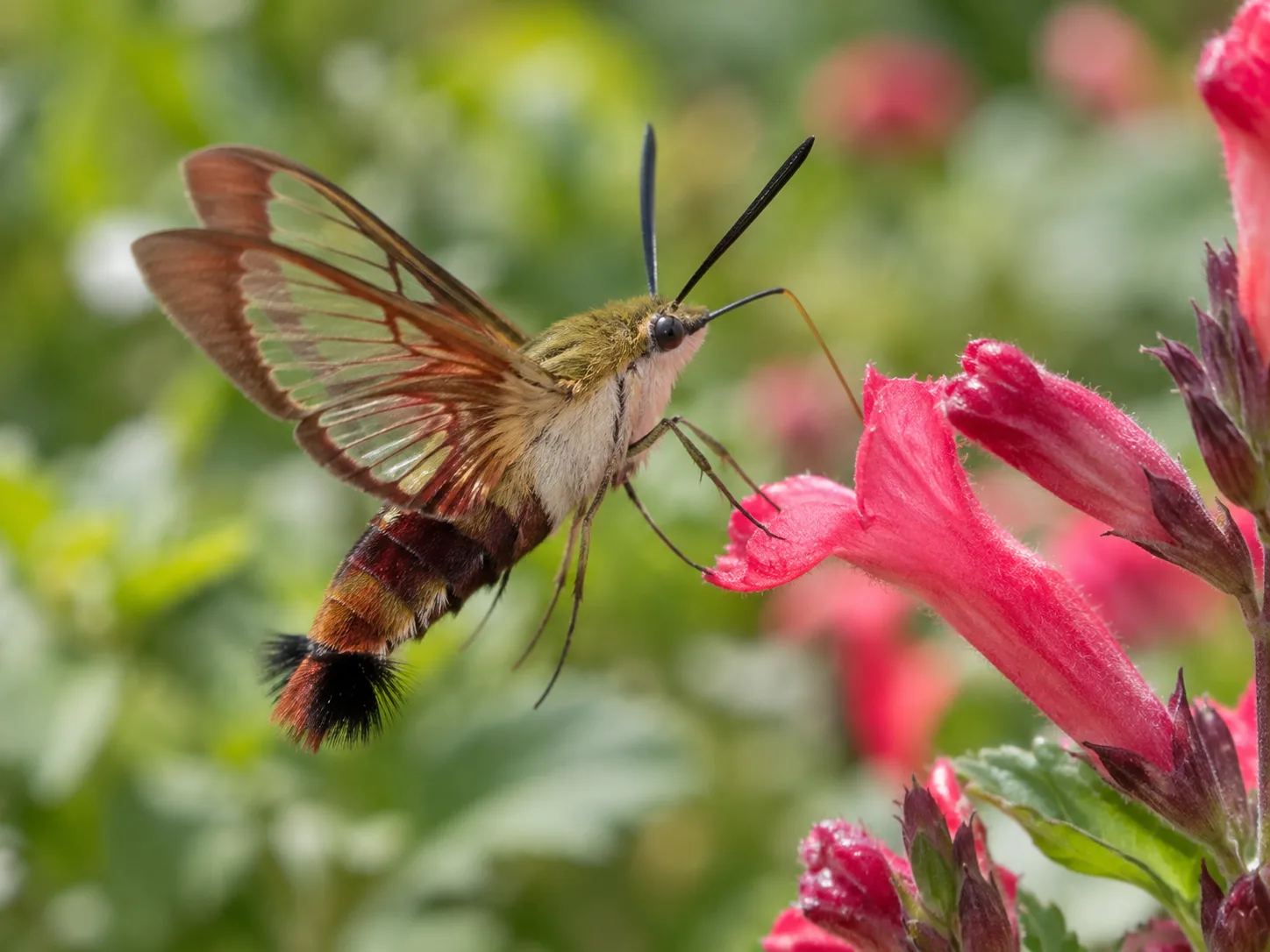
If you have only a moment, check three places: the head for antennae, the underside for dangling legs, and the front of the face for a coiling proboscis or a rigid bill. Those clues work better than broad color descriptions because several species can be olive, brown, yellow, or red-banded, while a bird cannot grow moth antennae or a moth cannot grow a true beak.
A real-time comparison is easiest when both visitors are feeding: the bird has a straight bill and smooth feathers, while the moth shows antennae, a fuzzy body, and hanging legs.
Antennae are the fastest head clue
Two antennae are the clearest sign that the visitor is an insect. On a hummingbird clearwing, they rise from the head and may look like a pair of short dark feelers or narrow clubs. They can be hard to see in a blurred photograph, but they are often obvious when the moth pauses or approaches a flower from the side.
Hummingbirds have no antennae. A crest or a few raised feathers can create a similar impression at a distance, but feathers form one central crown or a soft outline rather than two separate feelers projecting from the head. If you can see two distinct structures above the eyes, treat that as a strong moth clue.
Six legs and two wing pairs reveal the insect
Hummingbird moths have six legs, and several may dangle beneath the body as the moth feeds. The legs often look surprisingly prominent because the insect does not tuck them into a sleek aerodynamic line the way a bird does. You may also see a small fan or brush at the end of the abdomen, especially in a male hummingbird clearwing.
Counting two pairs of wings is harder because the wings beat too quickly. Look for a front and rear wing outline when the moth slows, lands, or appears in a photograph. A bird has one pair of wings and two legs; an insect has two pairs of wings and six legs, even when motion blur hides some of them.
A coiling proboscis is not a beak
The long structure entering the flower is another high-value clue. A moth uses a flexible proboscis, a tube-like mouthpart that uncoils to reach nectar and then curls up like a spring when the moth is done. University of Wisconsin–Madison Division of Extension shows this contrast clearly in its account of Hemaris thysbe, including the way the proboscis coils when not in use.
A hummingbird uses a firm bill that keeps the same basic shape whether it is feeding or perched. The bill may curve slightly in some species, but it does not disappear into a tight coil. If the apparent “beak” bends into a loop or hangs like a fine thread, you are looking at a moth’s feeding tube.
Compare the whole silhouette
Once the animal has moved away from the flower, step back and assess the whole shape. A hummingbird moth has a robust, barrel-like abdomen and a visibly furry surface. A hummingbird’s body is feathered but usually reads as a smooth, tapered form, with a more distinct head and tail.
The difference is easiest to see when you compare the visitor with the flower it is using. A moth may be only a little longer than the flower’s corolla, while a bird can look large enough to bend a thin stem or cast a recognizable bird-shaped shadow. This is a visual aid, not a rule: the group called hummingbird moths includes both small clearwings and larger hawkmoths.
Use size as a range, not a verdict
For the two Hemaris species commonly described by extension offices as hummingbird moths, University of Minnesota Extension lists a body length of roughly three-quarters to one inch and a wingspan of about 1.5 to 2.25 inches. Mass Audubon gives a similar practical comparison for Massachusetts, describing the hummingbird clearwing as around 1.5 inches long and a ruby-throated hummingbird as about three inches long.
Do not reject a moth because it appears larger than that range. “Hummingbird moth” is a common name, not one species. A white-lined sphinx moth, for example, is a larger hawkmoth that may hover at flowers and be called a hummingbird moth in everyday conversation. Use size after the anatomy clues, and compare the animal with the bloom rather than guessing its measurement from a distant view.
Look for clear wing panels and dark borders
Clearwing moths earn their name because much of the wing surface is transparent or nearly transparent. The wings may show a dark brown or black border, visible veins, and rusty scales near the body. When the moth is moving, the wings can disappear into a blur; when it lands, the transparent panels become a strong confirmation.
Bird wings are made of opaque feathers. Fast wingbeats can make a hummingbird wing look translucent in a photograph, but there will not be true open-looking panels bounded by veins. Be cautious with a blurry phone image: a pale or overexposed bird wing can imitate a clearwing, so confirm with the head, legs, and mouthpart before naming the visitor.
Read the body bands and tail fan
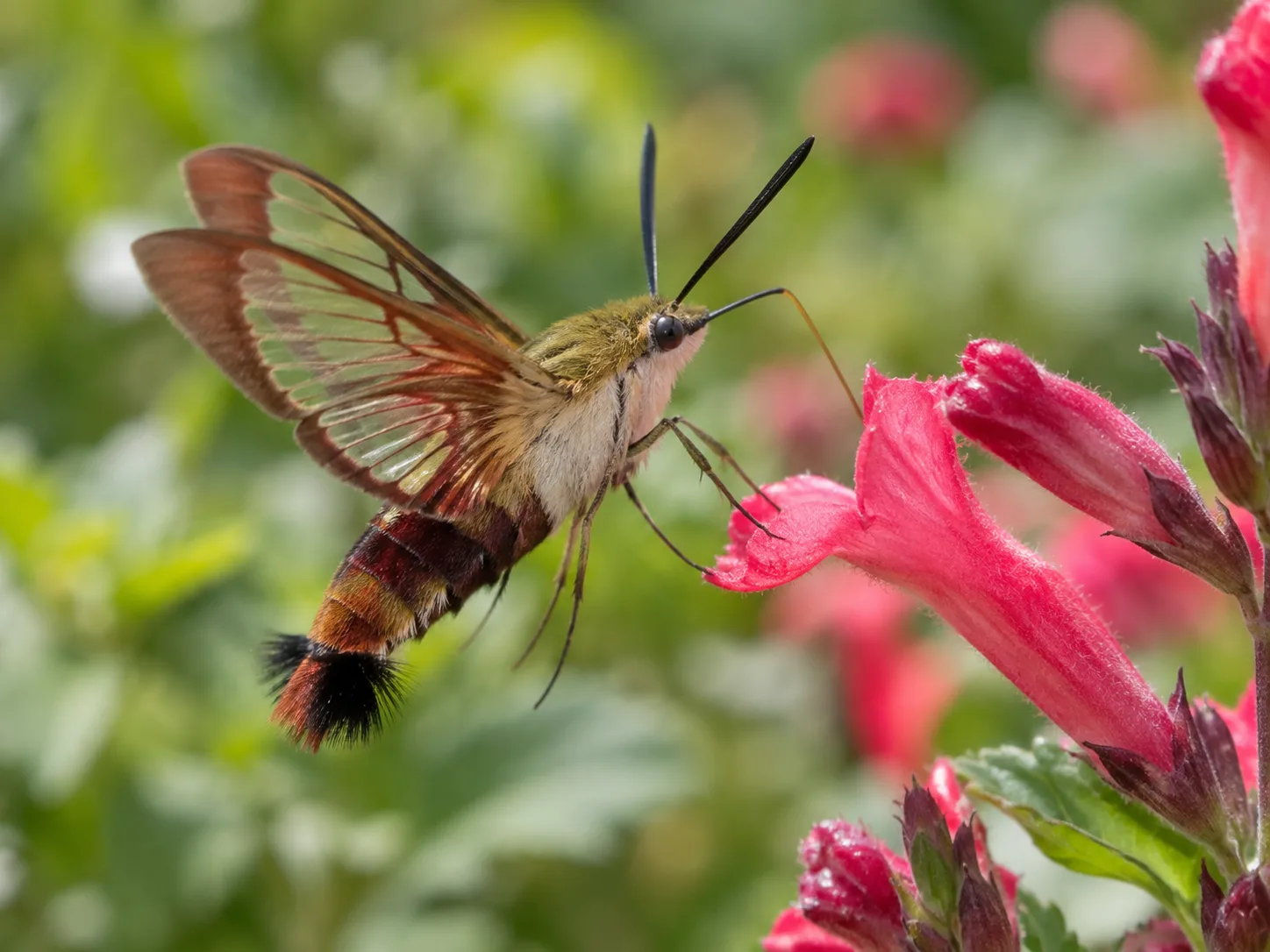
Color is useful only after you know what kind of animal you are viewing. A hummingbird clearwing, Hemaris thysbe, commonly has an olive green, tan, or yellowish fuzzy thorax, a reddish-brown banded abdomen, pale legs, and a dark-edged clear wing. The pattern can vary with light, wear, sex, and the individual moth.
A hummingbird can also show a colored throat, back, or tail, but its feathers have a different texture and its tail is a feather fan that can open, close, or pump while the bird hovers. The moth’s abdomen ends in a short, fuzzy tail-like fan that does not move with the same controlled rhythm. Look for texture and movement together, not a single red or brown patch.
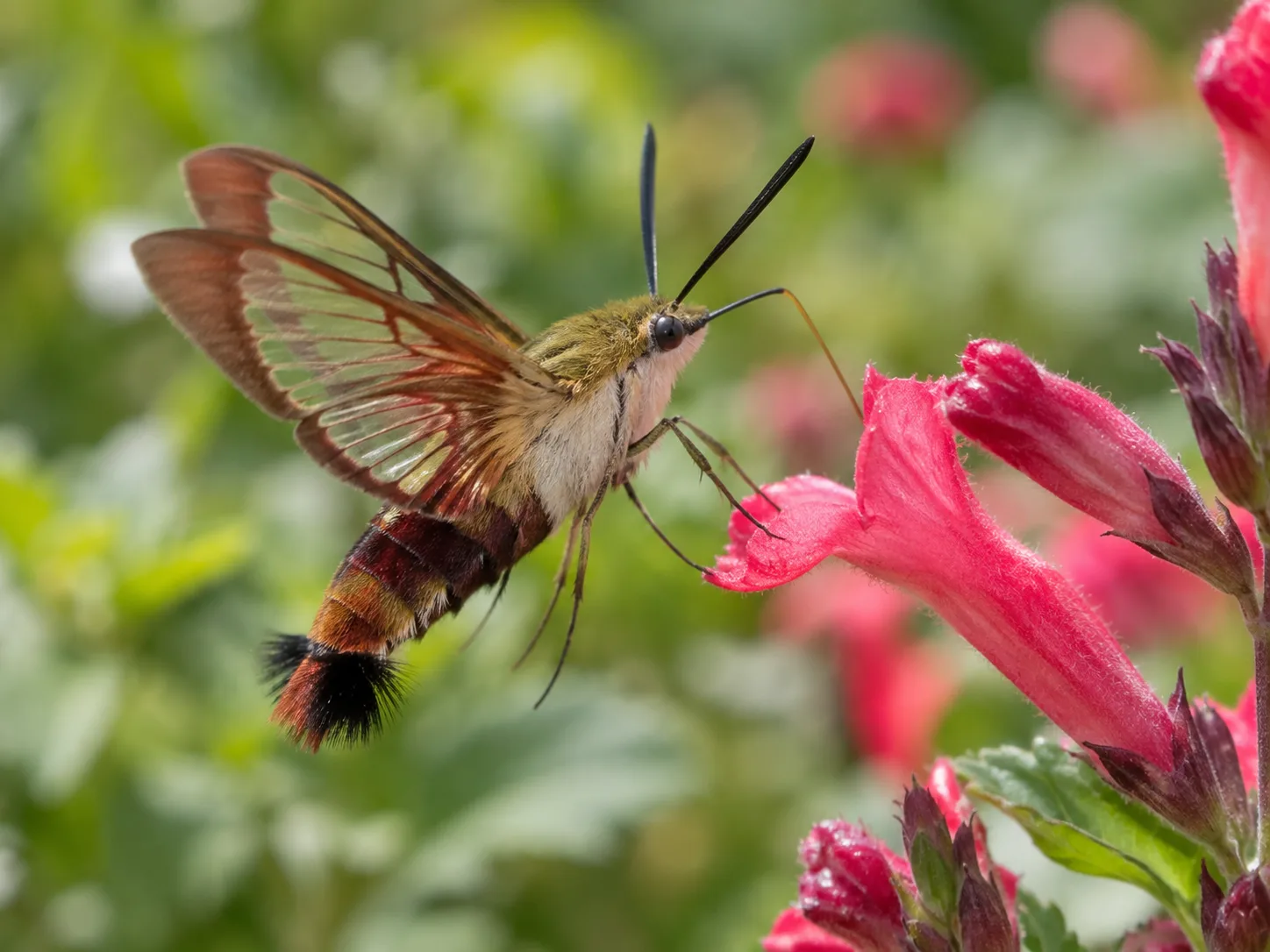
A close view makes the insect anatomy easier to read: antennae at the head, a curled proboscis, dangling legs, and transparent wing panels with a dark border.
Hummingbird moth or bumblebee?
The snowberry clearwing, Hemaris diffinis, is frequently confused with a bumblebee because it has a bold black-and-yellow body. It can also hover and buzz, so color and sound are poor ways to separate the two. NC State Extension notes that Hemaris moths can look like stinging insects but are harmless.
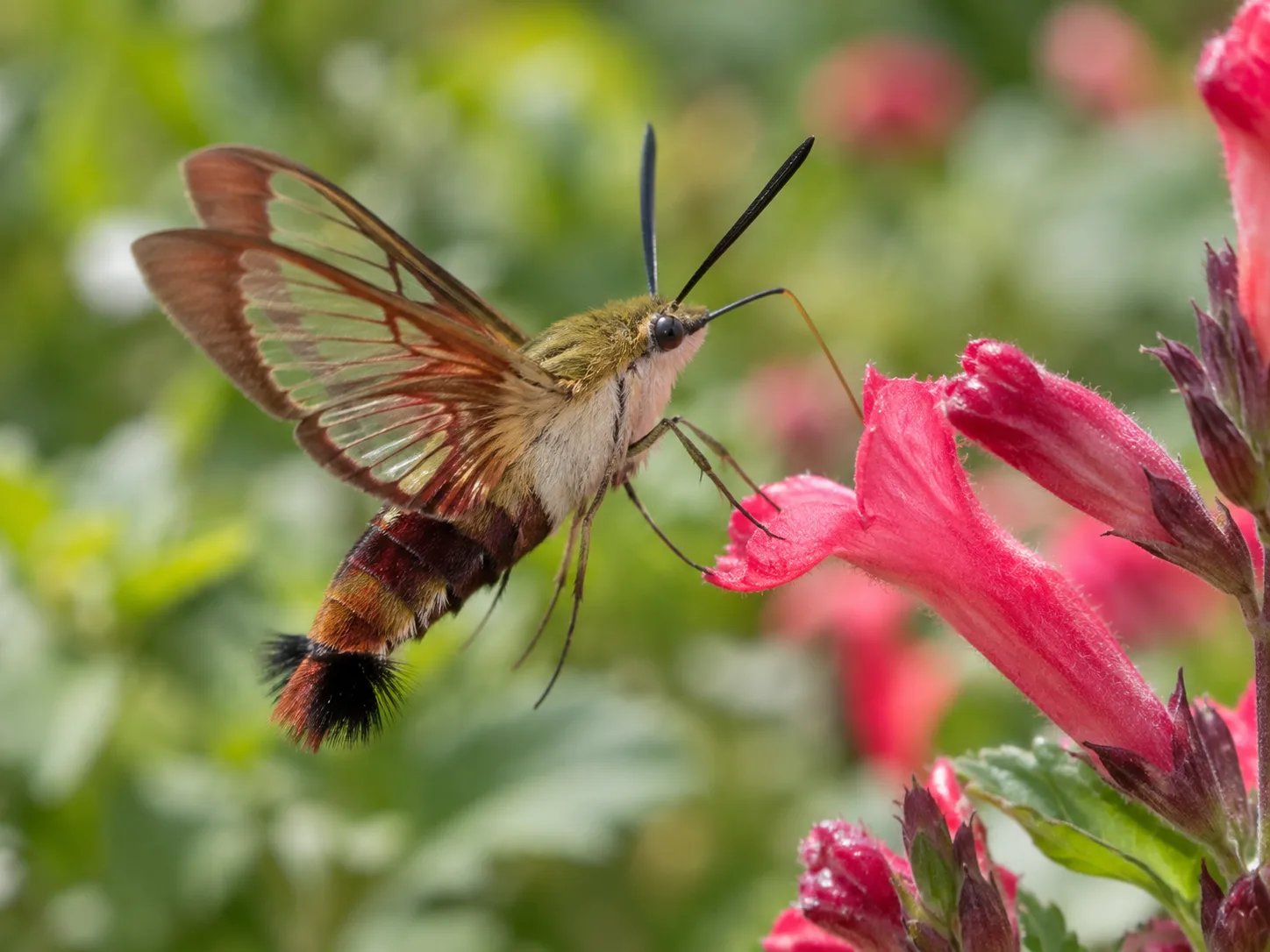
Look for a moth’s long, straw-like proboscis reaching into a deep flower and the clean, rapid hover from bloom to bloom. A bumblebee usually has a rounder, denser-looking body and may land on the flower while it works; it also carries pollen on its body or legs. Bees have antennae and six legs too, so those clues alone do not separate a bee from a moth.
Wing texture helps. Clearwing moths show transparent panels and a dark border, while a bumblebee’s wings are a separate, much smaller pair that usually looks clear only as it beats. If the visitor is too fast to inspect, record several seconds of video and look for the mouthpart and wing outline afterward rather than relying on the first impression.
Know the main kinds you may encounter
There is no single universal “hummingbird moth” appearance. Gardeners use the name for multiple sphinx moths, and the species available to you depend on geography, season, host plants, and habitat. Treat the names below as a narrowing guide, not a substitute for a regional insect key.
Hummingbird clearwing
The hummingbird clearwing, Hemaris thysbe, is the classic bird-like visitor in much of eastern North America. Wisconsin Horticulture describes it as a fairly common moth in the eastern United States and Canada, with a furry greenish-yellow or tan body, a wide reddish-brown abdominal band, and a wingspan around 1.5 to 2.25 inches.
It often visits flowers in daylight and stays only briefly at each bloom. It may use bee balm, petunia, verbena, butterfly bush, butterfly weed, purple coneflower, Joe-Pye weed, and other nectar-rich flowers, but the exact flower list changes with the local garden and what is in bloom.
Snowberry clearwing
The snowberry clearwing, Hemaris diffinis, tends to look more like a bumblebee than a tiny bird. It is usually yellow and black, has black legs, and may show a dark line through the eyes and along the sides. Mass Audubon’s species notes use those color and leg differences to distinguish it from the olive-and-red-brown hummingbird clearwing.
Its adult appearance is only half of the story. The caterpillar uses different host plants, including snowberry, honeysuckle, viburnum, hawthorn, cherry, and plum in the regional accounts cited by Mass Audubon and extension sources. Finding a black-and-yellow adult near one of those shrubs is helpful context, but it still does not replace an anatomical look.
White-lined sphinx and other hawkmoths
The white-lined sphinx, Hyles lineata, is a larger and more heavily scaled hawkmoth that can also hover while feeding. Colorado State University Extension calls it the most commonly encountered “hummingbird moth” in Colorado and notes that it is especially active in the late afternoon and at dusk there. Wisconsin Horticulture distinguishes it from Hemaris by its larger size, fully scaled wings, and greater tendency toward dusk activity.
That regional difference matters. A day-flying clearwing in a northeastern garden and a dusk-flying white-lined sphinx in the Mountain West may both be called hummingbird moths, even though they are not the same genus. Colorado State University Extension documents that regional pattern for the white-lined sphinx. When the insect does not match a clearwing, record the location, date, time, wing markings, and the flower it visited before searching for a species name.
Use habitat, timing, and flowers as supporting clues
Habitat can make an identification more plausible. Mass Audubon reports hummingbird moths in open meadows, forest edges, and suburban gardens, while extension sources describe them visiting a wide range of flowering perennials. A visitor in a sunny flower bed is not automatically a moth, but a hovering, fuzzy insect in that setting fits the pattern.
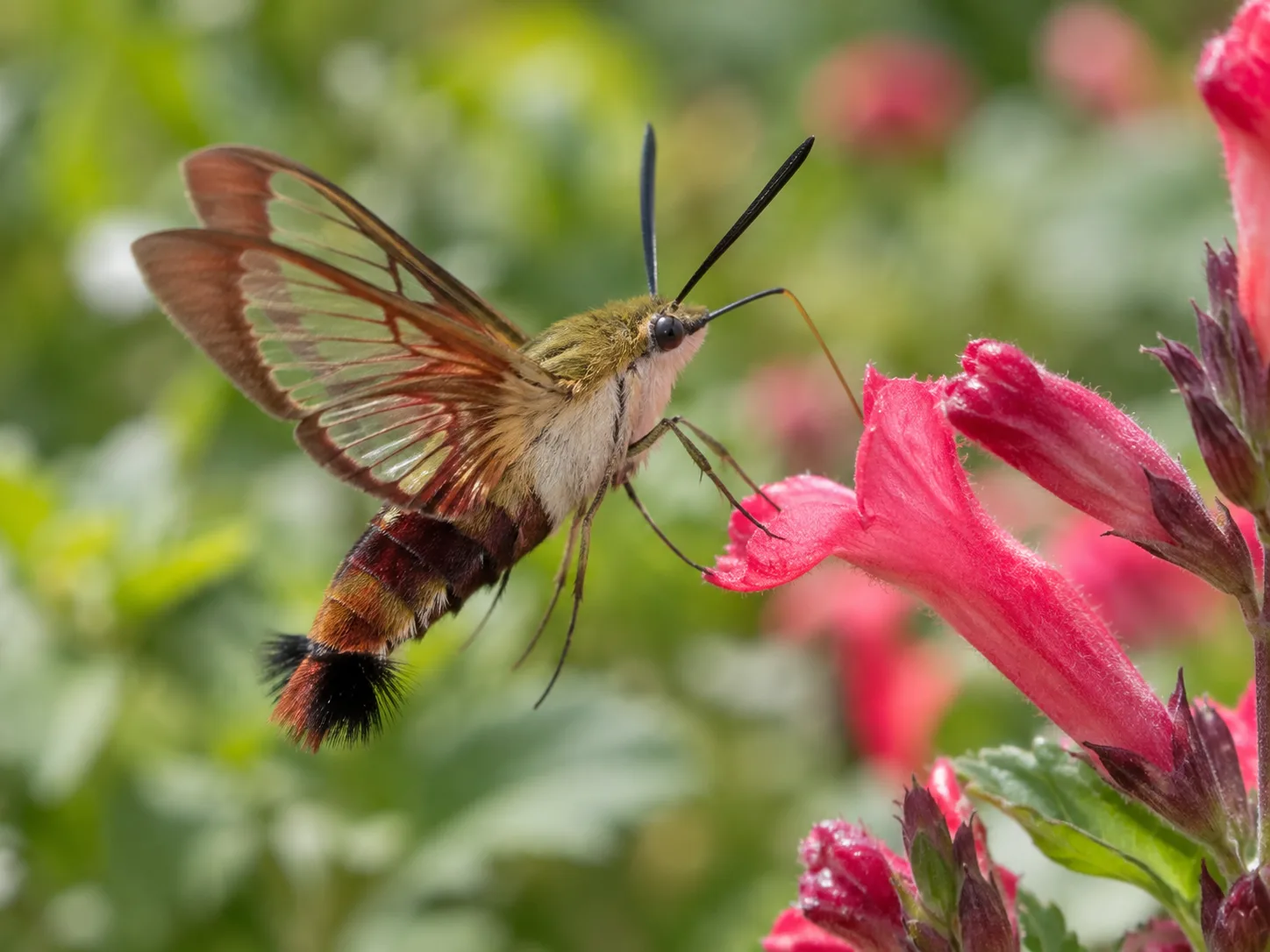
Time of day helps you narrow the group. Hemaris clearwings are unusual among moths because they commonly fly in daylight, while some other sphinx moths are most active at dusk or after dark. The University of Minnesota Extension lists Hemaris thysbe and H. diffinis visiting perennials during the day, but Colorado State’s account of the white-lined sphinx emphasizes late afternoon and dusk. Use the clock as a filter, not a final verdict.
Flower choice can be useful in the same way. Hummingbird moths often seek tubular flowers that allow a long proboscis to reach nectar. Birds & Blooms highlights coral honeysuckle and bee balm as favorites for hummingbird clearwings, while Gardening Know How recommends a succession of nectar plants such as bee balm, coneflower, honeysuckle, liatris, petunia, verbena, and zinnia so flowers remain available through the growing season.
A continuous nectar garden creates more chances to observe a visitor, but the flower it chooses is supporting evidence rather than a species label.
Do not confuse adult nectar plants with caterpillar host plants. Adults drink from flowers, but females lay eggs on particular plants that their larvae can eat. A garden can attract adults with nectar while the caterpillars develop quietly on viburnum, honeysuckle, snowberry, blueberry, cherry, plum, or other locally suitable hosts.
If you find a caterpillar, identify the host plant too
Hummingbird moth caterpillars are sphinx-moth larvae, commonly called hornworms because many have a tail horn. The horn is not a stinger. Mature larvae may be plump and green, yellowish green, or brown, and their markings and host plants vary by species.
This is where gardeners most often make a costly assumption. Seeing a hornworm does not automatically mean you found a tomato hornworm. NC State Extension lists dogbane, snowberry, honeysuckle, and dwarf bush honeysuckle for the Hemaris larvae it discusses, while Mass Audubon includes viburnum, honeysuckle, blueberries, and members of the rose family in its regional life-cycle account.
Observe the plant before deciding what to do. A caterpillar on viburnum or honeysuckle may be part of a native moth’s life cycle; a large green caterpillar stripping a tomato or pepper needs a different identification and management decision. Photograph the larva, its markings, the host plant, and the surrounding leaves, then compare the record with a local extension guide.
After feeding, many sphinx-moth larvae leave the plant and pupate in leaf litter or loose soil. NC State Extension notes that Hemaris caterpillars form cocoons in leaf litter or soil, and Wisconsin Horticulture describes thin brown cocoons under leaf litter. Removing every fallen leaf or applying an insecticide on sight can eliminate the next generation before you know what it was.
Should you protect or remove a hummingbird moth?
Adult hummingbird moths do not sting or bite people. Their proboscis is a nectar-feeding structure, not a defensive needle, and the adults are valuable pollinators. Mass Audubon emphasizes their importance for deep flowers, including blooms that may be visited during twilight when other pollinators are less active.
For an adult moth, the best action is usually no action: let it feed, avoid spraying the flowers, and keep a varied supply of blooms open. Broad-spectrum insecticides can harm many beneficial insects at once, including moths and their caterpillars. If a pest-control decision is necessary, identify the larva and read the product label or consult a local extension service such as NC State Extension instead of treating a whole garden on the basis of a fast adult sighting.
There is a reasonable exception for prized plants. If you confirm that a caterpillar is feeding heavily on a crop, you can hand-pick it or move it only when you know the species and have a suitable host plant available. Do not relocate an unidentified larva to a random shrub, and do not assume that every hornworm belongs in a vegetable bed or that every one is a harmful species.
The most helpful habitat changes are simple: grow nectar plants suited to your region, keep flowers coming across the season, retain some host plants, and leave a small amount of leaf litter where it will not create a plant-disease problem. Gardening Know How recommends extending bloom with a mix of annuals and perennials, while also warning readers to check that any chosen native or ornamental plant is appropriate and not invasive locally.
Use this 30-second field checklist
When the visitor is gone, write down what you actually observed rather than what you think you saw. This keeps a dramatic first impression from becoming a false species identification.
- Watch the flight. Did the animal hover in place, dart between flowers, land, or work only at dusk?
- Find the head. Can you see two antennae, or only a smooth bird head with a bill?
- Inspect the underside. Are multiple legs dangling, or are two small feet tucked close to a bird’s body?
- Check the mouthpart. Did a flexible tube enter the flower and curl afterward, or did a firm bill remain straight?
- Look at the wings. Are there transparent panels and a dark border, two wing pairs, or one opaque feathered pair?
- Estimate scale. Compare the visitor with the flower, but remember that some hawkmoths are much larger than Hemaris clearwings.
- Record context. Note the flower, nearby shrubs, habitat, date, temperature, and exact time.
- Use a photograph carefully. Take a still image or short video from a distance. Do not catch, pin, chill, or handle the insect just to get a closer look.
If the image is blurry, report the identification at the right level: “a hummingbird moth,” “a clearwing moth,” or “a likely Hemaris” may be more accurate than naming a species. A local extension office, natural-history group, or regional moth guide can make the final call when the markings matter.
Conclusion
Identify a hummingbird moth by combining the clues that a hummingbird cannot share: antennae, six legs, two pairs of wings, a fuzzy body, and a coiling proboscis. Then use size, wing transparency, body bands, time of day, flower choice, and habitat to narrow the possibilities without treating a common name as a precise species label.
The most useful garden response is observation and habitat, not alarm. Let adults feed, protect a succession of nectar flowers, retain appropriate host plants, and identify a caterpillar before removing it. Once you learn to look for anatomy instead of the illusion of flight, that “tiny hummingbird” becomes an easier and more interesting moth to recognize.



