Tomato Stakes vs. Cages: A Practical Guide
Learn when to stake or cage tomatoes, how to anchor each support, and why determinate, indeterminate, container, and row-grown plants need different plans.
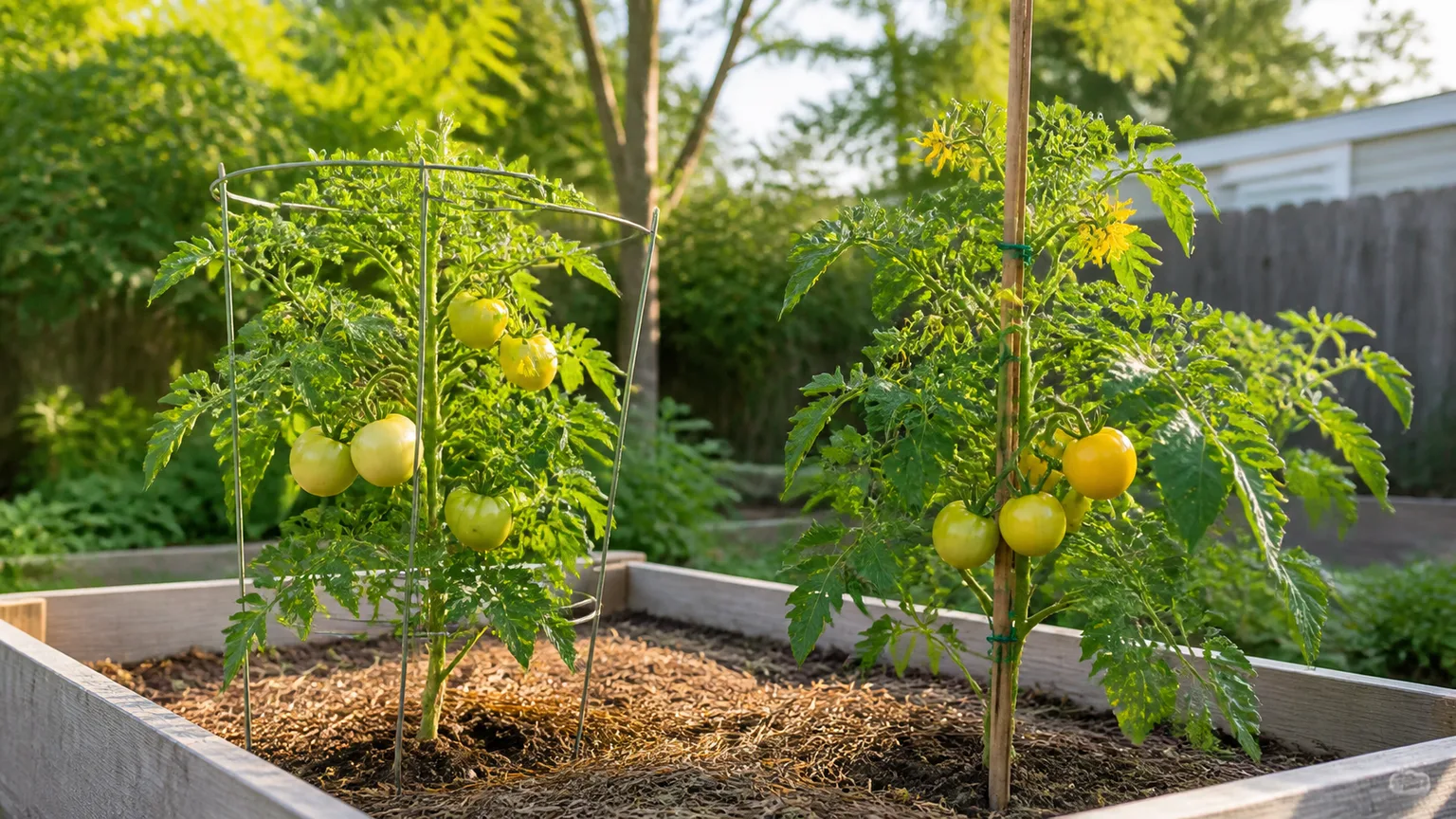
For most gardeners growing tomatoes in the ground, a sturdy, anchored cage is the better default—especially if you want to let the plant keep several branches and do only light pruning. A cage spreads support around the canopy, keeps fruit off the soil, and reduces the number of ties you need to make during the season.
A stake is better when space is narrow, the plant is in a container, or you plan to prune an indeterminate tomato to one or two leaders. It gives precise control, but that control comes with regular tying and pruning. If you are growing several plants in a row, the Florida weave can be more efficient than either individual cages or one stake per plant.
The important qualification is the word sturdy. A short, flimsy cone cage is not the same tool as a heavy wire cage with wide openings and reliable anchors. The right answer depends on the tomato’s growth habit, the fruit load, your available space, and how often you are willing to walk the row.
The quick verdict: choose the support you will maintain
Use this table as a starting point, then check the plant label. “Determinate” and “indeterminate” describe growth and fruiting behavior, not a universal rule that every plant must use one particular support.
| Your situation | Best first choice | Why |
|---|---|---|
| Bushy determinate tomato in an in-ground bed | Short, sturdy cage | Holds several branches with little tying and protects a heavy crop from tipping. |
| Large indeterminate tomato with many leaders | Tall, heavy-duty cage or trellis | Supports a broad canopy without forcing every branch into one line. |
| Indeterminate tomato pruned to one leader | Tall stake, string, or trellis | Fits a narrow footprint, but requires repeated ties and close pruning. |
| Tomato in a container | Strong stake or compact cage | A full-size cage may be too wide; the pot and support must act as one stable unit. |
| Several tomatoes planted in a row | Florida weave | Shared stakes and horizontal string support multiple plants efficiently. |
| Exposed, windy garden | Anchored cage, double stakes, or a rigid row system | The anchor matters as much as the visible support. |
If you want one practical answer for a typical raised bed and do not yet know how aggressively you will prune, buy or build a large-gauge cage that can be anchored. If your garden is small or your plants are in pots, choose a stake early and accept the maintenance it demands. University of Georgia Cooperative Extension describes support as a way to keep plants off the ground and says the structure should be durable, weather-resistant, and able to last through the growing season (UGA Extension’s tomato staking and pruning guide).
Why tomato plants need support in the first place
Tomato stems can look rigid when a plant is young, but the plant’s architecture changes quickly once branches, leaves, and fruit accumulate. The support is carrying more than the main stem: it also has to keep side branches from bending into the soil and stop a top-heavy plant from levering itself out of the ground during wind or rain.
Keeping foliage and fruit above the soil improves access for watering, harvesting, and inspection. It also helps reduce soil splashing onto lower leaves. Support alone does not prevent early blight, leaf spot, or other problems, but it works with spacing, mulch, soil-level watering, and removal of diseased tissue to create a drier, easier-to-manage canopy. Cornell Cooperative Extension specifically lists staking and caging among the practices that improve airflow and help keep tomato foliage dry (Cornell Cooperative Extension’s growing-tomatoes guidance).
Support also saves bed space, but vertical does not automatically mean crowded. A plant trained tightly against one stake can occupy less horizontal room, while a freely growing caged plant needs a wider footprint. If your spacing is already tight, choose a support system and pruning plan together; do not install a narrow stake and then allow every sucker to become a full-weight branch.
Identify your tomato’s growth habit before you buy support
The variety label is more reliable than the fruit size or the plant’s appearance at the garden center. A cherry tomato can be determinate or indeterminate, and an heirloom is often indeterminate but not always. Gardening Know How summarizes the practical distinction: indeterminate tomatoes keep growing and fruiting until frost or another limiting condition, while determinate plants stop at a set size and produce most of their crop in a shorter window (Gardening Know How’s determinate-versus-indeterminate guide).
Determinate tomatoes
Determinate, or bush, tomatoes stay comparatively compact and set much of their crop over a concentrated period. They are common choices for containers, short growing seasons, and gardeners who want many tomatoes ready for sauce or preserving at roughly the same time. Their stems can still splay or tip when fruit loads build, so “determinate” does not mean “support never needed.”
A modest cage is usually the easiest fit. Put it in place when you plant, allow the branches to fill the interior, and remove only lower growth that touches the soil or clearly obstructs airflow. Heavy pruning can remove the foliage that shades fruit and reduce the plant’s productive surface; if a determinate plant is already bushy, support it rather than trying to turn it into a single vine.
Indeterminate tomatoes
Indeterminate tomatoes are vining plants that continue making new leaves, flowers, and fruit while conditions remain favorable. They include many beefsteaks, heirlooms, and cherry tomatoes, but the label—not the fruit category—should decide the support. Without a strong structure, the main stems eventually sprawl, bend, or snap under their own weight.
Choose a tall cage, trellis, Florida weave, or stake system based on how many leaders you intend to keep. A cage gives an indeterminate plant room to branch and is forgiving if you miss a week of maintenance. A single stake can work beautifully when you deliberately train one leader, but it is a high-attention system rather than a set-it-and-forget-it solution.
Semi-determinate plants and uncertain labels
Semi-determinate or dwarf varieties sit between the two habits. They may stay shorter than a conventional indeterminate but still produce enough branches and fruit to overwhelm a tiny cone cage or a flimsy garden stake. Treat an unlabeled plant as potentially vigorous until you confirm its mature height from the seed packet, nursery tag, or breeder’s description.
When the label is missing, look for clues without treating them as proof. A plant advertised as “bush,” “patio,” or “compact” is more likely to suit a small cage; “vining,” “cordon,” or a mature height above about 4 feet signals that the support needs more height and anchoring. If you still cannot tell, choose the stronger support and leave room for growth.
When a tomato cage is the better choice
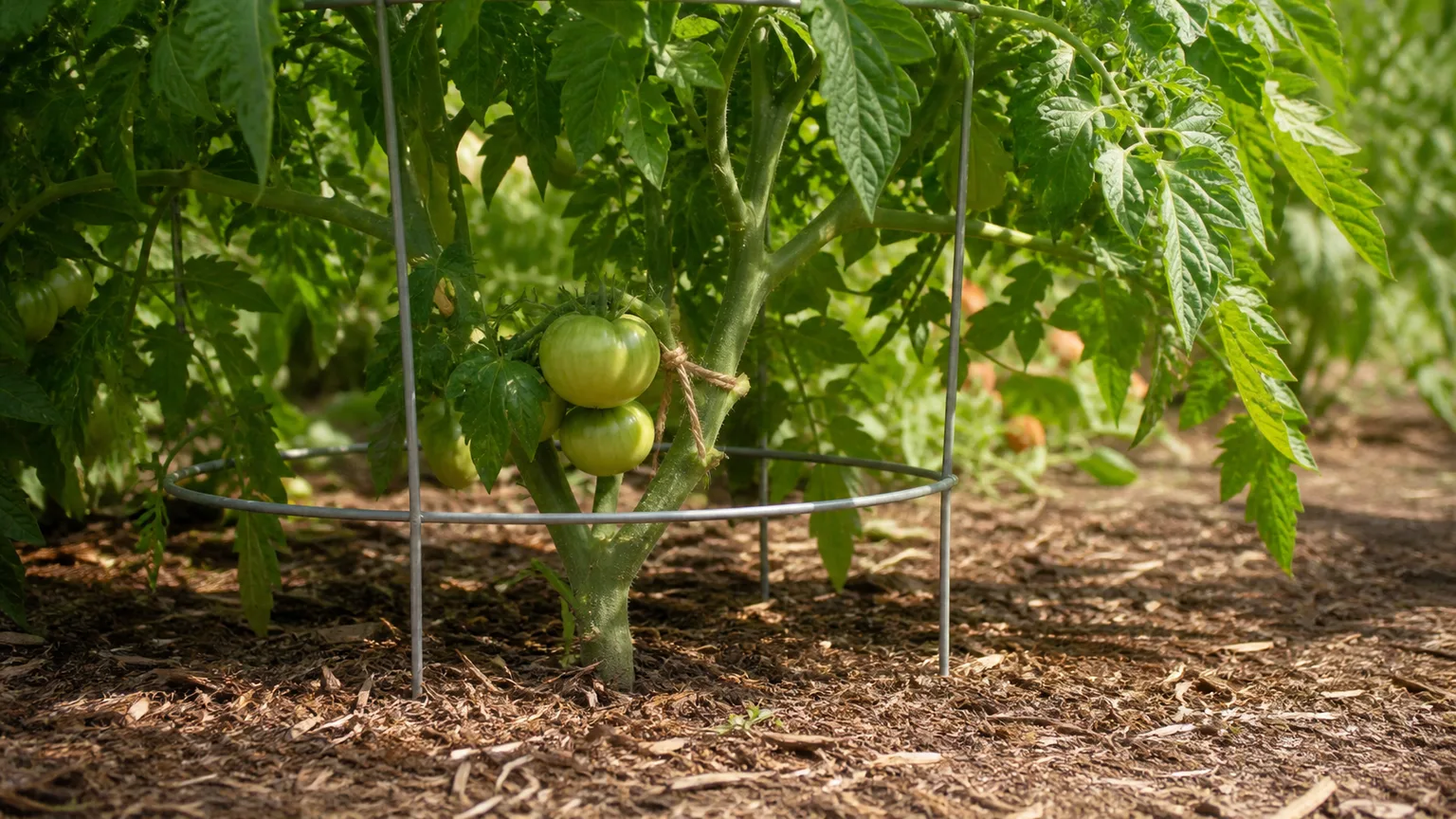
Caging is the best match for gardeners who want a broad plant with several productive branches and minimal tying. The plant does not actually climb or cling by itself; branches grow through and around the wire, and you guide wayward stems back inside when they begin to hang out. That small amount of tucking is usually easier than chasing a new stem with a tie every few days.
The cage also distributes pressure. Instead of one tie carrying the weight of a long branch, several sides of the structure catch branches at different heights. This is especially useful for determinate plants with a dense canopy and for indeterminate varieties that you are allowing to grow with multiple leaders. Better Homes & Gardens makes the same practical distinction: heavy-duty cages are nearly maintenance-free compared with the repeated tying required by a staked, vigorously growing plant (BHG’s tomato cage and stake comparison).
What makes a cage sturdy enough
Do not judge a cage by its shape in the package. Judge it by the wire gauge, opening size, height, width, and whether the legs can be anchored in your soil. The small cone-shaped cages sold in many garden centers may be adequate for a compact patio tomato, but they often buckle or tip once a vigorous plant reaches the top.
For a durable cage, look for or build:
- Heavy-gauge metal wire that does not flex easily when you push against it.
- Openings around 4 to 6 inches wide, large enough to reach through for harvest without trapping a branch.
- Enough diameter for the plant’s habit. UGA Extension recommends a minimum diameter of about 3 feet for a strong homemade cage; a compact determinate plant can use less, while a vigorous indeterminate may need more.
- Enough height for the variety. A 4- to 5-foot cage may suit many plants, but an indeterminate variety that will grow taller needs a taller structure or a plan to lower, prune, or trellis it.
- A way to add anchors. A cage loaded with wet foliage is a sail in a storm, even if the wire itself is strong.
Galvanized livestock fencing with wide woven squares and concrete reinforcement wire are durable DIY choices. Cut wire only with appropriate tools, bend or cap sharp ends away from harvest paths, and place the finished cage where you can reach fruit from both sides if the bed allows.
How to install and anchor a cage
Install the cage at transplanting time, before roots and branches occupy the space around the plant. Late installation forces you to push wire through foliage, bend stems, or drive legs close to the root ball. If the plant is already large, work slowly around the outside and use a temporary stake to hold leaning stems while you fit the permanent support.
Push every leg firmly into the soil, then test the cage with a gentle side-to-side motion. If it rocks in loose soil, add two stakes on opposite sides and tie the cage to them. In raised beds, secure the stakes deep enough to reach stable soil rather than relying only on the shallow top layer. Recheck after heavy rain because saturated soil reduces holding power.
As the plant grows, tuck branches inward and upward rather than bending a stiff branch sharply. Keep the lower fruit clusters from resting on mulch or soil, but do not strip the interior of leaves simply to make the cage look tidy. A green canopy protects fruit from intense sun and continues to support photosynthesis.
When a stake is the better choice
Staking wins when you need a narrow footprint, precise training, or a support that fits a container. It is also useful when the variety is compact enough that one central support can carry the main stem and a few side branches. The trade-off is straightforward: the fewer surfaces the plant has to lean on, the more often you must decide where each new stem belongs.
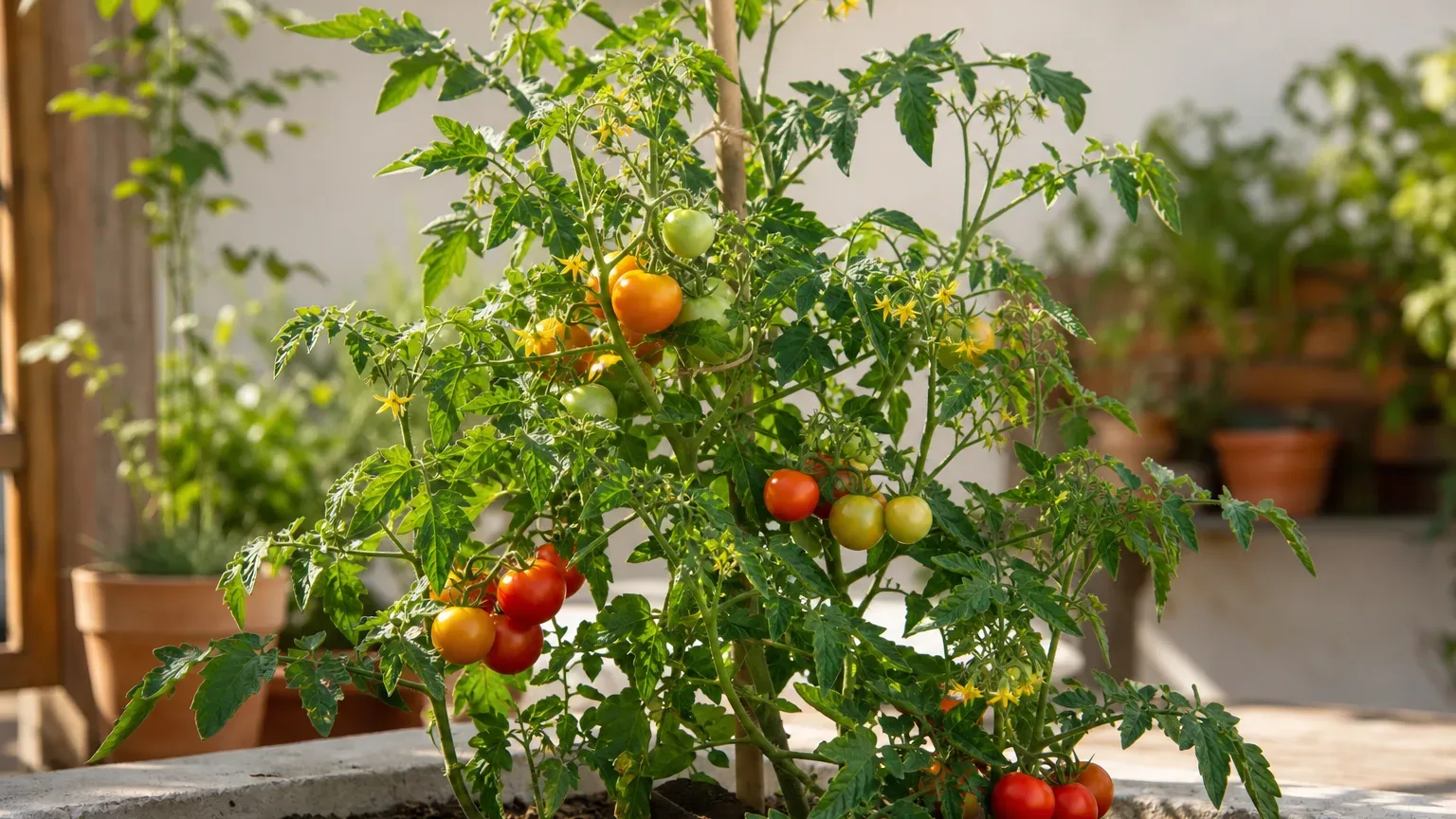
Single-stake training is most predictable when you keep one main leader, or at most two, and remove unwanted suckers while they are small. An indeterminate plant trained this way can grow very tall, so the stake must extend high enough above the soil to support the intended mature height. If the only stake is 3 feet tall, do not expect it to manage a 7-foot vine without a midseason failure.
Single and double stakes
A single stake sits close to the plant and supports the main stem. UGA Extension recommends driving a stake about 6 to 12 inches into the soil, beginning ties when the plant is roughly 10 to 12 inches tall, and adding ties about every 8 inches along the main trunk. Those measurements are useful starting points, not a reason to force a rigid schedule in rocky, sandy, or unusually loose soil.
Use a second stake when a plant is broad, the site is windy, or you are keeping two leaders. Place the stakes on opposite sides of the plant and distribute ties so no one point carries the entire fruit load. In a pot, be careful not to drive a long stake through the root ball after planting; install it at planting or use a support that attaches to the container or nearby frame.
Wood, bamboo, plastic, and metal can all work if the support stays rigid through wet weather. A metal T-post or other durable stake lasts for several seasons, while a thin bamboo cane may suit a small determinate plant but flex under a large cherry or beefsteak crop. Match the material to the plant’s mature weight, not its nursery size.
How to tie a tomato without girdling the stem
Use soft garden twine, fabric strips, or a flexible tomato clip. Make a loose figure-eight: one loop around the stake, one loop around the stem, with the crossing between them. The crossing keeps the stem from rubbing directly on the support, and the looseness leaves room for the stem to thicken.
Tie below a fruit cluster or along a strong section of stem rather than around a delicate leaf stalk. Leave enough slack that you can slide a finger between tie and stem, then inspect each tie whenever you pass the plant. A tie that was safe in May can constrict the stem by July.
Keep ties supporting the stem, not pulling a heavy fruit cluster sideways. If a branch wants to grow away from the stake, add a second tie farther up or reconsider whether you are trying to keep too many leaders on a single support. Staking is a training system; it is not a way to make a naturally broad plant occupy a single line without consequences.
The Florida weave: a row-friendly middle ground
The Florida weave uses stakes and horizontal string to support a row of tomatoes as a group. It is a strong choice when several plants share one bed and you want less material and less individual tying than a one-stake-per-plant system. It is not a good substitute for a cage around one isolated container plant because it depends on the row’s end and intermediate posts.
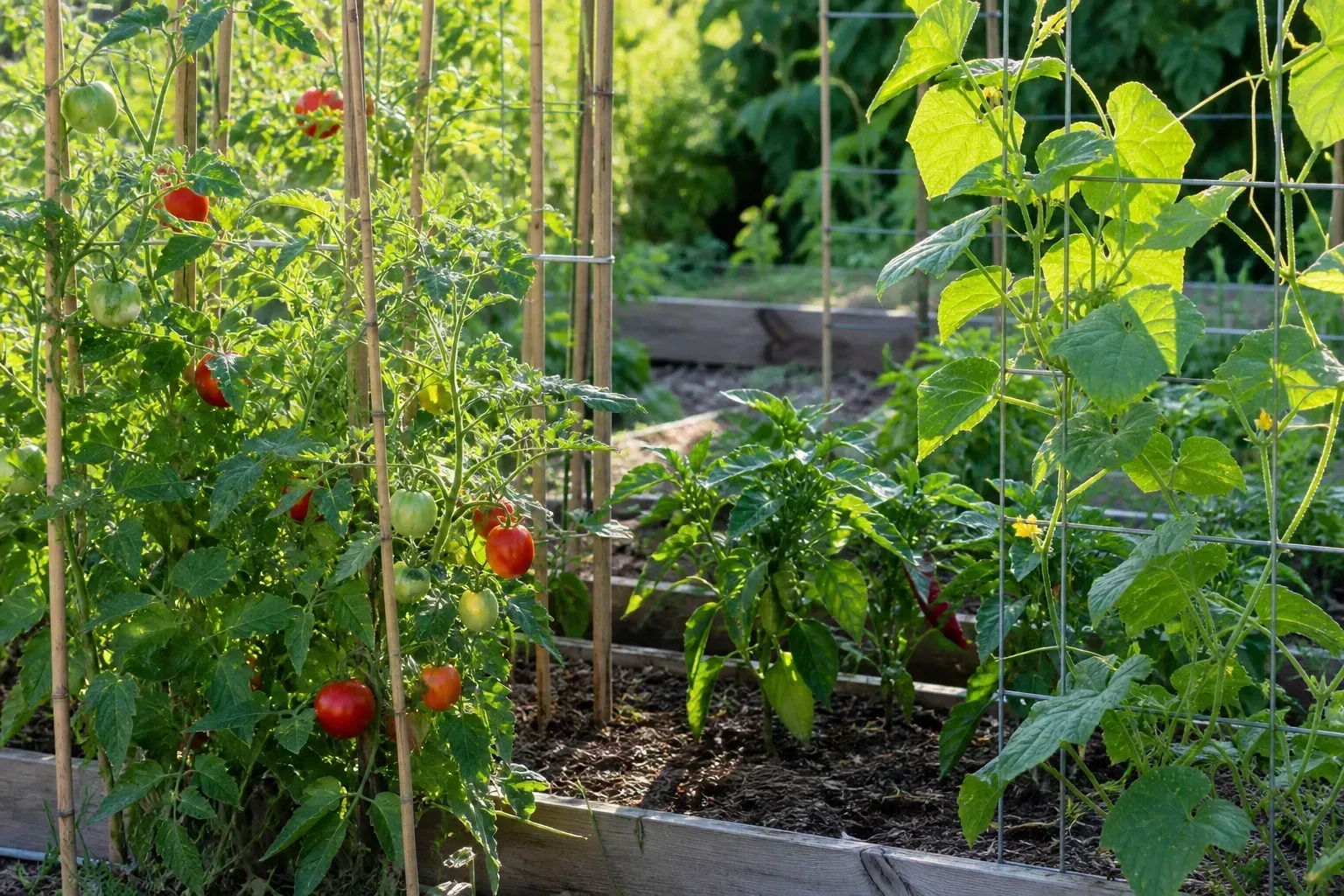
Set sturdy stakes at both ends of the row and between every few plants, with closer spacing if the row is long, exposed, or carrying vigorous varieties. Tie durable string to an end post, weave it in and out between the plants, and loop it around each intermediate stake so the line stays tight. Add a matching run of string on the other side of the plants, then repeat higher up as the canopy rises. UGA Extension describes the method as a series of woven string levels between securely placed stakes (UGA’s Florida weave instructions); Homestead & Chill notes that the system can support determinate, semi-determinate, and indeterminate tomatoes while using less horizontal space than individual cages (Homestead & Chill’s tomato support methods).
The weave gives side branches a place to rest, so you can keep more than one leader without tying every branch individually. You still need to guide stems between the strings, tighten or add levels as plants grow, and check the end posts after wind. If one plant leans, the weakness can spread along the row; repair the post or string before the fruit load increases.
Staking and caging in containers and raised beds
Containers change the problem because the root zone and the support share one small, movable footprint. A tall plant can turn a lightweight pot into a lever and tip the whole container, even when the stake itself is strong. Choose a heavy, stable container with drainage, place the support at planting time, and avoid a top-heavy combination that cannot withstand watering, wind, and harvest movement.
For a determinate patio tomato, a compact cage may provide enough support with little work. For a vining tomato in a pot, a sturdy stake, trellis fixed to a wall or frame, or overhead string system may be more practical than a wide cage. Keep the support outside the root ball when possible, and secure the pot or frame if the site is exposed.
Raised beds give you better soil access but not automatically better anchoring. A cage leg or stake driven only into a loose compost-rich top layer can pull out when the soil is wet. Push supports into firm soil below the amended layer, use longer stakes, or attach the support to the bed frame if that construction is strong enough to take the load without splitting.
Spacing still matters. A cage needs room around the plant for its branches and for your hands to harvest; a staked single leader can be closer, but only if you are actually pruning and training it. Crowding plants until leaves touch creates a humid canopy that no support style can fully correct. Cornell’s guidance pairs staking or caging with proper spacing, mulch, soil-level watering, and crop rotation for disease management (Cornell’s tomato disease-prevention practices).
How pruning changes the support decision
Support and pruning are linked because every leader becomes another stem that must be held upright. A caged tomato can usually keep more suckers and side branches; the wire catches the expanding canopy. A staked tomato trained to one leader needs more deliberate sucker removal because one narrow support cannot safely carry a sprawling, multi-leader plant.
Do not treat pruning as an automatic way to increase yield. Removing some lower growth that touches soil and taking out damaged or diseased tissue is a sensible maintenance baseline. Beyond that, the choice is a trade-off: fewer leaders can make a plant easier to tie and may improve access and airflow, while more foliage can mean more fruiting sites and better shade for ripening tomatoes.
Determinate plants deserve special restraint. Their crop is concentrated, and severe sucker removal can reduce the plant’s productive area. A light cleanup below the first flower cluster or near the soil may be reasonable for your variety, but do not force a bush tomato into a single-leader staking style simply because the stake looks neater.
Indeterminate plants give you more room to choose. You can keep one leader for a tall stake, two or three leaders for a stronger trellis, or several leaders inside a large cage. Remove suckers when they are small, leave enough healthy foliage to shade fruit, and never confuse a flower cluster with a sucker. If a branch is already large and supporting fruit, cut it only when you have a clear reason and a plan for the weight it was carrying.
Avoid these tomato-support failures
Most support disasters are installation or maintenance problems rather than evidence that cages or stakes do not work.
- Waiting until the plant flops. A bent stem is harder to reposition without cracking. Install support at planting or as soon as you identify the variety, then add ties or levels before branches become heavy.
- Buying the smallest cage. A narrow cone can be fine for a compact patio tomato but will not carry a vigorous indeterminate plant. Size the cage for mature width and height, not the transplant.
- Leaving the support unanchored. A full canopy catches wind. Add stakes to a cage, secure a row system at its posts, and recheck after storms or heavy rain.
- Driving a stake into an established root ball. Late support can damage roots. Place the stake at planting, or set it just outside the root zone and use soft ties to draw the plant over gradually.
- Tying too tightly. Rigid wire, thin string, and tight loops can rub or girdle the stem as it expands. Use soft material and inspect ties weekly.
- Pruning the support plan out of existence. Stripping too much foliage can expose fruit to sunscald and reduce the plant’s ability to produce energy. Remove what is touching soil, diseased, damaged, or genuinely obstructive rather than chasing a perfectly bare stem.
- Ignoring dirty supports. Old cages, stakes, and clips can carry plant debris and pathogens. At the end of the season, remove vines, brush off soil, and clean or disinfect reusable tools and supports before storing them.
If a plant is leaning, do not pull the top upright in one motion. Anchor the support first, then use loose ties at several points to move the stem over a few days. If the main stem has already split, support each healthy side separately and remove only tissue that is clearly broken or diseased.
A simple weekly routine through harvest
Walk the plants once a week, and more often during rapid growth or after a storm. Start at the soil line and work upward so you catch problems before the canopy hides them.
- Check the base: Are lower leaves or fruit touching soil? Is mulch splashing onto foliage? Remove contact points and replenish mulch without piling it against the stem.
- Check the support: Does the cage rock? Has a stake loosened? Are row strings sagging? Fix the structure before adding another tie.
- Check the growth: Tuck a cage branch inward, add a soft tie to a stake, or guide a leader between Florida-weave strings. Do not bend a rigid, fruit-laden branch sharply.
- Check the ties: Loosen or replace any tie touching the stem. Add support below heavy clusters rather than tying directly around the fruit truss.
- Check the canopy: Remove lower, diseased, or damaged tissue and keep healthy leaves that shade fruit. Avoid working through wet foliage when you can wait for it to dry.
- Check harvest access: Pick ripe fruit promptly and make sure your hand can reach through the cage openings without pulling branches.
Water at the soil line, keep moisture reasonably consistent, and avoid using support as an excuse to plant too closely. At season’s end, remove vines before they become a tangled, dried mass, then clean reusable cages, stakes, clips, and pruners. A few minutes of cleanup now makes next year’s support stronger and reduces the chance of carrying plant debris into a new crop.
Conclusion: the best support is the one sized for the plant
Choose a heavy-duty, anchored cage when you want a broad, productive plant with light maintenance, especially for determinate tomatoes and indeterminates with several leaders. Choose a stake when you need a narrow footprint, have a container, or are willing to prune and tie an indeterminate plant regularly. Choose a Florida weave when several tomatoes share a row and you want efficient group support.
Whichever system you use, install it early, size it for mature growth, anchor it against wind, and leave room for stems to expand. The support does not have to look perfect; it has to keep the plant and its fruit off the ground without creating a new problem. A cage that is strong enough, a stake that is tied loosely, or a weave that is checked every week will outperform a theoretically ideal system that the gardener cannot maintain.