Moss Pole vs Trellis for Climbing Houseplants
Decide moss pole vs trellis for Monstera and climbing aroids: aerial roots vs ties, moisture chores, bark boards, and install tips.
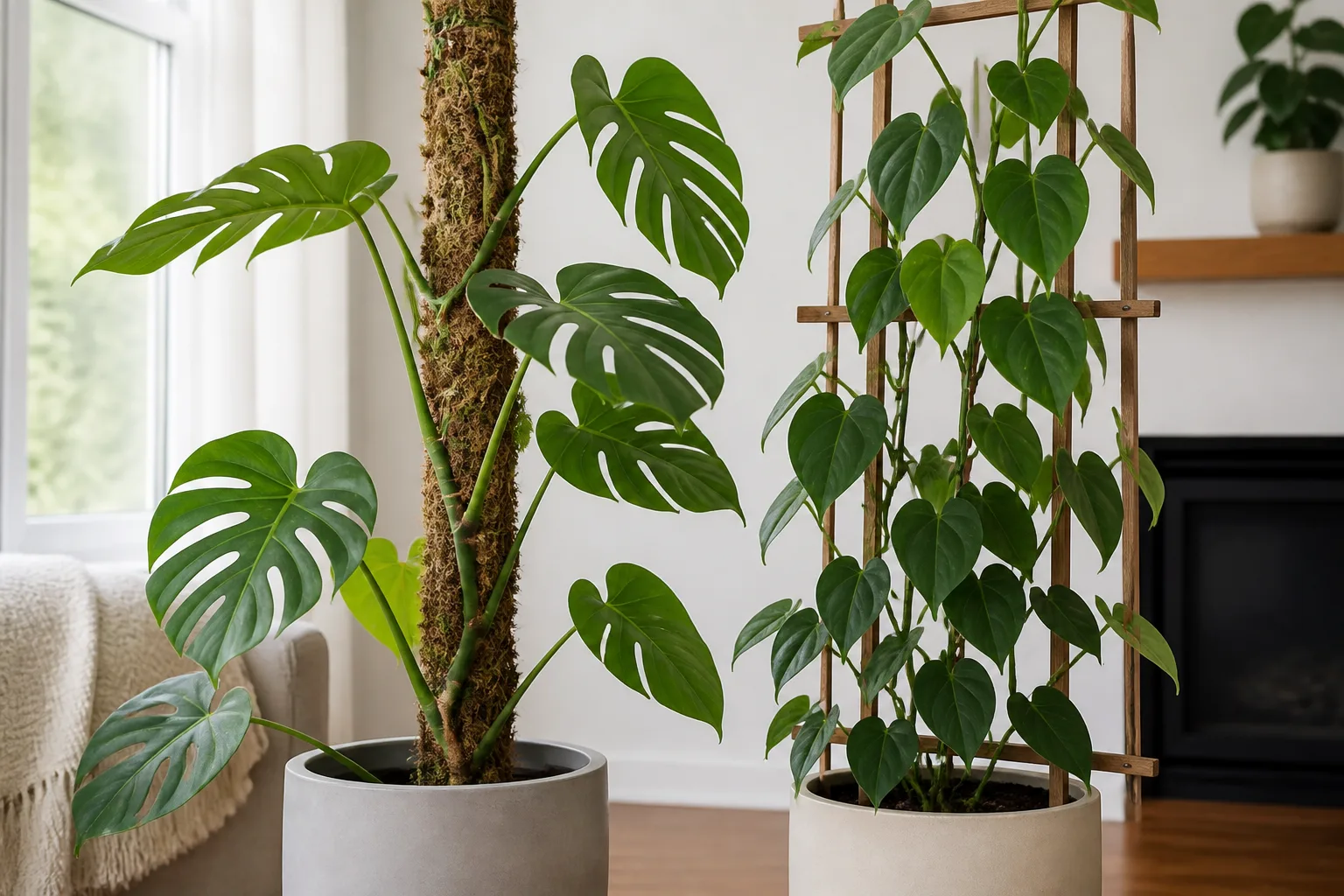
The store sold you a dry coir stick for a big Monstera, or a flat lattice that looks perfect against a wall—and now you are stuck between products that both claim to “support climbers.” A moss pole and a trellis both keep plants upright, but they solve different problems. A moss pole (or a bark board kept damp) gives aerial roots something moist and textured to grip—closer to a rainforest trunk. A trellis is a rigid lattice or fan you train stems onto with soft ties so the plant covers a shape, fills a wall niche, or stays off the floor. Pick based on how your plant climbs, how much moisture maintenance you will do, and whether you care more about attachment biology or about a flat, designed silhouette.
This page helps you decide before you buy. It is not a build manual. If you already know you want a pole and need materials and dimensions, use the DIY moss pole guide. If you already want a lattice and need cuts and hardware, use the DIY indoor plant trellis guide. For species care after you choose a support, pair this page with the Monstera and philodendron hubs rather than copying one watering schedule onto every vine.
Quick Verdict: Which Support Should You Buy?
Choose a moss pole (true sphagnum-filled or well-wrapped) when you grow climbing aroids that produce aerial roots—especially Monstera deliciosa, climbing philodendrons, and pothos you want to grow upright—and you can keep the moss damp enough for roots to attach. Extension and botanical references consistently describe Monstera as a climber that uses aerial roots and benefits from a moss-covered support sunk into the pot, not just a bare stake. (Penn State Extension; University of Wisconsin Extension)
Choose a trellis when you want a flat or fan-shaped display, need to spread several stems across a panel, prefer dry maintenance (no pole misting), or grow lighter trailers that are fine being tied rather than rooted into a moist column. Heartleaf philodendron, for example, can climb a screen, trellis, pole, or bark board, and it also thrives trailing from a hanging basket—so the “best” support depends on the look you want, not a single mandatory product. (UF/IFAS)
Choose a bark board, sphagnum board, or totem when you want trunk-like attachment without a round column silhouette—or when extension sources list boards alongside poles as valid moist/textured supports. Penn State includes sphagnum-covered boards with moss sticks and trellises; Wisconsin mentions tree bark or moss-covered supports; Clemson notes heartleaf types trained on bark- or moss-covered boards or totem poles. (Penn State Extension; Wisconsin Extension; Clemson HGIC)
Choose neither—or a simple stake only—when the plant is a self-heading philodendron, a compact rosette, or a trailer you intentionally keep cascading. Support will not fix low light, a wet root ball, or a pot that tips because it is too light for a tall column.
How Climbing Houseplants Actually Climb
Most popular “climbing” houseplants in the arum family (Araceae) do not twine like beans. In the wild, vines such as Monstera start on or near the forest floor, then climb trees. As they rise, many become more epiphytic—using the host for support while still producing roots that can take moisture from bark, moss, and humid air. Indoors you see the same toolkit in miniature: flexible stems, nodes, and aerial roots that seek a vertical surface.
Without support, those plants often sprawl sideways. Missouri Botanical Garden notes that Monstera can be grown with a pole or trellis for its climbing habit, and that without support plants tend to grow horizontally. Penn State Extension adds that indoors Monstera still needs something sturdy to climb—moss sticks, trellises, bamboo stakes, and sphagnum-covered boards all work—and that the plant must be gently attached using its roots or stalk. That “gently attached” line is the whole decision in one sentence: attachment can be biological (roots into damp moss or bark) or mechanical (ties on a dry trellis).
Aerial Roots vs Soft Ties
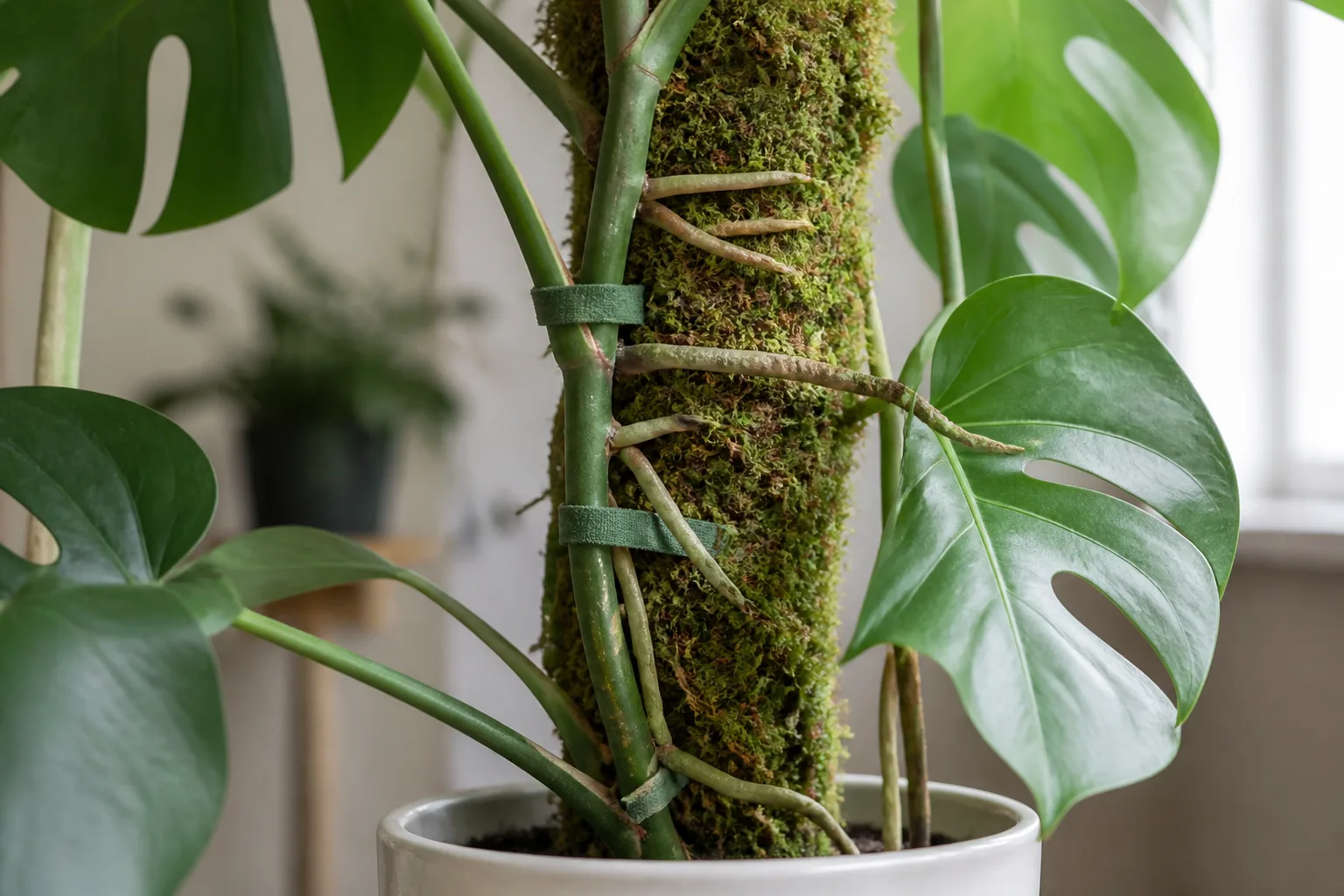
Aerial roots are normal climbing organs, not a crisis. On Monstera, lower aerial roots can reach the soil and help with water and nutrients; upper ones can attach to a moss-like climbing surface. Wisconsin Extension recommends a strong moss-covered support sunk into the pot so aerial roots can attach, and it specifically says to water the moss-covered support so those roots can obtain water and nutrients. RHS guidance for Swiss cheese plants says they benefit from being trained or tied onto a moss pole, into which they will eventually root if the moss is kept moist—and that climbing often coincides with larger, more fenestrated leaves.
Soft ties are the other half of training. Even on a moss pole, young stems rarely “know” to hug the column on day one. You guide the stem with garden twine, fabric strips, or rubber plant ties, then loosen or remove ties as aerial roots take over. RHS climber advice is clear: put supports in place early, use soft materials, avoid wire that cuts into thickening stems, check ties regularly, and use a figure-of-eight style for heavier stems so the tie buffers against rubbing. That outdoor climber logic transfers cleanly to indoor trellises and poles.
If your plant has few or no aerial roots yet, a damp pole still gives physical support, but attachment will be slow. Improve light and wait for active growth rather than forcing stiff stems into a sharp bend. For Monstera-specific root questions, see the aerial roots guide.
What a Moss Pole Really Does
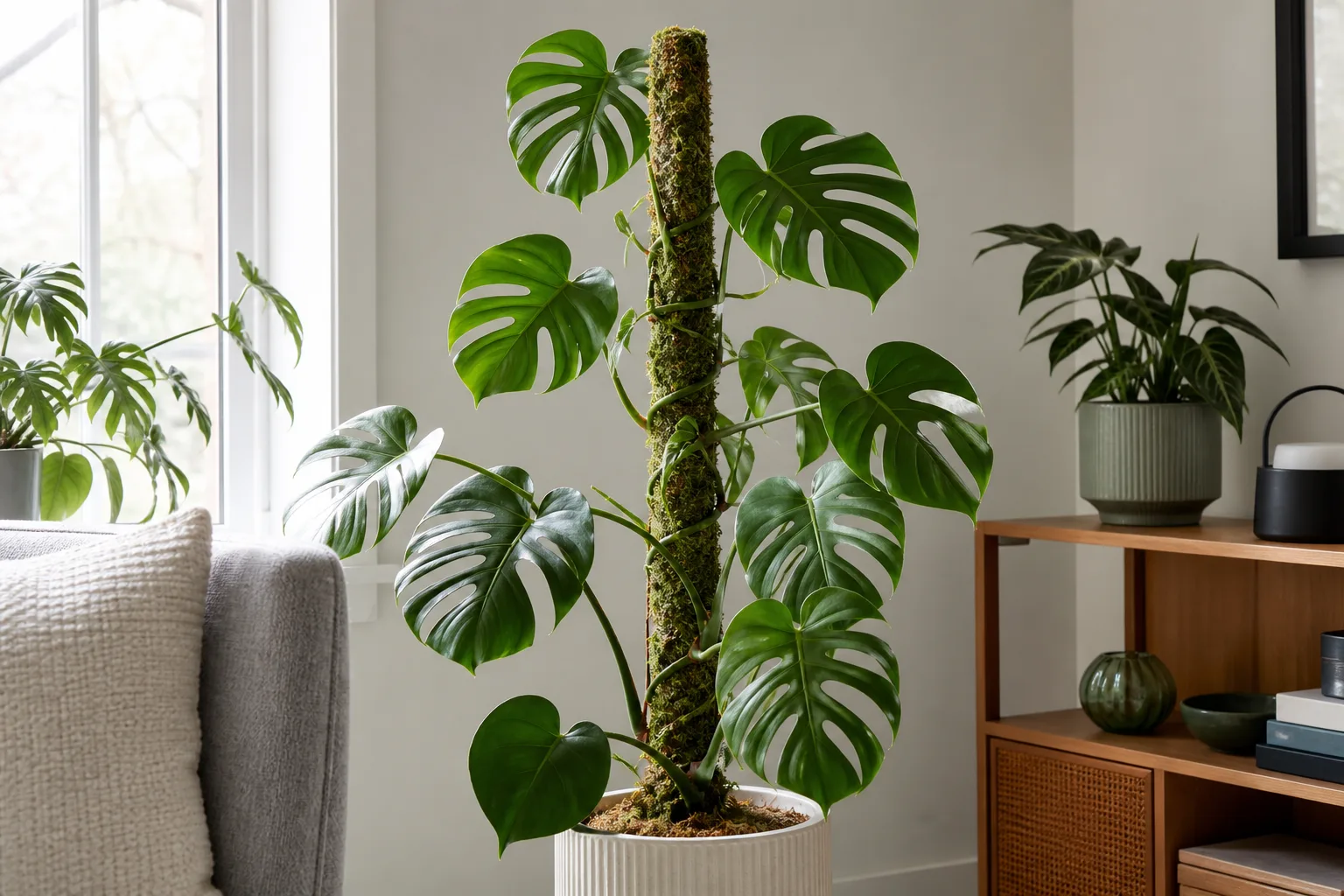
A moss pole is a vertical core—bamboo, PVC, wood, or mesh cylinder—wrapped or filled with long-fiber sphagnum moss (sometimes coco coir as a drier substitute). Its job is to offer a moist, irregular surface that aerial roots can penetrate and cling to, while the rigid core stops heavy stems from snapping. RHS notes that Epipremnum (pothos) can trail or grow up a moss-covered pole as a vertical feature; the same pattern applies to many climbing philodendrons. Clemson HGIC likewise shows pothos commonly grown up totem posts so aerial roots have a place to attach. (Clemson HGIC)
A pole is not magic fertilizer. It does not replace bright indirect light, a chunky mix, or sensible watering. Climbing and better leaf maturity often travel together because the plant is growing in a more natural orientation with better light exposure on new leaves—but light and plant age still decide fenestration. Myth vs reality: a moss pole alone does not guarantee split leaves. RHS links climbing with larger, more perforated leaves once a Swiss cheese plant “feels” it is climbing, while young plants and low light still produce entire hearts. If your Monstera will not split, diagnose light and maturity with how to get Monstera leaves to split instead of buying a taller pole as the only fix. (RHS Swiss cheese plants)

Moisture, Texture, and Attachment
Sphagnum holds water. That is the advantage and the chore. Keep moss evenly damp—not dripping into a soggy root ball—so aerial roots stay active on the pole. Water the potting mix on its own schedule; do not assume a wet pole means the soil is correctly watered, or that dry soil means the pole is fine. Wisconsin’s guidance to water the moss support exists because dry moss behaves like a decorative stake: stems stay upright only where you tied them, and roots never lock in. (Wisconsin Extension)
Coir-wrapped poles are common and cheaper. They can work as a textured stake, especially for light vines, but they usually dry faster indoors and often need more frequent misting to behave like true moss. Plastic “moss” sleeves that never hold water are mostly cosplay. If you want the attachment benefit, choose real sphagnum or a design you can keep damp without rotting the soil. For coir as a potting ingredient rather than a pole wrap, see coco coir vs peat moss.
What a Trellis Really Does
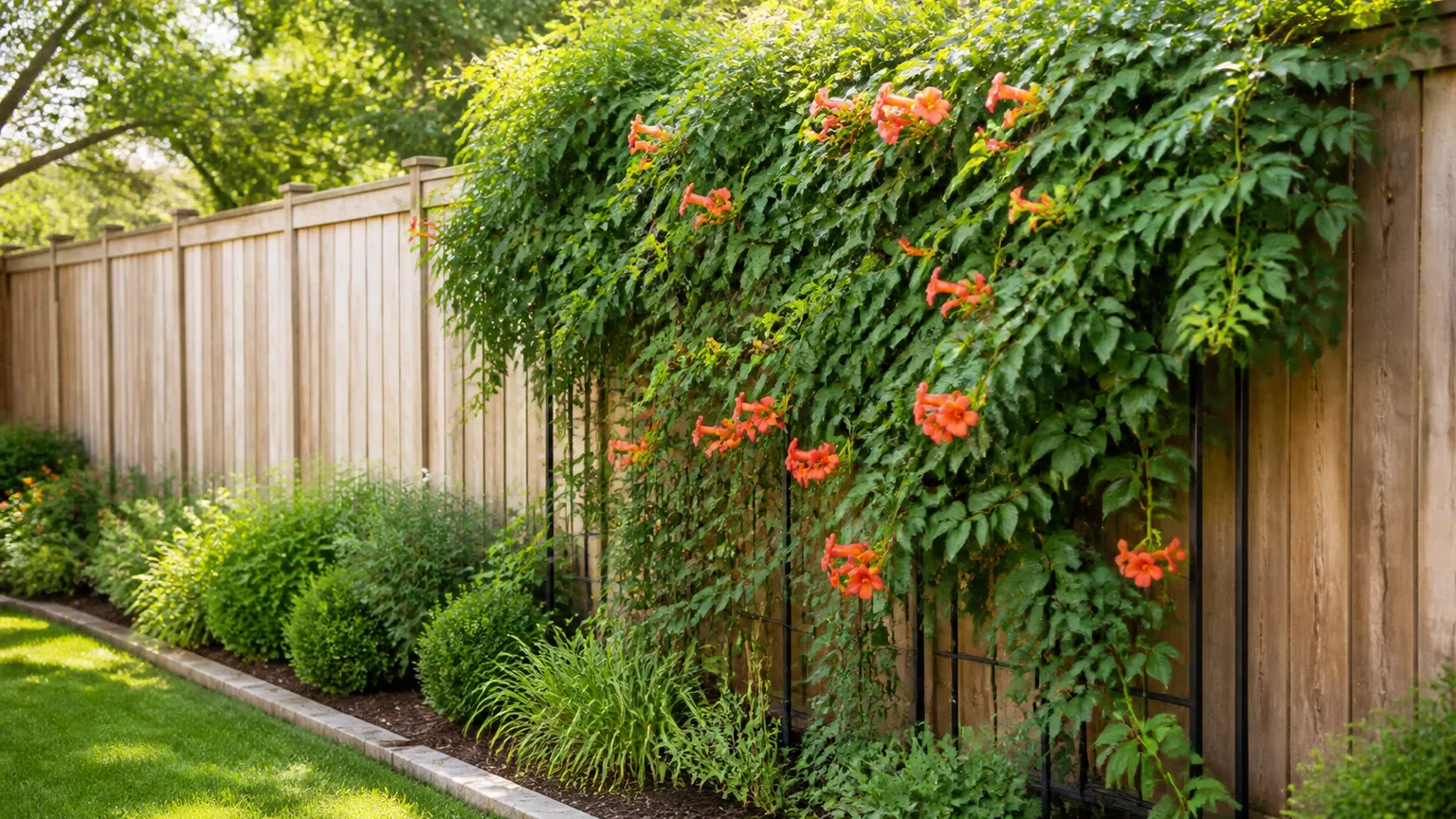
A trellis is a lattice, fan, hoop, or panel that creates climbing real estate in two dimensions. You space stems across it and secure them with soft ties. Air moves through the openings, leaves present as a flat “green screen,” and you can lean the structure against a wall or mount a small pot trellis in the container. RHS outdoor climber guidance treats wooden trellis as a standard support type—raised slightly off a wall for airflow—and the same spacing idea helps indoors: do not crush stems between lattice and a hot window. Avoid reusing rusty outdoor metal lattice indoors without checking for sharp edges that can nick petioles.
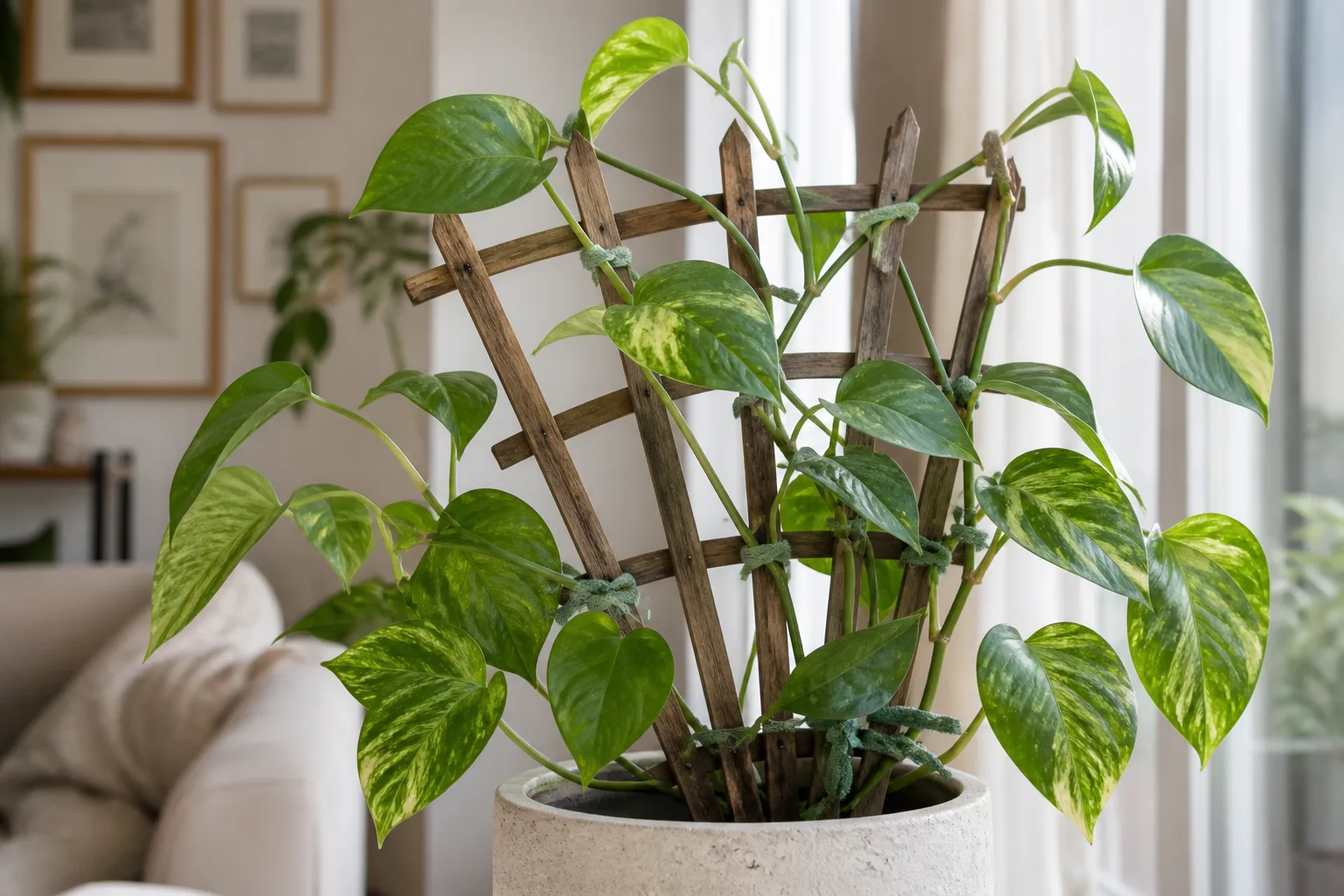
A trellis shines when your goal is coverage and shape rather than root-into-support attachment. Multi-stem pothos, heartleaf philodendron, jasmine in a patio pot, or a syngonium you want to fan out all respond well to lattice training. UF/IFAS notes heartleaf philodendron can be trained up a screen, trellis, pole, or bark board, and that indoor size depends on support height, training, and pruning. That flexibility is the point: the plant does not require moss; it requires a plan. When you are ready to build rather than buy, follow the DIY indoor plant trellis guide for sizing and materials—keep this page for the decide step only.
Lateral Shape and Multi-Stem Coverage
Trellises let you send stems sideways as well as up. That is useful in apartments where height is limited but width along a shelf backboard is available. It is also the better tool when you have three or four leaders and a single pole would create a crowded spiral of leaves fighting for the same column of light. Soft-tie training on a trellis follows the same rules as outdoor climbers: space stems, avoid crossing congested knots, position ties just above a leaf or node so they do not slide, and retie as growth softens and elongates. (RHS how to tie-in climbers)
The trade-off is biological. Most trellis materials are dry wood, coated metal, or plastic. Aerial roots may wrap or press against them, but they rarely “root into” the support the way they do into damp sphagnum. You will rely on ties longer. That is fine if you check them so they never girdle thickening stems.
Bark Boards and Totems as a Third Option
A bark board (or sphagnum-covered plank / coco totem) is the middle lane many shoppers miss when retailers force a pole-versus-lattice binary. It offers a flat or slightly curved trunk face that aerial roots can press into, often with less “column in the middle of the pot” bulk than a thick round pole. Extension sources treat boards and totems as legitimate supports alongside poles and trellises—not as fringe DIY only. (Penn State Extension; UF/IFAS; Clemson HGIC)
Choose a board when you want attachment biology with a wall-facing silhouette, when a round pole crowds a narrow pot, or when you already have a cork/bark slab you can keep lightly moist. Treat an unmoistened dry coir totem like a textured stake: useful for light vines with ties, weak for Monstera aerial-root lock unless you actively rewet it. Build details for poles live on the moss pole DIY page; here the only rule is match the surface to the attachment style you will maintain.
Side-by-Side Decision Table
| Factor | Moss pole | Trellis | Bark board / totem |
|---|---|---|---|
| Main job | Moist, textured climb for aerial roots | Shape stems across a panel with ties | Flat trunk face for attach + soft ties |
| Best for | Monstera, climbing philodendrons, upright pothos | Multi-stem trailers, flat wall displays, dry maintenance | Climbers that need attach without a round column |
| Attachment style | Roots into damp moss + temporary ties | Soft ties (ongoing) | Roots into damp bark/moss + ties |
| Moisture work | Regular misting / top-watering of moss | Usually none beyond plant watering | Light dampening of face; less volume than a fat pole |
| Pot stability | Tall column can tip; deep anchor + heavy pot | Lower tip risk if panel is short and pot is stable | Moderate; still ballast tall slabs |
| Leaf-maturity signal | Stronger when damp and plant is climbing | Mostly physical support; less “trunk” cue | Similar trunk cue when kept textured and damp |
| Aesthetics | Vertical specimen column | Flat screen, fan, or hoop silhouette | Slim vertical face / wall-lean look |
| Main downside | Mold if overwet; dry pole = fake stake | No moist grip; ties can girdle if ignored | Can dry unevenly; harder to “stack” than poles |
Use the table as a filter, then confirm with plant habit below. Penn State’s list—moss sticks, trellises, bamboo stakes, sphagnum boards—already shows there is no single correct product. There is a correct match to how you will maintain the setup. (Penn State Extension)
Which Plants Prefer Which Support
Habit beats marketing. Ask: does this plant climb with aerial roots toward a trunk-like surface, trail by preference, or grow as a self-heading clump?
Monstera and Heavy Climbing Aroids
Monstera deliciosa is the clearest moss-pole or bark-board candidate. It is a climbing evergreen vine that can reach tens of feet in habitat and typically 6–8 feet indoors, with aerial roots that attach to trees. NC State notes sturdy support is necessary to prevent stems from breaking, and that in nature the plant starts terrestrial and becomes epiphytic once it finds a climb. Missouri Botanical Garden describes upper aerial roots attaching to a moss-like climbing pole. RHS links moist moss poles to eventual rooting into the pole and to more mature, fenestrated leaves once the plant “feels” it is climbing—again, alongside light and age, not instead of them. (RHS Swiss cheese plants)
For large Monstera, prefer a thick sphagnum pole or bark board over a skinny decorative stick. Anchor deeply at repotting, use a pot heavy enough to counter top weight, and keep moss damp. A small indoor trellis can still hold a young plant, but a mature deliciosa usually outgrows a light lattice and needs a stout vertical core. Pair support choice with Monstera care and the Monstera overview so you are not forcing a pole through a packed root ball later.
Philodendron, Pothos, and Lighter Vines
Climbing philodendrons and pothos sit in the middle. NC State describes heartleaf philodendron as a trailing or climbing vine that climbs or trails if given support. UF/IFAS lists hanging baskets and training up screens, trellises, poles, or bark boards as valid options. RHS notes Epipremnum can trail or climb a moss pole, and that heartleaf types such as Brasil can climb several meters indoors with support—or trail if you let them. For day-to-day routines after you pick a support, use the philodendron overview alongside the hub.
Practical split: use a moss pole when you want a single upright column and you will mist; use a trellis when you want a cascading-to-upright hybrid, multiple stems fanned out, or zero pole moisture chores; use a bark board when you want attach biology with a flatter face. Light pothos on a budget often do well on coir poles or small trellises because the stems are light and ties hold easily. Heavy Philodendron scandent types with thick petioles benefit more from damp moss or a bark board once aerial roots appear.
Self-heading philodendrons (Birkin-type uprights, many “tree” philodendrons sold as floor plants) are not vines seeking a trunk. A decorative stake may prevent lean, but a full moss pole is usually unnecessary theater. Confirm habit on the plant tag before you buy a six-foot column.
Plants That Do Fine Either Way — or Need Neither
Either way: Syngonium, Scindapsus, Rhaphidophora tetrasperma, and juvenile Monstera adansonii often accept poles or trellises. Match the support size to stem weight and keep expectations honest—small leaves in low light stay small on any structure.
Prefer trail: Many growers keep heartleaf philodendron and pothos in hanging baskets on purpose. Support is optional aesthetics, not survival.
Need neither: Succulents, most peperomias, snake plants, ZZ plants, and true self-heading aroids. If a plant has no climbing nodes or aerial roots, a moss pole will not “unlock” maturity—it will just occupy pot space.
Installation and Training Basics
Install support when the plant is still flexible—ideally at repotting, with the pole, board, or trellis base seated to the pot bottom behind the root ball. Forcing a tall pole into a crowded pot later damages roots and often leaves the support wobbling. Size the above-soil height so you have headroom for a season of growth; extending a moss pole is easier than rebuilding after a tip-over.
Orient the plant so the natural lean faces the support. New leaves usually emerge toward light, so place the column on the side opposite the window if the plant leans toward the glass—or accept that you will rotate and retie. Keep the potting mix chunky for aroids so the buried base sits in a mix that drains; a waterlogged base plus constantly wet moss is how you invite fungus gnats and stem-base soft spots.
Anchoring, Ties, and Aerial-Root Placement
- Seat the support to the pot floor and backfill firmly.
- Bring the main stem flush to the pole, board face, or first trellis rung without snapping nodes.
- Tie loosely every 15–20 cm (6–8 in) with soft ties; use a figure-eight on heavier stems.
- Tuck aerial root tips into damp moss or against damp bark where they reach; do not break brittle dry roots.
- Mist or pour lightly down the moss until evenly damp; drain excess from the saucer.
- Recheck ties monthly during fast growth so nothing digs into the stem.
RHS tying guidance applies indoors: temporary bamboo can bridge gaps until stems reach the main support, and regular tying prevents soft new growth from flopping and scarring. For a full materials list and measured DIY builds, use moss pole DIY or the DIY indoor trellis guide.
Maintenance Trade-Offs You Should Expect
Moss poles ask for a second watering habit. In warm, dry rooms you may wet the moss when the surface feels dry to the touch—often about weekly in active growth when indoor RH sits in the low 40s%, and less in cool, humid weather or winter. If moss stays bone dry, treat the setup as a stake-plus-ties system and do not expect aerial roots to lock. If moss stays swampy and air is stagnant, watch for surface mold—reduce misting, improve airflow, never let the pot sit in runoff, and treat persistent flies via the fungus gnats houseplants guide.
Trellises ask for tie discipline instead. Soft stems thicken. A forgotten plastic zip tie will girdle a leader and weaken everything above it. Schedule a quick monthly check the same way you check for pests on leaf undersides.
Both supports change watering dynamics slightly: a dense pole occupies volume and can create a wetter shadow on one side of the root ball. Water thoroughly, then let the mix dry to the plant’s normal cue—not to a calendar that ignores the new structure. Tall columns raise the center of gravity; if the plant leans, move to a heavier pot or a wider base before the whole specimen tips.
Extension is normal. When growth tops a moss pole, stack a matched extension or repot onto a taller column in spring rather than letting the crown flop back into juvenile, horizontal mode. When a trellis fills, prune for shape or add a second panel—do not let a congested mat block light to inner leaves.
First-Hand Notes From Training Climbers
These are single-setup LeafyPixels editorial notes from apartment grows (bright east window unless noted). They are not universal timelines—use them as texture, then watch your own plant.
Damp sphagnum attach (Monstera, ~10-inch ceramic). After seating a mesh sphagnum pole at spring repot and soft-tying the leader every 6–8 inches, the first aerial root tip pressed into the moss within about three weeks of active growth. By week six, two roots held enough that we loosened the lowest tie. Moss was rewetted when the outer wrap felt dry—roughly weekly at ~40% RH with AC running—not on a fixed “every Sunday” mist.
Dry coir decorative pole (same shelf, smaller Monstera). A store coir sleeve left unmisted for a month never took an aerial root. Stems stayed upright only where zip-free fabric ties held them. Once we misted daily for two weeks, surface stayed barely damp overnight and still dried by afternoon; attachment remained weak compared with the sphagnum column. We relabeled that setup as a textured stake and stopped expecting rainforest bark behavior.
Tip-over / ballast. A ~4-foot pole in a light plastic nursery pot tipped after a growth flush pushed leaf mass above the rim. Moving the same plant into a heavier ceramic of the same diameter stopped the lean; burying the pole to the pot floor at the next repot mattered more than buying a “stronger” retail pole of the same height.
Overwet mold and gnats. Keeping the pole dripping plus leaving saucer water overnight produced a pale film on the moss face and a burst of fungus gnats within two weeks. Cutting pole moisture to touch-dry cues, emptying the saucer, and improving airflow cleared the film; adult flies tapered after we also let the top of the mix dry between waterings (see fungus gnats).
Heartleaf on a small trellis. A multi-stem heartleaf philodendron on a 12-inch fan trellis filled the panel in one warm season with soft ties only—no moss chore—and stayed stable in a lightweight pot because the structure was short and wide rather than tall and narrow.
Common Mistakes That Waste a Support
Buying a dry decorative pole and expecting Monstera aerial roots to attach as if it were rainforest bark is the most common miss. Choosing a trellis that is too flimsy for a top-heavy Monstera is the second. Forcing a false binary—ignoring bark boards and totems when a flat moist face would fit the pot better—is the third. Other frequent errors: installing support after stems have lignified into unbendable arcs; tying with wire or tight twist-ties; wetting moss so aggressively that the soil never dries; ignoring light while blaming the support for small leaves; and putting a tall pole in a light plastic nursery pot with no ballast.
Another quiet mistake is using a moss pole on a plant that wants to trail, then fighting the habit every week with more ties. If you love the cascade, let it cascade—and save the pole budget for a climber that will use it. Conversely, leaving a climbing Monstera unsupported until stems crack under leaf weight is how people end up emergency-staking a damaged plant.
Related guides
- DIY moss pole — materials, height, and stability once you choose a pole
- DIY indoor plant trellis — build and size a lattice after you choose shape over moss
- Monstera aerial roots — what aerial roots are doing on (and off) supports
- Monstera care 101 — light, water, and soil after support is in place
- When to repot — best moment to seat a tall support without root damage
- Fungus gnats on houseplants — if swampy moss plus soggy mix brings flies
Conclusion
Use a moss pole when you want climbing aroids to attach with aerial roots into a damp, textured column—Monstera first, then other aerial-root climbers you will actually mist. Use a trellis when you want shape, multi-stem coverage, and dry, tie-based training without a moisture chore. Use a bark board or totem when you want trunk-like attachment with a flatter face. Both poles and trellises can keep plants upright; only a moist, textured surface meaningfully replaces the trunk cue many aroids are built for.
Buy-tomorrow checklist:
- Confirm habit (climber with aerial roots vs trailer vs self-header).
- Pick the maintenance you will keep (moss/board dampness vs monthly tie checks).
- Match pot weight and depth to support height so the specimen cannot tip.
- Install at repotting, train with soft ties, and keep light honest for leaf size.
For the build path, open the DIY moss pole guide or the DIY indoor plant trellis guide. For species routines, stay inside the Monstera and philodendron care clusters rather than treating the support as a substitute for basics.