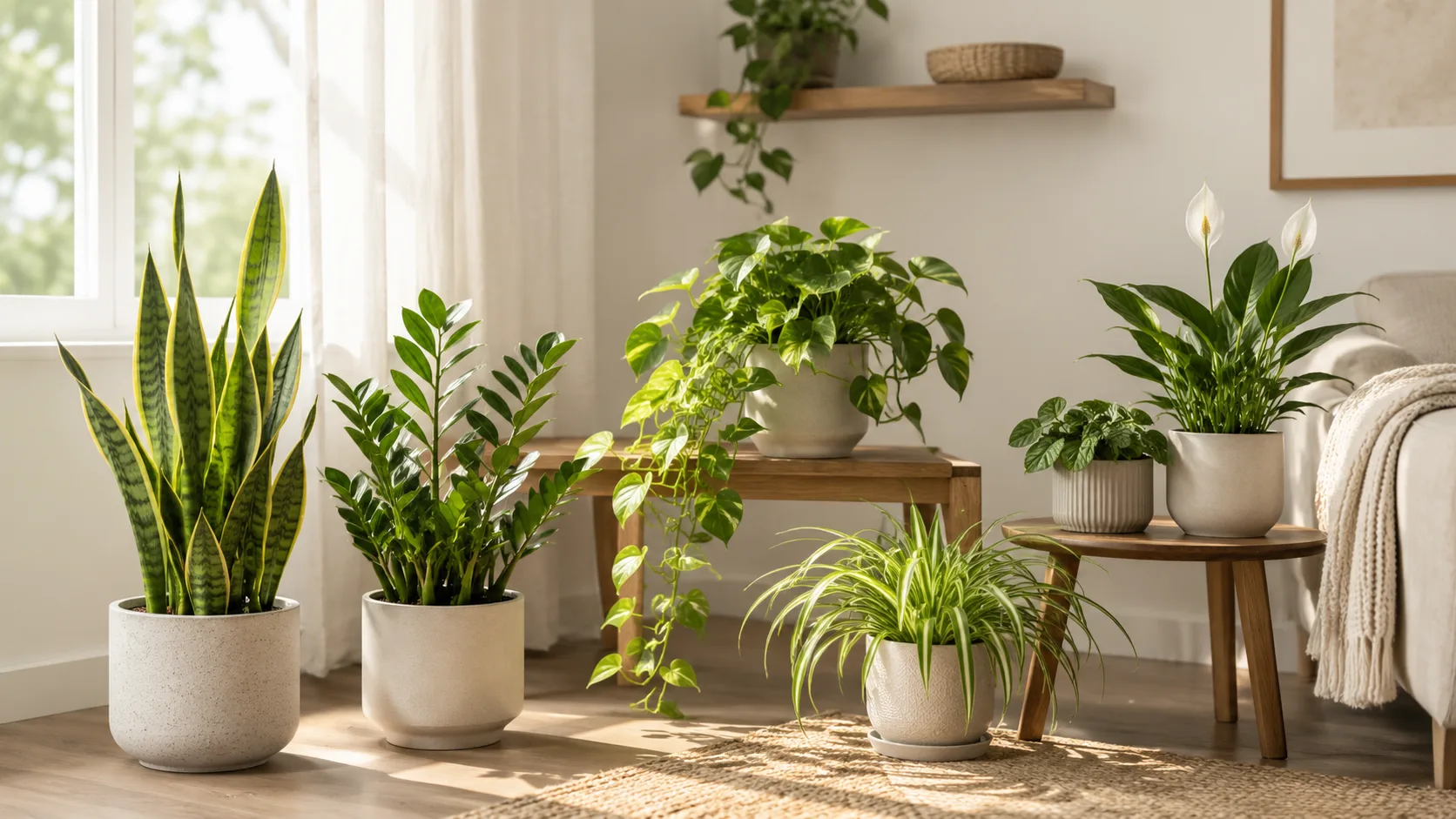
15 Toxic Plants to Avoid If You Have Dogs (Indoor & Outdoor)
Discover which 15 common indoor and outdoor plants are toxic to dogs, what symptoms to watch for, and how to keep your dog safe from accidental poisoning.
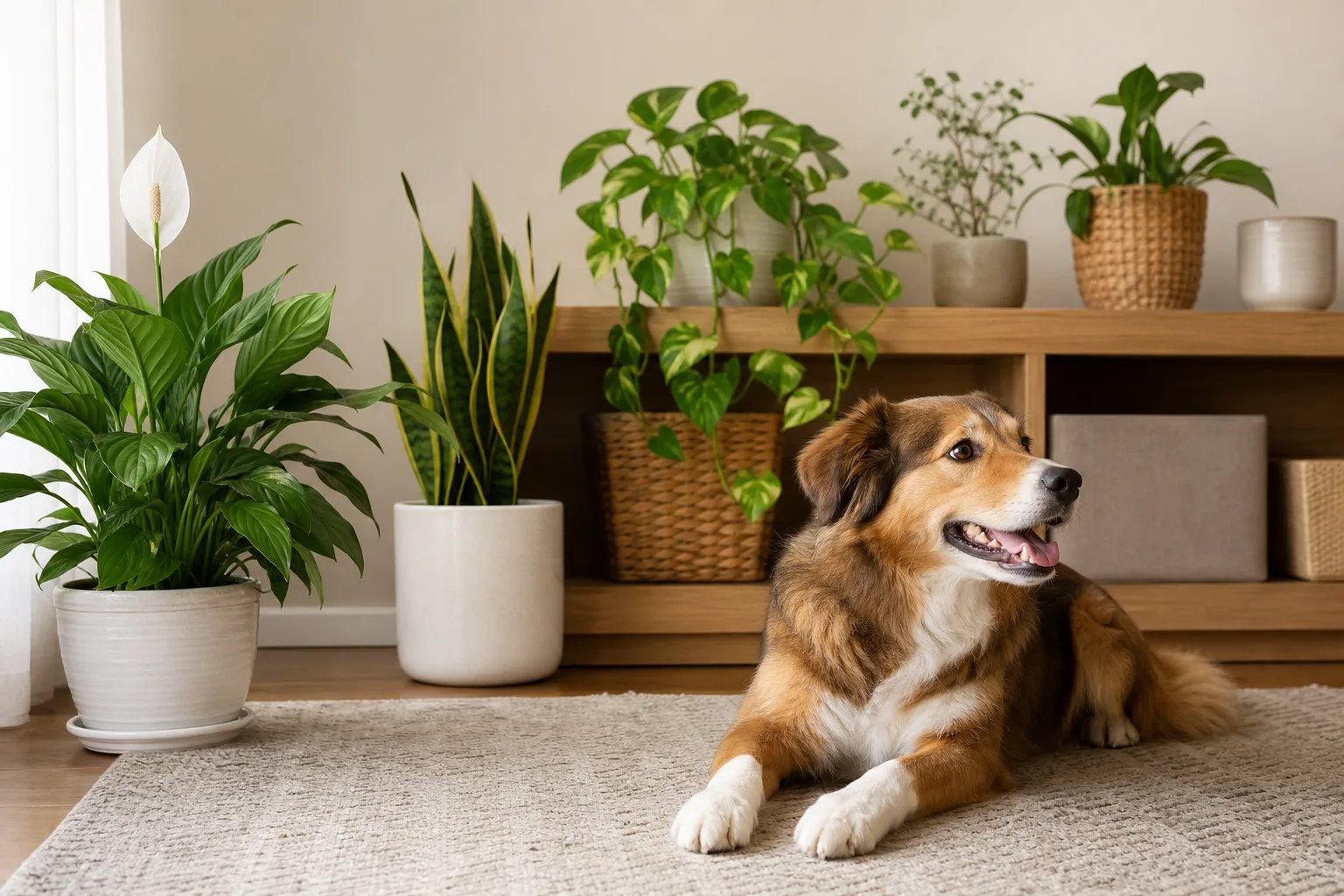
Why This List Exists (And What It Won’t Do)
Most dog owners never plan to bring a poisonous plant home. They bring home a pretty pothos from the garden center, or a friend gifts a peace lily, or a snake plant seemed like the lowest-maintenance option for a dark corner. Nobody reads the fine print on a plant tag that says “toxic to pets” — assuming it even says it at all.
This guide covers 15 plants that are toxic to dogs, verified against the ASPCA toxic plant database, that are among the most commonly kept indoor and outdoor plants in the United States. Every plant on this list appears in homes across the country right now. Some of them are already in yours.
This is not an exhaustive catalog of every plant that can harm a dog — the ASPCA lists hundreds. It is also not a diagnostic tool. If your dog has eaten a plant and is showing symptoms, stop reading and call your veterinarian or the ASPCA Animal Poison Control Center at (888) 426-4435. What this guide is: a clear-eyed look at which popular plants pose a real risk, what that risk actually looks like, and what you can do about it in practical terms. Because “toxic to dogs” can mean anything from mild mouth irritation to fatal liver failure, and treating every plant as equally dangerous is neither accurate nor helpful.
What “Toxic to Dogs” Actually Means
Plant toxicity is not binary. It is a spectrum that depends on the specific toxic compound, the amount ingested, the size of the dog, and which part of the plant was eaten. The sago palm — number one on this list — can kill a dog from eating just a few seeds. By contrast, a dog that chews one leaf of a pothos will probably experience unpleasant oral irritation and maybe some drooling, but is unlikely to need more than supportive care.
Most of the plants in the “Moderate Toxicity” section below contain calcium oxalate crystals — microscopic, needle-shaped crystals called raphides that embed themselves in the soft tissues of the mouth, tongue, and throat when chewed. The result is immediate pain, swelling, drooling, and sometimes vomiting. It is extremely uncomfortable but rarely life-threatening.
A smaller number of plants on this list contain systemic toxins — compounds that affect organs, heart function, or the nervous system after absorption. These are the genuinely dangerous ones whose ingestion should trigger an immediate emergency vet visit regardless of how much was eaten, how big the dog is, or whether symptoms have appeared yet.
Quick Reference Table: Toxicity Severity at a Glance
| Plant | Severity | Toxic Principle | Key Symptoms | Veterinary Urgency |
|---|---|---|---|---|
| Sago Palm | Severe | Cycasin | Vomiting, liver failure, seizures, death | Immediate |
| Aloe Vera | High | Saponins, anthraquinones | Vomiting, diarrhea, lethargy, urine color change | Within hours |
| Peace Lily | Moderate-High | Calcium oxalate crystals | Oral pain, drooling, vomiting, difficulty swallowing | Same day |
| Dieffenbachia | Moderate-High | Calcium oxalate crystals | Oral pain, swelling, potential airway obstruction | Same day |
| English Ivy | Moderate-High | Triterpenoid saponins | Vomiting, diarrhea, hypersalivation, abdominal pain | Same day |
| Pothos | Moderate | Calcium oxalate crystals | Oral irritation, drooling, vomiting | Monitor closely |
| Philodendron | Moderate | Calcium oxalate crystals | Oral irritation, pawing at mouth, vomiting | Monitor closely |
| Monstera Deliciosa | Moderate | Calcium oxalate crystals | Oral irritation, drooling, difficulty swallowing | Monitor closely |
| Snake Plant | Moderate | Saponins | Nausea, vomiting, diarrhea | Monitor closely |
| Dracaena | Moderate | Saponins | Vomiting, depression, loss of appetite | Monitor closely |
| Syngonium | Moderate | Calcium oxalate crystals | Oral irritation, drooling, vomiting | Monitor closely |
| ZZ Plant | Moderate | Calcium oxalate crystals | Vomiting, diarrhea, oral irritation | Monitor closely |
| Schefflera | Moderate | Calcium oxalate crystals | Oral irritation, vomiting, drooling | Monitor closely |
| Alocasia | Moderate | Calcium oxalate crystals | Oral pain, drooling, vomiting | Monitor closely |
| Jade Plant | Moderate | Unknown toxin | Vomiting, depression, slow heart rate | Monitor closely |
Severe Toxicity — These Plants Can Kill
1. Sago Palm (Cycas revoluta)
Safety status: Toxic — one of the most dangerous plants for dogs
Severity: Severe — potentially fatal. All parts are toxic, with seeds/nuts containing the highest concentration
Best for: This plant should not be in any home with a dog, period
Light: Bright light
Water: Allow soil to dry between waterings
Difficulty: Easy
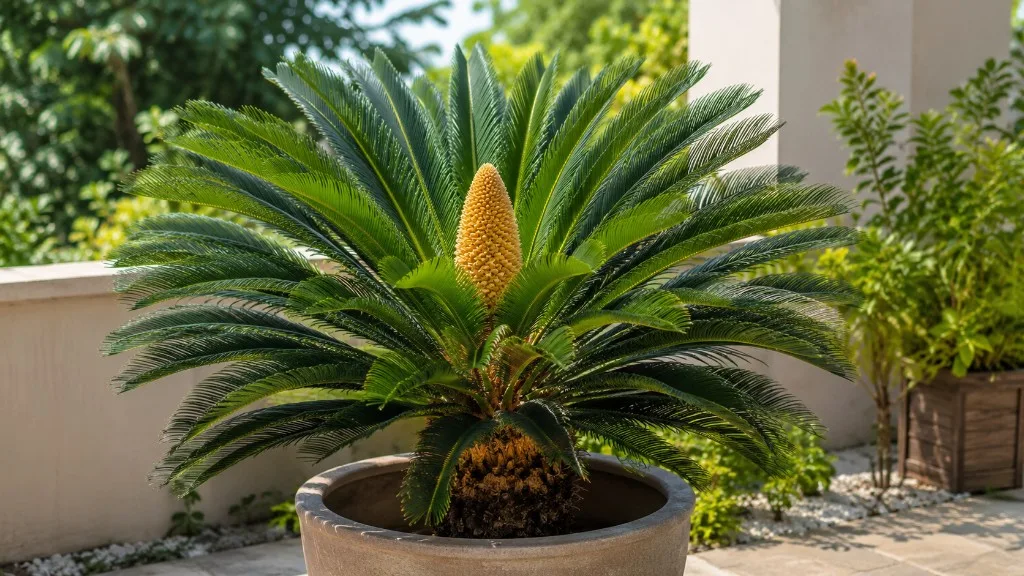
The sago palm is not a true palm — it is a cycad, a primitive plant group that produces a toxin called cycasin. Every part of the plant contains it, but the seeds or “nuts” are so concentrated that ingesting even one or two can cause acute liver failure in a medium-sized dog. The ASPCA identifies sago palms as among the most dangerous plants for dogs, with a mortality rate of approximately 50% even with aggressive veterinary treatment.
Symptoms typically begin with vomiting, diarrhea, and lethargy within 15 minutes to a few hours. This can progress to seizures, fluid accumulation in the abdomen, black tarry stool indicating gastrointestinal bleeding, and ultimately liver failure. The window for effective treatment is narrow — the sooner a dog receives veterinary care after ingestion, the better the outcome.
If you have a sago palm anywhere your dog can access it — indoors, on a patio, or planted in the yard — remove it. There is no safe placement for this plant in a home with dogs. The seeds are small enough to be swallowed quickly, and the consequences are too severe to gamble on training or supervision.
Safety note: Do not wait for symptoms. If you know or suspect your dog ate any part of a sago palm, go to an emergency veterinarian immediately. Call the ASPCA Animal Poison Control Center at (888) 426-4435 en route.
Useful care guides:
High Toxicity — Significant Risk, Needs Veterinary Attention
2. Aloe Vera
Safety status: Toxic to dogs
Severity: High — vomiting, diarrhea, lethargy, and potential urine color changes
Best for: Homes without dogs; otherwise, high shelves entirely out of reach
Light: Bright, indirect light
Water: Allow soil to dry completely between waterings
Difficulty: Easy
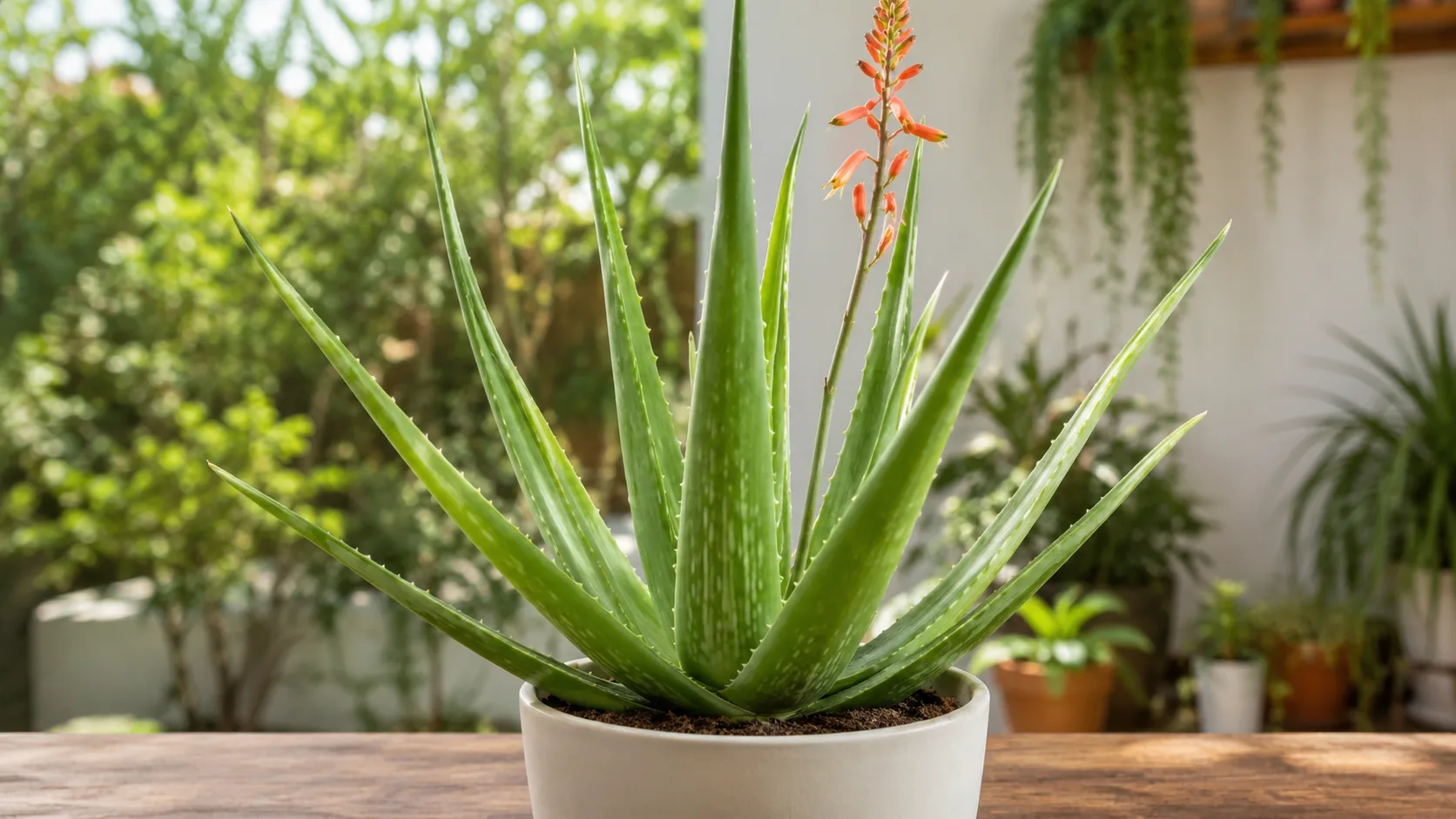
Aloe vera is the classic “kitchen windowsill plant” — people keep it to snap off a leaf for burns. The gel inside the leaf is the useful part; the outer leaf rind contains saponins and anthraquinone glycosides that are toxic to dogs when ingested. The ASPCA lists aloe as toxic to both dogs and cats.
A dog who chews on an aloe leaf will typically develop vomiting, diarrhea, and lethargy within a few hours. The anthraquinones act as a strong laxative, so diarrhea can be significant. More concerning is the potential for urine to turn reddish or brown — a sign the toxins are affecting the kidneys or causing muscle damage.
Most dogs recover with veterinary supportive care, but the gastrointestinal symptoms are severe enough that a vet visit is warranted rather than waiting it out at home. Dehydration from vomiting and diarrhea can compound the problem, especially in small dogs.
Safety note: Unlike calcium oxalate plants that cause immediate mouth pain and are usually spit out, aloe’s bitter taste may not deter a determined chewer. The symptoms may not appear until hours after ingestion when the vomiting starts.
Useful care guides:
3. Peace Lily (Spathiphyllum)
Safety status: Toxic to dogs — contains calcium oxalate crystals
Severity: Moderate-High — oral pain, vomiting, and difficulty swallowing
Best for: High shelves in dog-free rooms or homes without pets
Light: Low to medium indirect light
Water: Keep soil consistently moist but not soggy
Difficulty: Easy
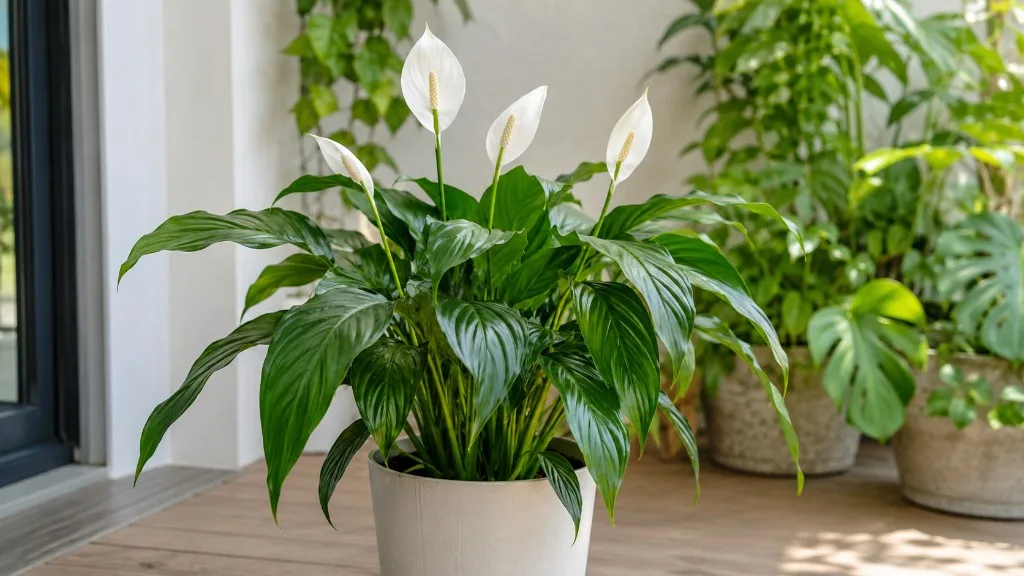
The peace lily is one of the most popular gift plants — it thrives in low light, produces elegant white spathes, and forgives irregular watering. It is also consistently represented in ASPCA toxic plant warnings. The entire plant contains insoluble calcium oxalate crystals that cause immediate and intense pain when chewed.
The good news: the instant oral burning sensation makes most dogs stop chewing after the first bite. The bad news: even a small amount can cause significant swelling of the lips, tongue, and throat. In rare cases involving large ingestion or small dogs, airway swelling can become a medical emergency.
Symptoms include pawing at the mouth, heavy drooling, vomiting, and obvious distress. The pain usually resolves within 24 hours with supportive care, but a vet visit is recommended to manage swelling and rule out airway involvement.
Safety note: Peace lilies are not true lilies (which belong to the Lilium genus and are far more dangerous), but the name confusion can cause people to either panic unnecessarily or dismiss genuine risk. A peace lily ingestion warrants prompt veterinary attention but is not a Lily-level emergency.
Useful care guides:
4. Dieffenbachia (Dumb Cane)
Safety status: Toxic to dogs — contains calcium oxalate crystals and proteolytic enzymes
Severity: Moderate-High — severe oral pain and potential airway swelling
Best for: Standing floor plants in strictly dog-free rooms
Light: Medium indirect light
Water: Allow top inch of soil to dry between waterings
Difficulty: Easy to Medium
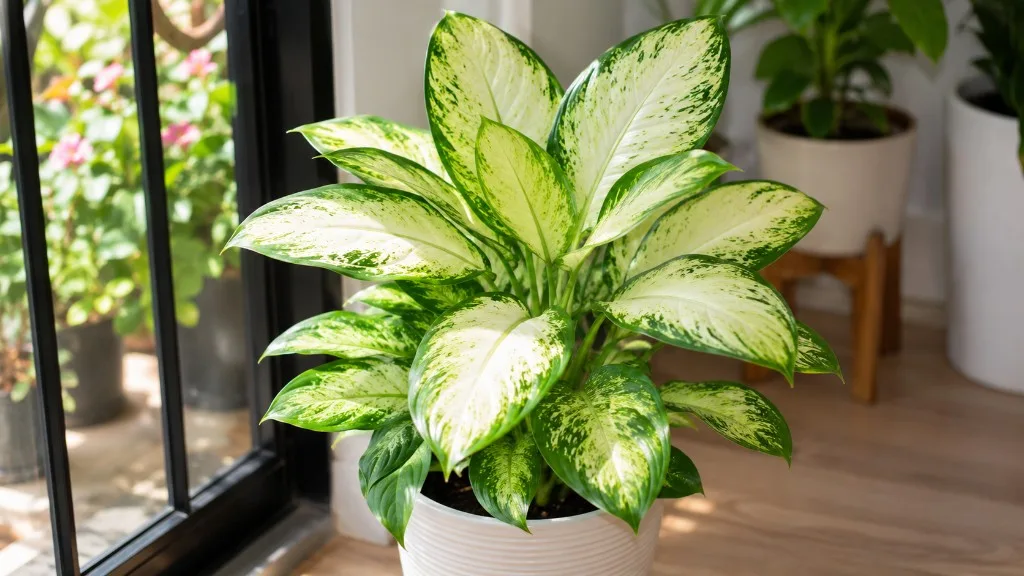
Dieffenbachia earned its common name “dumb cane” because chewing the stem can cause such severe swelling of the mouth and throat that a person temporarily loses the ability to speak. In dogs, the same mechanism applies — calcium oxalate raphides combined with proteolytic enzymes produce a uniquely intense inflammatory response.
The ASPCA lists Dieffenbachia as toxic to dogs, and its effects are among the most painful of any calcium oxalate-containing houseplant. A dog that bites into a stem or leaf will experience immediate burning, significant swelling, and profuse drooling. The swelling can extend to the throat and, in small dogs or with significant ingestion, partially obstruct the airway.
Dieffenbachia is commonly kept as a floor plant because it can grow several feet tall with large, attractive leaves. This puts it at mouth height for medium and large dogs. A tall plant in a heavy pot may feel like a permanent fixture, but a curious dog can still reach the leaves. Place it behind a barrier or in a room your dog cannot access.
Safety note: Even a small chew can cause disproportionate pain. Contact your vet immediately. Do not induce vomiting — the swelling is the primary concern, and vomiting can worsen airway inflammation.
Useful care guides:
- Dieffenbachia care guide
- Dieffenbachia watering guide
- Dieffenbachia light guide
- Dieffenbachia problems guide
5. English Ivy (Hedera helix)
Safety status: Toxic to dogs — contains triterpenoid saponins (hederagenin)
Severity: Moderate-High — vomiting, diarrhea, hypersalivation, abdominal pain
Best for: Hanging baskets in rooms dogs cannot access
Light: Medium to bright indirect light
Water: Allow soil to partially dry between waterings
Difficulty: Easy
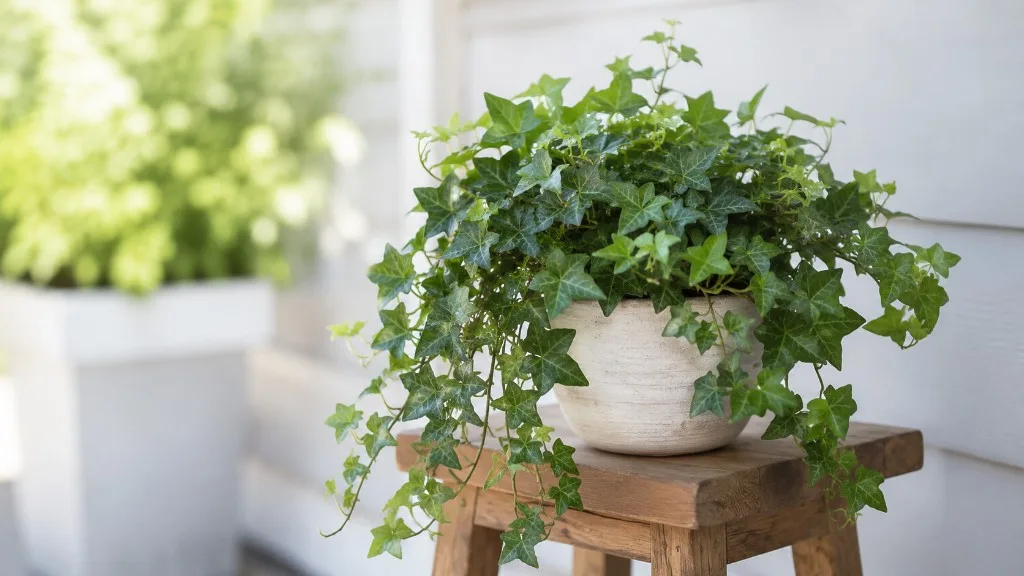
English ivy is popular as a trailing indoor plant and as an outdoor ground cover, which creates a dual risk — a dog might encounter it inside on a shelf or outside in the yard. The ASPCA lists English ivy as toxic to dogs, with the leaves containing triterpenoid saponins that primarily affect the gastrointestinal system.
Unlike calcium oxalate plants that cause immediate mouth pain, ivy’s toxins are absorbed after swallowing, so a dog may eat more before symptoms begin. Clinical signs include vomiting, diarrhea, excessive drooling, and abdominal pain. Symptoms usually appear within a few hours of ingestion.
The outdoor risk deserves particular attention. If you have English ivy in your garden or climbing a fence, and your dog has access to the yard, they are at risk. Dogs that eat grass outdoors may incidentally consume ivy. Consider removing ground-cover ivy from dog-accessible areas or fencing it off.
Safety note: English ivy’s trailing habit makes it tempting to hang in baskets where vines dangle down. Hanging at height reduces — but does not eliminate — risk if vines are long enough to reach or if leaves drop.
Useful care guides:
- English Ivy care guide
- English Ivy watering guide
- English Ivy light guide
- English Ivy propagation guide
Moderate Toxicity — Unpleasant but Rarely Life-Threatening
6. Pothos (Epipremnum aureum)
Safety status: Toxic to dogs — contains insoluble calcium oxalate crystals
Severity: Moderate — oral irritation, drooling, vomiting
Best for: High shelves or hanging baskets, trailing out of reach
Light: Low to bright indirect light
Water: Allow soil to dry between waterings
Difficulty: Very Easy
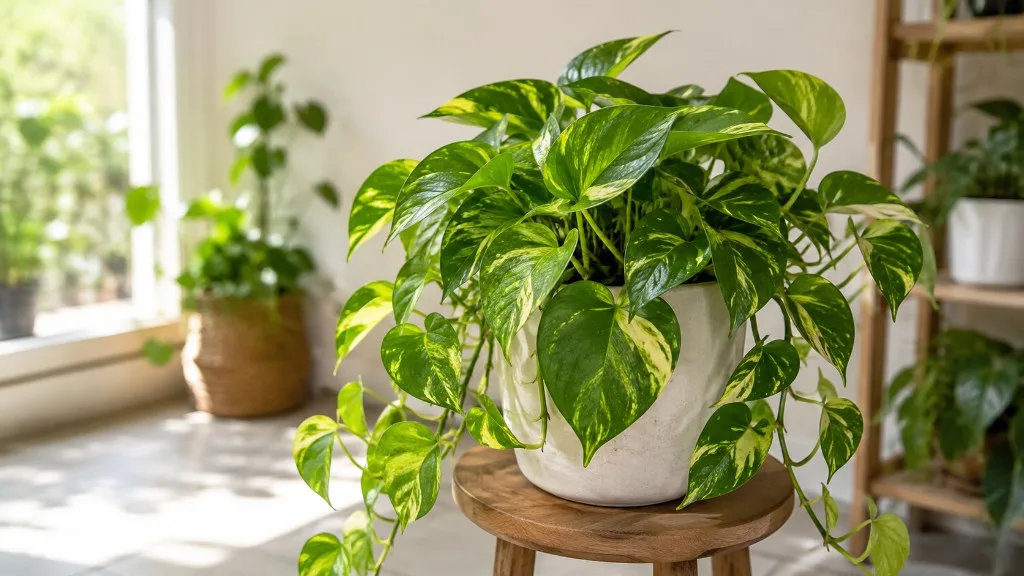
Pothos is arguably the most common houseplant in America — it is sold in every garden center, grocery store, and home improvement store, often simply labeled “tropical foliage” with no mention of toxicity. The ASPCA lists pothos (as “Devil’s Ivy” and “Golden Pothos”) as toxic to both dogs and cats.
The calcium oxalate crystals in pothos leaves and stems cause immediate burning and irritation when chewed. A dog will typically drool, paw at their mouth, and may vomit shortly after. The pain is self-limiting — the raphides cause surface-level tissue damage that heals within a day or two. In most cases, the dog stops chewing after the first bite because it hurts, limiting the total dose.
While pothos toxicity is rarely serious enough to require hospitalization, a veterinary consultation is still recommended. Small dogs, puppies, and dogs that manage to swallow significant amounts may need anti-nausea medication or fluid support. The trailing vines can reach floor level even from a shelf, so placement requires vigilance.
Safety note: Do not confuse pothos with satin pothos (Scindapsus pictus) — both contain calcium oxalate crystals and pose the same oral irritation risk. All pothos varieties (Golden, Marble Queen, Neon, Jade, N’Joy, Cebu Blue, etc.) share this toxicity.
Useful care guides:
- Pothos care guide
- Pothos watering guide
- Pothos light guide
- Pothos propagation guide
- Golden Pothos care guide
7. Philodendron
Safety status: Toxic to dogs — contains insoluble calcium oxalate crystals
Severity: Moderate — oral irritation, drooling, vomiting
Best for: Shelves, plant stands, or hanging pots above dog height
Light: Medium indirect light
Water: Allow top inch of soil to dry between waterings
Difficulty: Very Easy
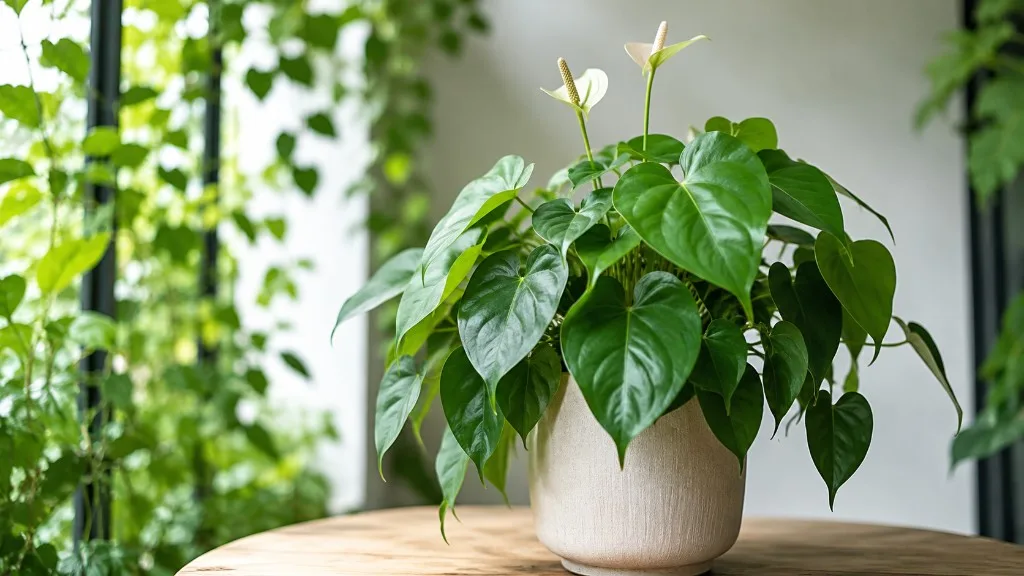
Philodendrons are the second pillar of the “everyone has one” houseplant world, right alongside pothos. The ASPCA lists heartleaf philodendron (Philodendron hederaceum) and numerous other philodendron species as toxic to dogs. The mechanism is the same calcium oxalate raphide injury seen in pothos — immediate oral pain, drooling, and potential vomiting.
Philodendron leaves are generally larger and broader than pothos leaves, which can mean more crystals per leaf if a dog takes a full bite. The trailing or climbing habit also means vines may reach floor level. A dog that pulls a pot down from a shelf will have access to the entire plant.
One philodendron worth singling out is Philodendron selloum (now reclassified as Thaumatophyllum bipinnatifidum, but still sold under the philodendron name). Its large, deeply lobed leaves sit on long stems at dog-chewing height when kept as a floor plant. Its size and accessibility make it a higher-risk philodendron in households with dogs.
Safety note: The sheer number of philodendron varieties sold — Birkin, Brasil, Micans, Pink Princess, Prince of Orange, and dozens more — means many dog owners don’t realize they own a philodendron. If the plant tag says “philodendron,” the plant contains calcium oxalate crystals. All varieties share this toxicity.
Useful care guides:
- Philodendron care guide
- Philodendron watering guide
- Philodendron light guide
- Philodendron propagation guide
- Philodendron Brasil guide
- Philodendron Birkin guide
- Philodendron Pink Princess guide
8. Monstera Deliciosa (Swiss Cheese Plant)
Safety status: Toxic to dogs — contains insoluble calcium oxalate crystals
Severity: Moderate — oral irritation, drooling, vomiting, difficulty swallowing
Best for: Large floor plants in rooms dogs don’t access, or behind barriers
Light: Bright indirect light
Water: Allow top 2 inches of soil to dry between waterings
Difficulty: Easy to Medium
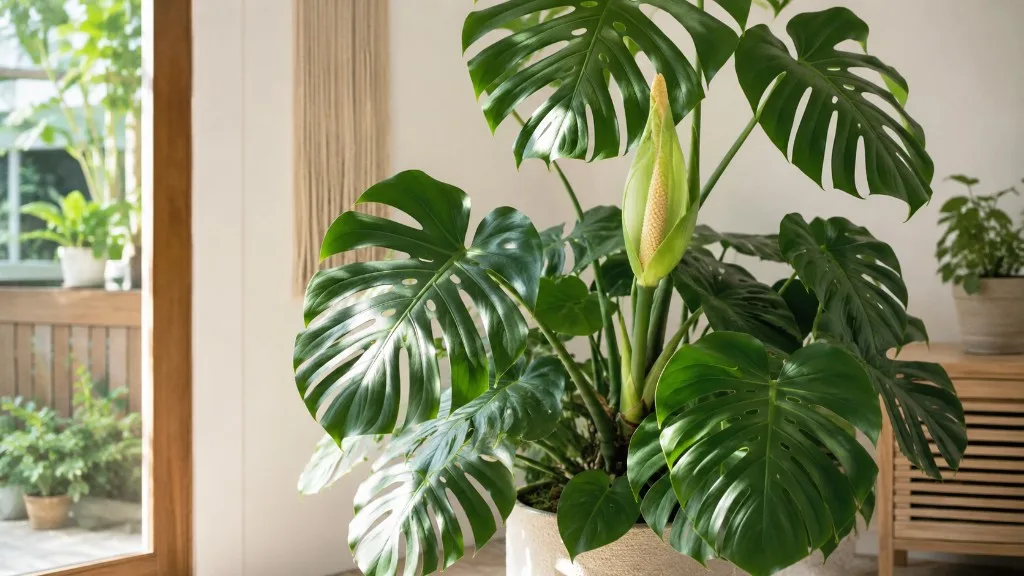
The monstera’s iconic split leaves make it the Instagram plant of the decade, and it is now found in millions of homes. The ASPCA lists Monstera deliciosa (under “Ceriman,” “Cutleaf Philodendron,” and “Swiss Cheese Plant”) as toxic to dogs, containing insoluble calcium oxalates.
Monsteras are typically kept as floor plants in large pots — which puts their broad, accessible leaves right at snout level for medium and large dogs. A dog can take a substantial bite before the oral pain kicks in, especially from a mature leaf. The symptoms match the calcium oxalate pattern: immediate burning, significant drooling, pawing at the face, and possible vomiting.
Most dogs recover without intervention because the pain stops further chewing, but the distress is real. A veterinarian can provide pain relief, anti-inflammatory medication, and anti-nausea support if symptoms are severe.
Safety note: Raphide concentration increases with leaf maturity. A well-established monstera with large, fenestrated leaves contains more crystals per leaf than a young plant. Unripe monstera fruit also contains oxalate crystals — though indoor plants rarely produce fruit.
Useful care guides:
- Monstera Deliciosa care guide
- Monstera Deliciosa watering guide
- Monstera Deliciosa light guide
- Monstera Deliciosa propagation guide
- Monstera Deliciosa problems guide
9. Snake Plant (Sansevieria trifasciata)
Safety status: Toxic to dogs — contains saponins
Severity: Moderate — nausea, vomiting, diarrhea
Best for: Tall plant stands or rooms dogs cannot access
Light: Low to bright indirect light — extremely tolerant
Water: Allow soil to dry completely between waterings
Difficulty: Very Easy
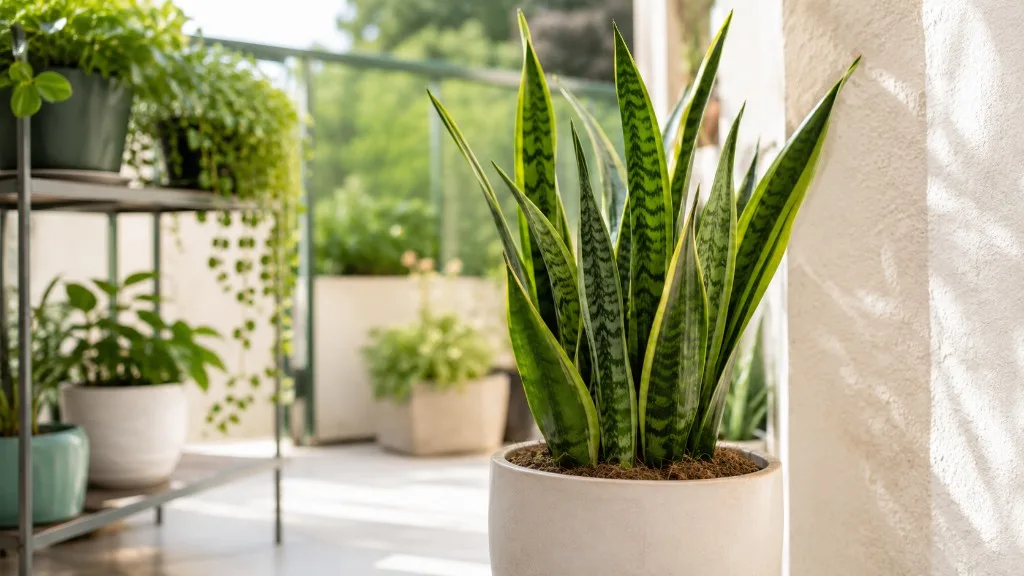
The snake plant’s reputation as an indestructible houseplant has made it ubiquitous. It is sold as the plant for people who kill every plant. The ASPCA lists snake plant (also under “Golden Bird’s Nest” and “Mother-in-Law’s Tongue”) as toxic to dogs, with saponins as the toxic principle.
Unlike calcium oxalate plants, snake plant toxicity does not cause immediate oral burning. The saponins produce gastrointestinal symptoms after ingestion — primarily nausea, vomiting, and diarrhea. Because there is no instant pain deterrent, a dog that finds the taste tolerable may eat more than they would from a pothos or philodendron, increasing the dose.
Snake plants are often placed on the floor because of their upright, sculptural growth habit. The stiff, sword-like leaves can be at perfect chewing height. Placing the pot on a tall plant stand or behind a barrier is the practical fix.
Safety note: All sansevieria varieties share this toxicity, including Sansevieria Cylindrica, Sansevieria Laurentii, Sansevieria Moonshine, and Sansevieria Fernwood. The toxicity profile is the same regardless of variety.
Useful care guides:
- Snake Plant care guide
- Snake Plant watering guide
- Snake Plant light guide
- Snake Plant propagation guide
10. Dracaena (Corn Plant, Dragon Tree)
Safety status: Toxic to dogs — contains saponins
Severity: Moderate — vomiting, depression, loss of appetite, dilated pupils (in cats)
Best for: Tall plant stands, corners behind furniture
Light: Medium indirect light
Water: Allow top inch of soil to dry between waterings
Difficulty: Easy
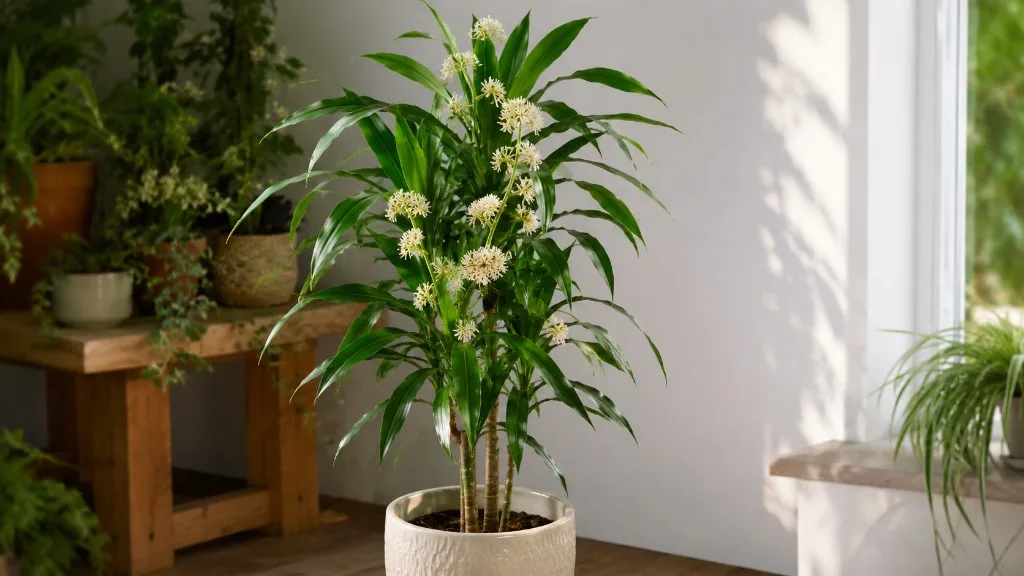
The dracaena family includes some of the most widely sold indoor trees: corn plant (Dracaena fragrans), dragon tree (Dracaena marginata), Janet Craig, Warneckii, and Song of India. The ASPCA lists the entire Dracaena genus as toxic to dogs, with saponins as the active toxin.
A dog that chews dracaena leaves or stems may experience vomiting, depression, and loss of appetite. These symptoms are less immediately dramatic than the oral pain from calcium oxalate plants, but they are genuine and warrant veterinary attention. In cats — which this article is not about, but many households have both — dracaena can cause dilated pupils in addition to gastrointestinal signs.
Dracaenas are commonly sold as 3- to 6-foot-tall floor plants with a canopy of strappy leaves at the top. A taller plant may be out of reach for a small dog but creates a tempting target for a larger breed that can reach the leaves.
Safety note: Lucky bamboo (Dracaena sanderiana) is a dracaena, not a true bamboo. It shares the same saponin toxicity despite its benign name. The water-cultured presentation in low dishes makes it unusually accessible to dogs.
Useful care guides:
- Dracaena care guide
- Dracaena watering guide
- Dracaena light guide
- Dracaena Marginata guide
- Corn Plant guide
- Lucky Bamboo guide
11. Syngonium (Arrowhead Vine)
Safety status: Toxic to dogs — contains insoluble calcium oxalate crystals
Severity: Moderate — oral irritation, drooling, vomiting
Best for: Hanging baskets or high shelves, well above dog height
Light: Medium indirect light
Water: Allow top inch of soil to dry between waterings
Difficulty: Very Easy
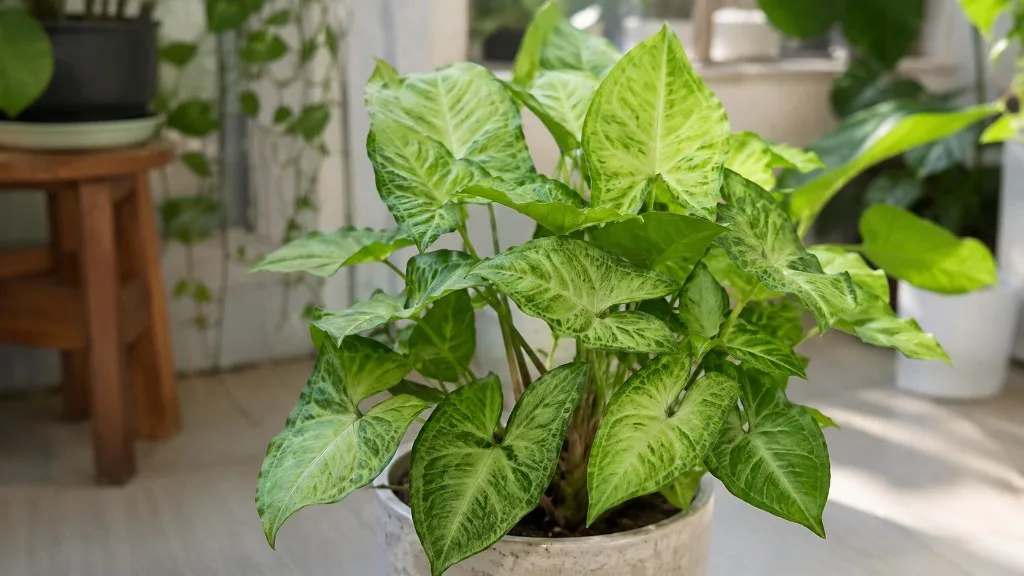
Syngonium, sold as arrowhead vine or nephthytis, is a fast-growing trailing or climbing plant that appears in many beginner plant collections. The ASPCA lists it (under “Arrow-Head Vine,” “Nephthytis,” and “Green Gold Naphthysis”) as toxic to dogs. The mechanism is calcium oxalate — same family as pothos and philodendron, same oral irritation pattern.
The plant’s rapid growth and tendency to cascade make it an attractive hanging basket option, which is also the safest way to keep it in a home with dogs. When grown on a moss pole or trellis, the lower leaves can remain within dog reach.
Syngonium leaves change shape as the plant matures — juvenile leaves are arrow-shaped, while mature leaves develop distinct lobes. The oxalate concentration is present at all growth stages, so a small starter plant and a mature specimen pose the same toxicity risk per leaf.
Safety note: Syngonium is often confused with caladium, which is also toxic and contains calcium oxalate crystals. They are different genera — but the safety advice is identical: keep out of dog reach.
Useful care guides:
12. ZZ Plant (Zamioculcas zamiifolia)
Safety status: Toxic to dogs — contains calcium oxalate crystals
Severity: Moderate — vomiting, diarrhea, oral irritation
Best for: Tall plant stands in low-traffic rooms
Light: Low to bright indirect light — extremely tolerant
Water: Allow soil to dry completely between waterings
Difficulty: Very Easy
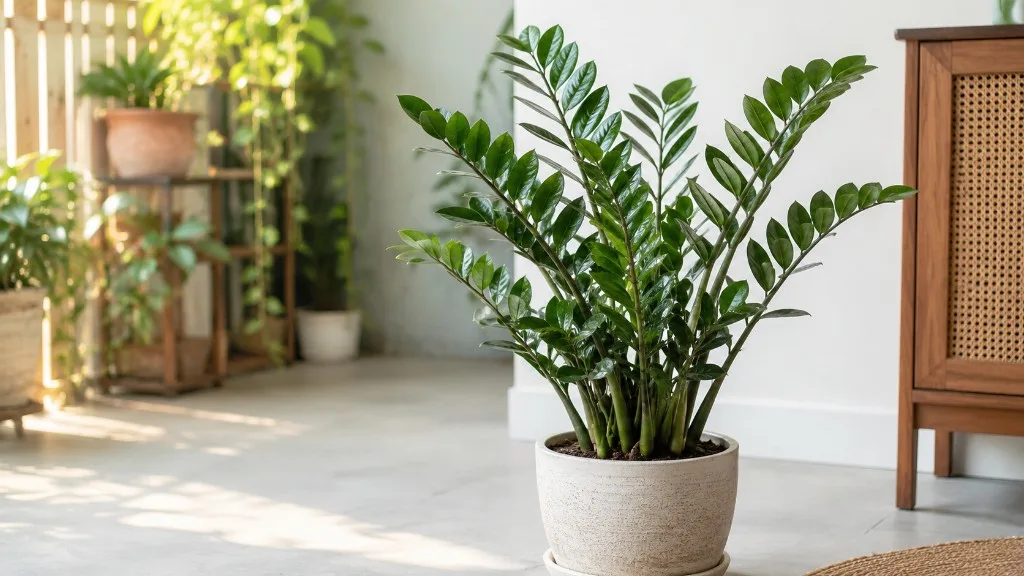
The ZZ plant became wildly popular over the last decade for a reason: it survives in windowless offices, thrives on neglect, and looks glossy and architectural while doing absolutely nothing demanding. Its toxicity to dogs is less widely known than its resilience, but it contains calcium oxalate crystals in all parts of the plant.
What makes the ZZ plant a particular concern is its low placement profile. It is commonly sold in 6- to 10-inch pots placed on the floor or low stands, putting the thick, juicy stems at perfect chewing height. A dog that bites into a ZZ stem will experience the familiar calcium oxalate response — oral pain, drooling, and potentially vomiting.
The waxy coating on ZZ leaves may make them less immediately appealing to chew, but the thick, succulent-like stems are a different story. Reports to poison control centers confirm that dogs do ingest ZZ plant material.
Safety note: The sap can also cause skin irritation on contact. If your dog has sensitive skin or you handle the plant and then pet them, mild dermatitis is possible. Wash hands after repotting or pruning.
Useful care guides:
13. Schefflera (Umbrella Tree)
Safety status: Toxic to dogs — contains calcium oxalate crystals Severity: Moderate — oral irritation, vomiting, drooling Best for: Behind barriers or in rooms dogs cannot access Light: Bright indirect light Water: Allow top inch of soil to dry between waterings Difficulty: Easy
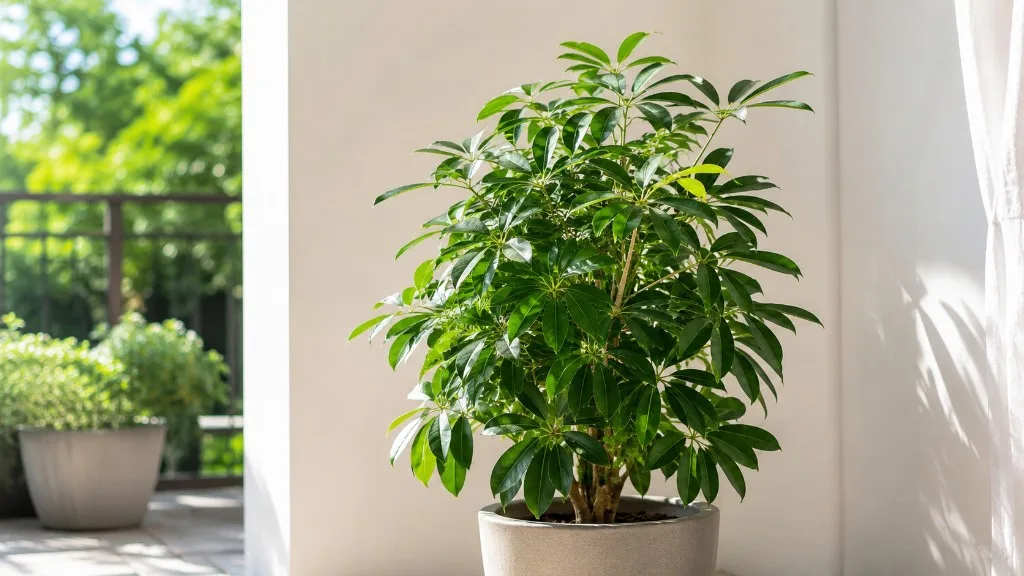
Schefflera, also sold as umbrella tree or octopus tree, is a common indoor tree that can reach 6 to 8 feet indoors. The ASPCA lists schefflera as toxic to dogs, with calcium oxalate crystals as the toxic principle. The ASPCA entry covers both Schefflera actinophylla and Brassaia actinophylla (synonyms for the same plant).
A mature schefflera has an umbrella-like canopy of compound leaves on woody stems. The lower leaves on a floor specimen are easily reachable. A dog that chews them will experience oral irritation, drooling, and potentially vomiting — the standard calcium oxalate response.
The dwarf umbrella tree (Schefflera arboricola) is a smaller, bushier version that is often kept as a tabletop or low-stand plant in 8- to 12-inch pots. Despite its smaller size, it shares the same toxicity profile. Its placement on a coffee table or low shelf can make it more accessible than a tall specimen.
Safety note: Schefflera is sometimes confused with money tree (Pachira aquatica), which is non-toxic to dogs. If you have a braided-trunk plant with five-lobed leaves, that is likely a money tree and safe. A plant with compound leaves radiating from a central point like umbrella spokes is schefflera and toxic.
Useful care guides:
- Schefflera care guide
- Schefflera watering guide
- Schefflera light guide
- Dwarf Umbrella Tree care guide
14. Alocasia (Elephant’s Ear)
Safety status: Toxic to dogs — contains calcium oxalate crystals Severity: Moderate — oral pain, drooling, vomiting Best for: High shelves, plant cabinets, or rooms dogs cannot access Light: Bright indirect light Water: Keep soil consistently moist but not waterlogged Difficulty: Medium
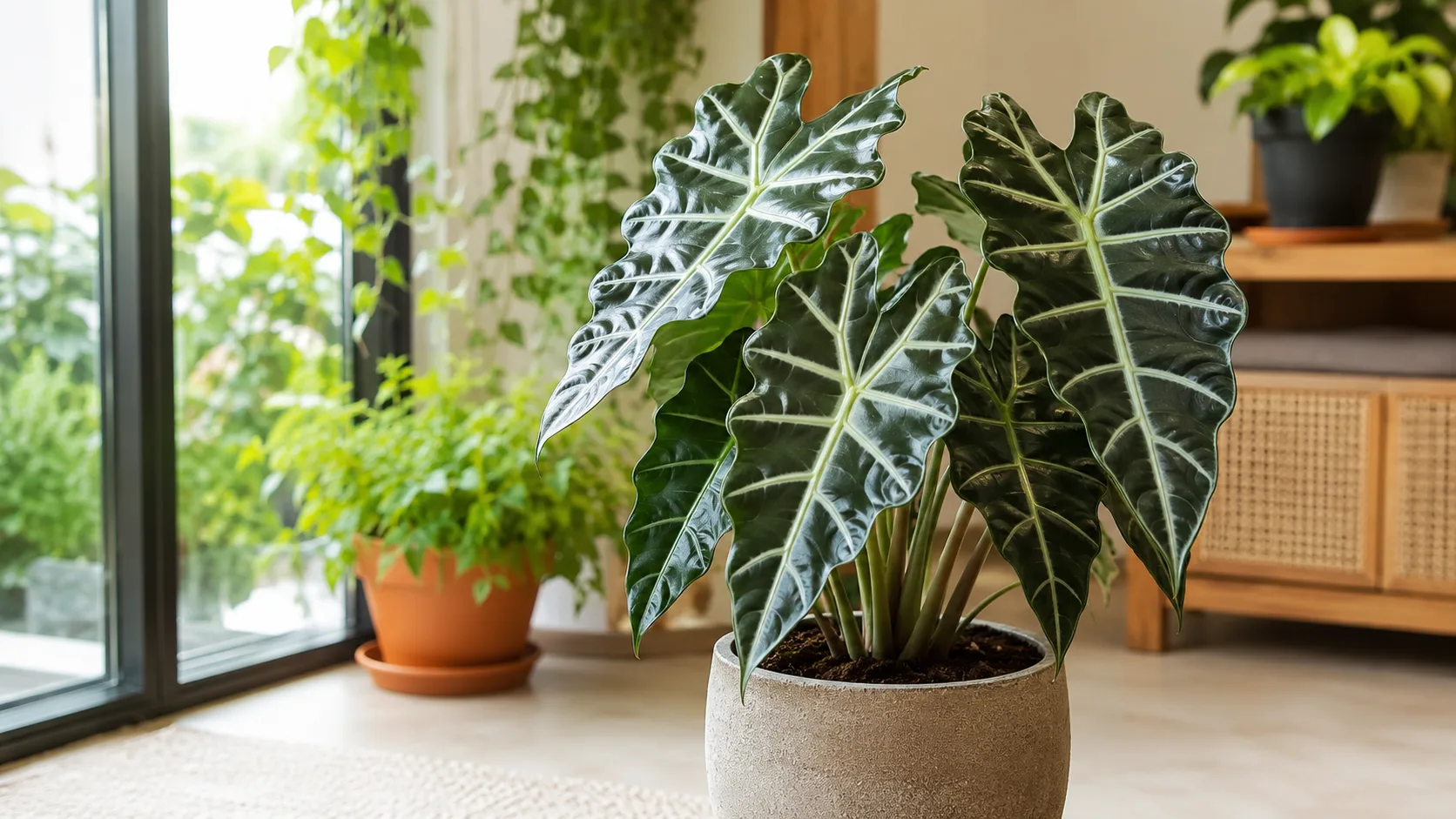
Alocasia has surged in popularity as plant collectors seek out dramatic, architectural foliage. Varieties like Alocasia Polly, Alocasia Black Velvet, and Alocasia Frydek are now widely available. The ASPCA lists alocasia as toxic to dogs, with calcium oxalate crystals present in all parts of the plant.
Alocasia leaves are typically held on long, upright petioles that rise from a central rhizome. The leaves themselves can be large — Alocasia Regal Shield and Alocasia Zebrina can produce leaves over a foot long. A curious dog that takes a bite will experience immediate oral pain and drooling.
Beyond the indoor toxicity concern, colocasia and alocasia species grown outdoors in warm climates (USDA zones 8-11) pose a yard risk. Outdoor elephant’s ear plants can form large clumps with leaves at dog-chewing height. If you live in a climate where these grow as perennials and your dog has yard access, the risk extends beyond the house.
Safety note: Alocasia sap can cause skin irritation in addition to oral toxicity. If a dog breaks a stem or leaf and gets sap on their skin, wash the area with mild soap and water.
Useful care guides:
- Alocasia Amazonica guide
- Alocasia Polly guide
- Alocasia Black Velvet guide
- Alocasia Frydek guide
- Alocasia Zebrina guide
15. Jade Plant (Crassula ovata)
Safety status: Toxic to dogs — toxic principle not fully characterized Severity: Moderate — vomiting, depression, incoordination, slow heart rate Best for: High shelves or desks in dog-free rooms Light: Bright light, including some direct sun Water: Allow soil to dry completely between waterings Difficulty: Very Easy
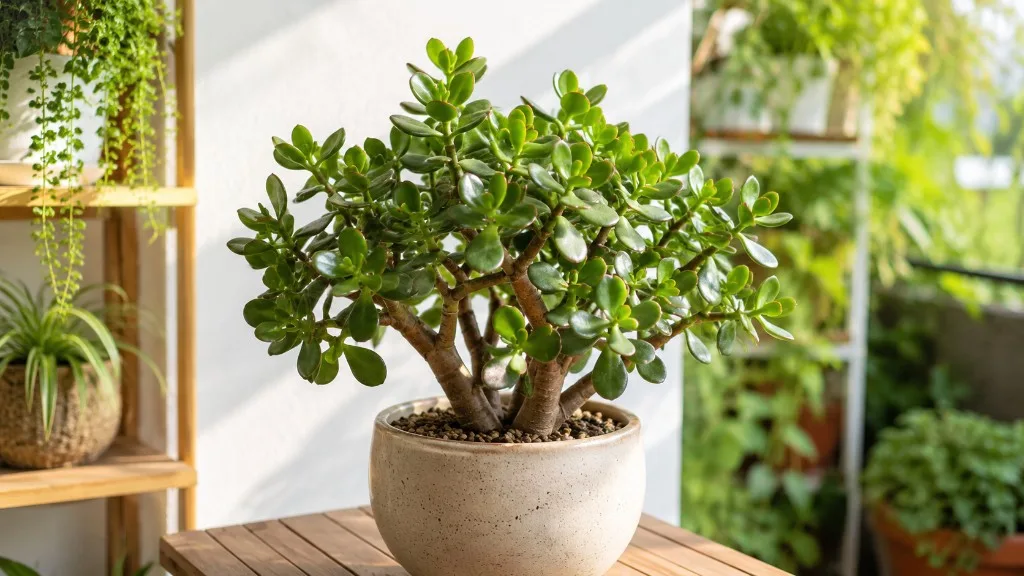
Jade plants are the classic succulent — thick, glossy, oval leaves on a woody stem, often passed between family members as cuttings. The ASPCA lists jade plant as toxic to dogs. The specific toxin has not been fully characterized in the veterinary literature, but clinical signs in dogs include vomiting, depression, incoordination, and in some cases a slowed heart rate.
The slow heart rate (bradycardia) distinguishes jade plant toxicity from most other common houseplant poisonings. Where calcium oxalate plants cause oral pain and saponin plants cause vomiting, jade plant can produce neurological and cardiac effects that are harder to detect at home. A dog that seems unusually lethargic or uncoordinated after possible plant ingestion should be evaluated by a veterinarian.
Jade plants are typically small enough to fit on windowsills, desks, and shelves — placement that is usually above dog height, which is protective. The risk increases when a jade plant grows large and is moved to the floor, or when leaves drop and are accessible on the ground.
Safety note: Fallen leaves are the most common route of ingestion. Jade leaves detach easily and can sit on the floor for days before being found by a dog. Sweep up dropped leaves regularly, especially after repotting or moving the plant.
Useful care guides:
- Jade Plant care guide
- Jade Plant watering guide
- Jade Plant light guide
- Jade Plant propagation guide
- Jade Plant problems guide
What to Do If Your Dog Eats a Toxic Plant
If you see your dog eating a plant — or find evidence they have — here is what to do, in order:
Step 1: Remove your dog from the plant immediately. Get them away from any remaining plant material so they cannot ingest more.
Step 2: Identify the plant or collect a sample. Take a photo of the plant, grab a fallen leaf, or collect a sample of any vomit. If you know the plant’s name, write it down. The more accurately you can identify what your dog ate, the more targeted the veterinary treatment can be.
Step 3: Assess severity. Use this rough triage:
- Immediate emergency (go to the vet now): Sago palm ingestion of any amount; any plant if your dog is having seizures, collapsing, or struggling to breathe; any plant if your dog loses consciousness.
- Urgent (call the vet or go within hours): Aloe vera, dieffenbachia (due to airway risk), English ivy, peace lily, jade plant, or any plant if your dog is vomiting repeatedly, seems disoriented, or has significant facial swelling.
- Prompt veterinary consultation (call the vet for guidance): Pothos, philodendron, monstera, snake plant, dracaena, syngonium, ZZ plant, schefflera, alocasia — especially for small dogs, puppies, or if you’re unsure how much was eaten.
Step 4: Call the ASPCA Animal Poison Control Center at (888) 426-4435 or the Pet Poison Helpline at (855) 764-7661. Both are available 24/7. Have the plant name (or a description), your dog’s approximate weight, and an estimate of how much they ate ready. These services will give you a case number that your veterinarian can reference.
Step 5: Do not induce vomiting unless instructed by a veterinarian. With calcium oxalate plants, vomiting can re-expose the esophagus and throat to the crystals, causing additional damage. With sago palm, the toxin is absorbed quickly, and the benefit of vomiting must be weighed by a professional.
Step 6: Go to the veterinarian or emergency clinic. Bring the plant sample, the poison control case number, and any relevant information about when ingestion happened and what symptoms you have observed. Even if your dog seems fine, some toxins (like cycasin in sago palm) cause delayed organ damage that early intervention can mitigate.
How to Keep Plants and Dogs in the Same Home
You do not have to choose between plants and a dog. You do have to be intentional about placement.
Elevate. Hanging baskets, tall plant stands, wall-mounted shelves, and ceiling hooks put plants where dogs physically cannot reach them. For trailing plants like pothos, keep vines trimmed above jump-and-snatch height. A standing dog on hind legs can reach surprisingly high — do not underestimate vertical reach.
Separate rooms. A door is the most reliable barrier. Keep toxic plants in rooms your dog does not access when unsupervised. A spare bedroom, a closed-off home office, or a bathroom with a window can become a plant room.
Barrier furniture. Tall, heavy plant stands behind a sofa or armchair create a physical gap between dog and plant. Glass-door cabinets (like IKEA greenhouse cabinets popular in the plant community) provide full enclosure while maintaining visibility and humidity.
Sweep up fallen leaves. A single dropped pothos leaf can sit on the floor for days and be chewed by a bored dog. After watering, repotting, or pruning, check the floor and dispose of any plant debris.
Train “leave it.” A solid “leave it” cue will not prevent every ingestion — dogs are fast and plants are stationary — but it adds a layer of protection for moments when you are present and can intervene.
Know which plants are non-toxic and cluster those in dog-accessible areas. If your main living space is where the dog spends most of their time, fill it with pet-safe plants. Put the pothos, philodendron, and monstera in rooms the dog does not use.
Plants That Are Actually Safe for Dogs
The ASPCA maintains a searchable database of non-toxic plants, and many popular houseplants are on it. These plants are verified as safe for dogs and can be kept at any height without worry:
- Spider Plant — entirely non-toxic, safe at any placement
- Calathea — all prayer plant varieties are dog-safe
- Parlor Palm — non-toxic and low-maintenance
- Areca Palm — safe, feathery, and thrives indoors
- Boston Fern — dog-safe but needs humidity
- Peperomia — all varieties are non-toxic
- Hoya — waxy and trailing, safe for dogs
- African Violet — compact and completely non-toxic
- Baby Rubber Plant (Peperomia obtusifolia) — not a true rubber plant, safe for dogs
- Christmas Cactus — unlike many holiday plants, this one is dog-safe
- Money Tree — safe and popular as a braided floor plant
- Cast Iron Plant — nearly indestructible and non-toxic
- Haworthia — looks like aloe but completely safe
For a more detailed guide on filling your home with plants that will not harm your dog, see LeafyPixels’ pet-safe plant guides.
Common Myths About Dogs and Houseplants
Myth: “My dog doesn’t chew plants, so I don’t need to worry.”
Dogs’ behavior changes. A puppy that ignored plants may develop an interest as an adolescent. A dog that never touched a plant for years may suddenly decide to sample a new plant you brought home. Boredom, curiosity, and the novelty of a new plant in a familiar space can trigger a single exploratory bite that causes real harm.
Myth: “If the plant is toxic, my dog will instinctively avoid it.”
This is dangerously wrong. Dogs do not have an evolved instinct to avoid toxic houseplants because houseplants did not exist in their evolutionary environment. The oral pain from calcium oxalate plants will stop a dog from continuing, but it does not prevent the first bite — and the first bite still causes injury.
Myth: “A small bite won’t hurt a big dog.”
This is true for mild irritants like pothos — a single small bite from a large dog is unlikely to cause more than brief mouth irritation. It is categorically false for sago palm, where a single seed can cause fatal liver failure in a large-breed dog. Severity depends on the toxin, not just the dose-to-weight ratio.
Myth: “If I spray the plant with bitter apple, my dog will leave it alone.”
Bitter deterrent sprays can help, but they are unreliable. The spray wears off, needs reapplication, and some dogs simply do not mind the taste enough to be deterred. Deterrents are a supplement to safe placement, not a replacement for it.
Myth: “Outdoor plants aren’t a problem because my dog doesn’t eat plants outside.”
English ivy, sago palm, aloe, and jade plant are all grown outdoors in appropriate climates. A dog that chases a ball into a flower bed or noses through ground cover may incidentally ingest plant material. If you garden and have a dog, the same toxicity awareness applies outdoors as in.
Related Guides
- Safe Plants for Pet-Friendly Homes — a companion guide to filling your home with verified dog-safe plants
- Snake Plant care guide
- Monstera Deliciosa care guide
- Pothos care guide
- Philodendron care guide
- ZZ Plant care guide
- Peace Lily care guide
- Aloe Vera care guide
Conclusion
If you have a dog and want to keep houseplants, start with this: identify every plant in your home. Check each one against the ASPCA toxic plant database. Move anything dangerous out of dog-accessible areas. Replace the worst offenders — sago palm first and foremost — with verified safe alternatives.
The 15 plants on this list span a wide range of risk. Sago palm demands removal from any home with a dog. Calcium oxalate plants like pothos, philodendron, and monstera can be safely kept with elevation and separation. And dozens of genuinely safe plants — calathea, spider plant, parlor palm, peperomia, hoya — can fill your home without any risk at all.
You probably will not get rid of every mildly toxic plant, and for most dog owners, that is a reasonable decision if those plants live on high shelves behind a closed door. What matters is knowing which plants you own, understanding their real risk level, and making deliberate placement choices. The goal is not a plant-free home. It is a home where plants and dogs coexist without an avoidable emergency vet visit.
This guide was written using toxicity data from the ASPCA Animal Poison Control Center toxic plant database, ASPCA Pet Health Insurance resources, and Pet Poison Helpline guidance. Toxicity information was current as of July 2026. If you believe your dog has ingested a toxic plant, contact the ASPCA Animal Poison Control Center at (888) 426-4435 or your veterinarian immediately.