12 Common Types of Birch Trees to Grow
Compare 12 birch trees by bark, size, moisture, climate, and pest risk so you can choose a beautiful tree that fits your yard.
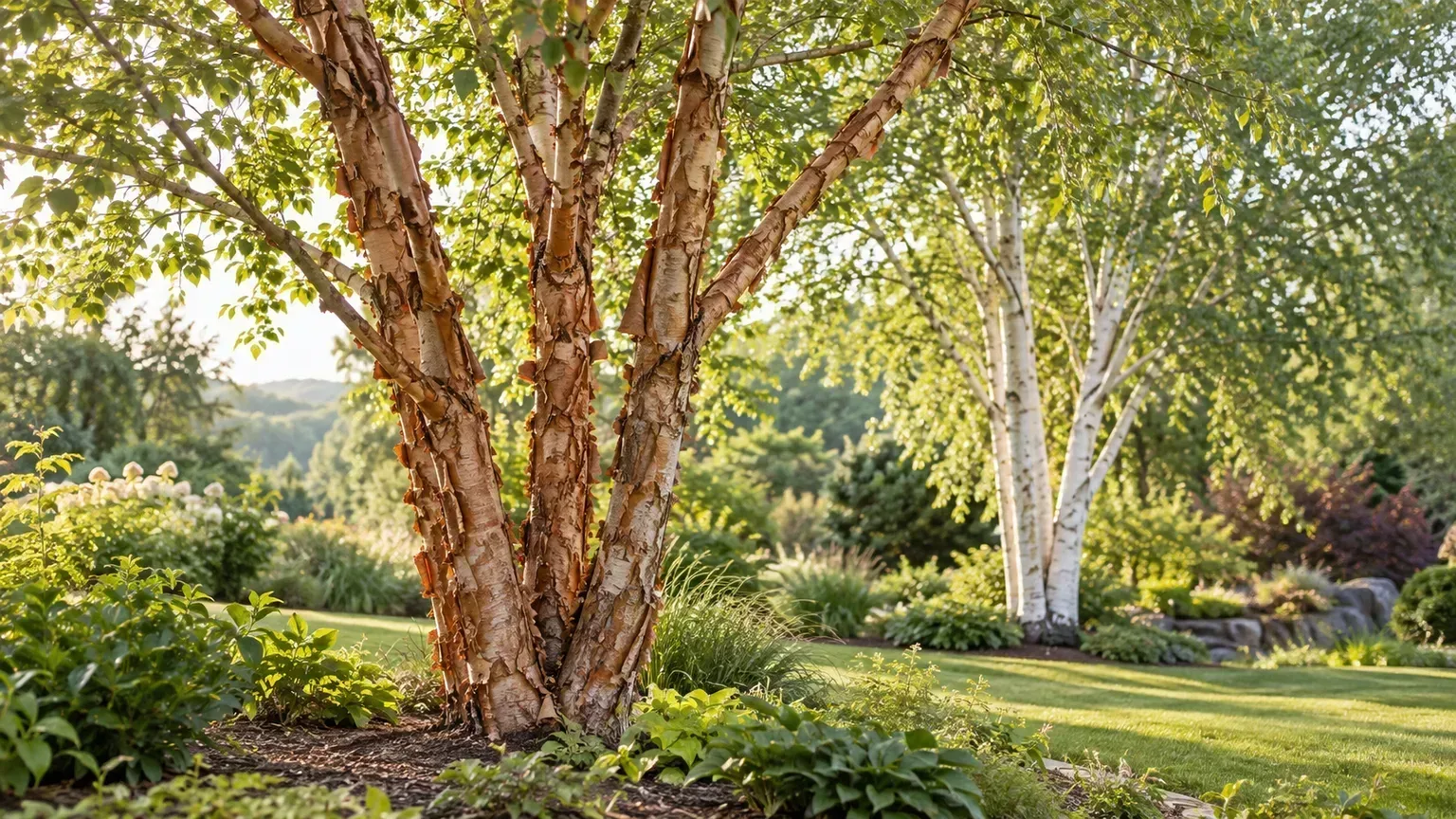
Birch trees are easy to recognize but surprisingly easy to choose badly. The peeling bark, open canopy, yellow fall color, and spring catkins are tempting in a nursery, yet a paper birch in a hot, dry yard can struggle while a river birch in that same region may settle in beautifully. The best birch is the one whose natural habitat resembles the difficult parts of your property.
This guide compares 12 common birch species and cultivar groups by bark, mature habit, soil moisture, climate, and maintenance risk. Use it as a shortlist, not a promise that every tree will perform everywhere. A healthy start, adequate water while roots establish, and enough room for the mature canopy matter just as much as the name on the plant tag.
Birch is also a seasonal design plant, not only a trunk color. A Fine Gardening seasonal birch feature shows how white bark can stay visually useful through winter while the canopy and surrounding planting change through the year.
How to Choose a Birch Before You Fall for the Bark
Start with the site. Walk the proposed planting area after a heavy rain and again during a dry spell. Is the soil damp but breathable, briefly flooded, or bone dry by midsummer? How many hours of direct sun reach the trunk? Will the mature branches clear the house, driveway, utility lines, and gutters? Those answers eliminate more unsuitable birches than a hardiness-zone map alone.
Moisture, Heat, and Mature Size Matter More Than a Hardiness Zone
Most birches prefer consistent moisture, but “moist” does not always mean waterlogged. River birch can handle wet sites and periodic flooding far better than many white-barked birches, while bog birch belongs in a wet shrub or rain-garden role rather than a dry lawn. A well-drained soil that stays cool is often the sweet spot: roots have water to use, but they are not starved of oxygen.
Summer heat changes the calculation. NC State’s plant profile describes river birch as one of the more heat-tolerant and culturally adaptable birches, especially in the South, while also warning that it can shed interior leaves during drought and hot, humid weather. That is a useful distinction: heat tolerance does not remove the need for irrigation during establishment.
Mature size is the second filter. A “small” birch may still reach the roofline in a few years, while dwarf and bog birches are shrubs that fit a very different design job. Read the nursery tag for mature height and spread, then add room for branchlets, leaf litter, and root competition. Do not select a tree from a photograph that hides the scale of the surrounding garden.
Where a Birch Fits in a Yard—and Where It Does Not
Birches work well as a specimen, a loose group, a rain-garden tree, or a woodland-edge planting where their open crowns let dappled light reach plants below. BBC Gardeners’ World notes that birches can grow quickly without casting dense shade, which is one reason they can work in medium-sized gardens when the species and cultivar are chosen carefully.
They are a poor fit beside foundations, narrow paths, overhead wires, or a roof whose gutters cannot tolerate falling twigs and catkins. Their roots are near the soil surface, so turf and thirsty perennials planted directly under a birch may compete for the same moisture. If you want a tidy, low-litter tree in a tightly paved courtyard, choose a different tree rather than trying to train a birch into a shape it does not naturally hold.
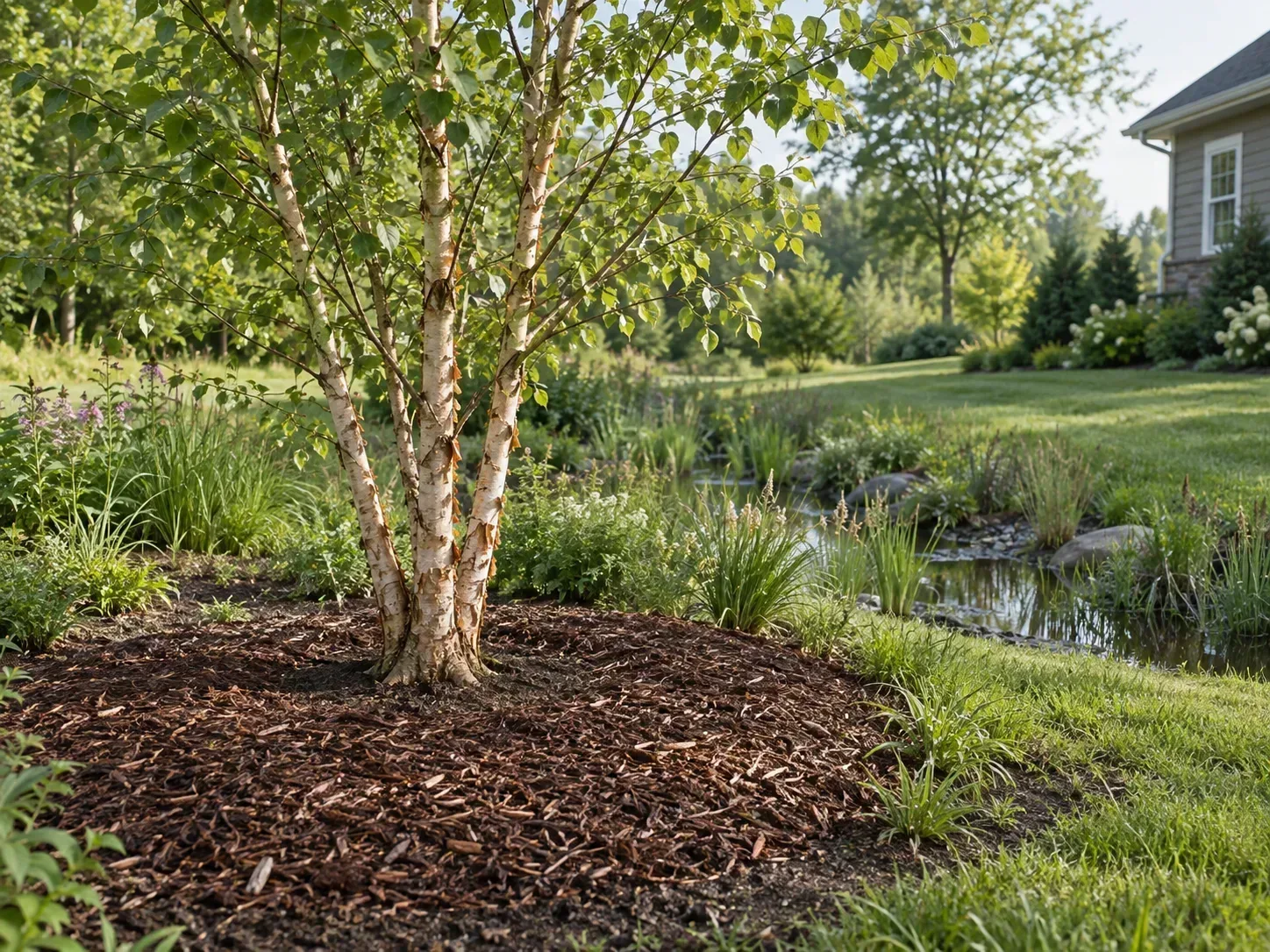
12 Birch Types and Cultivars
The entries below mix species with recognizable cultivar groups because that is how gardeners encounter birches in nurseries. “Best for” describes a reasonable landscape use, not a universal ranking. Before buying, confirm the scientific name, cultivar, mature dimensions, and local availability.
1. River Birch
River birch (Betula nigra) is the strongest all-around choice for warm regions, wet ground, and gardeners who want exfoliating bark without forcing a cool-climate tree into a stressful site. Young trunks range from salmon to cinnamon brown and peel to reveal lighter inner bark; the tree may grow as a single trunk or a multi-stem clump, and the foliage turns a modest yellow in fall.
It suits full sun to part shade and moist, acidic, sandy, rocky, well-drained loam. NC State’s river birch profile describes it as a native tree that tolerates extended flooding and is the native birch that performs well at low elevations in the South. The same profile recommends keeping the root zone consistently moist and cool with deep watering and bark mulch, and it notes that the tree can drop twigs and interior leaves during dry stress.
Choose river birch for a rain garden, streamside edge, naturalized lawn, or hot-summer yard where a white birch would be a gamble. ‘Cully’ or ‘Heritage’ is often sold for its attractive bark and adaptable landscape habit, but verify the cultivar’s mature size before planting a group. River birch is less susceptible to bronze birch borer than many white birches, not immune to every pest or disease.
2. Paper Birch
Paper birch (Betula papyrifera) is the classic white-barked birch of northern forests. Its thin bark peels in papery layers, often becoming whiter with age, and its yellow fall color and open crown make it a strong choice for cool northern landscapes. It may be grown as a single trunk or a small clump.
Paper birch prefers cool summers, full sun to light shade, and moist but well-drained sandy or loamy soil. It is a poor choice for a hot, drought-prone site with reflected heat from pavement. Give it deep soil moisture, protect the root zone from turf competition, and avoid pruning or wounding the trunk unnecessarily.
The trade-off is pest pressure. White birches are generally more vulnerable to bronze birch borer when stressed than river birch, so the tree’s famous bark should not be the only reason you buy it. If your site is warm or routinely dry, use river birch or a non-birch tree instead.
3. Himalayan Birch
Himalayan birch (Betula utilis, especially var. jacquemontii) is grown for brilliant white bark, a tidy upright or pyramidal habit, spring catkins, and yellow autumn leaves. It makes a striking specimen or a small group in a contemporary lawn or woodland-edge design, and multi-stem forms can bring a lighter, more sculptural look.
BBC Gardeners’ World’s Himalayan birch guide describes Himalayan birch as relatively compact compared with some silver birches, while still reaching more than 10 meters in height and about 6 meters in spread within 15–20 years under favorable conditions. That is compact in a tree collection, not in a small courtyard. Give it room from buildings and plan for a substantial canopy.
Choose a cool, moist site with sun or light shade. Keep new trees watered through dry spells for the first couple of years, and prune only when necessary in late summer or early autumn. ‘Grayswood Ghost’ and ‘Silver Shadow’ are popular white-barked forms, but cultivar names do not cancel the species’ susceptibility to heat, drought, or borer stress.
4. Silver Birch
Silver birch (Betula pendula) has white bark, fine hanging branchlets, and a naturally airy, pendulous outline. It is native to Europe and Asia and is often sold as a European white birch or weeping birch, although not every silver birch has a strongly weeping form. Leaves turn yellow in fall and the tree is especially effective when its trunk is backlit in winter.
This species prefers full sun and medium to moist, well-drained, often sandy soil. It is better suited to cool climates than to hot, dry ones. Expect a tall tree unless you select a named compact or weeping cultivar, and remember that a narrow crown at the nursery can broaden as the tree matures.
Silver birch can be beautiful, but it is not the default answer for a warm landscape. If summer drought is common, its stress can increase pest risk and shorten the period of good performance. Use it where the climate and soil make the tree easy, not where irrigation must constantly rescue it.
5. Yellow Birch
Yellow birch (Betula alleghaniensis) is a large, single-trunk northeastern North American tree with yellow-bronze bark that peels in narrow horizontal strips. It is valued as a long-lived forest tree, a wildlife resource, and a source of fall color, but its mature size makes it a poor choice for most tiny residential lots.
Give yellow birch fertile, well-drained sandy loam, consistent moisture, and full sun to part shade. It is at home in cool woodland conditions and can live far longer than the short-lived birches often planted as quick landscape accents. Its form and scale are best in a spacious naturalized garden, large property, or carefully planned woodland edge.
Buy this species for its ecological and long-term character rather than for a bright white trunk. The bark is more golden and bronze than paper-white, and the tree will reward patience more than aggressive pruning or a tightly manicured lawn setting.
6. Gray Birch
Gray birch (Betula populifolia) is a smaller North American birch that commonly forms multiple trunks and reaches roughly 20–40 feet. Its white to gray bark, triangular leaves, and yellow fall color give it the birch look without the scale of a mature yellow or paper birch.
It prefers full sun to partial shade and tolerates a range of soils, including occasional dampness if drainage remains adequate. Gray birch can be useful for a cool-climate grouping, a naturalized edge, or a smaller property where a huge canopy would be out of proportion.
Do not interpret “adaptable” as “drought proof.” Like other birches, gray birch benefits from steady moisture while young and from a mulch ring that keeps grass away from the shallow root zone. Its multi-stem habit also needs room to look intentional rather than crowded.
7. Sweet Birch
Sweet birch (Betula lenta), also called cherry birch or black birch, has shiny red-brown bark that develops scaly vertical plates with age. Crushed twigs have a wintergreen fragrance, and the species supports wildlife with catkins, seed, and browse. Its glossy leaves turn yellow in autumn.
This is a large eastern North American tree for a single-trunk lawn, woodland edge, or naturalized property. Plant it in moist, well-drained acidic soil—sandy, rocky, or loamy—and give it full sun to part shade. It is not a compact substitute for a paper birch; its mature height and spread need to be respected.
Sweet birch is a good choice when you want fragrance, wildlife value, and darker bark rather than a glowing white trunk. It also demonstrates why “birch” should not be treated as a synonym for one appearance: bark texture, size, and habitat differ dramatically within the genus.
8. Japanese White Birch
Japanese white birch (Betula platyphylla var. japonica) has white bark, spreading branches, and drooping branchlets that create a light, elegant crown. It is native to parts of East Asia and is often chosen for a refined specimen or group planting in cool-temperate gardens.
Full sun gives the best growth, although some afternoon shade can help in warmer exposures. The non-negotiable is consistent soil moisture with good drainage. A site that alternates between saturated clay and baked summer soil is a poor match, even if the tree is technically hardy there.
This birch can work in a northern or eastern exposure where afternoon light is filtered, but warm zones increase stress and borer risk. Mulch the root zone, irrigate deeply during dry periods, and avoid planting it simply because the tag says “white bark.”
9. Water Birch
Water birch (Betula occidentalis, also called B. fontinalis) is a western North American streamside birch that often grows as a dense shrub or small tree. Its bark is dark red-brown to blackish and generally smooth rather than papery, so it is a poor pick if your main goal is a peeling white trunk.
Choose water birch for a naturally wet, mountainous or stream-like site where dense branching and bank stabilization fit the design. It can reach about 25 feet in shrubby form and more as a tree, but its final habit depends heavily on the site. A dry ornamental border is not an appropriate substitute for its natural habitat.
This species is valuable when you want to support a riparian planting and accept a less polished, more thicket-like appearance. Leave room for wildlife and do not force it into a formal specimen role that conflicts with its growth habit.
10. Bog Birch
Bog birch (Betula pumila) is a clump-forming North American shrub for wet sites, pond edges, and rain gardens. It is much smaller than the headline birch trees, generally staying around 5–10 feet, and it tolerates occasional flooding, clay, alkaline soil, and road salt better than many birches.
Use bog birch when you need a wet-site shrub with multi-stem structure rather than a tall shade tree. Full sun and reliable moisture help it hold a dense, useful form. Because it is short-lived compared with some woodland birches, it makes most sense as part of a layered wetland or rain-garden planting rather than as the only permanent focal tree.
Its tolerance has limits. A rain garden should drain between storms, and even a flood-tolerant plant needs oxygen around roots for long-term health. Test the site’s drainage before assuming any wetland plant will solve standing-water problems.
11. Dwarf Birch
Dwarf birch (Betula nana) is a small arctic and cool-temperate shrub, not a miniature version of a 70-foot landscape birch. Depending on conditions it may stay only inches to a few feet tall, with a low, shrubby habit suited to rock gardens, alpine plantings, cold-climate borders, or specialized bog-like sites.
It prefers full sun and moist but well-drained, often acidic and nutrient-poor soil. Shade, rich dry soil, and hot summer conditions work against its natural growth pattern. In much of the United States it is a collector’s or habitat plant rather than the easiest garden-center choice.
Buy dwarf birch only when its small scale and cool-climate requirements solve a real design problem. If you want a white trunk with a tree-like canopy, choose a different entry from this list.
12. Weeping Birch Cultivars
Weeping birch is a cultivar group rather than one single species. Many forms are selections of silver birch, including ‘Youngii’, ‘Tristis’, ‘Laciniata’, and other cultivars with pendulous, cutleaf, purple, or golden foliage. Their final height, spread, hardiness, bark color, and pruning needs depend on the exact cultivar and sometimes on the height of the graft.
‘Youngii’ forms a low domed crown with branches that cascade toward the ground, making it useful as a specimen in a lawn or as a focal point near a path. ‘Laciniata’ offers incised foliage and a more pendulous outline without the same dramatic umbrella form. A weeping habit does not make the root system smaller, so always check the mature spread and keep the tree away from paving and foundations.
When shopping, insist on the full botanical name and cultivar. “Weeping birch” on its own is not enough information to judge size or climate fit. This is the category where a nursery label can save you from years of trying to correct the wrong tree.
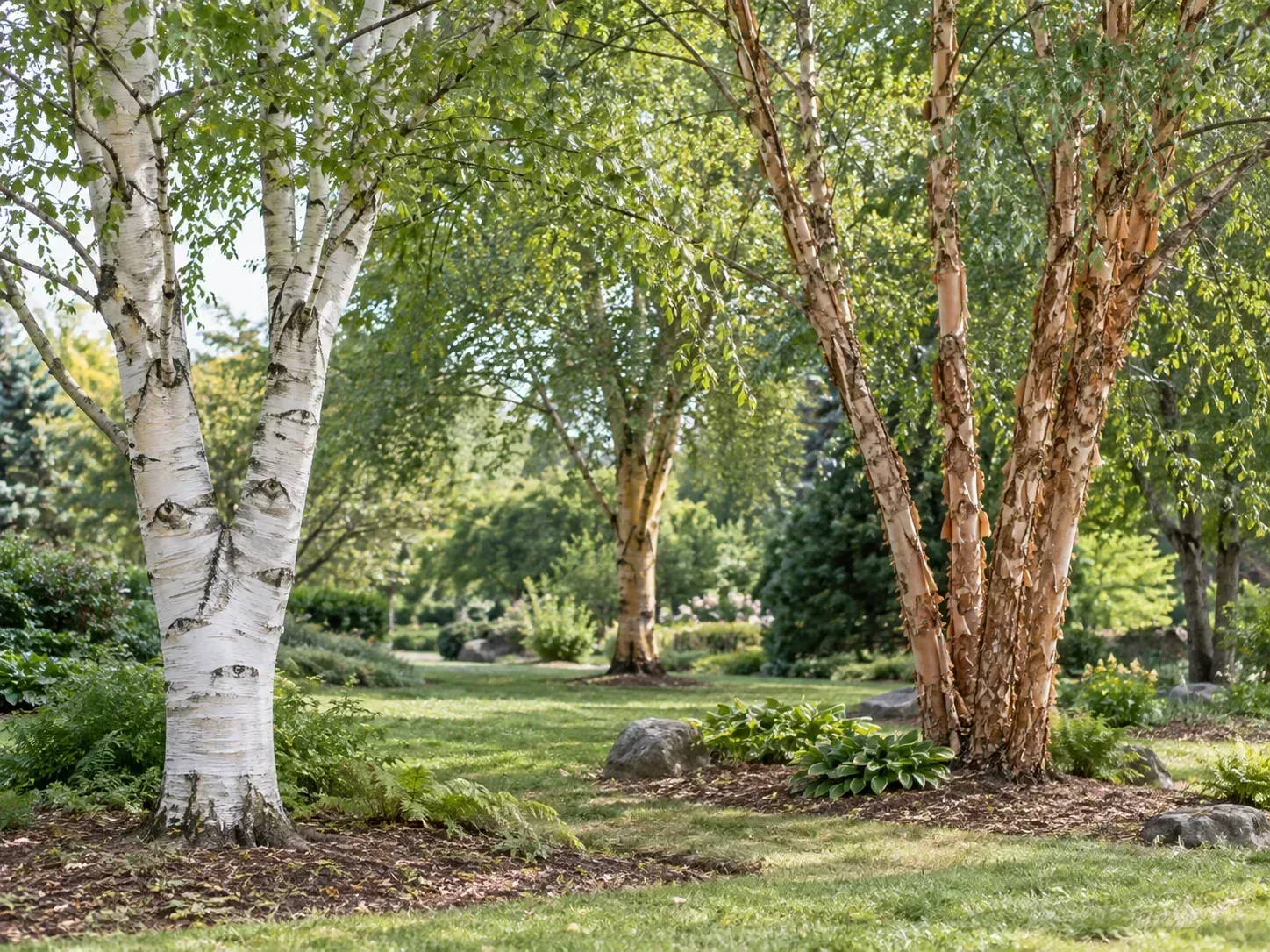
Planting and Caring for a Birch Tree
Plant a birch in autumn when the tree is dormant or in early spring before strong new growth, unless your local climate and nursery stock suggest another window. Container-grown trees can be planted more flexibly, but they still need reliable water through spring and summer. Bare-root trees should be moved only during dormancy and planted promptly.
Dig a hole no deeper than the root ball and at least twice as wide. Set the root flare at soil level or slightly above the surrounding grade; burying the flare creates a chronic moisture and decay problem. Backfill with the excavated soil, water slowly to settle air pockets, and do not amend the hole into a rich pocket that encourages roots to circle rather than move outward.
Keep grass and weeds away from the trunk in a broad circle. Apply a shallow layer of bark or leaf mulch over the root zone, but leave a visible gap around the trunk so bark stays dry. Mulch moderates temperature and slows evaporation; it does not compensate for a tree planted too deep or placed in soil that stays saturated.
During the first growing season, water thoroughly whenever the upper soil begins to dry rather than sprinkling the leaves daily. In the second year, continue watering during extended dry spells, especially for white-barked species and any tree planted in lawn or near pavement. A soaker hose or slow drip at the outer root zone is more useful than a quick splash at the trunk.
Birches usually need little routine pruning. Remove dead, broken, crossing, or badly placed branches, and make clean cuts just outside the branch collar. Avoid topping: it destroys the natural crown, produces weak water shoots, and can leave the tree more stressed and vulnerable. BBC Gardeners’ World’s growing guidance recommends avoiding topping and gives cultivar-level examples of upright, pendulous, and multi-stem forms; local arborist guidance should take priority for large branches.
Do not fertilize a stressed birch by default. First correct water competition, planting depth, mulch, or drainage. Excess nitrogen can produce lush, soft growth without fixing drought stress, and NC State Extension’s bronze birch borer guidance specifically advises avoiding heavy fertilization around birches where the pest is a concern.
Birch Problems: Borers, Drought, and Wet-Soil Misfits
The bronze birch borer (Agrilus anxius) is the risk that makes site selection more than an aesthetic exercise. NC State Extension explains that the beetle tends to attack stressed birches, with drought, defoliation, and other adverse conditions weakening the tree. River birch has lower susceptibility than many white birches, while paper birch and other stressed or poorly matched trees are more vulnerable.
Watch for thinning or dieback in the upper crown, D-shaped exit holes, bark cracks, and serpentine galleries beneath the bark. These symptoms can have several causes, so do not start an insecticide program from a photograph alone. Keep the tree watered through drought, protect its roots from compaction, avoid unnecessary trunk wounds, and ask a qualified arborist or local extension office to confirm the diagnosis before treatment.
Leaf miners, aphids, birch skeletonizers, leaf spots, and powdery mildew can also occur. A few insects or spotted leaves do not automatically justify spraying; assess whether the canopy is losing significant function, whether the problem is spreading, and whether cultural stress explains the symptoms. Chemical treatments have to match the pest, timing, label, and site, especially around ponds and streams.
The other common failure is choosing the wrong moisture profile. A river birch can be unhappy in a bone-dry lawn, and a bog birch can be unhappy in a raised, fast-draining bed. If a tree repeatedly wilts despite deep watering, drops large amounts of interior foliage, or develops chronic dieback, reconsider the site and species rather than assuming it needs more fertilizer.
Conclusion
The most useful way to compare types of birch trees is to start with the property and work toward the bark. Pick river birch for heat, wet soil, and adaptable native performance; paper, Himalayan, silver, Japanese white, or gray birch for cooler sites where white bark is realistic; yellow or sweet birch for spacious woodland settings; and bog, water, or dwarf birch when a specialized shrub or wet-site role is the real goal.
Whatever you choose, confirm the mature size, plant the root flare at grade, keep the root zone consistently moist while the tree establishes, and never top the canopy to make a large birch fit a small space. A well-matched birch gives you bark, catkins, fall color, open shade, and wildlife value for years; a poorly matched one gives you a recurring irrigation and pest problem with attractive bark attached.