12 Common Willow Tree Species and Shrubs
Compare 12 willow tree species and shrubs by size, water needs, catkins, roots, and landscape use before you plant one near your home or pond.
Willows are not one landscape plant repeated 12 times. The genus Salix includes low, flexible shrubs, colorful-stemmed border plants, floodplain natives, and broad trees that can outgrow a residential yard quickly. The Royal Horticultural Society’s willow profile describes the genus as deciduous shrubs and trees with very different habits, while the USDA Plants Database profile for Salix treats the genus as a broad group rather than a single landscape formula.
That range is useful, but it makes the nursery label important. A compact dappled willow and a 50-foot weeping willow may share the word “willow” and a preference for moisture, yet they create completely different root, shade, pruning, and storm-risk decisions. Use the list below to match the species to a real site—not just to choose the prettiest photograph.
How to choose a willow before you plant it
Start with mature size and water, not the branch shape
First decide whether the planting site has room for a tree, a shrub, or only a container-sized ornamental. Large willows are fast-growing and often short-lived compared with slower landscape trees. Their mature canopy is only part of the footprint: surface roots can extend well beyond it, and soft wood can shed branches during wind, ice, or heavy snow.
Next, describe the soil accurately. “Moist” means the root zone stays evenly damp but still contains air. “Wet” means drainage is slow for long periods. “Standing water” means the soil is saturated or submerged. Some riparian willows tolerate flooding, but a dappled shrub in a poorly drained planting hole is not interchangeable with a native willow established on a floodplain. Choose the plant whose natural habitat resembles the site, and do not use a willow as a cure for a drainage problem beside a foundation.
Treat roots, wood, and local status as design constraints
The Missouri Botanical Garden’s profile of black willow explains why some willows work well for soil binding but are poor residential specimens: their shallow, spreading roots seek moisture, the wood is weak, and the trees become large. The University of Florida IFAS profile of weeping willow gives a useful practical warning: roots can spread roughly three times the distance from the trunk to the canopy edge and may lift paving or interfere with underground lines.
Do not plant a large willow over or beside sewer lines, septic drain fields, water pipes, foundations, retaining walls, or narrow sidewalks. Before digging, locate underground utilities and check local rules for non-native or potentially invasive plants. A native willow from a reputable local nursery may be a better ecological choice than a fashionable cultivar, especially beside a natural wetland. Even native willows need room; “native” does not mean “small.”
12 willow species worth knowing
The entries are grouped by the job they are most likely to do. Heights are useful comparisons, not guarantees: cultivar, climate, soil, pruning, and available water can change the final size. Hardiness zones are also planning ranges, not a promise that a plant will thrive in every microclimate; wind exposure, summer heat, winter wet, and nursery provenance matter. Common names overlap, so confirm the italicized botanical name before buying.
Large, water-edge trees
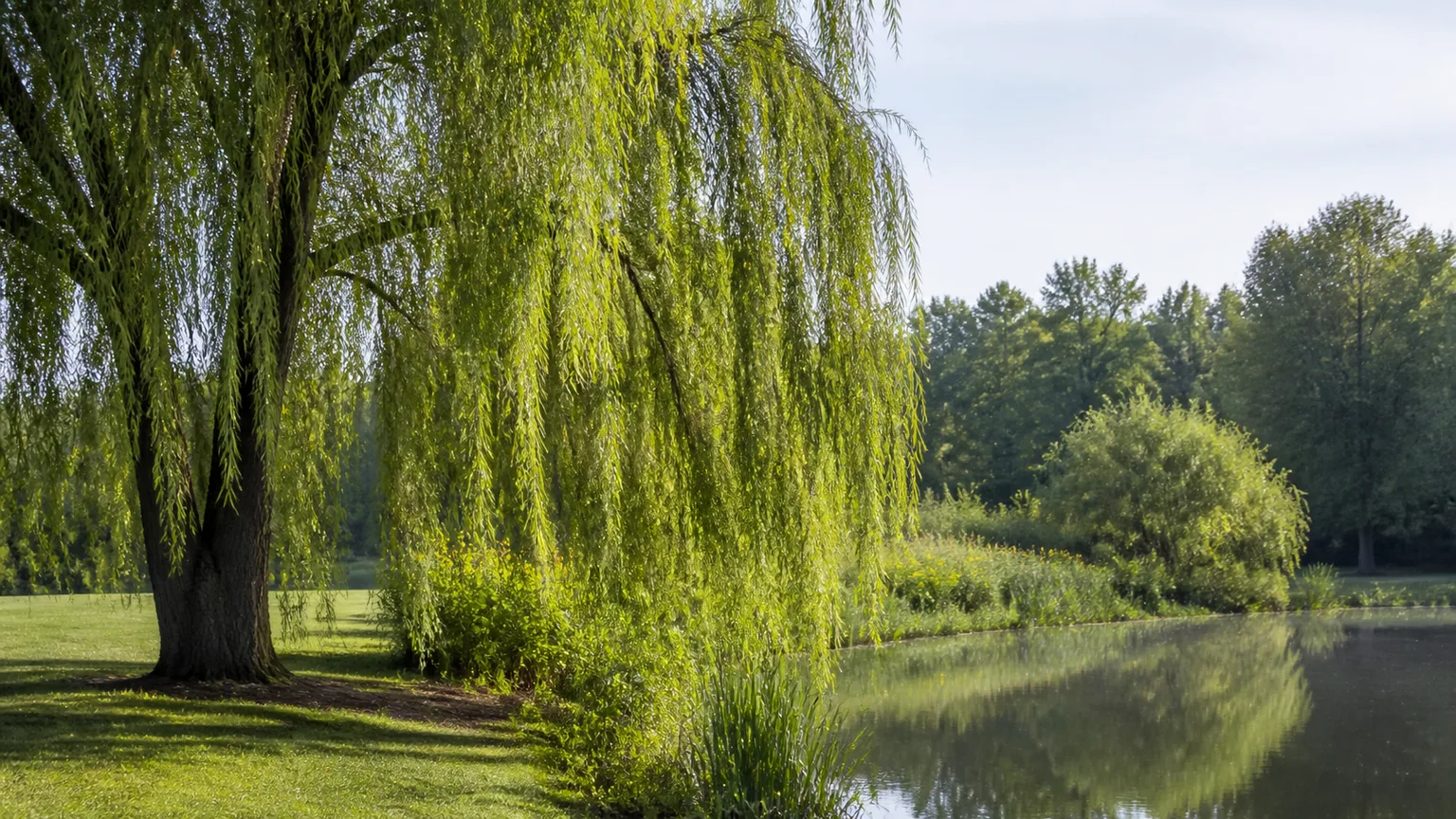
1. Weeping willow (Salix babylonica) is the classic pond-side tree, with long cascading branches and narrow leaves that move in the slightest breeze. It commonly reaches about 30 to 50 feet tall and wide, grows quickly, and looks most convincing as a specimen beside open water or a broad lawn. The IFAS reference notes that it can also grow in a drier site if it receives regular irrigation, but drought often shows as leaf drop. Choose it for scale and silhouette, not for a small garden or a tidy, low-litter patio.
2. Peach-leaf willow (Salix amygdaloides) gets its common name from long leaves that resemble peach foliage. It is a North American tree associated with streams and cottonwood communities, and it can fill a bare, erosion-prone area quickly. That speed is also the trade-off: it is a short-lived, large tree better suited to a naturalized or restoration-style setting than to a formal residential border. Buy it for habitat and soil work only when the site and local plant list support it.
3. White willow (Salix alba) has pale-backed leaves, a broad crown, and showy winter-stem forms such as ‘Tristis’. It can reach roughly 50 to 80 feet, and the Missouri Botanical Garden profile of white willow lists it for medium-to-wet soil while also warning about weak wood, shallow roots, litter, and naturalization in parts of North America. That makes white willow a specialist for a spacious pond edge, low wet spot, or managed restoration site—not a default shade tree for a suburban lawn.
4. Scouler’s willow (Salix scouleriana) is a western North American multi-stemmed tree or large shrub that handles drier conditions better than many willows. It offers browse and cover for wildlife and can stabilize disturbed ground where a locally appropriate native plant is wanted. Its size can approach 20 to 50 feet, so “more drought tolerant” does not mean “safe beside a house.” In the West, ask a native-plant nursery or extension office whether the local form is appropriate before introducing it outside its natural range.
5. Yellow willow (Salix lutea) is a shrub-like willow that can become an upright tree over 20 feet tall. It occurs across parts of central and western North America and is associated with flood repair, erosion control, and browsing wildlife. Its flexible growth and easy reproduction are assets for a streambank project but liabilities in a small ornamental bed. Source plants ethically and keep cuttings contained; a willow that roots readily should not be casually moved into a natural watercourse.
Flexible shrubs and catkin willows
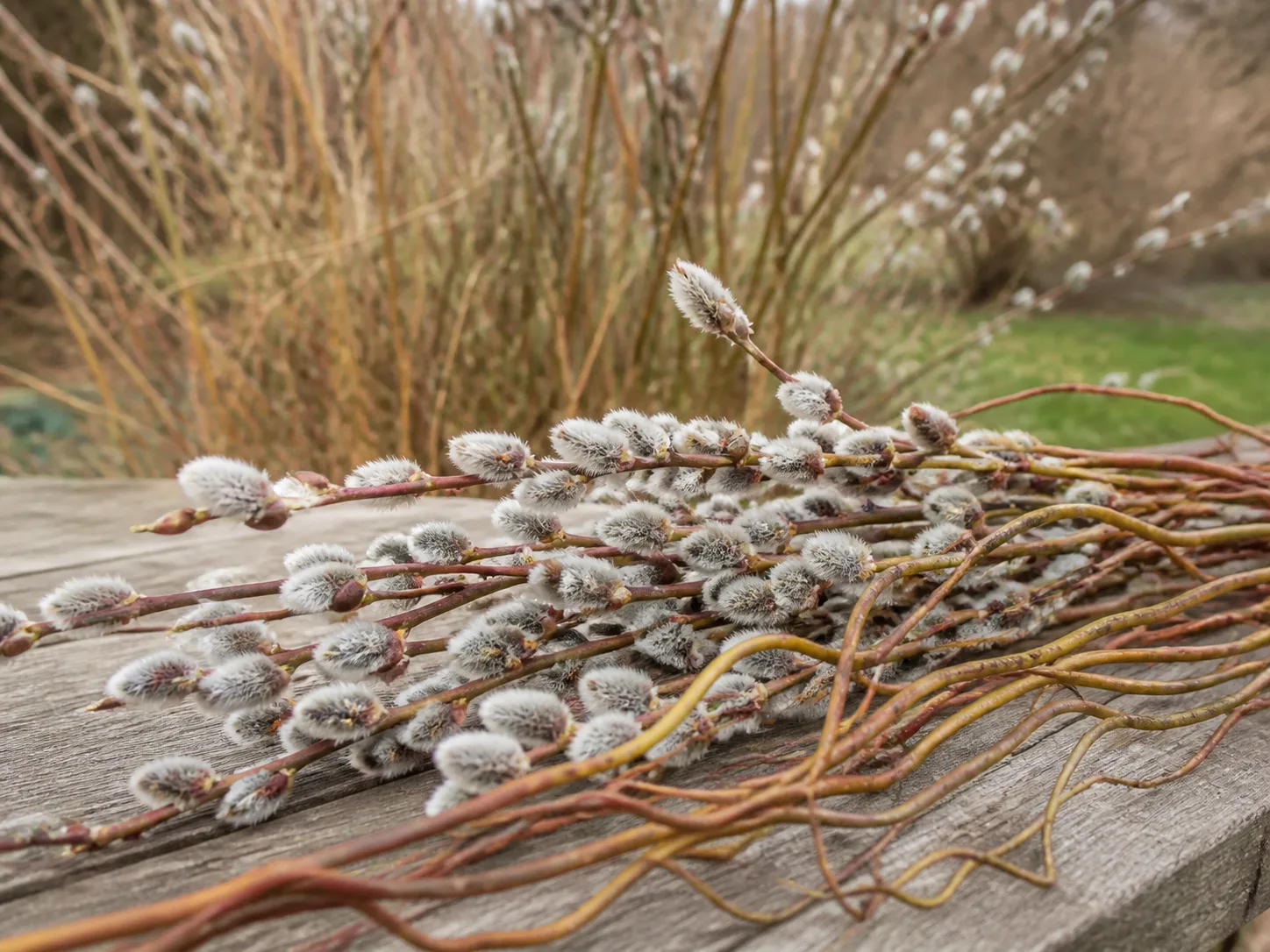
6. Goat willow (Salix caprea) is a European and Asian species grown for its large, soft catkins, often sold under the broader “pussy willow” name. It usually forms a multi-stemmed shrub or small tree around 12 to 25 feet tall. Willow flowers are commonly dioecious, meaning male and female flowers occur on separate plants; the Garden Design overview of willow varieties notes that male goat willows are the ones prized for showy catkins. If branches for arrangements are your goal, verify what the nursery is selling instead of assuming every plant will produce the same display.
7. Pussy willow (Salix discolor) is the North American species most often meant by “pussy willow” in a garden context. It makes a 6- to 15-foot shrub or small tree with silvery catkins on upright stems, and it suits stream edges, wet meadows, rain gardens, and wildlife plantings. Its suckering habit can help bind soil but can also make a bed look untidy. Plant it where a thicket is welcome, then renew older stems in the dormant season rather than trying to force the plant into a permanent clipped ball.
8. Bebb willow (Salix bebbiana) is a northern North American shrub or small tree associated with streams, lakes, bogs, and thickets. It is more valuable as habitat, browse, and a natural bank plant than as a polished specimen. The gray, sometimes diamond-patterned wood has craft interest, but the species can be short-lived and vulnerable to insect and disease damage. Choose it when the landscape goal is ecological transition or naturalized structure, not when you need a perfectly uniform hedge.
9. Narrowleaf or coyote willow (Salix exigua) has slender, gray-green leaves and flexible stems that can be used for poles, living structures, or rustic craft. It is widely distributed across North America and tolerates both extended flooding and periods of drought once established, but its status varies by region. In riparian work, local provenance matters: use stock suited to the watershed and avoid moving material between waterways where it could spread disease or disrupt local genetics.
Ornamental stems and compact forms
10. Corkscrew willow (Salix matsudana ‘Tortuosa’) is grown for its contorted branches, which remain visible after the leaves fall and are popular in winter arrangements. It usually becomes a 20- to 40-foot tree, not a tiny curly shrub, although nursery labels and related cultivars vary. Give it sun, room, and a realistic plan for branch litter. Its twisted structure is a strong reason to plant it, but it does not cancel the root and weak-wood behavior shared by many larger willows.
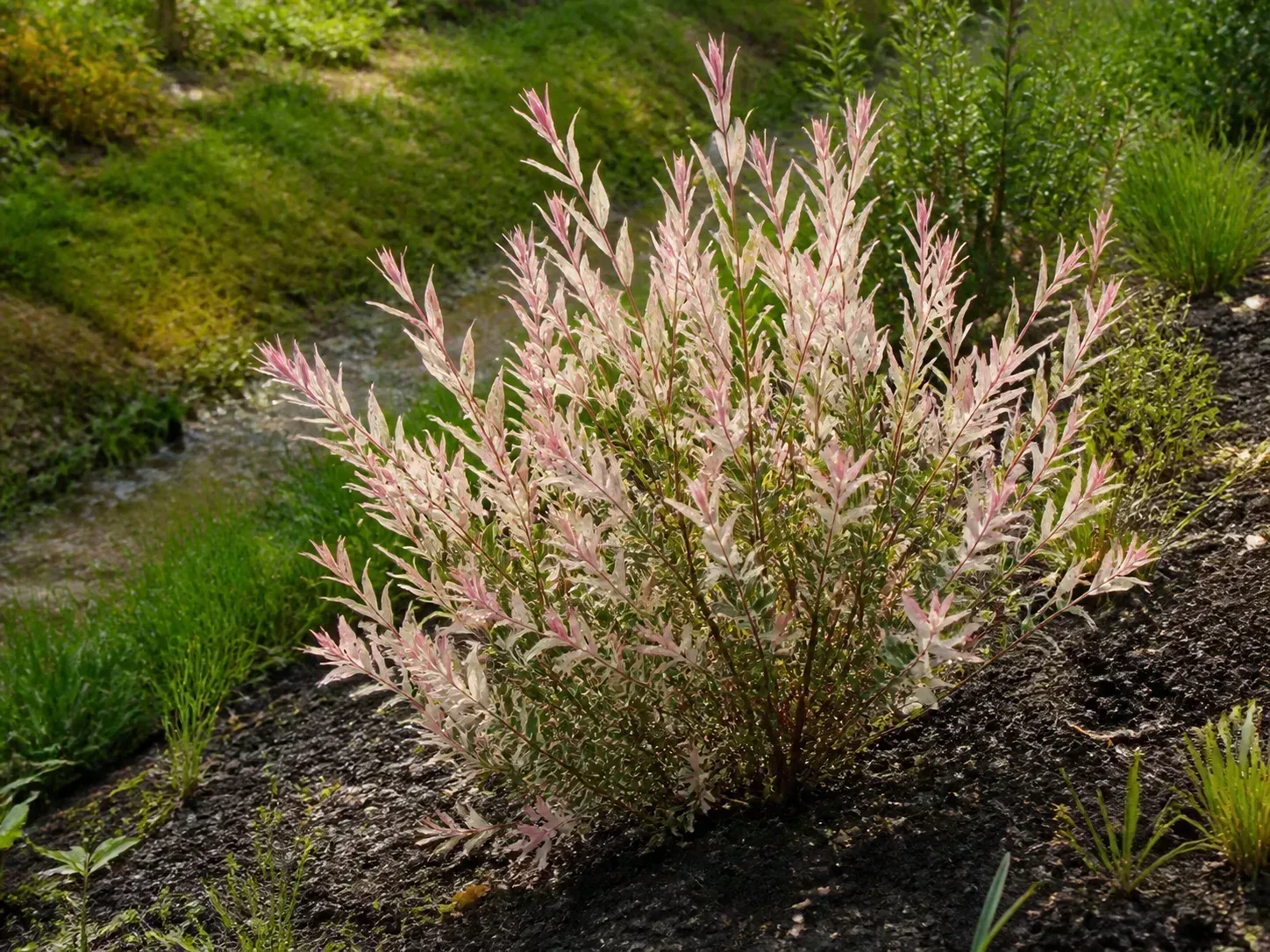
11. Dappled willow (Salix integra ‘Hakuro-nishiki’) is one of the more useful choices for a small landscape when kept as a shrub. New leaves open pink, cream, and green before settling toward green and white, and young stems can add red color in winter. It is commonly kept around 4 to 6 feet through regular renewal pruning, but a neglected plant can become much larger and less colorful. Use it in a sunny, consistently moist bed with enough air movement; do not place it in a tiny foundation pocket where roots and irrigation are trapped.
12. Purple osier willow (Salix purpurea) has narrow blue-green leaves and purple to reddish young stems that make it useful for hedges, baskets, living fences, and erosion control. The species is more tolerant of dry soil after establishment than many willows, though it still performs best with reliable moisture during its first seasons. Compact cultivars are much more manageable than the species. Shear or renew it only when you have room for vigorous regrowth, and check whether the cultivar you want is listed as suitable in your climate.
Match the willow to your landscape job
Best fits for wet soil, erosion, and wildlife
For a pond margin or floodplain-style planting, start with a locally native willow whose natural range includes your region. Pussy willow, narrowleaf willow, yellow willow, Bebb willow, and other local species can provide stems, browse, cover, and root binding. Black willow is another important native example in many eastern and central regions, but it is intentionally not included in the 12 entries above; the Missouri Botanical Garden’s profile makes clear that its mature size and root behavior limit residential use.
For erosion control, the plant must be matched to the failure. A willow can help hold a moist bank, but it cannot replace grading, drainage design, or engineering on a steep slope above a structure. Ask a local conservation district or extension service about planting windows, flood levels, and native stock. A bundle of cuttings from an attractive tree may root, but it may be the wrong species for the watershed.
Best fits for small yards, hedges, and cut stems
For a small yard, begin with dappled willow, a compact purple osier cultivar, or a correctly identified pussy willow. Even these need pruning access and a root zone that is not squeezed between paving and a foundation. If you cannot leave a few feet of open soil around the planting and keep the canopy away from utilities, choose a non-willow shrub with a slower, more predictable root system.
For cut stems, goat willow and S. discolor are the natural starting points. Male plants often have the showier catkins, but labels are not always precise. Ask the grower, buy during the catkin season when possible, and plant more than one only if you have room for the mature spread. Corkscrew and purple osier are better choices when the craft goal is twisted or flexible stems rather than fuzzy catkins.
Native versus introduced willows
Native status is a local question, not a genus-wide label. A species can be native in one region and introduced in another, while a cultivar may have a different growth habit but the same root and water demands. Check your state or provincial invasive-plant list, native-plant society, extension office, or conservation district before planting an introduced willow near a natural wetland.
Do not release willow cuttings into streams, drainage ditches, or public land. Use nursery-propagated stock, clean tools between plants, and dispose of unwanted cuttings in a way that prevents them from contacting wet soil. This is especially important for species that root easily from dormant stems.
Planting and early care that prevents problems
Site, spacing, and planting
Pick the final location before you buy the plant. A site with full sun—roughly six hours or more for most vigorous growth—and consistent moisture is a good starting point, but the species profile decides whether the plant can tolerate shade or flooding. Leave enough space for the mature width, not the width of the nursery pot. Large trees belong in open landscapes where falling branches and leaf litter are acceptable.
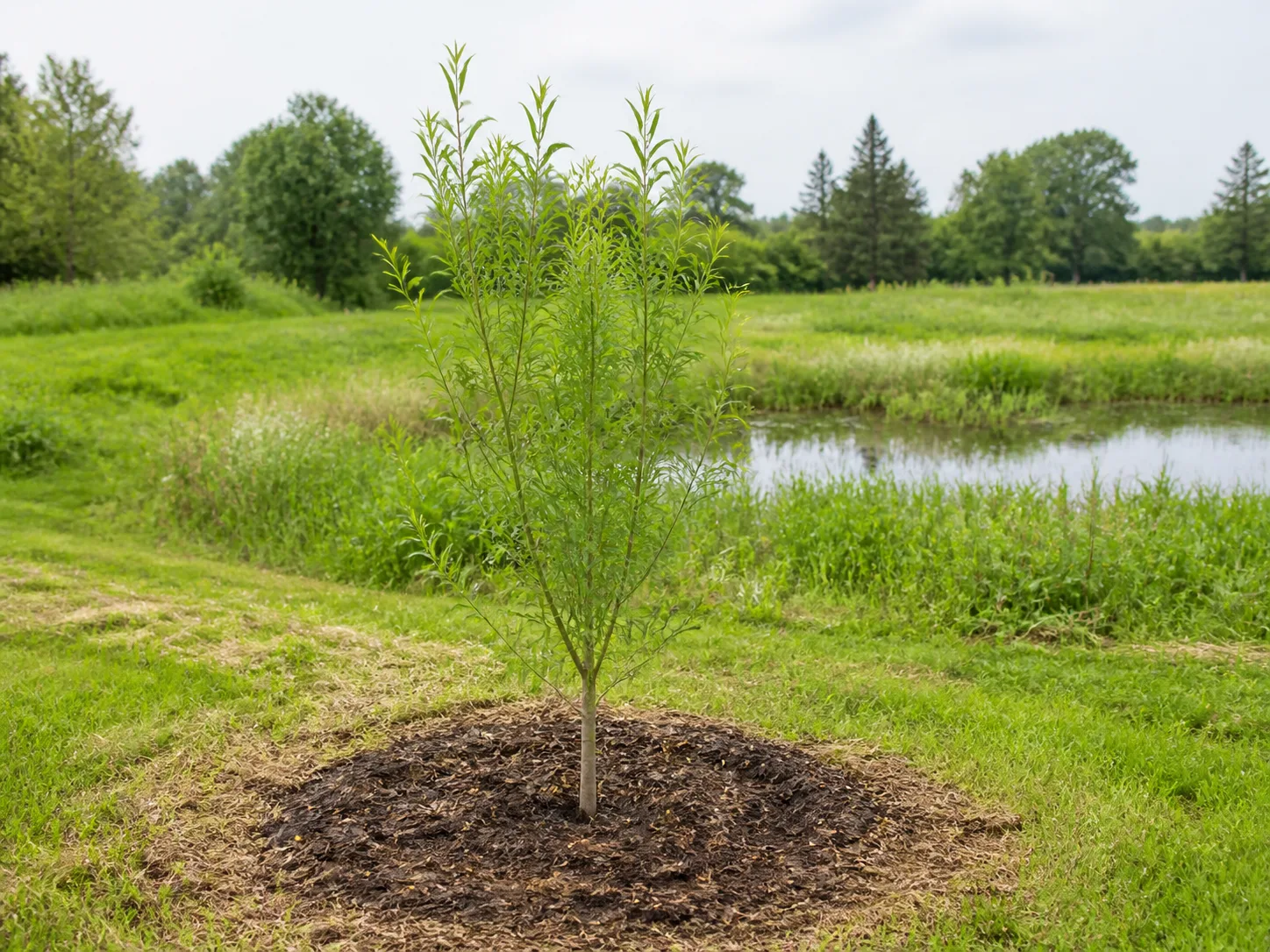
Plant in spring after severe frost has passed or in fall early enough for roots to establish before the ground freezes. Dig a hole about twice the root ball’s width and no deeper than the root ball. Set the top of the root ball level with the surrounding soil, backfill with the excavated soil, water slowly to settle air pockets, and mulch in a broad, thin ring. Keep mulch off the trunk; a wet mulch collar invites decay and hides girdling roots.
Call the utility-locating service before you dig. If a sewer, septic field, water line, or foundation sits in the likely root zone, move the planting or select another species. Do not rely on a root barrier as a universal fix for a large, moisture-seeking tree; barriers can deflect roots but do not eliminate the need for space or maintenance.
Watering, mulch, and fertilizer
Water a new willow deeply enough to moisten the root ball and surrounding soil, then check the soil before watering again. During the first growing season, the goal is consistent moisture, not daily shallow sprinkling. A two- to three-inch layer of organic mulch over the root zone reduces evaporation, but leave a clear gap around the trunk.
Do not fertilize automatically. Willows grow quickly in average soil, and excess nitrogen can push soft, weak shoots that are more difficult to manage. If growth is poor, inspect light, soil moisture, root damage, compaction, and pests first. A soil test is more useful than a random fertilizer application, especially in a rain garden or wetland planting where runoff matters.
Pruning and troubleshooting
Build young structure before you chase size
The best willow pruning is often the pruning done while the plant is young. The Gardening Know How guide to willow pruning recommends working during dormancy, removing damaged wood, choosing a central leader for tree forms, eliminating competing stems, and keeping branch unions open. Those decisions reduce future crowding and make storm damage less likely; they are more effective than removing a large limb years later.
For a young tree, remove broken branches first, then select one upright leader if a single-trunk form is desired. Remove narrow, crowded, rubbing, or inward-growing branches while they are small. For a shrub willow, renew the oldest stems at the base and thin enough new growth to keep air moving. Dappled, pussy, and purple osier willows can tolerate stronger renewal pruning than a mature weeping tree, but the exact cultivar still matters.
Prune in late winter or very early spring before active growth, using clean, sharp tools. Do not top a large willow yourself: indiscriminate heading cuts create weak regrowth and leave large wounds. For a mature tree near a building, road, or overhead line, hire a qualified arborist who can assess branch unions and climbing risk.
Read yellow leaves, dieback, and broken branches
Start with the site, not a spray bottle. Yellow leaves can follow drought, root damage, saturated soil, poor light, or normal seasonal change. Check soil moisture several inches down, look for standing water, inspect the trunk and root flare, and compare affected leaves with healthy new growth. A willow beside a pond can still suffer from root damage if the planting hole stays stagnant and oxygen-poor.
Brown or crispy leaves usually point first to water stress, heat, wind, or root loss. Restore even moisture and protect a young plant from reflected heat, but do not keep adding water if the soil is already saturated. If symptoms spread with spots, cankers, or dieback, prune out affected small branches, remove fallen diseased leaves, and ask an extension office to identify the problem before treating it.
Broken branches are a structural warning, not just a cleanup job. Look for narrow forks, rubbing limbs, included bark, ice loading, and crowded regrowth. Thin young trees gradually, keep pedestrian clearance, and do not make large cuts merely to force a mature willow into a size it was never bred to hold.
Few or dull catkins may reflect the species, the plant’s sex, immature age, poor light, or pruning at the wrong time. Confirm the botanical name and whether the plant is male or female before changing fertilizer. For ornamental catkins, preserve healthy dormant stems rather than stripping the entire shrub of its new growth.
Willows are also easy to propagate from some dormant or semi-hardwood cuttings, which is why they are useful for living fences and restoration work. Take material only from plants you own or have permission to propagate, keep the cutting oriented correctly, and root it in a contained nursery bed with steady moisture. Before planting a rooted cutting outdoors, confirm that the species belongs in your region and that the future root system has room.
Conclusion
The best willow is the one whose mature size, moisture tolerance, root behavior, and local status match the site. Choose weeping, white, peach-leaf, Scouler’s, or yellow willow for spacious water-edge or naturalized settings only when you can accept large growth and branch litter. Choose goat willow or S. discolor for catkins, narrowleaf willow for a locally appropriate riparian project, and dappled or compact purple osier forms when you need a manageable shrub with a clear pruning plan.
Before planting, locate utilities, check local plant guidance, and measure the open root zone. After planting, keep moisture even, mulch correctly, and train young structure while branches are small. Those few decisions do more to make a willow successful—and prevent an expensive removal—than any fertilizer, growth stimulant, or last-minute pruning can do.



