12 Types of Cypress Trees You Can Easily Grow in Your Garden
Compare 12 cypress trees by mature size, climate, water, privacy value, and form before planting the right evergreen for your garden.
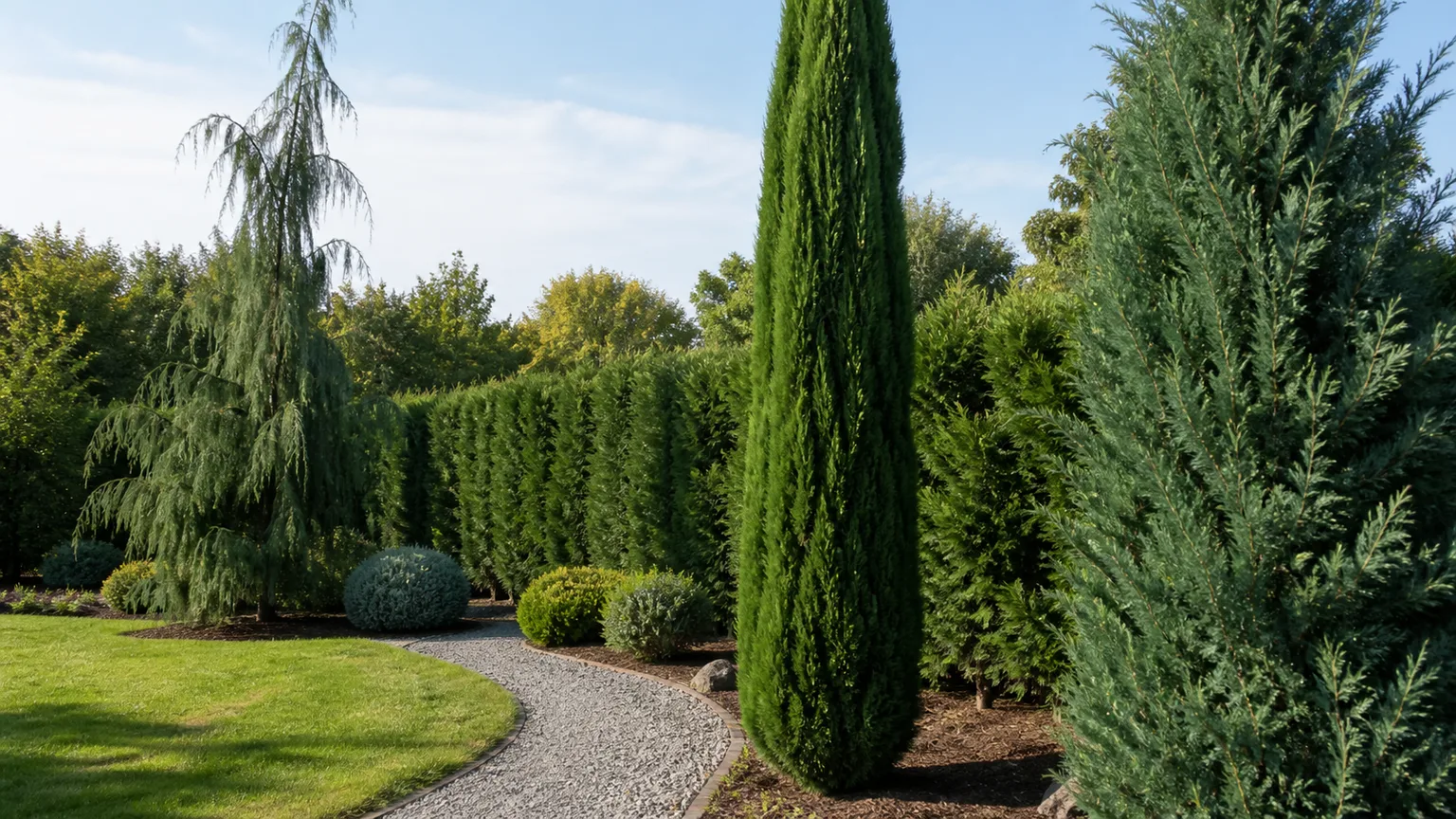
Cypress trees are not one uniform plant. They are a useful group of evergreen and deciduous conifers in the cypress family, Cupressaceae, with forms ranging from pencil-thin columns to broad, wind-shaped trees and graceful weepers. Some tolerate drought once established; others come from cool ravines and need evenly moist soil. A few “cypress” names also belong to different genera, including false cypresses and bald cypress.
That variety is good news if you choose by site first. It is also the reason a fast-growing privacy tree can fail in a hot, cramped yard while a slower, narrower selection succeeds. The twelve types below include practical landscape choices, distinctive specimen trees, and rare California species that are better treated as regional or conservation-sensitive plants than as universal nursery staples.
What Counts as a Cypress Tree?
True cypresses are generally placed in the genus Cupressus, while several plants called cypress belong to Hesperocyparis, Callitropsis, Chamaecyparis, or Taxodium. They share the family’s conifer character—small scale-like or awl-like foliage, woody cones, and a strong evergreen presence in many species—but they do not share identical water, temperature, or size requirements.
The common name can therefore hide the most important distinction. Leyland cypress is a hybrid; Nootka cypress is sometimes sold as Alaska cedar or yellow cedar; Mediterranean cypress is also called Italian cypress; and bald cypress is a Taxodium that drops its needles in autumn. Bald cypress is not one of the twelve profiles here, but it matters when you are shopping for a tree that can handle persistently wet soil.
The taxonomy on a nursery label may also differ from an older gardening book. For example, North Carolina State Extension lists Arizona cypress as Hesperocyparis arizonica, Monterey cypress as Hesperocyparis macrocarpa, and Leyland cypress as × Hesperotropsis leylandii, while older labels may use Cupressus or Cupressocyparis. Use the common name, botanical name, mature size, and growing conditions together when you compare plants.
Choose the Tree by Job, Climate, and Space
Start with the job the tree must do for the next twenty years, not the height of the plant in the nursery pot. A young cypress can look harmless beside a fence and still become a tall, heavy canopy that shades a neighbor, catches snow, or becomes difficult to prune. Measure the planting strip, overhead clearance, access for equipment, and distance from buildings before you choose a species.
For fast privacy, Leyland cypress is the obvious candidate, but its speed comes with disease, drought-stress, and structural trade-offs. For a dry, sunny site, Arizona cypress and—where locally appropriate—Tecate cypress offer a better water story. For a cool coastal garden, Monterey cypress can be superb, while Nootka cypress suits cooler regions with moist, draining soil. For a formal vertical accent, Italian cypress is usually more appropriate than a broad-growing species.
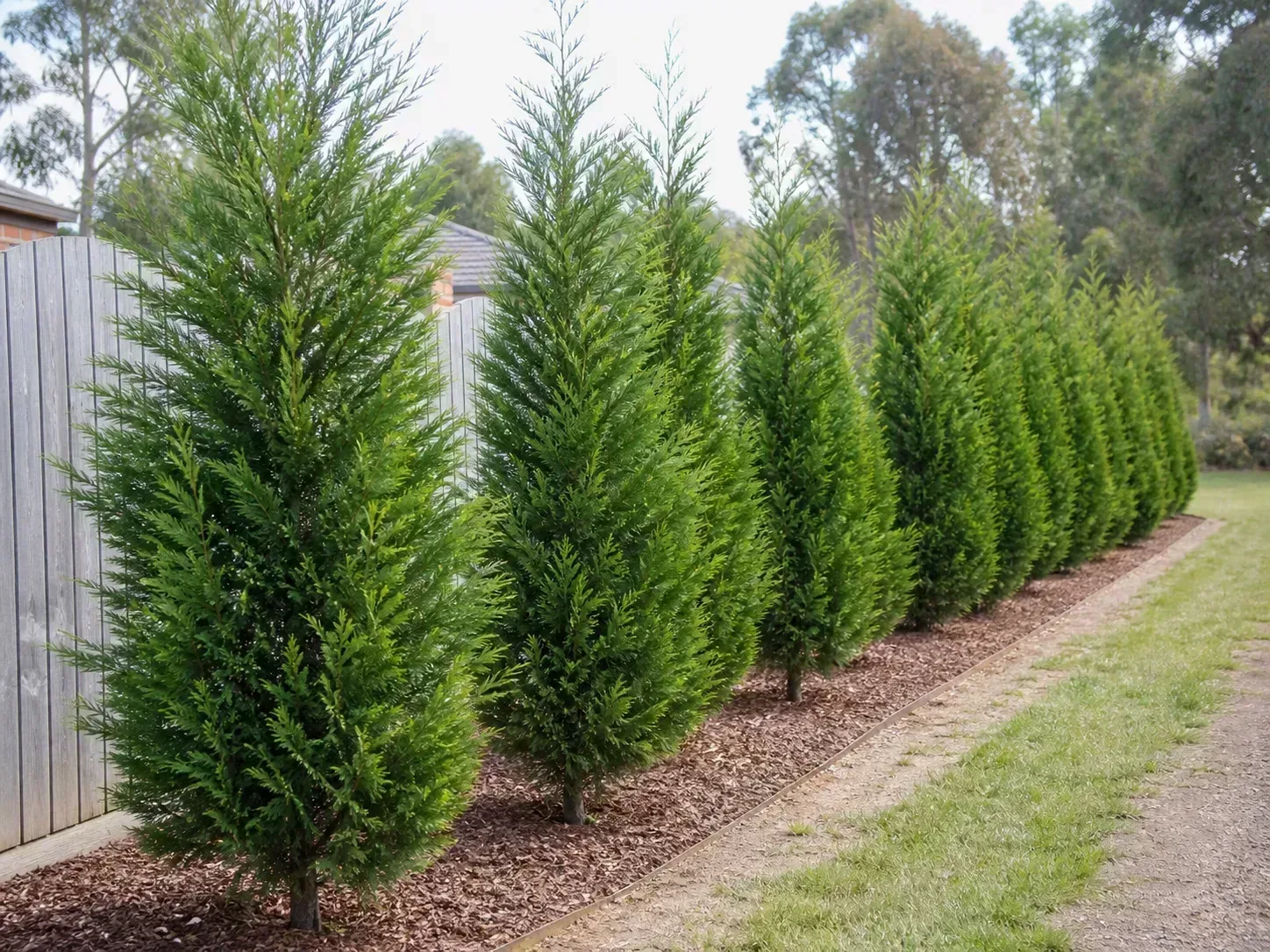
Use the following quick filter:
| Your main need | Strong candidates | The catch to check first |
|---|---|---|
| Tall, quick screening | Leyland, Mexican, Monterey | Mature width, canker, root-zone drainage, and pruning access |
| Blue foliage and dry-climate performance | Arizona, Tecate | Full sun and fast drainage; do not equate drought tolerance with no establishment water |
| A narrow formal accent | Mediterranean or Italian cypress | Warmth, winter minimums, and the cultivar’s actual width |
| A cool-climate specimen | Nootka or weeping cypress | Moist but well-drained soil and enough room for a large tree |
| A regional native collection | Cuyamaca, MacNab, Sargent, Tecate | Nursery availability, local provenance, and conservation status |
| Partial shade or unusual texture | Selected Nootka or weeping forms | Shade can thin foliage; confirm the cultivar rather than assuming the species behaves uniformly |
12 Types of Cypress Trees to Consider
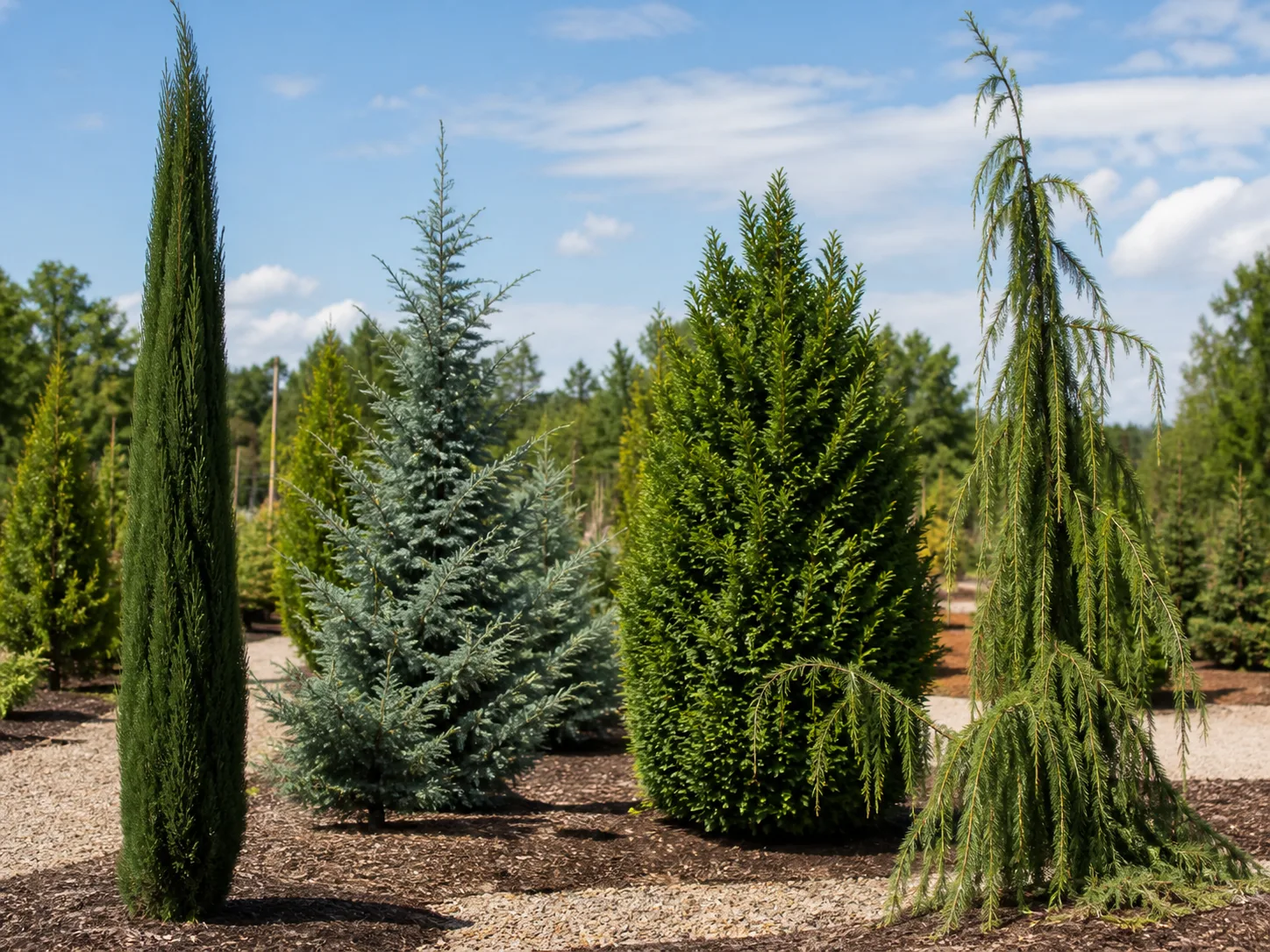
1. Arizona Cypress
Arizona cypress, Hesperocyparis arizonica, is one of the clearest choices for a hot, sunny garden that needs an evergreen screen or windbreak without the thirsty reputation of many fast-growing trees. Its blue-gray to teal foliage, gray-brown bark, and broad conical habit make it useful as a specimen as well as a row planting. North Carolina State Extension reports a mature range of roughly 40 to 60 feet tall and 15 to 20 feet wide, with growth around 4 to 8 inches per year under its conditions.
Give it full sun, good drainage, and room to develop. It is moderately drought tolerant, heat tolerant, and moderately salt tolerant once established, but it is not a tree to bury in irrigated lawn or compacted, slow-draining clay. NC State also notes susceptibility to canker, so steady root-zone care and quick removal of clearly diseased wood matter more than simply calling the tree “low maintenance.”
Choose Arizona cypress for blue foliage, a dry slope, or a broad screen in a warm climate. If you need a very narrow hedge in a small front yard, its mature width is a reason to keep looking.
2. Cuyamaca Cypress
Cuyamaca cypress, Hesperocyparis stephensonii, is a rare California native associated with the Cuyamaca region of San Diego County. It has blue-gray to green foliage and reddish bark, and its appeal is as much ecological and regional as ornamental. The California Native Plant Society identifies it as the rarest of California’s cypress species and says it is known from only four locations.
That makes “easy to grow” a qualified phrase here. A plant adapted to a specific mountain habitat and mineral soil is not automatically a good match for an ordinary garden bed, and a rare plant should never be collected from the wild. If a specialist native nursery offers legally propagated stock, confirm the plant’s provenance and ask for growing conditions before buying it.
Use Cuyamaca cypress as a conservation-minded specimen only when your climate, soil, and local plant expertise line up. It is not the default substitute for Leyland cypress, and its scarcity means that admiration may be the most responsible way to include it in your garden plan.
3. Guadalupe Cypress
Guadalupe cypress, Hesperocyparis guadalupensis, is a distinctive, warm-climate tree associated with Guadalupe Island off the coast of Baja California. It is valued for blue-green foliage and smooth, reddish-brown to chocolate-colored bark, but it is also one of the least broadly available trees on this list. In a garden, it belongs with collectors and botanical-style plantings rather than impulse privacy purchases.
Give it full sun, excellent drainage, and a climate without hard freezes. Do not treat a rare island species as interchangeable with a common landscape conifer; ask a nursery how the stock was propagated and whether the plant is appropriate for your region. Its ultimate size also rules it out for narrow foundation beds and most small urban lots.
The useful lesson from Guadalupe cypress is that rarity and garden suitability are different questions. A tree can be beautiful, drought-aware, and botanically interesting while still being a poor choice for a typical residential screen.
4. Mediterranean (Italian) Cypress
Mediterranean cypress, Cupressus sempervirens, is the tall, narrow column that gives formal courtyards and Mediterranean landscapes their vertical rhythm. The species can become a very large tree, but narrow cultivars such as ‘Stricta’ or ‘Totem’ are the forms most gardeners mean when they want an Italian cypress accent. Check the cultivar’s mature width instead of assuming every plant sold under the common name will remain pencil-thin.
This cypress wants full sun and sharply draining soil, and it performs best where summers are warm and winters are mild. It is a good candidate for a pair flanking an entry, a formal line along a long path, or a vertical punctuation mark in a dry garden. It is a poor candidate for a wet hollow, a shaded side yard, or a spot where a mature tree would have no room above or below ground.
Avoid topping it to control height. If you need a lower screen, buy a naturally smaller cultivar or a different plant; cutting a conifer into old, leafless wood often leaves permanent brown gaps.
5. Leyland Cypress
Leyland cypress, currently listed by NC State as × Hesperotropsis leylandii, is the hybrid of Monterey cypress and Nootka cypress. It remains popular because it can add about 3 feet of growth per year in its early years and forms a dense, upright screen. That speed is also its central warning: the tree can reach roughly 60 to 70 feet tall and 10 to 15 feet wide, and an unmanaged row quickly outgrows its planting strip.
North Carolina State Extension calls attention to shallow roots, poor adaptation to hot summers, toppling risk in large specimens, and a typical life span of about 20 to 50 years depending on conditions. It also lists bagworms, root rots, and cankers among its problems. The NC State Plant Toolbox profile is a useful reminder that “fast growing” does not mean “maintenance free.”
If you plant Leyland cypress for privacy, leave access for pruning on both sides when possible, keep irrigation from creating a perpetually wet root zone, and do not plant it so close to a fence that you can only shear one face. A slightly slower tree with a better mature footprint may provide more durable privacy than a row that needs severe cutting every year.
6. MacNab Cypress
MacNab cypress, Hesperocyparis macnabiana, is a compact California native that often reaches about 10 to 30 feet in cultivation. Its flat, spreading branch sprays distinguish it from the more three-dimensional, feathery appearance of many garden cypresses. It is a good fit for a dry, sunny, naturalistic landscape where a small evergreen tree is more useful than a tall hedge.
The species is associated with interior California habitats and can occur on demanding soils. That does not mean it wants a rich, wet planting hole; it means you should match the drainage, exposure, and regional climate rather than over-amend the site into a moisture-retaining pocket. Give it space to show its branching pattern and avoid squeezing it into a formal columnar role.
MacNab cypress is also a reminder that small at maturity does not mean common at the garden center. Look for responsibly propagated native stock and expect to search more than you would for Leyland or Italian cypress.
7. Mexican Cypress
Mexican cypress, Hesperocyparis lusitanica or Cupressus lusitanica on older labels, is a tall, vigorous evergreen used for windbreaks, screening, and large landscapes. It can exceed 100 feet in favorable conditions, so it belongs on a property with real vertical and lateral clearance—not in a narrow suburban border chosen because the young plant fits in a five-gallon pot.
This species is more forgiving of partial shade than many cypresses, but full sun usually gives the densest growth. It prefers evenly moist soil while establishing and still needs drainage; a drought-tolerant label should not be read as permission to let a newly planted tree dry out repeatedly. In hot, dry regions, mulch and deep, well-timed watering are more useful than shallow daily sprinkles.
Choose Mexican cypress when you need a large windbreak or tall screen and can accommodate its eventual scale. For a small garden, a named compact conifer or a shrub-sized false cypress will be a safer decision.
8. Monterey Cypress
Monterey cypress, Hesperocyparis macrocarpa, is a fast-growing, long-lived coastal California tree with bright to dark green scale-like foliage that releases a lemony scent when crushed. It may start narrow and pyramidal, then become irregular and broad with age. NC State lists mature heights up to roughly 80 or 90 feet and notes that the species is one of the largest cypresses.
Its best landscape performance comes in cool coastal conditions with full sun, moisture that drains, and protection from hot inland summers. It tolerates salt spray and wind, making it valuable near the coast, but away from cool coastal breezes it is more vulnerable to canker. The species also drops cones and other litter, which is part of the maintenance calculation for patios, driveways, and pools.
Use Monterey cypress as a coastal specimen, windbreak, or spacious screen. Cultivars such as ‘Goldcrest’ offer golden foliage and a more ornamental profile, but the cultivar still needs outdoor conditions that match its parentage; a plant sold as lemon cypress is not automatically a durable indoor tree.
9. Nootka Cypress
Nootka cypress, Callitropsis nootkatensis, is also sold as Alaska cedar, yellow cedar, or Nootka cedar. Its gray-green or blue-green foliage and graceful pendulous branches give it a softer, more expressive outline than a rigid privacy column. North Carolina State Extension describes it as a Pacific Coast tree associated with streams, ravines, and moist soils, typically reaching about 30 to 45 feet tall and 10 to 15 feet wide in its profile.
Plant it in full sun to partial shade with moist but well-drained soil. It is one of the better cypress-family choices for cool climates, but it is not a bog plant: the same profile lists susceptibility to phytophthora, root rot, rust, borers, and spider mites. Avoid hot reflected heat, polluted urban exposure, and a site that alternates between waterlogging and drought.
Choose Nootka cypress for a cool-climate specimen, a pond or stream edge that drains between rains, or a weeping cultivar such as ‘Pendula’. Give it room to show its branches; crowding the trunk into a tight hedge removes much of what makes it special.
10. Sargent Cypress
Sargent cypress, Hesperocyparis sargentii, is a California native with a rounded to conical habit and attractive gray-green foliage. It is generally a better fit for a regional, dry-climate landscape than for a formal row of identical screening trees. Its mature size is often described in the broad range of 30 to 60 feet, but local climate and cultivar or seed source can change the final silhouette.
Provide full sun or light shade, drainage that does not stay saturated, and enough room for the crown to develop. As with other California cypresses, local provenance matters more than a generic care label; a tree from a matching seed zone has a better chance of fitting the heat, winter, and rainfall pattern of your site.
Sargent cypress is worth considering when you want a native evergreen with structural value and can obtain responsibly propagated material. It is not the best choice when your priority is instant, tightly clipped privacy.
11. Tecate Cypress
Tecate cypress, Hesperocyparis forbesii, is a small to medium Southern California and northern Baja native with bright green foliage, reddish bark, and an upright form that becomes more rounded or contorted with age. Calscape describes it as very drought adapted and warns that excessive supplemental water can make it floppy. That is unusually practical guidance for gardeners who assume every newly planted evergreen should be irrigated heavily forever.
Use Tecate cypress as a sunny specimen or a regional hedge plant where the climate and soil suit chaparral plants. The Calscape profile lists low to very low water needs once established, full sun, and a mature size around 33 feet tall by 25 feet wide. Those dimensions still demand real space, even if the tree is more compact than Monterey or Mexican cypress.
Buy nursery-propagated plants rather than collecting wild cones or seedlings. California Native Plant Society research explains that many California cypresses are rare and that their fire-adapted, serotinous cones are part of a delicate natural system; a garden plant should not be removed from that system.
12. Weeping Cypress
Weeping cypress, Cupressus cashmeriana, is also called Bhutan or Kashmir cypress. Its long, drooping branchlets create a striking specimen-tree silhouette, and selected cultivars can look almost architectural beside a lawn, pond, or large courtyard. It is a warm-climate tree, generally suited to mild winters and long growing seasons rather than cold inland gardens.
Give it full sun, well-drained soil, and a location where the branches can fall without blocking paths or rubbing against structures. It can become a very large tree—reported mature heights vary widely by source and growing conditions—so study the nursery’s cultivar information instead of relying on a photograph of a young specimen.
This is a tree for form, not for a clipped hedge. Choose it when a single living sculpture is the goal and you have the room to support its mature crown. If you need a narrow screen, Italian cypress or a carefully selected hedge plant will be more predictable.
Planting and Cypress Care That Prevents Problems
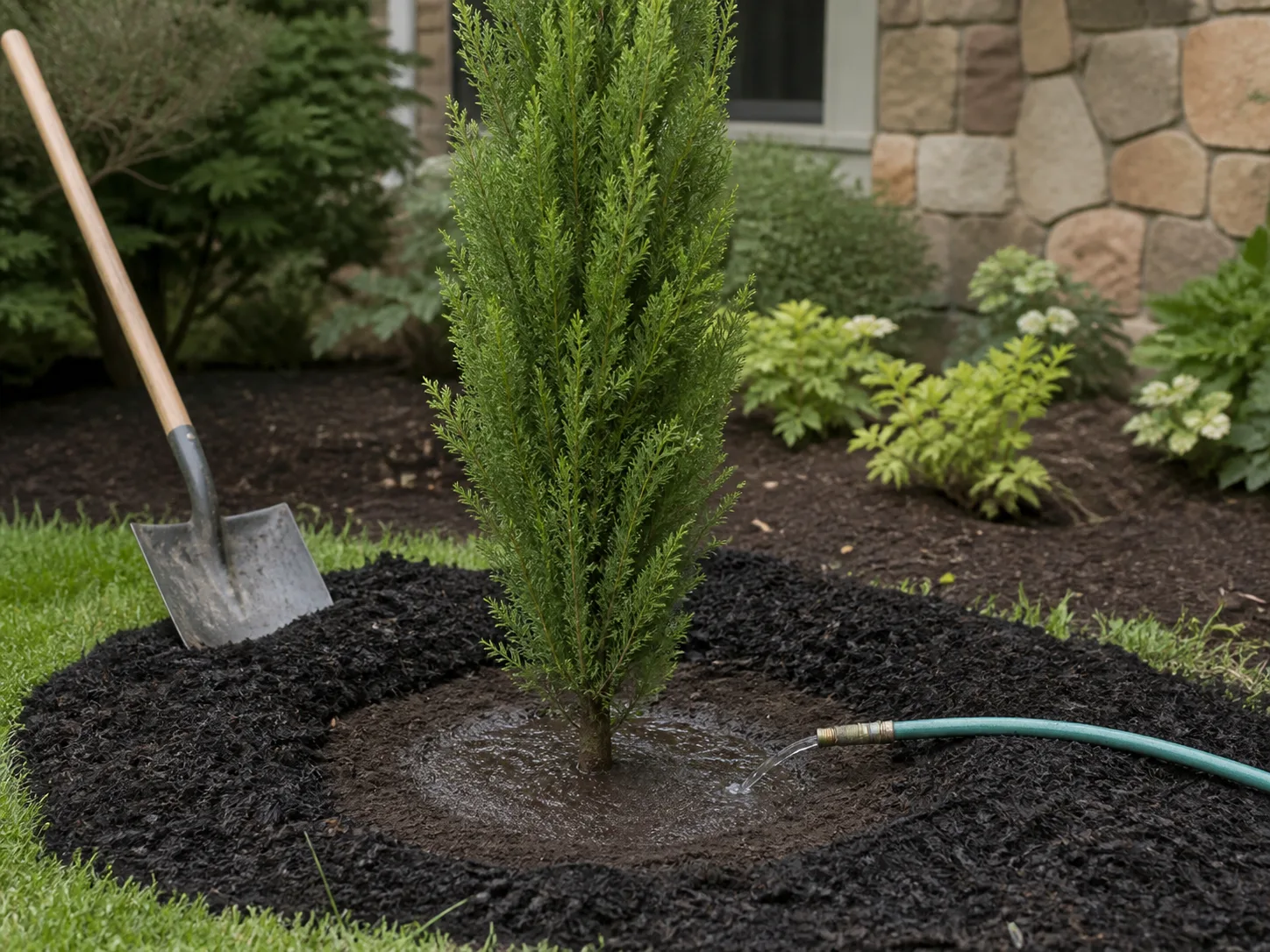
Plant at the right time. Early fall or early spring is usually easier on a new tree than the hottest part of summer or frozen ground, but local frost timing matters. Plant when the soil can be worked and the tree has time to develop roots before its hardest heat or cold. A container-grown tree can be planted outside that window if aftercare is reliable, but the watering burden rises in warm weather.
Prepare a wide, not deep, hole. Dig roughly twice the width of the root ball and no deeper than its height. Set the tree so the root flare and top of the root ball are at or slightly above the surrounding soil; a tree planted too deeply can suffocate at the trunk and hold water around the roots. Backfill with the native soil you removed, breaking up large clods but resisting the urge to create a rich, soft pocket that encourages roots to circle inside the hole.
Water deeply while roots establish. The first growing season is when drought-tolerant cypresses most often fail. Water slowly across the root ball and the surrounding soil so moisture reaches beyond the original container shape, then let the surface begin to dry rather than keeping it constantly saturated. Plant Addicts recommends regular water—about 1 to 2 inches weekly during the first two growing seasons as a general starting point—while stressing that established trees need deep watering during extended dry periods rather than a fixed indoor-style schedule.
Mulch, but do not volcano-mulch. Apply about 2 to 4 inches of organic mulch over the root zone, keeping it several inches away from the trunk. Mulch moderates soil temperature, slows evaporation, and makes it easier to water deeply, but a wet collar around the trunk invites problems. In heavy clay, correct drainage with grading or a better planting location before planting; piling compost into one hole rarely fixes a site that stays underwater.
Prune with a boundary in mind. Remove dead, broken, crossing, or clearly diseased branches with clean tools. Shape young hedge trees lightly and regularly while they are still within bounds. Do not cut a columnar cypress back into bare brown interior wood and expect green shoots to fill it; many conifers do not regenerate from old, leafless branches. SavATree’s Leyland cypress guidance also emphasizes young-tree pruning for structure, air movement, and reduced snow or ice damage.
Do not fertilize by reflex. A healthy tree growing in reasonably fertile soil usually needs more attention to water and drainage than to a large dose of fertilizer. If a soil test or weak growth indicates a nutrient issue, correct the specific deficiency or use a modest, slow-release product at the recommended rate. Excess nitrogen can push soft growth that is more vulnerable to drought, cold, and pests.
Treat browning as a clue, not a diagnosis. Brown branches can follow drought, root damage, canker, bagworms, mites, or heat stress. Interior needle shedding may be normal, while scattered reddish-brown branch tips, resin, bark lesions, or one-sided dieback deserve closer inspection. Check the soil moisture several inches down, inspect the trunk and branch collars, and look for insects before changing the entire irrigation schedule. When a large tree is declining or could fall, have a qualified arborist identify the problem rather than repeatedly applying an unverified treatment.
The most important disease prevention is site selection: match the species to the climate, keep irrigation off the foliage when possible, maintain drainage, avoid wounding trunks, and do not crowd a mature canopy against another tree. NC State’s profiles specifically flag canker and root-rot problems in several cypresses, while Gardenia’s cypress growing guide summarizes the same core principle: sun, drainage, sensible watering, and pruning that removes problem wood are more reliable than a one-size-fits-all care calendar.
Conclusion: Choose the Cypress That Fits the Site
The best cypress tree is not automatically the fastest or the bluest. Choose Leyland for rapid screening only when you can manage its eventual height, width, pruning, and disease risk; choose Arizona or Tecate for a dry, sunny regional garden; choose Monterey for a cool coast; choose Nootka for a cooler, moist-but-draining site; and choose Italian or weeping cypress when form matters more than hedge density.
For Cuyamaca, Guadalupe, MacNab, and Sargent cypresses, treat responsible sourcing and local adaptation as part of the decision. Then give any cypress a correctly sized planting hole, deep establishment water, an open root zone, and enough room to become the tree you actually want. That small amount of planning is what turns an attractive nursery label into a durable garden choice.