Brown Patches in Your Lawn: Causes and Diagnosis
Learn how to distinguish drought, pet urine, mower damage, grubs, disease, and compaction—and what evidence to gather before repairing a lawn patch.
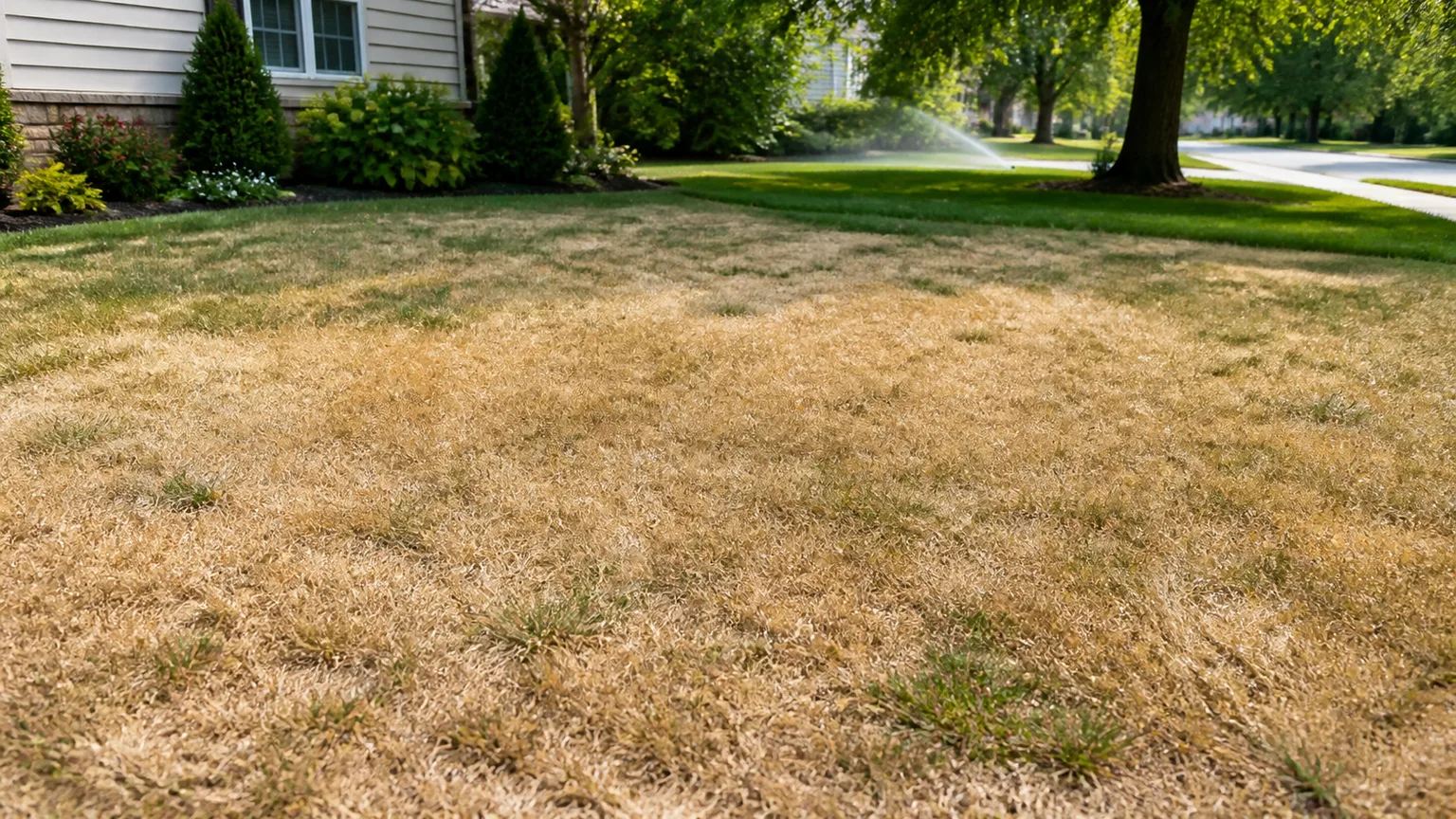
Brown grass is a symptom, not a diagnosis. Drought, uneven sprinkler coverage, concentrated dog urine, fertilizer or mower injury, insects, disease, compacted soil, and seasonal dormancy can all leave tan or bare areas that look deceptively similar from standing height.
The safest first move is to collect evidence before you water, feed, spray, or reseed. A patch’s shape and timing can suggest a cause, but the blades, root zone, recent weather, and what is happening at the patch edge often tell you more. Even an experienced gardener may need a soil or turf sample to separate look-alike problems. A Fine Gardening turf-care article also lists compacted soil, uneven fertilizer, insects, mower injury, pet damage, and too much or too little water among the possible causes of brown turf, underscoring why color alone is not enough.
Brown color is a clue, not a diagnosis
Start by asking whether the patch is actually dead. Brown blades can sit above living crowns and roots when turf is stressed or dormant; dead crowns will not resume growth simply because the weather improves. A dry, curled blade that springs back weakly is different evidence from a soft, wet, rotting patch, but neither one identifies a single cause by itself.
Then look at the whole pattern rather than zooming in on one brown circle. A series of parallel stripes can point toward a mower or spreader route, a narrow band by pavement can suggest salt or heat, and an isolated round spot near a dog’s regular route raises a different possibility. Irregular patches can still come from several causes, including drought, insects, soil problems, or disease.
The Royal Horticultural Society makes the same central point in its dead-patch diagnosis guide: appearance alone can be tricky, so consider the setting and the conditions that could produce the damage. That principle is especially useful when a familiar pattern tempts you to treat before checking.
Run a short field investigation before treating
You do not need specialized equipment for a useful first pass. A notebook or phone camera, a hand trowel, and a simple way to compare soil moisture in the brown area and nearby healthy turf can rule in or out several common causes.
Map the pattern and recent events
Photograph the patch from above and from the side, then mark its outline with a few small flags or note a fixed reference such as a sprinkler head, walkway, tree, or mower turn. Check again in a few days. A stable spot after a one-time spill is different from a patch that is widening across wet turf; new growth at the edge also matters more than a single day’s color.
Write down the recent conditions before your memory smooths them over: the last rain, irrigation days and duration, a heat wave, fertilizer or herbicide use, mowing height, new construction, pet access, snowmelt, or repeated foot traffic. If a product was applied, keep its packaging and record the date and rate. These details can be more diagnostic than the patch’s exact shade of brown.
Look around the entire yard for a pattern. Is the damage confined to a sunny slope, a low spot that stays wet, the path between a gate and patio, the edge under a tree, or every third sprinkler zone? Brown areas that align with a site feature suggest an environmental or maintenance cause; scattered spots across unrelated areas deserve a closer check for insects or disease.
Compare blades, roots, and soil moisture
Inspect several blades from the border where green turf meets brown turf, not only the fully dead center. Look for leaf spots, clipped tips, powdery growth, pink or red threads, orange dust, chewed tissue, or a uniform straw color. Disease clues often appear on individual blades before they are easy to see across the whole lawn.
Use a trowel to lift a small plug at the patch edge, where living and damaged grass meet. Check whether the roots are present and firmly attached, whether soil is powder-dry or saturated, whether there is a thick spongy layer between blades and soil, and whether roots encounter rubble or a hard compacted layer. Compare that plug with one from apparently healthy grass a few feet away.
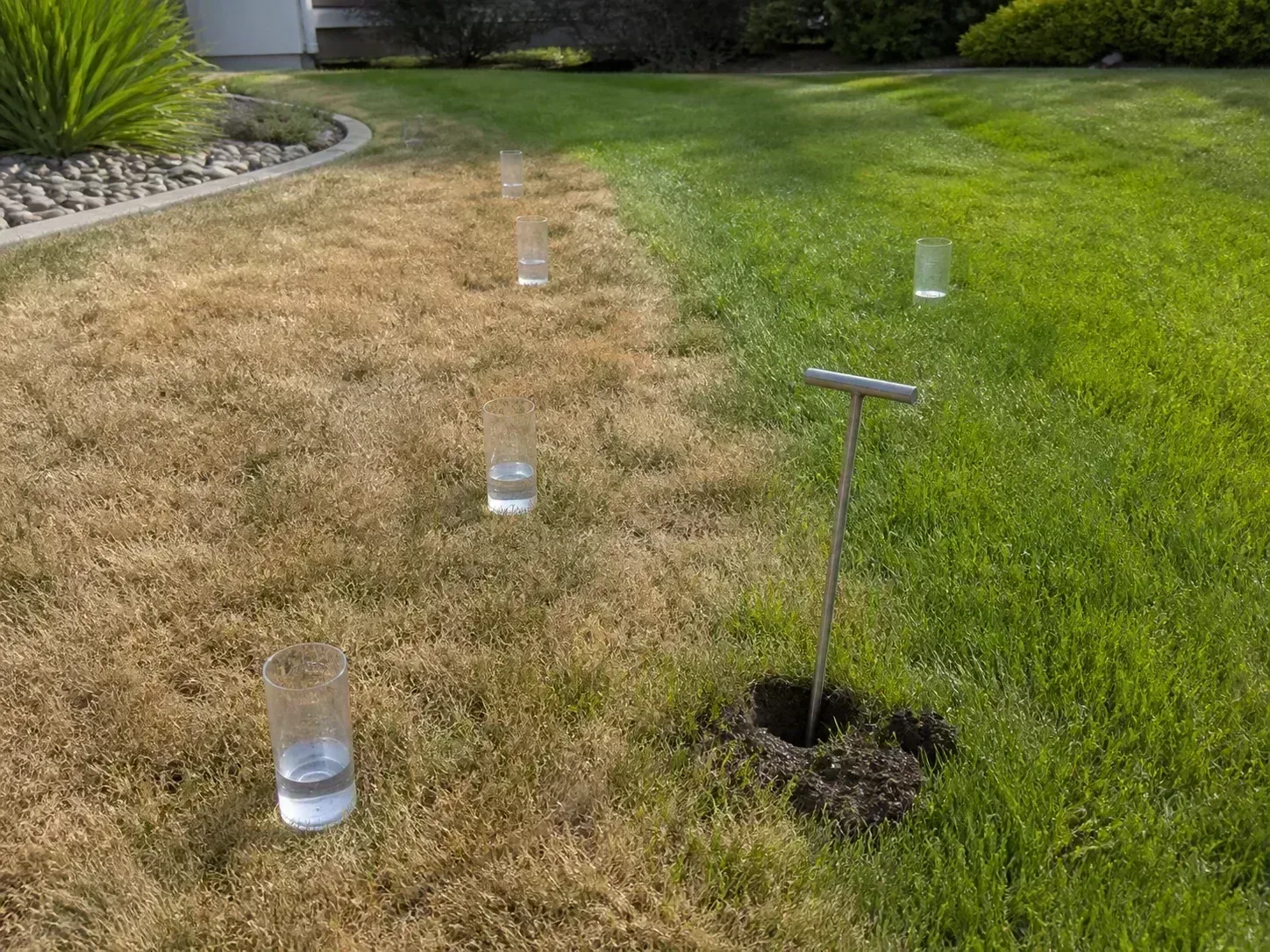
Compare conditions in the damaged area with nearby healthy turf; a lawn-wide schedule can miss one dry or poorly draining spot.
A screwdriver or narrow soil probe can help compare how easily the ground accepts water, but treat it as a screening check rather than a laboratory test. If the soil is dry under the brown spot but moist under the green grass, investigate sprinkler coverage, runoff, hydrophobic soil, and tree-root competition. If the soil is wet and the grass is soft or smells rotten, adding more water is likely to make the situation worse.
Match the evidence to the most likely cause
No clue below proves a cause on its own. Use the combination of timing, site, blade condition, roots, and history to decide what to check next.
| What you notice | More likely explanations | Next useful check |
|---|---|---|
| Broad tan areas after a hot, dry stretch | Drought stress or uneven irrigation | Compare soil moisture and sprinkler coverage |
| Small circles with a darker green edge where dogs visit | Concentrated urine nitrogen | Watch for repeat spots and dilute a fresh deposit with water |
| Stripes, arcs, or sharp-edged damage after lawn work | Mower scalping, fertilizer, herbicide, or fuel spill | Match the pattern to the work path and product used |
| Turf lifts easily and roots are missing | Root-feeding grubs or another root problem | Sample the living/dead border for larvae and root loss |
| Blades have lesions, threads, powder, or spores | Possible fungal disease | Photograph the blades and seek a local diagnosis if spreading |
| Damage follows traffic, a building project, or a low wet area | Compaction, debris, poor drainage, or waterlogging | Compare soil structure and drainage with healthy turf |
Drought, missed irrigation, or water-repellent soil
Drought stress usually fits the weather and the site. Exposed sunny areas, slopes, sandy soil, or turf competing with tree roots may dry sooner than the rest of the yard. If multiple areas brown during a sustained hot, rainless period, and the blades look dry rather than rotten, water stress is more plausible than a sudden disease outbreak. The University of Minnesota Extension turf guide notes that cool-season turf can thin and brown under heat and drought, sometimes with green tufts remaining; recovery depends on how severe and prolonged the stress became.
Check the soil before starting a longer watering cycle. If the brown patch is dry but the nearby green lawn is moist, place several straight-sided containers across the sprinkler zone and run it briefly. Compare how much water reaches each area, including the edge of the damaged patch. A sprinkler may rotate unevenly, be blocked by a shrub, or send water past a slope instead of into the soil.
If the surface gets wet but the root zone stays dry, water may be running off compacted ground or the soil may have become difficult to re-wet. The RHS describes this as lawn dry patch, where water-repellent soil can leave grass drought-stressed even after rain. Do not respond by keeping the entire lawn constantly wet: first confirm the mismatch between surface moisture and moisture several centimeters down, then correct coverage and soil conditions.
Dog urine and concentrated nitrogen
A small round brown spot with a darker green ring, especially where a dog repeatedly stops, is consistent with urine injury. The green margin can occur because diluted nitrogen at the edge feeds the grass while the concentrated center is damaged. This is a clue rather than proof: fertilizer spills and other localized injuries can create a similar contrast.
UW–Madison Extension explains that urine damage is primarily associated with concentrated nitrogen, not the urine’s acidity. Do not give a dog tomato juice, vinegar, baking soda, or marketed urine-changing supplements to “fix” the lawn; the extension article warns these changes can pose health risks and advises discussing diet or urinary concerns with a veterinarian.
If you see a fresh deposit and want to reduce the concentration on the turf, promptly pour water over that small area. For recurring damage, redirect the dog to a designated surface or location and avoid trying to grow a perfect uniform lawn in a favorite dog spot. Existing small lesions may fill in from surrounding grass; larger patches are easier to reseed after the dog’s route is addressed.
Mowing, fertilizer, salt, and chemical injury
Look for a connection between the patch and a recent lawn-care pass. Scalping often follows raised bumps, roots, or uneven ground where a mower cuts grass much shorter than the rest; repeated tire tracks and turns can compact or bruise turf. Torn, ragged blade tips after mowing point toward dull or damaged mower blades, while a pattern that repeats in wheel-width lanes can reflect equipment or application routes.
Fertilizer injury often appears as stripes, arcs, or a concentrated patch after an uneven spread or spill. Check the calendar, the spreader path, the product label, and whether granules collected in a pile. The RHS notes that excess fertilizer can scorch grass and recommends calibrated equipment and label rates; more fertilizer will not correct a patch caused by an application overdose. Avoid adding another feed until you know whether the turf is deficient or injured.
Brown strips beside a street, sidewalk, or driveway after winter may reflect de-icing salt, while fuel or concentrated chemical spills can leave irregular, sharply localized damage. These clues do not justify a blanket pesticide or herbicide application. If you are unsure what was spilled, identify the product and follow its label’s spill directions; do not hose an unknown pesticide or herbicide toward a drain or waterway.
Grubs and other turf-feeding insects
Root-feeding grubs become more plausible when damaged turf pulls up easily, roots are largely missing, and birds or mammals are pecking or digging nearby. However, wildlife digging for grubs can damage the surface even when the number of grubs would not harm the grass on its own. A few white grubs in soil do not automatically mean the lawn needs an insecticide.

Loose turf is a reason to inspect the roots and soil; it is not, by itself, enough evidence to apply grub treatment.
Check one or more small square-foot samples along the boundary between healthy and damaged turf, then note both the number of larvae and the condition of roots. The University of Minnesota’s diagnostic guide describes turf that can roll back like carpet when roots have been heavily eaten; UW–Madison Extension’s white-grub guide explains that many white grubs occur without visible lawn injury and that thresholds depend on context and species.
Other insects produce different signs. Sod webworms can leave small ragged brown spots that expand, while bluegrass billbug injury may begin as yellow or straw-colored irregular patches, often near hot pavement. If you see caterpillars, larvae, clipped blades, or frass, photograph or collect a sample for identification before choosing any treatment. Insect species, life stage, timing, and local guidance all affect whether intervention is warranted.
Fungal disease and other living look-alikes
Fungal diseases can cause scattered tan patches, rings, or larger areas where damaged spots merge, but brown rings are not synonymous with fungus. Disease likelihood rises when the timing and weather fit the local disease, patches are progressing during damp conditions, and close inspection reveals blade lesions, fungal threads, spore-like dust, or other characteristic signs.
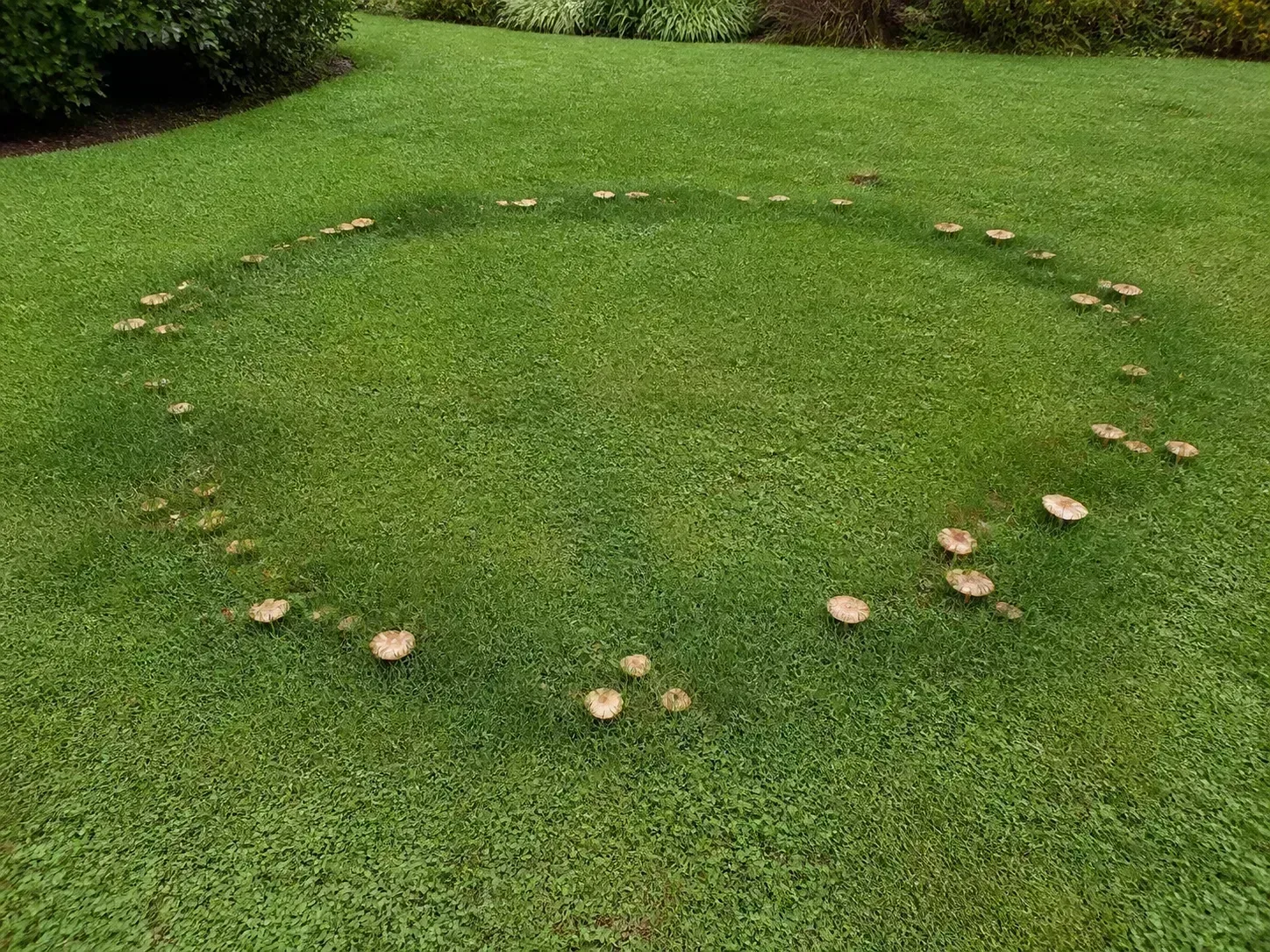
Some fungi form visible rings, but a ring-shaped patch without mushrooms can have other causes.
The University of Minnesota’s turf diagnostic pages describe distinguishable clues such as orange rust spores, pink-red threads in humid weather, and leaf lesions. Its diagnosis guide is a useful way to compare symptoms, but not every disease can be identified from a homeowner photo. UW–Madison’s lawn disease reference cautions that very few diseases can be accurately diagnosed by eye and points gardeners toward its Plant Disease Diagnostics Clinic when a sample is needed.
Do not apply fungicide just because a patch is brown or because a neighbor’s lawn had a disease. Some diseases are brief or become less damaging when weather changes, while drought, mowing, salt, or root stress will not be fixed by a fungicide. If the patch keeps spreading, the lawn is valuable, or a disease-specific pesticide is being considered, get a local diagnosis and use only a product labeled for the identified problem and site.
Compaction, thatch, drainage, and buried debris
Compaction is more likely when damage follows repeated foot or vehicle traffic, new construction, or a route where water puddles rather than soaking in. Roots may be shallow, the soil can feel hard when moist, and turf often thins rather than forming a clean isolated circle. Compacted soil can make drought and heat injury worse because roots have less room to grow and water does not infiltrate evenly. BBC Gardeners’ World Magazine’s lawn-care guidance notes that compaction can contribute to bare patches in summer and muddy turf in winter.
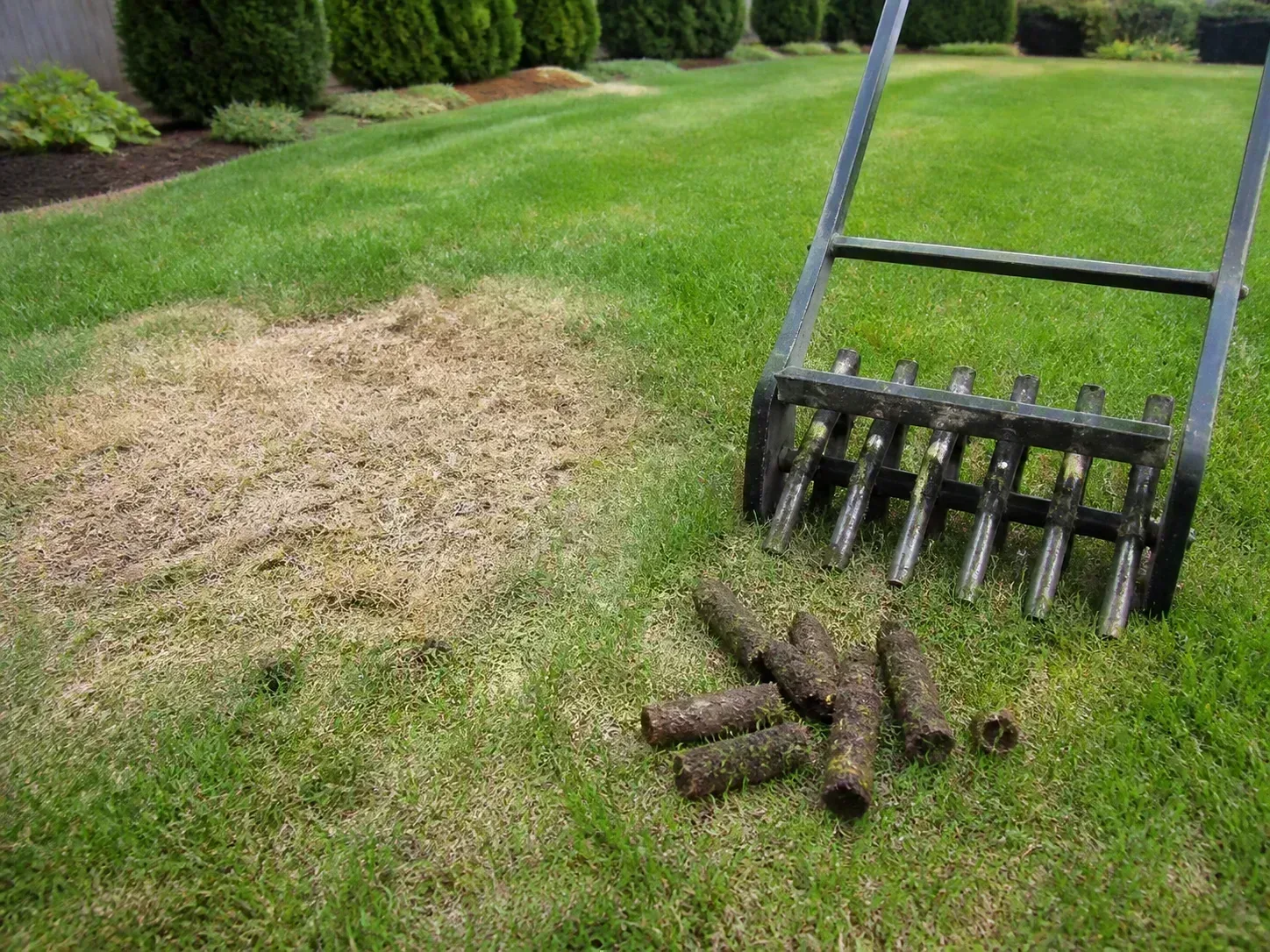
Core aeration can relieve confirmed compaction; it does not diagnose or cure every brown patch.
Thatch is the interwoven layer of living and dead stems, roots, and other plant material between green blades and soil. A thin layer is normal; a thick, spongy layer can interfere with water reaching roots and can make seed-to-soil contact difficult. Lift a plug to judge its depth and texture before considering dethatching. A few brown blades or loose clippings are not proof of excessive thatch, and aggressive removal can stress already thin turf.
Low spots with soft, muddy soil, mushy grass, or a sour, rotted odor point toward standing water or poor drainage. New lawns can also have construction debris, buried fill, or soil layers that dry at different rates. Core aeration may help confirmed compaction when turf is actively growing, but it will not solve every cause of a brown patch; fix a drainage issue, remove rubble, or redirect traffic when those are the actual problems.
Heat stress and seasonal dormancy
Some lawns turn tan during summer heat or winter conditions and resume growth when the grass’s growing season returns. Dormancy is a survival response, not a guarantee: a lawn’s recovery depends on the grass species, root health, length and severity of stress, and local weather. The University of Minnesota Extension notes that cool-season turf can green up again after cooler conditions and more frequent rain, but severe stress can leave areas unable to recover fully. Gardeners’ World makes a similar point for established lawns; grass type and climate still determine how much recovery to expect.
Check whether the brown area follows the lawn’s seasonal pattern. If most of a warm-season lawn changes color in cooler weather, or a cool-season lawn browns during extended summer drought, a sudden spot treatment may do more harm than good. Compare the crowns and roots at the patch edge and watch for new green growth as favorable conditions return before declaring the turf dead.
Choose a test that can actually confirm the cause
A soil test is useful when a broad area looks weak, symptoms recur, or you suspect pH or nutrient issues. It can guide fertilizer or lime decisions, but it usually does not identify a leaf disease, insect species, uneven sprinkler coverage, a dog-urine spot, or a single spill. Sample according to the local lab’s instructions and keep the soil from the problem area separate from the healthy comparison area.
For insects, take a small turf-and-soil sample from the advancing edge, where damaged and healthy grass meet, and record the date, patch size, and larvae found. For a suspected disease, follow the diagnostic lab’s instructions for fresh grass blades and roots; a bag of completely dead grass may not contain the evidence needed. Include close-up photos of blades, a wider image showing the patch pattern, and notes on recent weather and care.
If the patch’s cause remains unclear, ask your county or state extension service whether it offers turf identification or testing. A diagnostic lab can distinguish conditions that look alike and can help you avoid spending on an insecticide or fungicide that does not match the actual problem.
What to do during the next two days
First, pause inputs that could obscure the evidence. Do not add fertilizer, lime, weed killer, fungicide, or insecticide as a precaution. Keep people and pets away from any recently applied lawn product for the period stated on its label, and do not change a pet’s diet to alter urine without veterinary guidance.
Second, make one targeted correction only when the evidence is strong and the action is low risk. If a sprinkler clearly misses the dry zone, correct that coverage and recheck the root-zone moisture. If fertilizer has just spilled and you know the product, follow its label directions promptly. If the grass is wet, soft, and foul-smelling, stop irrigation and address standing water rather than adding more.
Third, wait to renovate until you know whether the grass is dormant, injured but living, or dead. Rake only loose dead blades when you are ready to repair; do not strip a large area of healthy turf to “stop disease” without a diagnosis. Fix traffic, drainage, mowing height, or the recurring animal route first, because seed or sod placed into the same damaging condition will likely fail again.
If the grass is truly gone, match the repair to your grass type and season. Reseed when the appropriate turf species can germinate and establish in your climate, keep the seedbed evenly moist without saturating it, and limit foot traffic while seedlings root. A small patch may also recover from creeping stems or neighboring turf once the stress ends, so monitor before buying seed.
When to ask an extension service or turf professional
Get a local diagnosis when patches spread quickly, multiple causes seem possible, the turf lifts but you cannot confirm root injury, or you see distinct blade lesions or fungal structures. Ask for help before applying a pesticide, especially if children, pets, pollinators, nearby gardens, or storm drains could be exposed. Professionals and university clinics can also tell you when a sample is worth the cost.
Bring evidence rather than only a description of “brown spots.” A useful record includes a dated overview photo, close-ups of several blades, a plug from the brown/green boundary, the grass type if known, recent irrigation and mowing history, product names and application dates, and any grubs or insects you found. Include both a damaged-area sample and a healthy comparison if the service requests them.
A lawn professional should explain what observations support the diagnosis, what uncertainty remains, and why a proposed treatment fits the site and timing. Be wary of a one-product answer based only on a drive-by view. Good diagnosis may lead to a simple irrigation adjustment, a period of observation, a soil test, a repair, or no treatment at all.
Conclusion
Brown patches can come from drought, urine, insects, disease, equipment, fertilizer, compaction, drainage, or normal dormancy, and several of those causes overlap in appearance. Start with timing and pattern, compare the blades and roots at the edge, and check soil moisture against nearby healthy turf before reaching for a product.
Treat the evidence you actually have. Correct water coverage, traffic, or mowing when those are clear; test or ask a local extension service when the cause remains uncertain; then repair the patch only after the underlying stress is addressed. That sequence protects the lawn from repeat damage and keeps an uncertain brown spot from becoming an unnecessary chemical application.



