23 Winter Plants for Flowers, Berries, and Color
Explore 23 winter plants for blooms, berries, evergreen structure, and foliage, with planting, climate, and care advice to help each one perform in your garden.
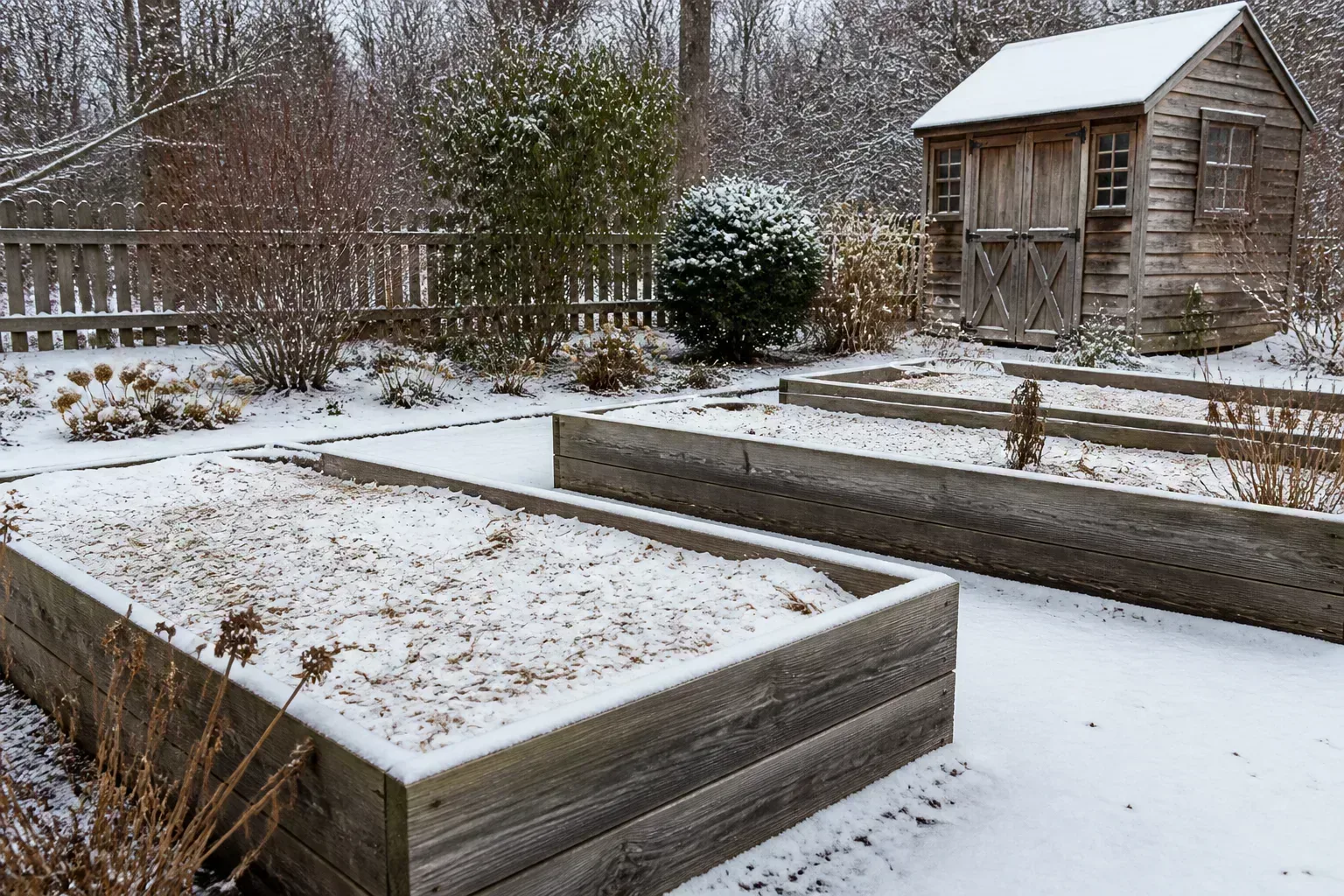
Winter interest does not have to mean a flower open every day from December through February. In a cold garden, the dependable display is usually a sequence: evergreen leaves and berries carry the early winter, a few shrubs flower during mild spells, and bulbs or hellebores take over as days lengthen. In milder climates, the same plants may bloom earlier or for longer.
The 23 winter plants below cover those different jobs. Some are true cold-season bloomers; others offer colored stems, persistent fruit, or foliage that still looks good when the rest of the bed is dormant. Match each plant to your local low temperatures, soil drainage, light, and available space, and you can build a garden that remains legible and attractive even when flowers are scarce.
What does winter success look like?
Garden catalogs use “winter plant” for several different things. A plant may flower during winter, hold its leaves, keep fruit or colorful bark visible after dropping its leaves, or simply survive winter and return in spring. Those are not interchangeable benefits. A hardy perennial can tolerate a cold winter and still be completely dormant above ground; an evergreen may look handsome without producing a single flower.
Bloom time is also regional. A witch hazel or snowdrop can open during a warm spell in one region and wait until late winter in another. The Philadelphia Horticultural Society uses mid-December through mid-March as a practical winter-flowering window for its Mid-Atlantic plantings, while University of Georgia Extension describes pansies, camellias, winter daphne, jasmine, and witch hazel for North Georgia. Those examples show why a plant list should be read as a menu, not a promise that every item will bloom in January in every state (Philadelphia Horticultural Society’s winter plant guide; UGA Extension’s North Georgia winter bloomers).
For planning, think in layers. Put a stable evergreen or bark feature where it can be seen from a window, add a berrying shrub or cool-season annual near a path, and plant small bulbs where they can naturalize without being mown or dug up. That approach looks better than betting the whole winter display on one shrub’s flowering date.
Choose winter plants by job and climate
Start with the view you want to improve. For flowers near a doorway, try pansies, camellias, or a winter-blooming heath, depending on your climate. For a shaded bed, consider snowdrops, cyclamen, or Christmas rose where local conditions suit them. If the main problem is a bare winter border, winterberry gives fruit, red-twig dogwood gives stem color, and Japanese holly or Leyland cypress provides evergreen mass.
Next, check the plant’s mature size, not just the nursery pot. Winterberry can become a substantial deciduous shrub; Leyland cypress can become a large tree, which makes it a poor fit for a narrow foundation bed unless you have room to manage it. Winter jasmine can be left to arch over a low wall or trained against a support, while winter heath stays close to the ground. Small gardens benefit from plants that add interest at eye level without overwhelming paths and windows.
Then check exposure and soil. Winter sun can dry evergreen leaves while frozen ground prevents roots from replacing lost water, so a sheltered position can matter as much as cold tolerance. Bulbs and many woody ornamentals dislike persistently saturated soil; a plant labeled hardy for your zone may still fail in a poorly drained pocket. Better Homes & Gardens advises checking that a perennial is suited to the local hardiness zone, and the practical next step is to verify the cultivar and site rather than relying on the species name alone (Better Homes & Gardens’ cold-hardy perennial guide).
Flowering shrubs and bedding plants
These are the plants to choose when flowers matter more than a long, reliable evergreen outline. Their biggest advantage is timing: they can bloom when pollinators and people have few other flowers to visit. Their limitation is the same—flowers and buds are exposed to abrupt cold, and the display often pauses during a deep freeze.
Camellias
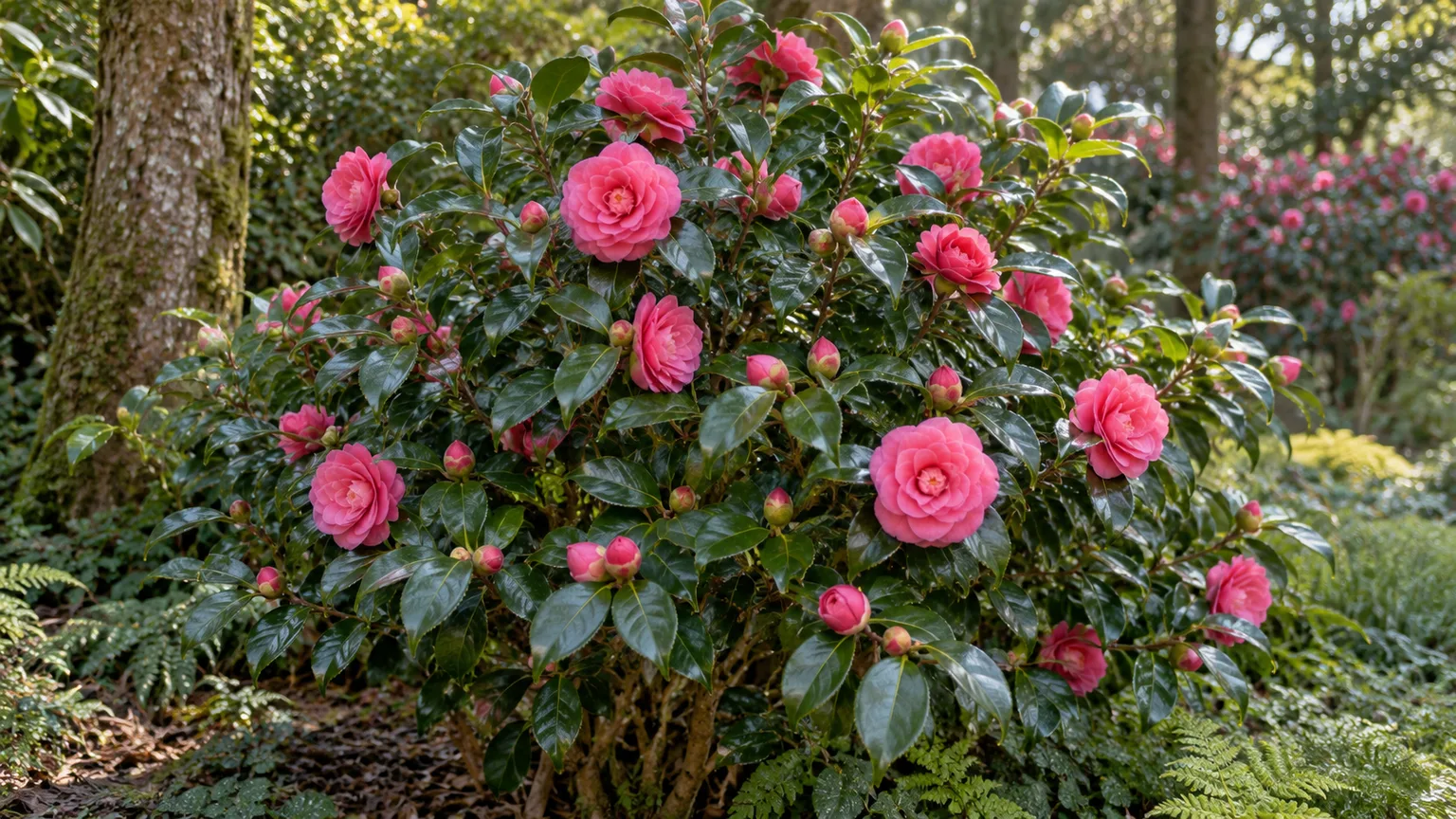
Camellia japonica is a broadleaf evergreen shrub with glossy leaves and large flowers in shades that include white, pink, and red. Choose a cultivar whose bloom window suits your region: some camellias flower in fall or early winter, while others open in late winter or spring. This distinction matters when the goal is a winter show rather than simply a plant that survives winter. UGA Extension notes that camellias can range from small, slow-growing forms to much larger shrubs, so check a named cultivar’s final size before planting near a wall or walkway.
Give camellias filtered light or light shade, especially where afternoon sun is intense, and keep the root zone evenly moist without leaving it waterlogged. They need a sheltered site in climates where hard freezes can damage buds. Avoid moving a blooming container abruptly between a warm room and outdoor cold; a steady, protected outdoor position generally causes less stress. Use a camellia for evergreen structure plus flowers, not as a guaranteed source of color during every winter week.
Winter jasmine, winter daphne, and cyclamen
Winter jasmine (Jasminum nudiflorum) is a useful choice when you want flowers on bare, arching branches rather than a compact shrub. Its yellow blooms usually appear in late winter or early spring, with exact timing shifting by climate. Let it spill over a low retaining wall, or tie stems to a support if you want more height. Branches that touch soil can root, so give it room and remove unwanted rooted stems before they form a thicket. It tolerates partial shade and pruning better than many winter bloomers, according to UGA Extension.
Winter daphne (Daphne odora) offers a different reward: clusters of pinkish or white flowers with powerful fragrance. It is an evergreen shrub for a protected, well-drained position, not a plant to tuck into compacted wet soil and forget. UGA Extension describes it as difficult to grow and recommends a protected site with deep, well-drained woodland soil. If drainage or shelter is poor, choose a more forgiving shrub rather than trying to rescue a struggling daphne each winter.
Cyclamen coum is a low tuberous perennial for the front of a bed or beneath deciduous shrubs. It can flower in late winter, often before a garden looks awake, and its rounded leaves add pattern after the flowers fade. Plant it where the soil drains well and the site is not repeatedly disturbed. Like other seasonal tuberous plants, it is not a summer bedding plant that wants constant watering while dormant; let the soil and the species’ growth cycle guide irrigation.
Pansies and violas
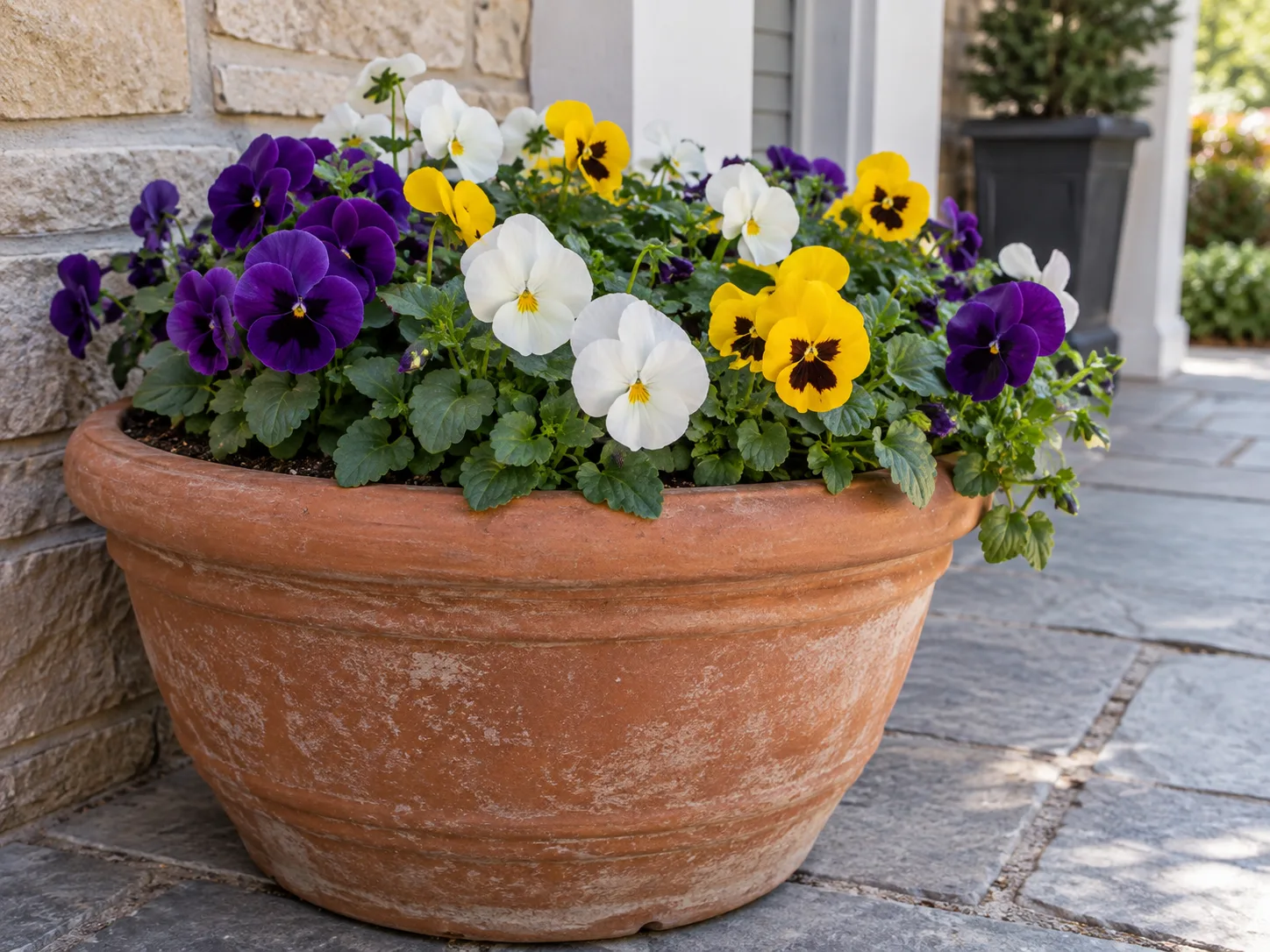
Pansies and violas are among the easiest winter flowers to place in a pot, window box, or front-of-border strip. Their compact size makes them especially useful near doors, where a small cluster is visible from indoors. UGA Extension describes them as winter bedding plants that can bloom through winter and spring in North Georgia; in colder regions, expect flowering to slow or pause in harsh weather rather than assuming every plant will stay in bloom through every freeze.
Give them sun when winter days are short, fertile soil, and a container with drainage holes. Water when the top layer starts to dry, but do not leave pots sitting in water. In a hard freeze, plants may wilt temporarily; wait for a thaw before removing foliage that still looks viable. A frost-hardy flower still needs roots insulated from repeated freeze-thaw cycles, particularly in a small exposed pot.
Bulbs and low-growing perennials that wake early
Small bulbs and corms are best planted before winter, then left to grow on their own calendar. Their low height makes them easy to overlook in summer, so mark the planting area and avoid digging there while they are dormant. They are ideal under deciduous trees: the canopy is open when many early bulbs flower, then leaf shade helps keep the soil cooler as the plants finish their cycle.
Snowdrops and winter aconite
Snowdrops (Galanthus nivalis) are among the earliest bulbs to appear, with nodding white flowers that can open in late winter or early spring. They suit a woodland edge, the base of a deciduous tree, or a narrow border where you can see their small flowers at close range. A patch reads better than a single bulb, so plant several together and let the clump expand rather than spacing them as isolated accents.
Winter aconite (Eranthis hyemalis) makes a low carpet of bright yellow flowers, often alongside or just before snowdrops. It is a good choice for a naturalistic patch if the ground does not stay soggy. Both plants depend on leaves after flowering to rebuild energy for future seasons. Let that foliage yellow naturally; cutting it down immediately after the flowers fade can weaken the next display.
Crocus, reticulated iris, glory-of-the-snow, Siberian squill, and early daffodil
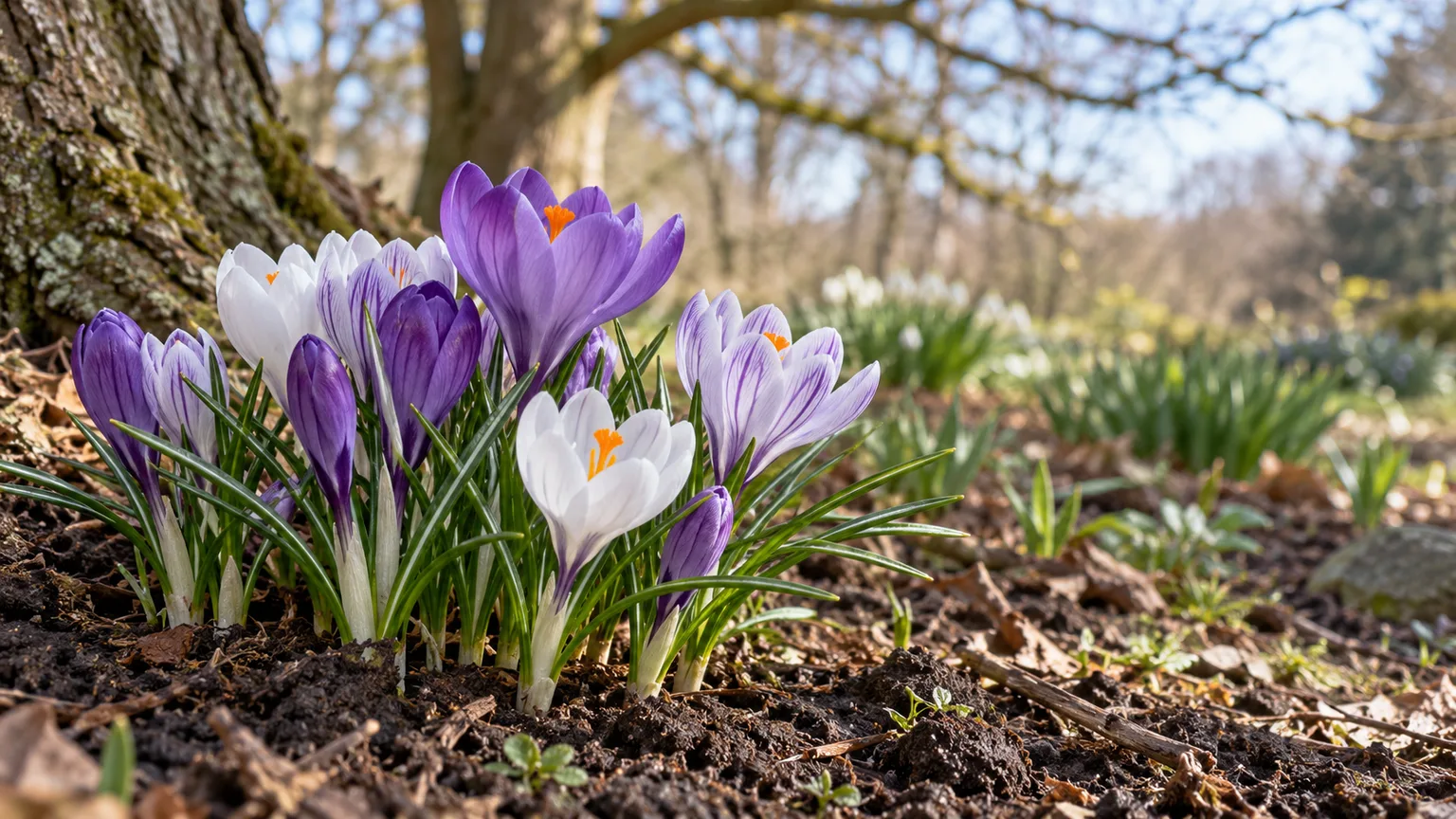
Early crocus gives a bright, low splash in lawns, rock gardens, and sunny edges. Choose early-flowering types if you want the show to start near winter’s end; later crocus cultivars extend the sequence into spring. Flowers open best in light, and closed blooms on a gray day do not necessarily mean the bulb is failing.
Reticulated iris (Iris reticulata) brings jewel-toned flowers close to the ground, often in shades of blue, violet, or purple. It likes a sunny, sharply drained site and can fade after a few years, so replace bulbs if flowering declines. Glory-of-the-snow (Chionodoxa luciliae) and Siberian squill (Scilla siberica) are similarly small spring bulbs; the former tends toward blue starry flowers, while squill’s nodding blue bells can spread into a naturalized patch. Both are better as groups than as solitary specimens.
For a compact yellow flower, try an early miniature daffodil such as ‘Tête-à-tête’. It often opens at winter’s end in mild regions and later in colder areas. The exact date depends on the season, not just the cultivar name. Like crocus and iris, these bulbs need their leaves to remain until they yellow, so place them where fading foliage will not bother you. The Philadelphia Horticultural Society includes snowdrops, winter aconite, early crocus, dwarf iris, and early daffodils among late-winter options, reinforcing that a sequence of small bulbs can stretch color across several weeks rather than peak all at once (PHS’s bulb and early-flower guidance).
Christmas rose and Adonis
The Christmas rose (Helleborus niger) is not a rose; it is a low evergreen perennial with white flowers that may open in winter in milder climates and later in colder ones. It works well at a woodland edge or in partial shade, but it still needs drainage. Avoid planting it in a low, waterlogged spot simply because the bed is shady.
Adonis amurensis is a small perennial with yellow, buttercup-like flowers that appear early in the season. It makes sense for a collector’s border or a carefully planned woodland patch, but it is less commonly available than snowdrops or crocus. Buy from a reputable nursery and confirm that the plant is suitable for your region; do not assume every early-flowering perennial will thrive in every winter garden.
Shrubs for berries, bark, and evergreen shape
Flowers are only one way to make a winter garden look alive. Fruit, bark, and foliage are more dependable visual anchors because they can remain attractive between bloom spells. These shrubs also give the small bulbs and pansies a backdrop, so the garden does not feel empty once flowers close.
Witch hazel and winter heath
Witch hazel (Hamamelis) is a large shrub or small tree with narrow, ribbon-like flowers on bare branches. Depending on species and cultivar, flowering can begin in fall or run from midwinter into early spring. The hybrid ‘Arnold Promise’ is valued for yellow flowers, but cultivar and regional timing still matter; buy a plant in bloom or check a local botanical garden’s flowering records if exact timing is important. Give witch hazel enough space to develop its natural outline instead of pruning it into a tight ball.
Winter heath (Erica carnea) is a low evergreen subshrub that can bloom for an unusually long period, with cultivar timing ranging from early winter into spring. It is the better choice when you want a carpet of close-up color along a sunny path or in a rock garden. The National Gardening Association’s winter-heath guide notes that bloom time varies with climate and microclimate, and that the shallow-rooted plants need well-drained, slightly acidic soil. It also advises pruning just after flowering because buds for the next season form soon afterward (National Gardening Association’s winter-heath guide).
Winterberry and pussy willow
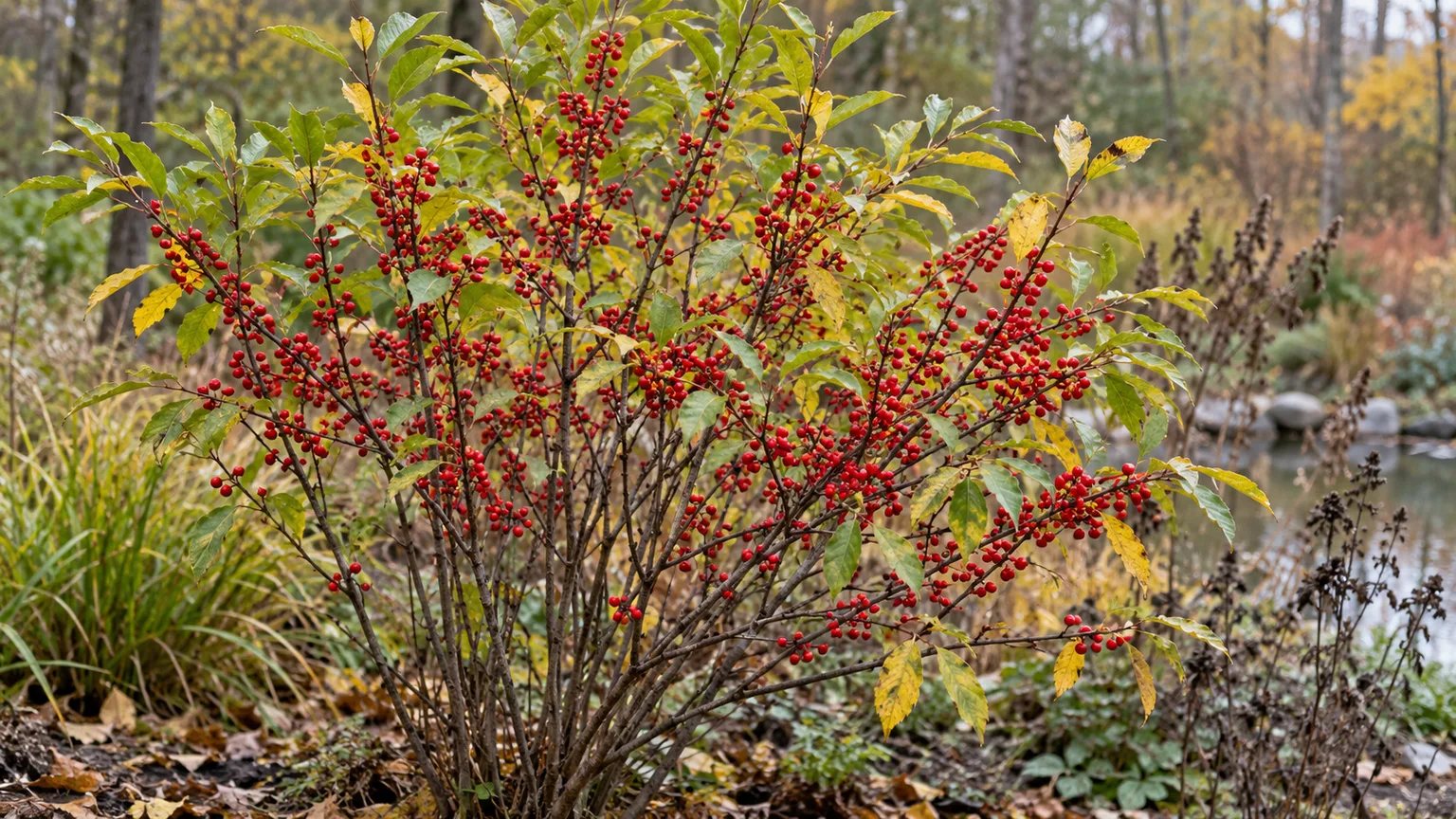
Winterberry holly (Ilex verticillata) is a deciduous native shrub whose red berries stand out after its leaves fall. It is a strong option for a moist garden, rain garden, or pond edge where an evergreen holly would feel too heavy. The berries are produced on female plants only when a compatible male plant blooms nearby; NC State Extension recommends matching bloom time and gives a practical planting ratio of one male pollinizer for roughly 10 to 20 females within 50 feet. A berryless winterberry is often a pollination-planning problem, not a sign that the shrub needs more fertilizer (NC State Extension Plant Toolbox profile for winterberry).
Pussy willow (Salix discolor) is grown for soft catkins on bare branches in late winter and early spring. It suits a moist, open part of the garden where a large shrub will not crowd paths or smaller plants. Use it as a seasonal focal point, or cut a few branches as the catkins begin to swell and bring them indoors. Its scale and vigorous growth make it a poor choice for a tiny foundation planting.
Red-twig dogwood, Japanese holly, and Leyland cypress
Red-twig dogwood (Cornus alba) earns its place through red or coral young stems, most visible after leaf drop. Plant it where the winter light can pass behind the stems, such as against a dark fence or evergreen background. The brightest color is on younger growth, so periodic renewal pruning can help a mature clump, but do it with a plan: removing too much at once also removes the shrub’s structure for the current season.
Japanese holly (Ilex crenata) has small, rounded leaves and a dense outline that can be clipped into a low hedge or left as a natural evergreen shrub. Use it when you want a compact-leaved contrast to larger foliage. It is not interchangeable with boxwood in every site; check the specific cultivar’s mature dimensions and local disease concerns before planting a long hedge.
Leyland cypress (Cuprocyparis leylandii) provides a fast evergreen screen, but it is a large plant, not a small ornamental shrub. Consider it only where there is ample room for its mature height and width. If your main goal is a small winter accent, choose a dwarf conifer or compact holly instead; planting a rapidly growing screen too close to buildings creates a recurring pruning burden.
Color from cold-tolerant foliage
When the garden is too cold for flowers to remain open, foliage can hold the color. That is why ornamental cabbage and kale belong in the winter palette even though the “flowering” name can mislead new gardeners.
Flowering cabbage and flowering kale
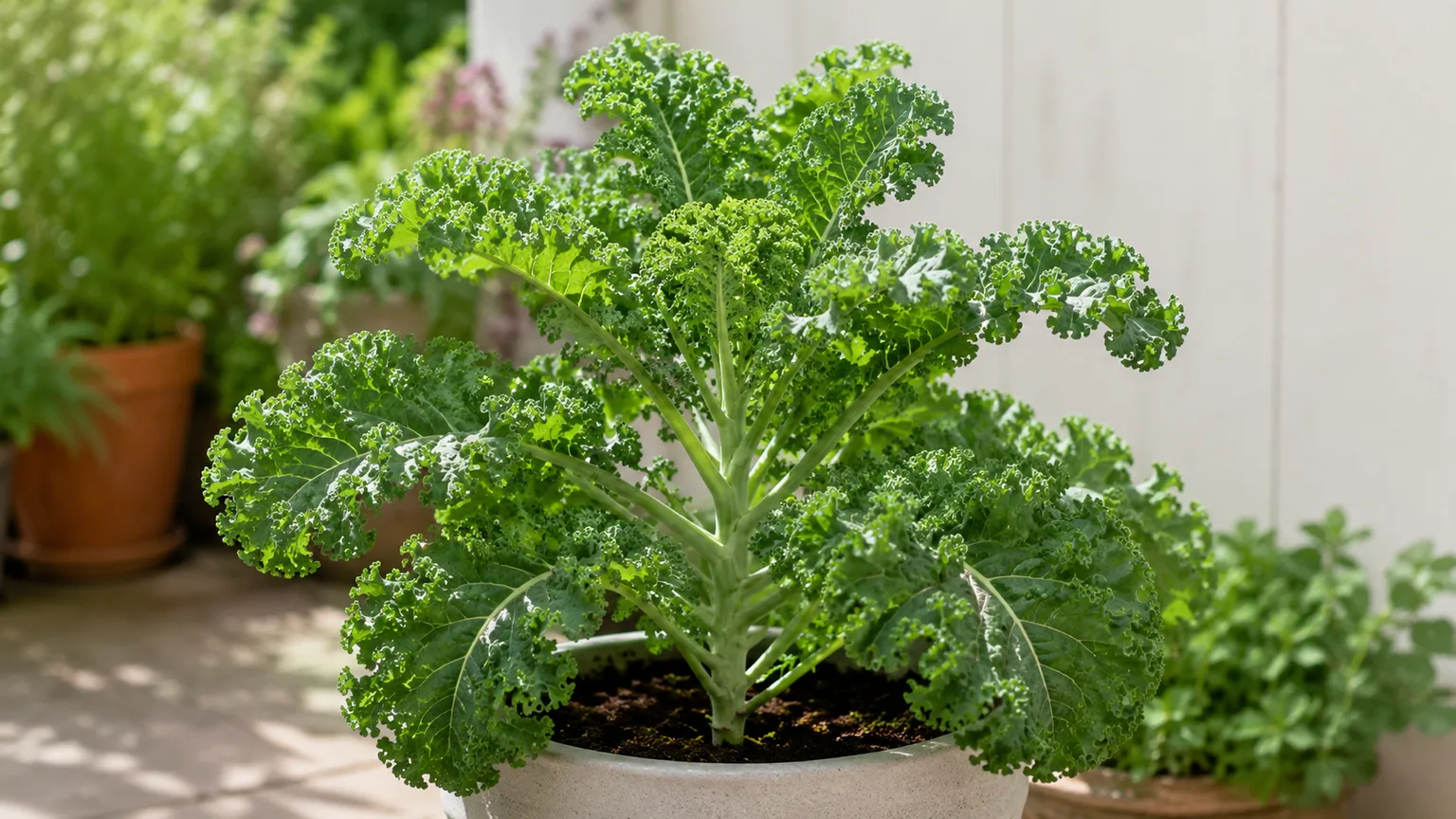
Flowering cabbage and flowering kale (Brassica oleracea) are ornamental forms grown for colorful leaf rosettes, not for flowers in the center of the plant. As temperatures cool, the inner leaves often develop stronger white, pink, or purple tones. They make reliable seasonal containers and front-of-bed accents, especially when paired with evergreen foliage, but treat them as cool-season annuals rather than permanent shrubs. Severe freezes can still damage leaves, and warm spells can shorten their tidy appearance.
Give ornamental brassicas full sun and fertile soil that drains freely. Space them so air can move through the rosettes, and avoid burying the crown during planting. If using them in a container, choose a pot large enough that the root ball is not exposed to rapid freeze-thaw swings. Their value is instant winter color; they do not replace a long-lived structural plant.
Plant and protect a winter display
Build the planting around the weather you actually get. In a mild winter, a broader mix of flowering shrubs and bulbs may perform well. In a colder region, make berries, evergreen leaves, bark, and the hardiest early bulbs the dependable layer, then add pansies or more tender shrubs in sheltered microclimates. The Philadelphia Horticultural Society’s winter-flowering list is based on Mid-Atlantic conditions, and UGA Extension’s examples are explicitly for North Georgia; use local extension advice when your climate differs from either region.
Plant bulbs at the depth and spacing on the package, in fall when soil is workable but before it freezes. Most bulbs perform best in groups because a cluster is easier to see and creates a stronger display. Do not braid, tie, or cut bulb foliage right after flowering. Let it fade naturally, which may mean hiding it behind later perennials or planting bulbs among groundcovers.
For shrubs, prioritize drainage and mature size. A winter-blooming plant in heavy, waterlogged soil may decline even when its top growth is cold hardy. Where winter wind dries exposed foliage, position broadleaf evergreens on the more protected side of a building or hedge. Do not move a plant into a warmer indoor room just because it has flowers; that can disrupt its outdoor acclimation and make the transition back harsher.
Use containers selectively. Pansies, ornamental kale, and some bulbs work well in pots, but containers expose roots to colder air than garden soil does. Choose frost-resistant containers with drainage, group pots near a sheltered wall, and water during a thaw if the mix is dry. A dry root ball can be as damaging as soggy compost, especially for evergreens, because a plant may lose water on sunny or windy days while its roots cannot draw from frozen soil.
Finally, plan maintenance around the plant’s next season. Remove broken stems after severe weather, but avoid heavy pruning before you know whether a branch is dead. Prune winter heath just after flowering, not in late summer when next season’s buds are developing. For winterberry, solve berry production by matching a male pollinizer rather than applying fertilizer or pruning more heavily. A little planning at purchase time prevents most winter-garden disappointments.
Conclusion
The most dependable winter garden mixes different kinds of interest instead of asking one plant to do everything. Use camellias, winter jasmine, pansies, or selected bulbs for flowers; winterberry for fruit; red-twig dogwood for stems; and holly, cypress, heath, or ornamental brassicas for foliage and structure. Choose by local climate, mature size, drainage, and the view you want to improve, then let bulbs and perennials finish their seasonal cycle. That combination gives a winter garden color when it can—and a clear shape when it cannot.