Sunburn & Scorched Ribs on Barrel Cactus: Causes, Checks &
Quick answer
Sunburn on barrel cactus usually follows a sudden jump to harsh direct sun—especially after months indoors or a nursery move. First step: pull the pot out of peak afternoon rays and give morning sun or filtered light until the scorch stops spreading.

Sunburn & Scorched Ribs on Barrel Cactus: Causes, Checks & Fixes
This guide covers sunburn / scorched leaves on Barrel Cactus. See also the general Sunburn / Scorched Leaves guide, watering, and light pages for this plant.
Sunburn & Scorched Ribs on Barrel Cactus: Causes, Checks & Fixes
Quick answer
Sunburn on barrel cactus (Ferocactus) shows up as bleached, tan, or brown patches on the rib that faces the strongest light—not on separate leaves, because this plant photosynthesizes through its ribbed stem. The classic trigger is moving a nursery or indoor plant straight into hot afternoon sun, unfiltered south or west glass in summer, or outdoor placement without gradual hardening.
First step: pull the pot out of peak direct sun—morning light only, dappled shade, or one to two metres back from hot glass behind sheer curtain. Leave watering, repotting, and fertilizer alone until you see no new bleaching for at least a week.
For how sun scorch behaves across houseplants in general, see our sunburn and scorched leaves guide. On barrel cactus, the one-sided rib pattern and firm dry texture tell you this is a light problem—not wet-soil rot.
When to use this page vs other Barrel Cactus guides
This page is for directional bleaching or browning on the stem ribs after a light change. Use sibling guides when the pattern does not fit.
- Black spots — go here when dark patches could be rot, scale, corking, or sun; the touch test sorts them
- Root rot — go here when the base turns soft, yellow, or mushy with damp soil
- Overwatering — go here when the pot stays heavy and the lower ribs soften without a recent light move
- Not enough light — go here when ribs stretch pale and thin toward the window without crisp scorch patches
- Barrel Cactus light guide — go here for long-term full-sun placement after recovery
- All Barrel Cactus problems — browse every issue on this species
What sunburn looks like on Barrel Cactus
Healthy Ferocactus skin is firm, evenly colored for the species, and dry between sharp ribs. Sun scorch has a directional, dry pattern on the stem surface:
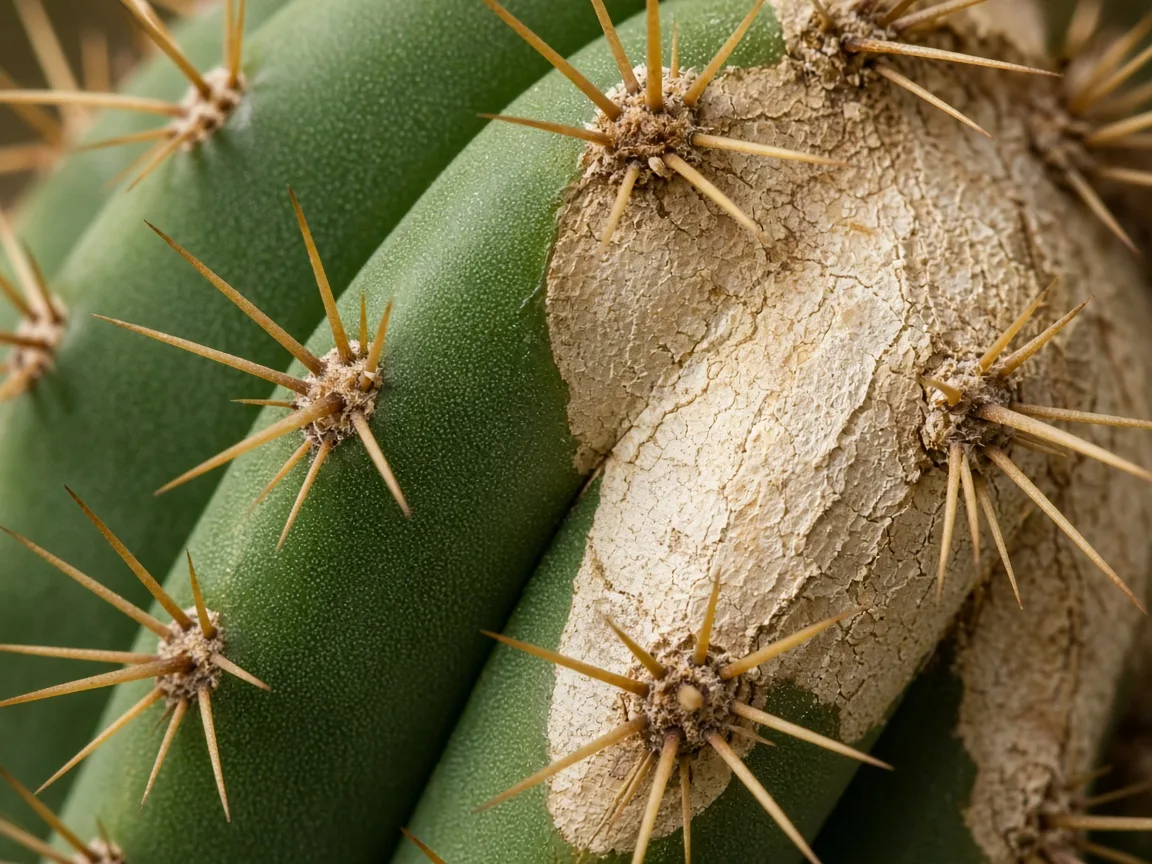
Bleached tan patches on the sun-facing rib of barrel cactus — compare hard dry scorch tissue with firm green ribs on the shaded side.
Typical sunburn on ribs:
- Bleached white, silvery, or pale tan patches concentrated on the rib that faces the window or outdoor sun
- Dry, papery, or slightly sunken epidermis that feels hard when pressed—not soft or squishy
- One-sided damage; ribs on the shaded side stay normal green or blue-green
- Fast onset within 24 to 72 hours after a light increase, outdoor move, or seasonal sun-angle shift through glass
- Firm base and dry soil despite ugly rib color; the pot feels light and a dry skewer passes cleanly
Advanced scorch may darken to tan-brown or black as tissue dies, but still feels hard and dry. Over months the patch often corks over into a permanent woody scar.
Not sunburn: reddish, orange, or purple flush on ribs is often sun-stress pigment—a protective anthocyanin response that can fade when light eases. True burn bleaches tissue white or papery and does not reverse.
Why barrel cactus sunburns despite loving desert sun
Ferocactus prefers full sun in its native Southwestern rocky habitat, but that tolerance builds slowly. Indoor or nursery plants develop an epidermis calibrated to lower UV and filtered glass. When intensity jumps faster than protective pigments and waxes can form, excess UV damages the outer tissue—often within hours on a hot afternoon.
Common barrel-cactus-specific triggers:
- Spring outdoor move after winter on a dim shelf or back from the window
- Nursery-to-sill transplant where the plant lived under shade cloth and you placed it in open south glass the same day
- Summer sun-angle change as a west window beam narrows onto one rib
- Reflective heat from white walls, gravel trays, or metal shelving that bounces extra light onto one side
- Post-repot exposure when fresh mix and handling coincide with a light increase—stressed plants burn faster
NC State notes that in scorching climates, afternoon shade is recommended even for sun-loving cacti. Indoors, hot glass can concentrate that same afternoon load onto a single rib.
Reading scorch rib-by-rib on Ferocactus
Barrel cactus grows as a ribbed cylinder with spines at areoles along each ridge. Light hits one or two outer ribs hardest, so damage reads like a vertical stripe on the bright side—not scattered spots.
Walk around the pot and note:
- Which rib faces the window or outdoor sun — scorch should match that face only
- Whether the crown spines look normal — sunburn rarely stops new spine growth at the top unless the whole plant was baked
- Whether ribs contract evenly — slight rib pinching on all sides after long drought points to underwatering on Barrel Cactus, not one-sided bleach
- Monthly rotation — plants left facing one direction too long can scorch one rib while the opposite side stays pale from not enough light
This rib map is why generic “check leaf undersides” advice fails here. Your diagnostic surface is stem epidermis between spines, not foliage.
How to confirm sunburn is the cause
Work through these checks before changing water or reaching for fungicide:
- Timeline — Did patches appear within one to three days of a light change? Sunburn timing is fast.
- Touch test — Press the discolored rib with a gloved finger or blunt tool. Hard and dry fits scorch. Soft or sunken at the soil line points to rot or overwatering.
- Soil moisture — Dry skewer through the entire pot matches sunburn. Heavy damp mix with yellowing base does not.
- Pattern — One-sided bleaching on the bright rib strongly suggests scorch. Even blackening around areoles suggests scale insects instead.
- Corking check — Firm dry dark bands creeping up from the base on an older plant may be harmless corking, not fresh burn. Fresh scorch appears on the exposed rib face after a recent light event.
If every check matches sunburn and the base is firm, skip fungicides and root surgery. The fix is light management.
The first fix: shade the burned rib immediately
Move the pot to a spot with bright light but no harsh midday direct sun on the damaged rib—an east window, covered porch, or south window filtered by sheer curtain. This single step stops active burning.
Keep the plant there for at least five to seven days. Watch for:
- No new bleached patches on adjacent ribs
- Existing tan areas staying firm, not softening
- Crown and base remaining solid when gently pressed
Do not compensate with extra water. Ferocactus needs the mix to dry completely between waterings—wet soil on a stressed stem invites rot through scorched skin.
Re-acclimating barrel cactus to full sun
Barrel cactus still needs strong light long term. After scorch stabilizes, increase exposure gradually over two to three weeks:
- Days 1–5: Morning sun only (roughly two to three hours before noon) or bright filtered light all day
- Days 6–10: Add late-morning sun; total direct exposure about four hours
- Days 11–14: Extend into early afternoon if no new bleaching appears
- Week 3+: Return to the final bright spot—full sun with afternoon relief on the hottest windows
Rotate the pot a quarter turn every week so all ribs harden evenly. Skip fertilizer until new spine growth at the crown looks normal.
Lookalike symptoms on Barrel Cactus
Several problems mimic scorched ribs. Separating them prevents the wrong fix:
| What you see | Likely cause | Key difference |
|---|---|---|
| Bleached patch on one sun-facing rib after a light move | Sunburn | Fast onset, hard dry tissue, firm base |
| Soft black at soil line with damp pot | Root rot | Mushy base, sour smell, not one-sided dry patch |
| Hard black on bright rib only | Sunburn or old injury | Dry texture; follows light history |
| Raised bumps at areoles with sticky residue | Scale insects | Insect bodies present, not uniform bleach |
| Firm woody band at base of old plant | Corking | Slow, base-origin; plant otherwise thriving |
| Pale stretch on all ribs toward window | Not enough light | Thin weak growth, no crisp scorch edge |
Mistakes to avoid
- Moving straight back into hot afternoon sun once one rib looks stable—partial recovery is not acclimation
- Extra watering because the rib looks “dried out”; scorched epidermis is not thirst, and wet mix risks Pythium rot at the soil line
- Fertilizing scorched plants to push growth—salts stress roots on a slow-growing desert cactus
- Carving firm dry scorch for cosmetics; open wounds invite infection on ribbed stems
- Misting or spraying burned ribs in hot sun, which can worsen tissue damage
Wear thick gloves when handling Ferocactus. Spines cause mechanical injury—keep the pot out of traffic paths.
Recovery timeline and what improvement looks like
Scorched rib tissue does not turn green again. Judge success by the stem base and crown:
- Days 1–7: Scorch spread stops; no new bleaching on neighboring ribs
- Weeks 2–6: Crown spines look normal; burned patch may tan and cork over
- Months 3–12: New growth rings at the top; old scar remains as a cosmetic mark on slow-growing Ferocactus
A firm base throughout is the best sign the plant will recover cosmetically. If the soil line softens while you are shading the plant, inspect for rot—sunburn alone should not mush the base.
How to prevent sunburn next time
- Acclimate every spring when moving barrel cactus outdoors after winter rest
- Harden nursery purchases in bright filtered light for one to two weeks before full sun
- Use morning sun as the entry point on hot south or west windows; add afternoon exposure only after ribs toughen
- Sheer-filter hot glass for the first two to three weeks after any indoor light increase
- Rotate monthly so one rib does not take all peak-season intensity
- Match long-term placement to the Barrel Cactus light guide and watering rhythm—healthy dry roots recover from light stress faster
When to worry
Sunburn is usually cosmetic if caught early. Escalate care if:
- The base turns soft or yellow at the soil line—rot may have started separately or through burned skin
- Scorch softens and spreads across ribs within a week despite shade
- Dark liquid or foul smell appears at the burn edge
- No new crown growth after six to eight weeks in warm, stable filtered light
For firm ribs and stable hard scorch, patience and gradual light are enough. Ferocactus grows slowly; a permanent rib scar is common and does not mean the plant is dying.
Related Barrel Cactus guides
- Barrel Cactus overview — species basics and spine safety
- Light — full-sun placement after recovery
- Watering — dry skewer checks that prevent rot compounding scorch
- Black spots — when dark rib patches need a texture fork
- Brown leaves — overlapping color change on stressed tissue
- Root rot — salvage when soft tissue follows burn
- All Barrel Cactus problems