Yellow Leaves on Barrel Cactus: Rib Zone Diagnosis
Quick answer
Barrel cactus does not have leaves—yellowing shows on rib skin, usually at the soil line (wet roots), on the sun-facing side (burn), or as dull overall color (thirst or low light). First step: map where the yellow sits, then press the lowest ribs with thick gloves while a dry skewer tests the full pot depth.
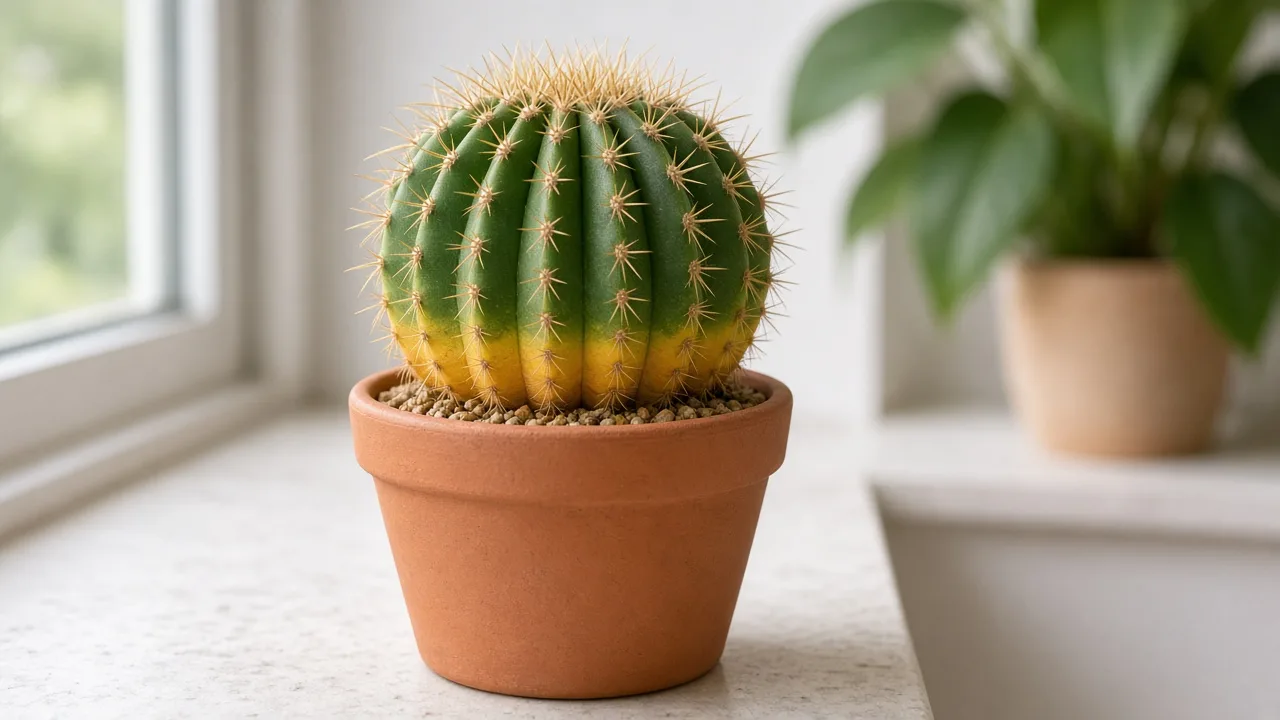
Yellow Leaves on Barrel Cactus: Causes, Checks & Fixes
This guide covers yellow leaves on Barrel Cactus. See also the general Yellow Leaves guide, watering, and light pages for this plant.
Yellow Leaves on Barrel Cactus: Causes, Checks & Fixes
Quick answer
Searchers often say “yellow leaves” on barrel cactus, but Ferocactus has no foliage—the green photosynthetic tissue is the ribbed stem wall between spines. Yellowing is almost always a zone pattern on those ribs: at the soil line, on the sun-facing arc, or as a dull wash across the whole barrel.
For how yellowing works on leafy houseplants in general, see our yellow leaves guide. On barrel cactus, the first job is mapping which rib zone changed color—because wet-root yellow at the base needs the opposite fix from sun-bleached patches on the south face.
First step: wear thick gloves, locate exactly where the yellow sits, and press the lowest ribs above the soil while a dry skewer probes the full pot depth. Do not soak, fertilize, or repot until that zone check points to thirst, burn, or rot.
When to use this page vs other Barrel Cactus guides
| Pattern | Read next |
|---|---|
| Yellow lower ribs + heavy wet pot + soft base | Overwatering → root rot if mushy |
| Dull ribs + light dry pot + slight rib shrinkage | Underwatering |
| Bleached yellow-tan on sun-facing side only | Sunburn scorched leaves |
| Overall pale dull green, not patchy yellow | Pale leaves or not enough light |
| Yellow around areoles + cottony deposits | Mealybugs |
| Firm brown band at very base of old plant | Often corking—stay here for the cork vs rot table |
| Black soft patches climbing ribs | Black spots or brown leaves |
What yellowing looks like on Barrel Cactus ribs
Unlike pothos or peace lilies, Ferocactus will never drop yellow leaves—because it has none. The diagnostic surface is rib skin (the green tissue between spines) and how color shifts by height and direction on the barrel.
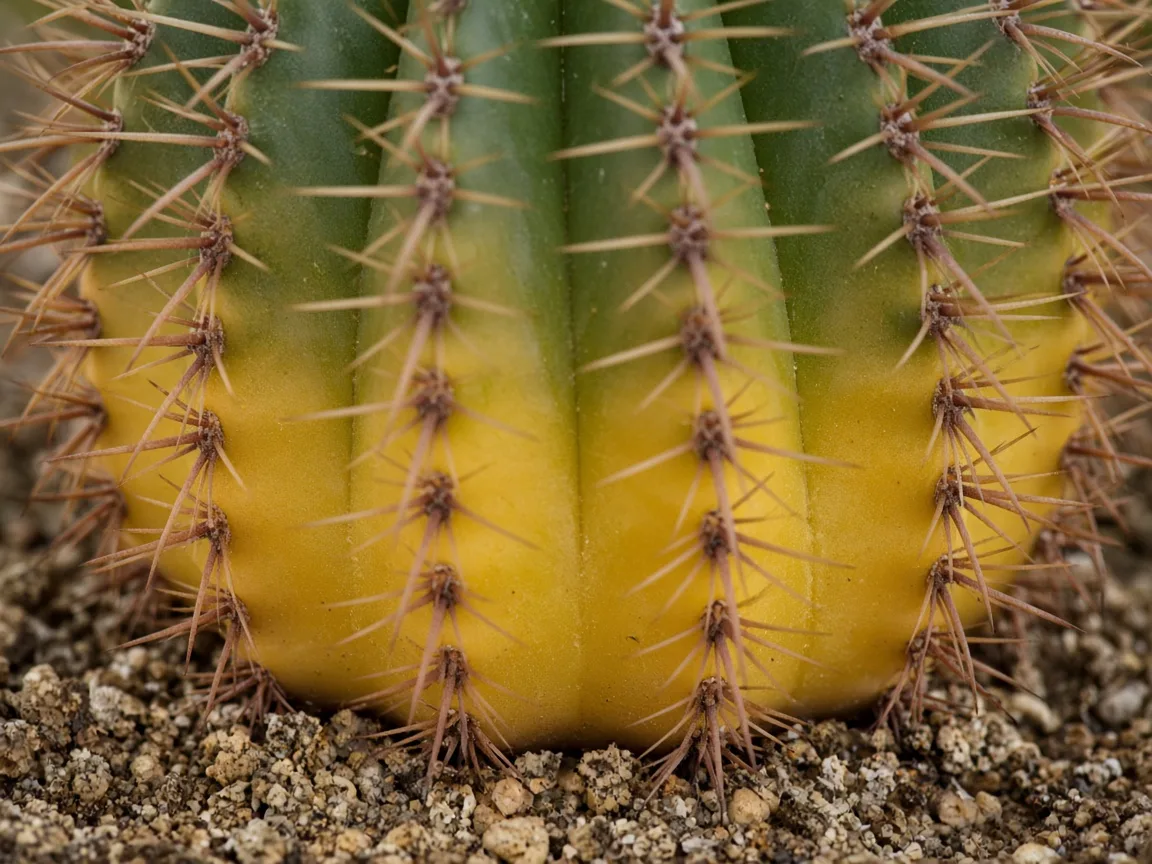
Yellow at the soil line on damp mix—translucent lower ribs with firm upper barrel still green; classic early wet-root stress before rot climbs.
Zone A: Soil-line yellow (wet-root pattern)
- Yellow or translucent lower ribs right where stem meets mix
- Upper ribs still firm and green while the base looks washed out
- Heavy pot days after watering; skewer emerges damp through full depth
- Soft or yielding tissue when you press the lowest ribs with a gloved finger
- May pair with fungus gnats or mold on soil on chronically wet mix
This pattern tracks overwatering or poor drainage that causes rot or brown mushy areas on the stems. Pythium rot symptoms often begin at the soil level with yellowing before the whole stem softens.
Zone B: Sun-facing bleach (burn pattern)
- Yellow-tan to bleached patches on one side—the window or outdoor face
- Opposite side stays darker green
- Often follows a sudden move to stronger direct sun or summer glass magnification
- Tissue feels firm, not squishy—different from rot
- Direct southern sunlight may burn the plant in peak summer even though Ferocactus prefers full sun
Zone C: Dull overall yellow-green (thirst or low-light pattern)
- Whole barrel looks dull or yellow-green, not patchy
- Slight shrinkage between ribs on a light dry pot
- Skewer clean and dry through the full depth
- Common after an overly cautious winter dry spell or a dim shelf
- May overlap with slow growth if light is the limiting factor
Ferocactus ribs expand to store water during wet periods and contract as stored water is used in dry spells—so some rib profile change is normal. Thirst adds dry skewer + dull color + light pot together.
Zone D: Corking at the base (aging, not disease)
- Firm brown or tan band at the very bottom of a mature barrel
- Tissue is hard, not mushy; no sour smell
- Color change is slow over years, not days
- Upper ribs and crown stay green with normal new spines
Do not confuse stable cork with active yellow rot—cork does not spread upward weekly.
The rib-zone map: a plant-only first check
This four-zone read would be nonsense on a fern. On barrel cactus it is the fastest way to avoid treating sunburn like thirst:
- Photograph or mark where yellow sits—base, one face, crown, or everywhere.
- Press lowest ribs above soil with thick gloves. Firm vs soft splits wet-root from burn/thirst.
- Skewer the full pot depth. Wet center + soft base = stop water. Dry center + dull ribs = consider a soak per the watering guide.
- Compare sun faces. One-sided bleach = shade or filter, not repot.
- Check crown spines. New spine tufts at the top are the best recovery signal on any pattern.
Why Barrel Cactus ribs turn yellow
Ferocactus is a slow-growing desert cactus that prefers full sun, gritty well-drained mix, and a dry environment. Yellow ribs usually mean one of its core needs slipped—not a mysterious “leaf” problem.
Chronic wet mix. When soil stays damp, roots lose oxygen and die. The stem cannot move water normally; chlorophyll breaks down at the soil line first. Winter calendar watering in a cool room is a frequent trigger—water even less during dormant fall and winter.
Stem buried too deep. Burying the fleshy stem in soil keeps the lowest ribs damp even when you water sparingly, producing yellow tissue exactly at the soil line.
Sun shock. Moving from a nursery shade bench to a south window without acclimation can bleach one face yellow-tan while roots are fine.
Extended drought on a small root ball. An indoor barrel in a warm window can still desiccate if the pot has been dry for months—the ribs dull and shrink before the base corks.
Pest stress at areoles. Mealybugs and scale can yellow tissue around feeding sites; look for cottony deposits or shiny honeydew before assuming water error.
Peat-heavy or oversized pots. Dense mix in a large glazed pot stays wet in the center while the surface looks dry—yellow at the base on an apparently “careful” watering schedule. Mineral soil in a snug porous pot dries evenly.
How to confirm the cause
Match zone + touch + skewer before any fix:
| Zone pattern | Skewer | Rib feel | Likely cause |
|---|---|---|---|
| Lower ribs only | Damp full depth | Soft at base | Overwatering / early rot |
| Lower ribs only | Damp | Firm | Check burial depth; may be beginning infection |
| One sun face | Dry | Firm | Sunburn |
| All ribs dull | Dry | Firm, slight shrink | Underwatering |
| All ribs dull | Dry | Firm, no shrink | Low light |
| Base band only | Dry | Hard brown | Corking (aging) |
| Random areole halos | Any | Firm | Pests |
Sniff the soil. Sour odor with yellow base tissue means open the root rot workflow the same day—not a light adjustment.
The first fix to try
Map the zone, then take one action matched to that zone—nothing else on day one.
- Soil-line yellow + wet skewer + soft base: Stop all watering. Move to bright air flow; do not repot yet unless tissue is mushy.
- Soil-line yellow + wet skewer + firm base: Stop water and let the mix dry out completely between waterings on a full-depth skewer before the next soak.
- One-sided bleach + dry skewer: Filter or move back from glass 1–2 weeks; do not deep-soak a sunburned barrel.
- Dull all-over + dry light pot: One deep soak through drainage holes, then return to dry-down rhythm in the watering guide.
- Firm cork band only: No treatment—monitor crown spines.
If the base is already squishy, skip the pause and follow root rot salvage steps immediately.
Step-by-step recovery by confirmed cause
Wet-root yellow (firm or early soft)
- Stop watering until a skewer is dry through the entire pot—surface dust-dry is not enough.
- Ensure drainage holes are open and cachepots are not holding water.
- Keep the plant in full sun with good air movement so the mix cycles faster.
- After two full dry-down cycles on firm ribs, resume soak-and-dry at the longest interval that kept the skewer dry.
- If yellow climbs or base softens, unpot and inspect roots—see overwatering for the rib squeeze protocol.
Sunburn yellow
- Move back from the hottest window or add sheer filter for 2–3 weeks.
- Rotate a quarter turn weekly so one face does not keep taking all the stress.
- Do not water extra to “help” burned tissue—roots were not the problem.
- Acclimate back to direct sun gradually over several weeks once color stabilizes.
Thirst dull yellow
- Confirm skewer dry and pot light.
- Water deeply until drainage runs free; empty the saucer within minutes.
- Wait for full dry-down before the next soak—terracotta pots help remove excess moisture but still need a complete dry cycle.
- Track new spine growth at the crown over the next month.
Recovery timeline
Yellow rib skin does not turn bright green again—judge success by stopped spread and crown activity.
- Sunburn: Bleached patches firm up and tan over 4–8 weeks; new crown spines mean the plant moved on.
- Mild wet-root yellow on firm base: Often stabilizes after one full dry-down cycle (2–6 weeks indoors depending on pot size).
- Active rot: Lower yellow tissue may cork or blacken permanently even after salvage; crown pup or seed restart may be the realistic path.
Escalate if yellow spreads up the barrel within a week, the base goes hollow, or crown spines stop emerging for three months after corrected care.
Mistakes to avoid
- Soaking a sunburned barrel because yellow “looks thirsty.”
- Fertilizing yellow ribs before you know whether roots are wet or dry—stressed Ferocactus rarely needs feed first.
- Repotting on day one when the fix is simply stopping water on firm ribs.
- Mistaking yellow spines for yellow ribs—spine color is genetic; rib skin between spines is the symptom surface.
- Pruning or cutting yellow ribs for cosmetics—open wounds at the soil line invite infection on wet mix.
How to prevent yellow ribs next time
- Water only after mineral mix is dry on a full-depth skewer, not on a calendar—details in the watering guide.
- Sharply reduce water in cool winter rooms; dormant barrels uptake slows.
- Keep the crown and lowest ribs above the soil line when repotting.
- Use fast soil in a porous pot sized to the root ball.
- Acclimate to direct light after moves; filter peak summer glass if burn repeats.
- Scout areoles monthly for pests that yellow tissue locally.
When to worry
Mild dull ribs on a firm base after one missed watering or a cloudy month are usually reversible. Treat as urgent when:
- The base feels squishy or hollow
- Yellow turns translucent on wet mix
- Black tissue climbs above the soil line within days
- The mix smells sour
- Yellow spreads around the barrel while the pot stays heavy
Related Barrel Cactus guides
- Overview — culture and spine safety
- Watering — soak-and-dry after you confirm thirst
- Light — full sun without shock
- Soil — mineral mix that dries evenly
- Overwatering — wet pot + soft base protocol
- Underwatering — rib shrink on dry mix
- Root rot — mushy base salvage
- Problems hub — full symptom index
Conclusion
Yellow “leaves” on barrel cactus are rib-zone signals on a spine-covered stem. Map where the color changed, press the lowest ribs with gloves on, and let a full-depth skewer tell you whether the mix is wet or dry. Wet base yellow needs a dry-down pause; one-sided bleach needs shade; dull dry ribs need a careful soak. Firm cork at the base of an old plant is often just age. Recovery is new crown spines—not re-greening old yellow skin.
Related tool
Use the Yellow Leaves Diagnosis Tool to narrow causes for yellow leaves on this plant before changing multiple variables at once.