Brahmi Propagation: Cuttings, Division & Timing
Brahmi Propagation: Cuttings, Division & Timing
Brahmi Propagation: Cuttings, Division & Timing
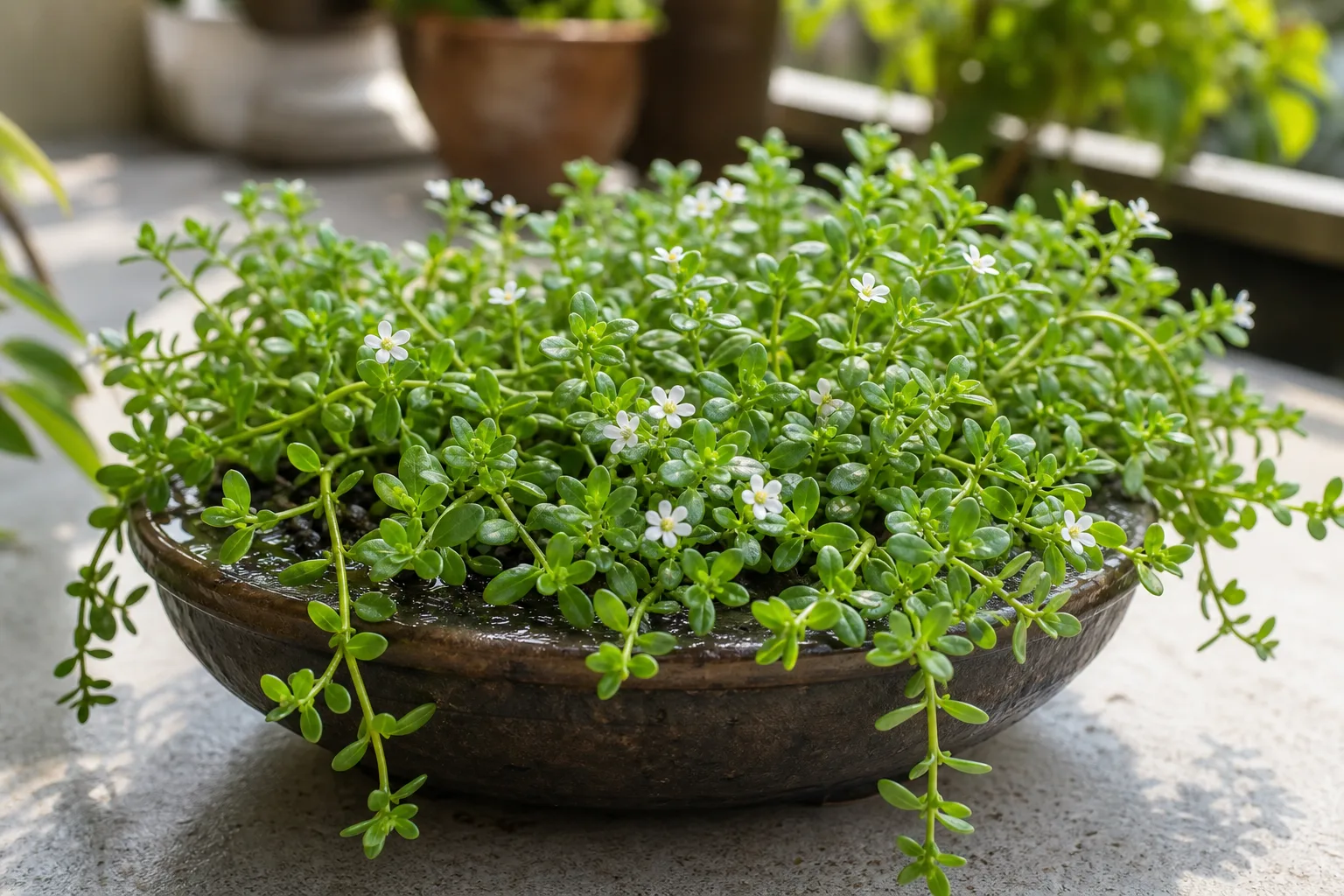
Brahmi propagation is one of the easiest wetland-herb starts you can do on an Indian balcony—if you treat Bacopa monnieri like a creeping marsh plant, not a drought-tolerant succulent cutting in dry mix. True Brahmi, also sold as water hyssop, herb of grace, or nirbrahmi, forms low mats of succulent stems that root at the nodes wherever they touch wet soil or shallow water. Extension and ethnobotanical references list stem cuttings and division as the recommended home methods, with seed as a slower optional path (NC State Extension Gardener Plant Toolbox; Plants For A Future).
This guide covers how to confirm the species, when to cut in warm Indian weather, step-by-step nodal cuttings in water or moist mix, mat division, seed basics, aftercare, and the failures that empty jars. Use it when you want more plants. For everyday moisture, light, and soil once a young mat is established, shift to those sibling guides instead of stretching this page into a full care manual.
Why Brahmi Roots So Easily—and Where It Still Fails
Brahmi’s biology does most of the work. It is a creeping, mat-forming perennial of moist to wet places—marshes, muddy shores, stream margins, and shallow water—with rapid growth when warmth and moisture stay steady. NC State notes it is heat tolerant but not drought tolerant at all, and that it spreads quickly in moist soil or shallow water as a ground cover (NC State Extension Gardener Plant Toolbox). Community growers describe the same habit: soft cuttings or division into boggy soil or water, where stems mingle and keep spreading (Yandina Community Gardens).
That node-rooting habit is why a 10–15 cm soft tip often “takes” within a couple of weeks. It is also why the same cutting collapses when the mix dries for a day, the water jar turns slimy and oxygen-poor, or the parent plant was already crisping from drought. Propagation fails on Brahmi almost never because the species is “hard.” It fails because the cutting was asked to behave like a dry houseplant.
Confirm You Have Bacopa monnieri Before You Cut
In India, the word “brahmi” is not a reliable ID. Packs labeled brahmi are sometimes Centella asiatica (gotu kola), a different Plantaginaceae relative with broader, kidney-shaped leaves and a different growth habit. NC State’s Centella profile is a useful cross-check if your nursery tag is vague (NC State — Centella asiatica). True Bacopa monnieri has small, thick, opposite, oblong to oval succulent leaves on smooth creeping stems, with small white (sometimes pink-tinged) bell flowers in the leaf axils (NC State Extension Gardener Plant Toolbox).
Also ignore advice written for ornamental hanging-basket “Bacopa” that is actually Sutera / Chaenostoma. Those trailing annuals are not Ayurvedic Brahmi. Propagate only stock labeled Bacopa monnieri with the wetland look above. Wrong identity wastes weeks and spreads the wrong plant under the right name.
Best Season and Timing in India
Propagate when the parent mat is actively spreading—warm days, bright light, and steady moisture. For most of India that means roughly late spring through monsoon (about March–September), when nights stay mild and new nodes keep pushing roots. Soft herbaceous cuttings generally root fastest while the plant is in active growth; cool, dark, dry conditions slow or stall the same process (Virginia Cooperative Extension).
Skip cold North Indian snaps and frost-prone nights. Brahmi is frost tender in cool climates (roughly USDA zones 8–11 in temperate references), and cuttings sitting wet while growth stalls invite soft stem collapse (Plants For A Future). In peak May heat, shade soft trays from midday scorch while keeping the medium wet—heat itself is fine; a dry crust is not.
Choose Stem Cuttings or Division for Your Goal
Both methods clone the parent. Pick based on how much plant you already have and how many new pots you need.
When stem cuttings are the better path
Choose stem cuttings when you want many small starts from one healthy runner, when the parent pot is not yet crowded enough to divide, or when you are sharing tips with neighbors. Soft nodal cuttings are the default home method for this species (NC State Extension Gardener Plant Toolbox; Plants For A Future). They cost almost nothing beyond a clean snip and a wet medium.
When division makes more sense
Choose division when a dense mat already fills the pot, roots pack the drainage holes, or the surface dries within a day in heat because the root mass is too large for the container. Division gives you instant rooted pieces—no waiting for a jar to sprout white tips. It is also the cleanest way to refresh a sour, compacted center while reclaiming healthy outer runners.
How to Propagate Brahmi From Stem Cuttings
Treat cuttings as mini wetland plants from minute one: nodes in contact with moisture, leaves kept out of foul water, and never a full dry-down.
Taking nodal softwood cuttings
Use clean, sharp scissors or a blade. Extension cutting guides stress cutting just below a node—the point where leaves attach—because roots form most readily there, and a long stub of stem below the node often rots (Missouri Botanical Garden). Aim for roughly 8–15 cm of firm, green, non-woody stem with two to three nodes and plump leaves. Strip leaves from the lower node or two so bare nodes can sit in water or mix; submerged foliage fouls the jar. Remove flowers or buds so energy goes to roots, not bloom (Missouri Botanical Garden).
Take material only from a healthy, actively spreading parent—not from a drought-crisped mat or a plant that was just hard-repotted. Leaf-only pieces without a node will not root. Rooting hormone is optional on this soft, easy species; warmth and constant moisture matter more than powder.
Water rooting vs moist-mix rooting
Water route: Stand cuttings in room-temperature water so at least one node is submerged. Keep the jar in bright, indirect light. Change the water every few days so it does not go stagnant and oxygen-poor—Virginia Tech notes that unchanged water becomes inhibitory and that water-formed roots can face more transplant shock than mix-formed roots (Virginia Cooperative Extension). When white roots are about 3–5 cm long (often within 2–4 weeks in warm weather), pot into a moisture-retentive mix and keep it wet while the plant adjusts.
Moist-mix route: Fill small pots with a wet, airy mix similar to adult Brahmi soil—potting mix with coco peat or compost plus some perlite or coarse sand so it stays moist without turning into sealed anaerobic mud. Set pots in a shallow water tray so the medium never crusts dry. Stick cuttings about 2–3 cm deep with a buried node, firm gently, and keep bright but not harsh midday sun until new tips push. Many growers prefer this path because roots are soil-adapted from day one and there is less transplant shock (Gardener’s Path).
Either route works. The non-negotiable rule is the same as adult Brahmi watering: never let the cutting dry out.
How to Divide an Established Brahmi Mat
Water the parent pot thoroughly an hour before you work so stems are plump and roots slide apart more cleanly. Tip the plant out and tease the mat into sections, each with several stems and attached roots. Replant divisions at the same depth in moist mix, firm lightly, and water until the pot drains into a tray you keep shallowly filled. Keep new divisions out of harsh midday sun for a few days while bruised roots catch up, then return them to the full sun to partial shade the species prefers (NC State Extension Gardener Plant Toolbox).
If the center of the old mat smells sour or feels slimy, discard the worst core and keep only clean outer runners. Division is also a natural moment to move into a slightly wider shallow pot if the mat was drying too fast—see the Brahmi repotting guide when container size is the real issue.
Seed Propagation (Optional and Slower)
Seed works but is slower and fussier than cuttings for home growers. Surface-sow on moist seed-starting mix, press lightly, and do not bury—seeds need light. Keep trays warm (around 24°C / 75°F), humid, and evenly moist; germination often takes roughly 10–20 days under good conditions (Gardener’s Path). Crowded, constantly saturated, poorly aired flats invite damping-off—seedlings collapsing at the soil line from fungi such as Pythium and Rhizoctonia. NC State’s prevention list is the right playbook: clean trays, airy mix, sensible density, good light, and avoiding chronically wet anaerobic pockets (NC State Extension — Damping-off).
Use seed when you want many genetically mixed starts or cannot access a healthy mother plant. Use cuttings or division when you want a clone of a known good mat.
Aftercare Until New Mats Spread
For the first two to three weeks after potting, keep new Brahmi slightly wetter and brighter than a stressed orphan cutting, but still out of scorching midday glare if leaves look soft. Hold fertilizer until you see clear new tip growth—feeding a barely rooted cutting only burns soft tissue. Match adult Brahmi light as soon as roots hold: full sun to partial shade with the moisture to back it up.
Success looks like new nodes rooting into the surface, stems lengthening, and small axillary buds or flowers returning once the mat settles. Failure still looks like crispy tips, wilting in heat, or soft collapsing stems in a foul tray—diagnose moisture quality first, then light, before stacking more interventions.
Common Propagation Failures and Fixes
Dry mix after sticking. Even one dry day can kill Brahmi tissue that evolved for wetlands (Gardener’s Path; NC State Extension Gardener Plant Toolbox). [Flagged: “one dry day” lethality is stronger than extension wording, which confirms drought intolerance without a one-day kill timeline] Fix: water trays under pots; check daily in heat.
No node on the cutting. Leaves alone never root. Fix: recut below a clear leaf joint.
Stagnant jar water. Slimy stems and stalled roots. Fix: refresh water every few days; move to moist mix sooner rather than later (Virginia Cooperative Extension).
Seedlings collapse at the soil line. Likely damping-off in crowded wet flats (NC State Extension — Damping-off). Fix: clean media, thinner sowing, more airflow and light; start again rather than nursing a rotten tray.
Wrong plant labeled brahmi. Centella or ornamental Sutera will not behave like Bacopa monnieri. Fix: confirm opposite succulent leaves and wetland habit before you multiply a whole balcony of lookalikes.
When to use this page vs other Brahmi guides
Use this page when you are making new plants—taking cuttings, dividing mats, or sowing seed. Switch to Brahmi watering when established pots wilt, crisp, or sit in sour trays. Use Brahmi light when mats look thin, pale, or stalled despite wet soil. Use Brahmi soil when the mix drains too fast, stays anaerobic, or was never moisture-retentive. Use Brahmi fertilizer only after new plants are actively spreading. Use Brahmi repotting when a crowded mat needs a wider home rather than more cuttings. For a full species snapshot, start at the Brahmi overview.
Related Brahmi guides
- Brahmi overview — identity, wetland habit, and care map
- Brahmi watering — moist-to-wet rhythm that keeps cuttings and mats alive
- Brahmi light — full sun to partial shade for dense new growth
- Brahmi soil — mixes that stay wet without sour sealed pots
- Brahmi fertilizer — light feeding after roots establish
- Brahmi repotting — when a mat needs space instead of more snips
- Brahmi pruning — tidy tips and bushier mats once plants settle
Conclusion
Propagating Brahmi is mostly about respecting Bacopa monnieri as a node-rooting wetland creeper. Soft stem cuttings and division are the reliable home paths; seed works when you have patience and clean, bright trays. Keep every cutting wet, rooted at a real node, and labeled as true Bacopa—not Centella—and new mats will fill trays as fast as the parent did. Once tips push and nodes grip the surface, graduate the young plants into your normal moisture and light routine and let the cluster guides handle the rest.