Brahmi Repotting: When, Pot Size & Soil Mix
Brahmi Repotting: When, Pot Size & Soil Mix
Brahmi Repotting: When, Pot Size & Soil Mix
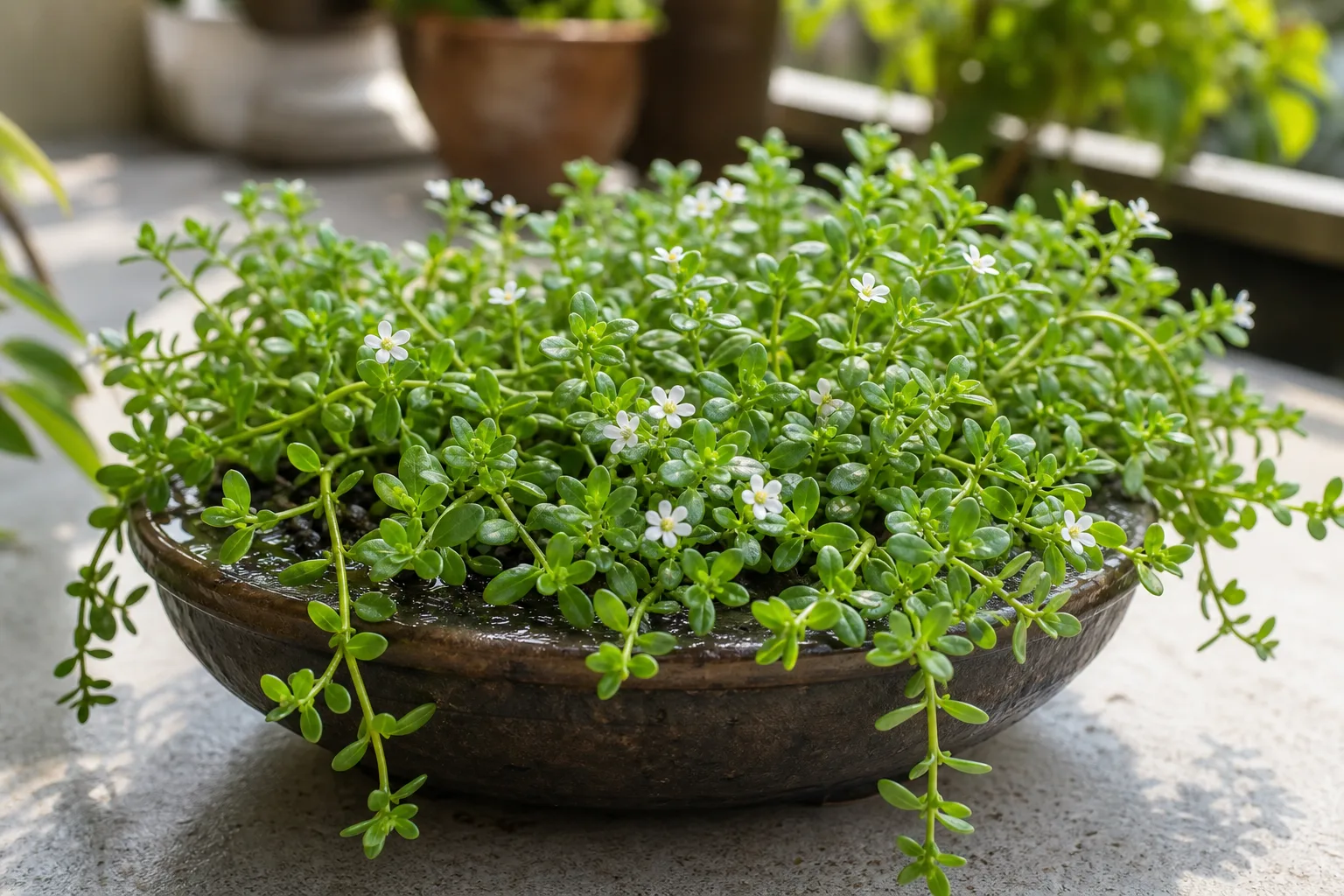
A Brahmi pot that drinks dry within a day of watering, crowds the rim with a dense green mat, or packs roots through every drainage hole is not asking for more fertilizer. It is asking for a reset of the root zone. Repotting fixes exhausted mix and cramped mats—but only if you treat Bacopa monnieri as a creeping wetland herb that stays moist to wet, not as a drought-tolerant houseplant that likes a dry-down between drinks.
True Brahmi for this guide is Bacopa monnieri—also called water hyssop, herb of grace, or nirbrahmi—in the family Plantaginaceae. NC State Extension describes it as a mat-forming perennial of marshes, streams, and muddy shores that is heat tolerant but not drought tolerant at all, and notes it thrives in moist to wet soils, hanging baskets, bog edges, and shallow water. That biology drives every pot decision: moisture-first mix, modest upsizing, spring-to-early-monsoon timing in India, and aftercare that never lets the shallow node roots bake. For the full care map, start from the Brahmi overview.
Why Brahmi Needs a Wetland-Style Pot Reset
Most foliage houseplants forgive a random spring pot upgrade into a “dries between waterings” mix. Brahmi does not. The Florida Native Plant Society places water hyssop on the wet side of the moisture spectrum—aquatic to usually moist with occasional inundation—in lake edges, floodplains, marshes, and swamps (Florida Native Plant Society). Plants For A Future summarizes cultivation the same way: it requires wet soil to shallow water and accepts sandy, loamy, or clay textures if moisture stays steady (Plants For A Future).
In a container, the failure modes are opposite to desert succulents. A tiny nursery pot under a fast-spreading mat dries too fast in terrace heat. A sealed decorative bowl with foul, unmoved water can go anaerobic even though the species loves wet culture. Florida Wildflower Foundation notes the plant is a fast grower that works well in containers or hanging pots, needs plenty of sun and water, and does not tolerate long periods of drought (Florida Wildflower Foundation). Pair this page with Brahmi soil and Brahmi watering—the new pot only works if the mix and watering match the wetland habit.
Confirm the label says Bacopa monnieri. In parts of India, packs marked only “brahmi” may be Centella asiatica (gotu kola) instead. Moisture-loving habits overlap, but leaf shape and growth pattern will not match if the species is wrong.
How Often to Repot Brahmi
For most home growers, every 1–2 years is a practical rhythm while the mat is still filling pots quickly. Vigorous balcony or hanging-basket plants in hot Indian weather may need a move sooner if the pot dries within a day and roots jam the holes. Once the plant sits in a roomy final tray or wide shallow bowl (roughly 20–30 cm across for a managed mat), you can often switch to a same-size soil refresh—tease the root mat, replace tired mix, and return it to the same container—instead of endless upsizing.
Do not repot on a calendar alone. If the mix still holds moisture evenly, new node roots keep forming, and the pot is not a solid root brick, leave the plant alone. A newly purchased Brahmi usually needs two to three weeks of quarantine and observation before any pot change unless the mix is already sour, bone-dry, or pest-ridden. Seedlings and small cuttings go up in small steps as they outgrow starter cups; established mats you keep tidy with light pinching may stay in the same wide pot with a mid-season soil top-up.
Clear Signs Your Brahmi Needs a New Pot
Penn State Extension’s pot-bound checklist maps cleanly onto container Brahmi: mix that dries unusually fast, roots through drainage holes, and stalled top growth despite decent light and season (Penn State Extension — Repotting Houseplants). Watch for these Brahmi-specific signals.
- Dense mat crowding the pot rim with little fresh mix visible between stems.
- Pot drying within a day of a thorough soak in weather that used to take longer—classic “more root and leaf than soil.”
- Roots packing drainage holes or a solid white-tan root pad when you slip the plant out.
- Water racing down the sides after the root ball shrinks from the pot wall, leaving the core dry.
- Crispy tips and stalled spread even when you water often—shallow roots have run out of usable volume.
- Sour, swampy smell with soft collapsing stems in a sealed or clogged pot—failed oxygen exchange, not a reason to switch to drought culture (Missouri Botanical Garden — Overwatering).
Any one sign can justify a refresh. Two or more usually mean you are overdue. Act before the mat becomes a thin, pale fringe with dead cores; recovery is slower once drought and compaction have stacked.
Best Season to Repot Brahmi
Timing decides how fast new node roots colonize fresh wet mix. Repot when the plant is about to push growth; avoid routine moves when cool weather keeps growth stalled and pots stay cold and heavy.
Spring to early monsoon—the default window
Spring through early monsoon—as new growth begins and humidity rises—is the default window across much of India. Roots and stems wake as days lengthen and heat returns, so the plant can occupy new moisture-retentive mix before peak summer demand. Extension guidance for houseplants likewise favors spring, when roots actively grow into fresh media (Penn State Extension — Repotting Houseplants). In frost-prone North India, wait until nights reliably stay above cool-stress levels and the mat has clearly restarted. Work in the morning or late afternoon on a mild day, not under harsh midday terrace heat with a dry wind. Keep the plant in full sun to partial shade after settling; Brahmi is light-responsive—see Brahmi light.
When an emergency move overrides the calendar
Two situations beat the calendar. Active root failure—mushy dark roots, foul smell, collapsing soft growth—needs immediate unpotting, trim of dead tissue, and a same-size or modestly larger pot of clean moist mix. A cracked pot, blocked holes, or peat brick that will not rewet also warrants an emergency refresh. In both cases, expect slower recovery in cool or cloudy weather: keep the mix evenly moist (never bone-dry), protect from cold snaps, and skip fertilizer until firm new tips appear.
Choosing Pot Size, Depth, and Material
Step up about one pot size—roughly 2–5 cm (1–2 inches) wider—rather than jumping into a huge container. Brahmi spreads laterally more than it builds a deep taproot, so prefer a wider, relatively shallow pot, hanging basket, or tray over a deep narrow cylinder packed with unused wet mix at the bottom. Oversized depth leaves a cold, stagnant lower layer that can sour even though the species tolerates flooding at the surface.
Drainage holes still matter. Use them, then manage wetland moisture with a shallow water tray under the pot in heat rather than a sealed, airless tub. Plastic and glazed ceramic hold moisture longer—useful for Brahmi—while unglazed terracotta dries faster and needs more frequent watering or a tray. Hanging baskets trail beautifully but dry fastest in wind; choose a liner or slightly larger basket when you repot so the mat does not crisp between drinks. NC State lists hanging baskets, containers, ponds, and bog sites among suitable landscape uses for this species (NC State Extension Gardener Plant Toolbox).
Soil Mix for Repotting Brahmi
The goal is a mix that stays moist to wet without compacting into a foul brick. NC State accepts clay, loam, or sand textures when drainage stays in the moist / occasionally wet / occasional flooding range, with soil pH spanning acid through alkaline (NC State Extension Gardener Plant Toolbox). FNPS similarly calls for moist to wet conditions and notes the plant is not built for long drought (Florida Native Plant Society).
A practical DIY blend for Indian pots is about 40% quality potting mix, 30% coco peat or compost, 20% perlite, and 10% coarse sand. That holds water for a wetland creeper while still letting a little dissolved oxygen move through the root zone. Avoid bone-dry cactus mixes and “moisture control” bricks that stay anaerobic for weeks without a refresh path. Moisten the new mix before potting so it absorbs water evenly—dry peat-heavy media can shed water at first (Penn State Extension — Repotting Houseplants). Full mix recipes and wrong-soil signs live in the Brahmi soil guide.
Step-by-Step: How to Repot Brahmi
Prep and unpotting
Water the plant in its old pot about an hour before you start so the root mat slips out with less tearing. Clean and rinse the new pot; if reusing a container with salt crust, scrub it thoroughly. Cover the drainage hole with a scrap of mesh if mix usually washes out, then add a base layer of pre-moistened mix so the finished surface sits about 1–2 cm below the rim.
Tip the pot, support the mat with your hand, and slide the root ball out. Brahmi often roots at many nodes, so expect a shallow, fibrous pad rather than one thick taproot. Gently tease circling roots and loosen compacted outer mix. Trim only soft, black, or foul-smelling roots; leave firm white or cream roots intact. If the mat is huge, this is also a good moment to divide for Brahmi propagation—replant one healthy section and pot the rest separately.
Settling the mat and watering in
Set the root pad on the base layer so stems sit at the same depth they grew before—do not bury long trailing stems under a deep soil mound. Fill around the sides with moist mix, firming lightly so there are no large air pockets, without compacting the media into a hard cake. Leave headspace for watering.
Water thoroughly until excess drains, then place the pot on a clean shallow tray if heat is high. Return the plant to bright light matching its previous exposure; a sudden jump from shade nursery stock into harsh midday terrace sun can scorch soft tips even when roots are fine. Keep the surface barely moist to wet from day one—never use a “wait until bone dry” rule after a Brahmi move.
Post-Repot Care and What Recovery Looks Like
Mild tip yellowing or a short pause in outward spread for one to two weeks can be normal while nodes reestablish in warm, bright, wet conditions. Soft collapsing stems, sour smell, or progressive browning through the mat are not normal—check for stagnant trays and improve airflow, or refresh foul mix. Crispy tips and a light pot mean drought stress: soak thoroughly and resume the never-fully-dry rhythm from the Brahmi watering guide.
Hold fertilizer for three to four weeks after a routine repot. Fresh mix plus transplant stress is enough work for the roots; feeding too soon can push soft growth before the mat has anchored. Resume a light monthly feed only after you see firm new tips and fresh node roots, following the Brahmi fertilizer guidance. Protect from frost and cold dry winds—Brahmi is frost tender in cooler regions (Plants For A Future).
When Not to Repot Brahmi
Skip routine repotting when the plant arrived this week and the mix still smells clean and holds moisture—learn its water rhythm first. Avoid moves during a cold North Indian winter when growth is stalled unless the pot is an emergency failure. Do not upsize into a giant pot “for the future” when the current mat is still small; unused wet volume sours more easily than a snug, frequently watered container. Do not stack hard pruning, heavy fertilizing, and a full pot change on the same day if the plant is already wilted from drought—rehydrate and stabilize first, then repot once stems firm up.
When to use this page vs other Brahmi guides
Use this repotting page when the question is pot size, timing, soil refresh, or post-move recovery. Open Brahmi watering when the mix volume is fine but the calendar or tray setup is wrong. Use Brahmi soil when you need mix recipes and drainage diagnosis without a full transplant. Choose Brahmi light when thin, sparse growth tracks shade more than pot size. Use Brahmi propagation when you want cuttings or divisions rather than a single upsizing. Return to the Brahmi overview for identity checks (including Centella lookalikes) and the full care snapshot.
Related Brahmi guides
- Brahmi overview — identity, habit, and care map
- Brahmi watering — moist-to-wet rhythm and tray use
- Brahmi soil — mix recipes and wrong-soil signs
- Brahmi light — sun vs shade placement
- Brahmi fertilizer — when to resume feeding after a move
- Brahmi propagation — cuttings and division during repot
Conclusion
Repot Brahmi when the mat outgrows moisture—not on a random calendar. Choose a slightly wider pot, a moisture-retentive mix that stays wet, and a spring-to-early-monsoon window whenever you can. After the move, keep the root zone evenly moist, hold fertilizer briefly, and judge success by new node roots and steady spread. Treat Bacopa monnieri as the wetland creeper it is, and the pot reset becomes a growth step instead of a setback.