Brahmi Pruning Guide: When, Where, and How Much to Cut
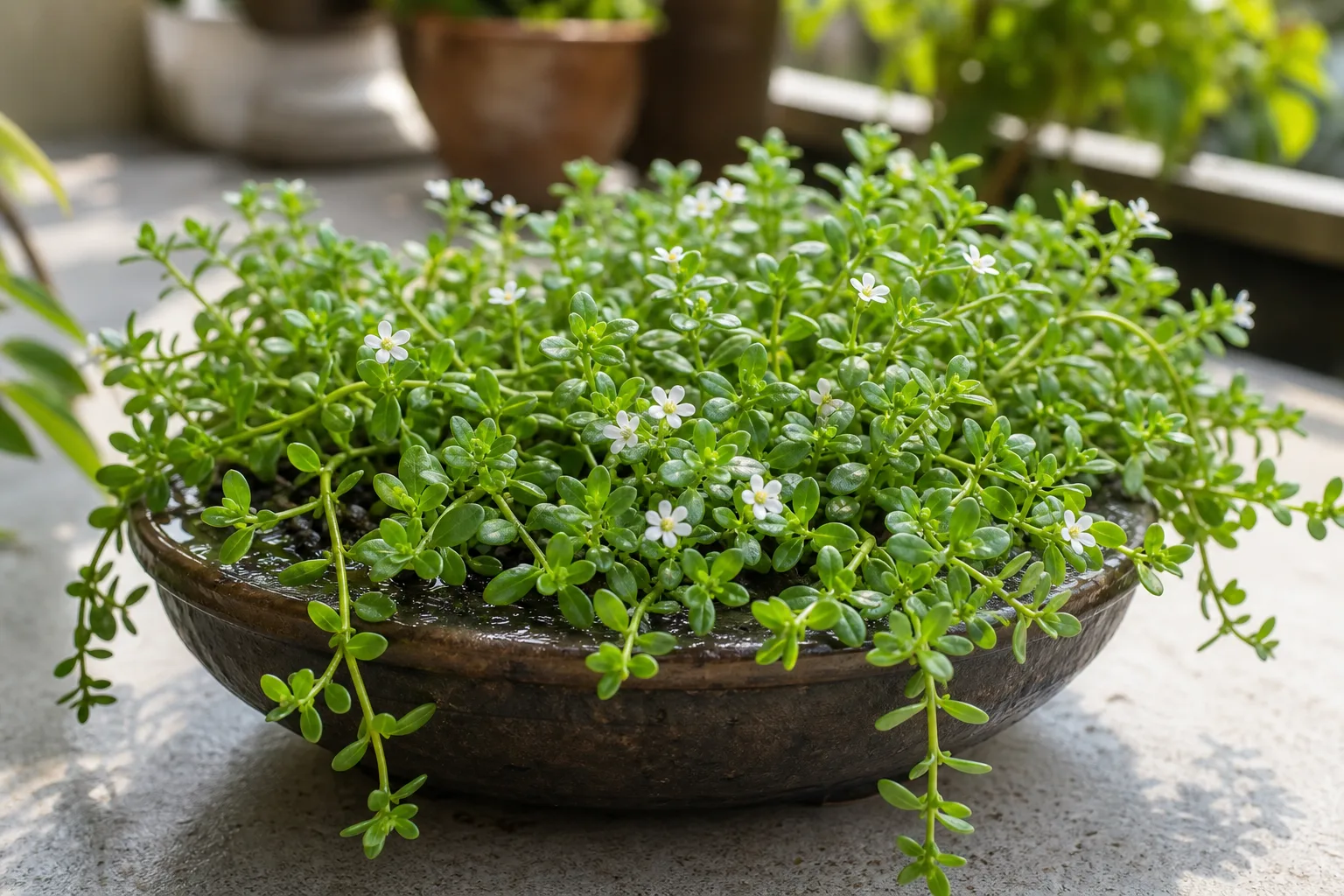
Brahmi Pruning Guide: When, Where, and How Much to Cut
Brahmi Pruning Guide: When, Where, and How Much to Cut
First action: Walk the mat and remove only fully brown, crispy, or soft collapsing stem tips with clean sharp scissors—finish that cleanup before you pinch healthy tips or shorten long runners for shape. Brahmi (Bacopa monnieri) is a creeping wetland herb; damaged tissue is usually drought, stagnation, or cold stress, not a cue to scalp the whole pot.
For whole-plant context—moisture needs, light, and identity versus gotu kola—see the Brahmi overview.
Reviewed by LeafyPixels Review Board · Author: sai-ananth
Quick answer
Prune Brahmi (Bacopa monnieri, also called water hyssop or herb-of-grace) to keep a dense mat, shorten leggy hanging-basket trails, and clear failing tips—not to “fix” dry soil. NC State Extension describes a creeping, spreading, mat-forming perennial that grows rapidly in moist to wet soil, suits hanging baskets, and roots readily from stem cuttings and division. (NC State Extension)
Make shaping cuts just above a node (where a pair of opposite leaves meets the stem), limit live removal to about one-third of the mat per session on healthy pots, and keep the mix consistently moist afterward. Pruning redirects tip growth into side shoots, but it cannot replace steady watering or adequate light—leggy, thin mats return quickly if the plant dries out or sits in deep shade.
What pruning does for Brahmi
Brahmi is a low, creeping wetland herb in the plantain family (Plantaginaceae), not a woody shrub. NC State notes small opposite succulent leaves, axillary white to pinkish flowers with a long bloom season, and rapid spread in moist soil or shallow water as a ground cover. (NC State Extension) Florida Wildflower Foundation likewise describes a creeping, mat-forming perennial that can grow aggressively when moisture and sun are right. (Florida Wildflower Foundation)
Left alone in a hanging basket or balcony tray, tip growth keeps racing outward. Lower sections near the rim can go bare while tips flower and trail. Pruning breaks apical dominance at soft tips so axillary buds push side shoots, thickens the mat, and lets you harvest node-bearing cuttings for the same pot.
Four jobs show up repeatedly:
- Cleanup removes crispy drought tips, soft collapsing stems, and fully brown leaves whenever you spot them.
- Tip pinching shortens soft new growth during active seasons so the mat branches instead of forming long sparse runners.
- Runner shortening cuts trailing stems above a leafy node to pull a basket back into a fuller outline.
- Renewal removes bare middle sections and replants fresh tip cuttings into gaps—often cleaner than hoping empty stems leaf out again.
Pruning cannot fix chronic drought. NC State stresses that Brahmi is heat tolerant but not drought tolerant at all. (NC State Extension) If tips crisp after every trim, fix moisture first.
Nodes, opposite leaves, and where new growth starts
Brahmi stems are soft and succulent with opposite leaves at each node. Run your finger along a runner: every leaf pair marks a node, and tiny buds sit in the leaf axils. New shoots emerge from those buds after you remove the tip. Flowers also form in the leaf axils, so light tip work can reduce bloom density in favor of foliage—useful when you want a greener mat rather than a flowering cascade.
Cut between nodes and you leave a bare internode stub with nothing to sprout. Cut 3–6 mm (about ¼ inch) above a healthy leaf pair, using sharp scissors on clean tissue. Avoid crushing soft stems with dull blades; bruised tips collapse quickly in wet trays.
What to check before you cut
Spend two minutes assessing the whole plant before cosmetic pinching:
- Moisture — finger-test the top 1–2 cm. If the mix feels dry and tips are crispy, water thoroughly and wait until stems plump before hard shaping.
- Live vs failing tissue — firm green stems versus soft, translucent, or brown tips. Soft collapse often means sour stagnant trays or cold stress, not a need for heavy shaping.
- Bare vs leafy runners — mark empty middle sections for removal; keep leafy tips as pinching stock or cuttings.
- Node spacing — stretched gaps between leaf pairs signal weak light or drought; note this before expecting pinching alone to create a dense mat.
- Identity — confirm Bacopa monnieri (water hyssop / nirbrahmi). In parts of India “brahmi” may be sold as Centella asiatica (gotu kola), which has a different leaf shape and pruning response.
- Tools — sharp scissors or fine snips. Sanitize blades if you recently cut diseased plants.
Plan the session’s goal: cleanup only, tip pinching for density, or renewal with cuttings.
When to prune Brahmi
Best window for pinching and shaping
Time major pinching and runner shortening for warm active growth—typically spring through early autumn in Indian climates—when new tips stay plump and the mat is spreading. That is when axillary buds break fastest after a tip cut. Light tip pinches can continue through the hot season while the plant is drinking daily or every other day.
Florida Native Plant Society notes propagation by seed, division, and cuttings, and that the plant can become aggressive in the right conditions under full sun to part sun with moist to wet moisture. (Florida Native Plant Society) Use that vigor: prune on a schedule rather than waiting until the basket is mostly bare stems.
Cleanup anytime
Remove crispy tips, fully brown leaves, and soft collapsing stems whenever you find them. Do not wait for the “perfect” season if tissue is already failing—cleanup reduces rot risk in wet trays and shows you what is left to shape.
When to delay hard pruning
Hold off on heavy mat reduction when:
- The plant is wilting from drought — restore watering rhythm first; cut only dead tissue until tips plump.
- The pot was repotted within the last week — wait until new tip growth resumes.
- Nights are cold and dry (approaching frost risk) — Brahmi is frost tender; hard cuts before cold snaps remove the leaf area that buffers stress.
- The mat has very little green tissue left — take a light pass, improve light and moisture, then renew with cuttings once growth resumes.
Emergency removal of soft, rotting, or pest-coated stems is always appropriate regardless of season.
How to prune Brahmi step by step
- Water if the mix is dry, then wait until stems feel firm—do not prune a crispy drought-stressed mat for shape.
- Sanitize scissors if needed, then remove fully brown tips and soft collapsing stems back to firm green tissue above a node.
- Identify long trailing runners and choose a target node with a healthy leaf pair where you want branching.
- Cut 3–6 mm above that leaf pair—whole tip, not random side leaves stripped from the stem.
- Repeat on other dominant runners, staying within about one-third live removal on a healthy pot.
- Optional: Take 5–10 cm tip cuttings with two to three nodes for propagation—NC State lists stem cuttings and division as recommended strategies. (NC State Extension)
- Tuck cuttings into bare spots in the same moist mix, or discard damaged tissue; do not leave soft cut pieces sitting in stagnant tray water.
On a hanging basket, work from the rim outward so you can see which runners still carry leaves and which are empty mid-sections.
How much you can safely remove
For a healthy, actively spreading pot, limit each shaping session to about one-third of the visible mat. Shallow roots still need leaf area while axillary shoots expand—especially in heat, when pots dry fast.
Dense trays and hanging baskets that have gone bare in the middle tolerate a harder renewal if you replace removed tissue with rooted tip cuttings. Florida Wildflower Foundation notes the plant is a fast grower that may spread aggressively and works well in containers or hanging pots. (Florida Wildflower Foundation) Use that: remove leafless runners at the soil line, then replant several tip cuttings into the gaps rather than leaving empty stems.
On drought-stressed or freshly moved plants, take only cleanup cuts. Wait until new tips are plump and spreading before another heavy pass—usually one to two weeks in warm weather with consistent moisture.
Where to cut — and what not to cut
Cut:
- Soft growing tips above a leaf pair for bushiness
- Long trailing runners above a leafy node for length control
- Fully brown or crispy tips back to firm green tissue
- Soft, translucent, collapsing stems that will not recover
- Bare mid-sections with no leaves (remove; do not “hope” they refoliate)
Do not cut:
- The entire mat down to bare soil on a stressed, dry pot
- Soft new tips the day after a hard drought wilt—wait for recovery
- Every flowering shoot if you still want blooms; flowers are axillary, so tip pinching reduces flowering while increasing foliage density
- Random individual leaves while leaving long bare internodes—always cut at nodes
Leave at least some leafy shoots across the pot so photosynthesis continues while side buds break.
Pruning for hanging baskets and tray mats
Hanging baskets and balcony trays are where Brahmi pruning pays off most. NC State notes the plant drapes well over pot edges and hanging baskets when moisture stays high. (NC State Extension) Trailing tips look lush while the crown near the soil thins if light is one-sided or pinching is skipped for months.
Pinch tips every few weeks during warm months before internodes stretch. Rotate the basket so light hits all sides. When the center looks empty, shorten outer runners and tuck tip cuttings into the crown rather than fertilizing harder—fertilizer cannot rebuild a bare mat without moisture and nodes.
Aftercare after pruning
Keep the mix consistently moist to wet—the same wetland habit that drives growth also drives recovery. In hot weather that often means daily or every-other-day watering so the shallow root mat never fully dries. Refresh stagnant saucer water rather than leaving sour water for weeks.
Hold heavy fertilizer for a week after a hard renewal. Resume light feeding only when new tips are visibly expanding—see the Brahmi fertilizer guide. Do not repot on pruning day unless the mix is failing or the mat is so root-bound that the pot dries within a day in heat.
Give full sun to partial shade so new internodes stay short. Weak light after a hard trim produces thin, stretched regrowth that needs another prune sooner.
Recovery timeline and signs pruning worked
In warm, bright, moist conditions:
- 3–7 days — remaining tips stay plump; cut ends dry cleanly without soft rot
- 1–2 weeks — new side shoots appear from leaf axils below pinches
- 3–6 weeks — the mat or basket looks fuller; gaps filled with cuttings begin to knit together
Signs pruning worked: firm new tips, closer leaf spacing, runners rooting at nodes into the mix, and steadier spread across the pot surface.
Signs the session was too hard or badly timed: widespread tip crisping within days (usually drought after leaf loss), soft collapse at cut ends in sour trays, or no axillary shoots after two weeks of warmth—check moisture, light, and whether cuts landed on live nodes.
Mistakes to avoid
- Hard shaping on a dry, crispy plant — restore moisture first; Brahmi is not drought tolerant.
- Cutting mid-internode — leave a stub with no bud; always cut above a leaf pair.
- Scalping the whole mat without replanting cuttings — empty pots recover slowly; use tip cuttings to refill.
- Leaving soft cut debris in stagnant tray water — remove failing tissue from the container.
- Expecting pruning to fix deep shade — thin, stretched growth returns until light improves.
- Confusing Bacopa with Centella — confirm species before you invest in a pruning and propagation plan.
- Heavy fertilizer right after a hard cut — push recovery with water and light first.
When not to prune
Skip structural pinching and runner shortening when the plant is wilted from drought, newly repotted and not yet pushing tips, sitting in cold dry winter air near frost risk, or reduced to a few green shoots. Cleanup of dead and soft tissue is still fine. If soft stems are collapsing across the pot, refresh the water tray, improve airflow, and remove only failing tissue until the remaining mat firms up—see soil and moisture guidance.
NC State notes edible leaves that can cause nausea and gastrointestinal upset if ingested in large quantities. (NC State Extension) Bag or compost trimmings where pets will not graze large piles of cut material; treat the plant as unverified around pets that chew foliage.
Related Brahmi guides
- Brahmi overview — identity, wetland habit, and placement for Indian climates
- Brahmi light — full sun to partial shade before you expect dense regrowth
- Brahmi watering — moist-to-wet rhythm after leaf loss
- Brahmi soil — moisture-retentive mix that supports recovery
- Brahmi propagation — rooting tip cuttings from pruning sessions
- Brahmi repotting — when a crowded mat needs a larger pot, not just more cuts
- Brahmi fertilizer — light feeding only after new tips resume