Brahmi Care Guide: Water, Light & Growing Tips
Bacopa monnieri
Brahmi needs full sun to partial shade and consistently moist to wet soil—never drought. Water daily in heat, use a moisture-retentive mix, and propagate by stem cuttings or division.
Brahmi Care Guide: Water, Light & Growing Tips
Start with wateringThe most common care mistake for BrahmiWatering guide →Brahmi care essentials
Light
Water
Keep the mix consistently moist to wet; Brahmi is heat tolerant but not drought tolerant. In hot weather, water daily or every other day in pots so the root zone never fully dries. It tolerates shallow standing water, bog edges, and trays of water under the pot.
Soil
Moisture-retentive loam or potting mix that stays wet. Clay, loam, or sand all work if moisture is steady. Tolerates acid to mildly alkaline and even saline conditions. pH about 6.0–8.0.
Humidity
High (60–80%)
Temperature
20°C to 35°C (68–95°F); frost tender—protect below about 10°C
Fertilizer
Feed lightly once a month during active growth from March through October with a balanced dilute liquid fertilizer or a thin compost top-dress.
About Brahmi
Brahmi is native to Wetlands and damp places across tropical Asia (India, Sri Lanka, Southeast Asia) and pantropical marsh margins, typically reaches 10–30 cm tall (prostrate stems); mats spread 30–90 cm indoors, with rapid when warm and consistently moist growth. Brahmi has a creeping growth habit and part of the Plantaginaceae family. It is also known as Water Hyssop, Herb of Grace, Thyme-Leafed Gratiola, Smooth Water Hyssop, and Nirbrahmi.
| Detail | Information |
|---|---|
| Also known as | Water Hyssop, Herb of Grace, Thyme-Leafed Gratiola, Smooth Water Hyssop, Nirbrahmi |
| Native region | Wetlands and damp places across tropical Asia (India, Sri Lanka, Southeast Asia) and pantropical marsh margins |
| Mature size | 10–30 cm tall (prostrate stems); mats spread 30–90 cm |
| Growth rate | Rapid when warm and consistently moist |
| Growth habit | Creeping |
| Scientific name | Bacopa monnieri |
| Family | Plantaginaceae |
Brahmi Care Guide: Water, Light & Growing Tips
Brahmi is a low, creeping wetland herb — not a dry windowsill “set and forget” houseplant. The species sold for Ayurvedic and balcony culture as nirbrahmi is usually Bacopa monnieri, also called water hyssop, herb of grace, or smooth water hyssop. It succeeds when you pair full sun to partial shade with a mix that stays moist to wet, and it fails fastest when the shallow mat dries hard between waterings.
This overview is the starting map for home growers in India and similar warm climates: how to recognize the right plant, what “good care” looks like in a pot or hanging basket, which warning signs matter first, and when to open the deeper Brahmi watering, light, and soil guides.
What Is Brahmi?
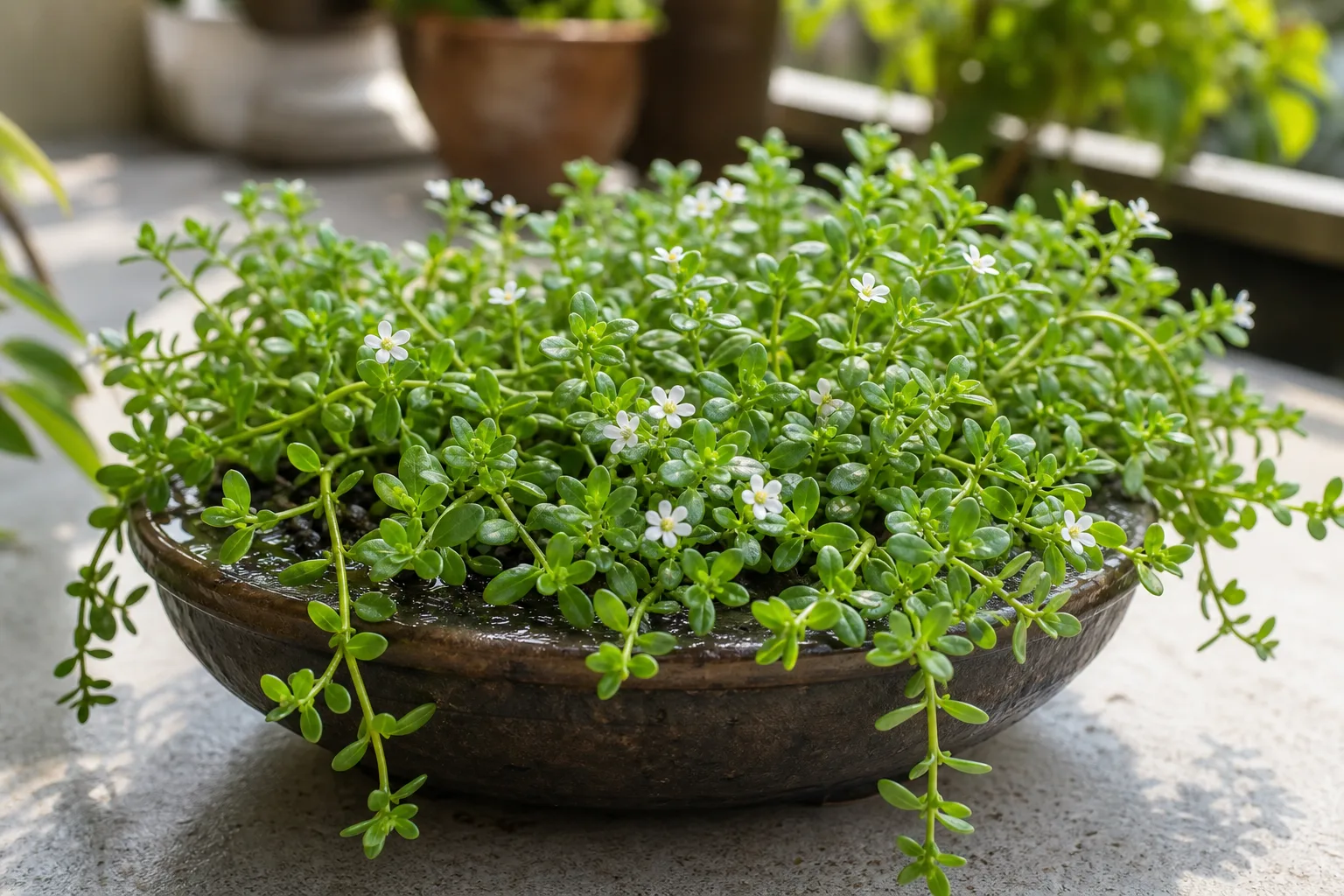
Bacopa monnieri belongs to the plantain family Plantaginaceae. Extension profiles describe it as a creeping, spreading perennial of marshes, streams, muddy shores, and other wet margins, with small succulent opposite leaves and tiny white (sometimes pink- or blue-tinged) bell flowers that can bloom for a long warm-season stretch. NC State notes it is heat tolerant but not drought tolerant at all, and that it is commonly used in hanging baskets, bog edges, and aquariums.
In containers, think of Brahmi as a mat-forming herb that roots at the nodes. New growth should look plump and glossy. Thin, pale stems with crispy tips usually mean the pot dried or light is too weak — not that the plant “needs fertilizer first.”
Bacopa monnieri vs Centella (gotu kola) mix-ups
In parts of India, nursery packs labeled only “brahmi” may contain Centella asiatica (gotu kola / Indian pennywort) instead of Bacopa monnieri. They are different plants: Centella is in the carrot family (Apiaceae), with fan-shaped, roundish leaves on longer stalks, while true Brahmi has small, thick, oblong-to-oval opposite leaves on creeping stems and no strong scent when crushed (unlike lemon bacopa relatives).
Confirm the botanical name on the tag before you copy someone else’s care calendar. Moisture-loving habits overlap, but leaf shape, flower form, and growth pattern will not match if the species is wrong.
Growth Habit, Size, and How It Spreads
Expect a prostrate to low mat, typically about 10–30 cm tall, spreading laterally as stems root wherever they touch damp mix. Florida Native Plant Society describes water hyssop as roughly to 6 inches tall with extensive mats, and notes it can become aggressive when moisture and light are ideal. Plants For A Future lists a compact footprint around 0.3 m by 0.3 m for a single clump growing at a fast rate in warm conditions — container mats often spread farther than that once nodes root along the rim.
In practice, a healthy balcony pot fills outward rather than upward. Hanging baskets trail; shallow trays and bog-style bowls knit into a green carpet. Judge success by new node roots and steady spread, not by height.
Best Growing Conditions at a Glance
If you only remember four rules for Brahmi care, use these:
- Light: full sun to partial shade — bright enough to keep internodes short.
- Water: keep the mix consistently moist to wet; never use a drought-tolerant calendar.
- Soil: moisture-retentive clay, loam, or sand is fine if it stays wet; pH roughly acid through mildly alkaline.
- Placement: balcony tray, hanging basket, or water-garden margin — not a bone-dry sill.
Light: full sun to partial shade
Extension and native-plant profiles agree on full sun to partial shade (FNPS: full sun or part sun). Outdoors in India, an east balcony, open terrace, or lightly filtered west exposure usually works. Deep shade produces thin, sparse mats with weak flowering. Sudden midsummer glass-magnified sun after a dim nursery shelf can scorch soft tips — acclimate over several days.
For the full placement decision tree, window angles, and low-light limits, open the dedicated Brahmi light guide.
Water: keep the root zone wet
Brahmi’s native habit is moist to wet soil with occasional flooding, not “water when bone dry.” NC State lists drainage as moist, occasionally wet, or occasional flooding. FNPS places it on the wet side of the spectrum — aquatic to usually moist with occasional inundation. In pots, that means watering as soon as the top 1–2 cm feels barely dry, often daily or every other day in hot weather, and using a shallow water tray under the pot in peak heat. Refresh stagnant tray water so the mix does not turn sour and anaerobic.
Drought shows up as wilting, crispy brown tips, and mats that stop spreading. Soft collapsing stems in a sealed, foul-smelling pot mean stagnant water and poor air, not a need to withhold moisture forever — refresh and improve airflow. Details and seasonal cadence live in the Brahmi watering guide.
Soil, pH, and containers
Bacopa monnieri accepts clay, loam, or sand as long as moisture stays steady. NC State notes soil pH across acid, neutral, and alkaline ranges, and lists salt among its resistance traits — useful near coastal breezes, though FNPS cautions it is not tolerant of inundation by salty or brackish water. A practical pot mix is roughly 40% potting mix, 30% coco peat or compost, 20% perlite, and 10% coarse sand: wet-friendly without turning into a sealed brick.
Use containers with drainage holes, then manage moisture with trays rather than sealed, airless tubs. For mix recipes, wrong-soil signs, and bog vs hanging-basket setups, see the Brahmi soil guide.
Temperature, Humidity, and Indian Climate Notes
Brahmi is a warm-climate, frost-tender herb. NC State lists USDA hardiness about zones 8–11; PFAF similarly treats it as frost tender in cooler regions. For Indian homes, a comfortable band is roughly 20–35°C (68–95°F) with high humidity (about 60–80%). Protect pots below about 10°C, and move containers under cover or indoors during cool North Indian winters and dry cold winds.
Monsoon and humid coastal cities suit the wetland habit well if trays do not go anaerobic. Hot, arid inland balconies need more frequent watering and often a water tray. Dry AC rooms without a moisture plan will crisp tips even if you “water on a schedule.”
Feeding, Pinching, and Seasonal Rhythm
Feed lightly only after moisture and light are stable. A dilute balanced liquid fertilizer once a month during active growth (roughly March–October in much of India), or a thin compost top-dress, is enough for denser mats. Skip feeding on drought-stressed, newly repotted, or stalled plants — fertilizer does not replace water.
Pinch or trim tip growth to keep baskets tidy and encourage branching. Heavier structural cuts belong in the pruning guide once the mat is established. Stop hard fertilizing in cool, slow months when the plant is barely spreading.
Propagation and Repotting Snapshot
NC State recommends stem cuttings and division; FNPS also lists seed. Home growers usually succeed fastest with softwood cuttings that root at nodes in moist mix, or by dividing rooted clumps. Keep new pieces warm, bright, and wet — dry cuttings fail quickly.
Repot every 1–2 years, or sooner when the mat crowds the rim and the pot dries within a day in heat. Prefer spring to early monsoon. Step-by-step methods: Brahmi propagation and Brahmi repotting.
Common Mistakes and Warning Signs
The most common failure is treating Brahmi like a succulent or drought-tolerant herb. Other frequent mistakes: buying unlabeled “brahmi” that is Centella; parking the pot in deep shade; leaving tray water sour for weeks; stacking fertilizer, repot, and hard prune on day one.
Watch for these patterns:
- Underwatering / dry mix: crispy tips, wilting, stalled spread.
- Stagnant sealed wetness: soft stems, sour smell, yellowing with no new growth.
- Too little light: thin, pale, leggy mats and weak bloom.
- Label mix-up: fan-shaped Centella leaves instead of small opposite Bacopa leaves.
Fix moisture and light first. Then open the matching sibling guide rather than changing everything at once.
Pet Safety and Edibility Notes
NC State notes the leaves are edible in small amounts for people (raw in mixed salads or cooked), but large quantities can cause nausea, increased intestinal motility, and gastrointestinal upset. That is a human-dose caution, not a pet-safety guarantee. Bacopa monnieri does not have a clear species-specific listing on the major ASPCA toxic and non-toxic plant lists used for this review, so treat household pets as caution / unverified — keep hanging baskets out of easy grazing reach and contact a veterinarian if a pet eats a large amount.
This page does not give medical, veterinary, or Ayurvedic dosing advice. Grow for horticulture first; treat herbal use as a separate, professional topic.
When to use this page vs other Brahmi guides
Use this overview to confirm you have Bacopa monnieri, to set the wetland care model, and to triage the first problem (usually dryness, stagnant trays, shade, or a Centella mix-up).
Open sibling pages when you need depth:
- Watering — finger-test cadence, trays, monsoon vs winter rhythm, over/under signs.
- Light — balcony angles, indoor limits, scorch vs stretch.
- Soil — mix recipes, pH, bog vs pot drainage.
- Fertilizer — dilute feeding, when to stop.
- Repotting — pot size, timing, aftercare.
- Propagation — cuttings and division steps.
- Pruning — shaping mats and hanging baskets.
Related Brahmi guides
Keep the cluster bookmarked as you grow:
- Brahmi watering — the make-or-break skill for this species.
- Brahmi light — sun vs partial shade without crispy scorch.
- Brahmi soil — wet-friendly mixes that still allow some air.
- Brahmi fertilizer — light feeding after basics are right.
- Brahmi repotting — when mats outgrow the pot.
- Brahmi propagation — node cuttings and division.
- Brahmi pruning — tidy trailing growth.
Conclusion
Brahmi care is simple once you stop fighting its wetland biology. Grow Bacopa monnieri in bright sun to part shade, keep the root zone moist to wet, use a moisture-retentive mix, and protect it from frost and chronic drought. Confirm you did not buy Centella under a shared “brahmi” label, watch for crispy tips as an early dry-pot signal, and use the sibling watering, light, and soil guides when you need a deeper fix. Steady moisture beats clever fertilizer every time.
How to care for Brahmi?
When should you water Brahmi?
Keep the mix consistently moist to wet; Brahmi is heat tolerant but not drought tolerant. In hot weather, water daily or every other day in pots so the root zone never fully dries. It tolerates shallow standing water, bog edges, and trays of water under the pot.
- Finger test at 1–2 cm - Keep the mix consistently moist to wet; Brahmi is heat tolerant but not drought tolerant.
- water as soon as the surface starts to feel barely dry—never wait for a dry pot - It tolerates shallow standing water, bog edges, and trays of water under the pot.
- Drain excess water - In hot weather, water daily or every other day in pots so the root zone never fully dries.
What soil works best for Brahmi?
Moisture-retentive loam or potting mix that stays wet. Clay, loam, or sand all work if moisture is steady. Tolerates acid to mildly alkaline and even saline conditions. pH about 6.0–8.0.
- 40% potting mix - Moisture-retentive loam or potting mix that stays wet.
- 30% coco peat or compost - Moisture-retentive loam or potting mix that stays wet.
- 20% perlite - Light white granules that keep soil airy and help prevent compaction.
Grower notes for Brahmi
What matters most with Brahmi
Brahmi is a creeping wetland herb (Bacopa monnieri), not a tall culinary grass. Steady moisture beats clever fertilizer. In practice, the care checkpoint is simple: full sun to partial shade, paired with a mix that stays moist to wet (pH about 6.0–8.0), and never letting the root zone dry out. Confirm the label says Bacopa monnieri—in parts of India "brahmi" is also sold as Centella asiatica (gotu kola).
Best placement in a real home
Brahmi belongs on a bright balcony, terrace tray, or hanging basket where full sun to partial shade is realistic—not on a bone-dry windowsill. Keep the mix consistently moist to wet; water daily or every other day in hot weather so roots never fully dry. A shallow water tray under the pot helps in peak heat. Humidity target: High (60–80%). Temperature comfort zone: 20°C to 35°C (68–95°F); frost tender—protect below about 10°C.
Before you buy this plant
Choose Brahmi with plump succulent leaves, firm creeping stems that root at the nodes, and soil that smells clean and stays damp—not sour and compacted. Prefer stock labeled Bacopa monnieri (water hyssop / nirbrahmi) over mixed \"brahmi\" packs that may be Centella. Be cautious if you see a dry crusted mix, crispy tips, or a pot that never looks watered.
First month after bringing it home
Do not repot Brahmi on day one unless the mix is failing or pests are obvious. Quarantine it, learn how fast the shallow root mat uses water, and keep care boring while it adjusts. Watch especially for drought stress, crispy tips, and mats that stop spreading. If problems appear, correct moisture and light first rather than stacking fertilizer, repotting, and hard pruning together.
Pet-aware note for Brahmi
Leaves are sometimes eaten by people in small amounts, but Bacopa monnieri has no clear species-specific listing in the major pet-toxicity databases used here, and large human doses can cause nausea or GI upset. Treat pots as unverified around pets that graze plants, and keep hanging baskets out of easy reach.
How to tell Brahmi is settling in
Also sold as Water Hyssop, Herb of Grace, and Nirbrahmi, this plant should be judged by new node roots and spreading mats rather than label names alone. If you plan to multiply it later, common methods include Stem cuttings and Division. Repot only when you see a dense mat crowding the pot rim and the pot drying within a day in heat. If wilting shows up early, inspect moisture first—drought, not \"overcare,\" is the usual failure.
Is brahmi safe for pets?
Bacopa monnieri is not clearly verified in major pet-toxicity databases. Leaves are sometimes eaten by people in small amounts, but large doses can cause nausea or GI upset. Prevent routine chewing.
Water hyssop (Bacopa monnieri) has no confirmed species-specific ASPCA listing in this review. Extension sources note edible leaves for humans with possible nausea or gastrointestinal upset in large amounts. Treat the plant as unverified rather than assuming it is chew-safe for cats, dogs, or other pets.
Watering Brahmi
For Brahmi, finger test at 1–2 cm; water as soon as the surface starts to feel barely dry—never wait for a dry pot and water daily to every 2 days in hot weather; every 2–4 days in cooler months if the surface stays damp. Water freely through India's warm growing months; ease slightly in cool winters but keep roots moist; protect from frost and cold dry winds.
| Detail | Information |
|---|---|
| How often | Daily to every 2 days in hot weather; every 2–4 days in cooler months if the surface stays damp |
| How to check | Finger test at 1–2 cm; water as soon as the surface starts to feel barely dry—never wait for a dry pot |
| Seasonal changes | Water freely through India's warm growing months; ease slightly in cool winters but keep roots moist; protect from frost and cold dry winds |
Signs of overwatering
- sour-smelling anaerobic mix in sealed pots
- soft collapsing stems
- yellowing leaves with stalled growth in stagnant, airless containers
Signs of underwatering
- wilting despite heat tolerance claims
- crispy or brown leaf tips
- thin, pale new growth
- mats that stop spreading
Soil & potting for Brahmi
Use a mix of 40% potting mix, 30% coco peat or compost, 20% perlite, 10% coarse sand for Brahmi. Moist to wet; occasional flooding OK; do not grow dry. Target soil pH around 6.0–8.0. Repot every 1–2 years, or sooner when the mat fills the pot and dries too fast between waterings, ideally in spring to early monsoon.
| Detail | Information |
|---|---|
| Recommended mix | 40% potting mix, 30% coco peat or compost, 20% perlite, 10% coarse sand |
| Drainage | Moist to wet; occasional flooding OK; do not grow dry |
| Soil pH | 6.0–8.0 |
| Repotting frequency | Every 1–2 years, or sooner when the mat fills the pot and dries too fast between waterings |
| Best season to repot | Spring to early monsoon |
Signs it needs repotting
- dense mat crowding the pot rim
- pot drying within a day in heat
- roots packing drainage holes
Humidity & temperature for Brahmi
Brahmi prefers high (60–80%), though normal home humidity is usually fine. Keep temperatures around 20°C to 35°C (68–95°F); frost tender—protect below about 10°C.
| Detail | Information |
|---|---|
| Humidity | High (60–80%) - normal home humidity is fine. |
| Ideal temperature | 20°C to 35°C (68–95°F); frost tender—protect below about 10°C |
Fertilizer & pruning for Brahmi
Use feed lightly once a month during active growth from March through October with a balanced dilute liquid fertilizer or a thin compost top-dress. for Brahmi.
| Detail | Information |
|---|---|
| Fertilizer type | Feed lightly once a month during active growth from March through October with a balanced dilute liquid fertilizer or a thin compost top-dress. |
Common problems on Brahmi
Yellow Leaves
MediumLikely cause: Common on this plant type; confirm with recent watering, light, and root checks.
Quick fix: Inspect the plant and correct the most likely care stressor before stacking treatments.
Full fix guide →Brown Tips
MediumLikely cause: Common on this plant type; confirm with recent watering, light, and root checks.
Quick fix: Inspect the plant and correct the most likely care stressor before stacking treatments.
Full fix guide →Root Rot
MediumLikely cause: Common on this plant type; confirm with recent watering, light, and root checks.
Quick fix: Inspect the plant and correct the most likely care stressor before stacking treatments.
Full fix guide →Overwatering
MediumLikely cause: Common on this plant type; confirm with recent watering, light, and root checks.
Quick fix: Inspect the plant and correct the most likely care stressor before stacking treatments.
Full fix guide →Underwatering
MediumLikely cause: Common on this plant type; confirm with recent watering, light, and root checks.
Quick fix: Inspect the plant and correct the most likely care stressor before stacking treatments.
Full fix guide →Spider Mites
MediumLikely cause: Common on this plant type; confirm with recent watering, light, and root checks.
Quick fix: Inspect the plant and correct the most likely care stressor before stacking treatments.
Full fix guide →Mealybugs
MediumLikely cause: Common on this plant type; confirm with recent watering, light, and root checks.
Quick fix: Inspect the plant and correct the most likely care stressor before stacking treatments.
Full fix guide →Aphids
MediumLikely cause: Common on this plant type; confirm with recent watering, light, and root checks.
Quick fix: Inspect the plant and correct the most likely care stressor before stacking treatments.
Full fix guide →Leggy Growth
MediumLikely cause: Common on this plant type; confirm with recent watering, light, and root checks.
Quick fix: Inspect the plant and correct the most likely care stressor before stacking treatments.
Full fix guide →Slow Growth
MediumLikely cause: Common on this plant type; confirm with recent watering, light, and root checks.
Quick fix: Inspect the plant and correct the most likely care stressor before stacking treatments.
Full fix guide →Wilting
MediumLikely cause: Common on this plant type; confirm with recent watering, light, and root checks.
Quick fix: Inspect the plant and correct the most likely care stressor before stacking treatments.
Full fix guide →Drooping Leaves
MediumLikely cause: Common on this plant type; confirm with recent watering, light, and root checks.
Quick fix: Inspect the plant and correct the most likely care stressor before stacking treatments.
Full fix guide →Low Humidity
MediumLikely cause: Common on this plant type; confirm with recent watering, light, and root checks.
Quick fix: Inspect the plant and correct the most likely care stressor before stacking treatments.
Full fix guide →Not Enough Light
MediumLikely cause: Common on this plant type; confirm with recent watering, light, and root checks.
Quick fix: Inspect the plant and correct the most likely care stressor before stacking treatments.
Full fix guide →Fungus Gnats
MediumLikely cause: Common on this plant type; confirm with recent watering, light, and root checks.
Quick fix: Inspect the plant and correct the most likely care stressor before stacking treatments.
Full fix guide →Mold on Soil
MediumLikely cause: Common on this plant type; confirm with recent watering, light, and root checks.
Quick fix: Inspect the plant and correct the most likely care stressor before stacking treatments.
Full fix guide →