Fungus Gnats on Brahmi: Wet-Soil Checks & Fixes
Quick answer
Fungus gnats on Brahmi (Bacopa monnieri) usually mean the potting mix or water tray has turned stagnant and organic—not that the plant wants dry soil. First step: press a raw potato chunk cut-side down on the mix for 48 hours to confirm larvae, dump and refresh sour standing water in trays, and set one yellow sticky trap at the pot rim before repotting or drenches.
Fungus Gnats on Brahmi: Causes, Checks & Fixes
This guide covers fungus gnats on Brahmi. See also the general Fungus Gnats guide, watering, and light pages for this plant.
Fungus Gnats on Brahmi: Causes, Checks & Fixes
Quick answer
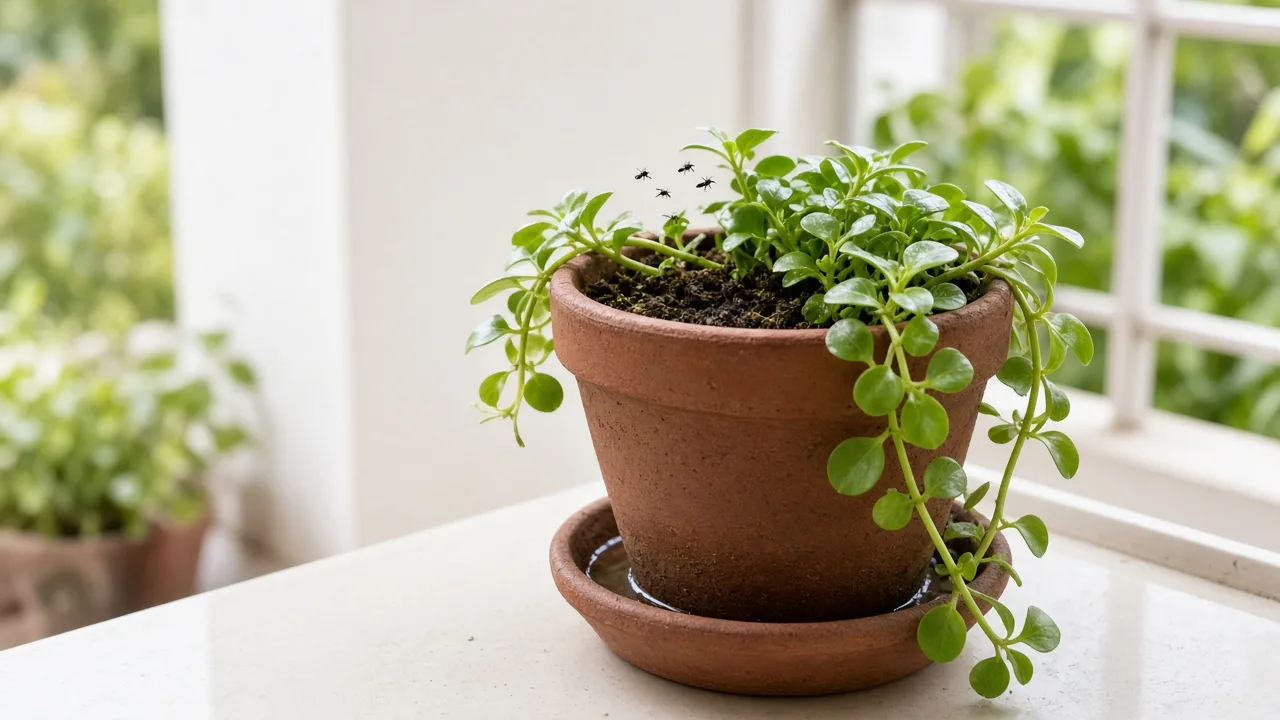
Fungus gnats on Bacopa monnieri are almost always a stagnant, overly organic root zone problem at the pot base and water tray—not insects attacking the succulent leaves on your creeping mat. Brahmi is a wetland herb that grows in moist to wet soils and tolerates shallow standing water in the right setup—but when mix stays airless, females lay eggs in moist organic debris and larvae feed on fungi, decaying matter, and fine roots.
For how fungus gnats behave in moist potting media in general, see our fungus gnats hub. On Brahmi, the useful clues are flies at the rim of a constantly full water tray, a slick dark surface that never gets any airflow, undecomposed compost on top, and a dim bathroom basket—not holes chewed in the small rounded leaves.
First step: press a raw potato chunk cut-side down on the mix for about 48 hours to confirm larvae, dump and replace sour tray or cachepot water, and set one yellow sticky trap at the pot rim. Make that one correction before repotting, systemic drenches, or spraying the whole balcony.
When to use this page vs other Brahmi guides
This page is the soil-line and tray-water entry when tiny flies appear around your water hyssop, nirbrahmi, or Bacopa pot.
| Pattern | Read next |
|---|---|
| White or gray fuzz on soil surface without many flies | Mold on soil |
| Soft collapsing stems, sour smell, wilt despite wet mix | Root rot or overwatering |
| Crispy tips, light pot, wilting, no flies | Underwatering |
| Thin pale mats in a dark corner | Not enough light |
| Fine webbing on leaf undersides | Spider mites |
| Mix stays slick despite careful watering | Soil guide — structure and perlite |
What fungus gnats look like on Brahmi
On this plant you usually notice adults at the pot rim, hanging-basket lip, and windows before leaf damage. The creeping stems and small succulent leaves often look fine while the soil story is wrong.
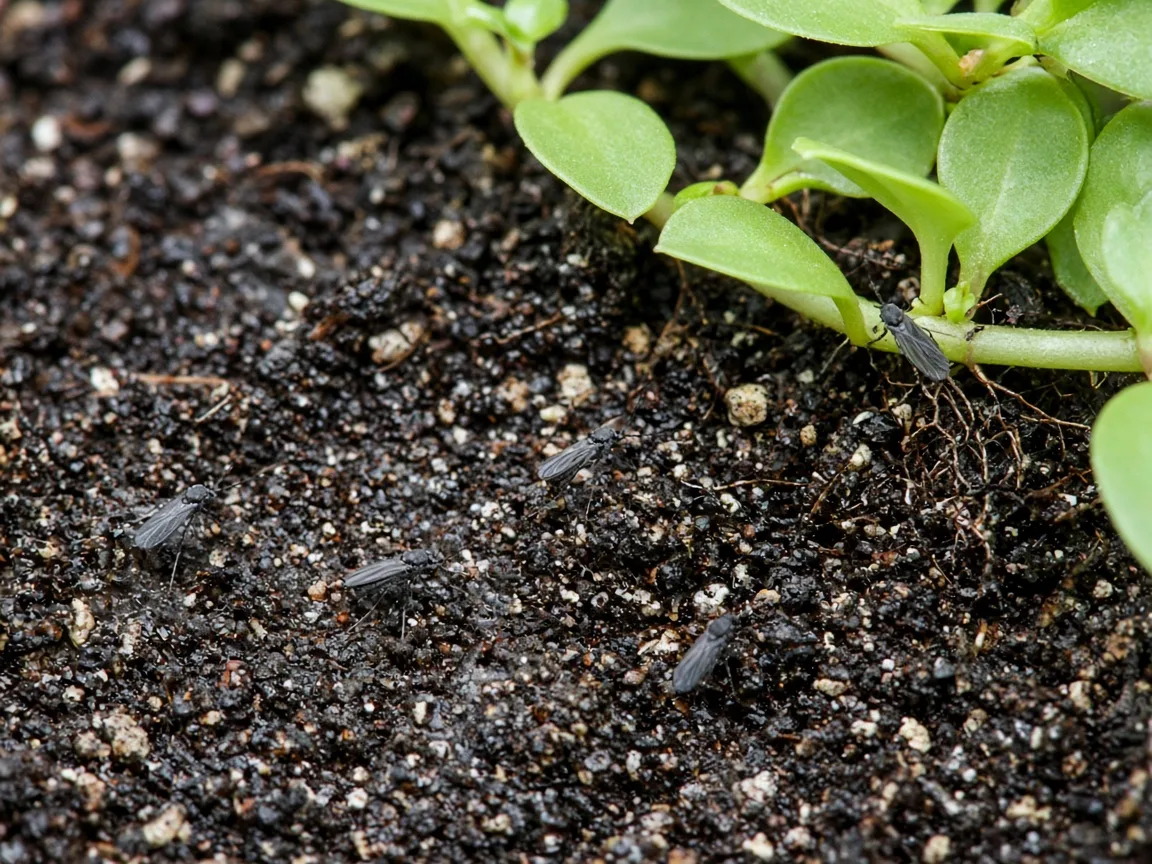
Tiny dark flies on moist organic soil at the Bacopa monnieri base—larvae need this persistently damp, decaying layer; leaves on the mat can stay plump while gnats breed below.
Typical signs:
- Small dark, mosquito-like flies about 1/16 to 1/8 inch long with long segmented antennae
- Flies that rise when you disturb the soil surface or top-water the basket
- Adults on windows, balcony glass, or the outside of a cachepot—not crawling on leaf blades along the mat
- Slender translucent larvae with black head capsules under a potato slice on the mix
- Optional shiny slime trails on the soil surface when larvae are abundant, as UC IPM describes on container media
What the mat looks like when gnats are only part of the story:
- Steady new node roots and spreading stems at the rim—gnats are likely a habitat nuisance tied to stagnant mix
- Yellowing with soft stems despite a heavy wet pot—prioritize root rot and overwatering over insecticide
- Brown crispy tips with a dry deep profile and no flies—see underwatering before blaming larvae
Fresh Brahmi cuttings and thin starter mats have fewer roots to absorb larval chewing. Larval root damage is more serious in seedlings and young plants than on a dense established basket—though chronic anaerobic mix still deserves correction before collapse spreads up the stems.
Fungus gnats vs. other small flies near wet herb pots
Several tiny flies share bathroom and balcony space with Brahmi. Identifying the adult prevents the wrong fix.
| What you notice | Likely insect | Where it breeds | First check |
|---|---|---|---|
| Slender dark fly, long antennae, Y-shaped wing vein | Fungus gnat | Damp potting mix, compost surface, organic top-dress | Potato slice, sticky trap at rim, tray water smell |
| Stockier fly, short bristle-like antennae, green algae on saucer | Shore fly | Algae on wet saucers, fouled cachepots | Clean saucer; compare antennae |
| Fly on fruit or kitchen waste | Fruit fly | Fermenting food | Remove food source |
| Fly from floor drain | Drain or moth fly | Drain biofilm | Clean drain—not the herb pot |
UC IPM notes that fungus gnats have long segmented antennae, while shore flies around algae have short bristle-like antennae.
Why Brahmi gets fungus gnats
Stagnant organic mix, not “too much water” by itself. Brahmi belongs in moist to wet soils along streams, ponds, and muddy shores. Home growers sometimes keep trays full but never refresh them, which turns clean wetland culture into sour, larva-friendly sludge—while the plant still needs dissolved oxygen at the roots.
Water trays and cachepots that never get dumped. A shallow tray helps in Indian heat, but water that sits for weeks without a rinse breeds both gnats and root stress from waterlogged, airless media. Empty cachepot runoff after top-watering hanging baskets.
Dense compost-heavy surface with no perlite. The soil guide calls for moisture retention with perlite and sand for airflow. Without that, the upper profile stays slick in a dim room even when stems look green.
Deep shade with unused water. In weak light, Brahmi mats stall and water lingers. That pairs with fungus gnats the way Colorado State Extension notes for houseplants in constantly moist medium—especially when organic matter decays faster than the plant uses it.
Fresh undecomposed organic top-dress. Thick compost, manure, or blood meal on the surface adds food for fungi and larvae. UC IPM advises avoiding excessive manure or similar organic materials on container media when gnats are present.
Neighboring houseplants are the real source. Adults are weak fliers that often stay near breeding media but drift to windows and tall pots nearby. A constantly wet peace lily on the same bench can supply flies that seem to belong to Brahmi.
Wet roots vs. stagnant swamp on Bacopa monnieri
This is the line that confuses Brahmi growers. Most fungus gnat articles tell you to let houseplant soil dry out completely. That advice fits succulents; it does not fit a heat-tolerant but not drought-tolerant wetland mat.
What Brahmi actually needs: consistent moisture in the root mat, with the surface passing the watering guide finger test at 1–2 cm—water when the surface starts to feel barely dry, not when the whole pot is dust.
What larvae need: persistently wet, decaying organic debris with poor airflow—the same conditions UC IPM links to fungus gnat outbreaks in houseplants.
Your job is to refresh and aerate the habitat without turning the plant into a drought stress case. Dump sour tray water, scrape moldy top-dress, loosen the surface crust with a fork, and improve light so the mat uses water—rather than stopping all irrigation for a week.
Where gnats hide on creeping mats and hanging baskets
Brahmi roots at nodes wherever stems touch damp mix. Larvae concentrate in:
- The rim gap where stems drape over the pot edge and trap moisture
- Shallow baskets where the entire profile is only a few centimeters deep and dries unevenly
- Aquarium or bog-tray margins where algae and organic film collect at the water line
- Fresh cutting inserts where new nodes sit in wet peat plugs longer than the rest of the mat
Lift one corner of the mat gently and look for larvae in the top centimeter—not deep in the root ball where Brahmi is supposed to stay wet.
How to confirm fungus gnats on Brahmi
Work in this order so you do not confuse flies with drought or rot.
- Adult check: Disturb the mix surface or water lightly; note flies with long antennae rising from the rim.
- Potato test: Raw potato chunks placed cut-side down on the mix for about 48 hours; larvae under the potato confirm the pest.
- Tray smell: Sour or rotten-egg odor from standing water points to anaerobic conditions that favor both gnats and root rot.
- Stem firmness: Firm creeping stems with plump leaves and flies present suggest gnats are primarily a surface-habitat issue. Soft collapse with yellow leaves suggests rot first.
- Sticky trap: One yellow sticky trap at the pot rim counts adults over a few days; it monitors progress, not elimination by itself.
The first fix to try
Confirm larvae with a potato slice, dump and refresh sour tray or cachepot water, and set one yellow sticky trap at the pot rim.
That single bundle targets the breeding layer without repotting, without drying the whole wetland mat, and without spraying leaves that gnats rarely touch.
Wait three to five days and recount flies on the trap and at the window. If adults drop but larvae persist under a fresh potato chunk, move to the recovery steps below—one change at a time.
Step-by-step recovery
1. Refresh standing water culture. Pour out tray or cachepot water, rinse the tray, and refill with clean water if you use the tray method on the overview hub. Do not leave weeks-old water “because Brahmi likes wet feet.”
2. Clean the surface. Remove undecomposed top-dress, moss crust, or fallen leaves on the mix. UC IPM recommends reducing decaying vegetation and excess moisture on the surface where females lay eggs.
3. Loosen airflow at the soil line. Gently fork the top 1–2 cm without tearing node roots. Add a thin layer of coarse sand or perlite if the surface has sealed shut—see the soil guide.
4. Adjust light before you slash watering. Move the basket to brighter light (full sun to partial shade) so the mat transpires and uses water. Shade plus constant tray water is a common gnat recipe.
5. Potato trapping cycles. Replace potato chunks every few days and dispose of infested pieces away from the pot.
6. Larval treatment if adults stay high. For persistent larvae in moist media, UC IPM notes that Bti products such as Mosquito Bits or Gnatrol can target fungus gnat larvae when applied as labeled drenches, with repeat applications about five days apart because Bti does not persist indoors.
7. Repot only when mix is failing. Repot into fresh open mix per the repotting guide if the profile smells sour throughout, roots are brown and mushy, or gnats return immediately after surface fixes. Do not repot on the same day you apply Bti and prune half the mat.
Avoid indoor fogging for flying adults; control targets the soil life stage.
Recovery timeline
Days 1–7: Adult counts on the sticky trap should fall after tray refresh and surface cleanup. Larvae may still appear under potato slices until the profile stabilizes.
Weeks 2–4: With better light and refreshed water culture, new node roots should stay white-tipped and stems should keep spreading. Persistent heavy fly clouds mean a neighboring pot or failing mix still supplies larvae.
When to escalate: Soft stems spreading up the mat, sour smell through the whole pot, or yellow leaves with no new node roots—treat as root rot even if some gnats remain.
Damaged leaves rarely return to perfect plumpness; success is clean new growth at the rim and fewer adults each week.
Mistakes to avoid on wetland herbs
- Bone-drying the pot to kill gnats—Brahmi wilts and crispy tips follow; see underwatering.
- Assuming wet culture means never changing tray water—stagnation is different from moisture.
- Spraying neem on leaves while ignoring sour tray water and compost crust.
- Repotting into even heavier peat without perlite because the plant “likes wet soil.”
- Confusing Centella asiatica (gotu kola) with Bacopa on the label—both are sold as “brahmi” in India, but the moisture and pest pattern should still match a creeping succulent-leaved mat in damp mix.
How to prevent fungus gnats next time
- Refresh water trays weekly in hot weather; never let them ferment for a month.
- Follow the watering guide surface check rather than calendar flooding in cool, dim rooms.
- Use open moisture-retentive mix from the soil guide; avoid thick fresh manure on top.
- Give enough light that the mat grows actively and uses water.
- Quarantine new pots before placing them beside your main basket; scout the problems hub when multiple issues stack.
Related Brahmi guides
- Brahmi overview — wetland habit, trays, and label check for Bacopa monnieri
- Brahmi watering — surface finger test without droughting the mat
- Brahmi soil — moisture retention with perlite and airflow
- Mold on soil — when fuzz, not flies, is the main clue
- Root rot — soft stems and sour anaerobic mix
- Overwatering — sealed pots and collapse despite “wet is good”
- Brahmi problems — full species issue list
Related tool
Use the Plant Problem Diagnosis Tool to narrow causes for fungus gnats on this plant before changing multiple variables at once.