Not Enough Light on Brahmi: Causes, Checks & Fixes
Quick answer
Not enough light on Brahmi (Bacopa monnieri) shows as long internodes on creeping stems, smaller pale leaves, mats that stop spreading, and little white bloom—even when the mix stays wet. First step: move the pot to full sun to partial shade with several hours of direct sun on clear days while keeping the root zone moist to wet, then judge only new node growth after two to three weeks.
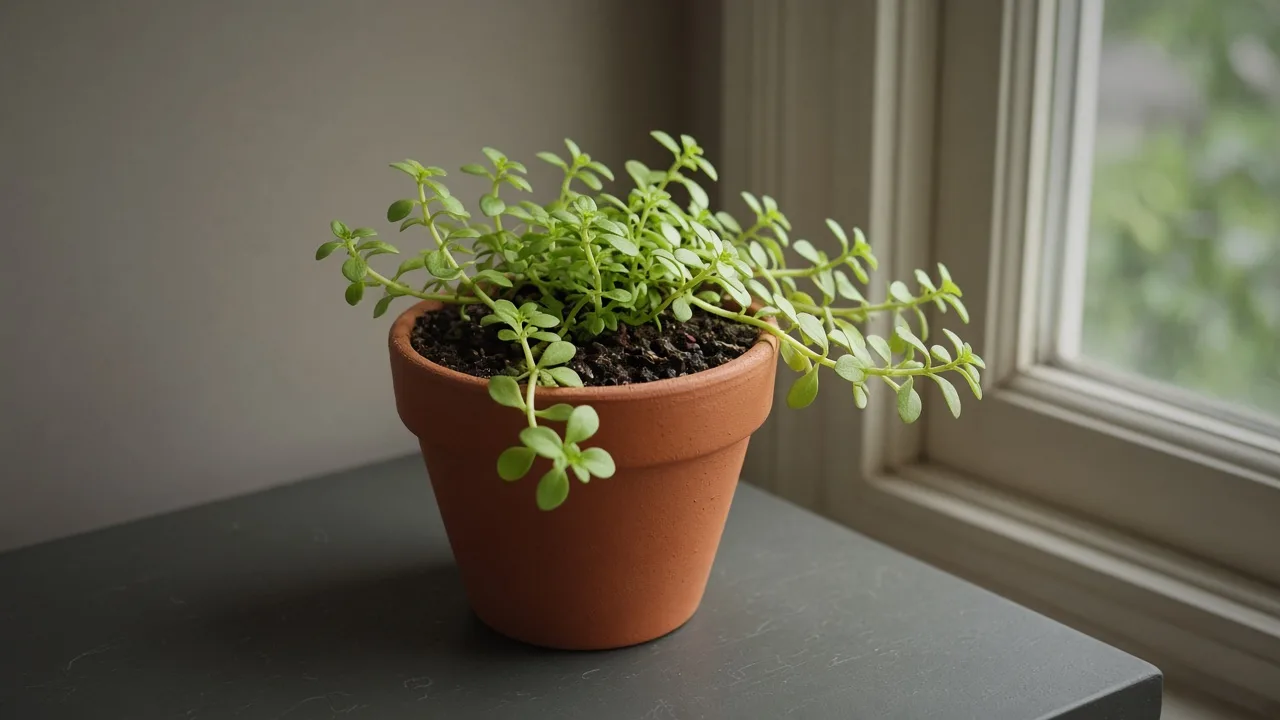
Not Enough Light on Brahmi: Causes, Checks & Fixes
This guide covers not enough light on Brahmi. See also the general Not Enough Light guide, watering, and light pages for this plant.
Not Enough Light on Brahmi: Causes, Checks & Fixes
Quick answer
Bacopa monnieri (water hyssop, nirbrahmi) is a low, creeping wetland herb that spreads as a moist mat—not a foliage plant that “likes shade” because it grows in marshes. Extension profiles place it in full sun to partial shade on moist to wet soil, and the Florida Native Plant Society lists full sun to part sun for the same species. Give it a dim covered verandah or a north room with no plant-facing brightness and you usually get long gaps between small succulent leaves, pale tips, mats that stop rooting at nodes, and little of the long-blooming white flowers the plant is capable of.
For how insufficient light limits photosynthesis in general, see our not enough light hub. On Brahmi, the decisive signal is internode stretch and stalled mat spread on wet mix—not whether the pot still feels damp.
First step: move the pot to the brightest spot you can keep moist—east or open south balcony, terrace tray, or within strong window light—so the mat receives several hours of direct sun on clear days while the mix stays moist to wet. Wait two to three weeks and judge only new runners and node roots, not old pale stem length.
This page is the symptom-first fix for shade-stressed Brahmi. For hour-by-hour placement, Indian balcony exposures, and grow-light targets, use the Brahmi light guide. For stretch that is already extreme, pair light correction with the leggy growth guide after compact new growth proves the brighter spot works.
When to use this page vs other Brahmi guides
| Pattern you see most | Read next |
|---|---|
| Long internodes, pale tips, lean toward light, weak flowers on wet mix | This page |
| Extreme bare runners with tiny leaves at tips | Leggy growth |
| Almost no spread for weeks in warm weather | Slow growth |
| Yellowing with sour stagnant mix in a dim corner | Overwatering or root rot |
| Crispy tips and dry surface despite your schedule | Underwatering or wilting |
| Proactive sun hours and acclimation | Light guide |
| Full problem index | All Brahmi problems |
What insufficient light looks like on Brahmi
Low light on Brahmi is a mat-architecture problem before it becomes a rescue cutting job. Read the newest runners, not a single older leaf at the pot edge.
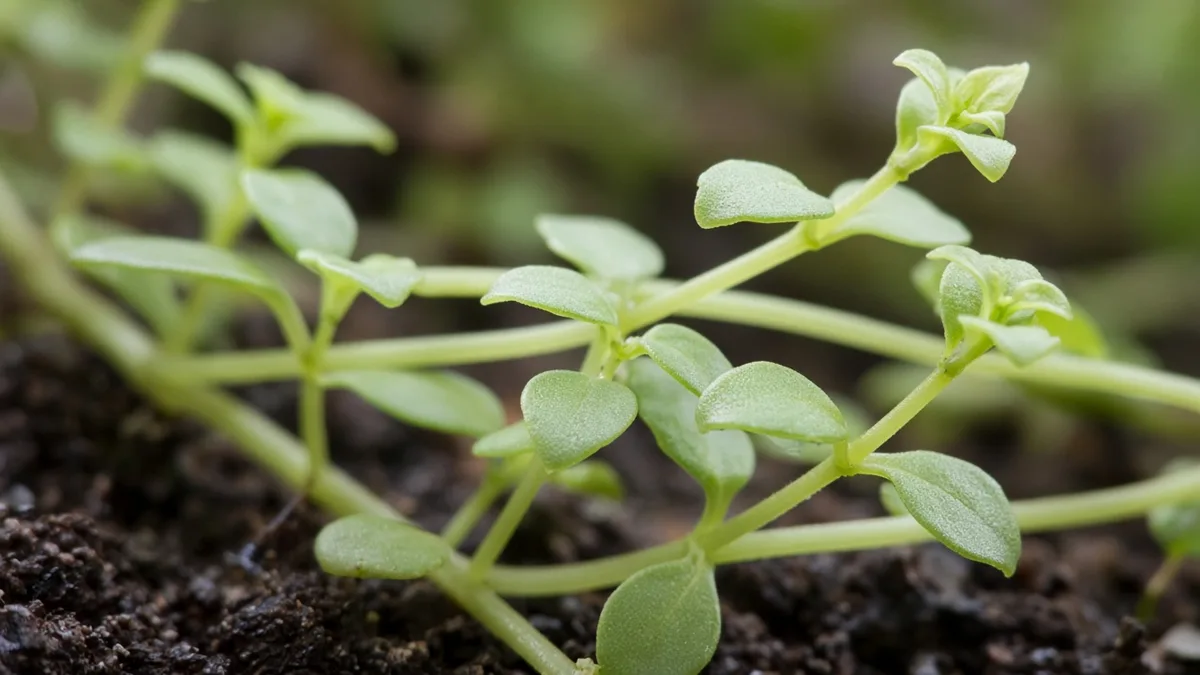
Low-light etiolation on Bacopa monnieri: smaller pale leaves spaced far apart on a creeping stem—compare with tighter node pairs lower on the same runner.
Typical shade-stress signs on water hyssop:
- Long internodes between pairs of thick, succulent leaves on prostrate stems—fresh growth gaps widen while the plant still looks alive
- Smaller, yellow-green new leaves at stem tips while older leaves nearer the crown still look greener
- Lean or one-sided spread toward the brightest window, balcony gap, or desk lamp
- Mats that stop knitting—runners creep but few new roots anchor at nodes, so the pot looks sparse despite moisture
- Weak or absent white flowers even through a long blooming season when sun is strong and water keeps up (NC State notes a long blooming season in good culture)
- Soil that stays wet for many days in a dim interior spot because transpiration slowed—often misread as overwatering alone
- Shop-to-shelf fade—compact at purchase under nursery brightness, thin and pale within a few weeks on a décor shelf
RHS guidance on light applies broadly: when plants cannot make enough food from light, you see weak, pale, spindly growth and fewer flowers. On Brahmi that shows up as stretched wetland runners, not upright houseplant lean alone.
Compare with leggy growth on Brahmi when bare stem is already extreme. Use this page when placement and pale mats are the main limits—or when stretch is early and you want brighter sun before structure fails.
Why Brahmi lacks enough light (wetland habit vs dim corners)
Growers sometimes assume “marsh plant” means “shade plant.” For Bacopa monnieri, open wetland margins are bright environments—reflective water, open sky, and long days—not forest floor gloom. NC State describes it in moist to wet soils along streams and ponds or in a bog garden in full sun to partial shade, and notes it is heat tolerant but not drought tolerant at all. Bright light drives the rapid spreading habit; shade only slows the same biology until the mat looks thin.
The Florida Wildflower Foundation is blunt outdoors: exposure is full sun, with the note that the plant can survive in partial sun but does best with plenty of sun and water. That “plenty of sun and water” pairing matters on balconies—dim corners keep moisture high while photosynthesis stays low.
Brahmi-specific placement mistakes
- Covered verandahs and north alcoves that feel “bright to humans” but deliver faint midday shadows on the leaves
- Hanging baskets tucked under deep eaves where only the pot rim catches sun while the mat sits in open shade
- Indoor tables far from glass while you still water on a sunny-balcony schedule—wet mix without photons
- Wrong “brahmi” species—Centella asiatica (gotu kola) tolerates more shade; stretch on true Bacopa monnieri in the same spot means you need more sun, not less water (NC State Centella profile for contrast)
- Aquarium or pond culture with weak lighting—submerged stems also need adequate light for steady growth; profiles list medium light as a baseline in tanks, another signal that dim energy limits this genus
Light–water coupling on shallow root mats
Brahmi’s roots sit in a thin, moisture-loving mat. In strong light the plant drinks heavily and you match it with daily or every-other-day watering in heat, per the Brahmi watering guide. In dim light the same wet mix dries slowly while new leaves shrink—so yellow leaves or mold on soil can layer on shade stress if you keep pouring water without fixing photons. Fix placement first; then align water to the new growth rate.
How to confirm the cause (step-by-step checks)
Run this Brahmi workflow before you repot, fertilize, or hard-prune.
- Internode gap on the newest runner — Measure leaf-pair to leaf-pair distance on the last 10 cm of stem. Widening gaps on fresh growth point to ongoing low light; stable tight pairs after a move mean light is adequate.
- Hand-shadow test at leaf height — Hold your hand above the mat at midday. A sharp shadow means useful direct sun; a soft readable shadow is bright ambient; faint or no shadow is survival light, not mat-forming light.
- Three-day sun log — Note when direct sun first hits the pot and when shade takes it. Fewer than about two hours of real sun with no strong ambient brightness usually explains thin mats indoors.
- Node rooting — Healthy Brahmi in adequate light roots at nodes and spreads outward. Stalled mats with creeping but unanchored stems often accompany chronic shade.
- Moisture vs stretch — Surface at 1–2 cm should stay damp for this plant, but endless sogginess with pale tips in a dim corner suggests slow water use—cross-check overwatering if mix smells sour or stems soften.
- Species check — Confirm Bacopa monnieri on the label or flowers (small white blooms, succulent paired leaves). Misidentified gotu kola changes the light target.
Two-to-three-week confirmation test: After moving to brighter sun while keeping mix moist to wet, success means the next node pairs are closer together, leaves are plumper, and new roots appear at nodes. If spacing stays wide and color stays pale, add grow lights per the light guide before expecting fertilizer or repotting to help.
Low light vs lookalike problems on Brahmi
| Pattern you see most | Likely cause | What to do first |
|---|---|---|
| Long gaps, pale tips, lean, wet mix in dim room | Not enough light (this page) | Move to brighter sun; keep moist |
| Extreme bare runners, tip-only leaves | Leggy growth | Fix light, then trim or propagate |
| No spread for weeks in warm weather | Slow growth | Broader stall—not only pale stretch |
| Crispy tips, dry surface, wilting | Underwatering | Water and tray; do not blame shade alone |
| Soft stems, sour mix, yellowing in shade | Overwatering / root rot | Inspect roots; improve light if plant survives |
| Low humidity with brown tips in AC | Dry air plus weak light | Humidity helps, but Brahmi still needs photons |
First fix for Brahmi
Move the pot to the brightest location you can keep consistently moist—without repotting or feeding on the same day.
Practical targets for home growers:
- East balcony or east window — morning direct sun plus bright day light; default safest upgrade from dim shade
- Open south terrace — densest mats when you water so roots never fully dry; use the overview hub moisture rhythm
- West exposure — workable with a water tray in heat; watch crisp tips after sudden moves from deep shade
- Indoors — strongest plant-facing glass or a full-spectrum grow light 12–14 hours daily; dim rooms are temporary holding spots only
Acclimate over one to two weeks if the plant lived in deep shade—add an hour or two of direct sun every few days while moisture stays steady so you do not confuse sun scorch with ongoing stretch. Judge new runners only after the move.
Do not repot, hard-prune, or fertilize until placement is fixed and you have read the response on fresh growth.
Step-by-step recovery after light improves
- Relocate using the first-fix targets above; keep mix moist to wet, not bone dry.
- Hold other variables steady for two weeks—same pot, same watering depth check at 1–2 cm, no nutrient push on a stressed mat.
- Pinch or trim only the worst bare tips after you see tighter new node pairs—otherwise you remove the little photosynthetic tissue the plant still has (pruning guide for mat shaping).
- Propagate insurance — If one runner is mostly bare, root a healthy tip cutting in moist mix once new growth looks firmer (propagation guide).
- Reassess soil only if drainage failed in the dim corner—switch to a moisture-retentive but airy mix per the soil guide if sour stagnation was part of the story.
Recovery timeline and what improvement looks like
| Phase | What to expect |
|---|---|
| Week 1 | Lean may stop worsening; no miracle on old internodes |
| Weeks 2–3 | New leaves larger, node gaps shorter, first fresh roots at nodes in warm weather |
| Weeks 4–6 | Mat begins outward knit; flowering possible if sun and moisture both strong |
| Old tissue | Pale stretched stem length does not shorten; leaves do not “inflate” back to nursery size |
Signs the problem is getting worse despite watering: longer gaps on every new node, increasing yellowing on wet stagnant mix, soft collapsing stems—shift to root-zone triage on wilting and rot guides, not more shade.
Mistakes to avoid
- Pouring more water into a dim corner to “wake up” a pale mat—adds stagnation risk without photons
- Assuming all plants sold as brahmi share the same light needs—verify Bacopa monnieri
- Fertilizing a stretched shade-grown mat before light improves—soft flushes without fixing the limiter
- Moving from deep shade to harsh west sun in one day—acclimate while keeping moisture up
- Judging recovery on old leaves—Brahmi tells the truth on the newest runners
How to prevent thin Brahmi mats next season
Anchor habits to the Brahmi light guide: full sun to partial shade with real sun hours, moist mix, and high humidity where air is dry. Re-check exposure when monsoon cloud cover lifts or when outdoor trees leaf out and steal afternoon sun. On interior winter shelves, move pots closer to glass or add a grow light before stretch restarts.
Related Brahmi guides
Use this page when pale, stretched mats in dim spots are the main issue. Use the light guide for proactive placement and acclimation, leggy growth when bare runners dominate, slow growth when the whole plant stalls in adequate sun, and watering whenever you increase sun so drought does not replace shade stress.
Related tool
Use the Plant Problem Diagnosis Tool to separate light limitation from watering and pest patterns before you change multiple variables at once.