Spider Mites on Calathea Dottie: Stippling on Dark Leaves &
Quick answer
Spider mites on Calathea Dottie show as fine yellow or bronze stippling and delicate webbing on the undersides of dark elliptical leaves—often worst on the newest spear and blades facing a heating vent while the room still feels humid. First step: isolate the plant and tap suspect leaf undersides over white paper under bright sidelight to confirm slow-moving specks before you shower or spray.
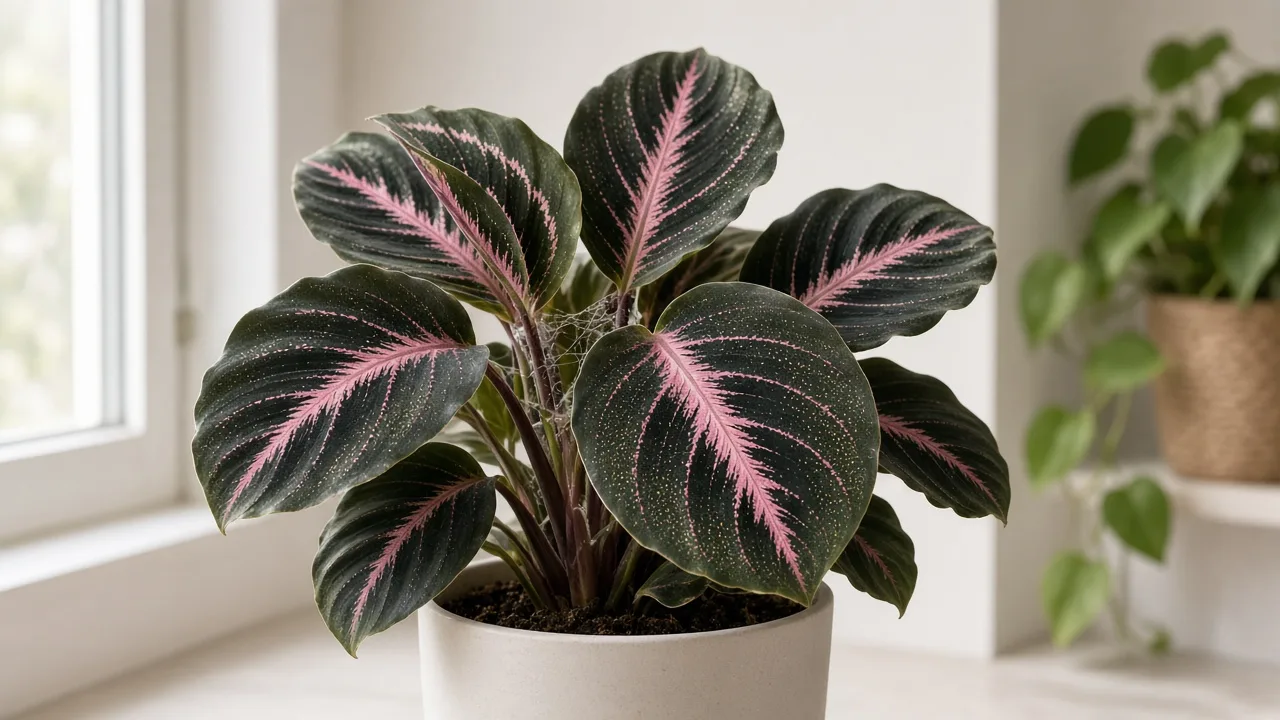
Spider Mites on Calathea Dottie: Causes, Checks & Fixes
This guide covers spider mites on Calathea Dottie. See also the general Spider Mites guide, watering, and light pages for this plant.
Spider Mites on Calathea Dottie: Causes, Checks & Fixes
Quick answer
Spider mites on Goeppertia roseopicta ‘Dottie’ (Calathea Dottie) are tiny arachnids—not insects—that pierce leaf cells and leave fine yellow or white stippling on dark elliptical blades, often with delicate silk webbing on undersides when colonies grow. They thrive in hot, dry, still air—common on Dottie beside heating vents, in bright east windows with winter furnace heat, or on the upper leaves while a humidifier mist never reaches the leaf surface.
For mite life cycles, why some insecticides backfire, and when horticultural oils help in general, see our spider mites pest guide. On Dottie, the tell is stippling plus webbing on dark leaf undersides and axils—not white cottony wax in prayer-plant pockets (mealybugs), soft colonies on shoot tips (aphids), or crisp pink margins without moving specks (low humidity or brown tips).
First step: isolate the pot away from other calatheas and marantas, hold white paper under a suspect blade, and tap the underside firmly to confirm slow-moving mites before you shower, soap, or oil anything.
If the whole plant limps with dry mix and no stippling, read underwatering on Calathea Dottie or wilting first. Soft stems on constantly wet mix without webbing point to overwatering or root rot—not a pest spray day.
When to use this page vs other Calathea Dottie guides
This page is the mite-first entry for stippling, bronzing, and fine silk on dark rose-painted foliage.
| Pattern | Read next |
|---|---|
| White cottony wax in axils or on spears | Mealybugs |
| Soft pear-shaped insects + sticky honeydew on tips | Aphids |
| Papery pink-brown margins, no stippling or silk | Low humidity or Brown tips |
| Evening leaf fold only, firm blades, no webbing | Normal nyctinasty—check watering if curl persists by morning |
| Faded pink veins on whole plant, no mites on tap test | Not enough light |
| Yellow lower leaves on wet mix, no stippling | Overwatering |
| Browse all issues | Calathea Dottie problems |
Why Calathea Dottie gets spider mites despite “humid” care
Rose-painted calatheas are listed mite hosts. NC State Extension notes spider mites among insects to monitor on Goeppertia roseopicta, including the ‘Dottie’ cultivar with near-black blades and pink midrib feathering. Mites are not a rare outdoor-only pest here—they track houseplant foliage the same way they do on other prayer plants.
Bright indirect light plus dry microclimates mimic mite weather. Dottie wants bright indirect light per the light guide and evenly moist peaty mix. Spider mites prefer hot, dusty conditions and damage is usually worse on water-stressed plants. A pot on a sunny sill or above a radiator can leave upper blade surfaces hot and dry while the room hygrometer still reads 55%—mites settle on the undersides where transpiration is highest.
Dark leaves hide early stippling. Yellow pinpricks are easy to spot on a green pothos; on Dottie’s near-black upper surface you often notice dull pink veins and a gray-bronze cast before you see individual dots. By then colonies may already web axils around the newest spear.
Unfurling spears are soft targets. The expanding prayer-plant spear is thin and high in nitrogen—mites cluster on its underside and in the groove along the midrib while the blade is still rolling open. Damage here shows up later as torn or washed-out pink veining on the first hard leaf.
Broad-spectrum sprays can spike populations. NC State notes that insecticides disrupting natural enemies often cause spider mite outbreaks, including imidacloprid and other neonicotinoids. If you recently treated aphids with a general “bug” spray, suspect mites before you blame humidity alone.
What spider mites look like on Calathea Dottie
On Dottie you are reading dark elliptical prayer-plant blades, not succulent pads:
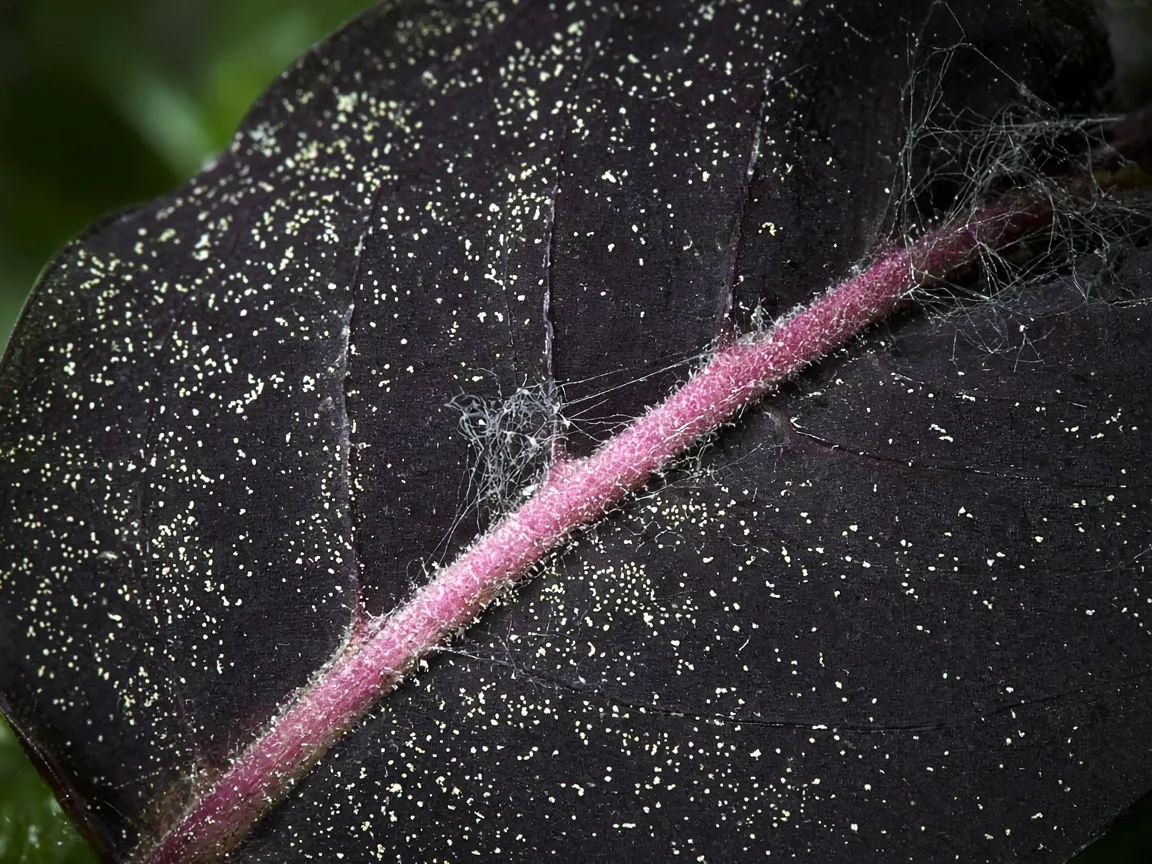
Fine stippling and silk in the midrib groove on a near-black underside—tap test should show slow-moving specks, not water spots.
- Fine yellow or white stippling visible when you tilt a blade toward light—light dots that may bronze as feeding continues
- Dull or bronzed patches on the upper surface while the pink central vein looks washed out on affected blades only
- Delicate silk webbing in leaf axils, along the underside midrib, or bridging a petiole to the next blade
- Tiny slow-moving specks on white paper after tapping an underside—mites are less than 1/20 inch long and live in colonies mostly on leaf undersides
- Worst on the newest spear and top three blades facing the heat source; lower shaded leaves may stay clean until webbing spreads
- No cottony wax tufts—that pattern fits mealybugs in the same axils
Pink vein fade vs mite stippling on near-black blades
Dottie signals stress through pink contrast before leaves yellow. That overlap confuses mite diagnosis:
- Even fade across most blades, no webbing, no specks on a tap test → often light or low humidity—pink washes out uniformly and margins may crisp without bronze pinpricks.
- Patchy bronze stippling on some blades only, pink vein dull on those same leaves, silk in axils → mites confirmed or highly suspected.
- Pink margins brown during unfurl with firm mix → fluoride or dry air per brown tips—usually no crawling specks on paper.
Use bright sidelight across the dark upper surface; stippling reads as a fine sandpaper texture where healthy blades look satin-smooth.
Evening leaf fold vs mite stress curl
Prayer plants fold leaves upward at night (nyctinasty) when light and temperature drop. That normal fold:
- Involves whole blades lifting on firm petioles
- Reopens by mid-morning in stable conditions
- Comes without stippling, bronzing, or silk on the underside
Mite-heavy plants may look slightly curled or limp in daytime too, with dull color and webbing in axils that stay closed. If curl persists through the day with dry surface mix, pair mite checks with the watering guide—but confirm mites before you only add water.
Where to inspect on a clumping Dottie
Work through this order on a 1–2 foot bushy clump:
- Underside of the unfurling spear — first colonies often hide on soft rolling tissue
- Top three to five mature blades — especially the side facing a vent or glass
- Leaf axils where the dark blade meets the petiole—webbing collects in the pocket
- Underside midrib groove on blades with washed-out pink veins
- Neighboring calatheas, marantas, and alocasias on the same shelf—mites disperse on air currents when foliage quality drops
Paper tap test: Hold white paper under a suspect blade, tap the underside sharply, and watch for specks that move rapidly once disturbed. Tap water spots and perlite dust do not crawl.
Confirm spider mites vs humidity, light, and lookalike pests
| What you see | Likely cause | Key check |
|---|---|---|
| Stippling + fine webbing on undersides | Spider mites | Paper tap shows moving specks |
| White cottony wax in axils | Mealybugs | Alcohol dab smears orange-gray |
| Soft insects + honeydew on tips | Aphids | Pear-shaped colonies; no silk mats |
| Even pink fade, papery margins, no mites | Low humidity | Hygrometer low; no stippling |
| Whole plant pale, etiolated | Not enough light | Leggy stems; no webbing |
| Yellow lower leaves, wet mix | Overwatering | Soil never dries; crown firm |
| Droopy blades, dry top 2 cm | Underwatering | No bronze pinpricks |
Confirmed diagnosis — Stippling plus webbing with live mites on the tap test and firm rhizome at the soil line. Suspected — Stippling only: re-check in three days with a 10× lens on axils before treating.
First fix: isolate and confirm with a paper tap test
Move the pot away from other moisture-loving houseplants for at least two weeks while you treat. Mites walk and drift between pots on shared plant stands.
Tap undersides over white paper under bright sidelight. If nothing moves, re-check the newest spear in three days—sometimes mites leave after brief hot spells and leaves stabilize. If specks crawl, proceed to targeted rinses—not a whole-day stack of repotting, fertilizer, and pesticide.
Do not repot or feed on day one. Dottie recovers slowly from crown stress; one clear pest step beats changing soil and spray on the same afternoon.
Step-by-step recovery on Goeppertia roseopicta ‘Dottie’
1. Targeted underside rinse
Epic Gardening recommends hitting spider mites with a strong stream of water as an early control step—adapt for prayer-plant anatomy:
- Work in morning so blades dry before cool evening
- Support each petiole and rinse undersides and axils only with lukewarm water
- Keep the crown and center spear as dry as practical—wet foliage with poor airflow can contribute to leaf spot on calatheas
- UC IPM suggests misting or spraying undersides at least once a day for infested plants—on Dottie, repeat every two to three days while colonies are active and humidity stays above 60%
Stop rinsing if blades stay wet overnight or spotting appears—switch to shorter bursts and better airflow before continuing.
2. Insecticidal soap or horticultural oil (after water fails)
If stippling spreads after a week of firm crowns and targeted rinses:
- Use insecticidal soap or horticultural oil labeled for mites on ornamentals
- UC IPM recommends covering undersides completely and avoiding treatment when plants are water-stressed or in extreme heat
- NC State suggests a follow-up application about 7 to 10 days later to catch newly hatched mites
- Patch-test one lower blade first—dark calathea foliage can show transient spotting after oil in low humidity
Hold fertilizer until new spears unfurl clean for two weeks. Feeding stressed Dottie while mites are active rarely helps and can soften tissue.
3. Fix the dry pocket, not just the hygrometer
Mites often persist when only the room average is humid:
- Move the pot away from heating vents and hot electronics
- Aim the humidifier so mist reaches the leaf layer, not just the floor
- Align watering with the Calathea Dottie watering guide—adequate irrigation reduces mite damage on water-stressed plants
Recovery timeline and what improves first
Days 1–7: Webbing stops spreading; tap tests show fewer live specks; existing stippling does not vanish.
Weeks 2–4: The next spear unfurls with sharp pink veining on unstippled tissue; older damaged blades keep their bronze cast.
Month 2+: Clump looks fuller as new blades accumulate; severely desiccated leaves can be trimmed once replacement growth is firm—see pruning for sterile cuts above the rhizome, not crown shredding.
Escalate if most blades bronze and drop, webbing returns within 48 hours after rinses, or the crown softens on wet mix—those patterns need problems hub triage, not repeated oil alone.
Mistakes to avoid on dark prayer-plant foliage
- Showering the whole plant daily without drying time—invites leaf spot on Dottie’s dark blades
- Misting only the upper surface—mites live on undersides; top mist does not reach colonies
- Treating pink vein fade as mites without a tap test—delays light or humidity fixes
- Broad-spectrum “kill all bugs” sprays after aphid treatment—can flare spider mites
- Repotting into fresh peaty mix on day one—rhizome disturbance stacks stress while mites are still mobile
How to prevent spider mites next time
Scout blade undersides and spears weekly during winter heating season. Quarantine new prayer plants two weeks. Keep filtered or rainwater on schedule so drought stress does not compound dry vent air.
Because Dottie is non-toxic to cats and dogs per ASPCA calathea listings, many owners keep it on living-room tables—still isolate when mites appear so pets do not brush against webbing and carry specks to other pots.