Cauliflower Light Needs: Full Sun, Blanching & India Timing
Cauliflower Light Needs: Full Sun, Blanching & India Timing
Cauliflower Light Needs: Full Sun, Blanching & India Timing
Cauliflower (Brassica oleracea var. botrytis) is not a low-light foliage crop like many houseplants. It is a cool-season heading brassica that builds one dense curd from actively photosynthesizing leaves. Those leaves want full sun—typically six or more hours of direct light per day during the main growth window (NC State Extension)—while the developing white curd often needs a separate light-management step called blanching. On most Indian plains, that window lines up with October through March transplanting and harvest, not with a hot lowland summer terrace where intense radiation plus heat commonly produce loose, ricey curds or premature bolting even when the plant looks well lit.
The practical rule is seasonal: maximize winter sun on the foliage, then manage heat and curd exposure once heads form. If you only remember one distinction, remember that leaves need brightness; white curds may need cover—but colored types usually need open light to develop pigment. Start with the overview for cultivar choice and season map; use this page when you are deciding where to place pots, whether seedlings are stretching, or why a large plant failed to head despite sitting in sun.
Cauliflower Light Needs: The Quick Answer
For home gardens and containers, cauliflower performs best in full sun while air and soil stay cool. NC State lists Brassica oleracea as thriving in full sun (six or more hours of direct sunlight daily) and tolerating partial shade (two to six hours) (NC State Extension). The RHS advises choosing a sunny site with fertile, moisture-retentive soil—light is not optional if you want firm heads.
On an Indian plains balcony, treat six or more hours of direct winter sun on the leaf canopy as the default from transplant through curd initiation. If February or March warms quickly, afternoon shade or 30–50% shade cloth over midday hours often protects curd quality better than blasting stressed plants with six hours of harsh rays above 27–30 °C (80–86 °F). Shallow shade alone will not fix a summer calendar mismatch; see the overview for why lowland May–June sun usually fails this crop.
How Much Light Cauliflower Actually Needs
Cauliflower converts light into the sugars and structure required before the curd appears. Unlike kale, you cannot harvest outer leaves for months and forgive weak light—the plant must reach size once, then switch energy into a single head.
Full Sun During Cool Head Formation
When temperatures sit roughly in the 15–21 °C (60–70 °F) range during head development—the band extension and seed guides commonly cite for quality curds (Epic Gardening)—give plants the brightest cool-season site you have. Epic Gardening summarizes mature growth as needing about 6–8 hours of full sun daily for strong development (Epic Gardening). Morning sun is especially valuable: it warms roots after cold nights without the combined stress of peak afternoon heat on waxy brassica leaves.
Container growers should still watch pot temperature. A dark plastic pot in all-day winter sun can heat roots even when air feels mild, which ties light placement to watering checks and soil choice.
Partial Shade Limits and Yield Trade-offs
Partial shade is a survival strategy, not a yield strategy. At four to five hours of direct sun plus bright ambient sky, cauliflower may live but often forms smaller, looser curds or stalls before heading. NC State’s partial-shade band (two to six hours) is a botanical tolerance range—not a target for Phool Gobhi production on a terrace.
If your only site is a bright courtyard with three to four hours of direct sun, choose compact or mini cultivars, start with vigorous transplants, and keep fertility and moisture impeccable. Expect a shorter harvest window and smaller heads rather than field-scale curds.
Why Light and Temperature Work Together on Cauliflower
Cauliflower is less forgiving than broccoli or kale because head quality depends on uninterrupted cool growth. Epic Gardening notes that plants generally mature best when temperatures stay roughly between 60° and 80 °F (about 15–27 °C), with ideal development often near 70 °F (21 °C) (Epic Gardening). Bright sun on a 35 °C afternoon does not replace that thermal window—it accelerates stress.
Buttoning (tiny premature heads) and bolting (flower stalks) can follow cold shock, drought, or heat even when daily light hours look adequate. A plant on a well-lit March terrace may still fail if soil warms and nights shorten. Light management here means pairing winter brightness with spring heat relief, not chasing more photons during the wrong season.
Seasonal Light Strategy for Indian Growers
October–March on the Plains
Sow or transplant from October into November so the rosette sizes up in shortening days and cool nights. Place seedlings in the brightest open winter position: an unobstructed south or west terrace, a railing without monsoon awnings still lowered, or an east-west combo that collects morning and midday sun. As late winter arrives, reassess—if lower leaves yellow while the center stays small, rule out weak light before assuming fertilizer deficiency.
Hill Districts vs Hot Lowland Summers
Cooler hills extend the full-sun window. Plants may sit in six to eight hours of direct sun for months without the heat stress lowlanders see in March. You can still use afternoon shade on unusually warm spring days.
Hot lowland summers combine intense radiation, warm soil, and short nights. Extra sun does not rescue that schedule. For summer greens, switch species; use cauliflower’s light budget during the cool season only.
Best Terrace, Balcony, and Window Placement
Reading Exposures and the Shadow Test
East-facing balconies deliver gentle morning sun plus bright midday ambient light—excellent for seedlings hardening off before peak winter harvest sites. South or west exposures produce the densest curds in cool months but need afternoon protection once heat builds. North exposures with open sky may grow small heads with patience; deep courtyard shade rarely supports standard cultivars.
On a clear day, hold your hand 30 cm above the soil. A sharp shadow means direct sun; count those hours across the season, not on one perfect January afternoon.
Moving Containers for Afternoon Relief
Containers are light tools. Roll pots into full sun from October through January, then slide them where a wall, railing, or shade cloth blocks harsh afternoon rays in late winter. Pair moves with steady watering so wet roots do not amplify heat stress.
Blanching White Curds Without Starving the Plant
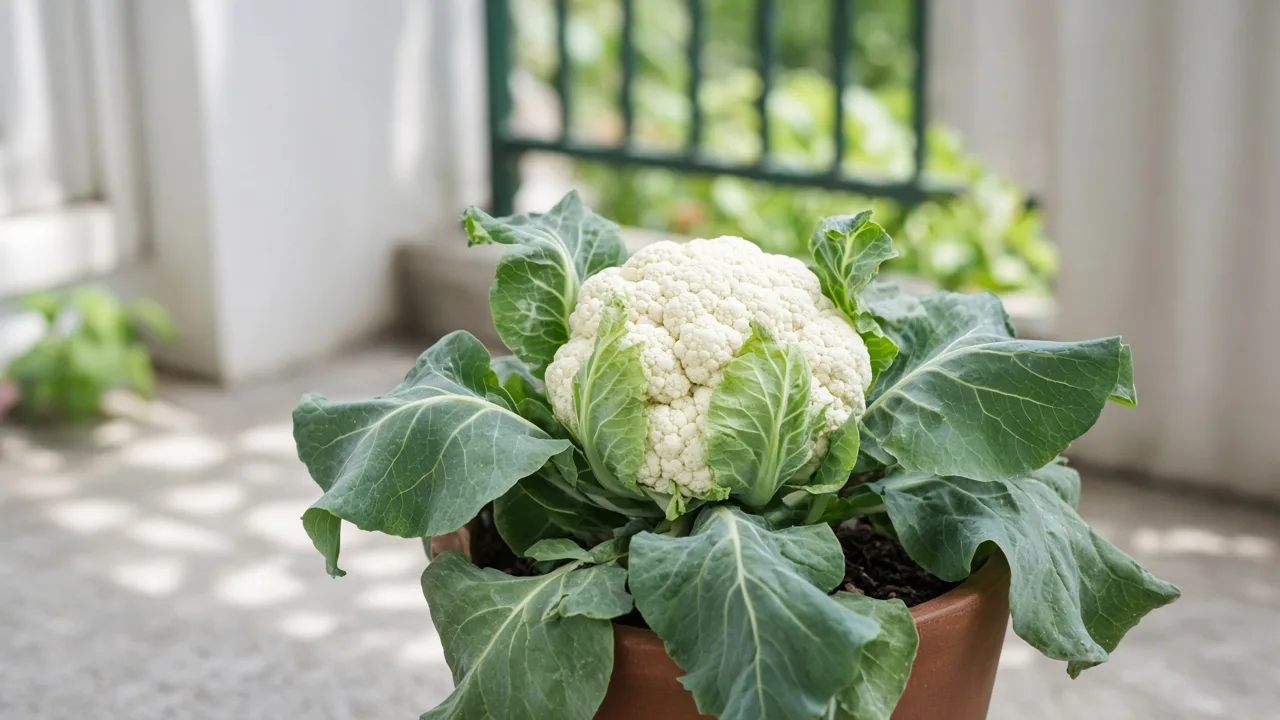
A common mistake is shading the entire plant. Leaves still need sun to feed the curd. UF/IFAS Gardening Solutions explains that blanching pulls outer leaves over the developing head to block light from the curd—especially on white varieties prone to discoloration and off flavors when exposed. Tie or fold leaves when the head is roughly 7–8 cm (3 in) or teacup-sized, snug enough to block light but not so tight that leaves tear.
The RHS notes that hot summer sun can yellow white heads and recommends folding leaves over the curd; in cool Indian winters, tying is often optional for fast-maturing whites. Self-blanching cultivars curl leaves naturally—still inspect for gaps.
When Colored and Romanesco Types Need Full Light
Purple, orange, and green cauliflower need light on the curd to develop pigment—do not blanch them. Romanesco spirals also grow best with open exposure. Treat blanching as a white-curd tool, not a universal rule.
Direct Sun, Heat Stress, and Curd Quality
Leaf edges may look fine while the curd suffers: grainy or ricey texture, brown spots, or rapid separation of florets often track heat plus strong sun during maturity more than disease. Epic Gardening warns that temperatures above about 80 °F (27 °C) during maturity distort heads (Epic Gardening). UF/IFAS Gardening Solutions adds that heads develop faster in warm weather—so a sunny late-March week can push curds from perfect to over-mature quickly.
If only the sun-facing leaf margin crisps while the rest stays firm, suspect heat and moisture before reaching for pest sprays. Relocate pots to afternoon shade and confirm soil moisture at the watering guide.
Grow Lights for Indoor Seedlings and Late Starts
If you start cauliflower indoors before transplanting, weak window light produces leggy, pale seedlings that head poorly later. Use full-spectrum grow lights about 12–14 hours daily while plants are indoors (Epic Gardening), keeping fixtures close enough that stems do not stretch. After hardening off on a cool terrace, outdoor winter sun outperforms most desk lamps—treat lights as a bridge for two to three weeks, not a substitute for a bright repotting window into final containers.
Warning Signs of Too Much or Too Little Light
Too little light shows as elongated stems, undersized leaves, delayed curd formation, and a plant that stays “all leaves, no head” deep into the cool season. Soil may stay wet for days because transpiration is low—do not water on autopilot.
Too much heat-linked sun shows as midday wilting that recovers overnight, bleached leaf patches, bitter or loose curds, and thickening flower stalks. Act on new growth after any move; old nursery scars are not diagnostic.
| Symptom | Likely light issue | First action |
|---|---|---|
| Leggy pale seedlings indoors | Low light before transplant | Increase lamp hours or move to brightest cool spot |
| Large plant, no curd by late winter | Shade + possible stress history | Increase direct sun; review water and transplant timing |
| Ricey or separating curd in March heat | Heat + strong sun during maturity | Afternoon shade; harvest promptly |
| Yellow white curd surface | Sun on exposed head | Blanch or choose self-blanching whites |
How Light Links to Watering and Head Development
Bright sun dries containers faster; dim light slows drying—both change how often you should irrigate. Cauliflower in full winter sun on a windy terrace may need checks every two to three days, while the same pot in March shade might need less. Because the crop gives one main harvest, there is no second chance to compensate with leaf picks—protect the single curd window with consistent moisture once light is adequate. For sowing dates and transplant timing tied to your brightest months, see propagation.
When to use this page vs other Cauliflower guides
Use this page when you are choosing terrace placement, interpreting leggy seedlings, or deciding when to blanch white curds. For moisture checks after you fix light, open watering. For mix, pH, and drainage, see soil. For nitrogen timing once light is adequate, see fertilizer. For pot size and final transplant timing, see repotting. For sowing dates and nursery care, see propagation. For identity, cultivars, and Phool Gobhi basics, start at overview.
Related Cauliflower guides
- Overview — cool-season identity, cultivar types, and India sowing windows.
- Watering — moisture checks that change with sun and wind exposure.
- Soil — mixes that hold moisture without overheating roots in sun.
- Fertilizer — feeding when bright light drives faster growth before heading.
- Propagation — sowing and transplant timing tied to your brightest cool months.
Conclusion
Cauliflower rewards generous cool-season sun on the leaves and careful curd protection on white types once heads show. Aim for six or more hours of direct winter light on Indian terraces, add afternoon shade when heat—not photons—becomes the limit, and never confuse blanching the curd with shading the whole plant. Watch new leaves and the center rosette after every placement change—they tell you whether today’s light is building a firm Phool Gobhi head or pushing the plant toward bolting.