Chikoo Fertilizer Guide for Pots & Gardens
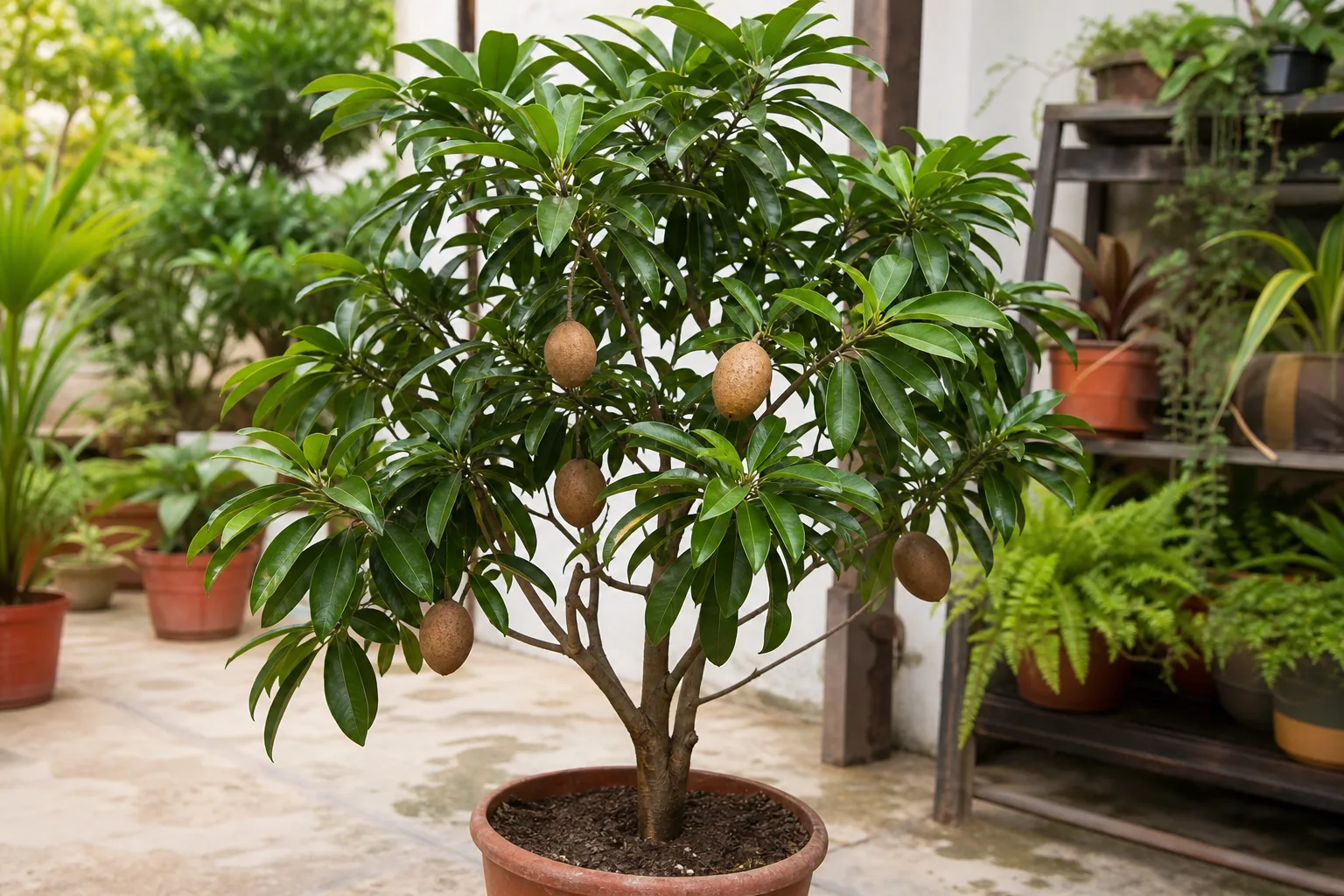
Chikoo Fertilizer Guide for Pots & Gardens
Chikoo Fertilizer Guide for Pots & Gardens
Your Chikoo does not need weekly “boosters.” It needs nutrients when warm weather, strong sun, and healthy roots let Manilkara zapota push shoots, flowers, and fruit. UF/IFAS describes sapodilla as not demanding in fertilizer, with a modest young-tree program that builds gradually as the canopy expands (UF/IFAS sapodilla guide). For a terrace or balcony tree, the safest starting point is a complete fruit-tree or balanced fertilizer at half the container label rate during visible active growth, skipped whenever the mix is saturated, the tree is drought-wilted, or growth has paused.
Field orchard doses from Indian crop manuals are useful context for garden trees, not recipes you can pour into a 40–60 cm pot. Feed the root volume you actually have.
Chikoo fertilizer: the quick answer
After planting, wait for new growth, then begin light feeding rather than stuffing the planting hole with fertilizer. UF/IFAS recommends about ¼ lb (113 g) of a young-tree fertilizer such as 6-6-6-2 (N-P-K-Mg) with minor elements—and preferably 20–30% of the nitrogen from organic sources—every 8–10 weeks in the first year, then stepping up toward 0.5, 0.75, and 1.0 lb per application as the tree grows (UF/IFAS sapodilla guide). Mature landscape trees are commonly fed 2.5–5.0 lb per application, 2–3 times per year, using a mix such as 6-6-6, 8-3-9, or similar that includes phosphate and potash, plus 2–3 minor-element foliar sprays from April through September in that Florida calendar.
India’s National Horticulture Board frames orchard nutrition differently: about 50 kg farmyard manure, 1 kg N (about 1.5 kg N for rainfed varieties), 0.5 kg P₂O₅, and 0.5 kg K₂O per tree per year, adjusted for age and soil nutrient status (NHB sapota crop guide). Under irrigated conditions NHB splits that fertilizer—half at the start of the monsoon and half in the post-monsoon window of September–October; under rainfed conditions it is applied before monsoon onset. Use those orchard figures for in-ground trees with a real root zone, and use product labels for pots.
Why Chikoo needs measured feeding, not constant boosters
Chikoo is a slow-growing tropical evergreen fruit tree. Nitrogen supports leaves and shoots, phosphorus supports energy transfer and establishment, and potassium supports water regulation and fruit development. The goal is a sturdy canopy that can flower and crop—not endless soft flush that shades itself and sets poorly.
Fertilizer cannot replace full sun, free drainage, or sensible watering. Check the Chikoo light guide before treating sparse growth as hunger, and fix drainage through the Chikoo soil guide if the pot stays wet for days. UF/IFAS also warns that heavy fertilization of lawn next to sapodilla can reduce fruiting and fruit quality, and that timed lawn irrigation often over-waters mature trees (UF/IFAS sapodilla guide). Nutrition only works when roots are aerated and not competing with a constantly wet turf program.
In-ground trees and potted Chikoo need different plans
Orchard and Florida landscape recommendations are written as pounds or kilograms per tree because the root system explores a large soil volume. A container Chikoo may have only tens of litres of mix, where salts concentrate and leaching is limited.
NC State Extension’s container guidance treats nutrient management as part of the whole pot system with water, temperature, light, and growing medium. That is why a measured liquid or labeled controlled-release dose, followed by observation, is safer than converting an NHB kilogram manure bag into a terrace handful. Prefer small, timed feeds while the canopy is actively expanding; pause through waterlogged monsoon weather and cool low-growth periods.
India seasonal fertilizer schedule for Chikoo
India has no single Chikoo calendar. A coastal terrace, a dry Deccan garden, and a humid southern courtyard enter active growth on different weeks. Use the table as a decision framework, then let new leaves, flowering, rainfall, and root-zone moisture decide the exact day.
| Seasonal cue | In-ground Chikoo | Container Chikoo |
|---|---|---|
| New flush begins (often late winter–spring) | First modest NPK or FYM split based on tree age, soil test, and product label | Start half-rate liquid feed after steady new growth appears |
| Hot, dry growth or fruit fill | Feed only if irrigation is reliable; never fertilize drought-stressed roots | Water first, then feed on a cooler morning; skip during severe heat wilt |
| Sustained monsoon rain | Pause if soil is saturated; NHB irrigated trees still use planned splits when drainage allows | Usually pause while the pot stays wet; resume after drainage normalizes |
| Post-monsoon (Sept–Oct cue in NHB irrigated systems) | Apply the remaining planned half if soil is moist but not flooded | Resume a half-rate feed if the tree is actively growing |
| Cool or low-growth period | Do not force growth with nitrogen | Stop routine feeding until fresh growth returns |
Late winter and spring flush
Begin feeding only after you see expanding leaves or shoots, especially on a tree that was recently moved, repotted, or hard-pruned. UNH Extension emphasizes soil testing and actual tree performance when deciding whether fruit trees need fertilizer; that restraint fits home Chikoo too.
If you planted into a pit amended with compost or FYM, do not immediately stack a heavy chemical dose on top. NHB planting guidance already places well-rotten compost or farmyard manure in the pit along with phosphorus and potash sources before settling rains (NHB sapota crop guide). Wait for establishment, then follow an age-appropriate schedule. Use the Chikoo repotting guide to separate transplant recovery from feeding.
Monsoon and post-monsoon splits
For irrigated orchard trees, NHB’s two-split pattern—half at monsoon onset and half in September–October—matches how roots use nutrients when soil moisture returns after rains (NHB sapota crop guide). Home growers should still postpone application when soil is flooded or a heavy downpour is expected. Clemson Cooperative Extension advises delaying fertilizer before heavy rainfall because nutrients can leach or run off before roots use them, and it warns against fertilizing during drought because water is required for uptake.
In pots, move containers out of constant roof runoff, confirm drainage holes are open, and wait until the mix returns to a normal wet–dry rhythm. Tie watering decisions to the Chikoo watering guide rather than feeding a constantly wet root ball.
Cool or slow-growth pauses
UF/IFAS’s Florida calendar advises against nitrogen-containing fertilizer after August because late nitrogen can push winter growth and reduce spring flowering (UF/IFAS sapodilla guide). Translate the principle, not the month: in any climate where growth slows or cool weather arrives, stop forcing soft flush with nitrogen. Resume when warm active growth returns.
Best fertilizer type and NPK for Chikoo
Choose a product with a declared analysis and directions for fruit trees or outdoor containers. UF/IFAS suggests young-tree formulas such as 6-6-6-2 with minors, and mature mixes such as 6-6-6, 8-3-9, or similar materials that include magnesium where recommended (UF/IFAS sapodilla guide). A complete water-soluble feed is easiest to reduce and distribute evenly in a pot. Controlled-release granules can work if you know the release period and avoid overlapping monthly liquid feeds.
Clemson’s fertilizer label guidance explains that the three large numbers are percentages of nitrogen, phosphate, and potash by weight. Read the guaranteed analysis for magnesium and trace elements, and follow the container line on the label instead of inventing a gram dose from marketing names.
Compost, FYM, and organic inputs
Well-rotted FYM and compost improve organic matter and contribute nutrients, and NHB builds orchard programs around roughly 50 kg FYM per tree per year plus measured NPK (NHB sapota crop guide). In a pot, bulky manure can reduce air space and vary in salinity and maturity, so use only well-finished material in a modest top-dressing kept away from the trunk collar.
UF/IFAS prefers that 20–30% of nitrogen in the young-tree fertilizer come from organic sources, which slows release and reduces burn risk (UF/IFAS sapodilla guide). Do not combine manure, oil cake, liquid feed, and slow-release granules in the same week; add one input, observe a growth cycle, and adjust. “Organic” still does not mean unlimited.
How much fertilizer to use in a container
There is no defensible gram dose without the fertilizer analysis, pot volume, tree size, and label directions. Start a healthy, actively growing potted Chikoo at half the label’s container rate. Repeat no sooner than every four to six weeks with a water-soluble product while growth continues, and stop if the tree is not producing new leaves.
UF/IFAS Gardening Solutions notes that too much fertilizer in containers can build salts in the media and cause stunted growth, leaf browning, or plant death. For controlled-release fertilizer, use the label rate for the actual container diameter or media volume and note the release period. A newly purchased tree may already contain coated pellets; check before stacking another product.
How to fertilize Chikoo step by step
- Confirm the Chikoo is in strong sun, actively growing, and free of severe wilt or root decline.
- Feel the mix. If it is bone dry, water and postpone feeding; if saturated, wait for drainage and aeration.
- Measure the product rather than estimating by handful. For a liquid feed, begin at half the label’s container concentration.
- Apply evenly over already moist soil or mix, keeping concentrated granules and solution away from the trunk.
- Allow drainage to leave the pot and empty the saucer. For in-ground trees, water lightly afterward so nutrients move into the root zone without flooding.
- Record the date and product, then reassess new growth over the next month. Do not “top up” because results are not visible in a few days.
This sequence reduces dosing errors and keeps feeding tied to root-zone moisture. If roots circle densely or the pot dries within a day, increasing fertilizer is the wrong response; the tree may need a larger root zone or canopy management through the Chikoo pruning guide.
Micronutrients, iron, and pale leaves
UF/IFAS recommends 2–3 minor-element foliar sprays per year containing nutrients such as magnesium, manganese, zinc, molybdenum, and boron during the warm season, and notes that sapodilla rarely develops iron deficiency even on rocky, high-pH soils—though when iron chlorosis appears, acid-to-neutral soils can use iron sulfate while alkaline soils need chelated iron soil drenches rather than foliar sprays alone (UF/IFAS sapodilla guide). NHB similarly flags zinc and iron deficiency responses with organic manures plus 0.5% ZnSO₄ or FeSO₄ where needed (NHB sapota crop guide).
Uniformly pale older leaves can suggest nitrogen shortage, while yellow new leaves with greener veins can point toward iron availability problems. Wet roots, high-pH mix, pests, drought, and natural leaf turnover can mimic deficiency. Diagnose pattern, moisture, pH, recent feeding, and root condition together before stacking another product.
Signs of too much fertilizer
Watch for a white crust on the media or pot rim, brown leaf tips and margins appearing after feeding, sudden wilt despite moist soil, leaf drop, or stalled growth. Clemson notes that excess fertilizer can injure plants and that surplus nutrients—especially nitrogen and phosphorus—can leave the root zone and harm water quality (Clemson Cooperative Extension). Soft, overly leafy growth with delayed flowering can also follow heavy nitrogen, including from nearby lawn programs that UF/IFAS links to poorer fruiting beside sapodilla.
Stop feeding immediately. Remove visible granules if practical, then leach a free-draining pot with plain water only if roots are otherwise healthy and the mix drains promptly. If the mix is compacted or smells sour, do not repeatedly flush an already waterlogged root ball; correct drainage first. For trees pushed into excess vegetative growth, withhold further nitrogen rather than adding a bloom booster.
When to use this page vs other Chikoo guides
- Use the Chikoo overview for placement, mature size, fruiting expectations, and first-month priorities.
- Use Chikoo light guidance when weak growth or poor flowering may come from shade.
- Use Chikoo watering guidance before feeding a wilted, dry, or persistently wet tree.
- Use Chikoo soil guidance for drainage, pH, and container-mix decisions.
- Use Chikoo repotting guidance when roots circle, drainage fails, or the pot dries unusually fast.
Related Chikoo guides
- Chikoo pruning — coordinate feeding with canopy control instead of forcing long shoots before a hard prune.
- Chikoo propagation — feed established young plants, not unrooted cuttings or freshly grafted unions still sealing.
- Chikoo fertilizer — bookmark this page to compare the next application with your seasonal notes.
- Chikoo care hub — return to the complete cluster when a symptom does not fit a nutrition problem.
Conclusion
The best Chikoo fertilizer plan is measured, seasonal, and scaled to the root zone. Feed an actively growing garden tree with modest FYM or complete NPK splits suited to local conditions, remembering that NHB kilogram rates are orchard context—not pot recipes. For a container Chikoo, begin with a complete feed at half the label’s pot rate during active growth, then pause through saturated monsoon weather, cool slow growth, drought stress, and recovery after planting or repotting.
Do not use fertilizer to solve shade, waterlogging, a cramped pot, or delayed fruiting caused by excess vegetative push from lawn or nitrogen overloads. Keep records, change one input at a time, and stop at the first signs of salt stress. Chikoo is productive when sun, roots, water, and nutrition work together; fertilizer is only one part of that system.