How to Prune Chikoo: When, Where & What to Cut
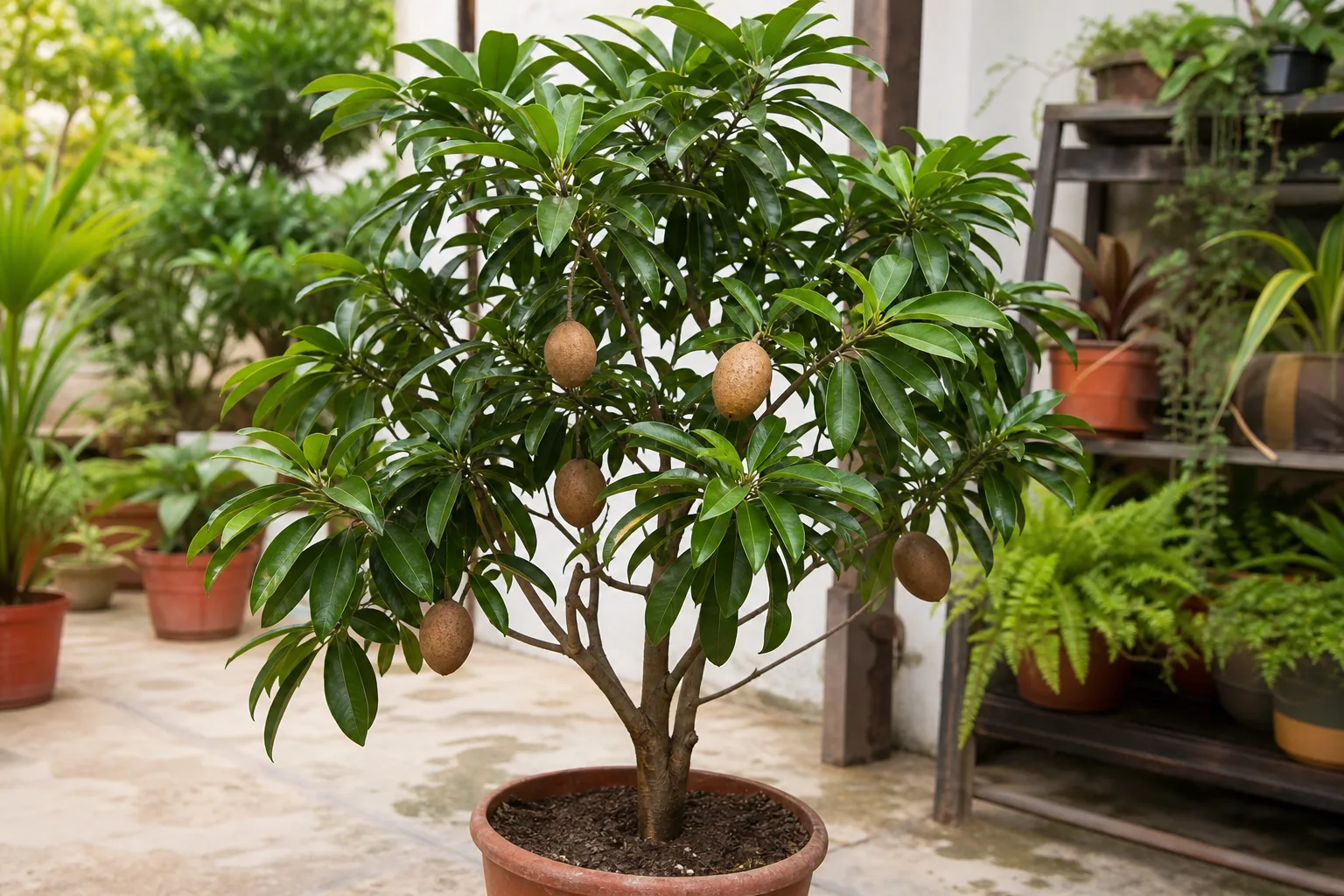
How to Prune Chikoo: When, Where & What to Cut
How to Prune Chikoo: When, Where & What to Cut
First, remove one clearly dead, broken, or diseased branch with clean, sharp bypass pruners. Cut it back to healthy wood or to the branch collar without leaving a long stub. Then step back and decide whether the tree needs young-tree training, after-harvest height control, or only light thinning—those are different jobs, and shearing every green tip while flowers or fruit are set can cost you the next crop.
Reviewed by LeafyPixels Review Board · Author: sai-ananth
Quick answer
Prune Chikoo (Manilkara zapota, also called sapodilla or sapota) to keep a low, open canopy that is easy to harvest and less likely to fail in storms. Unpruned trees are long-lived evergreens that can eventually reach about 18–30 m (60–100 ft), so home growers rely on regular size control rather than letting the crown race upward (UF/IFAS Extension). For mature landscape trees, UF/IFAS recommends holding height near 12–15 ft (3.7–4.6 m) and doing most selective shaping after harvest.
Wear gloves: all parts of the tree can bleed milky latex (chicle), which gums tools and sticks to skin and clothing (UF/IFAS Miami-Dade). Fix Chikoo light and watering problems before trying to prune a weak tree into productivity.
Decide what your Chikoo needs
Walk around the tree before cutting. Separate four goals:
- Training: building a strong, branched framework on a young tree so fruit load does not snap narrow forks.
- Sanitation: removing dead, broken, rubbing, or diseased wood whenever it appears.
- Canopy management: thinning a dense interior so light and air reach inner wood.
- Size control: holding height and spread within safe harvest reach or a container outline.
UF/IFAS lists sapodilla among tropical fruits commonly maintained at about 12–15 ft when annual pruning is practiced (recommended maintenance height). Miami-Dade Extension likewise recommends keeping the tree at fifteen feet or less with annual selective pruning, removing strong verticals and favoring lateral growth (UF/IFAS Miami-Dade). Before reducing a sparse or stretched canopy, check the Chikoo overview to confirm that poor growth is not mainly a care problem.
When to prune Chikoo
Selective pruning after harvest
Make the main shaping prune after harvest, when you can control height and spread without cutting through a crop you still want. UF/IFAS places selective pruning for mature bearing trees in the cultural calendar as an after-harvest operation aimed at height and spread control (UF/IFAS Extension). Cultivar harvest windows differ—some crop for months—so identify which flush of fruit just finished rather than pruning by calendar month alone.
Flowers form in leaf axils near the tips of shoots, so tip-cutting every green terminal while the tree is flowering or holding young fruit can remove the next crop. Prefer selective thinning and height reduction once fruit is off, then let warm growth rebuild leafy terminals.
Cuts that should not wait
Remove a snapped limb, dead stub, or clearly diseased wood promptly. Sanitation is not the same as shortening healthy fruiting shoots. During prolonged wet weather, make only necessary disease-removal cuts, disinfect tools, and prefer a drier spell when opening many wounds.
Delay non-urgent structural pruning when:
- the tree was recently transplanted or repotted;
- young roots are still establishing and foliage is soft from relocation;
- the canopy is already sparse from drought, waterlogging, or cold damage;
- you still need the current flower set or immature fruit on those same terminals.
What to check before cutting
Before the first structural cut, check four things:
- Shoot tips and flower clusters: Chikoo flowers near branch tips; decide whether a tip cut is training wood or sacrificing fruit.
- Crotch angles: Narrow, V-shaped unions are weak under fruit load and should be candidates for removal during training.
- Canopy density: A very dense crown blocks light and airflow; thinning selected inner branches helps more than shearing the outer shell.
- Root and water stress: Yellowing in wet soil, stalled flushes, or recent hard drought mean delay major cuts until watering and drainage are stable.
Also note overall height relative to the 12–15 ft home target. A tree already near that outline needs maintenance tipping and thinning, not a dramatic topping cut.
Tools, latex, and handling precautions
Use sharp bypass pruners for pencil- to finger-thick shoots, loppers for larger limbs, and a pruning saw for wood beyond lopper capacity. Leave the branch collar on thinning cuts so the wound can callus cleanly (UF/IFAS tropical fruit pruning).
Wipe cutting surfaces with 70% isopropyl alcohol before you start and after diseased cuts. UF/IFAS also notes that when tools remove diseased wood, cutting surfaces should be disinfected after each cut (for example, pine-oil disinfectant diluted 1:3 with water) (tool disinfection).
Expect milky latex from cuts on leaves, stems, and bark. It can gum blades and stick to skin and clothing, so wear gloves and long sleeves, wipe tools as you go, and bag trimmings rather than leaving them where pets or children can chew them. Plants For A Future records that seeds contain hydrocyanic acid and older leaves contain a poisonous alkaloid—keep prunings, seeds, and older foliage away from pets (known hazards).
The first cut to make
Start with one sanitation cut: a clearly dead, broken, or diseased branch back to sound wood or the collar. That single cut clears hazards, shows how the latex flows on your tools, and reveals whether the remaining canopy is crowded, tall, or merely uneven.
Only after that cleanup should you tip young shoots, remove a narrow crotch, or shorten an over-tall leader. Do not begin by topping the entire crown.
How to prune Chikoo step by step
Young trees: build a strong framework
Young Chikoo needs a framework that can carry fruit without splitting. UF/IFAS training guidance for sapodilla is specific:
- If the tree is leggy and lacks lower branches, remove part of the top so lateral buds break on the lower trunk.
- When new shoots reach about 3 ft, tip them by removing 1–2 inches once or twice between spring and summer to force branching and a more compact habit.
- Remove limbs with narrow crotch angles that may break under heavy fruit loads (UF/IFAS Extension).
Favor wider-angled laterals over strong uprights. Some cultivars are naturally upright and harder to reshape; still prefer selective removal of vertical water sprouts over shearing the whole crown (UF/IFAS Miami-Dade).
General tropical fruit-tree training from UF/IFAS supports the same idea: head an unbranched young tree near about three feet to start scaffold branches, then tip laterals as they lengthen so the framework stays low and branched (young-tree training). Match that pattern to Chikoo’s slower growth—expect fewer dramatic flushes than on mango, and tip only actively elongating shoots.
Mature trees: height, light, and cleanup
As trees mature, most pruning is for height and width control plus removal of damaged wood. Keep the canopy near a maximum of about 12–15 ft (3.7–4.6 m) so picking, spraying, and future pruning stay manageable and storm risk stays lower (UF/IFAS Extension).
If the interior is too dense, remove some inner branches to improve air circulation and light penetration. Do not strip low branches unless they touch the soil—lower wood is useful and cultural work is easier on a shorter tree with a full skirt. For very large landscape specimens that threaten buildings or neighboring trees, hire a licensed arborist familiar with local fruit-tree ordinances.
Make thinning cuts back to a lateral or the collar rather than leaving stubs. Use heading (tipping) cuts only where you want new shoots to break near a node. After harvest, selectively shorten the tallest leaders and crowded uprights instead of flat-topping the whole crown.
How much you can safely remove
For routine maintenance, make selective thinning and tipping cuts and keep a substantial leafy canopy. Annual height control toward 12–15 ft is the goal, not removing half the live crown in one day.
UF/IFAS warns that improper practices such as topping can form many clustered leaders and shorten the life of the tree (UF/IFAS tree fact sheet). If a neglected Chikoo is far above the target height, stage reductions over successive seasons rather than converting the crown into a brush of weak sprouts in one cut. Extreme stump-level cutbacks are a specialty “top-working” technique for regrafting, not routine home pruning (UF/IFAS Extension).
What not to cut
Avoid these cuts on Chikoo:
- Hard topping of a healthy pyramidal crown into a flat platform of stubs.
- Shearing every tip during flowering or while young fruit is set on those terminals.
- Removing low healthy branches that are not touching soil.
- Flush cuts that remove the branch collar.
- Stacking a hard canopy reduction with major root pruning or repotting on the same day.
- Propagating from soft, diseased, or pest-coated shoots without checking the propagation guide first.
Pruning cannot fix chronic shade, waterlogged soil, or a timer-driven irrigation schedule that keeps mature roots wet. Correct those first.
Aftercare and recovery
Return the tree to full sun rather than moving a newly thinned canopy into a darker corner and expecting compact regrowth. Water from the soil check, not because pruning occurred: soak when the upper root zone reaches the threshold in the Chikoo watering guide, and do not keep mature roots constantly wet to “force” new shoots.
Do not add a heavy fertilizer dose immediately after cutting. If the tree is healthy and entering active growth, resume its normal Chikoo fertilizer program rather than trying to compensate for lost canopy.
Useful recovery signs are firm bud swell below heading cuts, new laterals that stay angled rather than weakly upright, stable remaining foliage, and terminals that rebuild in full light. Slow response is normal on this long-lived, slow-growing species—judge success over the next flush, not overnight.
Mistakes to avoid
- Topping instead of selective height control, then fighting a thicket of clustered leaders.
- Tip-cutting flowering terminals and wondering why fruit set dropped.
- Ignoring latex until tools seize and skin is coated—wear gloves from the first cut.
- Cutting low productive wood for a “lollipop” look.
- Pruning a stressed, overwatered, or recently moved tree as if shaping alone will restore vigor.
- Leaving long stubs or removing the branch collar on large cuts.
Related Chikoo guides
- Chikoo overview — growth habit, fruiting, and latex cautions.
- Chikoo light — full-sun needs for sturdy shoots and fruiting.
- Chikoo watering — moisture checks before and after pruning.
- Chikoo soil — drainage support for container and garden trees.
- Chikoo fertilizer — feeding during active growth, not as a post-cut fix.
- Chikoo repotting — when root work should be staged separately.
- Chikoo propagation — use only healthy wood if you reuse cuttings.
Conclusion
Good Chikoo pruning keeps fruit within reach while protecting a strong framework. Begin with sanitation and latex-aware PPE, tip young shoots to build branching, and use selective after-harvest cuts to hold mature trees near 12–15 ft without hard topping. For a container or terrace tree, maintain the outline in small annual steps and keep root work separate from major canopy reduction.