Chikoo Care Guide: Grow Sapodilla at Home
Manilkara zapota
Grow Chikoo in full sun, warm conditions, and freely draining soil. Learn watering, potting, size control, and seed and latex precautions for Manilkara zapota.
Chikoo Care Guide: Grow Sapodilla at Home
Start with wateringThe most common care mistake for ChikooWatering guide →Chikoo care essentials
Light
Water
Water newly planted and young Chikoo regularly while roots establish, then ease off. Mature trees are drought-tolerant; UF/IFAS notes they need irrigation mainly during prolonged dry spells from flowering through harvest, and that over-watering can cause decline.
Soil
Use a deep, freely draining mix rather than heavy, waterlogged compost. Sapodilla adapts to many soils, including light sandy and calcareous ground, but performs poorly when drainage fails. A practical container blend is 50% quality potting mix, 25% coarse sand or grit, and 25% compost or fine bark.
Humidity
Temperature
Fertilizer
About Chikoo
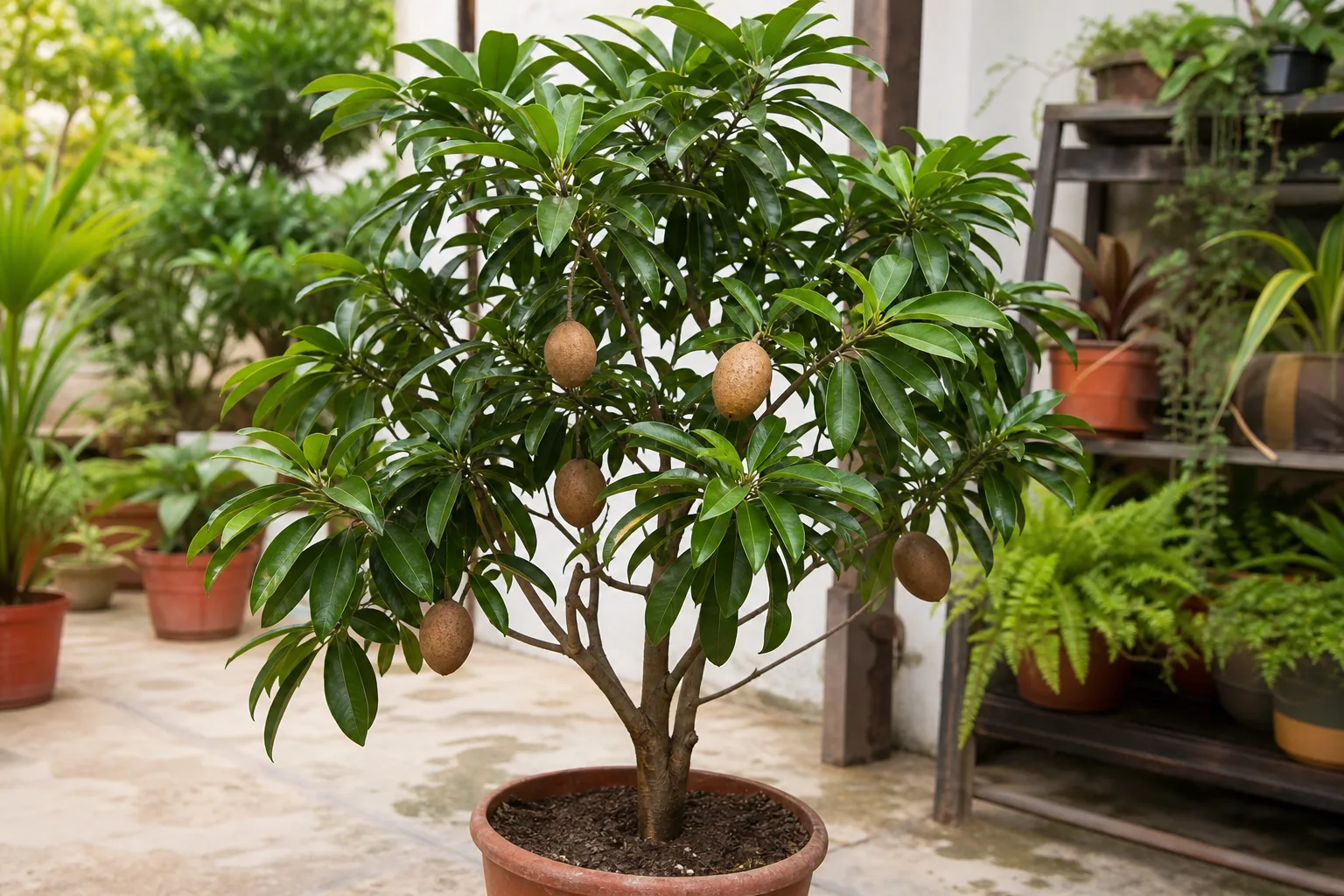
Chikoo is native to Southern Mexico (Yucatán Peninsula) and Central America; widely cultivated across India, Sri Lanka, the Caribbean, and other tropical regions, typically reaches 18–30 m (60–100 ft) tall if unpruned; home and container trees are commonly held at about 3.7–4.6 m (12–15 ft) with regular pruning indoors, with slow; long-lived evergreen that fills canopy over many years growth. Chikoo has a tree like growth habit and part of the Sapotaceae family. It is also known as Sapodilla, Sapota, Chiku, Naseberry, and Chicle.
| Detail | Information |
|---|---|
| Also known as | Sapodilla, Sapota, Chiku, Naseberry, Chicle |
| Native region | Southern Mexico (Yucatán Peninsula) and Central America; widely cultivated across India, Sri Lanka, the Caribbean, and other tropical regions |
| Mature size | 18–30 m (60–100 ft) tall if unpruned; home and container trees are commonly held at about 3.7–4.6 m (12–15 ft) with regular pruning |
| Growth rate | Slow; long-lived evergreen that fills canopy over many years |
| Growth habit | Tree Like |
| Scientific name | Manilkara zapota |
| Family | Sapotaceae |
Chikoo Care Guide: Grow Sapodilla at Home
Chikoo is a slow-growing tropical evergreen fruit tree, not a low-light windowsill plant. Manilkara zapota—also called sapodilla, sapota, or chiku—belongs to the Sapotaceae family and is native to southern Mexico and Central America, now widely planted across India and other warm regions. Care succeeds when you match the tree’s biology: full sun, warmth, freely draining roots, and watering that changes as the tree matures.
This overview gives you the whole care path in one place—identity, placement, water, soil, feeding, pots, fruiting expectations, and safety notes—then points you to deeper sibling guides when you need a single topic worked in detail.
Chikoo care at a glance
Give Chikoo full sun outdoors on a terrace, courtyard, rooftop, or garden bed that does not flood. UF/IFAS recommends planting in full sun for best growth and fruit, away from buildings and power lines. Prefer a deep, free-draining mix; the species adapts to sandy and even calcareous ground, but it declines in chronically wet soil.
Water by age, not by a fixed calendar. Newly planted and young trees need steady moisture while roots establish; mature trees are drought-tolerant and often decline when lawn timers keep the root zone wet. Feed modestly in warm active growth, prune to hold a manageable canopy, and start with a healthy grafted cultivar if earlier, more predictable fruit matters. Keep seeds, older leaves, and milky latex away from pets and children even though ripe flesh is a common human fruit.
Know the tree you are growing
Manilkara zapota is a long-lived evergreen with glossy leaves clustered toward shoot tips, small bell-shaped flowers near branch ends, and scurfy brown berries with sweet pulp when fully ripe. All parts can exude milky latex historically known as chicle. In India you will meet names like chikoo, chiku, and sapota; cultivar lists from state horticulture sources often include Kalipatti, Cricket Ball, Pala, and PKM selections.
Treat it as a tree-like fruit crop. A bright living room or a small decorative pot without drainage will not recreate the tropical, open-sky conditions this species uses for strong flushes and reliable flowering.
Growth habit and realistic size
Unpruned landscape trees grow slowly but can eventually reach about 18–30 m (60–100 ft) after many years, according to UF/IFAS Extension. That is why home growers plan space early. UF/IFAS advises holding home landscape trees near 3.7–4.6 m (12–15 ft) so harvest stays reachable and storm risk stays lower. Plants For A Future similarly describes a slow evergreen tree on the order of 18–30 m in open tropical settings.
Expect patience. Canopy fill and trunk girth build over years, not months. A grafted plant in a large container can look “stuck” while it is actually establishing roots and framework—judge progress by firm new flushes in warm weather, not by rapid height spikes.
Grafted cultivars vs seedlings
Seedlings are variable and slow to crop. UF/IFAS notes seedling trees usually begin bearing in 6–7 years or more, while grafted trees may bear in about 2–4 years. Purdue’s Morton account likewise places seedling bearing at roughly 5–8 years and emphasises vegetative propagation for consistent fruit quality. In India, TNAU describes approach grafting, often onto Manilkara hexandra (pala) rootstock, as a standard nursery method.
Buy a healthy grafted plant with a named cultivar when fruit timing and flavour matter. Avoid root-bound nursery stock, trunk wounds, scale colonies, sour-smelling mix, and tall trees jammed into undersized pots.
Light, climate, and placement
Chikoo needs unobstructed sun for most of the day. Partial shade against a wall may keep foliage alive, but fruiting and dense canopy growth suffer when neighbouring trees or buildings cast long shadows. Place the pot or planting hole in the warmest frost-free spot that still drains after heavy rain.
The species suits tropical and warm subtropical climates. UF/IFAS reports young trees may be severely damaged near 0°C to −1°C (30–32°F), while mature trees may tolerate brief dips near −3°C (26°F) for a few hours. India’s National Horticulture Board describes sapota as a tropical crop growable from sea level to about 1,200 m, preferring warm, humid conditions and coastal climates. PFAF lists USDA hardiness roughly 10–12 and notes frost tenderness on young growth.
Acclimate nursery foliage over several days before hard midday sun, and do not combine a sudden move into intense light with heavy pruning and a large root disturbance in the same week.
Watering by age and season
Watering mistakes cause more Chikoo decline than “not enough love.” Follow an age-based pattern grounded in extension guidance.
At planting, water thoroughly, then about every other day for the first week, then 1–2 times weekly for the first couple of months while the root ball settles, as UF/IFAS outlines. During prolonged dry spells, water young trees (roughly the first three years) about weekly. Once trees are about four years or older, irrigate mainly during long droughts—especially from flowering through harvest—and stop treating mature trees like thirsty annuals.
In Indian irrigated orchards, NHB guidance often spaces irrigation around 30-day intervals in winter and 15-day intervals in summer, which is a field schedule, not a pot recipe. On a hot terrace, check the top few centimetres of mix and the pot’s weight; water deeply only when that upper layer is dry, then let excess drain fully. Monsoon rain can replace irrigation for established plants; cool wet weather is when overwatering risk rises.
Yellow leaves on wet soil, a sour smell, soft dark roots, and stalled flushes point to excess water or poor aeration—the same pattern Missouri Botanical Garden describes for overwatering stress. Defoliation on a young tree in dry weather points the other way. For step-by-step checks, open the Chikoo watering guide.
Soil and drainage essentials
Sapodilla adapts to many soils—sandy, lateritic, alluvial, and highly calcareous—but it needs free drainage. UF/IFAS stresses well-drained light soils and warns that prolonged flooding reduces growth and yield even though the tree shows some short-term wet tolerance. PFAF prefers pH near 6–7 with a wider tolerance roughly 5.5–8.5. NHB lists well-drained alluvial, sandy loam, red laterite, and medium black soils as ideal for Indian plantings.
In containers, a practical blend is about 50% quality potting mix, 25% coarse sand or grit, and 25% compost or fine bark. Mulch the surface to steady moisture and suppress weeds, keeping mulch several centimetres off the trunk. Avoid sealed decorative cachepots without drainage holes. Deeper soil recipes live in the Chikoo soil guide.
Feeding without forcing growth
Chikoo is not a heavy feeder compared with many tropical fruit trees, but young plants respond to regular light nutrition during warm growth. UF/IFAS suggests starting young-tree fertiliser after new growth begins, repeating on an 8–10 week rhythm the first year, then increasing amounts as the canopy expands, with minor-element foliar sprays in the warm months. Mature trees often need only a few applications per year of a balanced mix that includes nitrogen, phosphate, and potash.
In India, orchard programmes vary by soil test and irrigation, but state guidance commonly pairs farmyard manure with measured NPK timed around monsoon and post-monsoon windows. Do not stack high-salt fertiliser onto a wet, cold, or root-bound pot. If leaves yellow while the mix stays soggy, fix drainage and watering before adding feed. Details belong in the Chikoo fertilizer guide.
Containers, pots, and size control
Large outdoor containers work when the pot is heavy enough for wind, has multiple drainage holes, and matches the root ball. Move a young tree up one size when roots circle densely, emerge from holes, or dry the pot within a day in warm weather. Prefer early spring or the start of warm active growth for repotting. Once the tree occupies its largest manageable container, refresh mix and selectively root-prune instead of chasing endless pot upsizing that stays wet.
Prune for framework early, then maintain height, light into the canopy, and damaged wood. Tip-pinch vigorous young shoots to encourage branching, remove narrow crotch angles that may split under fruit load, and open dense interiors for airflow. Pair container limits with annual height control toward roughly 3.7–4.6 m if you want harvest without ladders. Technique specifics sit in the Chikoo pruning guide.
Flowering, fruiting, and harvest basics
Small bisexual, off-white, bell-shaped flowers form near shoot tips. Fruit is a berry with a sandy brown scurf; pulp becomes soft and sweet only when fully ripe. UF/IFAS notes fruit may be picked at mature size and ripened off the tree. Immature fruit stays astringent and can hold pockets of coagulated latex. In India, NHB describes main flowering windows around October–November and February–March in many regions, with harvest roughly four months after flowering—local climate shifts those peaks.
Some cultivars are self-incompatible and need cross-pollination from another seedling or variety; others set alone but may crop better with a nearby pollen source. After a good crop, prune to hold height and reopen the canopy. For multiplying plants, use the Chikoo propagation guide rather than relying on backyard seedlings for fruit quality.
Latex, seeds, and handling precautions
Ripe Chikoo flesh is widely eaten, but that does not make every plant part casual forage. Plants For A Future records that seeds contain hydrocyanic acid and should be removed before eating the fruit, and that older leaves contain a poisonous alkaloid. All tree parts can bleed milky latex when cut. Wear gloves if sap irritates your skin when pruning, and keep seeds, older foliage, and latex away from pets and children. Seek veterinary advice after significant plant-part ingestion or any distress—this page does not give medical or veterinary advice.
Common care mistakes to avoid
The most expensive mistake is treating a mature Chikoo like a constantly irrigated lawn plant. Timed sprinklers and chronically wet pots cause decline even when leaves still look green for a while. The second is buying a seedling for quick fruit, then waiting half a decade for uneven quality. The third is planting in shade or a dim room and expecting orchard behaviour. The fourth is skipping size planning until the canopy hits wires or a balcony rail. The fifth is stacking fertiliser, hard pruning, and harsh sun exposure in one stressful week on a newly moved plant.
Correct light, drainage, and watering first. Then refine feeding, pruning, and pest checks. Sapodilla has relatively few major diseases in Florida extension guidance, but scale and other pests can appear; diagnose from roots and moisture before spraying.
When to use this page vs other Chikoo guides
Use this overview to decide whether Chikoo fits your space and to set the baseline care system. Open light when placement, shade, or sun-scorch questions dominate. Use watering when leaves yellow, the mix stays wet, or dry spells hit a young tree. Choose soil for mix recipes and drainage failures, fertilizer for feeding schedules and burn signs, repotting for pot sizing and root checks, propagation for grafting or nursery starts, and pruning for height and framework work. Return to the Chikoo plant hub for the short profile and cluster links.
Related Chikoo guides
- Chikoo light needs — full-sun placement and shade limits
- Chikoo watering — age-based irrigation and overwatering signs
- Chikoo soil — free-draining mixes and pH context
- Chikoo fertilizer — young-tree and mature feeding
- Chikoo repotting — container upsizing and root refresh
- Chikoo propagation — grafted stock and nursery methods
- Chikoo pruning — size control and canopy structure
Conclusion
Chikoo rewards growers who treat Manilkara zapota as a sun-loving tropical fruit tree with age-specific watering and stubborn drainage needs. Start with a grafted cultivar, give it open sky and a root zone that never stays swampy, water young plants steadily then ease off as the tree matures, and prune for a height you can actually manage. Keep seeds, older leaves, and latex out of reach even while you enjoy ripe fruit. When one factor is failing—light, water, soil, feed, pot, or pruning—open that sibling guide next and fix one constraint at a time.
How to care for Chikoo?
When should you water Chikoo?
Water newly planted and young Chikoo regularly while roots establish, then ease off. Mature trees are drought-tolerant; UF/IFAS notes they need irrigation mainly during prolonged dry spells from flowering through harvest, and that over-watering can cause decline.
- Feel the top 3–5 cm of mix and lift the pot - Water newly planted and young Chikoo regularly while roots establish, then ease off.
- water deeply only when that layer is dry - Water newly planted and young Chikoo regularly while roots establish, then ease off.
- then let excess drain fully - Water newly planted and young Chikoo regularly while roots establish, then ease off.
- Drain excess water - Water newly planted and young Chikoo regularly while roots establish, then ease off.
What soil works best for Chikoo?
Use a deep, freely draining mix rather than heavy, waterlogged compost. Sapodilla adapts to many soils, including light sandy and calcareous ground, but performs poorly when drainage fails. A practical container blend is 50% quality potting mix, 25% coarse sand or grit, and 25% compost or fine bark.
- 50% quality potting mix - A practical container blend is 50% quality potting mix, 25% coarse sand or grit, and 25% compost or fine bark.
- 25% coarse sand or horticultural grit - A practical container blend is 50% quality potting mix, 25% coarse sand or grit, and 25% compost or fine bark.
- 25% finished compost or fine pine bark - A practical container blend is 50% quality potting mix, 25% coarse sand or grit, and 25% compost or fine bark.
Grower notes for Chikoo
What matters most with Chikoo
Chikoo (Manilkara zapota) is a slow-growing tropical evergreen fruit tree, not a windowsill herb. Give it full sun, warmth, and a root zone that drains freely. Young trees need steady moisture; mature trees are drought-tolerant, and UF/IFAS warns that frequent over-watering can make established trees decline. Expect milky latex (chicle) from cuts on leaves, stems, and bark.
Best placement in a real home
Place Chikoo on a warm terrace, courtyard, rooftop, or frost-free garden with unobstructed sun and airflow. Unpruned trees can reach 18–30 m, so container culture needs a heavy pot, a grafted compact habit where available, and annual height control toward roughly 3.7–4.6 m. Keep the canopy clear of buildings and power lines, and protect young plants from frost near 0°C.
Before you buy this tree
Choose a healthy grafted plant with a named cultivar if earlier bearing and predictable fruit matter. Seedlings are variable and often take 6–7 years or more to fruit, while grafted trees may bear in about 2–4 years. Avoid root-bound pots, trunk wounds, scale, sour-smelling mix, and tall trees jammed into undersized containers.
First month after bringing it home
Water at planting, then keep the young root ball evenly moist without leaving the pot soggy. Quarantine, learn how fast the mix dries, and acclimate nursery foliage to intense sun over several days before hard pruning or heavy fertiliser. Do not stack a large root disturbance, hard cutback, and a sudden move into harsh midday sun in the same week.
Seeds, latex, and older leaves need caution
Ripe Chikoo flesh is a common human fruit, but Plants For A Future records that seeds contain hydrocyanic acid and should be removed before eating, and that older leaves contain a poisonous alkaloid. All tree parts exude milky latex. Keep seeds, older foliage, and latex away from pets and children, and wear gloves when pruning if sap irritates your skin.
How Chikoo flowers and fruits
Small bell-shaped flowers form near shoot tips; fruit is a scurfy brown berry with sweet pulp when fully ripe. Some cultivars need cross-pollination or set better with another tree nearby. Pick mature fruit and ripen off the tree—immature fruit may stay astringent and can hold pockets of coagulated latex. After harvest, prune to hold height and open the canopy.
Is Chikoo safe for pets?
Ripe Chikoo flesh is a common human food, but this does not make the whole tree pet-safe. Keep pets away from seeds (hydrocyanic acid risk), older leaves (alkaloid risk), milky latex, and treated potting mix.
Manilkara zapota does not have a species-specific ASPCA toxic/non-toxic plant listing cited for this hub. Plants For A Future notes that seeds contain hydrocyanic acid and should be removed before eating the fruit, and that older leaves contain a poisonous alkaloid. Do not classify the whole tree from the edibility of ripe flesh. Seek veterinary advice after significant plant-part ingestion or any distress.
Watering Chikoo
For Chikoo, feel the top 3–5 cm of mix and lift the pot; water deeply only when that layer is dry, then let excess drain fully and water water new plantings every other day for the first week, then 1–2 times weekly for the first couple of months; young trees about weekly in dry weather; mature trees only during long droughts. Keep young trees moist through hot dry months; rely on monsoon rain once established; avoid frequent irrigation of mature trees in cool or wet weather.
| Detail | Information |
|---|---|
| How often | Water new plantings every other day for the first week, then 1–2 times weekly for the first couple of months; young trees about weekly in dry weather; mature trees only during long droughts |
| How to check | Feel the top 3–5 cm of mix and lift the pot; water deeply only when that layer is dry, then let excess drain fully |
| Seasonal changes | Keep young trees moist through hot dry months; rely on monsoon rain once established; avoid frequent irrigation of mature trees in cool or wet weather |
Signs of overwatering
- yellowing leaves while the mix stays wet
- sour soil smell or soft dark roots
- stalled flushes and unthrifty canopy
- decline of mature trees under frequent timed irrigation
Signs of underwatering
- defoliation or decline on young trees in dry spells
- limp leaves and dry brown margins
- aborted new flushes
- reduced fruit set during prolonged drought at flowering
Soil & potting for Chikoo
Use a mix of 50% quality potting mix, 25% coarse sand or horticultural grit, 25% finished compost or fine pine bark for Chikoo. Free drainage is essential; mature trees tolerate brief wet spells but decline in chronically saturated pots or low spots. Target soil pH around 5.5–8.5 (prefer about 6.0–7.0). Repot every 1–2 years while young; once in a large final container, refresh mix and root-prune every 2–3 years rather than upsizing endlessly, ideally in early spring or the start of warm active growth.
| Detail | Information |
|---|---|
| Recommended mix | 50% quality potting mix, 25% coarse sand or horticultural grit, 25% finished compost or fine pine bark |
| Drainage | Free drainage is essential; mature trees tolerate brief wet spells but decline in chronically saturated pots or low spots |
| Soil pH | 5.5–8.5 (prefer about 6.0–7.0) |
| Repotting frequency | Every 1–2 years while young; once in a large final container, refresh mix and root-prune every 2–3 years rather than upsizing endlessly |
| Best season to repot | Early spring or the start of warm active growth |
Signs it needs repotting
- roots circling densely or emerging from drainage holes
- pot drying within a day in warm weather
- tree becoming top-heavy or unstable
- growth stalling despite full sun and sensible feeding
Humidity & temperature for Chikoo
Fertilizer & pruning for Chikoo
Common problems on Chikoo
Yellow Leaves
MediumLikely cause: Common on this plant type; confirm with recent watering, light, and root checks.
Quick fix: Inspect the plant and correct the most likely care stressor before stacking treatments.
Full fix guide →Brown Tips
MediumLikely cause: Common on this plant type; confirm with recent watering, light, and root checks.
Quick fix: Inspect the plant and correct the most likely care stressor before stacking treatments.
Full fix guide →Root Rot
MediumLikely cause: Common on this plant type; confirm with recent watering, light, and root checks.
Quick fix: Inspect the plant and correct the most likely care stressor before stacking treatments.
Full fix guide →Overwatering
MediumLikely cause: Common on this plant type; confirm with recent watering, light, and root checks.
Quick fix: Inspect the plant and correct the most likely care stressor before stacking treatments.
Full fix guide →Underwatering
MediumLikely cause: Common on this plant type; confirm with recent watering, light, and root checks.
Quick fix: Inspect the plant and correct the most likely care stressor before stacking treatments.
Full fix guide →Spider Mites
MediumLikely cause: Common on this plant type; confirm with recent watering, light, and root checks.
Quick fix: Inspect the plant and correct the most likely care stressor before stacking treatments.
Full fix guide →Mealybugs
MediumLikely cause: Common on this plant type; confirm with recent watering, light, and root checks.
Quick fix: Inspect the plant and correct the most likely care stressor before stacking treatments.
Full fix guide →Aphids
MediumLikely cause: Common on this plant type; confirm with recent watering, light, and root checks.
Quick fix: Inspect the plant and correct the most likely care stressor before stacking treatments.
Full fix guide →Leggy Growth
MediumLikely cause: Common on this plant type; confirm with recent watering, light, and root checks.
Quick fix: Inspect the plant and correct the most likely care stressor before stacking treatments.
Full fix guide →Slow Growth
MediumLikely cause: Common on this plant type; confirm with recent watering, light, and root checks.
Quick fix: Inspect the plant and correct the most likely care stressor before stacking treatments.
Full fix guide →Wilting
MediumLikely cause: Common on this plant type; confirm with recent watering, light, and root checks.
Quick fix: Inspect the plant and correct the most likely care stressor before stacking treatments.
Full fix guide →Drooping Leaves
MediumLikely cause: Common on this plant type; confirm with recent watering, light, and root checks.
Quick fix: Inspect the plant and correct the most likely care stressor before stacking treatments.
Full fix guide →Low Humidity
MediumLikely cause: Common on this plant type; confirm with recent watering, light, and root checks.
Quick fix: Inspect the plant and correct the most likely care stressor before stacking treatments.
Full fix guide →Not Enough Light
MediumLikely cause: Common on this plant type; confirm with recent watering, light, and root checks.
Quick fix: Inspect the plant and correct the most likely care stressor before stacking treatments.
Full fix guide →Fungus Gnats
MediumLikely cause: Common on this plant type; confirm with recent watering, light, and root checks.
Quick fix: Inspect the plant and correct the most likely care stressor before stacking treatments.
Full fix guide →Mold on Soil
MediumLikely cause: Common on this plant type; confirm with recent watering, light, and root checks.
Quick fix: Inspect the plant and correct the most likely care stressor before stacking treatments.
Full fix guide →