Chikoo Watering: Schedule, Dry Checks & Mistakes
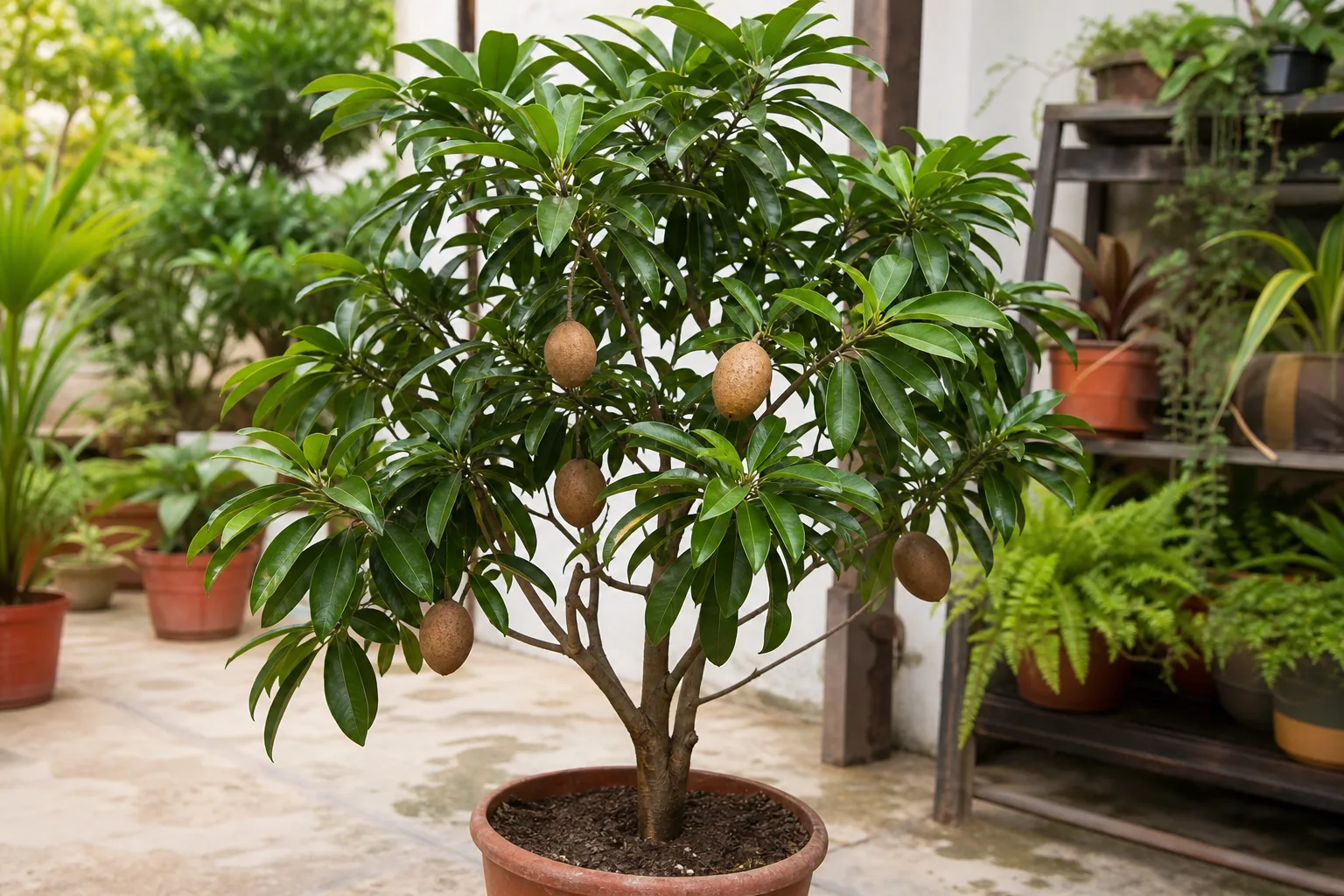
Chikoo Watering: Schedule, Dry Checks & Mistakes
Chikoo Watering: Schedule, Dry Checks & Mistakes
Chikoo watering is not a fixed weekly ritual. Manilkara zapota—also called sapodilla, sapota, or chiku—is a long-lived tropical evergreen fruit tree that stores resilience in a deep root system once it is established. Young plants need steady moisture while roots expand. Mature trees are drought-tolerant and often decline when lawn timers or daily saucers keep the root zone wet. UF/IFAS Extension is blunt about that split: irrigate new plantings on a short schedule, water young trees during dry spells, and treat frequent watering of established trees as a risk, not a kindness.
This guide covers age-based schedules, how to test dryness in ground and pots, monsoon and summer adjustments for India-style climates, overwatering versus drought signs, and the first move when you are unsure. Pair it with the Chikoo care overview for sun, size, and placement context, and use Chikoo soil needs when drainage—not just frequency—is the real problem.
How Chikoo watering differs by tree age
Treat watering as a function of root volume and establishment, not of how thirsty the canopy looks on a hot afternoon. A nursery graft in a 30 cm pot and a 10-year landscape tree are the same species with opposite moisture risk profiles.
Newly planted and young trees
Water at planting so the backfill settles against the root ball without air pockets. UF/IFAS recommends watering every other day for about the first week, then 1–2 times weekly for the first couple of months. During prolonged dry spells—roughly five or more days with little rain—newly planted and young trees in their first three years should still receive about one deep watering per week. TNAU gives a similar establishment pattern for grafts: irrigate thoroughly after planting, again on the third day, then about once every 10 days until the plant settles.
Young sapodillas can defoliate or decline when the root zone stays dry for too long, which is why periodic dry-season irrigation matters while canopy and roots are still shallow. Once monsoon rains return, cut back or pause supplemental water so the mix can breathe.
Mature landscape and orchard trees
After about four years, watering helps mainly during very prolonged dry periods, especially from flowering through harvest when fruit load and quality respond to moisture. UF/IFAS notes that well-established home trees often produce satisfactorily without regular watering, and that over-watering can make mature trees decline or look unthrifty. Julia Morton’s Purdue NewCROP sapodilla profile agrees: most mature trees receive no watering, yet dry-season irrigation can raise productivity—and good drainage is essential because trees bear poorly in low, wet ground.
India’s National Horticulture Board lists commercial orchard intervals of about 30 days in winter and 15 days in summer, with drip systems often preferred for efficiency. Use those figures as orchard context, not as a terrace-pot calendar. Home containers dry faster than field soil; landscape trees on heavy clay hold water longer than sandy beds.
Why Manilkara zapota hates chronically wet feet
Chikoo evolved as a drought-tolerant tropical tree that still prefers freely draining ground. Plants For A Future lists it as suited to dry or moist, well-drained soils and able to tolerate drought, with a preferred rainfall band around 1,000–1,500 mm and tolerance outside that range. That biology does not mean it thrives in a constantly saturated pot.
When soil stays waterlogged, roots cannot absorb oxygen, tissue dies, and rot organisms move in. Missouri Botanical Garden describes the familiar pattern: stunted growth, yellowing leaves, and roots that smell sour or rotten. On Chikoo, the same physiology shows up as a stalled canopy that people often “fix” with another drink.
Morton also stresses that sapodilla approaches date palm levels of salinity tolerance in some soils, but still bears poorly in low, wet locations. Free drainage is non-negotiable whether you grow in a courtyard bed or a large terrace pot.
How often to water Chikoo in India climates
There is no honest universal “every Tuesday” answer. Start from age, then adjust for pot size, mix texture, sun exposure, and whether monsoon rain already fills the root zone.
For a young container tree in hot, dry weather with full sun, expect to water more often than an in-ground tree of the same age because pots heat and dry faster. Still water deeply, then wait for the top several centimetres to dry—do not dribble daily. For a mature in-ground tree, skip routine irrigation during monsoon and cool, humid weeks; save deep soaks for long dry stretches, especially while flowers and fruit are developing.
Monsoon, summer dry spells, and cooler months
In monsoon months, rely on rainfall once the tree is established. Supplemental irrigation during weeks of cloud and rain is one of the fastest ways to create anaerobic pots and soggy tree wells. In peak summer dry spells, keep young trees on a weekly deep cycle if rain fails, and give mature trees occasional deep soaks only when leaf drop, aborted flushes, or prolonged soil dryness appear. In cooler months, growth slows and pots stay wet longer—lengthen the dry-down interval and never water because the calendar says so.
If you use drip for orchard or high-density plantings, NHB notes drip can save substantial water versus flood irrigation. For home growers, the useful takeaway is the same: wet the root zone thoroughly, then stop until dryness checks pass.
How to check dryness before you water
Surface colour lies. A pale crust can sit over damp roots, especially in peat-heavy mixes. Before every irrigation:
Finger test: Push into the top 3–5 cm of mix. If it feels cool or clings, wait. Bone dry at that depth is your cue in containers; in ground, probe a little deeper near the drip line for young trees.
Pot weight: Lift after a full soak and again each day. A light pot usually means the whole column has dried; a still-heavy pot means moisture remains even if the surface looks dusty.
Wooden skewer: Push a clean stick toward the bottom of a pot. Darkening or soil stuck to the wood means wait.
Tree-well feel: For landscape trees, dig a small probe hole away from the trunk under the canopy edge. Water only when that zone has dried meaningfully—not when lawn turf still feels damp.
Never water a Chikoo that is sitting in a saucer of old runoff. Empty catch trays after each soak.
Container and terrace watering for Chikoo
Terrace and rooftop Chikoo live in a different microclimate than orchard trees. Heat radiating from floors and walls accelerates drying, but oversized decorative pots without drainage create the opposite problem: a cold, wet core that never recovers between “calendar” waterings.
Choose a heavy pot with open drainage holes and a freely draining mix (see Chikoo soil). Water until liquid runs freely from the holes, then discard the runoff. In peak heat, a young pot-grown tree may need water more than once a week once the top layer is dry; a large, mature container specimen may still prefer longer gaps if the mix stays cool and heavy. If the pot dries within a day in warm weather, the plant may be root-bound—check Chikoo repotting before you simply water more often into a clogged root ball.
Full sun drives both fruiting and water use. Weak light slows growth and keeps mix wet longer, so watering mistakes often start with placement—confirm Chikoo light needs if the canopy looks soft and the soil never dries.
Signs you are overwatering Chikoo
Overwatering on Chikoo looks like a plant that is “thirsty” while the soil stays wet. Watch for yellowing leaves while the mix remains cool and dark, a sour or rotten smell from the root zone, soft dark roots, stalled flushes, and a generally unthrifty canopy despite frequent drinks. Mature trees under frequent irrigation can decline without dramatic overnight collapse—growth simply goes flat and foliage looks dull.
If several of those signs appear together, stop watering. Do not “perk it up” with another soak. Improve airflow around the pot, confirm drainage holes are open, and let the mix dry to a safer depth before the next deep irrigation. Chronic saturation is also when fertiliser salts and root pathogens pile on—hold heavy feeding until roots recover (see Chikoo fertilizer).
Root decline under timed lawn sprinklers
UF/IFAS specifically warns that lawn sprinkler systems on a timer can over-water sapodilla and lead to root rot, because too much water applied too often keeps the root zone anaerobic. If your Chikoo sits inside a turf irrigation zone, redirect heads, build a dry buffer, or switch that station off after monsoon. Mulching helps retain useful moisture without daily shallow wetting, but keep mulch 8–12 inches (20–30 cm) off the trunk and use a 2–6 inch (5–15 cm) layer of bark or wood chips as UF/IFAS suggests.
Signs your Chikoo needs water
Underwatering is most dangerous on young trees during dry spells. Look for limp leaves, dry brown margins, aborted new flushes, and—on severe drought—defoliation. During flowering and fruit set, prolonged drought can reduce fruit set even on older trees.
A dry Chikoo usually recovers from a single deep soak if roots are still firm. Rehydrate thoroughly, drain fully, then return to dryness checks. Do not compensate with daily sips; that swings the root zone from drought to oxygen starvation within a week.
If leaves are limp and the mix is wet, you are not underwatered—you are overwatered. The fix is opposite: dry down, inspect drainage, and only then resume careful watering.
Mulch, drainage, and soil partners
Watering fails when the medium cannot drain. Sapodilla adapts to sandy and even highly calcareous soils, but it will not thrive in chronically waterlogged ground. Refresh compacted container mixes, avoid sealed cachepots, and plant in-ground trees on a slight mound where the water table sits high—UF/IFAS recommends raised planting in low, flood-prone sites.
Mulch conserves moisture for young trees without daily irrigation, suppresses weeds that compete for water, and buffers surface heat on terraces. Keep it off the trunk flare so bark stays dry. When the mix itself is wrong—dense, peat-locked, or undrained—fix soil structure before you invent a new watering schedule.
When to use this page vs other Chikoo guides
Use this watering page when you need schedules, dryness checks, seasonal adjustments, or over/underwatering diagnosis for Manilkara zapota.
Use the Chikoo overview for species identity, mature size, and first-month setup. Use light when weak growth tracks shade more than moisture. Use soil when drainage and mix texture are the bottleneck. Use repotting when pots dry in a day or stay wet because roots are circling. Use fertilizer only after watering and drainage are stable. Use pruning for canopy height and airflow that also help the root zone dry after rain.
First actions when you are unsure
- Identify age and site: young pot vs mature ground tree change the default risk.
- Check the root zone, not the calendar: finger, weight, or probe before any drink.
- If wet and yellowing: stop water, clear drainage, empty saucers, wait for dry-down.
- If dry and wilting on a young tree: give one deep soak, then resume checks.
- If a lawn timer hits the tree: interrupt that cycle before you add more hand watering.
When in doubt on an established Chikoo, choose slightly too dry over slightly too wet. The species is built for dry intervals; it is not built for perpetual moisture.
Related Chikoo guides
- Chikoo care overview — sun, size, and whole-plant setup
- Chikoo light needs — full sun placement that drives water use
- Chikoo soil — free-draining mixes that make watering safer
- Chikoo repotting — when pots dry too fast or stay soggy
- Chikoo fertilizer — feeding after moisture is under control
- Chikoo pruning — canopy management for airflow and harvest height
- Chikoo hub — cluster entry point
Conclusion
Water Chikoo by age and dryness, not by habit. Keep newly planted and young trees evenly moist through establishment and dry spells; let mature trees ride on rainfall except during long droughts from flowering to harvest. Always soak deeply, drain fully, and wait for the top root zone to dry. Fix timer sprinklers, sealed pots, and waterlogged mixes before you blame the cultivar. Get those rhythms right and Manilkara zapota rewards you with a stable canopy—and fewer yellow-leaf mysteries that started with one watering too many.