Chikoo Light Needs: Full Sun, Terrace & Warning Signs
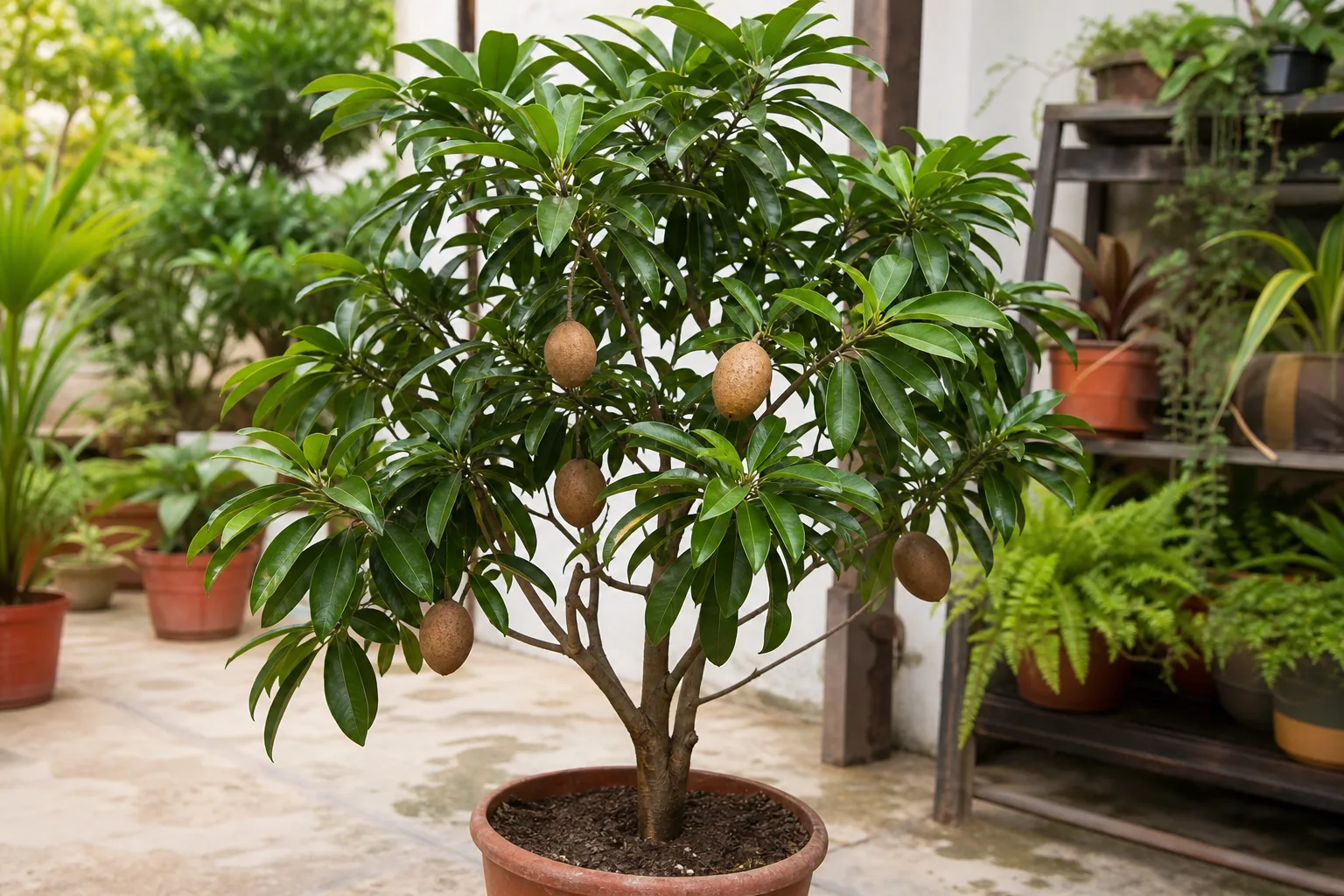
Chikoo Light Needs: Full Sun, Terrace & Warning Signs
Chikoo Light Needs: Full Sun, Terrace & Warning Signs
A chikoo seedling can stay green in a bright room, but that does not make Manilkara zapota a low-light houseplant. Chikoo—also called sapodilla, sapota, or chiku—is a slow-growing tropical evergreen fruit tree. Firm flushes, a compact canopy, flowering, and useful fruit all depend on unobstructed full sun, not the soft ambient brightness that keeps foliage houseplants alive.
In most Indian homes and other warm climates, the useful question is not “Is this corner bright?” It is “Can the canopy see open sky for most of the day?” For an in-ground tree, choose the sunniest frost-free site from the start. For a grafted tree in a large pot, prioritize a terrace, rooftop, or courtyard with clear sky exposure, then manage pot heat and watering rather than solving heat by parking the canopy in permanent shade.
This guide covers how much sun Chikoo needs, honest shade and indoor limits, terrace placement, acclimation after a nursery move, grow-light use for young plants, and the warning signs that tell you to move the tree before weak growth becomes a long stall.
How much light Chikoo actually needs
Give Chikoo full sun for best growth and fruit production—ideally at least 6–8 hours of direct sun on most clear days, with longer open exposure preferred for flowering and crop set. UF/IFAS states that sapodilla trees should be planted in full sun for best growth and fruit production, and that trees planted too close to other trees or structures may not grow normally or produce much fruit due to shading.
Count sun that actually reaches the leaves. A deep roof overhang, neighboring tower, dense shade net, or larger mango or neem canopy can cut usable hours even when the paving feels hot. Walk the site at mid-morning, noon, and mid-afternoon before you commit to a permanent hole or a heavy container you will not want to drag later.
For placement priority, rank options like this: open garden or orchard sun; open terrace or rooftop with a wide sky view; a sunny courtyard with reflected light from light walls; a large sun-facing window only as temporary holding for a young plant; a strong grow light only to bridge short indoor stretches. Ceiling lamps and north-facing rooms are survival spaces, not fruiting setups.
Full sun versus bright shade on a fruit tree
“Bright shade” under a pergola or beside a taller tree can look generous to human eyes and still starve a fruit canopy. Chikoo leaves are stiff and clustered toward shoot tips; they are built to harvest strong tropical light, not to scrape by in forest understory conditions. Plants For A Future records that the species cannot grow in the shade and grows best in full sun.
Partial morning sun with afternoon shade may keep a young plant alive through a hot summer, especially while you acclimate it. Treat that as a temporary compromise, not the long-term plan if you want reliable fruit. Shade also slows the drying of container mix, which can push you toward overwatering problems that look like “mystery yellowing” until you check light and drainage together. Pair light placement with the Chikoo watering guide when growth stalls in a dim corner.
Why Manilkara zapota is not a shade plant
Chikoo belongs to the Sapotaceae family and evolved as a canopy tree in tropical lowlands, not as a dim-room foliage shrub. UF/IFAS describes sapodilla as a medium to large, long-lived tree with a pyramidal to rounded crown that can eventually reach 60–100 feet (about 18–30 m) if left unpruned, originating in Mexico’s Yucatán Peninsula and Central America and widely grown across India and other tropical regions. (UF/IFAS sapodilla guide)
That biology matters for light. A tree that builds wood, latex-bearing shoots, and a fruiting canopy needs a high daily light integral. Shade stretches internodes, thins the canopy, and reduces flowering sites near shoot tips. Calling chikoo “hardy” because mature trees tolerate drought or wind does not mean it thrives without sun. Drought tolerance and shade tolerance are different traits.
Native habitat and canopy habit
In native and commercial tropical settings, sapodilla prefers moist hot climates at low to medium elevations and performs as an open-grown fruit tree rather than an understory specialty. PFAF notes a preference for a moist hot climate and states it grows best in full sun. Leaves emerge pinkish and mature to light then dark green, clustered at shoot ends—habit that works when each flush hardens in strong light.
Home growers in India often hold trees much smaller than landscape giants by choosing grafted cultivars and annual height control. UF/IFAS Miami-Dade Extension recommends keeping home trees at about fifteen feet or less through selective pruning so harvest and structure stay manageable. (UF/IFAS Miami-Dade) Opening a dense interior for air and light is part of that management, but pruning cannot invent sun that a building or shade tree permanently blocks. Use the Chikoo pruning guide for canopy work after you fix the site.
Best outdoor placement in India and warm climates
In India and similar tropical or warm subtropical climates, place Chikoo where mid-day light is not stolen by taller structures. South, southeast, and southwest exposures are often useful in the Northern Hemisphere, but compass labels matter less than clear-sky hours. A rooftop with open sky can outperform a “south” balcony that sits under a deep slab overhang.
Choose the warmest frost-free pocket that still drains. UF/IFAS advises selecting the warmest area of the landscape that does not flood after typical summer rains, and planting away from other trees, buildings, structures, and power lines because unmanaged trees become very large. (UF/IFAS site selection) Young trees can be damaged near freezing; do not trade away sun by hiding a young plant against a cold north wall unless you are only staging it for a few weeks.
Terrace, rooftop, and courtyard placement
Containers make light adjustable, which is why many urban growers keep grafted chikoo on terraces. Put the pot where the canopy receives direct sun for most of the day. Light-colored walls can bounce useful brightness onto lower leaves, but they do not replace overhead sun for fruiting.
Watch root-zone heat. On a west-facing rooftop in Ahmedabad, Hyderabad, or Chennai, black plastic pots on concrete can cook roots while leaves still want full sun. Shade the pot wall with a light sleeve or double pot, raise the container for drainage, and check moisture more often in peak heat. Do not solve a hot root zone by permanently shading the canopy. Match mix and pot choice to the Chikoo soil guide and repotting guide so a free-draining root zone can handle full sun without staying soggy.
Spacing so buildings and trees do not steal sun
UF/IFAS recommends planting sapodilla 25 feet (7.6 m) or more from the nearest tree or structure in the home landscape, noting that trees planted too close may not grow normally or produce much fruit due to shading. (UF/IFAS spacing) Even a slow grower eventually casts and receives shade; plan the mature footprint, not only the nursery pot diameter.
If your only ground pocket sits between a compound wall and a mature shade tree, a large container in a sunnier paved area often outperforms a permanent shaded planting. Leave room to walk around the canopy so you can prune for light penetration without fighting neighboring branches.
Can Chikoo grow indoors or by a window?
A young Chikoo can produce foliage indoors for a while beside a large, unobstructed sun-facing window, especially east or south exposures with several hours of direct beams. A normal room rarely supplies enough intensity or canopy space for a productive adult tree. Glass cuts and redirects outdoor light, and intensity falls quickly as you move the pot even a meter back from the pane.
University of Georgia Extension notes that an open sunny outdoor site can reach around 10,000 foot-candles, which helps explain the gap between full outdoor sun and an interior that merely “looks bright.” Treat indoor placement as nursery staging, winter protection, or a short quarantine—not the default fruiting plan. Move the container outdoors during reliably warm weather whenever you can, and return it gradually so leaves do not scorch.
If your only space is a dim apartment with no terrace access, choose a different plant. Chikoo is a poor fit for perpetual low light, and the Chikoo overview explains the whole-plant fit before you invest years in the wrong site.
Direct sun, heat, and leaf scorch on young trees
Mature, sun-hardened Chikoo foliage handles tropical sun well. Problems appear when intensity jumps faster than the plant can adjust—especially after weeks under nursery shade cloth or indoor glass. Sudden all-day west exposure in peak summer can bleach outer leaves, crisp margins, or leave dry scorched patches on the sun-facing side while shaded leaves stay green.
Scorch is permanent on damaged tissue; new flushes must grow under better management. Heat stress on black pots can look similar if roots cook, so check both leaf exposure and pot temperature. Do not confuse sunburn with the yellowing that comes from chronically wet mix in low light—those need different first actions.
Acclimating nursery plants to hard sun
Move shade-grown plants into stronger light over 7–14 days. Start with morning sun and bright open shade, then add mid-day hours, then full afternoon exposure if the site requires it. Avoid stacking a hard root disturbance, heavy pruning, and a sudden jump into harsh sun in the same week.
Water carefully during acclimation: brighter light dries mix faster, but flooding a pot “to help with stress” can smother roots. Keep the newest flush as your scorecard. If new leaves emerge firm and correctly colored without bleached patches, increase exposure. If soft tissue browns within a day of a move, pull back one step and slow down.
Grow lights for seedlings and cold-weather protection
Use a grow light when cold weather or temporary indoor holding would otherwise leave a seedling or young graft in weak window light. Oklahoma State Extension notes that artificial lighting can help where natural light is limited for indoor plants—useful context for a young chikoo in a room, not a substitute for outdoor sun on a fruiting tree.
Choose a full-spectrum LED panel, hang it so foliage sits within the manufacturer’s recommended distance (often roughly 30–60 cm depending on wattage), and run it about 12–14 hours daily on a timer. Keep air moving so leaf surfaces do not cook under a close fixture. Return the plant outdoors gradually when nights stay safely warm. A decorative desk lamp will not drive meaningful growth on Manilkara zapota.
Warning signs of too little or too much light
Too little light usually shows as slow or stalled flushes, longer gaps between leaves, a thin open canopy, leaning hard toward the brightest window, and poor flowering or fruit set even when watering and feeding look reasonable. UF/IFAS links shading from nearby trees or structures to weaker growth and reduced fruit. Soil that stays wet for many days after watering is a related clue outdoors in shade or indoors far from glass.
Too much sudden light or heat shows as bleached or crisp patches on sun-facing leaves within days of a move, leaf surfaces that feel hot at mid-day, and stress on plants still adapted to shade cloth. Old scars do not heal; judge recovery by the next flush after you adjust placement.
First action when unsure: move the plant to unobstructed morning sun plus bright day light for a week, correct watering to match the faster dry-down, and delay fertilizer until new growth looks steady. Then decide whether the permanent site needs more sky, a taller stake and rotation for even light, or canopy thinning via pruning.
When to use this page vs other Chikoo guides
Use this page when your question is about sun hours, terrace direction, indoor limits, scorch, shade, or grow lights. Switch guides when the main problem is wet or dry roots, mix choice, feeding, pot size, or cutting method.
- Start with the Chikoo plant hub for size, climate fit, and toxicity notes.
- Use the overview for whole-plant care context.
- Use watering when yellowing tracks wet mix or drought, especially after a light change.
- Use soil and repotting when drainage or pot heat undermines a sunny placement.
- Use fertilizer only after light and drainage are sane.
- Use pruning to open a dense canopy for light penetration once the site itself is bright enough.
- Use propagation when you are raising young plants that need strong light after grafting or seed start.
Related Chikoo guides
- Chikoo overview — identity, climate, and care map
- Chikoo watering — dry-down timing that changes with sun exposure
- Chikoo soil — free-draining mixes for sunny containers
- Chikoo fertilizer — feeding once light supports active growth
- Chikoo repotting — pot size and root refresh for terrace trees
- Chikoo pruning — height control and interior light
- Chikoo propagation — aftercare light for young plants
Conclusion
Chikoo is a full-sun tropical fruit tree. Give Manilkara zapota unobstructed outdoor light for firm growth and a realistic chance of fruit, keep terrace and rooftop pots in open sky while protecting roots from heat, and treat indoor windows and grow lights as bridges—not permanent shade homes. Acclimate nursery foliage before hard mid-day sun, watch new flushes for shade stretch or scorch, and fix the site before you stack fertilizer or hard pruning on a light problem.