Root Rot on Dracaena Reflexa: Causes, Checks & Fixes
Quick answer
Root rot on Dracaena Reflexa follows chronic wet mix—especially calendar watering in dim corners on peat-heavy soil. First step: stop all watering and unpot to inspect roots before repotting; firm stems above mushy roots can recover after trim, air-dry, and downsized repot.
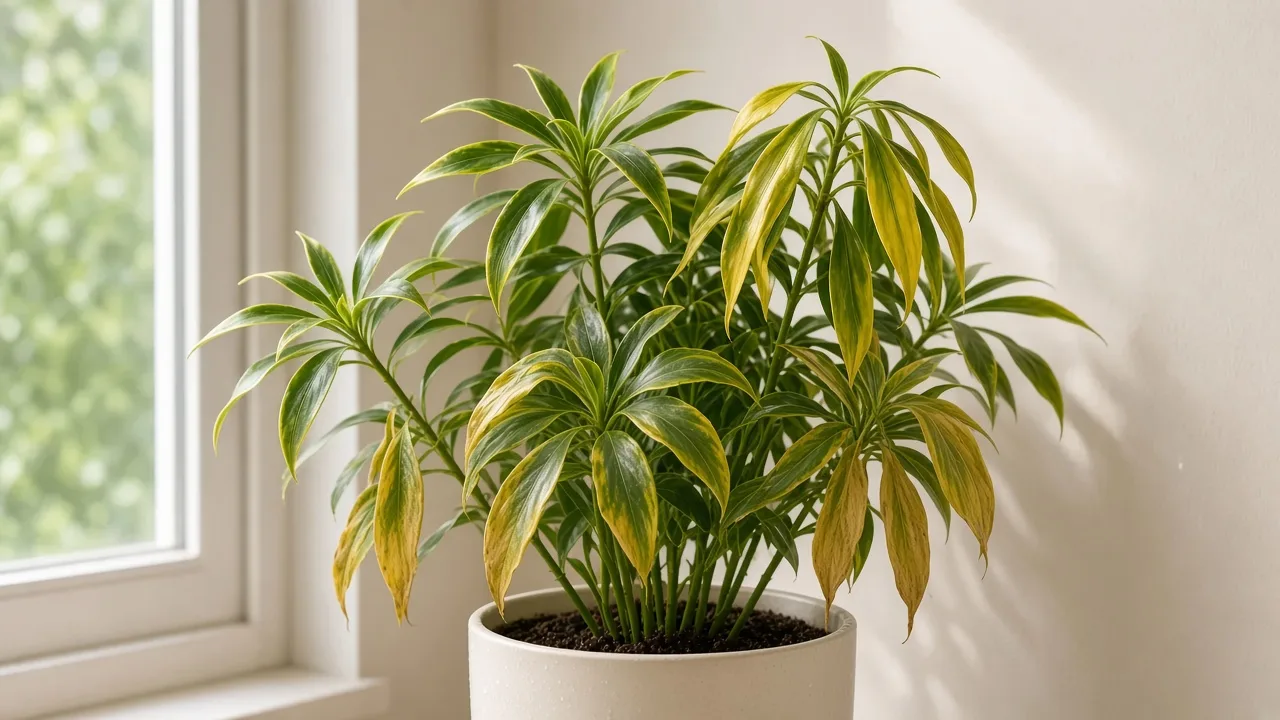
Root Rot on Dracaena Reflexa: Causes, Checks & Fixes
This guide covers root rot on Dracaena Reflexa. See also the general Root Rot guide, watering, and light pages for this plant.
Root Rot on Dracaena Reflexa: Causes, Checks & Fixes
Quick answer
Root rot on Dracaena Reflexa (Song of India, Pleomele) is almost always a watering and drainage failure—fine feeder roots sitting in wet, airless mix too long—not a random airborne disease. This shrubby dracaena with spiral rosettes of narrow, cream- or yellow-margined leaves on flexible stems wants moist, well-drained potting mix while avoiding overwatering. When the lower root zone stays damp for weeks—especially in a dim corner on a weekly watering calendar—overwatering can cause root rot even while upper rosettes still look variegated above the rim.
The hallmark paradox on reflexa: drooping or yellowing lower spiral clusters while the pot stays heavy and cool—sometimes with soft flexible stems at the soil line—because damaged roots cannot take up water even though the mix is wet.
First fix: stop all watering immediately, slide the nursery pot out of any cachepot, pour out standing water, and unpot to inspect roots before repotting or fertilizing. Trim mushy tissue, let cut roots air-dry briefly, then repot downsized into fresh mix. For how chronic wet mix damages roots in general, see our root rot guide. On Song of India, the decisive pattern is yellow clusters on wet soil below bare lower stems, sour odor from drainage holes, and stem-base firmness—not brown tips alone (usually fluoride or dry air on this species).
If you are still deciding between excess moisture and thirst, start with overwatering on Dracaena Reflexa—this page assumes you have confirmed or strongly suspect active root decay.
Why Dracaena Reflexa gets root rot
Reflexa is not dragon tree (Dracaena marginata). Its flexible stems and spiral leaf clusters need brighter light than corn plant to hold variegation, and it prefers moist mix without staying soggy. Many caretakers treat all dracaenas the same: water every Sunday regardless of light. In north-facing offices and deep shade, transpiration drops sharply, so the top-2-inch dry-down from the Dracaena Reflexa watering guide—often 7 to 14 days in bright indirect light and longer in shade or winter—gets ignored. Mix that never dries in the lower root zone is where Pythium and related organisms thrive in wet, poorly drained media.
Top-two-inch dry-down mismatch in dim rooms
NC State notes reflexa should keep soil moist while avoiding overwatering—language that fits watering soon after the upper layer dries, not leaving the entire ball saturated. LeafyPixels uses a finger test two inches deep: water only when that depth feels dry. Calendar watering every seven days in a hallway Song of India keeps the bottom wet while spiral rosettes still look crisp—a setup that also breeds fungus gnats on Dracaena Reflexa before yellow leaves appear.
Clemson Extension advises allowing dracaenas to dry slightly between waterings, then soaking thoroughly; root rot usually results from mix that does not drain quickly or from watering too often. For reflexa, “slightly dry” means the top 2 inches, not bone-dry through the whole pot.
Flexible stems hide early root failure
Press gently where each stem meets the mix. Firm upright stems with wet soil and yellow lower rosettes still warrants an unpot—do not assume thirst and pour again. Reflexa opens bare lower stems slowly in low light; early rescue depends on stem texture and root color, not whether old yellow tissue re-greens. Compare with wilting on Dracaena Reflexa when you need to separate dry wilt from wet wilt before disturbing roots.
Peat-heavy mix and cachepots
Song of India in decorative pots without drainage—or a saucer that never gets emptied—extends saturation for days after each soak. Roots standing in water and pots without drainage holes invite trouble; reflexa’s moderate growth means the problem can brew for weeks before stems soften at the base. Heavy peat Dracaena Reflexa soil without enough perlite or bark compounds the issue.
Fluoride in tap water is a separate stressor on dracaenas—reflexa does not tolerate fluoride and chlorine in tap water—and can cause brown tips that distract owners into watering more. After rescue, switch to filtered or rainwater per the watering guide; do not use extra irrigation to “fix” tip burn during active rot work.
What root rot looks like on Dracaena Reflexa
Early signs (wet-soil wilt on spiral rosettes)
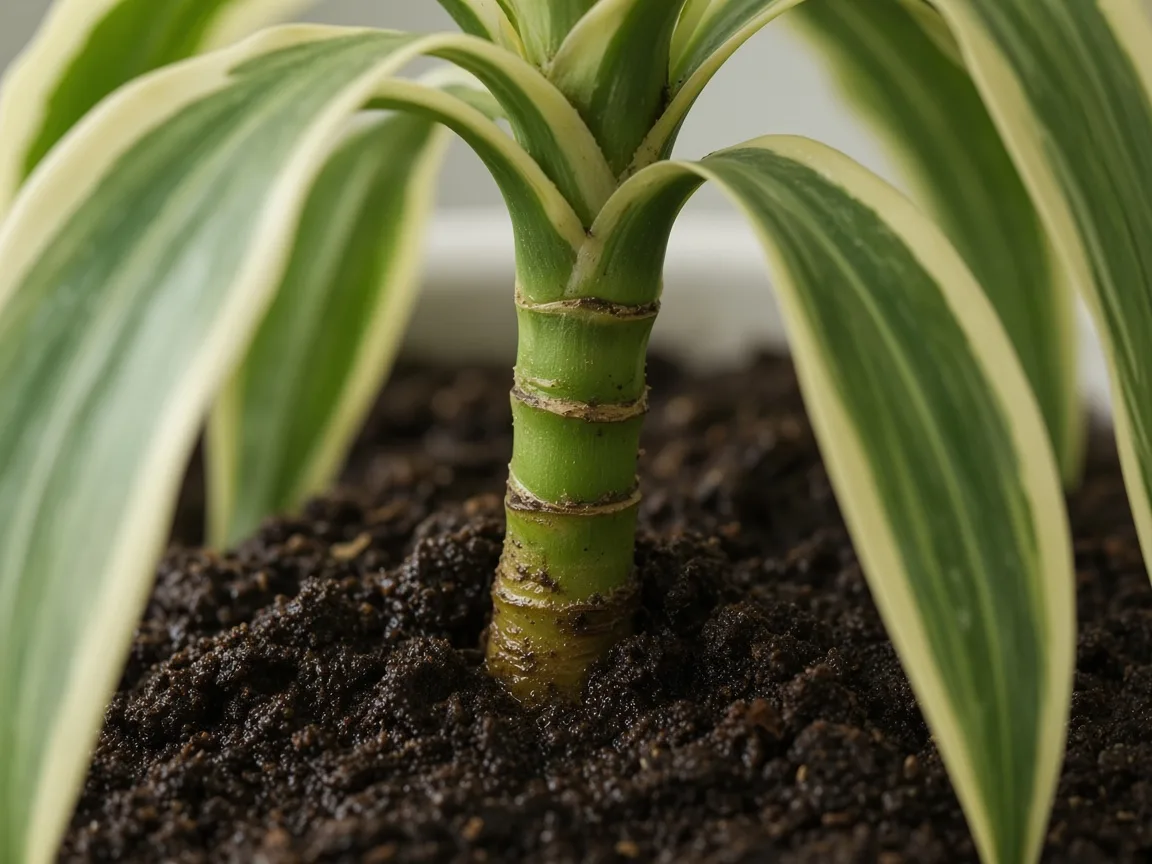
Root rot symptoms on Dracaena Reflexa—compare mushy stem tissue and damp root-zone clues with firm flexible stems and healthy variegated crown growth.
Early rot often mimics thirst: lower spiral rosettes yellow and droop while soil stays wet, because roots fail upstream. New cream-margined growth at stem tips may stall. Fungus gnats around the visible soil line are a moisture warning, not an isolated pest issue. Yellow leaves from overwatering overlap here—treat persistent wet mix plus declining lower clusters as a root-zone problem, not a leaf problem alone.
Stem-base softening on flexible stems
Advanced rot shows soft, discolored, or denting stem tissue at the soil line, blackened or hollow roots, and a sour odor when you lift the plant. Wilt-on-wet-soil with clusters of yellow lower leaves on a heavy pot is the Song of India signature. Faded variegation on stressed rosettes can follow, but do not confuse that with the crisp brown tips from fluoride—see brown tips on Dracaena Reflexa when margins are papery on otherwise dry mix.
Root rot vs. overwatering vs. dry wilt
Use pot weight, top-2-inch moisture, stem firmness, and smell—not rosette limpness alone.
| Signal | Confirmed root rot | Wet stress (overwatering, roots declining) | Dry wilt (underwatering) |
|---|---|---|---|
| Pot weight | Heavy, cool inside for days | Heavy several days after watering | Noticeably light |
| Top-2-inch skewer | Cool, dark, damp | Cool and damp | Dry or barely moist |
| Stem at soil line | Softening or discolored | Firm early; softening = escalate | Firm |
| Leaf pattern | Yellow clusters on wet soil; crown stall | Lower yellow/drop on wet mix | Drooping rosettes; crisp tips possible |
| Mix smell | Sour or musty | Sometimes musty | Neutral or dusty-dry |
| First fix | Stop water → unpot → trim → repot | Stop water; extend dry-down; inspect if declining | One thorough soak after dry-down confirmed |
When symptoms sit between overwatering and confirmed rot, follow overwatering triage first. Return here once mushy roots, sour odor, or stem-base softening confirm decay. For yellow lower leaves without confirmed mush, see yellow leaves on Dracaena Reflexa.
How to confirm the cause (inspection checklist)
Run this sequence before repotting:
- Weight test: Lift the pot 5 to 7 days after the last watering. Still heavy? The root zone is likely saturated.
- Top-2-inch test: Push a dry skewer or finger two inches deep. Cool, stained wood means wait—not water.
- Stem squeeze: Press each flexible stem at the soil line. Firm is better; give-way or denting is urgent.
- Smell: Sour or swampy odor from drainage holes or lifted root ball suggests active decay.
- Unpot and rinse: Gently remove the plant and rinse old mix from roots. Healthy reflexa roots are firm and whitish to tan. Rotted roots are mushy and brown or reddish.
Confirmation heuristic (starting point, not a lab rule): If more than roughly a third of the root mass is mushy and the mix smells bad, treat root rot as confirmed. If roots are firm and mix is dry with drooping rosettes, underwatering is more likely.
Severity ladder for Song of India shrubs
Branch rescue by how much tissue is still sound.
Mild: partial root loss, firm stems
Some brown mushy roots, but every stem is firm throughout and odor is mild. Trim affected roots, air-dry briefly, repot downsized into fresh mix per the soil guide, and resume conservative top-2-inch dry-down. Old yellow lower rosettes may drop but need not re-green—watch for new spiral clusters with crisp margins as the real recovery signal.
Moderate: more than half mushy roots, firm upper stems
More than half the roots are decayed, yet stems above the soil line stay firm. Aggressive root prune, 24 to 48 hour air-dry in bright indirect light (extend in cool humid rooms), then repot into a pot matched to the trimmed root ball—not the old oversized container. Expect weeks before strong improvement on this slow-to-moderate grower.
Severe: mushy stem base—stem-cut and propagate
When the stem base is soft, discolored, or hollow through several inches, repotting the whole plant rarely saves it. Plants with root rot may be salvaged by rooting stem cuttings of unaffected shoots. Cut firm stem sections above all soft tissue and root per the Dracaena Reflexa propagation guide. Multi-stem specimens may yield several salvageable tops—discard only mushy basal sections. Dracaenas can be propagated by stem cuttings while the parent stub often branches below the cut.
First fix for Dracaena Reflexa
Stop all watering immediately. Do not add fertilizer, peroxide drenches, or corrective extra irrigation on day one.
Then:
- Unpot and rinse roots to see true damage.
- Trim all soft, brown, or smelly roots back to firm tissue with sterilized scissors; sterilize between cuts.
- Optionally dust cut surfaces with cinnamon—optional home practice, not a substitute for air-drying cut roots.
- Let the trimmed root ball air-dry in bright indirect light for about 24 to 48 hours if damage is moderate.
- Repot into fresh well-draining mix in a pot only slightly larger than the trimmed root mass, with a drainage hole.
- Water lightly about one week later only if the top 2 inches of mix are genuinely dry—a starting heuristic; large pots in low light may need longer.
Match the repot blend to the soil guide: peat- or coir-based houseplant mix with roughly 20% perlite and coarse bark is a practical rescue recipe; some growers push perlite higher after chronic wet-office recoveries.
Step-by-step recovery
- Unpot and gently rinse away old wet mix to expose root condition.
- Cut all soft, brown, or smelly roots; sterilize tools between cuts.
- Air-dry the trimmed root ball before repotting unless rot is mild and odor is absent.
- Repot with a drainage hole; plant at the same depth as before—never bury flexible stems deeper to “stabilize” a wobbly shrub.
- Resume conservative top-2-inch dry-down per light level in the watering guide.
Worked example (bright living-room shrub): A bushy Song of India near an east window was watered every Tuesday. The pot stayed heavy, the mix smelled sour on unpot, roughly 40% of roots were mushy, but upper stems were firm. After trim, 48-hour air-dry, downsized repot with extra perlite, and first water delayed until day 10, new cream-margined rosettes opened in about six weeks. Old yellow leaves did not re-green—that is normal on reflexa.
Recovery timeline
Recovery is gradual; damaged narrow tissue does not bounce back overnight.
| Phase | What to expect |
|---|---|
| Days 0–2 | Stop water; unpot, trim, air-dry. Lower leaf drop may continue—do not interpret as failure yet. |
| Days 3–7 | Repot downsized; mix surface should dry steadily between checks. Stems should stay firm. |
| Week 2 | First cautious soak only if top 2 inches test dry. No fertilizer. |
| Weeks 3–6 | Leaf drop slows; pot weight normalizes for your light level. |
| Weeks 6–10+ | New spiral rosettes with crisp cream or yellow margins indicate real recovery. Old yellow foliage may persist until pruned. |
If softness climbs the stem, odor returns on dry mix, or the pot stays heavy without new crown growth after eight weeks of corrected dry-down, re-inspect roots or shift to stem-cut salvage.
What not to do
Do not keep watering wilting rosettes when soil is already wet. Do not fertilize during recovery. Do not return to weekly watering in a dim corner. Do not bury a wobbly stem deeper in mix. Do not treat cinnamon as mandatory fungicide.
Dracaena is toxic to cats and dogs—wear gloves when handling damaged tissue and keep trimmings away from pets.
How to prevent root rot next time
Match watering to light and pot size, not calendar guilt:
- In bright indirect light, confirm top-2-inch dry-down every 7 to 14 days; in dim corners or winter, intervals often stretch toward two to four weeks on larger pots.
- Use drainage holes; empty saucers and cachepots after every soak.
- Size pots to current root mass—oversized containers extend re-wet cycles on moderate-transpiration reflexa.
- Refresh compacted peaty mix every two years using the soil guide perlite and bark ratios.
- Treat fungus gnats as a moisture warning.
Review Dracaena Reflexa light when adjusting dry-down—lower light means slower drying and longer intervals between soakings.
When to worry
Act the same day if any of these appear:
- Flexible stem base turns soft or dents under light pressure
- Mix smells sour while the pot stays wet
- Yellow spiral rosettes drop in clusters on saturated soil
- More than half the roots are mushy on inspection
- Crown collapse or rapid wilt spread despite wet mix
Those signs mean progressing root failure—not another wait-and-see watering experiment. Escalate to full trim-and-repot here, or to propagation if the base is lost. For species context and care anchors, see the Dracaena Reflexa overview and problems hub.
When to use this page vs other Dracaena Reflexa guides
- Suspected wet soil but roots not inspected yet → overwatering
- Confirmed mushy roots or sour wet mix → this page
- Limp rosettes only—need dry vs wet wilt fork → wilting
- Small flies at soil line → fungus gnats (often the same moisture mistake)
- Mushy base lost—save firm stem tops → propagation
Related Dracaena Reflexa guides
- Dracaena Reflexa overview — species hub and care context
- Watering guide — top-2-inch dry-down, fluoride-safe water, pot checks
- Soil guide — perlite mix recipes and repot timing
- Propagation guide — stem-cut salvage
- Overwatering — early triage before confirmed rot
- Wilting — dry vs. wet wilt fork
- Drooping leaves — posture changes before full wilt
Related tool
Use the Root Rot Risk Checker to narrow causes for root rot on this plant before changing multiple variables at once.