Wilting on Jade Pothos: Causes, Checks & Fixes
Quick answer
Wilting on Jade Pothos usually means dry roots or drowned roots — opposite problems that look alike. Lift the pot and feel moisture 4–5 cm deep before adding any water.
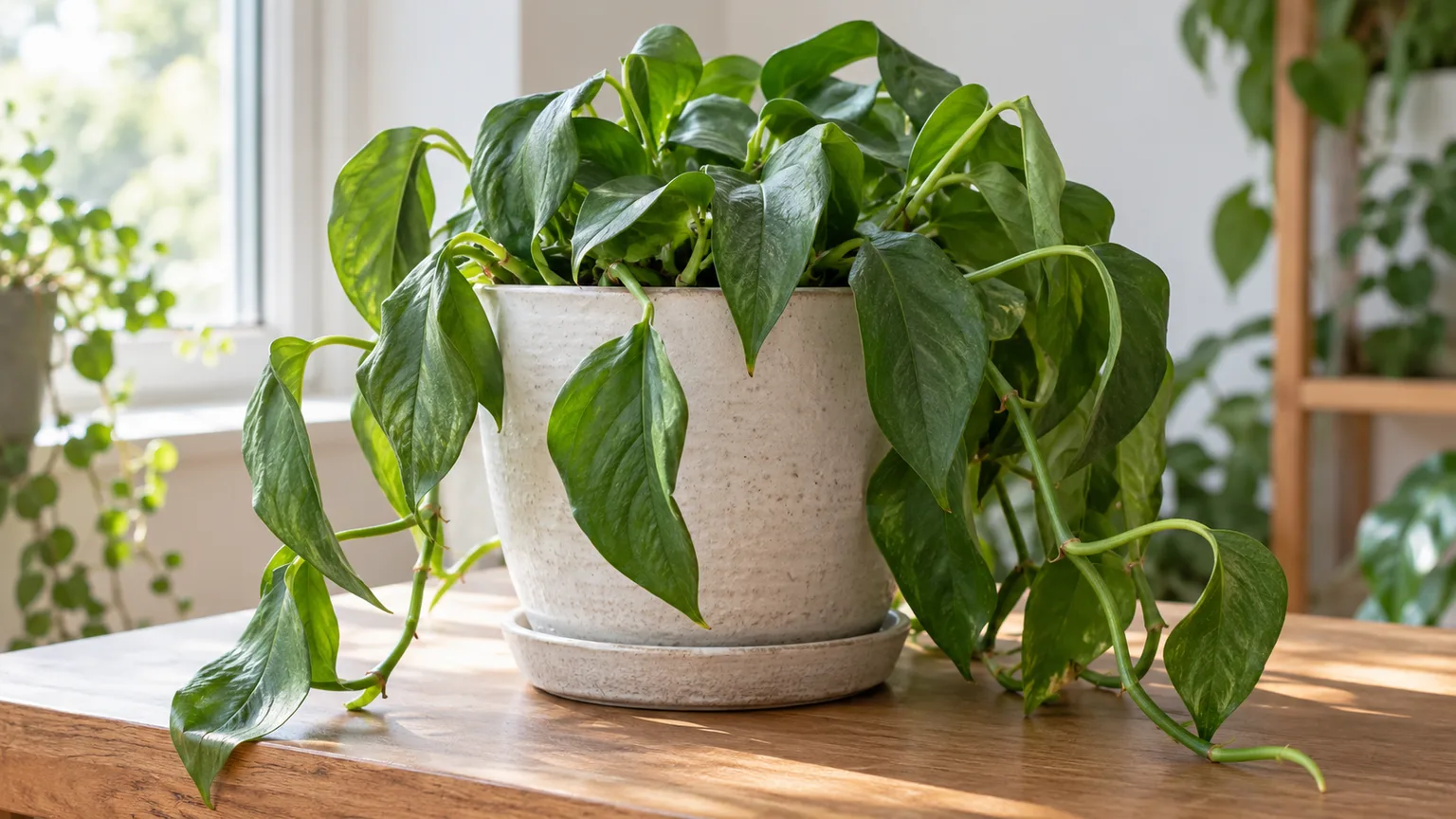
Wilting on Jade Pothos: Causes, Checks & Fixes
This guide covers wilting on Jade Pothos. See also the general Wilting guide, watering, and light pages for this plant.
Wilting on Jade Pothos: Causes, Checks & Fixes
Quick answer
Wilting on Jade Pothos looks alarming because whole sections of trailing vine go limp at once. The cause is almost always a water-uptake failure: either the mix is dry and roots have nothing to deliver, or the mix is soggy and damaged roots cannot deliver anything. Wilted leaves may indicate the soil is too dry OR too wet — pouring water on the second case makes it worse, which is why the check comes before the watering can.
First step: lift the pot and feel moisture 4–5 cm deep before you add any water. Light pot plus dry mix gets one thorough soak. Heavy pot plus damp mix gets a dry-down and a stem-base inspection, not another drink. For how wilt develops in general — limp tissue from lost turgor whether roots are too dry, too wet, or damaged — see our wilting guide. On Jade Pothos, the pattern usually shows up along the vines first, which is what the rest of this guide reads.
What wilting looks like on Jade Pothos
Healthy Jade Pothos (Epipremnum aureum ‘Jade’) holds solid deep-green, heart-shaped leaves out flat on firm trailing stems. When turgor drops, leaves fold downward along the petiole, feel soft and papery instead of springy, and whole vine tips flop over the pot rim. Because this cultivar carries solid dark green leaves, great in low light, wilt is easy to spot: the normally rich, flat green canopy turns dull and draped.
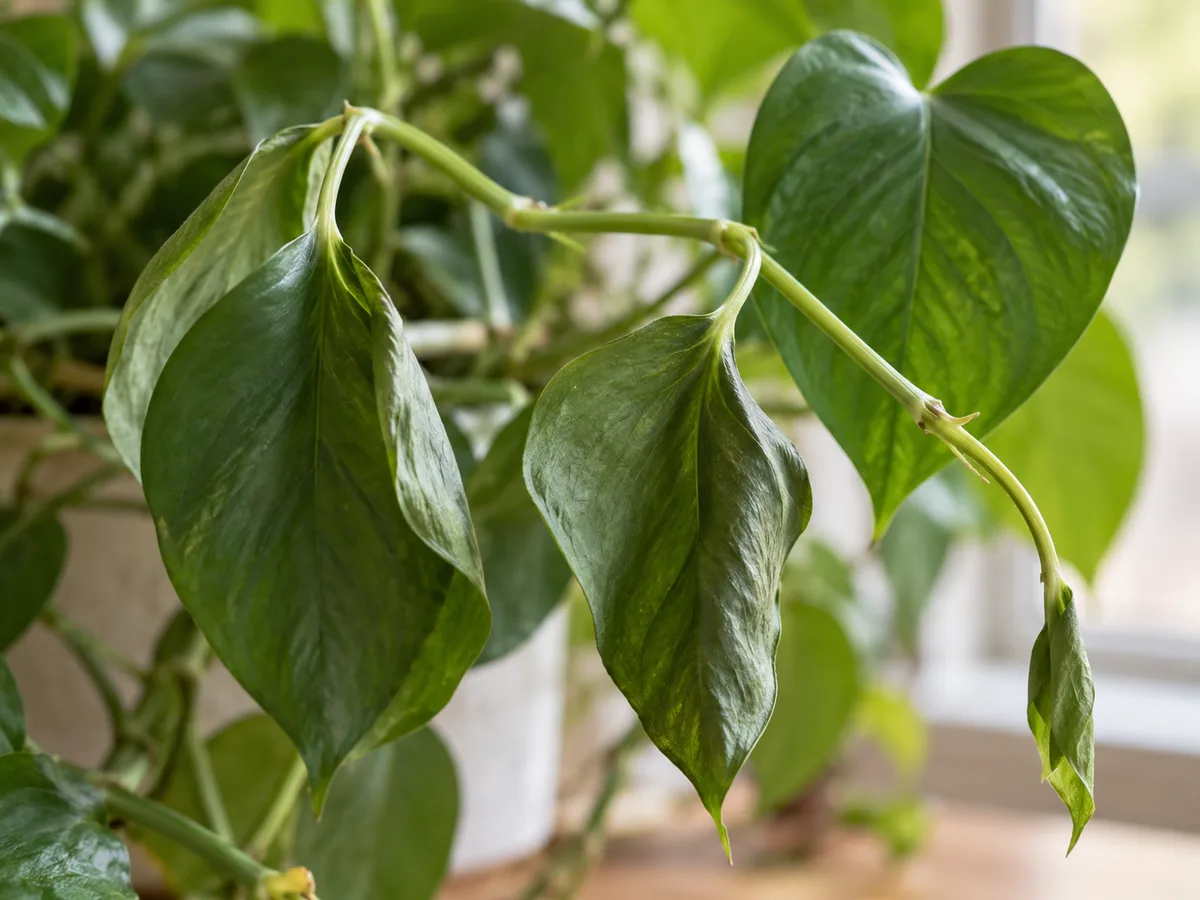
Close-up of wilted Jade Pothos foliage — note limp leaf blades and soft petioles compared with firm healthy growth.
Dry wilt shows uniformly floppy leaves on an upright-then-cascading plant with a noticeably light pot. The mix may shrink from the pot edge. Leaves feel thin; older leaves near the soil line droop first while the newest tip growth still looks green. This matches the classic pothos signal Penn State describes: too little water may lead to leaves temporarily drooping.
Wet wilt is the paradox. Soil stays damp for days, yet leaves hang limp and may yellow from the older foliage inward. Vine bases near the soil line feel soft instead of firm, and the pot weighs heavy. Root rot and blackening of the leaf margins can occur with overwatering — dark edges on limp leaves plus wet soil is a strong wet-wilt signature.
Heat or cold wilt appears after a temperature swing: a hot afternoon by sun-baked glass, a cold draft from a winter window, or a blast of heating air. Leaves droop during the extreme and partially recover when conditions ease. If the droop never eases overnight, suspect roots rather than weather.
Why Jade Pothos wilts
Jade Pothos is a fast trailing grower that moves a lot of water through long vines on a modest root system. Most wilting cases trace to a mismatch between how fast the pot dries and how often it gets watered.
Underwatering removes turgor when the mix stays dry too long. Jade tolerates short dry spells — its thick green leaves buffer a missed watering — but a root ball that has been dry for weeks cannot supply a multi-foot vine. Long intervals in bright light, small pots, or heating season dry-down cause this form. NC State’s baseline rule is to let the well-drained potting medium dry out between watering — the key word is between, not indefinitely.
Overwatering and root failure is the more dangerous cause. Jade’s solid-green leaves photosynthesize efficiently, so the plant keeps growing in medium or lower light — but in dim spots it drinks slowly, and the mix stays wet far longer than expected. Too much water will lead to root rot, and rotted roots cannot transport water, so leaves wilt in wet soil. Pots without drainage, cachepots holding standing water, and dense peat-heavy mix all push toward this outcome.
Low light plus steady watering is Jade’s special trap. Because the cultivar tolerates lower light better than variegated pothos, owners park it in dim corners and keep the summer watering schedule. Growth slows, evaporation slows, and the root zone goes quietly anaerobic. Wilt arrives weeks later with no obvious change in routine.
Temperature stress raises demand or damages tissue outright. Pothos prefers average room temperatures between 60 and 80 F. Hot glass, radiators, and cold winter windowsills all trigger wilt; cold plus wet soil is the worst combination because it invites rot.
Recent repotting or long, bare vines can wilt while roots re-establish or while an over-long vine outruns what damaged roots can supply. Wilt confined to the oldest, barest vine sections with firm new growth elsewhere points here rather than whole-pot rot.
Reading wilt along the trailing vines
This check only works on a trailer like pothos, and it is the fastest way to grade severity.
Start at the pot and walk each vine outward. Squeeze the stem gently every 15–20 cm. Firm, green stem with limp leaves means the plumbing is intact and the problem is likely simple drought — water uptake should resume after a soak. A vine that turns progressively softer, browner, or stringy toward the soil line means damage starts at the roots and travels outward; that vine is unlikely to recover past the soft point even after correct watering.
Check the nodes — the slight bumps where leaves and brown aerial roots emerge. Plump nodes with tiny firm aerial-root nubs are living tissue and root readily if you need cuttings. Flat, black, or mushy nodes are dead; prune back to the nearest firm node with healthy color.
Finally compare vines against each other. One wilted vine among firm ones suggests localized stem damage or a dry pocket in the mix. Every vine wilted at once points to a whole-pot problem: drought, saturation, or a temperature event.
How to confirm the cause
Work through these checks in order and stop when one gives a clear answer.
- Pot weight — Lift the pot. Noticeably light suggests dryness; heavy suggests saturation. Compare against how it feels right after a full watering so the reading means something.
- Deep moisture — Push a finger or wooden skewer 4–5 cm into the mix. Dry throughout supports underwatering. Damp or wet at depth with wilt on top supports uptake failure, not thirst.
- Vine-base firmness — Pinch stems where they enter the mix. Firm and green is reassuring. Soft, mushy, or brown means rot involvement — do not water into this.
- Leaf pattern — Uniform floppiness on dry soil points to drought. Yellowing older leaves plus wet soil and limp tips points to chronic overwatering. Blackened margins plus wet soil strengthen the rot case.
- Drainage check — Water should exit drainage holes freely and saucers should empty within minutes. A cachepot with standing water underneath keeps the bottom of the root ball saturated even when the surface looks dry.
- Light and heat context — Afternoon-only wilt near hot glass, or wilt that began the night temperatures dropped by a drafty window, suggests environment rather than roots — provided the pot-weight and moisture readings are normal.
If the pot is heavy, the soil smells sour, and vine bases are soft, unpot and inspect roots. Brown, mushy, foul-smelling roots confirm wet wilt; trim them before any recovery watering.
First fix to try
Lift the pot, check moisture 4–5 cm deep, then follow the single path that matches — do not water by reflex.
If the pot is light and the mix is dry throughout: soak once thoroughly until water runs from the drainage holes, discard all saucer water, and return the plant to its usual Jade Pothos light spot. One practical benchmark from nursery growers is to water your pothos when the top 2 to 3 inches of soil is dry — roughly matching this plant’s top-half-dry rule — usually once every week or two depending on light.
If the pot is heavy and the mix is wet: do not add water. Empty the saucer and cachepot, move the plant into brighter indirect light with airflow, and let the mix dry before the next soak. If vine bases feel soft or the mix smells sour, unpot immediately, cut away brown mushy roots with clean scissors, and repot into fresh well-draining mix.
Step-by-step recovery
Recovering from dry wilt
- Water evenly from the top until the whole root ball is moist and excess drains freely. If the mix repels water, bottom-water for 20–30 minutes instead.
- Empty the saucer completely.
- Wait 12–24 hours. Leaves that firm up and lift confirm drought was the cause.
- Resume the normal rhythm from the Jade Pothos watering guide: water when the top half dries, every 7–10 days in bright light and 14–21 days in low light.
Recovering from wet wilt
- Stop all watering and drain every drop of standing water from saucers and cachepots.
- Give brighter indirect light — pothos likes bright light but not direct sun — so the plant uses moisture predictably.
- If wilt persists after several dry days or stems soften, unpot, rinse roots, and trim away brown or mushy roots, keeping only firm pale tissue.
- Repot into fresh mix with perlite in a container with drainage, sized to the trimmed root ball rather than the old pot.
- Remove leaves that stay collapsed, yellow, or black-edged — they will not reopen and they slow your read on recovery.
Rescuing with vine node cuttings
Pothos has a backup plan most houseplants lack: vines easily root in water. If the base is rotted but outer vine sections have firm stems and plump nodes, cut 10–15 cm sections with at least two nodes each, strip the lower leaf, and place the bare node in clean water. Rooted cuttings become replacement plants via the Jade Pothos propagation guide while you discard the rotted base. This is the correct endgame when more than half the root system is mush — nursing a crown with no functional roots wastes weeks.
Recovery timeline
Mild dry wilt usually firms up within hours to one day after a proper soak. Severe drought with crispy leaf edges may need two to three days before new tip growth looks turgid; the crisped edges themselves will not heal.
Early wet wilt — heavy pot, still-firm stems — improves over one to three weeks once the root zone dries and watering resets. After root trimming and repotting, expect several weeks before fresh growth confirms stability. Judge recovery by firm new leaves and stable vine bases, not by old collapsed foliage.
Heat or cold wilt should ease within a day of stabilizing conditions. Wilt that stays constant around the clock with wet soil follows the root-damage timeline instead.
Lookalike symptoms
| What you see | How to tell it apart | Where to go |
|---|---|---|
| Leaves droop but stay firm and green | Classic drooping leaves from mild thirst or a light dip, without the soft papery collapse of true wilt | Drooping Leaves on Jade Pothos |
| Older leaves yellow first, then flop | Yellow leaves from chronic overwatering often precede wet wilt; confirm with pot weight and stem firmness | Yellow Leaves on Jade Pothos |
| Stems mushy at soil line, foul smell | Root rot — the advanced stage of wet wilt; needs unpotting and trimming, not a watering tweak | Root Rot on Jade Pothos |
| Brown crispy leaf tips, firm leaves | Brown tips from low humidity or salt buildup rather than turgor loss | Brown Tips on Jade Pothos |
| White cottony clusters in leaf axils | Mealybugs draining sap can mimic wilt on individual vines; look for the insects before watering | Mealybugs on Jade Pothos |
| Soil surface fuzzy, tiny flies | Mold on soil plus fungus gnats signal the same chronic wetness behind wet wilt | Mold on Soil on Jade Pothos |
Mistakes to avoid
Do not water every wilted Jade Pothos without checking the pot first — wet wilt gets worse with more water, and this single reflex causes most losses.
Do not assume a pothos cannot be underwatered because it is tough. Long dry spells damage fine roots, and the following watering cannot fix dead ones.
Do not fertilize while wilted. Fertilizer cannot restart damaged roots and salts stress them further; resume feeding only after new growth looks healthy.
Do not repot into a larger pot hoping to fix wilt. A bigger container holds more wet mix around a struggling root ball and deepens the oxygen problem.
Do not move a wet, wilted plant into harsh direct sun. Extra heat raises transpiration demand on roots that already cannot supply water.
Do not stack repotting, heavy pruning, and sprays on the same day unless rot forces your hand. Make one correction, then read the plant’s response.
Jade Pothos care cross-check
Wilting usually exposes a care mismatch nearby:
- Watering: Follow the pot, not the calendar — top half dry, then soak fully. See the Jade Pothos watering guide.
- Light: Medium indirect light keeps water use steady; dim corners need much longer dry-down intervals.
- Mix and pot: A well-draining standard mix with perlite in a pot with drainage holes forgives occasional overwatering; dense soggy mix does not.
- Vine length: Very long bare vines demand more water than damaged roots can move — pruning back to healthy nodes reduces load. See the Jade Pothos pruning guide.
- Temperature: Keep the comfort zone around 18–29°C (65–85°F); move pots off freezing sills and away from heat vents in winter.
How to prevent it next time
Learn your pot’s dry-down time in its actual spot — two identical plants in different light can differ by a week. Check the top half of the mix on a fixed weekday rather than watering on one.
Always use pots with drainage holes and empty saucers within 30 minutes of watering. Decorative cachepots are fine only if no water ever pools inside them.
Keep light steady year-round so winter watering stretches naturally as growth slows. When light drops, stretch the interval instead of holding the summer schedule.
Scout vine bases when you water. Softness where stems meet the mix is the earliest wet-wilt warning, days before the canopy collapses.
Repot every 1–2 years in spring into fresh mix, only one size up. Compacted old mix that stays wet at the bottom while the top looks dry is a classic hidden cause of recurring wet wilt.
When to worry
Treat as urgent when wilt persists after correct dry-side rehydration, when wet soil and soft vine bases appear together, or when multiple vines collapse within days on a heavy pot. Delaying unpotting after mushy stems often means losing the crown.
A plant with mostly mushy roots and soft stem bases may not be saveable as a whole — take healthy node cuttings above the firm tissue line and root them in water rather than waiting for total collapse.
A single dry-wilt episode that recovers within 24 hours after one good watering is not urgent. It is a reminder to check the pot on schedule, not a verdict on the plant.
Conclusion
Wilting on Jade Pothos is a water-movement alarm, not a single diagnosis. Read the vines, lift the pot, and feel moisture at depth before you act: light and dry gets one full soak, heavy and wet gets a dry-down or a root rescue. Match watering to this trailer’s actual light and pot size, keep drainage honest, and hold healthy nodes in reserve as cuttings when the base fails. That sequence gives limp solid-green vines their best chance to firm up — and tells you quickly when to start over from cuttings instead.
When to use this page vs other Jade Pothos guides
- Jade Pothos watering guide — Use for routine moisture rhythm before wilt appears or after recovery stabilizes.
- Underwatering on Jade Pothos — Use when the pot is clearly light and dry and leaves perk up fast after a soak.
- Overwatering on Jade Pothos — Use when the mix stays wet for days and the fix is schedule correction rather than root surgery.
- Root Rot on Jade Pothos — Use when stems are mushy and roots smell bad; that page covers the full unpot-and-trim rescue.
- Jade Pothos problems hub — Browse all 16 issues on this plant when the diagnosis is still open.
Related Jade Pothos guides
- Jade Pothos overview
- Jade Pothos watering
- Jade Pothos light
- Jade Pothos soil
- Underwatering on Jade Pothos
- Overwatering on Jade Pothos
- Root Rot on Jade Pothos
- Drooping Leaves on Jade Pothos
- Jade Pothos problems
Related tool
Use the Plant Watering Calculator to set a check-first watering rhythm for wilting on this plant before changing multiple variables at once.