Brown Tips on Jade Pothos: Causes, Checks & Fixes
Quick answer
Brown tips on Jade Pothos usually mean watering swings, fertilizer-salt buildup, or dry air near heaters—not disease. First step: probe soil to the bottom, lift the pot for weight, and check for white crust; then give one deep top-watering until it drains freely and pause feeding until new leaves emerge clean.
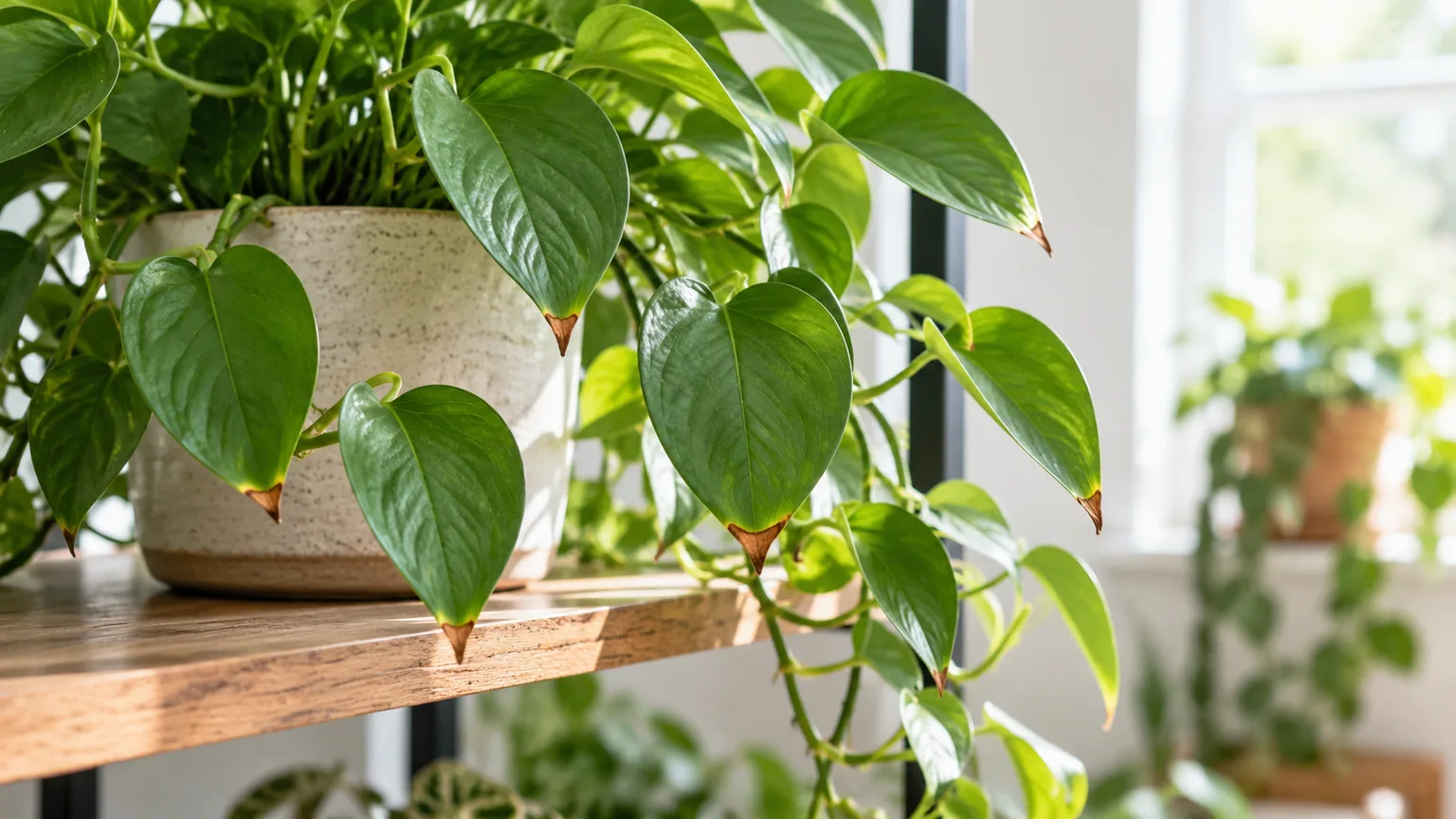
Brown Tips on Jade Pothos: Causes, Checks & Fixes
This guide covers brown tips on Jade Pothos. See also the general Brown Tips guide, watering, and light pages for this plant.
Brown Tips on Jade Pothos: Causes, Checks & Fixes
Quick answer
Brown tips on Jade Pothos (Epipremnum aureum ‘Jade’) are almost always a water or salt problem, not a disease. The leaf tip is the farthest point from the roots, so it dries out first when the pot swings too dry, when fertilizer salts accumulate, or when dry heater air pulls moisture faster than the vine can replace it. For how tip burn works on houseplants generally, see our brown tips guide. On Jade Pothos, the pattern on the tip plus the soil surface tells you which cause you have.
First step: push a finger or chopstick to the bottom of the pot, lift the pot for weight, and look for white crust on the soil. Dry-to-the-bottom mix with a light pot means underwatering—see the Jade Pothos watering guide for the top-half-dry rhythm. White crust plus recent feeding means salt buildup: run water through the pot several times until it drains clear, then pause feeding until new leaves emerge clean.
What brown tips look like on Jade Pothos
Jade Pothos shows tip burn as a crisp tan-to-dark-brown zone confined to the very point of its solid-green, heart-shaped leaves. The rest of the blade usually stays deep green and firm, which is why this symptom is easy to separate from yellowing or whole-leaf browning. Because Jade leaves carry no variegation, even small brown points stand out clearly against the uniform dark green.
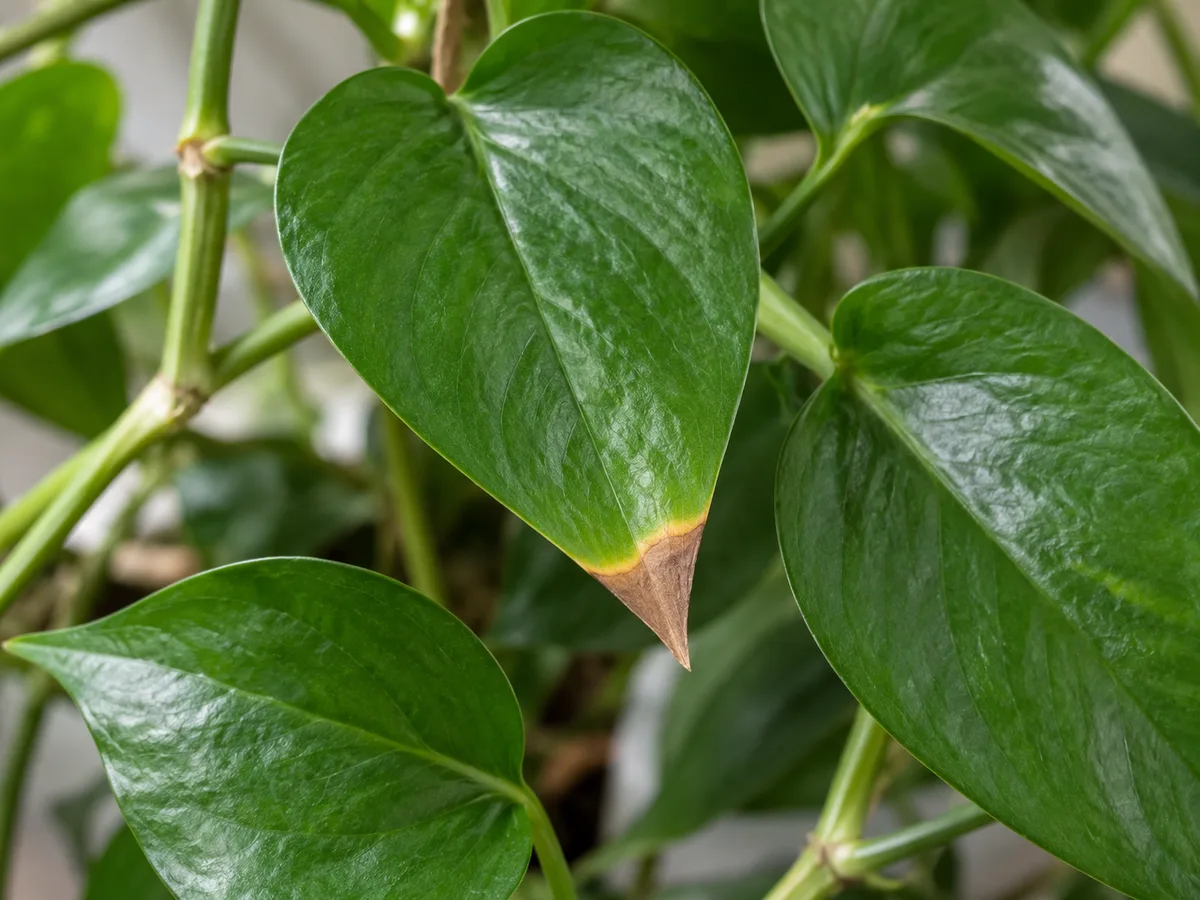
Crisp brown tips on solid-green Jade Pothos leaves — compare dry papery edges (water or air stress) with tips ringed in yellow over crusty soil (salt buildup).
On a trailing vine, check where the damage sits. Tips browning on the longest, farthest leaves first suggests the roots cannot push water all the way down the vine—either the pot runs too dry between waterings or the root system is weak. Tips browning on many leaves at once, right after feeding or a move near a heater, points to salts or dry air instead. Soft dark-brown tips with yellowing leaves over wet soil are a different problem; switch to the root rot guide rather than treating edges.
Why Jade Pothos gets brown tips
Jade is the solid-green form of pothos, and NC State Extension lists the ‘Jade’ cultivar as solid dark green and strong in low light. That extra photosynthetic capacity means Jade tolerates dim corners better than variegated siblings—so when tips brown in a dim spot, suspect water, salts, or roots before blaming light. The five causes below cover nearly every home case.
Fertilizer-salt buildup
The most common cause on established indoor plants. Pothos needs only light feeding—NC State advises fertilizing every other month except during winter dormancy—and full-strength liquid feed or monthly dosing lets salts accumulate. Salts concentrate at leaf margins, burning tips first, often with a yellow ring and white crust on the soil surface. If you feed heavily while the plant sits in weak light or on dry roots, burn follows faster. The dedicated fertilizer guide keeps dosing matched to Jade’s fast but light-feeding growth.
Underwatering swings on long vines
Jade trailers can reach several metres indoors, and every extra node taxes water delivery. A pot that repeatedly dries bone-deep forces the plant to sacrifice leaf extremities first, so tips go crisp while older leaves may also curl or droop. Penn State’s rule still holds: water when the soil is dry, since pothos is better kept too dry than too wet—but “too dry” as a habit, with the mix shrinking from the pot sides, crosses into tip burn. This overlaps with the underwatering guide whenever leaves go limp between drinks.
Dry air and heat sources
Jade tolerates average rooms, but a vine hanging beside a radiator, heating vent, or air-conditioner outlet loses moisture from thin leaf edges faster than roots resupply it. The result is small crisp points on many leaves at once with otherwise normal soil. Low humidity browns pothos edges when plants sit near heat sources, and moving the plant away from the airflow matters more than misting, which dries within minutes. Cross-check symptoms with the low humidity guide if edges crisp every heating season.
Hard tap water and mineral load
Over months, hard or heavily treated tap water can deposit minerals that show up as tip burn, especially once other causes are ruled out. If tips started browning after a move or a change of water source, try rainwater or filtered water for a few weeks and compare new leaves, as tap-water minerals can brown pothos tips after a source change. Letting chlorinated water sit uncovered overnight before use is a reasonable low-effort test. Keep this cause last in line—water quality rarely explains sudden tip burn on its own.
Weak roots that cannot feed the vine
Roots damaged by chronic sogginess fail to move water even in a wet pot, so tips brown softly while leaves yellow from the base. NC State notes that overwatering causes root rot and blackening of leaf margins on pothos. This pattern—wet mix, yellowing lower leaves, stalled new growth—belongs to the overwatering guide, not to edge trimming. Jade’s aerial roots at each node can look alarming but are normal climbing gear, not a distress signal.
How to confirm the cause
Read the tip, the soil, and the pot together before treating:
| What you see | Most likely cause | Confirm by |
|---|---|---|
| Crisp tan tips only, limp leaves, light dry pot | Underwatering swings | Soil dry to the bottom; pot feels very light |
| Brown tips with yellow ring, white crust, recent feeding | Salt buildup | Crust on soil or rim; feeding history |
| Small crisp points on many leaves, soil normal, near heater or vent | Dry air | Plant position; heating season timing |
| Tips browning after a water-source change | Tap-water minerals | Switch to rain or filtered water for a few weeks |
| Soft brown tips with yellowing over wet soil, sour smell | Root trouble | Slide out root ball; check for brown mushy roots |
Crispy, dry, and confined to the edge means moisture or salt stress; soft dark tips with yellowing signal root failure rather than dryness. One or two tipped leaves after a knock or a vine kink is physical damage—watch it, but do not treat the whole plant.
The first fix to try
Give the pot one deep, slow top-watering until water runs freely from the drainage holes, let it drain completely, and empty the saucer. This single action helps both leading causes: it rehydrates a dry root ball and begins flushing accumulated salts. If you saw white crust, repeat the drench two or three times so the pot drains clear, then stop feeding for at least two months. Do not fertilize, repot, or prune on the same day—one correction lets you read the plant’s response. Full soak technique lives on the Jade Pothos watering guide.
Step-by-step recovery
- Move the vine away from heaters, vents, and hot windows. Grouping with other plants raises local humidity more reliably than misting.
- Water thoroughly whenever the top half of the mix dries—roughly every 7–10 days in bright spots, less often in low light—instead of watering by calendar.
- If salts were the cause, flush until drainage runs clear and resume feeding at half strength no more than monthly in spring and summer only.
- Trim only fully dead edges with clean scissors, following the leaf’s point and leaving a hairline of brown so the cut does not re-brown.
- Shorten bare, over-long trailers just above a node to redirect energy into fuller growth—Penn State notes pothos can be trimmed just above a node at any point along the vine. Healthy cuttings root easily in water for backup plants.
- Check the soil mix if the pot stays wet for weeks; compacted mix needs aeration with perlite, not more frequent watering.
Recovery timeline
No existing brown tip will re-green—dead edge tissue is permanent, so trim for looks and judge everything by new growth. With the cause fixed, new leaves should emerge with clean margins within two to four weeks in the growing season; winter recovery runs slower. If fresh leaves keep tipping after a month of steady care, recheck roots and feeding rather than repeating the same flush. A vine that keeps pushing clean new tips while old damage stays static is already healed.
Lookalike symptoms
- Yellow leaves start from the base or whole blade and usually mean watering or light stress, not edge-only burn.
- Root rot adds mushy stems, wet sour soil, and rapid collapse—an emergency, unlike cosmetic tips.
- Sun scorch bleaches or tans the leaf face toward the window rather than crisping just the point; check the light guide for placement.
- Pest stippling from spider mites or mealybugs shows speckling, webbing, or sticky residue rather than clean dry edges.
Mistakes to avoid
- Feeding a tipped plant “to help it recover”—fertilizer on stressed roots deepens salt burn.
- Misting as the main humidity fix while the vine still sits in a heater’s airflow.
- Cutting deep into green tissue when trimming, which opens fresh wounds that brown again.
- Repotting on day one for cosmetic tips; repotting is for failed drainage or rotted roots, not edges.
- Handling vines roughly without gloves around pets or children—all pothos parts contain irritating calcium oxalate crystals, so keep trimmings away from cats and dogs.
Jade Pothos care cross-check
Brown tips recur when routine care drifts. Confirm the vine gets medium indirect light (Jade tolerates lower light but still grows best brighter), water matched to the pot’s actual dry-down, and a well-drained medium allowed to dry between waterings. Review the Jade Pothos overview and the problems hub if several symptoms overlap—tips plus yellowing plus stalled growth usually share one root-zone cause.
When to worry
Treat it as urgent if tips spread daily alongside yellowing over wet soil, soft stems, or fungus gnats clouding the pot—that combination means roots are failing. Also act fast if an entire vine section collapses or new leaves emerge already tipped and tiny, which signals the root system cannot support current vine length. Isolated crisp tips on a firm vine with healthy new growth are cosmetic and can wait for the next watering check.
When to use this page vs other Jade Pothos guides
- Jade Pothos watering — use for the ongoing soak-and-dry rhythm once tip cause is confirmed.
- Underwatering on Jade Pothos — use when limp, drooping leaves dominate rather than edge-only burn.
- Overwatering on Jade Pothos — use when soil stays wet and yellowing spreads with the tips.
- Yellow leaves on Jade Pothos — use when whole blades yellow instead of just edges.
- Jade Pothos problems hub — browse when several symptoms overlap and you need a different entry point.