Underwatering on Jade Pothos: Causes, Checks & Fixes
Quick answer
Underwatered Jade Pothos wilts with a light pot, dry mix in the top half of the pot, and solid-green leaves that curl inward yet perk back up after watering. First step: soak deeply until water drains freely, empty the saucer, and confirm leaves firm up within hours before changing anything else.
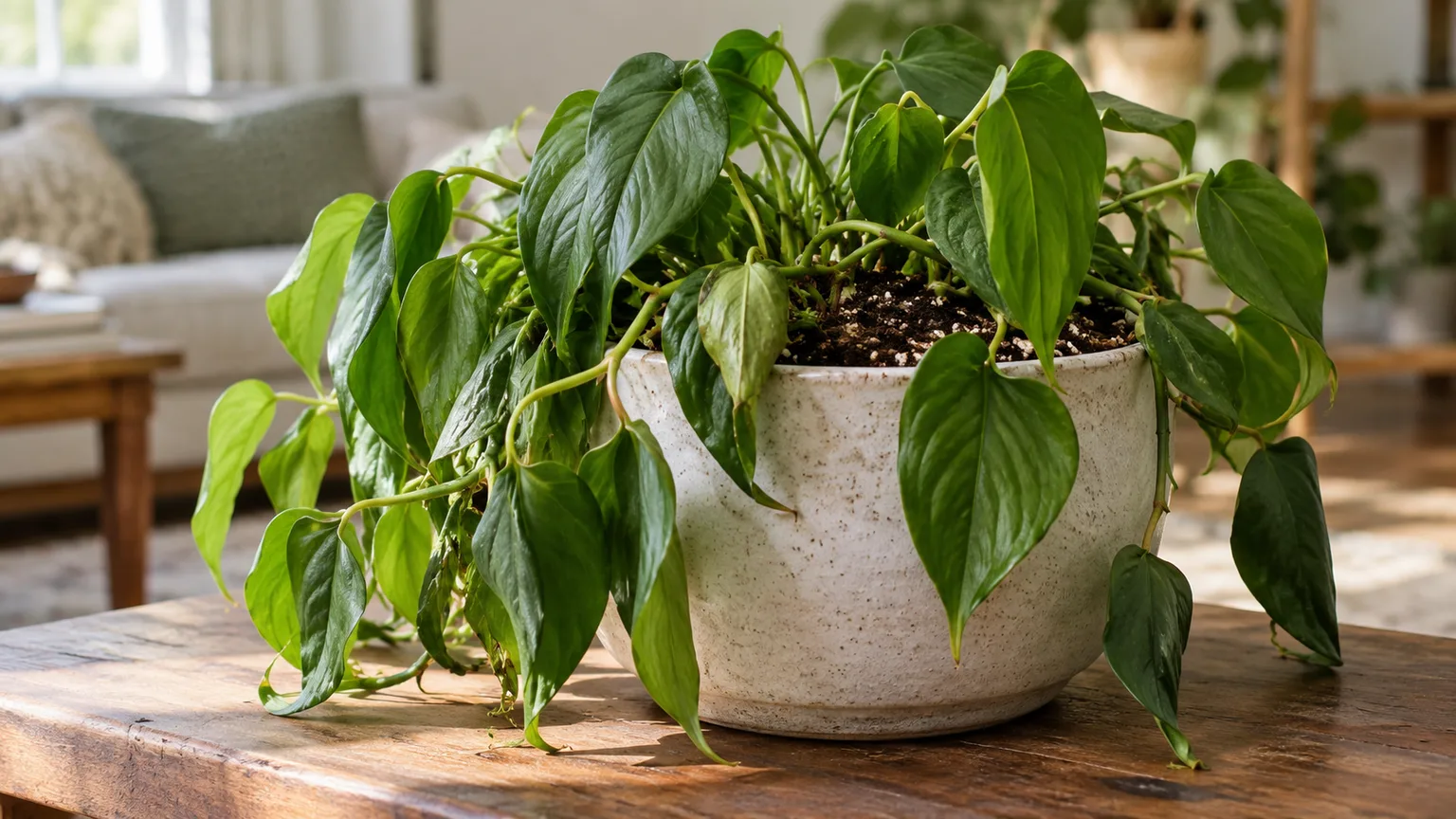
Underwatering on Jade Pothos: Causes, Checks & Fixes
This guide covers underwatering on Jade Pothos. See also the general Underwatering guide, watering, and light pages for this plant.
Underwatering on Jade Pothos: Causes, Checks & Fixes
Quick answer
Thirsty Jade Pothos (Epipremnum aureum ‘Jade’) shows a light pot, dry mix through the top half of the container, and limp solid-green leaves that curl inward yet perk back up after a drink — the classic wilting pattern for this cultivar. For how chronic dry-down stresses houseplant roots in general, see our underwatering guide. On Jade Pothos, the tell is drought plus firm stems and shriveling vine tips — not a heavy wet pot with yellowing lower leaves, which points to overwatering instead.
First step: water deeply once until excess flows from every drainage hole, then empty the saucer within thirty minutes. Do not give small daily sips or mist the leaves instead. One full soak rewets the root ball; then watch for perk-up over the next few hours before you decide anything else is wrong.
Why Jade Pothos gets underwatered
Jade Pothos is a fast trailing vine that can push stems 3 m long indoors, and every extra metre of vine is extra leaf area losing water. Penn State Extension advises to water when the soil is dry, noting that too little water leads to leaves temporarily drooping — and that pothos is better kept too dry than too wet. That forgiving reputation is exactly why underwatering happens: owners hear “drought tolerant” and stretch a 7–10 day rhythm into three or four weeks, especially for plants in bright spots or small pots.
Several Jade-specific patterns repeat:
Calendar watering after an overwatering scare. Pothos root rot is the better-known killer, so cautious owners underwater deliberately. A trailing Jade in a 15 cm hanging basket near a bright window can cross from “top half dry” to severely dry in days during summer growth, while the same plant in low light needs checking only every two to three weeks.
Surface-only checks on deep pots. The top crust pales while the middle of the root ball is still moist — or the reverse, where a quick sprinkle darkens the surface but the core stayed dusty. Jade’s routine is to let the well-drained potting medium dry out between watering, which means checking the top 4–5 cm, not glancing at the surface.
Hanging baskets and small nursery pots. Elevated pots catch warm air on all sides and dry far faster than the same plant on a shelf. Long vines compound it: the pot volume stays small while transpiration demand grows with every new leaf.
No variegation to warn you early. On Marble Queen or Golden pothos, paling variegation can flag stress before wilt. Jade’s solid dark green leaves stay richly colored until turgor collapses, so the first visible signal is often sudden whole-plant droop rather than a gradual fade.
Hydrophobic peat mix. When standard potting mix dries completely, water sheets down the inside wall while the centre stays dry. The plant keeps wilting after what looked like a watering, and each failed drink makes the mix repel water more.
What underwatering looks like on Jade Pothos
Healthy Jade leaves feel smooth, springy, and uniformly deep green on firm trailing stems. When the root zone runs too dry, turgor loss moves from the vine tips inward, and the solid-green color that makes this cultivar distinctive starts looking dull rather than glossy.
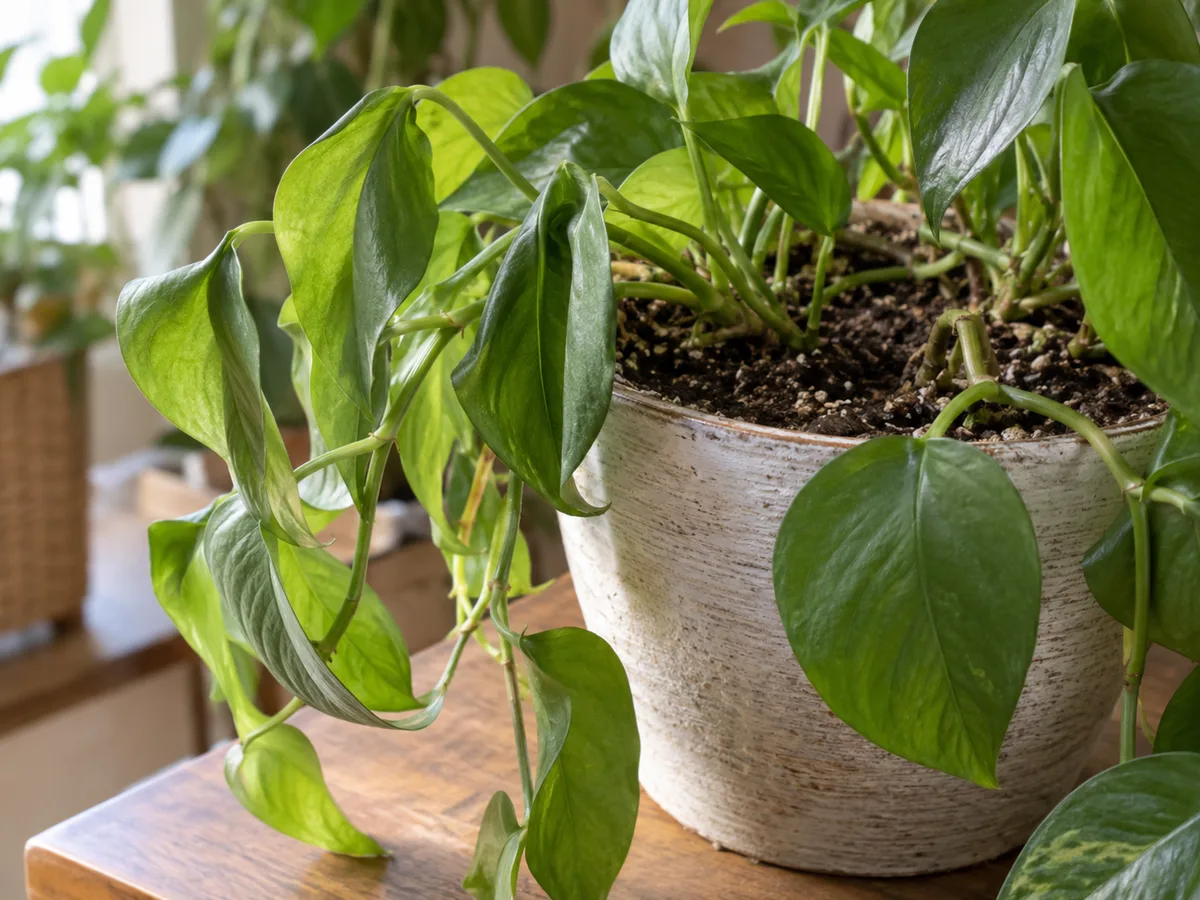
Underwatering symptoms on Jade Pothos - limp inward-curled leaves and dry mix; compare with firm glossy tissue on the same plant.
Typical underwatering signs on Jade Pothos overview:
- Whole-plant limpness: leaves hang down instead of holding out from the vine, yet stems stay firm rather than mushy
- Leaves curling or folding inward along the midrib — the classic pothos drought response, which relaxes within hours of thorough watering when roots are healthy
- A noticeably light pot plus mix that is dry and crumbly through the top 4–5 cm
- Soil pulling away from the pot wall, with water running straight through on the next pour
- Dull leaf surface and slightly thinner-feeling blades as stored moisture gets used up
- Older leaves yellowing and dropping while the newest growth stalls — distinct from the natural yellowing and leaf drop of aging vines because thirsty drop follows a dry pot, not a wet one
- Brown, crispy leaf margins appearing after repeated dry cycles — compare with the brown tips guide if edges crisp while soil moisture seems adequate
Because Jade stores little water in its thin blades compared with a succulent, limpness can look dramatic while the plant is still fully rescuable. Do not confuse dramatic wilt with death: the perk-up test below settles it. Step-by-step pothos leaf-troubleshooting routines use the same order — confirm dryness first, soak once, then reassess.
Vine tips and nodes: where drought shows first on trailers
On a trailing Epipremnum, the longest vines suffer first because they sit farthest from the roots. Check the last 15–20 cm of each vine: underwatered tips carry smaller-than-normal new leaves, limp segments that flop instead of arching, and aerial roots at the stem nodes that look brown and shriveled rather than plump and silvery.
This node check doubles as your salvage plan. Pothos vines easily root in water, so a vine that defoliated from repeated drought is not necessarily a total loss — firm nodes with viable buds can be cut back and rerooted even when every leaf on that section crisped. Judge the vine by its nodes, not by its worst leaf: green flexible stem with firm nodes is recoverable, while brown brittle stem that snaps is done.
Also read bare vines honestly. Jade drops oldest leaves first under drought, leaving long bare sections with a tuft of growth at the tip. Pruning those leggy sections back after rehydration redirects energy into bushier regrowth — see leggy growth once watering is stable, not before.
How to confirm the cause
Work through these checks before treating, because droop alone cannot separate thirst from rot:
- Pot weight — Lift the container. If it is light, it is in need of water; a heavy pot with wilted leaves points away from drought toward root trouble.
- Depth probe — Push a finger or wooden skewer 4–5 cm into the mix. Crumbly, dusty dryness confirms the top-half dry-down went too far. Cool dampness at depth with limp leaves means stop — you may be looking at overwatering or early root rot.
- Stem firmness — Squeeze several stems along the vines. Firm but floppy means thirst; soft, translucent, or mushy stem bases mean rot, and more water will make it worse.
- Perk-up test — Water deeply once and check after four to six hours. Thirsty Jade visibly firms up; rot-damaged roots cannot take up water, so nothing changes.
- Node and root spot-check — If the pot stays limp after a real soak, slide the root ball out. White to tan firm roots confirm drought (possibly with hydrophobic dry pockets); brown mushy roots with a sour smell confirm rot.
- Light and season context — A plant moved to brighter light or sitting near a heating vent uses water far faster. Wilt appearing days after such a move, with dry mix, is drought until proven otherwise.
Wilted leaves may indicate soil that is too dry or too wet — so treat the soil reading, not the wilt, as the verdict.
First fix for Jade Pothos
Soak the root ball thoroughly once, then drain completely. Water slowly in two passes ten minutes apart so dry mix absorbs instead of shedding water down the pot wall, until excess flows from every hole. Empty the saucer or cachepot within thirty minutes.
This single deep drink is the whole first fix. Do not fertilize, repot, prune, or spray anything on day one — drought-stressed roots take up salts poorly, and stacking treatments hides whether the soak worked. Check leaf turgor after four to six hours: firming leaves confirm underwatering and end the diagnosis.
Step-by-step recovery
After the first soak firms the leaves:
- Repeat only if the core stayed dry — If the pot still feels light and a skewer from mid-depth comes out dusty, bottom-water the pot in a sink for twenty to thirty minutes until the surface darkens, then drain fully.
- Fix hydrophobic mix — Poke several shallow holes with a chopstick before rewatering so the next soak penetrates instead of channeling. If water still runs straight through after two attempts, repot into fresh mix rather than watering a third time.
- Trim only fully dead tissue — Brown crispy margins will not revert. Remove entirely brown leaves, but leave partly green ones; they still photosynthesize for recovery.
- Hold fertilizer — Wait until new leaves emerge at normal size before feeding. Jade needs fertilizer only every other month outside winter dormancy at best, and never on a stressed root zone.
- Cut back bare vines after stability returns — Once turgor holds between waterings, prune defoliated sections above a firm node and root the cuttings in water. Do not prune while the plant is still limp; you cannot tell living from dead tissue yet.
- Repot only for cause — Repot when mix will not rewet, roots circle densely, or the pot dries in two days flat. See the repotting and soil guidance rather than upsizing reflexively; an oversized pot swings the plant toward rot.
Track one variable at a time. If leaves perk after one good soak, your only remaining job is preventing the next drought cycle.
Recovery timeline
Mild underwatering — one missed watering with limp leaves — usually shows visible firming within four to twelve hours and full leaf posture by the next day. Inward curl from a single dry cycle generally relaxes on the same timescale when the mix actually rewets.
Moderate stress — several dry cycles with crispy margins and dropped older leaves — needs one to two weeks of stable moisture before new leaves emerge at normal size. Judge recovery by firm existing foliage plus normally sized new growth, not by old damage disappearing: brown edges never green up again.
Severe drought — weeks bone-dry with bare vines — may take a month or more, with regrowth coming from nodes rather than existing leaves. If stems stay limp forty-eight hours after two thorough soaks with genuinely moist mix, inspect roots: fine-root dieback from long drought can mimic continued thirst while the plant cannot drink.
Lookalike symptoms to rule out
| What you see | Likely cause | How to tell apart |
|---|---|---|
| Droop with heavy pot, wet mix, yellowing lower leaves | Overwatering | Soil stays wet days after watering; stems soften at the base; more water makes it worse |
| Mushy stems, sour smell, black roots on unpotting | Root rot | No perk-up after a real soak; decay spreads from roots upward |
| Whole-plant flop with dry mix that perks after watering | Underwatering (this page) | Light pot, dry top half, firm stems, fast perk-up |
| Limp leaves only at midday, firm by morning, moist soil | Heat wilt, not drought | Check position near hot windows or vents; soil probe reads moist |
| Crispy brown edges with adequate soil moisture | Brown tips or low humidity | Pot weight normal; damage concentrates on margins, not whole-leaf wilt |
| Pale limp new growth in a dark corner | Not enough light | Stems stretch with small leaves; watering changes do not fix spacing |
| Stippled dull leaves that never perk after soaking | Spider mites | Fine webbing and speckling under leaves; shake-test shows moving dots |
| Gradual yellowing of oldest leaves on wet-adequate vines | Yellow leaves or natural aging | NC State notes older pothos leaves yellow and drop as vines extend; pattern matters more than one leaf |
When drought and overwatering signs mix — for instance, a dry surface over a soggy core — trust the depth probe and the perk-up test over any single symptom.
Mistakes to avoid
- Watering on a fixed calendar — Jade needs water when the top half dries: roughly every 7–10 days in bright light and every 14–21 days in low light. A rigid weekly schedule underwatered bright plants and overwatered dim ones.
- Shallow sips instead of a full soak — Small frequent pours wet the surface while the core stays dry, training roots upward and faking a watering routine.
- Misting leaves instead of watering soil — Mist evaporates in minutes and never rehydrates the root ball. Fix soil moisture first; humidity is a separate, minor lever on this plant.
- Overcorrecting into constant moisture — Keeping mix wet for days to “make up” for drought suffocates roots and trades thirst for rot. One deep soak, full drain, then back to the dry-top cycle.
- Fertilizing a wilted plant — Feeding drought-stressed roots adds salt stress without fixing the deficit. Hold all fertilizer until new growth looks normal.
- Repotting or pruning on day one — Rehydrate first and read the response for a day or two. Emergency repotting is only for hydrophobic mix that will not rewet or confirmed rot.
- Ignoring the cachepot — Water pooled in a decorative outer pot keeps the bottom soggy even as the top looks dry, producing rot symptoms on an “underwatered” schedule. Empty it every time.
How to prevent underwatering next time
Build the routine around Jade’s actual dry-down, per the watering guide:
- Check the top 4–5 cm before every watering, and check small or hanging pots twice as often in summer.
- Lift the pot after watering and memorize the heavy-versus-light difference — weight beats eyesight for trailing pots you cannot easily probe.
- Keep Jade in bright indirect light where it dries predictably; deep shade slows growth and confuses the rhythm.
- Use well-draining standard mix with perlite so each soak drains fully instead of alternating between hydrophobic and soggy.
- Size pots to the root ball. Oversized pots stay wet too long; tiny nursery pots in bright light can need checks every few days at peak growth.
- Shorten intervals proactively during heat waves, after moving to brighter light, and as vines lengthen — transpiration demand grows with the plant.
- Refresh peat-heavy mix that has started repelling water rather than fighting it with ever-larger pours.
Stable deep watering with full dry-downs between drinks beats both calendar schedules and emergency rescues.
When to worry
Underwatering on Jade Pothos is rarely fatal because the plant tolerates dry spells better than wet ones — but act promptly when:
- The whole plant stays wilted into the next morning after a thorough soak
- Mix has pulled away from the pot wall and water channels through without wetting the core, twice in a row
- Vine sections turn brown and brittle from the tip inward rather than just going limp
- Leaves keep dropping after two proper soaks with genuinely moist mix
- You smell sour soil or find mushy roots while trying to “save” a dry plant with constant moisture — that last pattern means rot has taken over, so switch to the root rot guide instead of more water
Limp-but-firm vines that perk after drinking are low urgency. Fix the rhythm and the plant usually rebounds without losing more than a few older leaves.
Conclusion
Underwatering on Jade Pothos is a moisture-timing problem, not a mystery disease. A light pot, dry mix through the top half, inward-curling solid-green leaves on firm stems, and quick perk-up after one deep soak tell you the plant was thirsty. Soak fully, drain fully, and return to watering when the top half dries — and this fast trailer rebuilds glossy growth within weeks. Confuse wet-soil droop with drought, or overcorrect into constant moisture, and you trade an easy fix for the faster killer: rot on roots that prefer to dry out between waterings.
When to use this page vs other Jade Pothos guides
- Jade Pothos watering guide — Use for the routine top-half dry-down rhythm once this rescue is over.
- Wilting on Jade Pothos — Use when you have not yet decided whether limp leaves mean thirst, heat, or root trouble.
- Drooping Leaves on Jade Pothos — Use when posture loss is the main symptom and soil readings are ambiguous.
- Overwatering on Jade Pothos — Use when the pot stays heavy and wet, or perk-up testing fails.
- Root Rot on Jade Pothos — Use when stems soften, soil smells sour, or unpotting shows dark mushy roots.
- Jade Pothos problems hub — Browse all 16 common issues on this cultivar.
Related Jade Pothos guides
- Jade Pothos overview - solid-green Epipremnum care basics
- Watering - top-half dry-down schedule and seasonal shifts
- Light - bright indirect placement that sets water use
- Soil - well-draining mix that rewets evenly
- Wilting - deciding thirst vs root trouble from limp leaves
- Drooping Leaves - posture-loss entry point with ambiguous soil
- Overwatering - the heavy-wet-pot mirror image of this page
- Root Rot - surgery steps when soak testing fails
- Yellow Leaves - aging vs stress yellowing on Jade vines
- All Jade Pothos problems