Not Enough Light on Jade Pothos: Causes, Checks & Fixes
Quick answer
A light-starved Jade Pothos stays solid green but looks dull, with smaller new leaves, wider gaps between leaves, and soil that stays wet for weeks. First step: move the pot within a few feet of a bright window behind sheer curtains — or add a grow light for 12 to 14 hours daily — and wait two weeks before pruning or feeding.
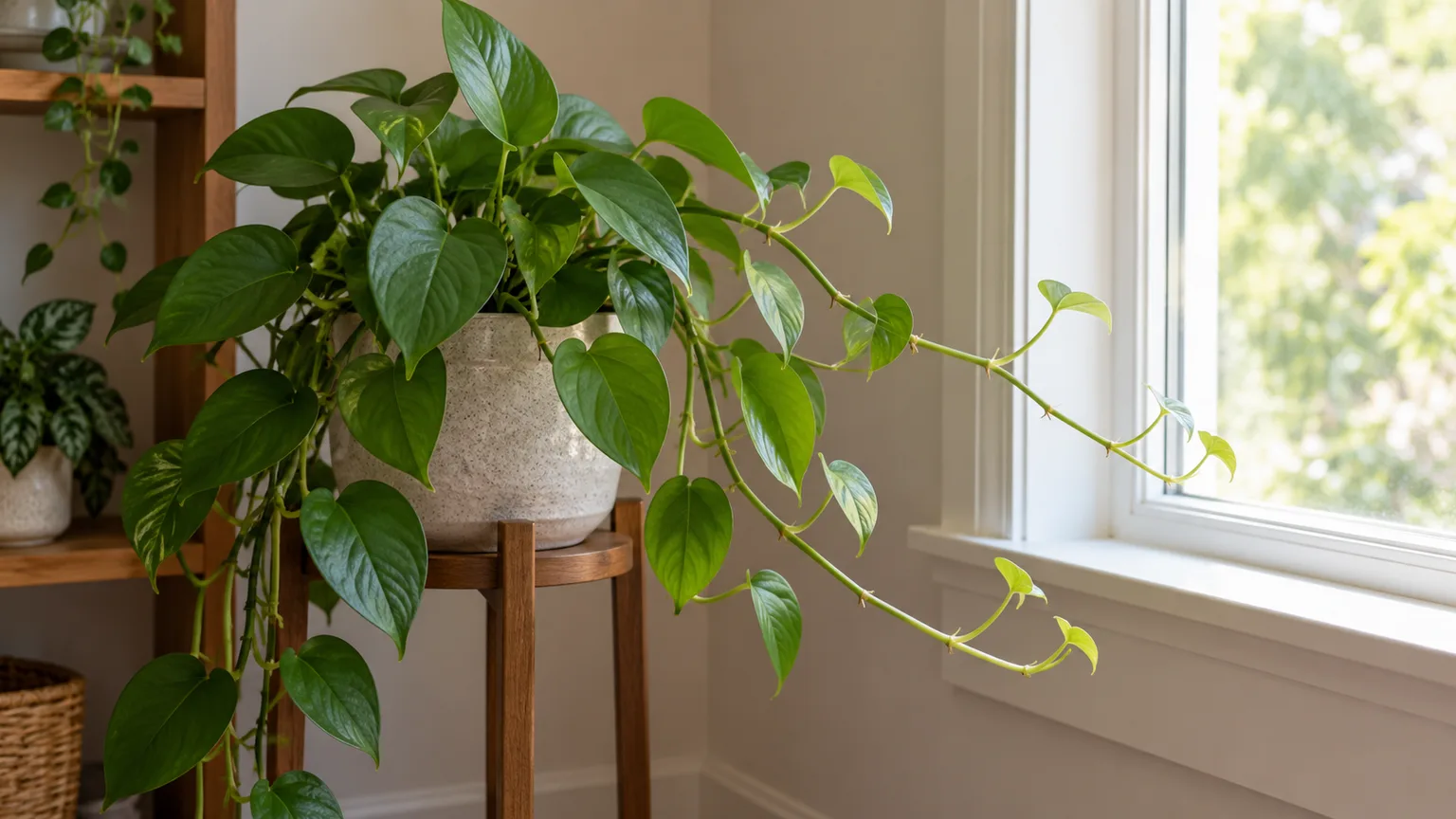
Not Enough Light on Jade Pothos: Causes, Checks & Fixes
This guide covers not enough light on Jade Pothos. See also the general Not Enough Light guide, watering, and light pages for this plant.
Not Enough Light on Jade Pothos: Causes, Checks & Fixes
Quick answer
Jade Pothos (Epipremnum aureum ‘Jade’) rarely announces light hunger with dramatic color change. The solid-green leaves stay green while the plant quietly downshifts: new leaves open smaller than older ones, stems stretch with wider gaps between leaves, vines lean toward the nearest window, and the pot stays damp far longer than its normal rhythm. Growth may stall almost completely through winter in a dim room.
First step: move the pot within a few feet of a bright window with sheer-filtered sun — or switch on a full-spectrum grow light for 12 to 14 hours daily — and change nothing else for two weeks. That single move lets you read whether tighter, larger new leaves follow. Do not fertilize, repot, or hard-prune during this observation window.
For how chronic dim conditions weaken houseplants in general, see our not enough light guide. On Jade Pothos, the pattern usually shows up as dull deep-green foliage with shrinking new leaves on runners that can trail up to 3 m, plus a potting mix that refuses to dry on schedule.
What not enough light looks like on Jade Pothos
A healthy Jade in good placement carries firm heart-shaped leaves of even size, rich deep green, spaced fairly close along its vines. Light starvation changes that look gradually, over weeks to months:
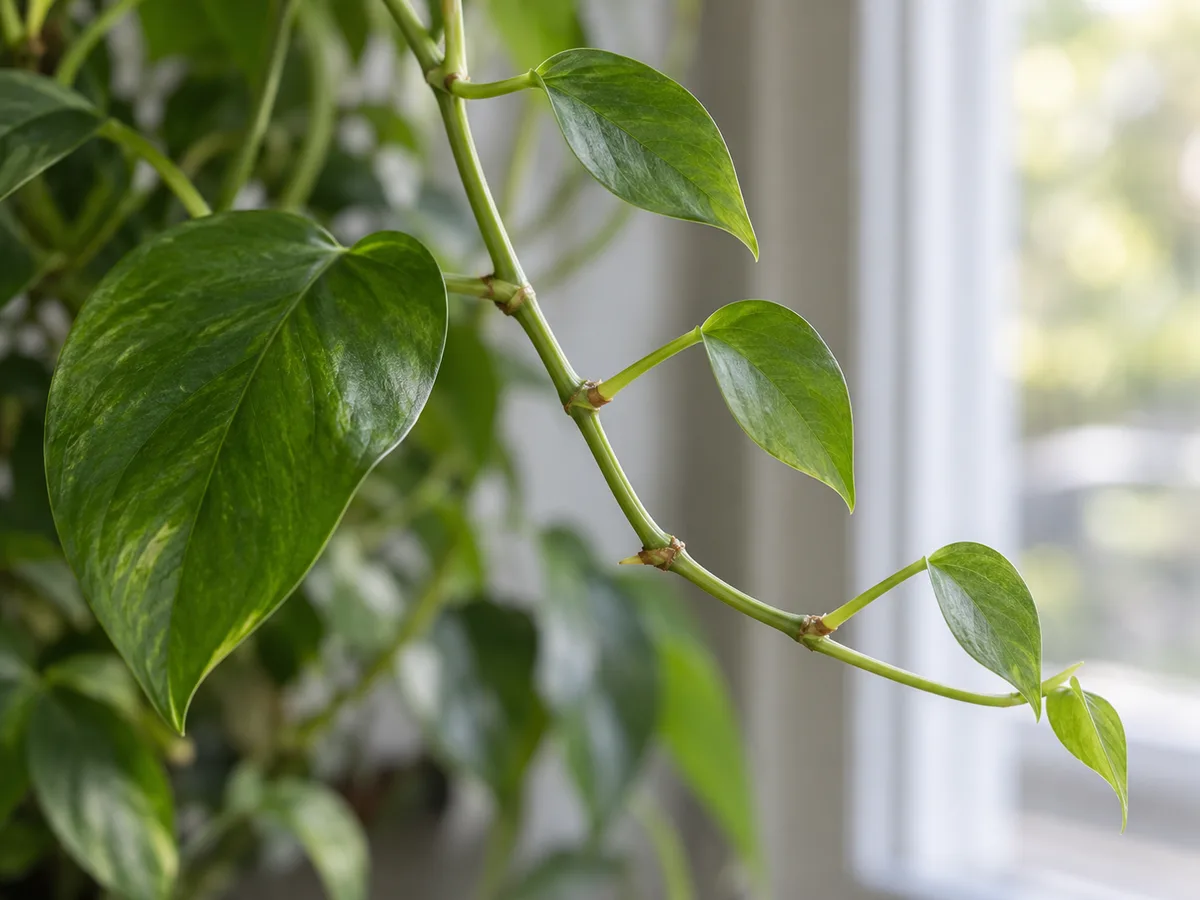
Light-starved Jade Pothos shows dull, smaller new leaves with wider gaps — compare with full-size older leaves lower on the same vine.
Foliage signals specific to solid-green Jade:
- New leaves open noticeably smaller than mature leaves lower on the same runner, yet stay solid green
- Leaf surfaces look dull and flat rather than glossy, sometimes with a slight downward cup
- No variegation to lose — unlike Golden or Marble Queen, Jade gives no color-fade warning, so size and spacing carry the diagnosis
- Older leaves hold normal size while only the vine tips look sparse and tired
Structure and habit signals:
- Widening gaps (internodes) between new leaves, sometimes 3 inches or more on fresh growth
- Vines leaning or curving hard toward a window, with the far side of a hanging basket going thin first
- Overall growth stalling for weeks, especially autumn through winter when daylight shortens
- Lower leaves yellowing one by one and dropping as the plant sheds foliage it cannot power — see yellow leaves on Jade Pothos if that dominates
The potting-mix clue owners miss: in dim rooms Jade uses far less water, so the top half of soil can stay damp 14 days or more. A pot that dried in a week near a window and now never dries on a bookshelf is telling you light, not thirst, changed. Details: Jade Pothos watering guide.
Why Jade Pothos ends up light-starved
Three forces converge on this particular cultivar.
Jade’s reputation works against it. NC State Extension lists the ‘Jade’ cultivar as solid dark green leaves, great in low light — and it is, compared with heavily variegated siblings that bleach or stall faster in dim rooms. Full-green leaves carry more chlorophyll per leaf, so Jade photosynthesizes efficiently and keeps its color where a Snow Queen would fade. Owners hear “great in low light” and park it on top of a bookshelf 10 feet from the nearest window, where it survives for months while slowly stretching. Survival is not thriving: pothos prefers bright, indirect light and survives for long periods in low light, and compact growth needs the first half of that sentence.
Pothos is a canopy climber stuck at floor level. In the wild, Epipremnum scrambles up tree trunks toward brighter canopy patches, gripping bark with fleshy aerial roots — the understory climber habit. Indoors, the same instinct becomes etiolation: the vine lengthens stems and spaces leaves apart to reach light rather than building dense foliage. A trailing basket hung in a dark hallway corner is the exact opposite of what the vine’s programming expects, so runners pour energy into reaching instead of filling out.
Homes hide how fast light falls off. Light intensity drops sharply with every foot of distance from glass, and what looks “bright” to human eyes is often dim to a plant. Common Jade placements that fail: styling shelves chosen for looks, bathroom corners with frosted glass, desks under ceiling fluorescents, and north-facing rooms in winter. Cool rooms compound the problem — growth slows, water use drops further, and the wet mix begins threatening roots. Penn State Extension places pothos in an area with moderate to bright light at average room temperatures, a band many decorative corners never reach.
Dust adds a final, fixable tax. Jade’s broad heart-shaped leaves collect household dust, and a gray film measurably cuts the photons reaching the leaf. The RHS growing guide advises wiping leaves with a damp cloth to remove dust so the plant absorbs light efficiently — a two-minute job owners of high-shelf baskets rarely remember.
How to confirm the cause
Work through this checklist on a bright midday before changing anything:
- Window distance and direction — Within a few feet of an unobstructed east window, or a south or west window filtered by sheer curtains, counts as bright indirect for Jade. More than 6 feet back from glass, or an interior room with no supplemental light, is typically too dim for compact growth. Full placement bands: Jade Pothos light guide. Unsure about your room? Run the Light Requirement Calculator with your window direction and distance.
- Hand-shadow test — At midday, hold your hand between the plant and the window and look at its shadow on the leaves. A soft but defined shadow means workable light. A faint or absent shadow means low light by indoor-plant standards.
- New-leaf comparison — Compare the three newest leaves on the longest runner with mature leaves from when the plant looked full. Clearly smaller blades plus wider gaps confirm light hunger; normal size with dull color points elsewhere.
- Lean check — Pothos leaves grow toward the light, so an unrotated pot develops one-sided fullness. If the window-facing side is dense and the far side is bare, direction — not disease — is shaping the plant.
- Soil-dryness check — Press a finger into the top 4–5 cm of mix. In dim rooms Jade may need water only every 14 to 21 days, versus every 7 to 10 days in bright light. Persistently damp mix with stalled growth confirms the plant is not using water because it lacks the light to grow.
- Rule out lookalikes first — Check leaf undersides for pests and sniff the soil before blaming light alone. Sour mix plus soft stems means roots are already in trouble — see root rot on Jade Pothos.
Confirmation test: after the light move described below, watch the next two or three leaves. If they open larger and closer together within two to four weeks, dim placement was the primary limiter.
First fix for Jade Pothos
Relocate the pot to bright indirect light — within a few feet of an east-facing window, or behind sheer curtains on a south- or west-facing window.
RHS guidance for Epipremnum recommends bright light but not direct sun, so do not swing from a dark corner straight into harsh midday rays. Leaves adapted to months of shade scorch easily. Acclimate over one to two weeks: start a few feet back from the glass or add the sheer, then settle into the brighter position.
If no brighter window exists, add a full-spectrum LED grow light centered over the canopy, roughly 10 to 18 inches above the foliage, running 12 to 14 hours daily on a timer. One-directional desk lamps keep vines leaning, so center the fixture and rotate the pot weekly.
Make this one change first. No fertilizer, no repotting, no hard pruning for two weeks — you need a clean read on whether new growth responds.
Step-by-step recovery
Once the plant sits in better light:
- Wipe the leaves — Clean both sides of every leaf with a damp soft cloth. Removing dust immediately raises usable light at the leaf surface, and the RHS damp-cloth wipe takes minutes. Repeat monthly for high-shelf plants.
- Reset the watering rhythm — Brighter light means faster drying, so retire the old dim-room schedule. Recheck the top half of soil before every watering instead of following the calendar. Expect the cadence to shift back toward the bright-light end of the range. Guide: Jade Pothos watering guide.
- Rotate weekly — Because pothos foliage orients toward light, turn the container weekly for balanced growth. A quarter-turn at each watering keeps baskets even instead of window-lopsided.
- Prune only after new growth tightens — Wait until fresh leaves open closer together, then cut the worst bare runners back to just above a leaf node, where the small brown aerial-root nub sits. NC State advises growers to prune stems back to maintain a bushy habit, and a light-starved Jade needs exactly that reset. Technique: Jade Pothos pruning guide.
- Root the trimmings in water — Healthy cuttings with one to three nodes each root readily; pothos vines easily root in water, usually within two to four weeks. Plant rooted cuttings back into the mother pot for instant fullness. Workflow: Jade Pothos propagation guide.
- Pause feeding until growth resumes — A light-starved Jade cannot use extra nutrients, and feeding stressed roots risks burn. Resume half-strength balanced liquid feed monthly only after new leaves prove the fix, per the Jade Pothos fertilizer guide.
- Support the climb (optional) — In stronger light, training vines up a damp moss pole encourages the larger mature leaves Jade produces when climbing with adequate light, instead of endless thin trailers. Check mix and container suitability first: Jade Pothos soil guide.
Wear gloves when handling cut stems. Like all Epipremnum aureum cultivars, Jade contains calcium oxalate crystals that irritate skin and mouths, and trailing vines tempt chewing pets — keep the plant out of reach while you work.
Recovery timeline
Expect the first proof within two to four weeks: new leaves opening larger and spaced closer together on the vine tips. That is the only success metric that matters early — existing small leaves never enlarge, and bare gaps never refill on their own.
Side shoots below pruning cuts typically push within two to four weeks during active growth. A severely thinned basket may need one full growing season of brighter placement plus one or two rounds of prune-and-replant to look dense again.
If nothing changes after four weeks in genuinely brighter light with correct watering, the limiter is no longer photons. Suspect root damage from the long wet period, a root-bound pot, or pest stress — start with slow growth on Jade Pothos rather than adding still more light.
Lookalike symptoms to rule out
| Pattern | Likely cause | Where to go |
|---|---|---|
| Long bare runners, wide internodes, small leaves | Chronic low light (this page) or established etiolation | Keep reading; see leggy growth on Jade Pothos for the prune-heavy reshape |
| No new growth at all for months, even in decent light | Stalled plant — roots, pot size, or season | Slow growth on Jade Pothos |
| Yellow lower leaves on wet soil, soft stems, sour smell | Overwatering or root rot amplified by dim-room slow drying | Overwatering on Jade Pothos and root rot on Jade Pothos |
| Wilts then perks up after watering, crispy edges | Underwatering | Underwatering on Jade Pothos |
| Pale leaves but normal leaf size and spacing | Nutrient shortfall rather than light | Jade Pothos fertilizer guide after light is confirmed |
| Bleached papery patches on sun-facing leaves | Too much direct sun — the opposite problem | Jade Pothos light guide for acclimation bands |
| Sticky residue, cottony clusters, or fine webbing | Pests on weakened growth | Mealybugs on Jade Pothos |
| Limp foliage that does not track watering | Water-uptake failure, not light alone | Drooping leaves on Jade Pothos |
What not to do
Do not feed a light-starved Jade to “give it energy” — fertilizer cannot replace photons and burns roots on tissue that is barely growing.
Do not move the plant from deep shade straight into unfiltered midday sun. Acclimate over one to two weeks or scorch becomes a second diagnosis.
Do not repot on day one unless the mix is failing or roots are visibly rotting. A stressed Jade in dim conditions gains nothing from a bigger pot of fresh wet mix.
Do not prune hard before confirming the new position. Cuttings taken from a still-starved plant root slowly, and fresh cuts regrow leggy in the same dark corner — practical growers note pothos vines grow leggy in too much shade and only hold their shape once placement improves.
Do not judge progress by old leaves. The Spruce notes pothos should be kept in bright, indirect light rather than prolonged direct sun — recovery shows in new foliage under that steady placement, not in yesterday’s leaves.
How to prevent it next time
Give Jade bright indirect light from day one instead of discovering the dim corner after months of stretch. Judge rooms by window distance, not by how bright they feel to you at noon.
Keep glass clean and unobstructed — dirty panes, heavy sheers, and furniture between plant and window cut usable light more than most owners realize. Wipe Jade’s leaves monthly so dust never taxes photosynthesis.
Supplement in north-facing rooms and through short winter days with a timed grow light rather than accepting a seasonal stall. And rotate the pot every one to two weeks year-round so trailers never commit permanently to one window.
Repot every 1–2 years in spring into well-draining mix so root crowding never compounds light stress — the Jade Pothos soil guide covers gritty blends that dry predictably once light improves.
When to worry
Low light alone is a slow care signal, not an emergency. Escalate when dim placement has already invited company:
- Wet soil for weeks with spreading yellow leaves and soft stems at the soil line
- Sour or swampy smell from the pot — unpot and inspect roots the same day
- Pest clusters (cottony mealybugs, webbing) exploiting weakened new growth
- Zero new growth for two months despite corrected light and watering
In those cases the plant needs root or pest triage first, with light as the supporting fix — not the other way around.
When to use this page vs other Jade Pothos guides
- Jade Pothos overview — Species care baseline: watering, soil, light, and trailing growth habit.
- Leggy growth on Jade Pothos — Use when long bare runners already dominate and you need the prune-above-node reshape workflow.
- Slow growth on Jade Pothos — Use when the plant is stalled rather than stretching toward light.
- Yellow leaves on Jade Pothos — Use when yellowing, not small leaves and gaps, is the main symptom.
- Overwatering on Jade Pothos — Use when wet soil and soft stems suggest the dim room has already caused root-zone damage.
- All Jade Pothos problems — Browse every diagnosed issue on this plant.
Related Jade Pothos guides
- Jade Pothos overview
- Jade Pothos light
- Jade Pothos watering
- Jade Pothos soil
- Jade Pothos pruning
- Jade Pothos propagation
- Leggy growth on Jade Pothos
- Jade Pothos problems
Conclusion
Not enough light on Jade Pothos hides behind the cultivar’s best trait: solid-green leaves that stay green while quietly shrinking, spacing out, and stalling in a dim corner. Move placement first — bright indirect light within a few feet of glass or a timed grow light — confirm tighter new leaves within two to four weeks, then prune bare runners and root the cuttings in water for fullness. Pair the brighter spot with a faster watering rhythm and monthly leaf wipes, and Jade’s efficient green foliage turns from a camouflage for neglect into the fast trailing growth it is known for.
How we wrote and verified this guide: Recommendations were checked against NC State Extension, Penn State Extension, Missouri Botanical Garden, Royal Horticultural Society, Clemson Cooperative Extension, and ASPCA references cited inline, with practical placement and pruning notes supported by established gardening publications. Author: sai-ananth. Reviewer: LeafyPixels Review Board. Methodology: plant problem guidance is reviewed against botanical references, extension resources, and LeafyPixels plant-care data before publication. Claims validation: claims-validator-v1 pass with inline external links documented below. Last reviewed: 2026-09-06.
Practical checks
Urgency check
Cosmetic unless paired with rot or pests. Act the same day if soil smells sour, stems soften at the base, or yellowing spreads across multiple leaves within a week.
Best inspection order
Window distance and direction, midday hand-shadow test, newest-leaf size versus older foliage, top 4–5 cm soil dryness, then leaf undersides and roots only if wet-soil or pest signs appear.
Related tool
Use the Plant Problem Diagnosis Tool to narrow causes for not enough light on this plant before changing multiple variables at once.